Abstract
The development of the “China-Kyrgyzstan-Uzbekistan” railway (hereinafter referred to as the CKU) can be cited as a promising project to increase transit cargo flows in our country. In organizing the uninterrupted transportation of transit freight flows planned to pass through the territory of our country as a result of the implementation of this project, the “Angren-Pop” railway section, which includes the 19.2 km long “Kamchik” tunnel, is of great importance. This article analyzes the impact of the development of the CKU railway on the throughput and carrying capacities of the “Angren-Pop” railway section. The current maximum freight capacity of the “Angren-Pop” railway section has been studied. The results show that this section is not capable of handling the expected volume of transit cargo. This substantiated the need to find solutions for effectively increasing the carrying capacity of the section while ensuring an economically rational balance. Methods for effectively increasing the carrying capacity of the section are recommended, including the systematic implementation of measures such as increasing the standard weight of freight trains, raising the operating speed on the section, and using electric locomotives with high tractive power.
1. Introduction
Today, one of the most important tasks in the development of our country’s railways remains the increase of transit cargo flows, as well as the improvement of the throughput and carrying capacity of railway sections. One of the promising projects aimed at increasing transit freight flows on our country’s railways is the development of the CKU railway. Such a large-scale infrastructure project envisions broad cooperation based on advanced engineering, innovative, and digital solutions. The total length of the “Kashgar-Torugart-Makmal-Jalalabad-Andijan” railway project is 532.53 km, of which 213 km lies within China, 260 km within Kyrgyzstan, and 50 km within Uzbekistan. In this direction, the construction of 20 railway stations is planned, including 2 border stations, 1 transshipment station, 4 intermediate stations, and 13 passing loops. The construction includes 48 bridges with a total length of 16.06 km and 27 tunnels with a total length of 103.63 km. The combined length of the bridges and tunnels is 119.69 km, accounting for 39.3 % of the total length [1]. The construction of this railway contributes to increasing our country’s transit freight flows and ensures the delivery of goods from China to the countries of Central Asia and the Middle East, including Turkey, and further to the countries of the European Union. The implementation of this project will reduce the freight delivery route from East Asia to the countries of the Middle East and Southern Europe by approximately 900 km, and the delivery time to 7-8 days. The CKU railway project is being financed under the Build-Operate-Transfer model. In the CKU railway project, China holds a 51 % stake, while Kyrgyzstan and Uzbekistan each hold 24.5 %. According to preliminary estimates, the cost of the project is $4.7 billion. Half of this amount is to be provided by the participating countries in proportion to their shares in the joint venture: China will contribute $1.18 billion, Kyrgyzstan approximately $700 million, and Uzbekistan $573 million. For the remaining half, China is expected to provide approximately $2.35 billion in loans [1-2, 4].
According to preliminary analyses, the launch of the CKU railway is expected to result in the transit of approximately 10-15 million tons of cargo through our country per year [3-4]. This may allow Uzbekistan to ensure an economically rational proportion of the funds allocated for the project. In other words, it highlights the need to transport the expected maximum transit cargo through the country’s territory without interruptions. The “Angren-Pop” railway section plays a significant role in ensuring the smooth passage of these transit flows. Because this section is the line in JSC “Uzbekistan Railways” with the steepest gradient and the lowest train weight limit. Therefore, developing measures aimed at increasing the throughput and carrying capacity of the “Angren-Pop” railway section is currently one of the most pressing issues.
The scientific novelty of this study lies in the determination of the optimal mass standards that allow for the most efficient use of the existing capabilities of the railway section, as well as in the development of a mathematical model (objective function) that maximizes its carrying capacity. This developed mathematical model enables the improvement of transport efficiency under complex mountainous conditions, ensures optimal use of energy and resources, and also contributes to enhancing maintenance and safety parameters. Moreover, the developed model and the proposed approaches can be applied as a methodological basis for other railway sections with mountainous terrain and gradients. The aim of the study is to evaluate the possibilities of increasing the carrying capacity by determining the optimal mass standards for trains under complex mountainous railway conditions, as well as to develop recommendations aimed at enhancing the section’s carrying capacity.
2. Literature analysis and methodology
The capacity of railway sections is determined by their carrying and throughput capacities [5]. Various measures aimed at improving the capacity and throughput of railway sections have been examined in the scientific studies of several leading researchers worldwide. In particular, the scientific study [6] developed a timetable compression methodology to assess how efficiently the existing infrastructure is being utilized, as well as to evaluate and enhance the capacity and throughput of railway sections. This methodology makes it possible to determine the minimal headway times that ensure safe, collision-free train movements through deterministic microscopic calculations, taking into account infrastructure and rolling stock characteristics. This methodology has been adopted as a standard by the international union of railways (UIC) and also incorporates the amount of buffer time required to ensure that the timetable can be executed under real operating conditions without disruption [7]. However, several studies [8-9] have criticized the method for its deterministic nature and its insufficient consideration of real-world train delays. To obtain more reliable results under real operating conditions, simulation, optimization, and graph-based methods have been recommended [10].
In the study [11], the use of various signaling systems for train traffic management is recommended, emphasizing the critical importance of signaling when assessing the capacity of railway sections. The impact of signaling systems on line capacity is examined in detail through microscopic modelling and analysis based on real operational data.
Studies [12-13] investigate the impact of increasing the share of long and heavy trains operating on railway sections on their capacity and operational efficiency. The findings indicate that increasing the share of heavy trains can enhance the throughput of railway sections and improve energy efficiency. However, a higher proportion of long and heavy trains also introduces additional challenges, such as the need for larger minimum headways and a greater risk of timetable delays.
Studies [14-15] have thoroughly examined the issue of improving the capacity of railway sections and the efficiency of train operations by modifying railway infrastructure parameters. The research findings indicate that the capacity of a railway section can be significantly increased by optimizing infrastructure parameters such as distance, braking and acceleration characteristics, as well as the design of stations and track segments.
The study [16] examined the importance of timetable types and train allocation methods when assessing the throughput capacity of railway sections. As a result, it has been scientifically demonstrated that the throughput capacity of railway sections can be increased by designing an optimal train timetable and selecting an appropriate train allocation method.
Studies [17-19] have investigated the significance of using optimization models and various computational tools in developing train timetables for railway sections. As a result, it has been demonstrated that the capacity and throughput of railway sections can be enhanced by optimally determining minimum headways between trains using mathematical models and algorithmic approaches.
At present, there are a number of scientific studies devoted to increasing the throughput and carrying capacity of railway sections depending on cargo flow, the development of station infrastructure, and the efficient use of rolling stock [20-25]. However, the scientific literature contains insufficient studies on assessing the impact of the development of the CKU railway on the throughput and carrying capacities of the sections of the Angren-Pop railway, as well as on developing appropriate recommendations and technical-technological solutions to ensure the smooth passage of cargo.
It is known that the capacity of a railway section is determined by the block section, the development of track infrastructure at intermediate and technical stations, the power supply system, the locomotive fleet, signaling, centralization and blocking devices (SCB) and communication systems, as well as other factors.
The existing capacity determines, based on the technical equipment of the crossings and the way trains are organized, the number of trains that can be passed through the section during the day.
The schedule period is determined by the section that limits the throughput capacity of the line (the section where trains spend the most time passing through). There are four train-dispatching schemes for block sections that limit line capacity (Fig. 1). In this study, the timetable periods for these schemes are determined, and the optimal scheme is selected based on the method of comparison, choosing the one that provides the minimum time consumption (the shortest period) for train movements. The selected optimal scheme is used for train movements on the block sections that limit the line capacity.
The following notations are used in Fig. 1, where, , – train running times between sections in odd and even directions, minute; , – acceleration and deceleration time of the train, respectively, minute, ( 3 minute); , – station intervals for train crossing and non-simultaneous arrival, minute (2, 3 minute).
For single-track railway sections using the scheme of train passage with paired opposing intervals (Fig. 1), the existing throughput capacity is determined by the following formula [26]:
where, – duration of the technological window (for single-track sections – 60 minutes); – schedule period (calculated for the sections that limit the throughput capacity of the section), in minutes; – reliability factor of technical means (for electric traction – 0,93); , – respectively, station crossing intervals at stations b and a, minute ( 2, 3 minute).
Fig. 1Paired parallel scheme of train passage on the section limiting throughput capacity
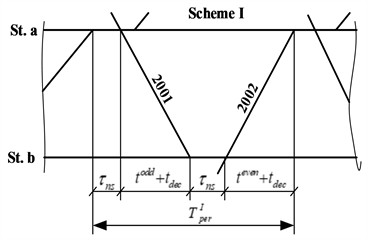
a) Scheme I: Non-stop train movement on the limiting block section. , minute
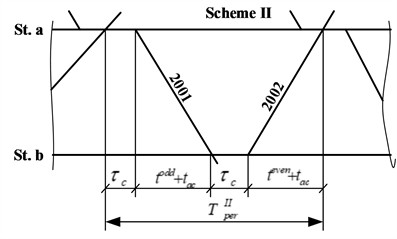
b) Scheme II: Non-stop train departure from the limiting block section. , minute
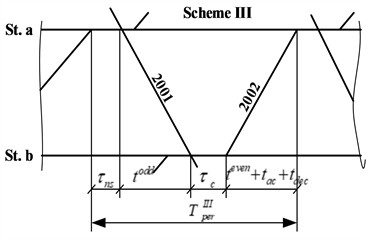
c) Scheme III: Non-stop passage of the designated intermediate points of the limiting block section by trains in the even direction. , minute
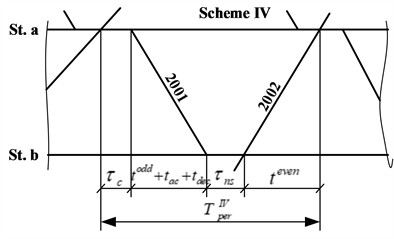
d) Scheme IV: Non-stop passage of the designated intermediate points of the limiting block section by trains in the odd direction. , minute
The existing throughput capacity of single-track railway sections not equipped with an automatic block signaling system is determined by the following formula based on the train’s speed on the section [27]:
where, – average distance between sections on the line, km; – section non-uniformity coefficient, – average train speed on the section, km/h; – part of the schedule period, including station intervals and time lost to acceleration and deceleration.
The non-uniformity coefficient, which takes into account differences in section lengths or technical conditions on the railway section, is determined by the following formula:
where, – length of the longest section on the line, km.
The existing throughput capacity of single-track railway sections, expressed by Eq. (2), taking into account the non-uniformity coefficient () and the reliability factor () of the technical means of railway infrastructure, can be represented as follows:
Based on the existing throughput capacity, the number of freight trains operating on the section is determined by the following formula [26, 29]:
where, , , , , – respectively, the number of high-speed, passenger, suburban, accelerated, and mixed trains operating on the section, train; , , , , – the coefficients of displacement of freight trains from the timetable by high-speed, passenger, suburban, express, and mixed trains operating on the section, respectively.
The total number of freight trains operating on the section is determined using the following formula, derived by combining Eqs. (4) and (5):
where, – the number of passenger trains of type (high-speed, passenger, suburban) operating on the section, train; – the coefficient of displacement of freight trains from the traffic schedule by passenger trains of type (high-speed, passenger, suburban) operating on the section.
Carrying capacity refers to the transport capability of railways, which depends on the weight of freight trains and the throughput capacity of the sections. The carrying capacity of a railway line on a section, depending on the daily number of freight trains and their average gross weight, is determined by the following formula [5, 26, 29]:
where, – average gross weight of a freight train, tons; – coefficient of unevenness of monthly shipments (accepted between 1.05 and 1.15); – coefficient of wagon fleet utilization (coefficient indicating the ratio of the net weight to the gross weight of a freight train).
The coefficient of wagon fleet utilization () is determined through the average weight or the coefficient of utilization of wagon carrying capacity () using the following formulas [26, 29]:
where, – net weight of cargo in wagons, tons; – tare weight of the wagon, tons; – coefficient of utilization of the wagon’s load-carrying capacity; – coefficient accounting for the tare weight of the wagon.
The coefficients of utilization of the wagon’s load-carrying capacity () and accounting for the wagon’s tare weight () are determined by the following formulas [26, 29]:
where, – wagon’s load-carrying capacity, tons.
The coefficient (), indicating the ratio of the net weight to the gross weight of a freight train, is accepted on railways on average as 0.73-0.76 for heavy cargoes (ore, coal, construction materials, metal), 0.6-0.70 for light cargoes, and on average 0.66-0.70 [26, 29].
Based on the above Eqs. (1-9), measures to increase the speed of freight trains, reduce safe crossing intervals of trains at stations, improve the operational characteristics of the rolling stock, and increase the average mass of freight trains are considered reserves for increasing the carrying capacity of railway sections.
The tractive force of locomotives, track profile, and the effective length of receiving and dispatch tracks are the main factors determining the average gross weight of a freight train.
In addition, the average gross weight of a freight train is significantly influenced by the full operation of trains according to the volume of freight flow in each direction, including the static load of wagons and the structure of the wagon fleet (presence of four- and eight-axle wagons). At the same time, increasing the static load on wagons is achieved by densely loading the cargo and rationally distributing empty wagons for carrying certain types of goods [5].
If the weight norm of the train is limited by the effective length of the station’s receiving and dispatch tracks, then the train weight is determined by the following formula [26, 29]:
where, – effective length of receiving and dispatch tracks, m; – length of the train locomotive, m; – load of the wagon per linear meter of railway track, t/lin.m.
The load of the wagon per linear meter of railway track is determined by the following formula [26, 29]:
where, – length of the wagon, m.
The normative weight of the train limited by the length of the station tracks (Eq. (10)) and the load of the wagon per linear meter of railway track (Eq. (11)) are represented in the following form [26, 29]:
Rational allocation of the locomotive fleet on railway sections allows increasing the weight standards of freight trains. That is, it is important to assign locomotives with high tractive power to sections with steep gradients, complex profile conditions, and mainly transporting heavy cargoes. On sections with simple profile conditions, locomotives with lower power should be used.
The maximum gross weight of trains operating on the section is determined by the following formula [28]:
where, – calculated tractive force of the locomotive moving on the section, N; – calculated weight of the locomotive, tons; – acceleration due to gravity, 9.81 m/s2; – calculated gradient of the section, ‰; – main specific resistance to motion of the locomotive in traction mode, N/kN; – main specific resistance to motion of wagons in the train consist in traction mode, N/kN.
Increasing the load capacity of wagons and improving their utilization efficiency, increasing the tractive force of the locomotive, and increasing the gross weight of the train are the most important conditions for increasing transport capacity.
3. Modeling the process of calculating the existing maximum carrying capacity of a railway section
The annual carrying capacity of a railway section (Eq. (7)) can be described as follows based on the formula for the daily number of freight trains (Eq. (6)):
The consists of freight trains operating on the section are formed simultaneously based on the following conditions, depending on the locomotive’s tractive effort and the effective length of the station’s receiving and departure tracks:
The constraints on freight train Eq. (15) show that the locomotive’s tractive effort and the effective length of the station’s receiving and departure tracks always have a disproportionate influence on each other. In other words, by forming trains according to weight standards that correspond to the tractive effort, it is possible to achieve efficient use of locomotives. However, forming trains according to the weight standards that correspond to the effective length of the stations’ receiving and departure tracks reduces the transportation capacity of the section. If the trains operating on the section exceed the weight limit defined by the effective length of the receiving and departure tracks, it creates a problem of crossing opposing trains at stations. On the other hand, when trains operate below the weight standard corresponding to the locomotive’s tractive effort, a reserve tractive power is formed. In such cases, the locomotive’s reserve tractive power can be used to increase the train’s running speed.
Taking into account the Eq. (15) imposed on the formation of freight trains operating on the section, the carrying capacity of the Eq. (14) can be described by the following formula:
– Depending on the locomotive's tractive effort:
– Depending on the effective length of the station’s receiving and departure tracks:
On railway sections with small gradients, the gross weight of a freight train depends not on the type of locomotive, but on the effective length of the station’s receiving and departure tracks. That is, it is more appropriate to use high-powered locomotives on railway sections with steep gradients.
When the effective length of the station’s receiving and departure tracks is minimal (850 m), the locomotive’s power is not fully utilized. Therefore, the unused power can be directed towards increasing the train speeds on sections with small gradients, and towards increasing the weight standards on sections with steep gradients.
Based on Eqs. (16) and (17), the carrying capacity of a railway section depends on the train's gross weight and travel speed:
To determine the train’s speed on a section depending on its gross weight, it is necessary to perform traction calculations or analytical computations for various weight standards:
The actual running speed of a train and its gross weight are inversely proportional: as the gross weight increases, the speed decreases, and vice versa. Therefore, to increase the throughput capacity of a railway section, it is important to optimally select both of these parameters:
Therefore, to achieve maximum transport capacity, it is necessary to maximize the product of the train’s running speed and its gross weight ():
The main tasks to ensure the maximum throughput capacity of a railway section are selecting optimal weight standards and running speeds for freight trains, uninterrupted passage of the expected annual freight flows through the section, and the introduction of high-power locomotives into the traction system. Solving these tasks is carried out based on the above-modeled formulas and traction calculations, providing several possible options.
4. Materials and methods
As the research object, the single-track “Angren-Pop” railway section with a length of 120.2 km, belonging to the Kokand Branch of JSC “Uzbekistan Railways”, was selected. This section is equipped with a semi-automatic block system. Due to the complex track profile of this section, the most powerful 2UZ-ELR type electric locomotives are mainly used. Appendix 1 to the order No. 261-H of the Chairman of JSC “Uzbekistan Railways” dated April 2, 2024, sets the weight standards for freight trains at 2400 tons for even directions and 2200 tons for odd directions [30]. Information about the stations located on this section, freight train running times, lengths of track segments, and maximum gradients is presented in Fig. 2.
Fig. 2Key data of the “Angren-Pop” railway section for traction calculations
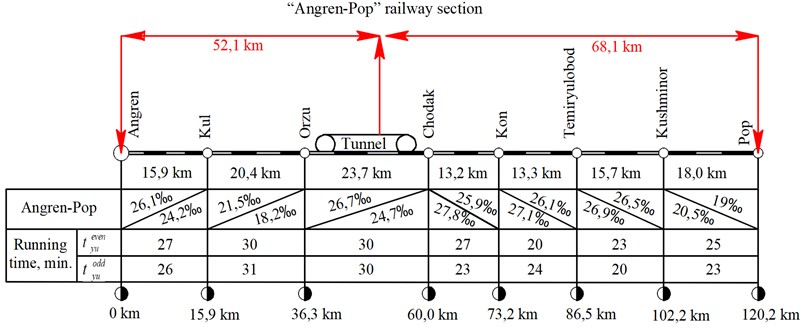
Based on the information presented in Fig. 2, this section has a design gradient of 26.7 ‰ in the even direction and a gradient of 27.8 ‰ in the odd direction. The maximum gross weight of trains operating on the section was calculated using Eq. (13), taking into account the conditions specified in references [28]. As a result of the calculations, it was determined that 2UZ-ELR electric locomotives are capable of hauling trainsets with a gross weight of up to 2950 tons in the even direction and up to 2800 tons in the odd direction. This indicates that the locomotive operates with a power reserve. Due to the complex profile of this section, increasing the running speed is nearly impossible.
To determine the optimal weight standard, traction calculations were performed for trains of various weights. The calculations were carried out using the KORTES software package developed by the All-Russian Scientific Research Institute of Railway Transport (VNIIZhT). The results of the traction calculations are presented in Table 1.
Table 1Results of the performed traction calculations
Gross weight | “Angren-Pop” railway section | Average running speed (), km/h | |||
Even direction | Odd direction | ||||
, t | , km/h | SA–P, t·km/h | , km/h | SP–A, t·km/h | |
0 | 47,7 | 0 | 54,6 | 0 | 51,2 |
2200 | 47,0 | 103400 | 52,8 | 116160 | 49,9 |
2300 | 47,0 | 108100 | 52 | 119600 | 49,5 |
2400 | 46,6 | 111840 | 50,6 | 121440 | 48,6 |
2500 | 46,4 | 116000 | 48,6 | 121000 | 47,6 |
2600 | 46,1 | 119860 | 46,5 | 120900 | 46,3 |
2700 | 45,4 | 122580 | 44,9 | 121230 | 45,2 |
2750 | 44,9 | 123475 | 41,3 | 113575 | 43,1 |
2800 | 44,4 | 124320 | 38,6 | ||
2900 | 43,3 | 125570 | 31,8 | ||
2950 | 41,6 | 122720 | – | ||
The maximum running speed for the “Angren-Pop” railway section is set at 60 km/h. Based on the data presented in table 1, the maximum speed of the locomotive when operating alone on the section is 51.2 km/h. According to the condition for achieving maximum throughput capacity (Eq. (21)), it is proposed to set the optimal gross weight of freight trains at 2900 tons in the even direction and 2700 tons in the odd direction. Based on the results of traction calculations for trains of various weights (Table 1), the average running speed of trains on the section under these weight standards is 44.1 km/h. The “Orzu-Chodak” section is considered the bottleneck limiting the current throughput capacity of the “Angren-Pop” railway section, as trains have the longest running time on this section. Additionally, the 19.2 km long “Kamchik” tunnel is located on this section, and a single-track railway line passes through the tunnel. Therefore, carrying out reconstruction measures to increase the throughput and carrying capacity of the “Orzu-Chodak” section is an extremely complex process and practically impossible. The existing throughput capacity of the “Angren-Pop” railway section for the proposed weight standards is determined according to Eq. (4) and equals the following value:
Considering that currently 5 pairs of passenger trains and 1 suburban train operate on this section, the existing freight train throughput capacity of the “Orzu-Chodak” section amounts to 11 pairs of trains. Therefore, the current maximum throughput capacity of the “Angren-Pop” section consists of 6 pairs of passenger trains, 1 pair of suburban trains and 10 pairs of freight trains.
Based on the performed traction calculations for the studied section, the inter-block running time of trains and the existing throughput capacity under the proposed weight standards were investigated. Taking into account the number of passenger trains, the number of freight trains operating on the section and the carrying capacity were calculated by block sections based on Eqs. (5-7). The calculation results are presented in Table 2. In the subsequent calculations, the names of the stations on the “Angren-Pop” railway section are presented in an abbreviated form. Each station name is denoted by its initial letter. The full station names and their order are shown in detail in Fig. 2.
Table 2Throughput and carrying capacity of the section under existing and proposed weight standards
Railway sections | Current mass standard, t | Proposed mass standard, t | ||||||||||
Running time, min. | Graph period, min. | Throughput and carrying capacity, paired train/ mln. t | Running time, min. | Graph period, min. | Throughput and carrying capacity, paired train/ mln. t | |||||||
In the graph | Traction calculations | |||||||||||
A-K | 27 | 26 | 64 | 20.05 | 13 | 15.1 | 26 | 18 | 55 | 23.33 | 16 | 22.6 |
K-O | 30 | 31 | 72 | 17.83 | 11 | 12.8 | 25 | 23 | 59 | 21.75 | 15 | 21.2 |
O-Ch | 30 | 30 | 71 | 18.08 | 11 | 12.8 | 31 | 31 | 72 | 17.82 | 11 | 15.5 |
Ch-K | 27 | 23 | 61 | 21.04 | 14 | 16.2 | 23 | 32 | 66 | 19.44 | 13 | 18.4 |
K-T | 20 | 24 | 55 | 23.33 | 16 | 18.6 | 19 | 22 | 52 | 24.68 | 18 | 25.4 |
T-K | 23 | 20 | 54 | 23.77 | 17 | 19.7 | 17 | 22 | 50 | 25.67 | 19 | 26.8 |
K-P | 25 | 23 | 59 | 21.75 | 15 | 17.4 | 22 | 22 | 55 | 23.33 | 16 | 22.6 |
A-P | 30 | 31 | 72 | 17.83 | 11 | 12.8 | 31 | 31 | 72 | 17.82 | 11 | 15.5 |
The block section with the largest timetable cycle is considered the one that limits the line capacity. According to the current train weight standard of the “Angren-Pop” railway section, the “K-O” block section has the largest timetable cycle, whereas under the proposed weight standard, the “O-Ch” block section becomes the limiting one. For this reason, in the present study, the figures corresponding to the block sections that limit the capacity and throughput of the “Angren-Pop” railway section are highlighted in bold in Table 2.
According to the results of the calculations presented in Table 2, currently, under the existing weight standard, the “Angren-Pop” railway section has a maximum freight carrying capacity of 12.8 million tons per year. According to the data provided by the employees of the Railway’s “Statistics and Accounting Department” (NCh), currently, 8.1 million tons of cargo are being transported on this section. This accounts for 63.5 % of the maximum carrying capacity.
According to the proposed weight standard, the possibility of transporting up to 15.5 million tons of cargo per year on the section is created. This increases the current carrying capacity by 21.8 % and allows the reserve carrying capacity to be raised from 4.7 to 7.4 million tons. As a result of the development of the CKU railway, it is required to increase the annual freight carrying capacity of the “Angren-Pop” railway section to an average of 18-23 million tons to timely handle the transit cargo flow expected to pass through our country’s territory without excessive waiting. The gap between the existing and required transportation volumes on the sections of the “Angren-Pop” railway line is shown in Fig. 3.
Fig. 3Maximum freight carrying capacity of the “Angren-Pop” railway section
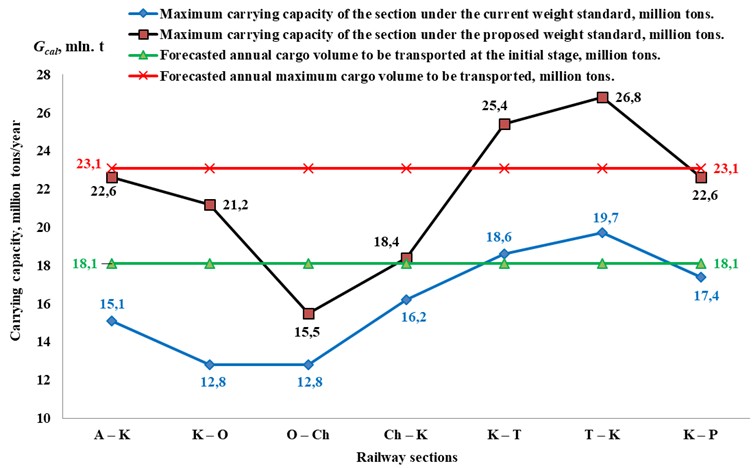
As can be seen from Fig. 3, based on the existing weight standard, the “Kon-Temiryulobod” and “Temiryulobod-Kushminor” sections of the railway have the capacity to handle the forecasted annual cargo volume at the initial stage of the CKU railway development. Based on the proposed weight norms, the sections “Angren-Kul”, “Kul-Orzu”, “Chodak-Kon”, and “Kushminor-Pop” will be able to handle the expected annual freight volume at the initial stage of transportation. However, the “Orzu-Chodak” section at the initial stage will not be able to handle the average transit freight flow of approximately 2.6 million tons predicted to pass through our country’s territory.
In this case, increasing the weight of freight trains is the most effective and economically feasible solution to enhance the carrying capacity of the section. That is, reconstructing the sections of single-track railway lines, implementing the best signaling and communication systems, deploying more powerful locomotives or combining several electric locomotives to generate the necessary traction power according to the transport volume, increasing the effective length of station tracks, and reducing the track gradient – all of these will help to increase the carrying capacity.
Two options are proposed for the gradual increase of the carrying capacity of the single-track railway section “Angren-Pop”:
1. Introducing the three-section 3UZ-ELR electric locomotive into the transportation process with efficient use of the train mass reserve based on the effective length of the receiving and dispatch tracks.
2. Organizing train movement based on a partial block timetable by dividing the sections into block sections using passing signals.
5. Result and discussion
On the studied section, trains composed of 4-axle wagons with an average carrying capacity of about 60 tons, mainly loaded with petroleum products, coal, cement, cotton, grain products, fertilizers, and other cargoes, operate. The average tare weight of the wagons is 22 tons, and the effective length of the receiving and dispatch tracks at stations is 850 meters. The train consists mainly of 33 (83 %) loaded and 7 (17 %) empty wagons. According to Eq. (11), the load per linear meter of railway track by a wagon is 5.1 tons. The mass reserve of the train composition based on the effective length of the receiving and dispatch tracks according to Eq. (11) is calculated as follows:
Taking into account the introduction of the proposed three-section 3UZ-ELR electric locomotives into the transportation process and the effective length of the station’s receiving and dispatch tracks, the average gross weight of freight trains can be set at approximately 4050 tons.
Fig. 4The impact of the 3UZ-ELR electric locomotive on carrying capacity
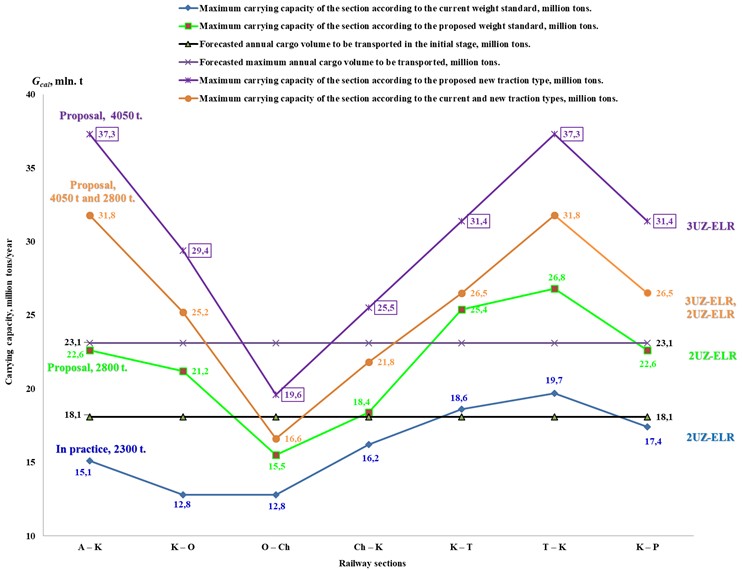
The results of improving the carrying capacity by introducing the operation of trains with the 3UZ-ELR type electric locomotive on the “Angren-Pop” railway section are shown in Fig. 4.
As seen in Fig. 4, organizing train operations using 3UZ-ELR and 2UZ-ELR electric locomotives does not allow achieving the intended transport capacity. As a result of fully introducing the three-section 3UZ-ELR electric locomotive into the transportation process, the sections “Angren-Kul”, “Kul-Orzu”, “Chodak-Kon”, “Kon-Temiryulobod”, and “Temiryulobod-Kushminor” will be capable of handling the expected maximum annual freight volume. The “Orzu-Chodak” section, however, is capable of handling the projected annual freight volume at the initial stage.
Fig. 5Train movements through a section divided by a passing signal (block post)
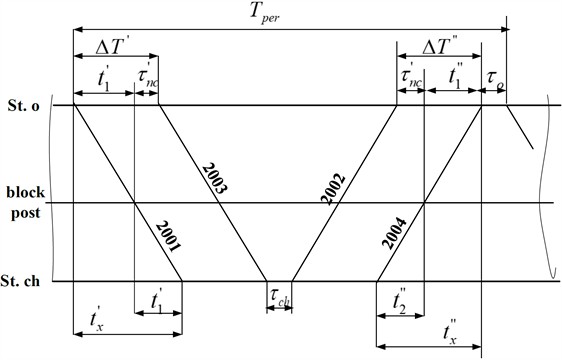
Fig. 6Measures to increase the carrying capacity of the “Angren – Pop” railway section
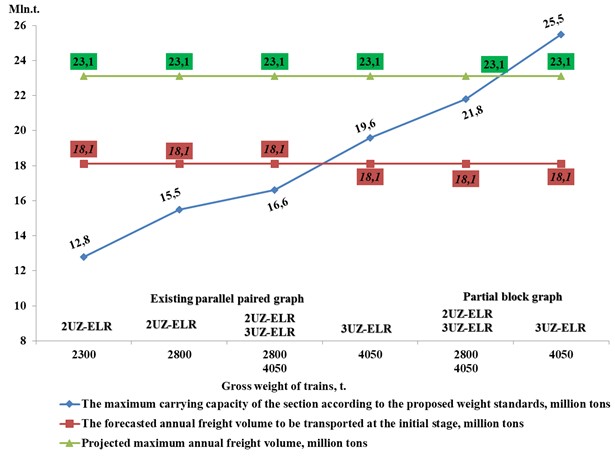
Table 3The impact of introducing the 3UZ-ELR electric locomotive into the transportation process on throughput capacity and carrying capacity
Railway sections | Type of traction – 3UZ-ELR electric locomotive, proposed weight norm – 4050 tons | Proposed weight norm | Overall | ||||||||
Running time, min. | Graph period, min. | Throughput and carrying capacity, paired train/ mln. t | 2UZ-ELR (2900 tons) | 3UZ-ELR (4050 tons) | |||||||
A-K | 22 | 17 | 50 | 25.7 | 19 | 37.3 | 9 | 12.2 | 10 | 19.6 | 31.8 |
K-O | 25 | 23 | 59 | 21.8 | 15 | 29.4 | 7 | 9.5 | 8 | 15.7 | 25.2 |
O-Ch | 35 | 31 | 77 | 16.7 | 10 | 19.6 | 5 | 6.8 | 5 | 9.8 | 16.6 |
Ch-K | 22 | 33 | 66 | 19.4 | 13 | 25.5 | 6 | 8.1 | 7 | 13.7 | 21.8 |
K-T | 19 | 25 | 55 | 23.3 | 16 | 31.4 | 8 | 10.8 | 8 | 15.7 | 26.5 |
T-Q | 17 | 21 | 49 | 26.2 | 19 | 37.3 | 9 | 12.2 | 10 | 19.6 | 31.8 |
Q-P | 22 | 22 | 55 | 23.3 | 16 | 31.4 | 8 | 10.8 | 8 | 15.7 | 26.5 |
A-P | 35 | 31 | 77 | 16.7 | 10 | 19.6 | 5 | 6.8 | 5 | 9.8 | 16.6 |
To improve the section’s throughput capacity, a passing signal was installed in the middle of the “Orzu-Chodak” section, dividing it into two block sections (Fig. 5). After division into two block sections, train operations are partially arranged according to a grouped timetable.
As a result of these measures, the section’s carrying capacity takes the form shown in Fig. 6.
6. Conclusions
As a result of the development of the CKU railway, regarding ensuring the uninterrupted passage of the planned 10-15 million tons of transit freight through the “Angren-Pop” section within our country, the following conclusions can be drawn based on the conducted research:
1) The reserve tractive effort of 2UZ-ELR model electric locomotives pulling trains operating under the current weight standards (2400 tons for even direction, 2200 tons for odd direction) has been determined. By directing the determined reserve tractive effort towards increasing the gross weight of freight trains, it was demonstrated that it is possible to set the weight standards for the section at 2900 tons for even direction and 2700 tons for odd direction. As a result, the maximum carrying capacity of the section can be increased from 12.8 million tons to 15.5 million tons.
2) Considering the expected increase in freight flow, it was recommended to introduce trains consisting of 3UZ-ELR electric locomotives with a gross weight of 4050 tons into the transportation process in order to effectively utilize the reserve in the train composition according to the useful length of receiving and dispatch tracks. As a result, by organizing train operations with two- and three-section UZ-ELR electric locomotives, it was established that the maximum carrying capacity of the section can be increased from 15.5 million tons to 16.6 million tons, and by fully utilizing three-section electric locomotives, it can be raised to 19.6 million tons. This provides the possibility of uninterrupted transportation of the expected freight flow passing through our country during the initial stage of the CKU railway development.
3) It was established that installing a transition signal at the midpoint of the “Orzu-Chodak” section to divide it into two block sections, and organizing the movement of trains with a gross weight of 4050 tons based on a partial block schedule, can increase the throughput capacity of the section. As a result, it was shown that the maximum carrying capacity of the section can be increased to 25.5 million tons. This provides the opportunity for uninterrupted transportation of the maximum expected freight flow passing through our country as a result of the development of the CKU railway.
4) As a result of the research, a technical specification was developed for setting the proposed weight standards for the studied section and organizing train operations based on them. These standards were established within the framework of the K1083506 economic contract dated July 22, 2025, titled “Development of scientifically based technical and technological solutions aimed at increasing train weight standards by ensuring the stability and reliability of freight train compositions on mountainous railway sections”.
References
-
T. Hanso, “Central Asia’s new railways: Russia’s pain, China’s gain,” International Centre for Defence and Security, Tallinn, Estonia, ICDS Analysis, 2025.
-
N. Aripov, S. Suyunbayev, M. Akhmedova, and U. Khusenov, “Study of the impact of the construction of the railway “China-Kyrgyzstan-Uzbekistan” on the work of the border station “U”,” Young specialist, Vol. 3, No. 1, pp. 70–78, 2022.
-
K. Umarov, Y. Tursinaliyeva, I. Khurramov, and S. Shayakhmetov, “Mathematical model for prediction of cargo flow during the construction of the railway line Uzbekistan-Kyrgyzstan-China,” in E3S Web of Conferences, Vol. 401, p. 03018, Jul. 2023, https://doi.org/10.1051/e3sconf/202340103018
-
“China-Kyrgyzstan-Uzbekistan railway exemplifies winwin BRI cooperation,” Global Times, Jul. 2024.
-
A. S. Al-Shumari and O. V. Kotenko, “Influence of the weight and speed of freight trains on the carrying capacity of single-track lines with high freight intensity,” Proceedings of Petersburg Transport University, pp. 27–34, 2011.
-
I.A. Hansen and J. Pachl, Railway Timetable & Traffic: Analysis, Modelling, Simulation. Hamburg: Eurailpress, 2008.
-
“UIC Code 406: Capacity,” International Union of Railways, Paris, 2004.
-
A. Landex, “Evaluation of railway networks with single track operation using the UIC 406 capacity method,” Networks and Spatial Economics, Vol. 9, No. 1, pp. 7–23, Nov. 2008, https://doi.org/10.1007/s11067-008-9090-7
-
T. Lindner, “Applicability of the analytical UIC Code 406 compression method for evaluating line and station capacity,” Journal of Rail Transport Planning and Management, Vol. 1, No. 1, pp. 49–57, Nov. 2011, https://doi.org/10.1016/j.jrtpm.2011.09.002
-
M. Abril, F. Barber, L. Ingolotti, M. A. Salido, P. Tormos, and A. Lova, “An assessment of railway capacity,” Transportation Research Part E: Logistics and Transportation Review, Vol. 44, No. 5, pp. 774–806, Sep. 2008, https://doi.org/10.1016/j.tre.2007.04.001
-
R. M. P. Goverde, F. Corman, and A. D. ’Ariano, “Railway line capacity consumption of different railway signalling systems under scheduled and disturbed conditions,” Journal of Rail Transport Planning and Management, Vol. 3, No. 3, pp. 78–94, Aug. 2013, https://doi.org/10.1016/j.jrtpm.2013.12.001
-
X. Wang, S. Li, and T. Tang, “Robust optimal predictive control of heavy haul train under imperfect communication,” ISA Transactions, Vol. 91, pp. 52–65, Aug. 2019, https://doi.org/10.1016/j.isatra.2019.01.029
-
J. Siroky, P. Siroka, M. Vojtek, and R. Divoky, “Establishing line throughput with regard to the operation of longer trains,” Transportation Research Procedia, Vol. 53, pp. 80–90, Jan. 2021, https://doi.org/10.1016/j.trpro.2021.02.011
-
M. Kendra, M. Babin, and D. Barta, “Changes of the infrastructure and operation parameters of a railway line and their impact to the track capacity and the volume of transported goods,” Procedia – Social and Behavioral Sciences, Vol. 48, pp. 743–752, Jan. 2012, https://doi.org/10.1016/j.sbspro.2012.06.1052
-
K. Odolinski and H. E. Boysen, “Railway line capacity utilisation and its impact on maintenance costs,” Journal of Rail Transport Planning and Management, Vol. 9, pp. 22–33, May 2019, https://doi.org/10.1016/j.jrtpm.2018.12.001
-
B. Pascariu, N. Coviello, and A. D. ’Ariano, “Railway freight node capacity evaluation: a timetable-saturation approach and its application to the Novara freight terminal,” Transportation Research Procedia, Vol. 52, pp. 155–162, Jan. 2021, https://doi.org/10.1016/j.trpro.2021.01.017
-
N. Weik, J. Warg, I. Johansson, M. Bohlin, and N. Nießen, “Extending UIC 406-based capacity analysis – New approaches for railway nodes and network effects,” Journal of Rail Transport Planning and Management, Vol. 15, p. 100199, Sep. 2020, https://doi.org/10.1016/j.jrtpm.2020.100199
-
F. Rosell and E. Codina, “A model that assesses proposals for infrastructure improvement and capacity expansion on a mixed railway network,” Transportation Research Procedia, Vol. 47, pp. 441–448, Jan. 2020, https://doi.org/10.1016/j.trpro.2020.03.119
-
N. Bešinović and R. M. P. Goverde, “Capacity assessment in railway networks,” in Handbook of Optimization in the Railway Industry, Vol. 268, Cham: Springer International Publishing, 2018, pp. 25–45, https://doi.org/10.1007/978-3-319-72153-8_2
-
S. Bykadorov, M. Arpabekov, S. Khudayberganov, S. Suyunbayev, U. Khusenov, and M. Makhmudovna, “About the model of railway transport management in Russia,” in E3S Web of Conferences, Vol. 389, p. 05024, May 2023, https://doi.org/10.1051/e3sconf/202338905024
-
A. Z. Abdurakhmanov, S. Khudayberganov, U. Khusenov, and S. Jumayev, “Mathematical model of criteria for a comprehensive assessment of the state of railway transport infrastructure,” in E3S Web of Conferences, Vol. 402, p. 06006, Jul. 2023, https://doi.org/10.1051/e3sconf/202340206006
-
N. Aripov, M. Arpabekov, S. Suyunbayev, M. Masharipov, and U. Khusenov, “Development of a mathematical model of sequential arrangement of a group of wagons along station tracks,” in 12th World Conference Intelligent System for Industrial Automation, pp. 12–22, Feb. 2024, https://doi.org/10.1007/978-3-031-53488-1_2
-
U. Khusenov, S. Suyunbaev, D. Umirzakov, M. Tokhtakhodjayeva, and I. Adizov, “Assessment of the effect of train traction by locomotives of different types on the quality indicators of the train schedule,” in E3S Web of Conferences, Vol. 583, p. 03018, Oct. 2024, https://doi.org/10.1051/e3sconf/202458303018
-
M. Masharipov, M. Rasulov, S. Suyunbayev, S. Jumayev, and S. Bekmurodov, “Establishing the impact of empty freight trains on the capacity railway lines,” in E3S Web of Conferences, Vol. 431, p. 08021, Oct. 2023, https://doi.org/10.1051/e3sconf/202343108021
-
M. Saburov, D. Butunov, S. Khudayberganov, S. Boltaev, M. Akhmedova, and M. Musaev, “Determination of the optimal requirement of the number of freight wagons,” in Asia-Pacific Conference on Applied Mathematics and Statistics, Jan. 2022, https://doi.org/10.1063/5.0090343
-
M. S. Borovikova, Organization of Train Traffic on Railway Transport: Textbook. Moscow: Marshrut, 2003.
-
F. P. Kochnev, V. M. Akulinichev, and A. M. Makarochkin, Organization of Train Traffic on Railway Transport: Textbook for Railway Universities. Moscow: Transport, 1979.
-
“Traction calculation rules for train operation,” JSC Russian Railways, Moscow, No. 867r, May 2016.
-
U. U. Khusenov, A. K. Yusupov, and M. D. Akhmedova, Technology of Transportation in Railway Transport and Its Organization: Textbook. Tashkent: TSTU, Transport Publishing House, 2023.
-
“On establishing the weight standards for freight trains,” JSC Uzbekistan Railways, No. 261-H, Apr. 2024.
About this article

The authors have not disclosed any funding.
The datasets generated during and/or analyzed during the current study are available from the corresponding author on reasonable request.
The authors declare that they have no conflict of interest.

