Abstract
It is known that the current train mass standards for railway sections often do not allow locomotives to fully utilize their tractive power. This limits the throughput and Carrying capacity of the railway sections. This article examines the issues of increasing the carrying capacity of freight trains by optimizing train mass standards, using the “Angren-Pop” railway section, which has the most complex profile in “Uzbekistan Railways” JSC, as an example. Updated optimal train mass standards have been proposed for freight trains operating on the “Angren-Pop” railway section, and experimental tests have been carried out based on these standards, followed by their implementation in practice. Based on traction calculations, the interstation travel times of trains for the updated mass standards have been determined. Methods for effectively increasing the transport capacity of the section have been recommended by implementing measures such as increasing the train mass standards and interstation running speeds of freight trains, as well as systematically organizing the use of electric locomotives with high tractive power.
1. Introduction
The throughput capacity of a railway section is one of the key indicators determining transport efficiency. This indicator is crucial for maximizing the use of railway infrastructure, improving train traffic regularity, and effectively organizing the transportation process [1]. Therefore, to increase the throughput and carrying capacity of railway sections, it is important to organize train operations based on mass standards corresponding to the maximum traction power of locomotives. Train mass standards are an important parameter that determine the efficiency of locomotive usage, as well as the throughput and carrying capacity of stations and railway sections. Especially on complex mountainous railway sections, determining the optimal train mass standards is a complicated process. Typically, train mass standards are established through experimental tests using special dynamometric wagons. However, on mountainous railway sections, such methods do not provide sufficient accuracy due to the variability of traction forces, track profile, and the complex nature of movement resistances. Therefore, determining the optimal train mass standards based on mathematical modeling is an important approach to increasing the throughput and carrying capacity of railway sections. The scientific novelty of this study lies in determining the optimal mass standards by developing a mathematical model (objective function) that maximizes the load-carrying capacity of a railway section. The aim of this study is to evaluate the possibilities of improving carrying capacity by establishing optimal train mass standards under the conditions of complex mountainous railway sections.
2. Analysis literature and methodology
There are numerous studies dedicated to increasing and planning the throughput and carrying capacity of railway sections in accordance with the expected traffic flow. Most of the current research worldwide focuses on studying the throughput and carrying capacity of double-track or multi-track railway sections [2-4]. However, many countries still operate single-track railway sections. In particular, in the United States, single-track railway sections make up 80 % of the entire railway network [5-6]. In Northern European countries such as Sweden, Denmark, and Norway, freight transportation is mainly carried out on single-track railway sections [7]. Additionally, the famous “Qing-Zang” railway section in China, which spans 1956 km and connects 89 stations in the southwest of the country, is also single-track. At present, 87.8 % of the railway sections of “Uzbekistan Railways” JSC consist of single-track lines. Researchers in our country have also conducted a number of studies on increasing the throughput and carrying capacity of railway sections depending on freight flow, developing station infrastructure, and efficiently utilizing rolling stock [8-11]. However, scientific studies on developing relevant recommendations and technical-technological solutions to increase the throughput and carrying capacity of complex mountainous railway sections based on optimizing train mass standards have not been sufficiently carried out.
It is known that the throughput capacity of a railway section is determined by factors such as track development on sections, intermediate and technical stations, the power supply system, locomotive operations, signaling, centralization and blocking devices (SCB) and communication systems, as well as other factors.
The existing capacity determines, based on the technical equipment of the crossings and the way trains are organized, the number of trains that can be passed through the section during the day.
For single-track railway sections using the scheme of train passage with paired opposing intervals, the existing throughput capacity is determined by the following formula [12-13]:
where, – duration of the technological window (for single-track sections – 60 minutes); – schedule period (calculated for the sections that limit the throughput capacity of the section), in minutes; – reliability factor of technical means (For electric traction – 0,93); , – train running times between sections in odd and even directions, minute; , – train acceleration and deceleration times, minute (3 minute); , – respectively, station crossing intervals at stations b and a, minute (2, 3 minute).
The number of freight trains operating on the section is determined according to the following formula [14]:
where, , , , , – respectively, the number of high-speed, passenger, suburban, accelerated, and mixed trains operating on the section, train; , , , , – the coefficients of displacement of freight trains from the timetable by high-speed, passenger, suburban, express, and mixed trains operating on the section, respectively.
The total number of freight trains operating on the section is determined by the following formula, obtained by combining Eqs. (1) and (2):
where, – the number of passenger trains of type (high-speed, passenger, suburban) operating on the section, train; – the coefficient of displacement of freight trains from the traffic schedule by passenger trains of type (high-speed, passenger, suburban) operating on the section.
If the train mass standard is limited by the effective length of the station’s reception and departure tracks, the train mass is determined using the following formula [12-13]:
where, – effective length of receiving and dispatch tracks, m; – length of the train locomotive, m; – load of the wagon per linear meter of railway track, t/lin.m.
The load of the wagon per linear meter of railway track is determined by the following formula [12-13]:
where, – length of the wagon, m.
The maximum gross weight of trains operating on the section is determined by the following formula [14]:
where, – calculated tractive force of the locomotive moving on the section, N; – calculated weight of the locomotive, tons; – acceleration due to gravity, 9.81 m/s2; – calculated gradient of the section, ‰; main specific resistance to motion of the locomotive in traction mode, N/kN; main specific resistance to motion of wagons in the train consist in traction mode, N/kN.
When determining the train mass standards for trains operating on railway sections, the primary comparative resistance to motion of the locomotive () and wagons () is of significant importance. Resistance forces depend on the moving train and the type of track, the curvature of the track profile, travel speed, the load mass, air temperature, wind, and many other factors. This study considers the resistance forces that constantly act on the moving train during motion, referred to as the basic running resistance. The effects of non-permanent factors (such as wind, air temperature, and the operation of undercarriage generators) are not taken into account, since the experimental tests were conducted outdoors in warm weather at temperatures of 25-30 °C. However, when it is necessary to consider the effects of non-permanent factors, they can be easily determined based on [14].
The primary comparative resistance to motion of the locomotive () is determined by the following formula [14]:
where, – calculated speed of the locomotive, km/h.
The traction force of a train locomotive depends on the curvature radius. The calculated traction force of electric locomotives is directly proportional to the adhesion coefficient and varies on curves with a radius of up to 500 meters as follows [14]:
where, – curve radius.
Carrying capacity refers to the transport capability of railways, which depends on the weight of freight trains and the throughput capacity of the sections. The carrying capacity of a railway line on a section, depending on the daily number of freight trains and their average gross weight, is determined by the following formula [12-13]:
where, – average gross weight of a freight train, tons; – coefficient of unevenness of monthly shipments (accepted between 1.05 and 1.15); – coefficient of wagon fleet utilization. The coefficient (), is accepted on railways for heavy cargo (ore, coal, metal) as an average of 0.73-0.76 [12].
When the effective length of the station’s receiving and departure tracks is minimal (850 m), the locomotive’s full power cannot be utilized. Therefore, the unused power can be directed to increasing train speed on sections with gentle gradients and to increasing train mass limits on sections with steep gradients. The carrying capacity of a railway section, depending on the train’s gross mass and operating speed, can be determined as follows:
When determining a train’s operating speed on a section depending on its gross mass, it is necessary to perform traction calculations or analytical computations for different mass standards:
A train’s operating speed and its gross mass are inversely proportional. Therefore, when increasing the carrying capacity of a railway section, it is important to optimally select both of these factors:
To achieve maximum carrying capacity, the product of the train’s operating speed and its gross mass must be maximized:
The main task is to select the optimal mass standard and operating speed for freight trains to ensure the maximum carrying capacity of the section in its current condition. Possible solutions to this task are carried out based on the modeled formulas and traction calculations presented above.
3. Materials and methods
The object of the study is the single-track “Angren-Pop” railway section, 120.2 km long, belonging to the Kokand Regional Railway Department branch of the Joint Stock Company “Uzbek Railways”, Due to the complex profile of this section, the most powerful 2UZ-ELR electric locomotives are primarily used. On this section, the mass standards for freight trains are set at 2.400 tons for the even direction and 2.200 tons for the odd direction. Information about the stations located on this section, the travel time of freight trains, the lengths of the track segments, and the maximum gradients is shown in Fig. 1.
Fig. 1Key data of the “Angren-Pop” railway section for traction calculations
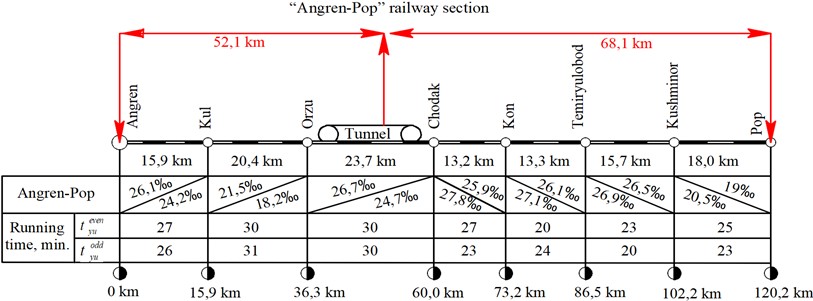
Based on the information presented in Fig. 1, this section has a design gradient of 26.1 ‰ in the even direction and a gradient of 27.8 ‰ in the odd direction. Information about the wagons forming the trains operating on the studied railway section is presented in Table 1.
Table 1Data on the wagons comprising the train
Wagon type | Direction | Share of the train composition by wagon types, % | Average gross mass per axle of the wagon, t | Conditional length of a single wagon, t |
4-axle open-top wagon | Even | 21.1 | 20.5 | 14.41 |
Odd | 28 | 20.5 | 14.41 | |
4-axle tank wagon | Even | 34.3 | 19 | 12.02 |
Odd | 30 | 19 | 12.02 | |
4-axle covered wagons | Even | 24.5 | 21.25 | 14.73 |
Odd | 30 | 21.25 | 14.73 | |
4-axle flat wagons | Even | 2.2 | 14 | 13.3 |
Odd | 2 | 14 | 13.3 | |
4-axle other types of wagons (fitting) | Even | 17.9 | 15 | 14.62 |
Odd | 10 | 15 | 14.62 |
The radius of small curved sections on the calculated and steepest gradients of the “Angren-Pop” railway section averages 400 meters. This reduces the calculated tractive effort of two 2UZ-ELR locomotives to 860.715 N.
The main comparative resistance to motion of freight wagons, depending on the wagon types shown in Table 1, was determined according to the methodology presented in study [15], while the maximum gross mass of trains operating on the section was determined based on Eq. (6), taking into account the conditions provided in references [14].
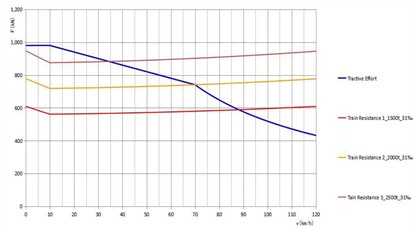
The tractive type of 2UZ-ELR electric locomotives shows that they are capable of hauling train compositions with a gross mass of up to 2950 tons in the even direction and up to 2750 tons in the odd direction. This indicates that, under the current mass standards, the locomotive operates with reserve tractive effort. Since this section has a complex profile, increasing the operating speed is practically impossible. Therefore, traction calculations were carried out for trains of various masses in order to select the optimal mass standard.
Traction calculations were carried out using the KORTES software suite, developed by the All-Russian Scientific Research Institute of Railway Transport (VNIIZhT). The results obtained from the traction calculations are presented in Table 2.
Table 2Results of the performed traction calculations
Gross weight | “Angren-Pop” railway section | Average running speed (), km/h | |||
Even direction | Odd direction | ||||
,·t | , km/h | , km/h·t | , km/h | , km/h·t | |
2200 | 47.0 | 103400 | 52.8 | 116160 | 49.9 |
2300 | 47.0 | 108100 | 52 | 119600 | 49.5 |
2400 | 46.6 | 111840 | 50.6 | 121440 | 48.6 |
2500 | 46.4 | 116000 | 48.6 | 121000 | 47.6 |
2600 | 46.1 | 119860 | 46.5 | 120900 | 46.3 |
2700 | 45.4 | 122580 | 44.9 | 121230 | 45.2 |
2750 | 44.9 | 123475 | 41.3 | 113575 | 43.1 |
2800 | 44.4 | 124320 | |||
2900 | 43.3 | 125570 | |||
2950 | 41.6 | 122720 | – | – | |
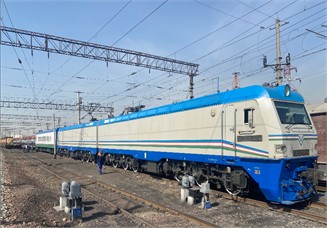
Based on the results of the traction calculations presented in Table 2 and the condition for achieving maximum carrying capacity (Eq. (13)), it is proposed to set the optimal gross mass of freight trains at 2900 tons for the even direction and 2700 tons for the odd direction. Based on the proposed mass standards, experimental tests of train operations on the “Angren-Pop” railway section were successfully conducted. The test freight train with a mass of 2900 tons, hauled by the 2UZ-ELR electric locomotive No. 0404 and dynamometric wagon No. 72006 from Angren station, is shown in Table 3.
Table 3Test freight train with a mass of 2900 tons, formed at Angren station and consisting of a 2UZ-ELR electric locomotive. Photo by Utkir Khusenov, 30 September 2025, at Angren Station, “Uzbekistan Railways” JSC
 |  | ||
Parameters | 2UZ-ELR | Parameters | 2UZ-ELR |
Design speed (km/h) | 120 | Year of manufacture | Years 2020–2021 |
Maximum test speed (km/h) | 132 | Type of electric locomotive | Freight (two-section) |
Operating voltage range (kV) | 17.5-31 kW | Weight (t) | 288 |
Axle load (t) | 23±0.5 | Body length (mm) | 42340 |
Starting tractive effort (kN) / tf | 980 (99960) | Body width (mm) | 3100 |
Electric braking force (kN) | 741kN | Body height (mm) | 4100 |
Service life | 40 | Power (kW) | 14400 |
Based on the proposed mass standards for the “Angren-Pop” railway section and the experimental test conducted with a 2UZ-ELR electric locomotive, the results of determining the running time between sections are presented in Table 4.
Based on the results of determining running times between sections from the experimental test (Table 4), the “Kul-Orzu” section is the limiting segment of the “Angren-Pop” railway section’s current capacity. This is because trains spend the most time traversing this section.
For the current and proposed mass standards, the capacity of the “Angren-Pop” railway section is almost the same in terms of the cycle time of the limiting sections. Therefore, under the proposed mass standards, the number of freight trains in the current train schedule does not change. That is, the maximum capacity of the “Angren-Pop” railway section consists of 6 pairs of passenger trains, 1 pair of mixed trains, and 10 pairs of freight trains.
Table 4Results of determining running times between sections based on the experimental test
Railway sections | Current mass standard, t | Proposed mass standard, t | ||||||
2200 | 2400 | Graph period, min. | Technical speed, km/h | 2900 | 2700 | Graph period, min. | Technical speed, km/h | |
Running time, min. | Running time, min. | |||||||
In the graph | Test experiment | |||||||
A-K | 27 | 26 | 64 | 36.0 | 29 | 21 | 62 | 45.4 |
K-O | 30 | 31 | 72 | 40.2 | 29 | 33 | 73 | 37.1 |
O-Ch | 30 | 30 | 71 | 47.4 | 26 | 25 | 62 | 56.9 |
Ch-K | 27 | 23 | 61 | 31.9 | 20 | 24 | 55 | 33 |
K-T | 20 | 24 | 55 | 36.6 | 18 | 19 | 48 | 42 |
T-K | 23 | 20 | 54 | 44.0 | 16 | 18 | 45 | 52.3 |
K-P | 25 | 23 | 59 | 45.1 | 21 | 21 | 53 | 51.4 |
A-P | 30 | 31 | 72 | 40.2 | 29 | 33 | 73 | 45.4 |
According to Eq. (9), the “Angren-Pop” railway section has an annual capacity of 12.8 million tons under the current mass standard and 15.5 million tons under the proposed mass standard. That is, the proposed mass standard allows increasing the current freight train capacity of the studied section by 21.1 %.
On the studied section, trains mainly consist of 4-axle wagons. The average tare weight of the wagons is 22 t, and the effective length of the station receiving and departure tracks is 850 meters. The train composition under the proposed mass standard includes 33 loaded wagons (83 %) and 7 empty wagons (17 %). According to Eq. (5), the mass per linear meter of railway track from a wagon is 5.1 tons. The reserve mass of the train composition based on the effective length of the receiving and departure tracks is 1162 t in the even direction and 1362 t in the odd direction.
As a result of implementing the “China-Kyrgyzstan-Uzbekistan” railway project, in order to ensure uninterrupted transportation of the expected 10-15 million tons of transit cargo passing through our country, and taking into account local cargo flows, it is required to increase the capacity of the “Angren-Pop” railway section to an average of 18-23 million tons per year. Therefore, the following 2 options are proposed for gradually increasing the capacity of the single-track “Angren-Pop” railway section:
1) Increasing the effective track length at the station to 1050 meters and gradually introducing 3UZ-ELR locomotives with higher tractive power into operation.
2) Organize train operations on a partially scheduled (packet) basis by dividing the sections into block sections with signals and equipping the section with an automatic block system, while introducing 3UZ-ELR locomotives with high tractive power into operation, making efficient use of the reserve train mass based on the effective length of the receiving and departure tracks.
For a partially scheduled (packet) train operation, the existing capacity of single-track railway sections is determined using the following formula [12]:
where, – the packet coefficient, equal to the ratio of the number of trains running in packets to the total number of trains, 0,7; , – interval between trains within a packet in the odd and even directions, respectively, min.
4. Result and discussion
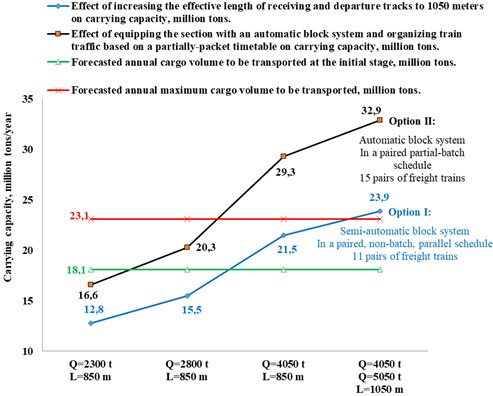
By equipping the section with an automatic block signaling system and organizing train movements based on a partially grouped schedule, it is possible to increase the daily freight train capacity of the section to up to 15 pairs of trains while operating simultaneously with passenger trains. The expected transportation capacity resulting from the implementation of the proposed measures on the “Angren-Pop” railway section is shown in Fig. 2.
While the total energy used per train may increase slightly due to the higher mass, the energy cost per transported ton of freight decreases, resulting in improved overall energy efficiency of the transportation process.
Fig. 2Measures to increase the transportation capacity of the “Angren-Pop” railway section
5. Conclusions
1) A mathematically modeled objective function was developed to optimally select the train speed and gross mass in order to ensure the maximum carrying capacity of the railway section. As a result, the possibility of determining the maximum carrying capacity of the section was established.
The reserve traction power of 2UZ-ELR electric locomotives, which haul freight trains according to the current mass standards, was determined. The identified reserve traction power was directed toward increasing the gross weight of freight trains. Based on the developed objective function, the optimal mass standards for the section were scientifically justified 2900 tons for the even direction and 2700 tons for the odd direction and practically verified through experimental testing. As a result, the potential to increase the section’s maximum carrying capacity by 21.1 % (2.7 million tons) was achieved.
2) Taking into account the effective length of the station’s existing reception and departure tracks, it was scientifically justified that the gross weight of freight trains can be set at an average of 4050 tons. As a result, the gradual introduction of 3UZ-ELR electric locomotives, which have sufficient traction power to haul trains with a gross mass of 4050 tons, was scientifically justified as a means to increase the section’s maximum transportation capacity by 38.7 % (6 million tons).
3) As a result of implementing the “China-Kyrgyzstan-Uzbekistan” railway project, the feasibility was established to increase the effective length of the station’s existing reception and departure tracks to 1050 meters, set the average gross weight of freight trains at 5050 tons, and gradually introduce locomotives with higher traction power than 3UZ-ELR electric locomotives into the transportation process, in order to organize uninterrupted transit freight movement through the territory of our country. As a result, it was demonstrated that the maximum transportation capacity of the section can be increased to 23.9 million tons, which enables uninterrupted transportation of the expected maximum freight flow.
4) It was demonstrated that equipping the “Angren-Pop” railway section with an automatic block signaling system, organizing train movements based on a partially grouped schedule, and efficiently utilizing the train mass reserve according to the effective length of the reception and departure tracks allows the train mass to be increased up to 4050 tons. As a result, organizing train operations with 2UZ-ELR and 3UZ-ELR electric locomotives enables uninterrupted transportation of the expected maximum freight flow through the section.
References
-
F. Li et al., “A subjective capacity evaluation model for single-track railway system with δ-balanced traffic and λ-tolerance level,” Transportation Research Part B: Methodological, Vol. 105, pp. 43–66, Nov. 2017, https://doi.org/10.1016/j.trb.2017.08.020
-
A. Landex, A. H. Kaas, B. Schittenhelm, and J. Schneider-Tilli, “Practical use of the UIC 406 capacity leaflet by including timetable tools in the investigations,” Computers in Railways X, Vol. 1, pp. 643–652, Jun. 2006, https://doi.org/10.2495/cr060631
-
M. Khadem-Sameni, A. Landex, and J. Preston, “Revising the UIC 406 method: revenue generating capacity,” in 2010 Joint Rail Conference, pp. 579–588, Jan. 2010, https://doi.org/10.1115/jrc2010-36281
-
T. Lindner, “Applicability of the analytical UIC Code 406 compression method for evaluating line and station capacity,” Journal of Rail Transport Planning and Management, Vol. 1, No. 1, pp. 49–57, Nov. 2011, https://doi.org/10.1016/j.jrtpm.2011.09.002
-
“National rail freight infrastructure capacity and investment study,” Association of American Railroads (AAR), CS-I, 2007.
-
D. Tolliver, “Railroad planning & design,” North Dakota State University, CE 456/656 Lecture Notes, 2010.
-
A. Landex, “Methods to estimate railway capacity and passenger delays,” Technical University of Denmark Department of Transport, Denmark, 2008.
-
A. Z. Abdurakhmanov, S. Khudayberganov, U. Khusenov, and S. Jumayev, “Mathematical model of criteria for a comprehensive assessment of the state of railway transport infrastructure,” in E3S Web of Conferences, Vol. 402, p. 06006, Jul. 2023, https://doi.org/10.1051/e3sconf/202340206006
-
N. Aripov, M. Arpabekov, S. Suyunbayev, M. Masharipov, and U. Khusenov, “Development of a mathematical model of sequential arrangement of a group of wagons along station tracks,” in Lecture Notes in Networks and Systems, Cham: Springer Nature Switzerland, 2024, pp. 12–22, https://doi.org/10.1007/978-3-031-53488-1_2
-
U. Khusenov, S. Suyunbaev, D. Umirzakov, M. Tokhtakhodjayeva, and I. Adizov, “Assessment of the effect of train traction by locomotives of different types on the quality indicators of the train schedule,” in E3S Web of Conferences, Vol. 583, p. 03018, Oct. 2024, https://doi.org/10.1051/e3sconf/202458303018
-
M. Masharipov, M. Rasulov, S. Suyunbayev, S. Jumayev, and S. Bekmurodov, “Establishing the impact of empty freight trains on the capacity railway lines,” in E3S Web of Conferences, Vol. 431, p. 08021, Oct. 2023, https://doi.org/10.1051/e3sconf/202343108021
-
M. S. Borovikova, Organization of Train Traffic on Railway Transport: Textbook. Moscow: Marshrut, 2003.
-
U. U. Khusenov, A. K. Yusupov, and M. D. Akhmedova, Technology of Transportation in Railway Transport and Its Organization: Textbook. Tashkent: TSTU, Transport Publishing House, 2023.
-
“Traction calculation rules for train operation,” Transport, Moscow, 1985.
-
U. Khusenov and S. Suyunbaev, “Methodology for assessing the impact of the main comparative resistance to movement of various wagons on the weight of the freight train,” Journal of Transport, Vol. 2, No. 1, pp. 146–150, 2025.
About this article

The authors have not disclosed any funding.
The datasets generated during and/or analyzed during the current study are available from the corresponding author on reasonable request.
The authors declare that they have no conflict of interest.

