Abstract
Bridge resilience assessment enables bridges to maintain their structural integrity and functionality in the face of loads and disasters, improves their reliability and recovery capability, and ensures the smooth flow of transportation. This study focuses on the assessment methods and indicator selection for the seismic resilience of bridges, summarizing the latest research progress in this field. It reviews the development history of commonly used bridge resilience assessment methods and frequently used assessment methods, and comparatively analyzes the advantages and disadvantages of experimental research and numerical simulation. Several bridge resilience assessment frameworks and evaluation models are introduced, including those for single bridges as well as for entire bridge networks, to assist researchers in selecting appropriate models and frameworks based on actual conditions. The key indicators for the seismic resilience assessment of bridges are reviewed, including structural strength, deformation capacity, durability, and reparability. Finally, future directions for research are proposed. The research indicates that assessment methods for bridge resilience under the coupled effects of multiple hazards are not yet mature and require further investigation. The close integration of intelligent algorithms with bridge resilience assessment is an important future research direction. This review aims to further promote the research and application of seismic resilience assessment for bridges.
1. Introduction
With the improvement of the economic level and the rapid development of transportation, bridges play a vital role in the transportation system and are a core component of the transportation infrastructure. They are crucial for ensuring daily passenger mobility and freight transportation. With the advancement of science and technology and the improvement of construction levels, the performance requirements for bridges are also constantly increasing. In bridge design, traditional methods usually focus on improving the strength and stiffness of the bridge, ignoring its deformation capacity and disaster resistance. Research on bridge resilience assessment can effectively enhance bridge performance, enabling structures to cope with various external loads and disaster events.
Under the influence of long-term traffic loads, natural disasters, and various man-made accidents, bridge performance faces enormous challenges. These factors can lead to structural damage, property loss, and casualties. In the Great Hanshin-Awaji Earthquake that occurred in Japan in 1995, the Hanshin Expressway's bridge piers could not withstand the significant horizontal displacement caused by the intense seismic waves and soil liquefaction, leading to the complete collapse of multiple sections of the elevated bridge. Particularly near Kobe City, the continuous collapse of the bridge resulted in a complete interruption of traffic. Some elevated bridges and piers on the Shinkansen were damaged, causing train derailments and suspension of Shinkansen services, which had a major impact on long-distance transportation. Furthermore, the Akashi Kaikyō Bridge, which was under construction at the time, experienced a displacement of approximately 1 meter in the spacing between its towers due to the earthquake.
In 2008, during the Wenchuan earthquake, the Xuankou Bridge in Yingxiu Town collapsed, and its piers were destroyed. The Zipingpu Bridge in Dujiangyan suffered partial deck fractures and tilted piers, leading to traffic interruption, which hindered rescue and reconstruction efforts. The Baihua Bridge shook violently during the earthquake, its deck fractured, its piers were destroyed by the shaking, and it ultimately collapsed completely.
In the 2022 Menyuan earthquake in Qinghai, the Liuhuangou Bridge on the Lanzhou-Xinjiang high-speed rail line, connecting the Daliang Tunnel and the Qilian Mountain Tunnel, was directly damaged by surface dislocations and ground vibrations from the earthquake due to its location near the seismic surface rupture zone. The main girder of the bridge underwent lateral displacement and deflection, the bearings showed signs of unseating, and the stoppers were also damaged. Table 1 summarizes the damage to bridges in some earthquakes, from which it can be seen that earthquakes are highly destructive to bridges. For the planning and construction of similar projects in the future, more attention needs to be paid to the prevention and mitigation measures for seismic and geological disasters. Therefore, assessing bridge resilience is an important measure to ensure the safety and reliability of bridges. Research into bridge resilience assessment can effectively mitigate the impacts of hazard events on both the bridges themselves and society at large.
Table 1Bridge hazards caused by earthquakes
No. | Time | Bridge | Location | Disastrous situation |
1 | Tangshan Earthquake (1976) | Qinglongwan Bridge | Baodi County, Tangshan City, Hebei Province | The horizontal and vertical displacements of the expansion joints occurred, and the entire bridge deck sank in the middle |
2 | Loma Prieta Earthquake (1989) | Cypress Viaduct | California, USA | A fracture developed in the pier, the abutment was displaced, and a portion of the bridge collapsed |
3 | Northridge Earthquake (1994) | San Francisco-Oakland Bay Bridge | San Francisco Bay Area, USA | The pier experienced displacement, connecting bolts were severed, and the upper deck collapsed |
4 | Osaka-Kobe Earthquake (1995) | Kobe Viaduct, Akashi Strait Bridge | Kobe, Japan | The viaduct partially collapsed, and the 500-meter-long section completely collapsed. The bridge deck broke and fell from the support column, and the bridge deck of the Akashi Strait Bridge was dislocated |
5 | Chi-Chi Earthquake in Taiwan (1999) | Yijiang Bridge | Nantou County, Taiwan | The bridge deck fell, the pier uplifted and displaced, the abutment was damaged, and the traffic was interrupted |
6 | Wenchuan Earthquake (2008) | Many bridges in Yingxiu-Wenchuan section of Duwen Expressway | Wenchuan County, Sichuan Province | The bridge deck of Baihua Bridge was broken, the pier was destroyed and completely collapsed. The abutment of Caopo Bridge was shifted, and the beam body fell off. The pier of Zipingpu Bridge was damaged, the bridge deck was cracked, and the traffic was interrupted |
7 | East Japan Earthquake (2011) | Yokohama Bay Bridge | Yokohama, Kanagawa Prefecture, Japan | The tuyere structure was damaged, and the bolts at the tower-beam connection were broken |
8 | Ya’an Earthquake (2013) | Longmen Township Bridge | Lushan County, Sichuan Province | The guardrails on both sides of the bridge were damaged, cracks appeared on the bridge deck, and some piers were damaged |
9 | Ludian Earthquake (2014) | Longtoushan Bridge | Ludian County, Yunnan Province | The pier fractured, the abutment displaced, the beam shed, and traffic was disrupted |
10 | Nepal Earthquake ((2015) | Bagmati River Bridge | Kathmandu, Nepal | Damage occurred to the pier, with cracks forming on the bridge deck, leading to traffic disruption |
11 | Jiuzhaigou Earthquake (2017) | Shangshizhai Bridge | Zhangzha Town, Jiuzhaigou County, Aba Prefecture, Sichuan Province | The pier was damaged, cracks appeared in the bridge deck, and traffic was disrupted |
12 | Qinghai Maduo Earthquake (2021) | Yematan Bridge, Yematan No.2 Bridge | Maduo County, Qinghai Province | The two-way collapse of the Yematan Bridge occurred, the bridge beam slab collapsed, the pier was damaged, and 'domino'-type damage was observed; the No.2 bridge of Yematan also collapsed, and multi-span falling beams appeared |
13 | Qinghai Menyuan Earthquake (2022) | Liuhuangou Bridge | Menyuan County, Haibei Tibetan Autonomous Prefecture, Qinghai Province | The bridge deck experienced deformation, the main girder rolled over and slipped. The pier and bearings were damaged, and cracks appeared |
14 | Turkey-Syria Earthquakes (2023) | Balkburnu Bridge, Gazilai Suburban Railway Bridge | Turkish-Syrian border region | Balkburnu Bridge damaged. A large section of the railway bridge in the suburb of Gazilai collapsed |
15 | Wushi earthquake (2024) | Yamansu Bridge | Wushi County, Xinjiang | There were cracks at the connection of the bridge, and the traffic was restricted |
With the gradual improvement of structural health monitoring (SHM) technology, it is now possible to more accurately obtain information on the operational status and damage of bridge structures. This provides a large amount of research data for bridge resilience assessment, and the analysis of structural monitoring data contributes to a more accurate evaluation of bridge resilience.
By assessing the resilience of bridges, the vulnerability of the bridge structure can be identified. Through the adoption of preventive and optimization measures, the risk of disasters can be effectively reduced, mitigating their social and economic impact. This ensures that bridges can maintain structural integrity and functionality in the face of loads and disasters, improves the reliability and availability of bridges, guarantees the smooth flow of transportation, and promotes social and economic development.
This paper reviews different methods and frameworks for bridge resilience assessment and summarizes the influencing factors and evaluation indicators of bridge resilience. In Section 2, the meaning of resilience and the definition of bridge resilience are summarized. In Section 3, a statistical analysis of papers related to bridge resilience is conducted, with a focus on relevant papers from the five years between 2020 and 2024. Section 4 summarizes different methods for bridge resilience assessment. In Section 5, bridge resilience evaluation models are reviewed, including recovery capability state models, bridge network resilience models, and evaluation models based on intelligent algorithms. Section 6 summarizes the factors influencing bridge resilience and the applicable conditions and scope of each assessment indicator. We aim to review the existing findings, current challenges, and future directions in the field of bridge resilience research to provide a reference for future studies in bridge resilience assessment.
2. Definition of bridge resilience
The term “resilience” originates from the Latin word “Resilio”, which means “to jump back.” It refers to an inherent characteristic and capability of a system to maintain a stable state or to restore equilibrium after being disrupted by external disturbances [1]. Resilience can be defined as the capacity of social units (e.g., organizations and communities) to mitigate disasters, manage their impacts, and recover in a way that minimizes social disruption and lessens the effects of future earthquakes [2].
Bridge resilience refers to the ability of a bridge to maintain its structural integrity, stability, and functionality under external loads or adverse conditions, such as natural disasters and traffic accidents. It also encompasses the capacities for load bearing, deformation accommodation, resistance to damage propagation, as well as damage detection and repair. Bridge resilience is an important indicator for assessing the ability of a bridge structure to withstand accidental loads and disastrous events.
In some studies, researchers have classified the degree of bridge damage into three levels: Level I represents the sliding of elastomeric bearings, Level II indicates large residual displacement, and Level III signifies structural collapse [3]. Bridge resilience includes the ability to rapidly recover to its initial state, as well as the capacity to anticipate, absorb, adapt to, and rapidly recover from potentially disruptive events [4].
Bridge resilience is closely related to its load-bearing capacity. A resilient bridge can withstand traffic loads, natural disasters, and accidental loads without undergoing severe structural damage. The deformation capacity of a bridge refers to its ability to deform to a certain extent under load without losing its functionality. A highly resilient bridge can absorb and dissipate loads through appropriate deformation, thereby reducing structural stress and lowering the risk of failure. The ability to resist damage propagation refers to the capacity of a bridge to prevent localized damage from spreading to other parts, thus maintaining the overall integrity and functionality of the structure. Detection and repair capability is the ability of a bridge to be promptly inspected for problems after being damaged and to be subsequently repaired and maintained. Therefore, bridges require effective monitoring systems that can timely detect potential structural issues and allow for appropriate measures to be taken for repair and strengthening.
As a crucial piece of infrastructure, the resilience assessment of bridges is an important component of disaster risk management. Resilience assessment can reveal the maximum load and deformation capacity that a bridge structure can withstand, thereby determining if the structure is sufficiently strong, safe, and reliable to cope with disaster events. By assessing bridge resilience, damage and problems can be identified in a timely manner, and priorities and strategies for repair and retrofitting can be established. This helps in the rational allocation of maintenance resources, extending the service life of the bridge, and reducing maintenance costs. Furthermore, incorporating resilience requirements at the design stage allows for full consideration of the structure's strength, deformation capacity, and disaster resistance, which reduces the need for future repairs and retrofitting, thereby lowering environmental impact and resource consumption.
3. Overall status of relevant literature
Bridges are an indispensable part of ground transportation infrastructure, reducing travel costs and improving traffic efficiency by providing passage over inaccessible terrain, high-altitude areas, bodies of water, and traffic intersections. The development and economy of a nation and society are closely linked to its bridges. In recent decades, natural disasters such as earthquakes and floods have occurred frequently, causing varying degrees of damage to many bridges. Over time, these bridges are at risk of collapse. Therefore, in recent years, the assessment of bridge resilience has become a major research hotspot in the transportation field.
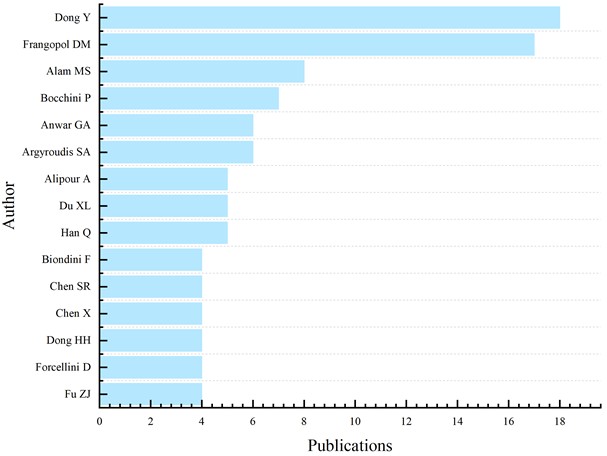
A source analysis was conducted on 457 documents retrieved from the Web of Science (WOS) Core Collection (SCI-E, SSCI) up to and including 2024, using the theme “bridge resilience assessment.” As shown in Fig. 1, the results indicate that the United States, China, and the United Kingdom have conducted more research on bridge resilience assessment. As shown in Fig. 2, the annual number of publications in the field of bridge resilience assessment shows an overall upward trend. Since 2019, the number of annual publications has grown significantly. The number of articles published in 2024 is nearly doubled compared to 2023, indicating that in the last five years, an increasing number of researchers have dedicated themselves to the study of bridge resilience assessment systems and evaluation methods. As shown in Fig. 3, among the many experts and scholars in the bridge engineering field, Dong Y. and Frangopol D.M. have a high number of publications.
Fig. 1Statistics of publication countries (regions)
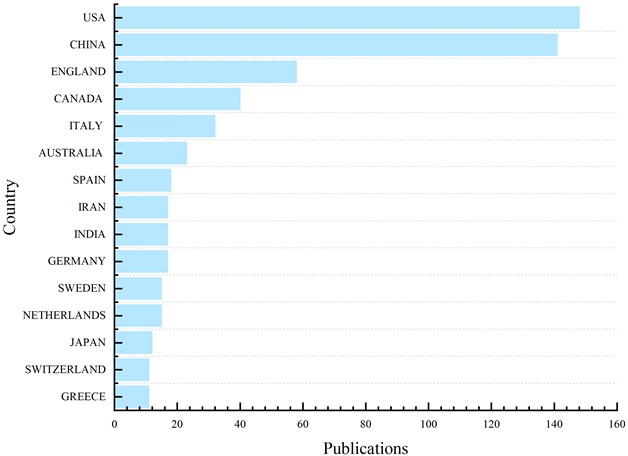
Fig. 2Statistics of publication years
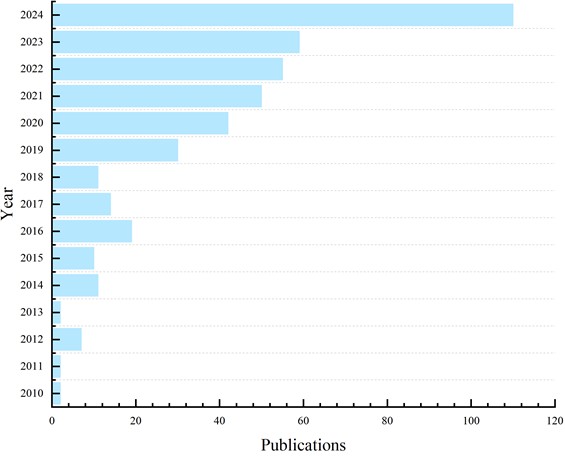
Fig. 3Statistics of the number of publications by authors
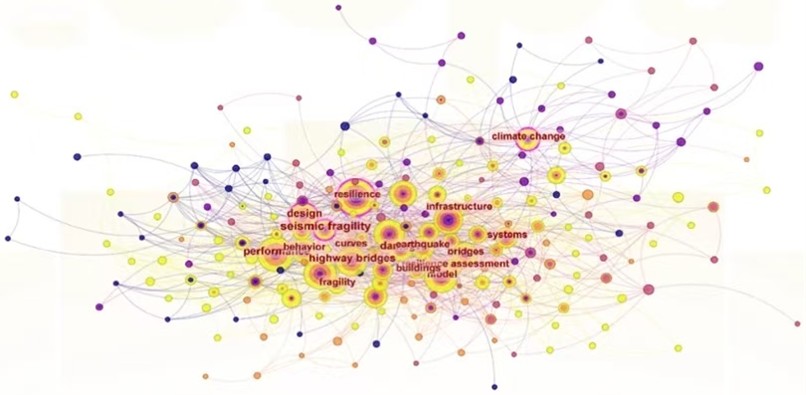
An analysis of the associations among 332 deduplicated papers published in the last five years (2020-2024) was conducted. Based on the frequency of keyword occurrences, the most frequently used keyword is “resilience” in Cluster 3, with 56 occurrences, highlighting its central role in the research. This is followed by “performance” from Cluster 2, with 53 occurrences. Ranking third is “model” from Cluster 5, with 46 occurrences. Subsequently, “framework,” also belonging to Cluster 5, appears 44 times, and “seismic resilience” from Cluster 2 has 42 occurrences. Furthermore, keywords such as “highway bridges,” “risk,” and “vulnerability” also have high frequencies, indicating their significance in bridge engineering-related research.
In terms of importance ranking, “seismic fragility” from Cluster 3 ranks first with an importance score of 48, making it one of the core research themes in the field. This is followed by “highway bridges” from Cluster 1, with an importance of 38, showing its key position in bridge engineering research. Third is “design” from Cluster 3 with an importance of 37, and fourth is “damage” from Cluster 1, with an importance of 35. Additionally, keywords such as “performance,” “earthquake,” and “infrastructure” also possess a high degree of importance. The high importance of these keywords suggests that they constitute the primary framework of current research in bridge engineering.
In the centrality ranking, “seismic fragility” from Cluster 3 ranks first with a centrality of 0.15, indicating its significant connecting role in the research network and its strong influence on other research topics within the field. Following this is “climate change” from Cluster 0, with a centrality of 0.13, showing its important position in the research network. Ranking third is “design” from Cluster 3, with a centrality of 0.10. The high centrality of these keywords indicates that they are not only research hotspots but also play a crucial role in connecting different research themes and promoting knowledge exchange within the field.
As shown in Fig. 4, keywords such as “resilience,” “vulnerability,” and “fragility” collectively reflect the current research hotspots in the field of bridge engineering, particularly in studies concerning seismic resilience, vulnerability assessment, and design frameworks for bridges. The high frequency of these keywords and their important position in the research network suggest that they will continue to be a key focus of research in the field of bridge engineering in the future.
Fig. 4Keyword statistics
4. Bridge resilience assessment methods
Early research primarily focused on the seismic design and performance assessment of bridges. As time progressed, researchers began to concentrate on the structural performance and damage assessment of bridges under seismic action. From the late 20th century to the early 21st century, researchers initiated preliminary explorations into bridge resilience assessment. Basöz and Kiremidjian assessed bridge damage data from the Loma Prieta and Northridge earthquakes in 1998[5]. Hewes conducted research on the seismic design and performance of precast concrete segmental bridge piers [6].
Probabilistic methods based on Monte Carlo simulation and Latin Hypercube Sampling are suitable for the preliminary assessment of the seismic resilience of bridges. Through fragility analysis, the potential degree of damage a bridge may suffer in a seismic event (no damage, slight, moderate, extensive, complete) is evaluated [2]. A probabilistic six-parameter sinusoidal function is employed to describe the pattern of bridge functionality changes over time. This method can account for the uncertainties of seismic events, and the six-parameter sinusoidal function can dynamically reflect the changes in bridge functionality over time, thereby enhancing the reliability of the assessment. However, Monte Carlo simulation requires a large number of samples, resulting in high computational costs, which makes it unsuitable for large-scale bridge networks.
A bridge resilience assessment method based on a probabilistic framework applies resilience metrics to bridge resilience assessment, considering the different levels of performance and functional states of the bridge during extreme events. It calculates the seismic demand of the bridge using an equivalent single-degree-of-freedom model to obtain the recovery patterns and performance assessment of the bridge [7]. The flowchart for the time-varying functionality and economic loss assessment adopted by this method is shown in Fig. 5. This method can quantify the recovery capability of a bridge in different functional states, but it only assesses individual bridges without considering the interactions within a bridge network. For the resilience assessment of bridge networks, some scholars have developed a probabilistic seismic resilience assessment method that integrates seismic influence factors and their impact on the resilience of the bridge network to evaluate the response of the bridge network to spatially correlated earthquakes [8]. This method integrates the effects of the bridge network and spatially correlated earthquakes, making it more suitable for regional resilience assessment.
These methods all employ probabilistic approaches to handle uncertainties and focus on the dynamic description of the bridge’s functional recovery process. Common issues include computational complexity, determination of model parameters, and data dependency. Future research could integrate machine learning to optimize computational efficiency or combine multiple methods to enhance accuracy.
Fig. 5Flowchart for the assessment of time-varying functionality and economic loss under mainshock-aftershock sequences, based on a probabilistic framework for bridge resilience assessment [7]
![Flowchart for the assessment of time-varying functionality and economic loss under mainshock-aftershock sequences, based on a probabilistic framework for bridge resilience assessment [7]](https://static-01.extrica.com/articles/25582/25582-img5.jpg)
Experimental research and numerical simulation are two major methods frequently used in bridge resilience assessment, playing important roles in bridge design, construction, and maintenance. As two core methods, experimental research and numerical simulation lay a solid foundation for bridge resilience assessment. Experimental research, through means such as scaled model tests, large-scale shaking table tests, and in-situ measurements, can intuitively demonstrate the complex dynamic response behavior of bridges under disaster loads. Shaking table tests can simulate the force and deformation processes of bridges under real earthquake conditions, providing reliable experimental data support for validating numerical models and analytical methods [9]. Zhou et al. used a bridge model with prestressed rocking double-column piers and, through shaking table tests on the piers with negative quadratic stiffness, studied the seismic response, recovery capability, and isolation performance of the piers under different levels of seismic excitation [10].
Large-scale shaking table tests, as a key research method, can intuitively reveal the dynamic response, displacement patterns, and failure modes of slopes under seismic action, and are used to verify the seismic effectiveness of new reinforcement structures such as ecological frame beams, thereby providing a scientific basis for the protection of infrastructure in mountainous areas [11]. Meanwhile, landslide displacement poses a serious threat to the structural safety of bridges. Even minor initial slope movements can, through soil-foundation interaction, induce rotation or translation of the bridge foundation, leading to structural deformation, bearing damage, or even overall collapse. Research has shown that the relative orientation of the bridge axis to the direction of the landslide (e.g., parallel or orthogonal) and the stiffness characteristics of the foundation type (e.g., pile groups or caisson foundations) are key factors in determining the seismic response of a bridge in a landslide environment [12].
Furthermore, advances in in-situ monitoring technology, such as the application of high-precision sensors and real-time data acquisition systems, have made it possible to study the dynamic behavior of bridges during actual disasters [13], [14]. Takahashi et al. developed metabolic seismic columns in 2021 that can replace plastic hinges under gravity loads [15]. This metabolic seismic columns can overcome the limitations of conventional structural damage mechanisms by replacing traditional plastic hinges, can overcome the limitations of conventional structural damage mechanisms, offering a new approach for actively controlling the energy dissipation of the structure.
The introduction of structural control devices mitigates seismic response by dissipating earthquake energy or altering the dynamic characteristics of the structure. Current research primarily focuses on the engineering application of passive and semi-active control devices. Passive control extends the structural period through the installation of devices such as lead rubber bearings (LRB) or friction pendulum systems (FPS). Research has shown that optimizing their damping ratio and friction coefficient can significantly reduce the base shear of the main tower and the acceleration of the main girder in cable-stayed bridges [16]. Semi-active control, on the other hand, utilizes devices like magnetorheological (MR) dampers to adjust the damping force in real time. Compared to traditional methods, it can more effectively constrain large bearing displacements and prevent pounding damage, demonstrating superior performance in reducing base shear and mid-span displacement. This provides a cost-effective solution for enhancing the seismic resilience of existing bridges [17].
The data obtained from experiments provide a basis for constructing accurate numerical models and can also be used to validate the reliability of numerical simulation results. Experimental research is characterized by high authenticity and credibility. Through actual physical loading, it is possible to simulate the stress state of a bridge under real disaster conditions, thereby obtaining accurate data on damage and failure. However, the high cost, time-consuming nature, and difficulty in fully controlling experimental conditions are disadvantages that limit the application of experimental research in practical engineering. Moreover, it can typically only be conducted for specific bridge structures or disaster types, making it difficult to cover all possible scenarios.
Numerical simulation methods, on the other hand, simulate the response of bridges to various disasters by establishing finite element models, dynamic analysis models, and so on, providing more extensive capabilities for parametric analysis and scenario simulation. Numerical simulation methods include static elasto-plastic analysis and dynamic time-history analysis. These methods can simulate the dynamic and static responses of bridges under different seismic intensities, working conditions, and material properties to assess their seismic performance.
In existing research, numerical simulations have been conducted by establishing finite element models, using a difference algorithm to analyze prestress loss [18], and analyzing the impact on the vulnerability of precast concrete segmental bridges under different limit states. The finite element method can simulate with high precision the influence of local factors, such as prestress loss, on the limit states of a bridge. Numerical simulation supports parametric analysis, which facilitates the study of the sensitivity of specific variables (such as construction techniques). However, the finite element method has a high demand for computational resources and is sensitive to the assumptions of material constitutive models and boundary conditions, which affects the accuracy of the results.
By constructing 2D numerical models and conducting numerical simulations, the elastic and plastic behavior of bridges during earthquakes can be assessed to determine the changes in structural performance under seismic actions of varying intensities. A multi-stripe analysis method is employed to obtain the seismic demand of the bridge at each intensity level, as shown in Fig. 6. The research results indicate that the transverse support width of the bridge is crucial for reducing the probability of structural collapse. Through the simulation of a bridge's response to seismic action using a three-dimensional finite element model, the effects of corrosion propagation and earthquakes can be fully considered. By introducing a time variable for corrosion propagation and combining material durability with seismic response, the seismic performance of the bridge can be evaluated at different points in time, revealing the key mechanisms of resilience degradation over the entire life cycle of the bridge [19].
Fig. 6Fragility curves of the parametric study [3]
![Fragility curves of the parametric study [3]](https://static-01.extrica.com/articles/25582/25582-img6.jpg)
a) Effect of seismic bars
![Fragility curves of the parametric study [3]](https://static-01.extrica.com/articles/25582/25582-img7.jpg)
b) Effect of lateral stoppers
![Fragility curves of the parametric study [3]](https://static-01.extrica.com/articles/25582/25582-img8.jpg)
c) Effect of transverse seat width
The 2D numerical model and the three-dimensional finite element model reflect the technological advancement from two-dimensional to three-dimensional analysis. They can more comprehensively simulate the complex responses of bridge structures (such as the coupling effect of corrosion and earthquakes), enhancing the reliability of assessment results. However, 2D models cannot fully capture the spatial force characteristics of a bridge (e.g., three-dimensional displacement of bearings, torsional effects), which poses a risk of localized conclusions regarding the transverse support width. Although three-dimensional finite element models offer higher accuracy, they are complex to build and consume significant computational resources, making them difficult to apply rapidly to large-scale infrastructure assessments. How to combine the use of 2D and 3D models in practical applications is an important future research direction.
Bayesian estimation has been introduced into the fragility analysis of bridges, leading to the development of a new bridge fragility method based on Bayesian theory (BEM method), which can improve the efficiency of bridge seismic fragility analysis while ensuring the accuracy of the calculation results [20]. The Bayesian method is highly dependent on the prior distribution; an improper choice of prior can lead to biased results, and there are issues with computational complexity when dealing with complex models. Later, other scholars used the static nonlinear analysis method (Pushover method) to conduct a resilience analysis of a long-span stiffened-skeleton arch bridge and verified the feasibility of this method in the seismic performance assessment of arch bridges [21]. Compared to the Bayesian method, the Pushover method is computationally simpler and suitable for the preliminary seismic performance assessment of structures such as long-span arch bridges. However, it cannot account for dynamic effects (such as the time-history characteristics of ground motion), has insufficient accuracy for the analysis of long-period bridges, and is only applicable to symmetric or simple structures, with limited capability for predicting responses under complex seismic actions.
For existing bridges, resilience assessment must explicitly account for aging effects, deterioration, and limited data availability. Simplified probabilistic models, Bayesian updating, and surrogate modeling techniques have been widely used to address the issue of data scarcity. Structural Health Monitoring (SHM) data, even when sparse, can be effectively combined with prior knowledge to update resilience metrics over time. Scenario-based assessments and component-level screening methods are also practical tools for prioritizing retrofitting interventions in aging bridge inventories.
By establishing time-variant degradation models (such as models for chloride ingress and concrete carbonation) to modify material constitutive relationships and using Incremental Dynamic Analysis (IDA) to generate time-variant fragility curves that change with service age, it is possible to accurately capture the characteristic of increasing post-earthquake damage probability in older bridges [22]. To address the cognitive uncertainty caused by the scarcity of post-disaster recovery data, fuzzy set theory is introduced, transforming key parameters like residual functionality and recovery time from traditional single-point values into triangular fuzzy numbers. This approach uses membership functions to cover a range of judgments from pessimistic to optimistic [23]. This method transforms the originally single-valued resilience assessment into a fuzzy resilience band with fluctuating boundaries, providing decision-makers with more robust strategies for the maintenance and post-earthquake recovery of bridge groups under the dual pressures of incomplete information and structural deterioration.
Linear and nonlinear dynamic analysis methods are widely used for predicting the seismic response of bridges, with nonlinear analysis being able to more accurately capture the damage evolution process of a bridge [24], [25]. Furthermore, the proposal and application of multi-scale modeling methods in recent years have enabled high-precision simulation of the mechanical behavior of bridges from the overall structure down to key local components, providing a multi-level perspective for bridge resilience assessment [26-29]. The dynamic characteristics and seismic response of a long-span spatial Y-shaped arch bridge were analyzed using a multi-scale model approach, verifying the reliability of the multi-scale modeling method [30]. A method for assessing the seismic resilience of bridges that combines the Response Surface Method (RSM) and the Monte Carlo Method (MCM) can effectively reduce the complexity of calculating the seismic failure probability of bridges and shorten the computation time [31].
Fig. 7Seismic fragility curves [23]
![Seismic fragility curves [23]](https://static-01.extrica.com/articles/25582/25582-img9.jpg)
The nonlinear dynamic time-history analysis method using recorded ground motions more realistically reflects the dynamic response characteristics of a bridge structure under seismic action by selecting representative actual earthquake ground motion records and adjusting their amplitudes based on the target design intensity and site conditions. Specifically, the research is typically based on a nonlinear finite element model, with detailed modeling of the bridge superstructure, piers, and foundations. After inputting multiple earthquake ground motions, the displacement, internal forces, and damage indices at critical structural locations are obtained. Further, by combining these results with the cloud method or probabilistic statistical methods, seismic demand models and fragility curves for the bridge structure can be developed, enabling a quantitative assessment of its seismic performance and failure probability.
Compared to analysis methods based on the response spectrum or simplified equivalent static forces, dynamic analysis using recorded ground motions has distinct advantages in capturing near-fault effects, spectral non-stationarity, and structural nonlinearity. This provides high-quality baseline data for subsequent intelligent algorithm modeling and multi-hazard coupling analysis.
Numerical simulation offers the advantages of flexibility and efficiency. By adjusting the model's parameters, simulations can be conducted for different bridge structures, material properties, and disaster scenarios, thereby achieving a comprehensive resilience assessment. Additionally, numerical simulation can complete the analysis of a large number of scenarios in a relatively short time, providing rapid decision support for bridge design and maintenance. However, the accuracy of numerical simulations depends on the construction of the model and the selection of parameters, necessitating validation and calibration with experimental data.
Although experimental research can provide valuable data, tests under laboratory conditions often struggle to simulate the response of actual bridges in complex environments. Furthermore, the high cost and time-consuming nature of experiments limit the implementation of large-scale experimental studies. While numerical simulation methods can model complex bridge responses, the accuracy of these methods depends on the precision of the model and the correctness of the input parameters. Moreover, the interpretation of numerical simulation results requires specialized knowledge, which limits their application in engineering practice.
Therefore, to enhance the accuracy and reliability of bridge resilience assessment, experimental research and numerical simulation methods are often used in combination [32-34]. By obtaining damage information of bridges under seismic action through experiments, this data is then used to calibrate numerical models, thereby further predicting the response of various bridge structures to different seismic intensities [35], [36]. Based on field investigations and data analysis, a bridge resilience assessment method that combines the Entropy Weight Method and an improved TOPSIS method has been proposed [37]. This method not only enhances the accuracy of the assessment but also expands its scope, providing solid support for the management of the entire life cycle of bridges.
With the continuous advancement of computer technology, assessment methods based on big data analysis and machine learning are gradually emerging. By integrating large amounts of experimental data and numerical simulation results, intelligent assessment models can be constructed to achieve rapid and accurate evaluation of bridge resilience. Furthermore, the assessment of bridge resilience under the coupled effects of multiple hazards will become a key focus of future research in order to address complex and variable disaster environments. The evaluation of bridge resilience should not only focus on its performance during disaster events but also consider its long-term performance and durability. At present, methods for assessing the performance degradation of bridges during long-term use are still relatively limited. Moreover, the field of bridge resilience assessment lacks unified evaluation standards and indicator systems, which makes it difficult to compare and integrate the results from different research and engineering projects.
5. Construction of resilience framework and evaluation model
Resilience frameworks and evaluation models are important tools for assessing the ability of a bridge to maintain functionality, recover rapidly, and reduce long-term impacts when facing disasters. Resilience assessment frameworks typically include four fundamental properties: robustness, redundancy, resourcefulness, and rapidity. In recent years, researchers have continuously focused on developing new seismic resilience frameworks, aiming to quantitatively assess the seismic resilience of bridges to provide a solid theoretical basis and practical guidance for the seismic design and resilience assessment in bridge engineering [39-41].
5.1. Recovery capability state model
The recovery capability state assessment model for bridges refers to the use of quantitative and qualitative methods to evaluate the ability and speed at which a bridge can recover its functionality after being subjected to natural disasters (such as earthquakes, floods, etc.) or other sudden events [42]. Decò et al. proposed a recovery model based on a six-parameter sinusoidal waveform, which can represent different types of recovery options, including the two stages of the recovery process: an idle time interval and the actual recovery process [2]. The recovery capability state assessment model is of great significance for formulating effective post-earthquake repair strategies, optimizing resource allocation, and enhancing the overall resilience of the bridge network.
Based on the analysis of degradation characteristics of component performance states during the seismic process, Fu et al. proposed a theory of post-earthquake recovery capability for components and, in conjunction with golden rescue scenarios, established a resilience model for the bridge system [43]. The system modeling approach of a parallel-series structure theoretically enhances the structural adaptability of the model, but the diversity of actual bridge constructions may pose a challenge to the model's universality. Using a Data Envelopment Analysis (DEA) method, with variables such as bridge age, area, design high flood level, and completed pavement as input variables, and the bridge resilience index as the output variable, three frameworks were established to calculate the resilience efficiency of bridges [44]. This DEA method introduces systematic indicators into efficiency assessment, expanding the means of resilience analysis, but its results are relatively dependent on the reasonableness of the input variable selection, which introduces a certain degree of subjectivity. A research method using fuzzy set theory and fuzzy logic to simulate earthquake recovery and resilience models the bridge recovery process through fuzzy functions and uses fuzzy measure theory to determine resilience indicators [45]. This method has a natural advantage in handling uncertainty and is particularly suitable for scenarios where data is ambiguous or judgments are human-made. However, the precision control and quantitative interpretation capabilities of the fuzzy logic model itself are relatively limited.
The functional recovery process model can quantitatively evaluate different recovery strategies. This model considers the resilience, repair time, post-earthquake economic losses, and the recovery capability of different recovery strategies for a bridge in various damage states [46]. Dong et al. proposed a comprehensive framework for quantifying the long-term resilience and losses of highway bridges under natural disasters [7]. It focuses on independent natural disasters, incorporating the processes of various disaster impacts in the resilience and loss assessment, including the stochastic process of hazard occurrence, structural fragility analysis, functionality analysis, and life-cycle analysis. This method breaks through the limitation of single-hazard analysis by introducing life-cycle analysis and the stochastic process of disasters, which more closely aligns with the complex disaster environment that bridges face throughout their entire life cycle. However, the multiple hazards in this framework only target independent disaster events and do not consider the cascading damage from hazard chains (e.g., an earthquake triggering a flood) or compound disasters, which may lead to an underestimation of the actual risk. Neither of the above two methods considers the impact of bridge service interruption on community resilience, thereby weakening the social value of the resilience assessment.
The resilience of bridges is often influenced by multiple hazards and cascading effects, such as earthquake-flood, earthquake-landslide, and corrosion-earthquake coupling. Flood scour may alter the seismic response under specific conditions by elongating the natural period; this correlation renders the traditional method of independently superimposing hazards inapplicable [47]. Network-level losses can be quantified by introducing correlated local damage patterns (e.g., increased displacement due to scour and strength loss due to earthquakes) into the functionality assessment framework [48]. The research by Biazar et al. on shallow-foundation bridges revealed the combined action mechanism of scour, earthquakes, and vehicle loads, finding that scour significantly amplifies component responses. In extreme multi-hazard scenarios, the impact of the earthquake is dominant, but the coupling of scour and vehicle loads significantly alters the system's damage threshold [49]. Earthquakes can weaken bridge foundations and bearings, significantly increasing their vulnerability to subsequent floods or scour. Similarly, long-term corrosion can reduce seismic capacity and prolong post-earthquake recovery time. These coupling effects highlight the necessity of an integrated multi-hazard resilience framework rather than independent single-hazard assessments.
For bridge engineering in arid and extreme climate regions, seismic disasters often do not occur in isolation but are coupled with various environmental effects. Typical multi-hazard combinations include earthquakes and wind-sand erosion, earthquakes and freeze-thaw cycles, and earthquakes and scour. A wind-sand environment can lead to the abrasion of concrete surfaces and the corrosion of steel reinforcement, thereby weakening the structure's load-bearing capacity under seismic action. Freeze-thaw cycles can cause material degradation and crack propagation, amplifying seismic damage. Scour action can reduce foundation stability, making the bridge more susceptible to overall failure during an earthquake.
Given the unique geographical and climatic characteristics of the Xinjiang region, this paper further discusses the multi-hazard coupling effects on bridges in this area and a corresponding resilience assessment framework. Bridges in arid regions not only face component section reduction due to long-term wind and sand abrasion and changes in dynamic characteristics caused by sand burial, but also experience the evolution of concrete microcracks due to freeze-thaw cycles in high-altitude, severe cold environments, and the accelerating effect this has on seismic strength degradation. Furthermore, there is a risk of pile foundation instability caused by the superposition of local scour from seasonal flash floods and seismic loads [50].
Table 2Comparison of seismic and multi-hazard resilience frameworks
Framework | Advantages | Limitations | Quantitative | Applicability |
Chloride-induced time-variant fragility | High precision in material-level degradation | Neglects non-coastal wind-sand abrasion | Cumulative failure probability | Low: Needs modification for non-coastal physical coupling |
Bayesian Networks + Machine Learning | High capability in handling stochastic uncertainties | Black-box physical mechanisms; high computational cost | Expected recovery time (ERT) | High: Suitable for extreme stochastic hazards in Xinjiang |
Scour-seismic coupling probabilistic framework | Focuses on pile-soil interaction evolution | Neglects long-term impacts of freeze-thaw cycles | Load-bearing capacity degradation rate | High: Applicable to inland river regions (e.g., Tarim Basin) |
Permafrost stability framework for cold regions | Specifically optimized for extreme cold environments | Lacks dynamic coupling of wind-sand and seismic loads | Lateral displacement of pile foundations | Very High: Highly suitable for Northern Xinjiang regions |
Fuzzy Set-Multi-Hazard hybrid framework | Fine-grained wind-sand evolution and resilience boundary assessment | High computational demand for non-linear iterations | Scour depth / resilience index | Very High: Highly suitable for extreme environments such as sandstorms/droughts |
Table 2 provides a comparative analysis of typical seismic and multi-hazard analysis frameworks for bridges proposed in recent years. While existing research has achieved considerable results in single-hazard modeling or the analysis of individual bridges, there are still shortcomings in multi-hazard coupling modeling, uncertainty quantification, and adaptability to arid environments. In contrast, multi-hazard hybrid analysis frameworks have better potential for expansion in comprehensively considering the effects of earthquakes and environmental degradation.
Evaluation models, on the other hand, focus on quantifying the resilience level of bridges. Common methods include component post-earthquake functional recovery models based on expert opinion and assessment models based on multi-criteria decision-making methods. In a BIM and GIS data environment, a multi-criteria decision-making method was used to assess bridge resilience. Starting from the two major attributes of resistance and recovery capability, eight resilience indicators, including social factors, were constructed [51]. Additionally, a safety resilience evaluation method for highway bridge engineering based on the Entropy Weight-Improved TOPSIS method achieves a quantitative evaluation of the safety resilience of bridge projects through optimized weighting [37].
5.2. Bridge network resilience model
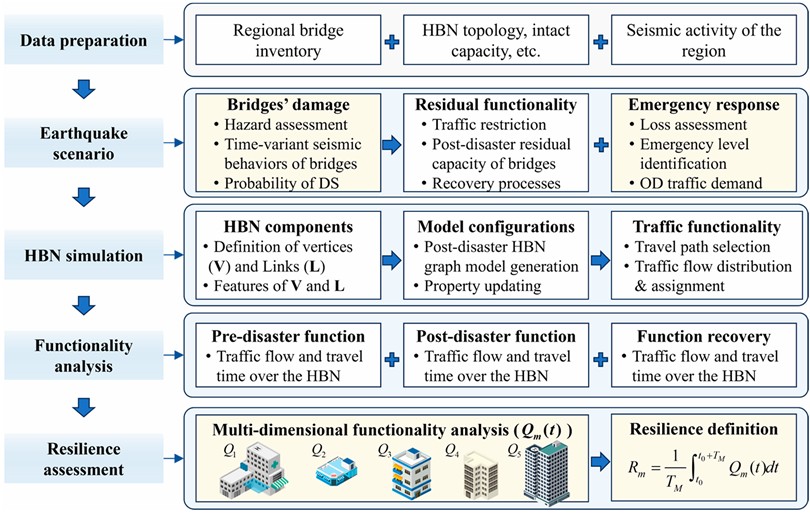
Bridge network resilience has gradually become a focus of research in recent years, particularly in seismically active regions. The resilience of a bridge network is of great significance for restoring the unimpeded flow of transportation lifelines and for the reconstruction of disaster-stricken areas after an earthquake. Bridge network resilience not only includes the seismic capacity of the bridge structures themselves but also involves the overall connectivity of the network and the distribution of traffic flow [52-54]. Therefore, many scholars have devoted themselves to the research and analysis of bridge network resilience. A decision-making framework for bridge network resilience, based on the concept of seismic disaster management, combines dual resilience metrics of network connectivity and traffic flow distribution. It effectively enhances the seismic resilience of the bridge network by optimizing post-earthquake repair sequences, pre-allocating resources, and implementing preventive seismic retrofitting [55]. Its advantage lies in its comprehensive multi-objective optimization strategy, which improves the network's seismic resilience from a macroscopic level. Chen et al., through an investigation of bridge damage in the Wenchuan earthquake, constructed a statistical model to assess the loss risk of the highway bridge system in that region during an earthquake [56]. Mostafa et al., using the PBEE and SMP frameworks combined with multi-hazard scenario analysis, proposed a new method for assessing bridge network resilience that can more accurately predict the functional recovery process of bridges after a disaster [57]. Ma et al. proposed an intelligent resilience analysis framework that considers multiple factors such as seismic hazard probability, bridge damage conditions, emergency response, and functional recovery for a comprehensive assessment of the post-earthquake resilience of highway bridge networks (HBNs) [58]. The flowchart and main modules of the framework are shown in Fig. 8.
These models and frameworks are suitable for post-earthquake decision support, providing a quantitative basis for the system-level risk management of bridges. However, they have high requirements for the volume of data and the quality of algorithm training, and face high technical barriers in data acquisition and complex system modeling. This may constrain their application in areas with incomplete information, and their universality and adaptability when applied to other regions still require verification.
5.3. Evaluation models based on intelligent algorithms
With the rapid development of intelligent algorithms and big data, an increasing number of experts and scholars are applying technologies such as intelligent models, digital twins, and big data to the assessment of bridge resilience to improve its accuracy and efficiency. Digital twin models can accurately simulate the nonlinear structural response of a bridge in a seismic sequence and are continuously updated through data fusion technology to reflect the actual state of the bridge [59]. A probabilistic assessment model for bridge components and the overall structure, based on the Generalized Bayesian method, has been used to evaluate the unknown parameters of the model by incorporating observational data [60], [61]. This method can more scientifically analyze the seismic vulnerability of reinforced concrete components and the entire bridge system. It allows for parameter updates based on limited observational data, thereby improving the credibility and adaptability of the model's results, making it one of the more scientific methods currently available. By applying machine learning algorithms to establish seismic prediction models for bridges, the post-earthquake reparability of bridges can be effectively assessed, enhancing the automation and efficiency of post-earthquake evaluations [62]. However, issues such as the poor interpretability of “black box” models and weak generalization capabilities still need to be addressed to achieve wider application in engineering practice.
Fig. 8Flowchart and main modules of the intelligent resilience analysis framework proposed by Ma et al.
With the development of structural health monitoring and computational capabilities, the application of intelligent algorithms in bridge seismic and disaster analysis has become increasingly sophisticated. Convolutional Neural Networks (CNN), due to their excellent spatial feature extraction capabilities, are widely used for bridge damage identification and condition assessment. For example, CNN models based on monitoring images or vibration signals can automatically identify typical damage features such as cracks and spalling, enabling the rapid assessment of post-earthquake bridge damage [63].
To address the time-varying characteristics of bridge response under seismic action, Long Short-Term Memory (LSTM) networks are used for predicting structural dynamic responses and for time-variant fragility analysis. LSTM can effectively capture the long-term dependencies in seismic response sequences, predicting the performance evolution trend of bridges under conditions of multiple aftershocks or continuous multi-hazard actions [64], [65].
In higher-level system analysis, Graph Neural Networks (GNN) and Bayesian networks are increasingly being used for bridge network-level risk assessment and optimized decision-making. GNN, by explicitly modeling the topological relationships between bridges, can assess the impact of a single bridge failure on the overall road network functionality [66]. Bayesian networks, on the other hand, characterize multi-factor uncertainties through probabilistic inference to quantitatively analyze bridge risks under the coupled effects of multiple hazards. These types of intelligent algorithms provide a new technological path for extending bridge seismic assessment from the individual structure level to the system level [67].
Table 3Comparison of seismic and multi-hazard assessment frameworks for bridges
No. | Framework / method | Quantitative indicators | Advantages | Limitations |
1 | Bayesian belief network-based resilience framework | Failure probability, resilience index | Explicit uncertainty modeling; suitable for multi-hazard coupling | Requires prior probability calibration; data-demanding |
2 | Nonlinear time-history-based fragility analysis | Demand-to-capacity ratio, fragility curves | High physical fidelity; widely accepted | Computationally expensive; single-Hazard focused |
3 | CNN-based damage identification framework | Classification accuracy, damage index | Fast post-earthquake assessment; strong pattern recognition | Requires large labeled datasets |
4 | LSTM-based time-varying vulnerability model | RMSE, time-dependent fragility | Captures temporal dependency; suitable for sequential hazards | Limited physical interpretability |
5 | Network-level seismic risk model using GNN | Network reliability, functional loss | Captures topological dependency; system-level assessment | Model complexity; high data requirements |
Data-driven fragility models based on Artificial Neural Networks (ANN) [8], [58] and deep learning approaches, by training the network model with a large amount of data on bridge structures and ground motions, enable the rapid prediction of post-earthquake damage to regional bridges. Such models generally exhibit high prediction accuracy and real-time performance, but they rely on a large volume of high-quality data and place higher demands on model training and interpretability. Data-driven fragility models based on Artificial Neural Networks (ANN) and deep learning methods, by training network models with a large amount of data on bridge structures and ground motions, enable the rapid prediction of post-earthquake damage to regional bridges. Such models generally exhibit high prediction accuracy and real-time performance but rely on a large volume of high-quality data and place higher demands on model training and interpretability. Data-driven models show a strong dependence on large, high-quality datasets, which are often unavailable for existing bridges or for rare extreme events. Current research often employs methods of data augmentation and multi-source fusion to mitigate the model bias caused by small sample sizes [68].
Furthermore, the limited interpretability of Black-Box models restricts their acceptance in engineering practice, where transparent decision-making and physical interpretability are essential. Hybrid methods that combine physics-based models with machine learning techniques, as well as eXplainable Artificial Intelligence (XAI) approaches, are increasingly recognized as promising solutions for balancing accuracy and interpretability. Introducing explainability techniques into the bridge resilience assessment framework can reveal the physical logic between input parameters (such as bridge geometry, materials, etc.) and the output (damage probability) [69]. The contribution of each structural attribute to seismic fragility can be globally quantified, and Partial Dependence Plots (PDP) can be used to distinguish the fragility characteristics of ductile seismic systems versus seismic isolation systems under different parameters [70].
Table 4 provides a comparative summary of some bridge resilience frameworks and evaluation models from existing research. Although numerous seismic resilience frameworks have made significant progress both in theory and practice, they still have shortcomings in practical application. Bridge resilience evaluation models need to comprehensively consider multiple dimensions, such as the structure's preventative, responsive, recoverable, and economic aspects. Existing research often focuses on a single or a few of these dimensions, lacking a framework that holistically integrates them.
Table 4Comparison of bridge resilience frameworks and evaluation models
No. | Framework / model name | Core components | Advantages | Disadvantages | Scope of application |
1 | The 4R framework (Robustness, Redundancy, Resourcefulness, Rapidity). | Four dimensions of resilience: robustness redundancy, resourcefulness, rapidity | Clearly structured, widely used, suitable for qualitative and semi-quantitative analyses | Difficult to quantify, highly subjective | Strategic level assessment, early programme design |
2 | Functionality curve (Functionality Curve) | Time-function relationship curves, indicators such as traffic flow rate, structural integrity, etc. | Can dynamically display the recovery process, suitable for post-disaster assessment. | Relies on a large amount of data, and the accuracy of assessment is limited by the quality of model inputs | Post-disaster recovery assessment, resilience evolution analysis |
3 | Life-Cycle Resilience Assessment Model (Life-Cycle Resilience Model) | Embedding resilience into bridge life Embedding resilience into all stages of bridge life cycle: design, operation, maintenance, and demolition. | Comprehensive consideration of the whole life cycle, strong long-term optimisation perspective | Large data requirements and complex modelling | High-grade bridge system design and assessment |
4 | System dynamics modelling (SDM) | Use causal feedback loop to model resilience influencing factors (e.g. resource allocation, traffic flow, policy support). (e.g. resource deployment, traffic flow, policy support) | Suitable for macro-level modelling and dynamic simulation of complex system behaviour. | High level of model abstraction makes it difficult to accurately quantify structural-level resilience | Resilience analysis of regional transport networks or bridge clusters. |
5 | Bayesian network-based bridge resilience evaluation models | Multi-source information fusion, probabilistic updating, modelling uncertainty (e.g. disaster probability, structural degradation, maintenance capability) | Uncertainty can be handled, suitable for integrating expert experience and data | High modelling cost, complex structure, relies on large amount of a priori knowledge | Oriented towards bridge analyses for multi-risk assessments or areas with little data |
6 | Performance-Based Resilience Assessment Modelling (Performance-Based Resilience) | Combines performance objectives (e.g., residual capacity, accessibility) with disaster scenarios to assess structural response and recovery. Response and recovery | Closely aligned with design guidelines and can be used directly in engineering evaluations | High modelling and simulation effort with multi-hazard simulation tools | New bridge design, seismic/hazard performance assessment |
7 | Multi-criteria Comprehensive Evaluation Models (MCDM, e.g. AHP, TOPSIS) | Integrated scoring of multi dimensional indicators, based on expert scores or historical data Establishment of weighting system | Convenient for decision support, suitable for multi objective comparative analysis | Strong subjectivity, high sensitivity of indicator selection and weighting | Project screening, multi option comparison |
Bridge resilience frameworks need to be able to dynamically adapt to different restoration environments and demands. While some studies have proposed optimization theories for phased processing, these theories often lack sufficient flexibility and real-time capability in practical applications, making it difficult to adapt to rapidly changing restoration needs. Furthermore, bridge resilience frameworks must demonstrate good adaptability when faced with different seismic environments, traffic flows, and network structures. In current research, the methods for analyzing the fragmented partitioning of bridge networks and prioritizing post-earthquake repairs are not yet mature enough to handle complex and variable real-world situations.
In future research, it is necessary to further refine the resilience assessment indicator system by considering more non-engineering factors, such as socioeconomic conditions and public earthquake awareness. Research on bridge resilience under the coupled effects of multiple hazards should also be strengthened, as earthquakes are often accompanied by other disasters like fires and floods, and the impact of these multi-hazard scenarios needs to be considered. Furthermore, a key direction for future research is how to effectively utilize the Internet and big data technologies, integrating resilience assessment with intelligent monitoring technologies to evaluate the health status of bridge networks in real-time and provide data support for resilience enhancement. Future studies should aim to further deepen the resilience assessment system, combining it with new technologies such as “Internet+” and “Artificial Intelligence” to improve the seismic intelligence and resilience of bridges.
6. Resilience influencing factors and assessment indexes
In recent years, many scholars have conducted extensive research on constructing resilience indicator evaluation systems, selecting various evaluation indicators and employing multiple evaluation methods. A resilience indicator evaluation system is established by selecting resilience indicators through the comprehensive consideration of factors such as the structure’s strength, deformation capacity, durability, and reparability. Commonly used resilience indicators include peak deformation, energy absorption capacity, residual strength, and residual stiffness [71]. The “4R” properties of resilience, with its main dimensions including Robustness, Redundancy, Resourcefulness, and Rapidity, provide a theoretical basis for the assessment and enhancement of bridge resilience [72]. Evaluation indicators based on strain energy have been used to deeply analyze the expressions of structural robustness, redundancy, and vulnerability, as well as the relationships among the three [73]. This provides a theoretical basis for quantifying the post-disaster load-bearing capacity of bridge structures and effectively enhances the scientific nature of structural-level resilience assessment.
The selection of indicators for bridge resilience assessment requires the comprehensive consideration of multiple factors, including the nature of the object being assessed (a single bridge or a bridge network), the type of hazard it faces, the availability of relevant data, and the specific objectives of the assessment. These factors collectively determine the focus of the assessment framework and the composition of the indicator system.
In practical applications, commonly used indicators for bridge resilience assessment primarily include robustness, redundancy, rapid recovery capability, adaptability, and the degree of functional maintenance. For a single-bridge assessment, the indicators typically focus on aspects such as structural performance, degree of damage, and the time and cost of repair. At the bridge network level, however, the assessment is more concerned with system attributes such as the maintenance of overall traffic functionality, the degree of redundancy of critical nodes and paths, systemic cascading reactions, and the capacity for regional traffic recovery.
Although the 4R framework (Robustness, Redundancy, Resourcefulness, and Rapidity) has been widely adopted for bridge resilience assessment, its practical interpretation and relative importance vary significantly across different bridge types and hazard scenarios. For example, for short- and medium-span girder bridges, robustness and rapidity dominate seismic resilience, as damage is often localized to bearings and piers, allowing relatively fast repair. In contrast, for long-span bridges (e.g., cable-stayed and suspension bridges), redundancy and resourcefulness play a more critical role due to strong system-level interactions and complex recovery logistics.
Moreover, under earthquake scenarios, robustness is mainly reflected in seismic capacity and ductility, whereas under flood or scour hazards, robustness is more closely related to foundation stability and hydraulic performance. Therefore, resilience assessment frameworks should be hazard- and bridge-type-specific rather than adopting a uniform 4R weighting scheme.
The focus shifts depending on the scenario: in a seismic context, structural dynamic performance and seismic response are emphasized, whereas in a flood scenario, pier scour risk and drainage capacity become more critical. The availability of data can also restrict the application of certain high-precision assessment methods, necessitating a trade-off between theoretical soundness and practical operability.
Table 5Trial range of bridge resilience indicators
Category | Indicator name | Applicable conditions and scope |
Structural performance | Residual load carrying capacity | Applicable to structural level assessment, especially in disaster situations such as earthquakes, explosions, etc. that cause structural damage; commonly used for individual bridges |
Ductility ratio | ||
Functional indicators | Accessibility (interruption or not) | Measures whether a bridge is still passable, applicable to traffic impact assessment, applicable to single bridges and bridge networks |
Rate of decline in capacity | ||
Time-related indicators | Recovery time | Mostly used to reflect the recovery process of the system, applicable to the scenarios where the function can be quantified (e.g. capacity, structural function), suitable for long-term analysis |
Recovery function curve | ||
Time integral of function loss | ||
Economic indicators | Direct/indirect economic loss | Applicable to projects with cost assessment needs, usually based on post-disaster reconstruction costs or economic impacts of traffic disruption. Usually based on post-disaster reconstruction costs or the economic impact of traffic disruption |
Repair costs | ||
Composite category | Resilience index | Suitable for integrated analyses across metrics, for multi objective decision support systems, for single bridges as well as networks. Suitable for multi-objective decision support systems, both for single bridges and networks |
Lifeline scoring method |
The construction of a bridge resilience assessment indicator system is typically based on multidisciplinary theories and methods. Its purpose is to comprehensively and systematically identify the key factors affecting bridge performance during extreme events, thereby enhancing the bridge system’s resistance and recovery capabilities when facing disasters. Commonly used methods in current research include bibliometric analysis, Work Breakdown Structure (WBS) theory, the Analytic Hierarchy Process (AHP), and the Fuzzy Analytic Hierarchy Process (FAHP). Taking a multi-span continuous rigid-frame bridge as the research object, Liang considered the constraints at the top of the rigid-frame piers, constructed a finite element model for nonlinear dynamic analysis, and analyzed the calculation methods for bridge damage indicators and their uncertainty [74]. Li et al. applied the Fuzzy Analytic Hierarchy Process method, building a hierarchical structure diagram for assessment and inspection and defining the weight allocation for the indicator and criterion layers and the corresponding judgment matrices, to construct a health assessment model for the in-service state of bridge bearings [75]. This method is suitable for the health assessment of the state of local bridge components and can provide targeted maintenance strategies. However, when faced with system-level disaster resilience assessment, it still lacks the capacity to respond to time-dynamic changes.
Currently, a combination of multiple methods is frequently used in research. An assessment method that combines WBS and FAHP first structurally decomposes the bridge system based on WBS theory to identify the constituent elements at different levels, and then utilizes FAHP to address the uncertainties and subjectivity inherent in the assessment process. Its advantage lies in its combination of systematicity and flexibility, which allows it to effectively capture the correlations among complex factors in bridge resilience assessment. A series of bridge resilience indicators includes system travel time resilience (), traffic distance resilience (), travel speed resilience index (), travel time resilience of important nodes (), travel distance resilience of important nodes (), resilience of nodes in a blocked thematic area (), and post-blockage system travel time resilience (). The Analytic Hierarchy Process (AHP) method is used to weight the importance of resilience indicators at different stages to comprehensively assess the resilience of the bridge network [8]. This type of method is suitable for the assessment of bridge systems at the transportation network level and can quantify the recovery of the system's operational capacity after a sudden event.
Time dimension indicators are a core component of bridge resilience assessment, used to dynamically measure the functional evolution process of a bridge or bridge system after being subjected to natural disasters or other sudden events. They not only focus on the time span from functional impairment to recovery but also reflect performance levels at different stages, including the rate of functional degradation, the ability to maintain minimum service capacity, and the efficiency and pathway of functional recovery. Through a systematic analysis of the time dimension, it is possible to comprehensively assess the adaptability, response capacity, and continuous service capability of a bridge during various post-disaster recovery phases. This, in turn, provides a basis for decision-making in the formulation of scientific emergency response and recovery strategies. Table 6 summarizes the relevant information on the more commonly used time dimension indicators.
Time-dimension indicators, such as recovery time and functional loss integral, are highly sensitive to assumptions regarding damage states, repair strategies, and resource availability. Empirical post-earthquake data indicate that even small variations in repair initiation time can lead to significant differences in resilience metrics [76].
The resilience index is more sensitive to early recovery delays than to the final recovery duration, emphasizing the importance of rapid emergency response in resilience-oriented bridge management. In recent years, for the restoration of missing data in structural health monitoring (SHM) systems, the research focus has shifted from simple mathematical interpolation to deeply mining the evolutionary patterns of the time dimension. In terms of the actual calculation of indicators, existing research increasingly relies on time parameters extracted from historical engineering experience. Quantifying the time dimension into multiple key stages (such as inspection, strengthening, and repair phases) and using these physically meaningful time nodes to define evolutionary indicators is more accurate than simple statistical smoothing [77]. This experience-based method of dividing the time dimension provides an important physical basis for determining the “vertical time dimension” trend term in SHM data imputation.
In the overall evaluation and optimization of the seismic performance of bridge systems, how to incorporate structural recovery capability and reflect resilience characteristics is currently an important research direction. Seismic safety and post-earthquake recovery capability are two important criteria for seismic assessment. In 2003, a framework for assessing the seismic resilience of bridges was first proposed, which included three complementary resilience metrics: probability of failure, consequences of failure, and recovery time [78]. Andrić et al. used fuzzy knowledge representation theory to define the basic seismic recovery parameters of a bridge, utilized the concepts of fuzzy measure theory to determine the seismic recovery index and seismic resilience function of the bridge, and modeled the recovery process of the bridge using fuzzy functions [79], with the hierarchical framework shown in Fig. 9. This research overcomes the difficulty of traditional quantitative models in handling uncertainty by proposing a recovery process modeling method based on fuzzy functions, which is more suitable for situations with limited data or incomplete information, possessing strong practicality and flexibility. However, it also has the problems of strong subjectivity in model parameter selection and difficulty in standardization.
Table 6Time dimension indicators
Indicator Name | Definition | Calculation method/expression | Applicable objects | Advantages | Limitations |
Recovery time | Time from loss of function after a disaster to recovery to a predetermined level of functioning | Can be estimated from field data, simulation or recovery function fitting | Suitable for both single bridge and network | Simple and intuitive for comparison | Ignores phase fluctuations in the recovery path |
Functional Recovery curve | Curve of function over time, usually expressed as area or integral of resilience. | Function value plotted against time | Suitable for single bridges and networks | Provides a complete picture of the recovery process | Requires more time series Supported by more time series data or fitted functions |
Loss of function time integral | Area of functional loss (product of degree of failure and time), used to measure total loss of function | Applicable for both single bridge and network | Combined loss intensity and time | Weaker interpretability than RT and function curves | |
Resilience index | Ratio of actual function to maximum function at a certain time after a disaster, reflecting the system’s Overall function maintenance level | Commonly used in bridge networks or regional transport systems | Easily compared between different systems | Sensitive to high-frequency fluctuations, dependent on functional definitions Definition | |
70 % recovery time / 90 % recovery time equi-quantile recovery metrics | Time to recover system function to a specific percentage (e.g., 90 %) (e.g. 90 %) | Determination of the corresponding time point based on the recovery curve | More commonly used in practice, especially in traffic bridge assessments | Specific recovery goals are defined | Does not reflect the full recovery process, only focuses on critical points Boundary points |
Later, some scholars, proceeding from the two major attributes of bridge resistance and recovery capability, constructed eight bridge resilience evaluation indicators that include social factors. They used the entropy weight method and the TOPSIS method to conduct a more comprehensive assessment of bridge resilience and established a bridge resilience assessment model [51]. This expanded the resilience evaluation of bridges from the level of structural performance to the level of social impact, reflecting the trend towards diversification in the bridge resilience assessment indicator system.
In subsequent research, other scholars discovered that the maximum displacement and residual displacement at the top of the pier can effectively reflect the damage condition of the components and the residual load-bearing capacity of the bridge, and thus can be used as performance indicators to measure the structural safety and post-earthquake functionality of the bridge [80]. This finding provides a quantifiable basis for the rapid post-earthquake assessment of bridges, but its accuracy still depends on the reasonable selection of ground motion input parameters and the deployment level of sensing technology. Mackie and Stojadinovic pointed out that selecting period-dependent spectral parameters, such as spectral acceleration and spectral displacement, as the ground motion intensity measures for the probabilistic response model of the seismic resilience of multi-span bridges can effectively reduce the uncertainty of the model [81]. It provides an important direction for improving the accuracy of resilience assessment, especially by setting clear requirements for the rationality of ground motion input during the design and assessment stages. An used the inter-story drift angle as a basic evaluation parameter and defined the residual seismic capacity of the structure as a performance indicator. The study focused on exploring the correlation characteristics between the seismic recovery capability parameter and the anti-collapse safety factor to assess the residual seismic capacity of the bridge [82]. It broadened the research perspective of bridge seismic resilience from “resistance” to “recovery,” inspiring researchers to pay more attention to the degree of structural performance retention after a disaster in resilience design. In particular, the defining criteria for recovery capability indicators still require further in-depth research.
Fig. 9Hierarchical framework for seismic resilience assessment of bridges
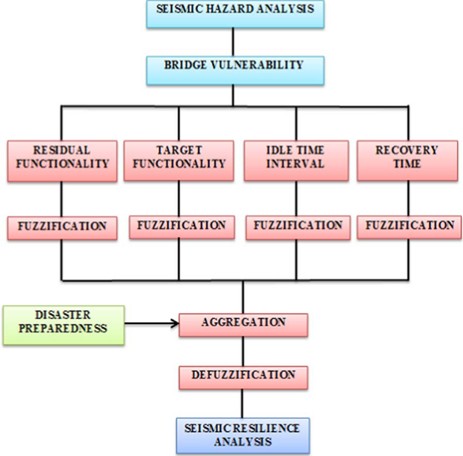
Seismic ground motion input is a crucial factor in the assessment and design of structural seismic performance. The ground motion input is influenced by multiple factors, including magnitude, epicentral distance, source type, input angle, and excitation method, exhibiting significant randomness [83]. The combined effect of these multiple factors greatly increases the uncertainty of the ground motion input. By using a 3D spatially varying ground motion simulation method, it is possible to consider the impact of different site conditions on the time-variant fragility of offshore bridges and to analyze the influence of local site conditions on ground motion input and bridge seismic resilience [84]. Spatially varying ground motion can exacerbate the seismic response of bridges, an effect that is particularly significant for long-span bridges [85]. The aforementioned studies all emphasize the non-negligible potential impact of the spatial variability of ground motion on the integrity of the structural system. Especially when conducting a phased analysis of resilience, traditional single-point ground motion input methods are insufficient for fully revealing system vulnerability, and site response analysis should become a part of the standard procedure. A large body of research has found that the direction of seismic excitation has a significant impact on the tangential fragility of components such as bridge piers and bearings. When analyzing the seismic performance of isolated curved girder bridges, attention must be paid to the effect of multi-directional seismic excitation on structural vulnerability [86], [87].
The attenuation pattern of seismic waves along their propagation path is also comprehensively affected by multiple factors such as geology and topography. Under different geological conditions, the propagation velocity and amplitude attenuation patterns of seismic waves vary, which leads to significant differences in the ground motion characteristics of an earthquake with the same magnitude and epicentral distance at different locations. The importance of the traveling wave effect in the dynamic response of bridges cannot be ignored. When conducting seismic resilience analysis of long-span bridge structures, the spatial variability effect of ground motion should be emphasized, and the influence of various factors should be accurately assessed. Simply considering traveling wave propagation can lead to a significant underestimation of the seismic response of the substructure [88]. The time resilience indicator for a highway bridge network coping with a level-III EISE, R2b( III), and the network traffic time resilience indicator after a post-earthquake level-III sudden disaster, R2t( III), increase with the intensity of the ground motion and decrease with an increase in epicentral distance, reflecting the dynamic characteristics of network-level bridge resilience [89].
Table 7Spatial variability of ground shaking working conditions [88]
Working condition | Site type | Travelling wave velocity / (m·s-1) | Degree of coherence loss |
1 | FFFF | infinite | None |
2 | FFFF | 500 | None |
3 | FFFF | infinite | Medium |
4 | FFFF | 500 | Medium |
5 | FMMF | 500 | Medium |
6 | FSSF | 500 | Medium |
7 | FFFF | 250 | Medium |
8 | FFFF | 1000 | Medium |
9 | FFFF | 500 | Low |
10 | FFFF | 500 | High |
Table 8Peak response of bridge abutment under multi-point multi-dimensional ground vibration [88]
Calculation conditions | 2#Abutment | 3#Abutment | ||||
Shear force/MN | Bending moment / (MN·m) | Displacement / m | Shear force / MN | Bending moment / (MN·m) | Displacement / m | |
Consistent excitation | 380.641 | 285.262 | 0.182 | 402.244 | 429.243 | 0.184 |
Travelling wave effect only | 130.215 | 124.308 | 0.168 | 124.670 | 377.329 | 0.164 |
Loss of correlation only | 323.037 | 202.167 | 0.173 | 394.313 | 418.430 | 0.168 |
Non-aligned incentives | 302.871 | 173.473 | 0.171 | 310.209 | 357.471 | 0.175 |
In bridge resilience assessment, in addition to seismic safety and post-earthquake recovery capability, it is also necessary to comprehensively consider important indicators such as the bridge's design service life, age, lifespan, and design flood level. These indicators not only affect a bridge's performance during an earthquake but also determine its reliability and maintenance needs over the long term.
The inter-criteria correlation (CRITIC) method is a technique for calculating the weights of criteria, and its specific research methodology is shown in Fig. 10. The CRITIC method can be used to effectively determine the weight coefficients of evaluation indicators; the standards considered include the bridge’s age, area, design high flood level (HFL), finished road level (FRL), and bridge resilience index (BRI) [90]. Research on the interaction among bridge infrastructure resilience parameters has shown that lifespan is the most critical reliability factor in the outcome group, while the pier is the most important parameter among the influencing factors. In the causal factors group, structural importance and resource availability are key recovery parameters, while maintenance is crucial in the effect group [91]. Research on the seismic resilience of long-span CFST arch bridges indicates that repair duration is the core parameter determining the overall resilience level of the structure, and components that significantly impact the repair cycle should be the focus of investigation [92]. By assessing and comparing the seismic resilience of bridges at different construction stages, the influence mechanism of repair delays on the recovery of seismic performance has been studied. As the Peak Ground Acceleration (PGA) increases, the functional loss of the system increases, while the system's functionality and resilience index decrease. There are significant differences in the seismic resilience of bridges at different construction stages; specifically, during the substructure construction phase, there is greater seismic safety redundancy, whereas at the mid-span closure or overall completion stages, the seismic resilience is relatively weaker. The delayed recovery period has a direct and significant impact on the resilience index, and therefore, this factor should be considered during the resilience assessment process [93].
Fig. 10CRITIC method Research methodology [90]
![CRITIC method Research methodology [90]](https://static-01.extrica.com/articles/25582/25582-img12.jpg)
The assessment of an individual bridge typically focuses on structural-level parameters and material properties, such as the seismic performance of components, redundancy, damage tolerance, and the durability of the materials used, in order to evaluate its load-bearing capacity and recovery potential after being damaged. At the bridge network level, however, the assessment relies more on comprehensive analysis methods based on big data, with a focus on traffic flow, the spatial layout of the bridges, network connectivity, the travel behavior patterns of users, and their impact on the functionality of the overall transportation system. Bridge network resilience emphasizes the ability of the entire transportation system to maintain its service capacity and recover quickly in the event of localized bridge damage. Therefore, it places a greater emphasis on multi-source data fusion and dynamic modeling analysis from a systemic perspective.
Table 9Selection of resilience indicators for single bridges and bridge networks
Evaluation dimension | Individual bridge | Bridge network |
Focus | Structural integrity | System connectivity |
Maintenance of function | Overall accessibility | |
Resilience | Critical node impact | |
Common metrics | Carrying capacity residual | Network efficiency (e.g. Average shortest path) |
Passability | Network resilience index | |
Recovery time | Traffic flow recovery ratio | |
Applicable scenarios | Bridge design optimisation | Urban/regional transport system assessment |
Post-disaster reconstruction prioritisation | Emergency response strategy development | |
Risk Assessment | Critical bridge identification |
Traffic volume is also an important functional indicator that affects bridge resilience. An increase in traffic volume can significantly reduce the reliability index of a bridge, leading to a higher probability of failure and increased maintenance costs [94-96]. Therefore, for bridges that have been built and are in use, it is particularly important to use traffic volume as an indicator for resilience assessment and as a basis for formulating maintenance strategies. Moreover, after an earthquake, sudden changes in traffic volume have a direct impact on the speed and degree of the bridge's functional recovery.
The continuous growth of traffic volume has a significant impact on the safety level of long-span bridges. A prediction model for the extreme value of vehicle-induced effects, which considers the interval changes in traffic volume, highlights the direct influence of traffic volume fluctuations on the extreme values of bridge loads. This allows for a better assessment of the impact of traffic volume growth on bridge safety and is suitable for risk prediction and durability assessment during the bridge design stage [97]. To accurately obtain the probability distribution characteristics of vehicle-induced effects on bridges, a non-stationary extreme value model has been developed. This model, which considers the influence of traffic volume growth, achieves extreme value inference for the load effects of random traffic flow based on the AGPD model [98]. The functional recovery of a bridge can be evaluated by analyzing the traffic volume it carries. Especially after a disaster event such as an earthquake, the traffic-carrying capacity of a bridge is significantly affected, and the recovery of traffic volume directly reflects the bridge's service capacity in the post-disaster period [2]. Using traffic volume as an important quantitative indicator for the functional recovery of a bridge can enhance the targeted nature of post-disaster recovery strategies. However, this method still needs to be combined with dynamic factors such as traffic guidance and travel demand to form a more systematic assessment framework.
The aforementioned methods that use traffic volume as a key indicator for resilience assessment have significant limitations. In practical application, these assessment methods have high requirements for the completeness and accuracy of traffic data. The parameter fitting and validation of the models rely on a large amount of long-term monitoring data, which is often difficult to achieve for newly constructed bridges or existing bridges with inadequate monitoring facilities. Existing research on the impact of traffic volume on bridge resilience primarily focuses on bridges that are already built and in service, while there is relatively little research on the seismic resilience of bridges under construction. Future research should further strengthen the focus on the seismic resilience of bridges under construction, while also conducting in-depth investigations into the mechanisms by which changes in traffic volume affect the recovery of bridge resilience, in order to enhance the seismic performance and post-disaster recovery capability of bridges throughout their entire life cycle.
Current bridge resilience assessment indicator systems do not yet cover all important aspects, such as social, economic, and environmental factors. Although some scholars have established bridge resilience evaluation systems that integrate social factors from the dual dimensions of resistance and recovery capability, problems of incomplete coverage may still exist. The seismic safety and post-earthquake recovery capability of bridges are two important aspects of bridge resilience assessment. By comprehensively considering the seismic performance and post-disaster recovery capability of the structure, it is possible to reduce the socioeconomic losses from seismic disasters and improve the seismic resilience of the bridge system. Future research directions include developing more structural systems with post-earthquake recoverable functions, establishing more accurate ground motion input models by integrating multidisciplinary knowledge, and optimizing post-disaster recovery strategies for infrastructure systems.
7. Main problems and future development trends
(1) Improve the standard system for bridge seismic resilience assessment. The existing standards for bridge seismic resilience assessment are not yet perfect, lacking systematic and unified standards to guide design, construction, operation and maintenance, and post-disaster recovery. Current standards mostly focus on the seismic performance of individual bridges and lack a holistic assessment method for the resilience of bridge network systems. Furthermore, existing standards face significant difficulties in quantifying resilience indicators, making it hard to comprehensively cover the resilience requirements under different disaster types and the diversified demands placed on bridge systems. Future research should focus on: 1) Establishing a unified evaluation framework for bridge seismic resilience that covers multi-scale assessment needs, from a single bridge to a regional transportation network; 2) Constructing a resilience assessment indicator system and grading standards for different disaster types (e.g., earthquakes, wind disasters, floods); 3) Developing highly operable and widely adaptable technical guidelines for bridge resilience assessment to guide the management of bridge resilience throughout its entire life cycle in engineering practice.
(2) Promote the deep integration of intelligent technologies in bridge seismic resilience research. With the rapid development of computer and network technologies, advanced technologies such as satellite remote sensing, artificial intelligence, machine learning, digital twins, big data, and cloud computing are gradually being applied in bridge seismic research. However, the application of these technologies in bridge seismic research is still in its developmental stage, and the potential of intelligent technologies in data acquisition, state identification, performance prediction, and rapid assessment has not yet been fully realized. In the future, it is necessary to more closely integrate intelligent technologies with the development of bridge seismic resilience, leveraging these technologies to more conveniently, quickly, and efficiently ensure the seismic performance of bridges during their design, operation, and post-earthquake repair phases. This will enhance the efficiency and accuracy of bridge seismic research and make seismic resilience assessment more convenient and intelligent.
Future research should focus on: 1) Constructing an intelligent perception system for bridge resilience based on multi-source heterogeneous data to achieve real-time monitoring and risk warning of the bridge’s state; 2) Developing artificial intelligence-based models for seismic performance analysis and damage identification to improve rapid post-disaster assessment and decision support capabilities; 3) Promoting the application of digital twin technology in the design, construction, and maintenance of bridges to achieve the integration, visualization, and intellectualization of resilience design and management, thereby enhancing the comprehensive resilience level of bridges in the pre-earthquake warning, co-seismic response, and post-earthquake recovery stages.
The models already utilized in existing research have high requirements for the completeness and accuracy of traffic data in practical applications, posing certain application barriers in regions with limited traffic information acquisition capabilities or imperfect monitoring systems. How to maintain the reliability and stability of these models in the presence of incomplete or noisy data is a pressing issue that future research needs to address.
Subsequent research could explore combining these models with time-series analysis methods such as Dynamic Bayesian Networks and Long Short-Term Memory (LSTM) networks to enhance their ability to capture the evolutionary patterns of traffic states and to improve the prediction accuracy and adaptability of the traffic function recovery process following sudden events. The fusion of multi-source sensory data and the introduction of online learning mechanisms could be explored to enhance the model's response speed, update capability, and practicality in real-world engineering environments. Furthermore, the deep coupling of structural mechanics models and transportation system models should be promoted, establishing an integrated modeling framework that extends from “structural load response” to “changes in traffic operational state” and further to “assessment of traffic functional recovery,” in order to achieve a more comprehensive and multi-dimensional characterization of bridge resilience.
(3) Establish comprehensive resilience assessment and enhancement strategies applicable to existing bridges. The current assessment systems for bridge seismic resilience still primarily serve idealized models, lacking a life-cycle assessment framework specifically for existing bridges, especially girder bridges. Faced with the impacts of factors such as material aging, load growth, and environmental degradation, the resilience assessment of existing bridges faces significant challenges. Future research should focus on the following directions: 1) Establishing resilience evaluation models that consider the influence of multiple factors such as material degradation, structural fatigue, and the evolution of functional demands; 2) Constructing multi-dimensional performance degradation databases and assessment algorithms applicable to existing bridges; 3) Developing retrofitting strategies and seismic design modification theories oriented towards performance enhancement, such as local strengthening design based on resilience requirements and the optimization and reconfiguration of structural systems, to extend the service life of existing bridges and enhance their post-disaster recovery capabilities.
(4) Strengthen bridge resilience assessment and design theory under multi-hazard coupling scenarios. The coupling effect of multiple hazards places higher resilience demands on bridge structures, yet current research in this area is still in its nascent stage, with immature assessment methods and theoretical systems, facing numerous challenges. When confronted with the combined effects of various disasters such as earthquakes, floods, windstorms, and fires, the damage modes and functional degradation processes of bridge structures become more complex, and traditional single-hazard assessment methods are no longer sufficient to meet practical needs. The assessment of bridge resilience under the coupling effect of multiple hazards will become a key direction for future research, with a potential focus on the following three aspects: 1) Establish a theoretical framework and numerical simulation methods for bridge resilience assessment under the coupling effect of multiple hazards; 2) Develop technologies for bridge damage identification, functional recovery, and optimized resource allocation oriented towards compound disasters; 3) Explore strategies for enhancing bridge resilience based on multi-hazard scenarios, such as collaborative protection design against multiple types of disasters and multi-objective optimization for retrofitting solutions, in order to achieve the rapid recovery and functional maintenance of bridge systems in complex disaster environments.
(5) In bridge resilience assessment, the quantitative integration of socioeconomic and environmental factors is of great significance for reflecting the real-world impacts of bridge failure. Socioeconomic factors are typically characterized from three levels: transportation functionality, economic loss, and social impact. Transportation functionality can be quantified by indicators such as average daily traffic, road network hierarchy, and detour distance or time. Economic impact comprehensively considers post-disaster repair costs and indirect economic losses caused by traffic disruption. Social impact mainly reflects the importance of the bridge to the regional service population and emergency access capability, often using a rating scale with normalization. Environmental factors focus on the ecological and resource costs during the post-disaster recovery process, including carbon emissions during the repair phase, material and energy consumption, and the degree of disturbance to the surrounding ecosystem; these indicators are usually quantified based on the results of Life Cycle Assessment or Environmental Impact Assessment. To address the issues of different indicator dimensions and varying levels of importance, methods such as the Analytic Hierarchy Process, the Entropy Weight Method, or combined weighting methods are commonly used in research to determine weights, and a comprehensive socioeconomic and environmental impact index is constructed through linear weighting. The aforementioned factors are typically coupled with structural and functional resilience, either as weights for functional loss or as independent sub-indicators, thereby forming a more comprehensive bridge resilience evaluation system that aligns with the needs of practical engineering decision-making.
References
-
S. L. Pimm, “The complexity and stability of ecosystems,” Nature, Vol. 307, No. 5949, pp. 321–326, Jan. 1984, https://doi.org/10.1038/307321a0
-
A. Decò, P. Bocchini, and D. M. Frangopol, “A probabilistic approach for the prediction of seismic resilience of bridges,” Earthquake Engineering and Structural Dynamics, Vol. 42, No. 10, pp. 1469–1487, 2013, https://doi.org/10.1002/eqe.2282
-
A. Martínez, M. A. Hube, and K. M. Rollins, “Analytical fragility curves for non-skewed highway bridges in Chile,” Engineering Structures, Vol. 141, pp. 530–542, Jun. 2017, https://doi.org/10.1016/j.engstruct.2017.03.041
-
M. D. Nezhad, R. Raoufi, and A. Dalvand, “A network-based importance measurement index for bridge security risk assessment and prioritisation,” The Baltic Journal of Road and Bridge Engineering, Vol. 17, No. 1, pp. 1–30, Mar. 2022, https://doi.org/10.7250/bjrbe.2022-17.549
-
N. I. Basöz and A. S. Kiremidjian, “Evaluation of bridge damage data from the Loma Prieta and Northridge, California earthquakes,” 1998.
-
J. T. Hewes, “Seismic design and performance of precast concrete segmental bridge columns,” University of California, San Diego, 2002.
-
Y. Dong and D. M. Frangopol, “Risk and resilience assessment of bridges under mainshock and aftershocks incorporating uncertainties,” Engineering Structures, Vol. 83, pp. 198–208, Jan. 2015, https://doi.org/10.1016/j.engstruct.2014.10.050
-
Z. Liu, S. Li, A. Guo, and H. Li, “Comprehensive functional resilience assessment methodology for bridge networks using data-driven fragility models,” Soil Dynamics and Earthquake Engineering, Vol. 159, p. 107326, Aug. 2022, https://doi.org/10.1016/j.soildyn.2022.107326
-
Z. Feng et al., “Shaking table test of time-history response of bridge pile foundation near fault in strong earthquake area,” Advanced Engineering Sciences, Vol. 55, No. 6, pp. 66–77, 2023.
-
Y.-L. Zhou, Q. Han, X.-L. Du, and Z.-L. Jia, “Shaking table tests of post-tensioned rocking bridge with double-column bents,” Journal of Bridge Engineering, Vol. 24, No. 8, p. 04019080, 2019, https://doi.org/10.1061/(asce)be.1943-5592.0001456
-
J. Niu, S. Zhang, L. Zhang, J. Zhang, and X. Jiang, “Seismic response and failure mode of a shallow overburden slope reinforced with an ecological frame beam structure,” Ecological Engineering, Vol. 222, p. 107795, Jan. 2026, https://doi.org/10.1016/j.ecoleng.2025.107795
-
E. Cernuto, A. Vitaletti, and D. Salciarini, “Effect of the relative bridge-landslide orientation on the seismic behaviour of a bridge,” Soil Dynamics and Earthquake Engineering, Vol. 200, p. 109899, Jan. 2026, https://doi.org/10.1016/j.soildyn.2025.109899
-
X. Zhu, “Application of a high-speed high-precision optical sensor technology in bridge monitoring,” Shandong University, 2012.
-
Cao Wei and Xu Yichao, “Design of bridge structure health monitoring data collection system based on LabVIEW,” (in Chinese), Engineering Technology Research, 2020, https://doi.org/10.19537/j.cnki.2096-2789.2020.18.095
-
Y. Takahashi, H. Maeda, and M. Hayashi, “Development of metabolic seismic columns to be able to replace plastic hinge under gravity load,” in 17th World Conference on Earthquake Engineering, 2021.
-
B. B. Soneji and R. S. Jangid, “Effectiveness of seismic isolation for cable-stayed bridges,” International Journal of Structural Stability and Dynamics, Vol. 6, No. 1, pp. 77–96, Nov. 2011, https://doi.org/10.1142/s0219455406001836
-
S. N. Madhekar and R. S. Jangid, “Variable dampers for earthquake protection of benchmark highway bridges,” Smart Materials and Structures, Vol. 18, No. 11, p. 115011, Nov. 2009, https://doi.org/10.1088/0964-1726/18/11/115011
-
Yuen T. Yp et al., “Effect of prestress loss on seismic vulnerability of post – tensioned precast concrete segmental bridge,” 17th World Conference on Earthquake Engineering, 2021.
-
S. Kim, Y. Yang, and D. M. Frangopol, “Optimum seismic retrofit of deteriorating RC bridge columns based on risk, cost-benefit, and real option analyses,” ASCE-ASME Journal of Risk and Uncertainty in Engineering Systems, Part A: Civil Engineering, Vol. 10, No. 3, p. 04024043, Sep. 2024, https://doi.org/10.1061/ajrua6.rueng-1290
-
J. Dong et al., “Seismic vulnerability analysis of bridge structures using Bayesian estimation,” (in Chinese), Journal of Harbin Institute of Technology, Vol. 53, No. 9, p. 88, 2021, https://doi.org/10.11918/202004083
-
K. Xie et al., “Pushover analysis method for long-span stiff skeleton arch bridge,” Railway Engineering, Vol. 9, p. 062, 2022.
-
Z. Shi, Y. Liang, Y. Cao, and J. Yan, “Time-variant seismic fragility of offshore continuous beam bridges based on collapse analysis,” Applied Sciences, Vol. 10, No. 23, p. 8595, Nov. 2020, https://doi.org/10.3390/app10238595
-
G. Weiyou, G. Weizuo, A. Yiliyar, and L. Yubei, “Fuzzy-based time-dependent seismic resilience assessment of curved bridge portfolios: A case study in Sichuan, China,” Structures, Vol. 79, p. 109549, Sep. 2025, https://doi.org/10.1016/j.istruc.2025.109549
-
Q. Zhao, “The optimization design of highway bridge seismic performance based on non-linear finite element analysis,” Engineering Technology Research, Vol. 9, No. 15, pp. 195–197, 2024.
-
G. Wu et al., “Transverse seismic response analysis of small and medium-span highway bridges in service considering time-varying characteristics of materials,” Technology for Earthquake Disaster Prevention, Vol. 19, No. 3, pp. 536–547, 2024.
-
Q. Han et al., “Integral FEM for seismic response analysis of long-span arch bridge and its application,” Journal of Beijing University of Technology, Vol. 50, No. 12, pp. 1448–1457, 2024.
-
Z. Zhu et al., “Local stress analysis of railway steel truss bridge based on co-simulation method,” Journal of the China Railway Society, Vol. 43, No. 7, pp. 144–152, 2021.
-
F. Zhang, “Multi-scale modeling method of bridge structure and its application,” North China University of Water Resources and Electric Power, 2021.
-
Z. Li et al., “Multi-scale perspective bridge damage detection and service performance evaluation research: A Review,” Journal of Civil and Environmental Engineering, pp. 1–17, May 2025.
-
Q. Han et al., “Seismic performance analysis of spatial Y-shaped arch bridge based on multi-scale model,” (in Chinese), World Earthquake Engineering, Vol. 39, No. 3, pp. 183–193, 2023, https://doi.org/10.19994/j.cnki.wee.2023.0064
-
X. Wu et al., “Seismic risk assessment of large-span Y-shaped steel box ribbed arch bridge,” Highway, Vol. 68, No. 4, pp. 108–113, 2023.
-
J. Xu, “Research on bridge damage under the coupling effect of shock wave and fragment,” Xi’an University of Technology, 2023.
-
D. Wu, B. Liang, and Y. Xiong, “Seismic performance of modular steel structure with X-shaped rubber bearings: Shaking table tests,” Advances in Structural Engineering, Vol. 28, No. 8, pp. 1461–1475, Dec. 2024, https://doi.org/10.1177/13694332241307722
-
Z.-Q. Yuan, Z.-C. Wang, X.-C. Kuang, Y. Xin, and Y.-J. Ding, “Probabilistic parameter estimation and reliability assessment of nonlinear structures based on generative adversarial networks with Gaussian process regression,” Journal of Civil Structural Health Monitoring, Vol. 15, No. 5, pp. 1349–1367, Dec. 2024, https://doi.org/10.1007/s13349-024-00887-6
-
X. Lu, “Numerical simulation and experimental study of acoustic elastic effect in steel strand,” Chongqing Jiaotong University, 2020.
-
X. Zhang et al., “Numerical simulation and experimental study of aerodynamic interference on adjacent three separated deck bridge,” Journal of South China University of Technology (Natural Science Edition), Vol. 49, No. 12, pp. 101–112, 2021.
-
X. Wu et al., “An evaluation method of safety resilience for highway bridge engineering based on an entropy weight and improved TOPSIS model,” Traffic Information and Safety, Vol. 42, No. 3, pp. 139–147, 2024.
-
“Review on China’s bridge engineering research: 2024,” (in Chinese), China Journal of Highway and Transport, Vol. 37, No. 12, pp. 1–160, Dec. 2024, https://doi.org/10.19721/j.cnki.1001-7372.2024.12.001
-
Y. Li, “Methodology for assessing life-cycle seismic resilience of structures,” Guangzhou University, 2023.
-
C. Zou, “Seismic resilience enhancement and evaluation of railway simply-supported girder bridges near faults,” Chongqing Jiaotong University, 2023.
-
M. Bruneau and X. Wei, “Experimental performance of buckling restrained braces subjected to bidirectional displacement histories,” in 16th World Conference on Earthquake Engineering (16WCEE), pp. 9–13, 2017.
-
L. Zhou, X. Wu, X. Wang, and A. Ye, “Seismic resilience assessment of unbonded laminated rubber bearing supported highway bridges considering high variability of residual displacement,” Structure and Infrastructure Engineering, Vol. 54, No. 6, pp. 1–16, 2025, https://doi.org/10.1080/15732479.2025.2598802
-
P. Fu, X. Li, L. Xu, and M. Wang, “An advanced assessment framework for seismic resilience of railway continuous girder bridge with multiple spans considering 72h golden rescue requirements,” Soil Dynamics and Earthquake Engineering, Vol. 177, p. 108370, Feb. 2024, https://doi.org/10.1016/j.soildyn.2023.108370
-
V. H. Lad, D. A. Patel, K. A. Chauhan, and K. A. Patel, “Data envelopment analysis for efficiency measurement of bridge resilience,” The Baltic Journal of Road and Bridge Engineering, Vol. 17, No. 4, pp. 189–212, Dec. 2022, https://doi.org/10.7250/bjrbe.2022-17.585
-
S. Banerjee, B. S. Vishwanath, and D. K. Devendiran, “Multihazard resilience of highway bridges and bridge networks: A review,” Structure and Infrastructure Engineering, Vol. 15, No. 12, pp. 1694–1714, Dec. 2019, https://doi.org/10.1080/15732479.2019.1648526
-
Z. Kou and N. Li, “Study on earthquake resilience analysis and optimization for urban bridge network system based on NSGA-II algorithm,” Engineering Mechanics, Vol. 38, No. 3, pp. 148–158+180, 2021.
-
J. Ren, J. Song, and B. R. Ellingwood, “Reliability assessment framework of deteriorating reinforced concrete bridges subjected to earthquake and pier scour,” Engineering Structures, Vol. 239, p. 112363, Jul. 2021, https://doi.org/10.1016/j.engstruct.2021.112363
-
P. Gehl and D. D. ’Ayala, “System loss assessment of bridge networks accounting for multi-hazard interactions,” Structure and Infrastructure Engineering, Vol. 14, No. 10, pp. 1355–1371, Oct. 2018, https://doi.org/10.1080/15732479.2018.1434671
-
S. Biazar, S. Kameshwar, and G. P. Balomenos, “Multi-hazard fragility modeling framework for bridges with shallow foundations subjected to earthquake, scour, and vehicular loading,” Soil Dynamics and Earthquake Engineering, Vol. 178, p. 108482, Mar. 2024, https://doi.org/10.1016/j.soildyn.2024.108482
-
K. Zhang, Z. Wang, T. Wang, J. Tian, H. Zhang, and Y. Liu, “Numerical simulation of flow field deposition and erosion characteristics around bridge-road transition section,” Journal of Mountain Science, Vol. 21, No. 5, pp. 1491–1508, Jun. 2024, https://doi.org/10.1007/s11629-023-8492-9
-
X. Chen et al., “Multi-criteria decision method for bridge resilience assessment in BIM and GIS data environment,” (in Chinese), Journal of Engineering Management, Vol. 35, No. 6, pp. 61–66, Jun. 2021, https://doi.org/10.13991/j.cnki.jem.2021.06.011
-
J. Zhao, M. Liang, Z. Zhang, X. Cao, Q. Lu, and Z. Cai, “Post-disaster resilience optimization for road-bridge transportation systems considering economic loss,” Sustainability, Vol. 15, No. 19, p. 14380, Sep. 2023, https://doi.org/10.3390/su151914380
-
Y.-J. Lee and S. Yoon, “A surrogate model-based framework for seismic resilience estimation of bridge transportation networks,” (in Korean), Smart Structures and Systems, Vol. 32, No. 1, pp. 49–59, Jan. 2023, https://doi.org/10.12989/sss.2023.32.1.049
-
M. Mogheisi, H. Tavakoli, and E. Peyghaleh, “Probability assessment of the seismic risk of highway bridges with various structural systems (case study: Tehran City),” Sustainability, Vol. 15, No. 12, p. 9783, Jun. 2023, https://doi.org/10.3390/su15129783
-
W. Zhang et al., “A decision framework for improving bridge network resilience based on earthquake disaster management,” (in Chinese), China Civil Engineering Journal, Vol. 56, No. 4, pp. 72–82, Apr. 2023, https://doi.org/10.15951/j.tmgcxb.21121231
-
L. Chen et al., “Analytical investigation of bridge seismic vulnerability in Wenchuan earthquake,” Journal of Southwest Jiaotong University, Vol. 47, No. 4, pp. 558–566, 2012.
-
M. Badroddin and A. Muntasir Billah, “Multi-state functionality restoration of highway bridges using stochastic process,” Engineering Structures, Vol. 293, p. 116623, Oct. 2023, https://doi.org/10.1016/j.engstruct.2023.116623
-
L. Ma, C. Zhang, X. Liu, K. Fang, and Z. Liu, “Rapid emergency response resilience assessment of highway bridge networks under moderate earthquakes,” Sustainability, Vol. 16, No. 13, p. 5491, Jun. 2024, https://doi.org/10.3390/su16135491
-
K. Lin, Y.-L. Xu, X. Lu, Z. Guan, and J. Li, “Digital twin-based life-cycle seismic performance assessment of a long-span cable-stayed bridge,” Bulletin of Earthquake Engineering, Vol. 21, No. 2, pp. 1203–1227, Dec. 2022, https://doi.org/10.1007/s10518-022-01567-w
-
P. Gardoni, A. der Kiureghian, and K. M. Mosalam, “Probabilistic capacity models and fragility estimates for reinforced concrete columns based on experimental observations,” Journal of Engineering Mechanics, Vol. 128, No. 10, pp. 1024–1038, Oct. 2002, https://doi.org/10.1061/(asce)0733-9399(2002)128:10(1024)
-
P. Gardoni, K. M. Mosalam, and A. Kiureghian, “Probabilistic seismic demand models and fragility estimates for RC bridges,” Journal of Earthquake Engineering, Vol. 7, No. sup001, pp. 79–106, Sep. 2009, https://doi.org/10.1080/13632460309350474
-
W.-Z. Guo, J. Liu, Y.-J. Song, K.-H. Wang, and Y. Tang, “A data-driven seismic fragility model for post-earthquake repairable performance of highway curved bridge portfolios,” Structures, Vol. 70, p. 107780, Dec. 2024, https://doi.org/10.1016/j.istruc.2024.107780
-
X. Zhou, Y. Zhao, I. Khan, and L. Cao, “Comparative study on CNN-based bridge seismic damage identification using various features,” KSCE Journal of Civil Engineering, Vol. 28, No. 12, pp. 5618–5627, Jan. 2024, https://doi.org/10.1007/s12205-024-0559-9
-
Y. Choi, J. Lee, and J. Kong, “Performance degradation model for concrete deck of bridge using pseudo-LSTM,” Sustainability, Vol. 12, No. 9, p. 3848, May 2020, https://doi.org/10.3390/su12093848
-
Z. Bai, C. Shen, Y. Wang, Y. Lin, Y. Li, and W. Shen, “Bridge deformation prediction using KCC-LSTM with InSAR time series data,” IEEE Journal of Selected Topics in Applied Earth Observations and Remote Sensing, Vol. 18, pp. 9582–9592, Jan. 2025, https://doi.org/10.1109/jstars.2025.3552665
-
Y. Liu, L. Zhang, J. Xin, and S. Peng, “TPS-GNN: Predictive model for bridge health monitoring data based on temporal periodicity and global spatial distribution characteristics,” Structural Health Monitoring, p. 14759217251330971, Apr. 2025, https://doi.org/10.1177/14759217251330971
-
J.L. Tan and S.E. Fang, “Safety evaluation of truss bridges using continuous Bayesian networks,” Structural Control and Health Monitoring, Vol. 29, No. 4, p. e2912, Dec. 2021, https://doi.org/10.1002/stc.2912
-
L. Zhou and G. Yao, “An Optimized GWO-BPNN model for predicting corrosion fatigue performance of stay cables in coastal environments,” Journal of Marine Science and Engineering, Vol. 12, No. 12, p. 2308, Dec. 2024, https://doi.org/10.3390/jmse12122308
-
R. Gu, J. Jia, J. Bian, and T. Guo, “Machine learning-based rapid damage states assessment and seismic response prediction of highway bridges supported by unbonded laminated rubber bearing,” Structures, Vol. 75, p. 108826, Feb. 2024, https://doi.org/10.2139/ssrn.4910821
-
W. Guo, J. Liu, Y. Song, K. Wang, W. Qiu, and W. Guo, “Seismic fragility analysis of horizontally curved bridge portfolios using a machine-learning-based partial dependence plot approach,” Structure and Infrastructure Engineering, pp. 1–18, Oct. 2025, https://doi.org/10.1080/15732479.2025.2571603
-
Z. Xiong et al., “Seismic resilience evaluation of steel-concrete composite girder bridge in cold regions with high seismic intensity,” (in Chinese), Progress in Steel Building Structures, Vol. 26, No. 9, pp. 65–75+85, Sep. 2024, https://doi.org/10.13969/j.cnki.cn31-1893.2024.09.007
-
M. Bruneau and A. Reinhorn, “Exploring the concept of seismic resilience for acute care facilities,” Earthquake Spectra, Vol. 23, No. 1, pp. 41–62, Feb. 2007, https://doi.org/10.1193/1.2431396
-
W. Ren and Q. Jin, “Structural robustness, redundancy, and vulnerability,” (in Chinese), Journal of Harbin Institute of Technology, Vol. 50, No. 9, pp. 1–10, Sep. 2018.
-
Y. Liang et al., “Analysis of calculation method for seismic fragility index of multi span continuous rigid frame bridge,” (in Chinese), Journal of Railway Science and Engineering, Vol. 16, No. 6, pp. 1466–1475, Jun. 2019, https://doi.org/10.19713/j.cnki.43-1423/u.2019.06.016
-
W. Li et al., “Evaluation of service performance and health status of bridge bearings based on fuzzy analytic hierarchy process,” (in Chinese), Highway, Vol. 69, No. 3, pp. 157–161, Mar. 2024.
-
L. Liu et al., “Cumulative damage modeling for RC girder bridges under probabilistic multiple earthquake scenarios,” Earthquakes and Structures, Vol. 27, No. 4, pp. 303–315, Apr. 2024.
-
C. Wu et al., “Modeling post-earthquake functional recovery of bridges,” Earthquake Spectra, Vol. 41, No. 3, pp. 2089–2122, Jan. 2025, https://doi.org/10.1177/87552930251321301
-
M. Bruneau et al., “A framework to quantitatively assess and enhance the seismic resilience of communities,” Earthquake Spectra, Vol. 19, No. 4, pp. 733–752, Jul. 2003, https://doi.org/10.1193/1.1623497
-
J. M. Andrić and D.-G. Lu, “Fuzzy methods for prediction of seismic resilience of bridges,” International Journal of Disaster Risk Reduction, Vol. 22, pp. 458–468, Jun. 2017, https://doi.org/10.1016/j.ijdrr.2017.01.001
-
X. Wang, A. Shafieezadeh, and A. Ye, “Optimal EDPs for post-earthquake damage assessment of extended pile-shaft-supported bridges subjected to transverse spreading,” Earthquake Spectra, Vol. 35, No. 3, pp. 1367–1396, Jul. 2019, https://doi.org/10.1193/090417eqs171m
-
K. Mackie and B. Stojadinović, “Seismic demands for performance-based design of bridges,” Pacific Earthquake Engineering Research Center, Jan. 2003.
-
N. An, “The structural seismic resilience and consistent collapse probability of reinforced concrete frame,” Dalian University of Technology, Dalian University of Technology, 2016.
-
H. Li, H. Cheng, and D. Wang, “A review of advances in seismic fragility research on bridge structures,” Engineering Mechanics, Vol. 35, No. 9, pp. 1–16, Sep. 2018.
-
C. Li, H. Hao, H. Li, and K. Bi, “Seismic fragility analysis of reinforced concrete bridges with chloride induced corrosion subjected to spatially varying ground motions,” International Journal of Structural Stability and Dynamics, Vol. 16, No. 5, p. 1550010, Apr. 2016, https://doi.org/10.1142/s0219455415500108
-
S.-H. Kim and M. Q. Feng, “Fragility analysis of bridges under ground motion with spatial variation,” International Journal of Non-Linear Mechanics, Vol. 38, No. 5, pp. 705–721, Jul. 2003, https://doi.org/10.1016/s0020-7462(01)00128-7
-
X. Li, K. Pu, G. Yang, and Mu Bohai, “Fragility analysis of isolated curved girder bridges under different seismic excitation directions,” (in Chinese), China Earthquake Engineering Journal, Vol. 46, No. 1, pp. 26–38, Jan. 2024, https://doi.org/10.20000/j.1000-0844.20211230002
-
L. Zhou, “Probability-based performance and post-earthquake functionality assessment for pile-supported bridges under combined effects of scour and earthquake hazards,” (in Chinese), Tongji University, Jan. 2022, https://doi.org/10.27372/d.cnki.gtjsu.2022.000786
-
X. Li et al., “Seismic response of continuous beam-arch bridge under spatially varying ground motions,” Journal of Southwest Jiaotong University, Vol. 56, No. 2, pp. 221–228, Feb. 2021.
-
Z. Liu, W. Yuan, and S. Li, “Resilience assessment of highway bridge networks subjected to both earthquakes and earthquake-induced secondary emergencies,” China Safety Science Journal, Vol. 32, No. 8, pp. 176–184, Aug. 2022.
-
V. H. Lad, D. A. Patel, K. A. Chauhan, and K. A. Patel, “Prioritisation of bridge for improving its resilience using multi-criteria decision-making techniques,” Engineering, Construction and Architectural Management, Vol. 31, No. 7, pp. 2952–2976, Jun. 2024, https://doi.org/10.1108/ecam-11-2021-0997
-
F. G. Román, M. S. A. Khan, G. Kabir, M. Billah, and S. Dutta, “Evaluation of interaction between bridge infrastructure resilience factors against seismic hazard,” Sustainability, Vol. 14, No. 16, p. 10277, Aug. 2022, https://doi.org/10.3390/su141610277
-
Zhang, Jiwei, Du, and Ke, “Seismic resilience assessment of long-span, deck concrete-filled steel tube arch bridge,” (in Chinese), Journal of Seismological Research, Vol. 47, No. 1, pp. 37–50, Jan. 2024, https://doi.org/10.20015/j.cnki.issn1000-0666.2024.0029
-
H. Li, Y. Huang, and E. Guo, “Construction stage seismic resilience evaluation of a continuous girder bridge with the cast-in-place cantilever construction method,” Tehnicki vjesnik – Technical Gazette, Vol. 30, No. 4, Jan. 2023, https://doi.org/10.17559/tv-20210929102016
-
W. Yan, C. Wu, and X. Luo, “Bridge fatigue failure and weight limit analysis based on machine learning,” (in Chinese), Journal of Railway Science and Engineering, pp. 1–11, Jan. 2025, https://doi.org/10.19713/j.cnki.43-1423/u.t20241488
-
G. Zhang, W. Zhao, and L. Dai, “Analysis of maintenance strategies of in-service bridges considering traffic growth,” (in Chinese), Highway and Automobile Applications, Vol. 40, No. 4, pp. 124–131, Apr. 2024, https://doi.org/10.20035/j.issn.1671-2668.2024.04.027
-
H. Chen, “Study on corrosion fatigue damage mechanism and failure safety reliability assessment of cables during service,” (in Chinese), Chongqing Jiaotong University, Jan. 2024, https://doi.org/10.27671/d.cnki.gcjtc.2024.000014
-
N. Lu, Y. Liu, and M. Noori, “Extrapolation of time-variant extreme effect on long-span bridge considering steadily growing traffic volume,” Engineering Mechanics, Vol. 35, No. 7, pp. 159–166, Jul. 2018.
-
W. Xu et al., “Extreme value of non-stationary bridge vehicle load effect considering traffic flow growth,” (in Chinese), Vibration and Shock, Vol. 40, No. 21, pp. 275–282, 2021, https://doi.org/10.13465/j.cnki.jvs.2021.21.036
About this article

Supported by the Scientific and Technological Research and Development Program of Xinjiang Transportation Investment (Group) Co., Ltd.: XJJTZKX-FWCG-202312-0456. (Project Leader: Zhou Jiuqing, Establishment Time 2023 October).
The datasets generated during and/or analyzed during the current study are available from the corresponding author on reasonable request.
Jiuqing Zhou: writing-original draft preparation. Mingyou Chen: writing-original draft preparation. Leifa Li: Investigation. Guanghui Zhang: writing-review and editing. Daming Lin: conceptualization, supervision.
The authors declare that they have no conflict of interest.

