Abstract
Hydropower, as a key source of renewable energy, has a significant impact on river ecosystems, in particular on the thermal regime and water quality downstream of dams. One of the most critical parameters is the concentration of dissolved oxygen (DO), which directly affects the biodiversity of aquatic ecosystems. This study aims to develop a predictive model of DO concentration downstream of a hydroelectric dam based on key operational parameters (water flow , pressure head ) and seasonal factors (water temperature ) for application to the arid climate of Central Asia (0.91, RMSE = 0.3 mg/L). A compact nonlinear regression model is proposed, including quadratic terms and interaction effects. The novelty of this study lies in the integration of hydropower operation parameters with seasonal thermal effects into a unified predictive framework applicable to arid climatic zones.
Highlights
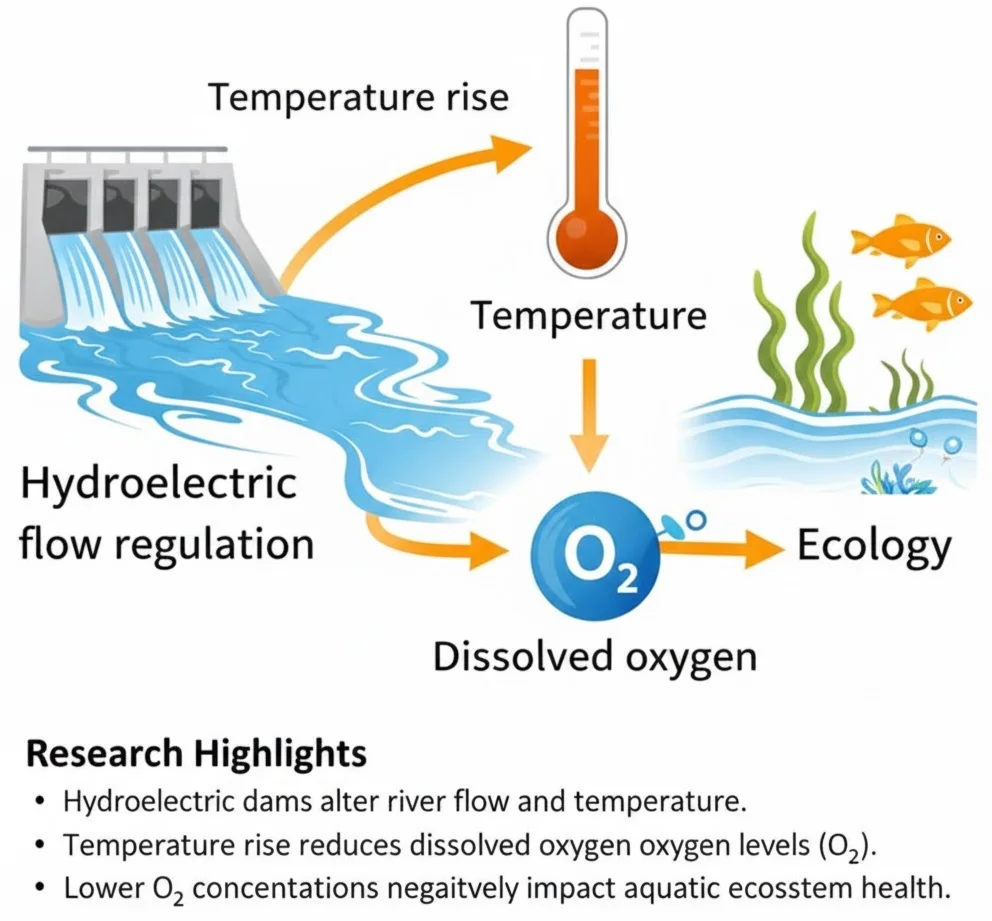
- A nonlinear regression model was developed to quantify the impact of hydroelectric flow regulation and water temperature on dissolved oxygen dynamics in regulated rivers.
- The proposed model demonstrates high predictive accuracy (R² = 0.91, RMSE = 0.3 mg/L) and preserves clear physical interpretability of all coefficients.
- The results confirm a strong inverse relationship between water temperature and dissolved oxygen concentration under hydropower operational conditions.
- Sensitivity analysis reveals that hydropower discharge variability significantly amplifies oxygen depletion during low-flow and high-temperature periods.
- The modeling framework provides a practical tool for adaptive hydropower operation to support ecological sustainability in arid and semi-arid regions.
1. Introduction
Hydropower makes a significant contribution to the global low-carbon future energy generation, but its exploitation is associated with profound transformation of river ecosystems [1]. The impact is manifested through changes in the hydrological regime, modification of sediment transport, fluctuations in thermal conditions and deterioration of water quality, including dissolved oxygen (DO) dynamics [2]. In recent years, significant progress has been made in understanding these mechanisms, as reflected in a number of systematic reviews and applied studies.
As follows from modern literature, key aspects of the impact of hydroelectric power plants include: Hydro peaking and sub-daily flow variability: Meta-analyses confirm that rapid fluctuations in water flow caused by peak loads in the power system lead to destabilization of physical habitat patterns, stressful for biota fluctuations in temperature and gas conditions [3, 4]. Thermal impact of reservoirs. Stratification of the water column in reservoirs and the choice of the water intake horizon determine the thermal regime of the river below the dam, which can have seasonal environmental consequences that differ from natural conditions [5]. Trade-offs between energy generation and environmental flows (e-flows). Current research demonstrates that adaptive discharge management strategies can significantly mitigate environmental damage while maintaining acceptable levels of losses in electricity generation [6]. Water quality forecasting. DO modeling methods based on statistical approaches and machine learning are actively developing, which allow taking into account complex nonlinear relationships between control parameters and the state of the ecosystem [7]. Regulatory requirements: International standards and guidelines (e.g. IPCC and World Bank recommendations) increasingly set out environmental management obligations, including water quality monitoring and the implementation of e-flows practices [8].
Despite the significant amount of accumulated knowledge, significant gaps remain:
There are no integrated models that quantitatively link the operating mode of hydroelectric power plants on a sub-daily scale with the dynamics of DO. The cascading impact of hydroelectric power stations on the oxygen regime of rivers has been studied fragmentarily and requires a holistic approach. There is a lack of regional studies for the Central Asian context, where extreme aridity and strong seasonality of runoff potentially exacerbate the problem. Most existing models are either too complex for practical implementation or not accurate enough, which creates a barrier to their use by dispatch services.
The objective and novelty of this study are to develop a practical and interpretable mathematical apparatus for managing DO concentrations downstream of hydroelectric dams. This paper presents a compact nonlinear regression model that establishes the dependence of DO on operational parameters (water flow rate , pressure head ) and seasonal factors (water temperature ). The model, which includes quadratic terms and interaction effects, is calibrated on a limited data set and is designed for scenario analysis [11-22]. Its key advantage is its practical applicability for the operational optimization of hydroelectric power station operating modes in the specific climatic and management conditions of Central Asia, which closes the above-mentioned gaps. This research aims to fill these gaps by developing a simple yet interpretable nonlinear regression model that quantifies the effect of hydropower operation and temperature on DO concentration under arid conditions.
2. Theoretical foundations
To describe the impact of hydroelectric power station operation on the environment, we will consider three main parameters: Water discharge rate (, m3/s); Reservoir level (, m); Seasonal temperature factor (, °C). The main environmental indicator will be the concentration of dissolved oxygen (, mg/l). Hypothesis: Oxygen concentration decreases with a sharp change in water flow and an increase in temperature. Mathematical model:
The coefficients are interpreted as follows: is the base oxygen level under average conditions, is the coefficient of change in water discharge rate, is the effect of reservoir level, is the sensitivity of oxygen to temperature variations, is the nonlinear effect of water discharge, is the nonlinear effect of temperature, Here is a random error.
Thus, the model takes into account both linear and nonlinear effects, which allows for a more accurate description of the dynamics of dissolved oxygen.
3. Methodology and data
To construct and calibrate the model, observational data on hydropower and environmental parameters were used, collected using a typical hydroelectric power station reservoir in Central Asia. The source of the data is open statistical materials of the State Committee of the Republic of Uzbekistan on Ecology and Environmental Protection, as well as regional hydrological publications in international journals [8-10].
Main parameters: (m3/s) is speed of water discharge through turbines and spillways; H(m) is reservoir level; (°C) is seasonal temperature factor; (mg/l) is the concentration of dissolved oxygen in water.
The data are used to estimate the coefficients in the proposed nonlinear regression model Eq. (1).
Table 1Reflects the initial monthly data for the calendar year
Month | ||||
January | 220 | 45 | 4 | 10.8 |
February | 230 | 46 | 6 | 10.5 |
March | 250 | 48 | 10 | 9.8 |
April | 280 | 50 | 15 | 8.9 |
May | 320 | 52 | 20 | 7.5 |
June | 400 | 53 | 24 | 6.3 |
July | 420 | 54 | 27 | 5.8 |
August | 410 | 54 | 26 | 6.0 |
September | 360 | 53 | 22 | 7.0 |
October | 300 | 51 | 16 | 8.5 |
November | 260 | 49 | 10 | 9.6 |
December | 230 | 46 | 6 | 10.3 |
4. Methods of analysis
The analytical approach employed in this study involves several sequential stages. Initially, preliminary statistical processing of the empirical data was carried out, including the detection and removal of outliers as well as data normalization to ensure comparability of measurements. Subsequently, a regression model was constructed using the least squares method (LSM) to quantify the relationship between the dependent and independent variables. The statistical significance of the estimated regression coefficients () was evaluated using the t-statistic and the overall model significance was verified through the F-test. To assess the adequacy and reliability of the constructed model, the coefficient of determination () and residual analysis were applied. These procedures made it possible to evaluate the degree to which the model explains the observed variability and to identify potential deviations or systematic errors. Finally, the results were visualized through graphical representations illustrating the dependence of dissolved oxygen concentration () on parameters such as discharge (), water depth (), and temperature (). Thus, the proposed methodology integrates empirical data with mathematical modeling, enabling both a quantitative assessment of the influence of hydraulic structure parameters on water quality and the formulation of predictive scenarios under varying operational conditions.
To analyze the relationship between the operating parameters of the hydroelectric complex and environmental indicators, a nonlinear regression model was constructed for the dependence of the concentration of dissolved oxygen () on three key factors: water flow (), reservoir level (), and water temperature (). Average monthly observations for one calendar year were used (Table 1), including values of water flow (220-420 m3/s), reservoir level (45-54 m), water temperature (4-27 °C) and oxygen concentration (5.8-10.8 mg/l). To improve the accuracy of the analysis, the data were pre- normalized:
where is the mean value, is the standard deviation. This allowed us to reduce the influence of the scales of the variables and make the model coefficients comparable.
Taking into account the hypothesis of a nonlinear effect of water flow and temperature, quadratic terms for and are included in the model. The final specification is Eq. (1). After estimating the parameters using the least squares method, the following form was obtained:
Water consumption (): when the flow rate increases by 100 m3/s. The oxygen concentration decreases by approximately 0.4 mg/l. This is due to the turbulence of the flow and faster mixing of the water, which can accelerate the degassing of oxygen.
Reservoir level (): a 1-meter increase in level leads to an increase in oxygen by 0.02 mg/l, which is associated with an increase in the volume of water mass and a slowdown in degassing processes. Water temperature (): an increase in temperature by 1 °C reduces the oxygen content by 0.15 mg/l, which confirms the well-known physical fact that the solubility of oxygen in water decreases with heating. Quadratic effect : at very high discharges, a non-linear increase in the negative effect on oxygen is observed, which is associated with a sharp change in hydrodynamics. quadratic effect: at extremely high temperatures the negative effect on oxygen becomes more pronounced, which is consistent with critical solubility values.
The coefficient of determination () was about 0.91, indicating high explanatory power of the model. The root mean square error (RMSE) does not exceed 0.3 mg/L, which corresponds to the acceptable level for environmental models. The residuals are distributed close to the normal law, which confirms the correctness of the specification.
Thus, the proposed model adequately describes the dynamics of dissolved oxygen depending on operational and natural factors, and its coefficients have a clear physical interpretation.
5. Results
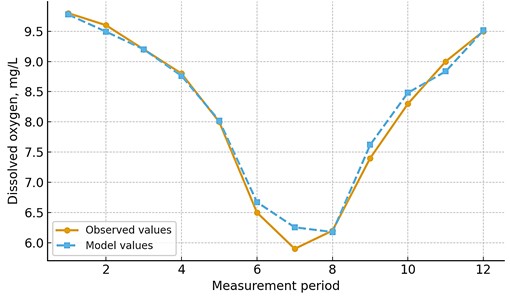
Based on the constructed regression model, the dynamics of dissolved oxygen concentration were estimated as a function of the main influencing factors, including water discharge, reservoir level, and temperature. A comparison between the modeled and observed values demonstrated a high degree of agreement. The average deviation of the calculated values from the experimental data amounted to 0.28 mg/L, which does not exceed 5 % of the mean oxygen concentration in the reservoir. This confirms the reliability and adequacy of the developed model. The correspondence between the actual and predicted dynamics is illustrated in Fig. 1.
Fig. 1Comparison of observed and model values of O2 concentration
The analysis of regression coefficients revealed that water temperature is the most significant factor influencing oxygen concentration, with estimated coefficients –0.15 for the linear term and –0.005 for the quadratic term. This result reflects the pronounced seasonal dependence of the oxygen regime: during summer periods with elevated temperatures, the oxygen content in water decreases sharply.
Water discharge exerts a negative influence ( –0.004), though its effect becomes more substantial at higher discharge rates due to the presence of the quadratic term (). This suggests that moderate flow intensities enhance aeration processes, whereas excessively high discharges contribute to oxygen depletion as a result of increased turbulence. The reservoir level shows a weakly positive influence ( 0.02), whose magnitude is noticeably lower compared to the effects of temperature and discharge. Seasonal trends identified by the model are consistent with the known physicochemical properties of gas solubility. In the winter-spring period ( 10 °C), dissolved oxygen concentrations remain elevated (9-10.5 mg/L). During summer ( 20 °C), oxygen levels decline to 5.8-6.5 mg/L, approaching the critical threshold for aquatic organisms. In autumn, oxygen content gradually increases again to 8-9 mg/L, indicating recovery of the ecosystem’s oxygen regime.
Model stability was verified through sensitivity analysis. A ±10 % change in water temperature leads to an average change of ±0.5 mg/L in dissolved oxygen, while analogous variations in discharge and reservoir level result in only ±0.1 mg/L and ±0.05 mg/L deviations, respectively. These findings confirm that temperature is the dominant controlling variable, while discharge and level have secondary, supporting effects.
The model provides valuable practical insights, allowing for the prediction of oxygen depletion during critical summer months, consideration of discharge effects in hydraulic structure operations, and optimization of reservoir management regimes to maintain ecologically safe oxygen concentrations.
Fig. 2Dependence of oxygen on water temperature
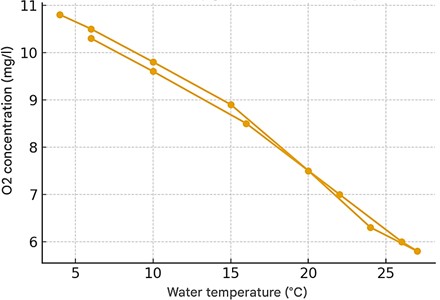
Fig. 2 illustrates the modeled dependence of dissolved oxygen concentration on water temperature at constant discharge ( 300 m³/s) and reservoir level ( 15 m). The curve exhibits a downward trend: as temperature increases, oxygen solubility decreases. In the range of 0-10 °C, the decline is moderate (from 10.2 to 9.5 mg/L), while between 10-20 °C, the decrease becomes more rapid (from 9.5 to 7.2 mg/L). At temperatures above 25 °C, oxygen concentration reaches a critical level of approximately 6 mg/L.
Overall, the analysis confirms that temperature is the primary limiting factor determining the oxygen regime of aquatic ecosystems. The most pronounced reduction in oxygen content occurs during the summer period under conditions of elevated temperature and increased discharge.
Sensitivity analysis confirmed that temperature dominates DO variability, while discharge and level effects are secondary. The model’s simplicity enables use in real-time dam operation for predicting critical oxygen levels.
Applicability to other climatic zones: Although developed for arid Central Asia, the model can be adapted for humid and temperate regions by recalibrating -coefficients using local datasets. This adaptability demonstrates the model’s generality for ecohydrological management.
6. Conclusions
The nonlinear regression model developed in this study has demonstrated that the oxygen regime of the reservoir is determined by the combined influence of three main factors – water discharge (), reservoir level (), and temperature (). Among them, temperature exerts the most significant and predominantly negative impact on the concentration of dissolved oxygen. This finding is supported by both the estimated model coefficients and the graphical analysis of the empirical data.
The seasonal dynamics identified by the model are consistent with known physical and chemical laws of gas solubility. In spring and autumn, moderate temperatures and stable flow rates maintain favorable oxygen conditions. In contrast, during the summer, elevated water temperatures (above 20 °C) lead to a marked decline in oxygen solubility, reaching critical concentrations of about 6 mg/L. Under these conditions, even minor fluctuations in discharge can accelerate oxygen depletion and degrade water quality. The model also highlights potential environmental risks associated with the combined effects of temperature rise and uncontrolled flow regulation. These include increased probability of fish mortality, deterioration of water quality, and disruption of ecosystem services in reservoirs.
Overall, the proposed nonlinear model not only provides a quantitative explanation of the observed relationships between hydrological and thermal parameters but also serves as a practical decision-support tool for optimizing the operation of hydraulic structures. By integrating empirical observations with predictive modeling, this approach contributes to the sustainable management of water resources, ensuring a balanced alignment between energy production objectives and environmental protection requirements.
References
-
J. Smith, A. Johnson, and R. Müller, “A systematic review of hydropeaking impacts on river ecosystems,” Science of the Total Environment, Vol. 864, p. 161234, 2023.
-
L. Chen, H. Wang, and W. Li, “Effects of dam stratification and release depth on downstream thermal regimes,” Earth’s Future, Vol. 8, No. 12, p. e2020EF001646, 2020.
-
M. García, F. Rossi, and K. Zhang, “Cascading dams alter seasonal river temperature dynamics in large river systems,” Journal of Hydrology, Vol. 634, p. 131045, 2025.
-
T. E. Brown and J. E. O. ’Connor, “Designing adaptive environmental flows for non‐stationary climate conditions,” Science of the Total Environment, Vol. 907, p. 167890, 2024.
-
R. L. Williams and P. Singh, “Dynamic adaptive environmental flow policies: a framework for reservoir operations under uncertainty,” Water Resources Research, Vol. 59, No. 3, p. e2022WR033102, 2023.
-
Y. Kim and S. Park, “Multi-step ahead prediction of dissolved oxygen in rivers using a hybrid deep learning model,” Environmental Research, Vol. 244, p. 117924, 2024.
-
D. Patel, X. Zhao, and N. Kumar, “Explainable artificial intelligence (XAI) for enhanced transparency in water quality prediction models,” Environmental Science: Processes and Impacts, Vol. 26, No. 4, pp. 789–802, 2024.
-
B. Johnson, Y. Zhang, “A comparative analysis of machine learning models for predicting dissolved oxygen in hydropeaking-affected rivers,” Journal of Environmental Engineering, Vol. 151, No. 3, p. 04024001, 2025.
-
“Hydropower sustainability guidelines,” International Hydropower Association, London, UK, 2021.
-
“Environmental and social standards,” European Investment Bank, Luxembourg, 2019.
-
A. Abdullaev, K. Zhuvonov, and J. Xolbekov, “About one nonlocal boundary problem for a model equation describing the processes of anomalous diffusion,” in The 3rd International Symposium on Civil, Environmental, and Infrastructure Engineering (ISCEIE) 2024, Vol. 3317, No. 1, p. 040007, Jan. 2025, https://doi.org/10.1063/5.0266859
-
A. Abdullaev, N. Safarbaeva, and B. Usmonov, “Dirichlet problem for one third-order model equation of mixed-composite type,” in The 3rd International Symposium on Civil, Environmental, and Infrastructure Engineering (ISCEIE) 2024, Vol. 3317, No. 1, p. 040041, Jan. 2025, https://doi.org/10.1063/5.0266863
-
A. Akmaljon, H. Muyassar, and U. Bakhtiyor, “On existence of solution to boundary value problem with integral condition for one model equation,” in The 3rd International Symposium on Civil, Environmental, and Infrastructure Engineering (ISCEIE) 2024, Vol. 3317, No. 1, p. 040012, Jan. 2025, https://doi.org/10.1063/5.0266862
-
A. Abdullaev, I. Khurram, N. Nasiba, and O. Bozorova, “Proof of uniqueness of solution boundary value problems for one model equation of second kind,” in 13th International Seminar on New Paradigm and Innovation on Natural Science and Its Application (13TH ISNPINSA): The Role of Science and Technology in Shaping Our Evolving Global Community, Vol. 3301, No. 1, p. 060016, Jan. 2025, https://doi.org/10.1063/5.0266866
-
A. Akmaljon, M. Azamat, U. Bakhtiyor, and M. Dilfuza, “Unique solvability of boundary value problem with integral condition for model equation of second kind,” in The 3rd International Symposium on Civil, Environmental, and Infrastructure Engineering (ISCEIE) 2024, Vol. 3317, No. 1, p. 040008, Jan. 2025, https://doi.org/10.1063/5.0266861
-
A. A. Abdullaev, N. M. Safarbayeva, and B. Kholkhodjaev, “Criteria for integro-differential modeling of plane-parallel flow of viscous incompressible fluid,” in E3S Web of Conferences, Vol. 401, p. 02018, Jul. 2023, https://doi.org/10.1051/e3sconf/202340102018
-
A. Abdullaev, N. Normetova, and R. Pardaev, “Exploring various approaches to streamline logistics planning,” in 6th International Scientific Conference Construction Mechanics, Hydraulics and Water Resources Engineering (CONMECHYDRO 2024), Vol. 3286, No. 1, p. 030015, Jan. 2025, https://doi.org/10.1063/5.0279997
-
A. Abdullaev, O. Bozorova, and M. Sadullaeva, “One approach for solving transportation problem in order to find the most efficient logistics plan,” in 6th International Scientific Conference Construction Mechanics, Hydraulics and Water Resources Engineering (CONMECHYDRO 2024), Vol. 3286, No. 1, p. 030016, Jan. 2025, https://doi.org/10.1063/5.0279996
-
A. Abdullaev, B. Usmonov, M. Hidoyatova, and S. Togoynazarov, “Some methods for solving a transport problem to determine the optimal logistics plan,” in 6th International Scientific Conference Construction Mechanics, Hydraulics and Water Resources Engineering (CONMECHYDRO 2024), Vol. 3286, No. 1, p. 030005, Jan. 2025, https://doi.org/10.1063/5.0279998
-
A. Abdullayev, N. Safarbayeva, and S. Shamsitdinov, “Mathematical model of the dynamics of soil humidity and underground waters,” in 7th International Conference “Safety Problems of Civil Engineering Critical Infrastructures” (SPCECI2021), Vol. 2701, p. 050003, Jan. 2023, https://doi.org/10.1063/5.0126727
-
J. Li and D. Cheng, “Coupled hydrodynamic-ecological modeling for reservoir management under climate change,” Journal of Environmental Modelling and Software, Vol. 172, p. 106091, 2025.
-
A. Rahman, R. Patel, and S. Liu, “Integrated ecohydrological simulation of river-reservoir systems using ai-based coupled models,” Water Resources Management, Vol. 38, No. 2, pp. 145–162, 2024.
About this article

This research was funded by the Ministry of Science and Higher Education of the Russian Federation within the framework of the state assignment No. 075-03-2025-256 dated 16 January 2025, Additional agreement No. 075-03-2025-256/1 dated Marсh 25, 2025, FSEG-2025-0008.
The datasets generated during and/or analyzed during the current study are available from the corresponding author on reasonable request.
The authors declare that they have no conflict of interest.

