Abstract
The given research is made as a seismic investigation of a monolithic (continuous) reinforced concrete overpass that is placed at 1083 km length of the M-39 highway that is passed the city of Samarkand. The main aim was to determine the structural performance of the overpass with the force of seismic loading, especially the influence of the tremor initiated by the forces on the foundation aspects of the overpass. The Midas Civil software package was used as the analysis tool and the Finite Element Method (FEM) was utilized under frame work of the linear spectral theory that is commonly employed in the analysis of seismic performance in building structures. The outcomes of the computational model indicate that the stress induced by the piles on the underlying soil is within recommended limits and this implies that there can be a stable interaction between the subgrade and the foundation in the case of seismic activities. In addition, analysis determined maximum bending moment near the pile head, which happens to be a critical point that usually has the maximum stress concentrations under lateral motion of the ground. This observation makes it necessary to strengthen the pile head area to make the structure secure. The findings of the study will provide significant information on seismic resistance of reinforced concrete bridges and will also serve the purpose of enhancing bridge design researches in regard to ensuring earthquake resistance in a bridge. The findings can also be used to have a wider implication of the developments of infrastructure in Uzbekistan concerning the introduction of the betterment of the safety and reliability of the highway overpasses in seismically active areas.
1. Introduction
The construction or rather the design of transport facilities (bridges, overpasses, overpasses) is now undertaken in modern cities at high rate. Today, development of urban passenger transport is one of the most acute problems facing the process of formation of a modern megapolis. This causes severe issues of transport and passenger traffic, traffic jams and does not allow people to get to their destination fast and effortlessly [1]. Nowadays the modern principles of design and building are under investigation in the internal world of bridge construction but with small steps to remove the traditional principles of design and building, new techniques and technologies are getting used. The building of structures by the unconventional monolithic method is one of the famous and unconventional methods [2]. This approach is very popular in construction of peculiar objects in the world major cities. Tashkent and Samarkand cities are some of the megacities that are found in Central Asia and the largest in recent years. The number of cars driving on the streets raises more than 700-800 thousand cars per day 2-3 times faster under the increasing traffic flow in these cities [3]. Consequently, road system, building of transport facilities, such as bridges, flyovers and underground railways are in progress as per the new demands.
The target of study is monolithic bridge and it is the widely used in the formation and upgrading of the road and transport system of Samarkand, one of the largest historical cities of the Republic of Uzbekistan. The good illustration of this fact is the latest overpass constructed on the 1083 rd kilometer of the M-39 highway running through the city of Samarkand [4-5]. As it can be observed, one of the acute problems is the development of technical solutions (design and calculation) of the monolithic reinforced concrete bridges and overpasses. It exerts an accumulative effect on the building of the bridge industry of the Republic of Uzbekistan [6-8].
2. Methods
The further increase in the volume of accumulated data on the parameters of seismic vibrations of the soils mass of the seismic hazard and the accumulation of the information on the actual properties of engineering and construction structures allows to take into greater account the physical properties of the structure, as well as to cross over to the calculation of seismic effects with further switching over to the calculation method based on the actual data on the seismic effects, in the first place, the methods of calculation on the earthquake accelerograms [9]. Information of the working documentation of the object Construction of an overpass on the Initial data was used in the form of M-39 highway in the city of Samarkand amounting to 1083 km. Its length is 110 m, the width is 28.9 m, and it is arranged in the form of 3 lanes 3.5 m wide on each side [10-12]. The span structure of the overpass is individual, the continuous monolithic reinforced concrete calculation scheme is 33+42+33 m. The overpass has a width of 3.5 m on both sides consisting of three lanes. The span construction of the facade is variable: in the spans - 1.3 m and on the support - 2.3 m in a variant of solid plates [13, 14].
Fig. 1 contains the general view of the overpass.
Fig. 1Overview of the continuous (monolithic) reinforced concrete overpass in Samarkand
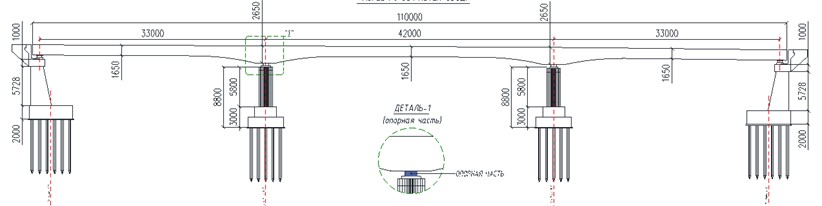
Its intermediate supports have the following dimensions: height – 5.85 m, width along the facade- 2 m, and height along the sides of 5-8.4 m. The assumption made in these calculations is that they move because the earth is moving as it is in the case of an earthquake [15]. The seismicity of the region is evaluated according to the seismic microregionalization map of the Institute of Seismology of 1980, 9 and 8 points are assigned to the Samarkand. The construction site was designed to be in an 8- point area [16-19].
As it is listed in Table 1.1 of KMK 2.01.03-19 within the boundary of site, in the upper The thickness of an 10 m layer is counted on the bottom of the foundation, the soils of category II, according to seismic characteristics, are contained, clay sands with a porosity coefficient 0.8 (stones-alloy soil). It is suggested to consider the seismicity of the designed construction site to be 8 points, in that regard. Cavity-forming elements will be built in during the concreting of PND (low-pressure polyethylene pipes) pipes, which will be carried out to ease the load created by the weight of reinforced concrete in the span structures [20]. The pipes of the structure have a diameter of 400 mm, the outer gaps measure 16.5 meters and the centre is 22 meters. The 9-degrees angle of intersection between the overpass and the roadway is presented in the design of the overpass (the end faces of the overpass are inclined at 9-degrees and supported on the axis of the overpass at 9-degrees angle on the intermediate supports) [21]. The overpass of the seismic effects were calculated in the context of the linear-spectral theory in the context of the Midas Civil program package, which works on the basis of the finite element method (FEM).
3. Results and discussion
Midas Civil is a package of software products intended to model and computationally analyze transport facilities, objects of the construction used in the interests of concreting all types of purposes, modeling structural elements and evaluation of their load-carrying capacities. MiDAS Civil is an engineering programme tool that has developed a new paradigm in the design of bridges and civil constructions. The interface is simple to use in this program which executes numerous designing tasks such as calculation to solve nonlinear problems among others using the formation of a database. Its extremely developed models and computing analysis tools also aid in the surmounting of typical issues that come about in the evaluation of buildings that were calculated with LEU.
Adoption of the value of the seismic load was made by regulations:
– KMK 2.01.03-96 2.01.03.96.
– Construction in Seismic Areas; SHNK 2.01.20-16. Building of means of transport in seismic regions.
– Euroval 8 EN 1998-2 2011, Design of structures, earthquake resistance Part 2; Toshkent, 2016.
– With the so-called Design Rules.
The determined seismic loads were received with consideration on the spectral theory:
– In the and axis direction towards horizontal action:
– Along the axis for vertical impacts:
where: 0.5 – multiplier according to clause 4.16 of SHNK 2.01.20-16; – the weight of the structure (element) belonging to point , determined taking into account the design loads; – acceleration adopted in accordance with clause 8.3.34 of SP 268.1325800.2016; 0.2 gm/s2 – for seismicity equal to 8 points; – dissipation coefficient, applied in accordance with clause 2.16 of KMK 2.01.03-96 to the horizontal components of the seismic impact FX, FY; – efficiency according to Eurocode 8 EN 1998-2-2011; – period-dependent dynamic coefficient, T.
In accordance with Article 2.3.2.2 of Eurocode 8 EN 1998-2-2011, the formation of plastic hinges in prestressed structures is not allowed, taking into account the use of seismic isolation devices on supports, as well as paragraph 2.3.2.3 of Eurocode 8 EN 1998-2-2011, a coefficient of operation q=1.5 was introduced into the calculations as a multiplier of the vertical component of the FZ of seismic impact.
In the calculations, the spectral curvature (T) was used in accordance with SHNK 2.01.20-16 (without taking into account the requirement > 0.8 only) (Fig. 2).
Reactions from a constant load, taking into account the prestressing applied to the support: 862 m + 767 m + 1629 m.
The horizontal component of the seismic force, attributable to the support from the constant normative weight of the span structure and the bridge pavement, is determined in accordance with clause 4.18 of SHNK 2.06.20-15: 0.05∙2.7∙1629 t = 219.9 t.
The weight of the support body located above the foundation cut: 168.1 t.
Horizontal component of seismic force, in accordance with clause 4.18 of SHNK 2.06.20-15: 0.05·2.7∙168.1 m = 22.7 m.
Support weight: 312.2 t.
Fig. 2Graph of spectral curve
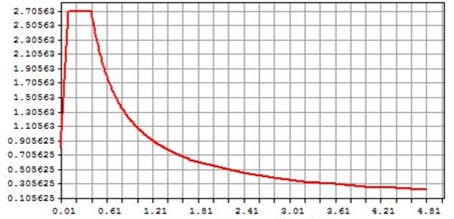
Table 1Ground characteristics
Parameters | Ground layer | ||||
1 | 2 | 3 | 4 | ||
Layer thickness | m | 1.300 | 2.400 | 8.300 | 20.000 |
Proportionality coefficient | kN/m4 | 7000 | 50000 | 7000 | 50000 |
Specific gravity of soil | kN/m3 | 19.300 | 19.600 | 19.200 | 19.600 |
Internal friction angle | grade. | 24.000 | 43.000 | 24.000 | 43.000 |
Soil specific adhesion coefficient | kPa | 27.500 | 2.000 | 23.000 | 2.000 |
Table 2Characteristics of pile foundation
Stake section type | Square | |
Enter the side of the pile cross-section | 0.35 | m |
Stake concrete elasticity modulus | 3 30000000 | kPa |
Distance from ground surface to pile bottom | 13 | m |
Poisson coefficient | 0.2 | – |
Depth | 2.725 | m |
The number of soil layers within the depth | 2 | Pieces |
Concrete displacement module | 12500000 | kPa |
Proportionality coefficient | 18759 | kN/m4 |
Conventional pile width | 1,025 | m |
Inertial moment of the pile’s cross-section | 0.00125 | m4 |
Deformation coefficient | 0.875 | 1/m |
Reduced pile penetration depth | 11,37331 | m |
Horizontal displacement of the cross-section by force 1 | 9.717E-05 | m/kN |
Horizontal displacement of the cross-section from the moment 1 | 5.645E-05 | 1/kN·m |
Angle of rotation of the cross-section from force 1 | 5.645E-05 | 1/kN |
Angle of rotation of the section from the moment 1 | 5.335E-05 | 1/kN·m |
Vertical displacement by force 1 | 7.040E-06 | m |
By the method of work production, the pile is | Forgettable | 0,6 |
Figs. 3-10 indicate the force and moment diagram of the formed supports due to longitudinal and transverse seismic effects.
Seismic forces. To continue the calculations, the overpass design model was designed in the MiDAS Civil program package. These are given as the result of the calculation of a monolithic overpass under a dynamic load, in which the seismic effects FH, FY, FZ influences an orthogonal use of the three directions and the effects must be regarded with both signs of the forces, and the displacements.
Fig. 3Calculation scheme of the intermediate support in Midas Civil
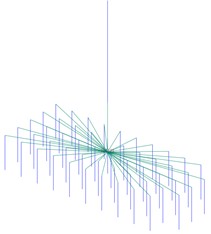
Fig. 4Design scheme of the intermediate support-pile fastening
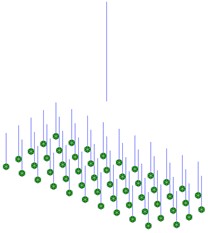
Fig. 5Reactions at pile reinforcement nodes from longitudinal seismicity
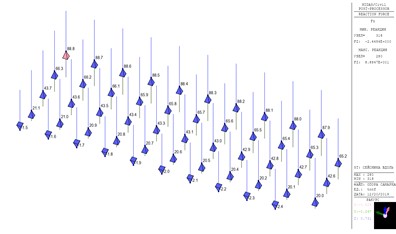
Fig. 6Reactions at pile fastening nodes from transverse seismicity
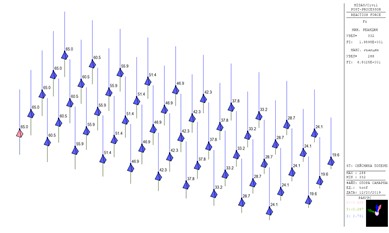
Fig. 7Epyures of longitudinal seismic cutting forces
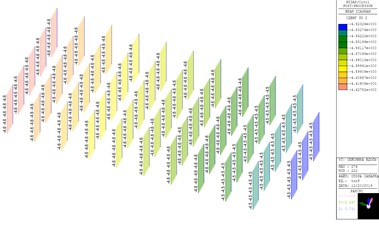
Fig. 8Elastic moment diagrams from longitudinal seismicity
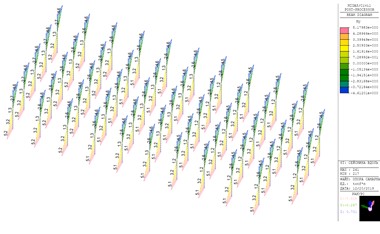
Fig. 9Cross-seismic force diagrams
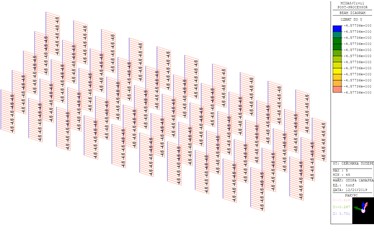
Fig. 10Cross-seismic bending moment diagrams
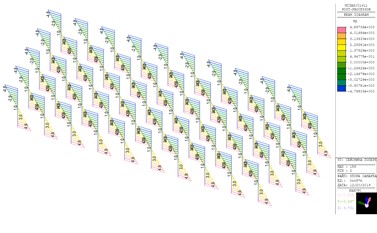
According to the calculation, the pile’s pressure on the base soil does not exceed the limit, while the maximum value of the bending moment corresponds to the moment in the pile head. Based on the value of the bending moment in the pile head and the tensile longitudinal force, the required reinforcement (pile type) is determined from the graphs. The values of the acting forces in the pile cross-sections are satisfied by the reinforcement according to the T4 type, therefore, we accept a pile with a length of 14 meters with T4 reinforcement.
4. Conclusions
Within the scope of the research activities, an in-depth analysis of the seismic effects on the continuous (monolithic) reinforced concrete overpass located at the 1083rd kilometer of the M-39 highway passing through the city of Samarkand has been thoroughly carried out. The dynamic behavior of the structure under seismic loading was assessed using the Midas Civil software package, applying the finite element method (FEM) within the framework of linear spectral theory.
During the analytical process, a detailed three-dimensional model of the overpass was created, including the superstructure, substructure, and pile foundations. Seismic load combinations, response spectrum parameters, soil-structure interaction characteristics, and structural stiffness properties were taken into account to ensure the reliability of the obtained results.
The results of the Midas Civil DM linear-spectral calculations demonstrated that the pile-soil contact pressure values remain within the permissible limits, indicating that the foundation system has adequate load-bearing capacity even under design-level earthquake effects. This finding confirms that no overstressing or soil-bearing failure is expected in the analyzed seismic scenarios.
Furthermore, the analysis revealed that the maximum bending moment occurs at the pile head, which is consistent with the structural behavior of pile-supported bridges subjected to lateral seismic forces. This concentration of bending moment at the pile head highlights the importance of ensuring proper reinforcement detailing and structural continuity at the pile-to-cap connection zone.
Overall, the expanded seismic assessment confirms that the structural configuration of the overpass-including its monolithic reinforced concrete system and pile foundation design-meets the required seismic performance criteria. The obtained results validate the structural safety, stability, and reliability of the overpass under the expected seismic conditions in the Samarkand region.
References
-
P. P. Borodavkin, Soil Mechanics in Pipeline Construction. (in Russian), Moscow, Russia: Nedra, 1986, p. 224.
-
A. B. Karimova, “Seismic resistance of continuous reinforced concrete bridges and overpasses,” Tashkent State Transport University, Tashkent, Uzbekistan, 2023.
-
“Construction of a new overpass at km 1083 of the M-39 highway in Samarkand,” (in Russian), Samarkand, Uzbekistan, 2019.
-
“KMK 2.01.03-19, Construction in Seismic Areas,” (in Russian), Tashkent, Uzbekistan, 2019.
-
“KMK 2.01.03-96, Construction in Seismic Areas,” (in Russian), Tashkent, Uzbekistan, 1997.
-
“Eurocode 8: EN 1998-2 – Design of Structures for Earthquake Resistance – Part 2,” Brussels, Belgium, 2011.
-
U. Shermukhamedov, A. Karimova, A. Abdullaev, and I. Hikmatova, “Calculation of monolithic bridges taking into account seismic conditions of Republic of Uzbekistan,” in E3S Web of Conferences, Vol. 365, p. 02005, Jan. 2023, https://doi.org/10.1051/e3sconf/202336502005
-
A. Abdusattarov, N. Ruzieva, and F. Abdukadirov, “Modeling of elastic-plastic deformation of main pipelines under repeated static and dynamic loading,” in The 6th International Conference on Energy, Environment, Epidemiology and Information System (ICENIS): Topic of Energy, Environment, Epidemiology, and Information System, Vol. 2476, p. 030016, Jan. 2023, https://doi.org/10.1063/5.0103093
-
U. Z. Shermukhamedov, A. B. Karimova, A. R. Abdullaev, and Y. T. Khakimova, “Comparison of operating costs of reinforced concrete bridges and overpasses with different static schemes,” in E3S Web of Conferences, Vol. 401, p. 02035, Jul. 2023, https://doi.org/10.1051/e3sconf/202340102035
-
U. Z. Shermukhamedov, A. B. Karimova, and B. S. Zakirov, “Calculation of continuous reinforced concrete bridges and overpasses inseismically hazardous areas,” in E3S Web of Conferences, Vol. 401, p. 01078, Jul. 2023, https://doi.org/10.1051/e3sconf/202340101078
-
U. Z. Shermukhamedov, Z. Z. Ergashev, S. M. Takhirov, and A. A. Abdullaev, “Improving reliability of Uzbekistan’s transport infrastructure facilities under impact of natural hazards by analysis of its vulnerability, monitoring and modeling,” in 9th International Conference on Computational Methods in Structural Dynamics and Earthquake Engineering Methods in Structural Dynamics and Earthquake Engineering, pp. 3817–3830, Jan. 2023, https://doi.org/10.7712/120123.10682.21320
-
U. Shermukhamedov, A. Abdullaev, and D. Svezhentsev, “Seismic resistance of continuous monolithic bridges accounting for post-tensioning cable tension during interaction between support foundations and soil,” in The 3rd International Symposium on Civil, Environmental, and Infrastructure Engineering (ISCEIE), Vol. 3256, p. 030031, 2025, https://doi.org/10.1063/5.0266831
-
G. Ibragimova et al., “Assessment of options for the location of railway infrastructure facilities,” Discover Applied Sciences, Vol. 7, No. 5, pp. 1–16, Apr. 2025, https://doi.org/10.1007/s42452-025-06869-7
-
S. Salikhanov and F. Zokirov, “Studying possibilities of joint operation of main beam and protective layer constructions,” in The 3rd International Symposium on Civil, Environmental, and Infrastructure Engineering (ISCEIE), Vol. 3256, No. 1, p. 030029, Jan. 2025, https://doi.org/10.1063/5.0266815
-
S. S. Salixanov, F. Z. Zokirov, Y. T. Xakimova, and G. B. Ismailova, “The effect of increasing loads on foundations of operating bridges,” in E3S Web of Conferences, Vol. 401, p. 01080, Jul. 2023, https://doi.org/10.1051/e3sconf/202340101080
-
S. Djabbarov, R. Mukarramov, A. Zhahongir, and G. Bimurzaev, “Evaluation of landslide risk on railway line Tashguzar-Boysun-Kumkurgan based on results of field monitoring,” in The 3rd International Symposium on Civil, Environmental, and Infrastructure Engineering (ISCEIE), Vol. 3256, No. 1, p. 060025, Jan. 2025, https://doi.org/10.1063/5.0267395
-
A. Z. Khasanov, U. Z. Shermukhamedov, and A. R. Abdullayev, “Smart geotechnics for smart societies,” in 17th Asian Regional Conference on Soil Mechanics and Geotechnical Engineering, 2022, https://doi.org/10.1201/9781003308820-60
-
A. Abdullaev, I. Mirzaev, U. Shermukhamedov, and D. Askarova, “Influence of seasonal temperature on the strength of continuous monolithic road overpasses,” in 15th International Conference on Thermal Engineering: Theory and Applications, Jun. 2024.
-
C. Raupov, A. Karimova, F. Zokirov, and Y. Khakimova, “Experimental and theoretical assessment of the long-term strength of lightweight concrete and its components under compression and tension, taking into account the macrostructure of the material,” in E3S Web of Conferences, Vol. 264, p. 02024, Jun. 2021, https://doi.org/10.1051/e3sconf/202126402024
-
S. Salikhanov, Z. Pulatova, F. Zakirov, Z. Rahimjonov, and A. Abdullayev, “Determination of deformations and self-stress in concrete on stress cement,” in E3S Web of Conferences, Vol. 264, p. 02056, Jun. 2021, https://doi.org/10.1051/e3sconf/202126402056
-
S. Dostanova, S. Shayakhmetov, K. Lesov, K. Umarov, and Z. Kalpenova, “Bearing capacity of road overpasses under dynamic influences,” in The 3rd International Symposium on Civil, Environmental, and Infrastructure Engineering (ISCEIE), Vol. 3256, p. 030037, Jan. 2025, https://doi.org/10.1063/5.0267571
About this article

The authors have not disclosed any funding.
The datasets generated during and/or analyzed during the current study are available from the corresponding author on reasonable request.

