Abstract
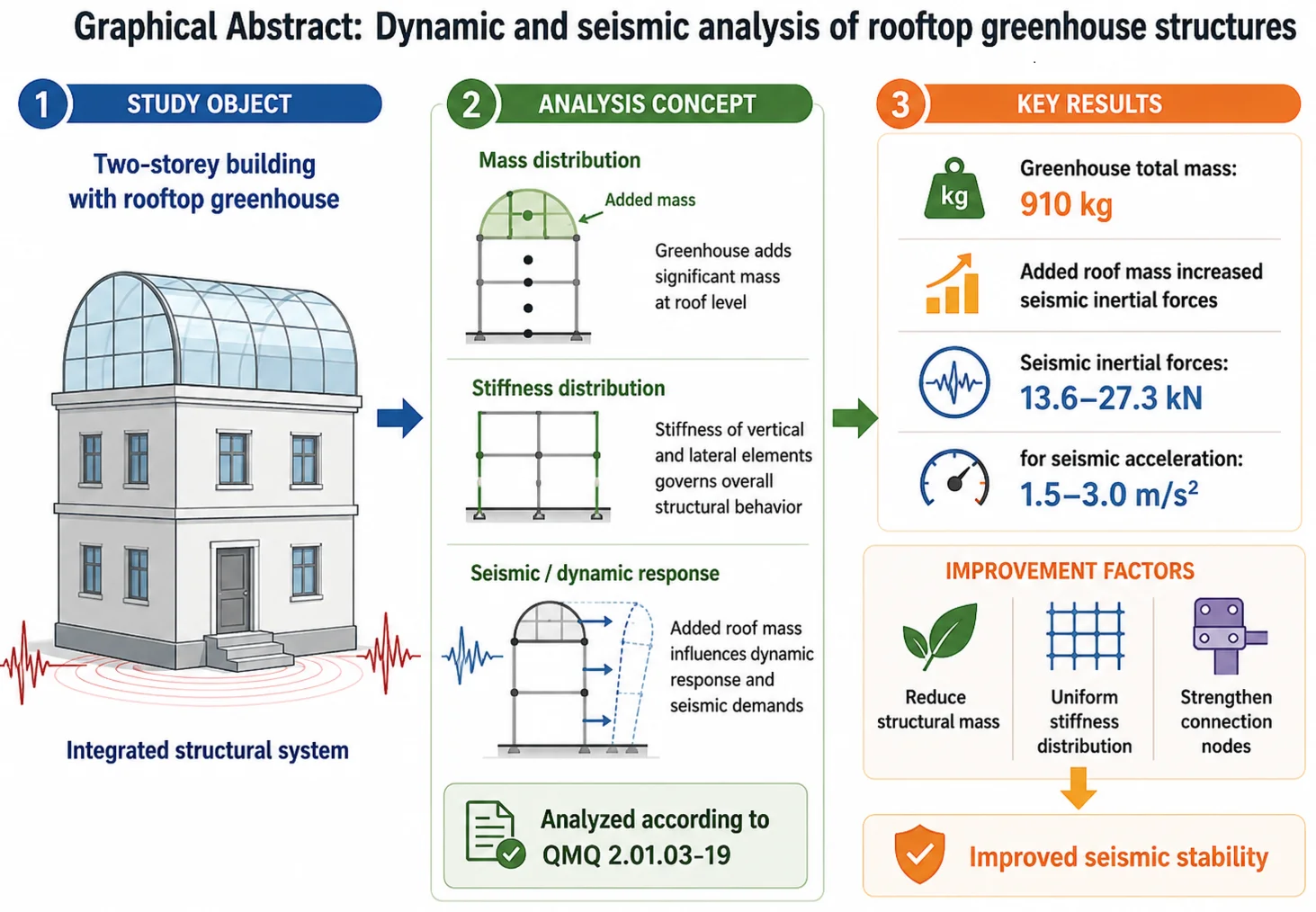
This study investigates the dynamic and seismic behavior of greenhouse structures installed on the roofs of buildings in accordance with the requirements of the regulatory document QMQ 2.01.03-19 “Construction in Seismic Zones”. Rooftop greenhouses are considered as additional structural systems integrated with existing buildings, which influence the overall mass distribution, stiffness characteristics, and dynamic response of the structure. In this research, a two-storey building with an arched greenhouse structure located on its roof was adopted as the research object. The greenhouse and building were analyzed as a single spatial structural system. Seismic inertial forces were determined based on the mass of structural elements and seismic acceleration parameters. The results showed that the total mass of the greenhouse structure is 910 kg, with the metal frame accounting for the largest portion. Due to the additional mass at the roof level, seismic inertial forces increase significantly, reaching values from 13.6 kN to 27.3 kN for seismic accelerations of 1,5-3,0 m/s2. The study demonstrates that reducing structural mass, ensuring uniform stiffness distribution, and strengthening connection nodes are key factors in improving the seismic stability of rooftop greenhouse systems.
Highlights
- Rooftop greenhouse structures were dynamically and seismically analyzed according to QMQ 2.01.03-19.
- The rooftop greenhouse added 910 kg of mass to the roof level of the building.
- Additional roof mass increased seismic inertial forces in the structural system.
- Seismic inertial forces ranged from 13.6 to 27.3 kN under accelerations of 1.5–3.0 m/s².
- Reducing structural mass, ensuring uniform stiffness, and strengthening connection nodes improve seismic stability.
1. Introduction
In recent years, the need for the efficient use of rooftops in large cities, the introduction of energy-efficient construction solutions, as well as the need to develop local food growing systems in urban areas have significantly increased the scientific and practical interest in rooftop greenhouse structures. Since such systems are integrated into the existing building volume as an additional functional layer, they are subject to an in-depth analysis not only in terms of thermotechnical and operational performance, but also in terms of constructive safety criteria. Especially in seismically active regions, a rooftop greenhouse can have a significant impact on the total mass, stiffness distribution, center of gravity position, and dynamic response of the building. Therefore, when designing such additional structures, it is not enough to limit them to static loads, but also to evaluate their spatial performance during earthquakes on a normative basis. According to the norm QMQ 2.01.03-19, when designing buildings located in areas with an estimated seismicity of 7, 8, 9 points and above, it is required to necessarily take into account seismic impacts. From the point of view of seismic safety, rooftop greenhouses are unique in that they form additional vertical and horizontal loads, ventilation and covering elements, local stiffness fluctuations, as well as eccentricities in contrast to the usual roof roof structure. This complicates the vibrational shapes of the structure, the distribution of inertial forces and the state of tension of some nodes under the influence of an earthquake. QMQ 2.01.03-19 states that when calculating seismic impacts, buildings and structures should be evaluated on two boundary conditions, namely by pay-load capacity and operational suitability. It is also determined that seismic loads will be considered in special compounds with permanent and temporary loads. These requirements indicate the need to study the rooftop greenhouse not as a separate element, but as a holistic constructive system that works in conjunction with the existing building [1].
Constructive simplicity and regularity are among the fundamental principles in ensuring seismic tolerance. The practical manual recommends that the plan solution for private residences be as simple as possible, symmetrical and evenly distributed of masses and stiffnesses; Complex layouts, uneven loading, and adverse grunt conditions have been cited as factors that increase seismic risk. In addition, the implementation of foundations in a interconnected tape system, the use of antisesmic arches along the walls and reliable connection of roof structures with walls are among the main constructive measures to increase seismic stability. These rules are also relevant for the rooftop greenhouse system, and the greenhouse frame, base ramps, connecting elements, and roof junction nodes must work sufficiently against relative displacement and local disturbances during an earthquake [2]. The relevance of this study lies in the fact that rooftop greenhouse structures are commonly evaluated in terms of energy efficiency and microclimatic performance, while their dynamic and seismic behavior remains insufficiently investigated. According to QMQ 2.01.03-19, reducing mass eccentricity, using lightweight materials, and ensuring structural integrity are essential for improving seismic resistance. These aspects are particularly critical for rooftop greenhouses, as their elevated position significantly affects the dynamic characteristics of the building. Therefore, this study aims to assess the dynamic and seismic performance of rooftop greenhouse systems by considering them as integrated spatial structures with the building. The analysis includes mass distribution, load combinations, and structural stability, leading to scientifically grounded recommendations for their design in seismic regions [3].
2. Research methodology and computational model
In this study, the dynamic and seismic behavior of rooftop greenhouse structures was evaluated in accordance with QMQ 2.01.03-19, considering the building and greenhouse as a single integrated system under seismic loads, including inertial forces, deformations, and overall stability. The building was modeled as a two-story reinforced concrete frame with slab floors. Floor number affects mass and height, influencing seismic force distribution and center of mass, while floor type contributes to overall stiffness () and damping. These parameters were used as initial conditions in the computational model. According to the requirements of QMQ 2.01.03-19, when designing buildings located in seismic zones, structures need to be inspected according to two extreme conditions, which consist of load-bearing capacity and operational suitability. In this study, too, greenhouse design was evaluated on the basis of these criteria [4]. As a result of the placement of an additional structure on the roof of the building, the total mass of the structure increases, and an upward shift of the center of mass is observed. This leads to a magnification of the forces of inertia, which is generated during the impact of an earthquake. Therefore, determination of mass and geometric parameters of greenhouse construction is considered one of the important stages of seismic calculation [5]. The basis for determination of seismic loads is the general rules of normative document QMQ 2.01.03-19. According to this document, seismic forces affecting buildings and structures are determined depending on the mass of the structure and the acceleration of earthquakes in the ground.
During an earthquake, inertial forces are generated in the structure of a building, which are determined by the following expression, depending on the mass of the structure and the acceleration of vibration:
where: – seismic inertia force; – mass construction; – acceleration of the earth’s vibration.
This expression is taken as the basis for determining seismic forces, with the greenhouse and roof considered as a single mass system. The structure was modeled as a simplified mass-damping system to represent its oscillatory behavior.
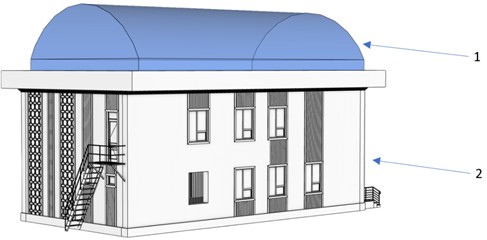
Fig. 1General scheme of arrangement of the greenhouse located on the roof of the building: 1 – rooftop greenhouse; 2 – building
Energy dissipation at the “greenhouse-roof” connection was implicitly included through an equivalent damping coefficient (). However, connection-specific damping was simplified, which may affect resonance analysis accuracy [6]:
where: – system mass; – extinction coefficient Stiffness of the; – structure; – shift amount; is an external force that changes over time.
This equation makes it possible to determine the dynamic response of building and greenhouse structures to the effect of an earthquake. Using the dynamic model, the amplitude of vibration, the maximum displacement values of the structure and the stresses generated by the structural elements are evaluated. An important parameter is the frequency of natural vibrations when evaluating the seismic stability of the structure. The inherent frequency of the system depends on the parameters of mass and stiffness and can be determined by the following expression:
This parameter makes it possible to estimate the likelihood of approaching the resonant state of the structure. If the natural frequency of vibrations of a structure is close to the frequency of earthquake vibrations, a resonant phenomenon can occur, and this adversely affects the stability of the structure [7].
In the research methodology, the regularity of the constructive scheme and the uniform distribution of the masses were also considered as important factors. Practical guidelines show that in buildings constructed in seismic zones, simplicity of the plan shape, symmetry of the structure and uniform distribution of loads reduce the likelihood of constructive damage during an earthquake. For this reason it was adopted that the main frame elements of the greenhouse structure were placed uniformly on the roof of the building, and it is ensured that their base nodes are securely connected with the existing building constructions [8].
On the basis of the methodology developed in this way, determination of mass parameters of greenhouse structure on the roof of buildings, calculation of seismic inertial forces and evaluation of dynamic response of structure were carried out. Based on the results obtained, constructive recommendations were developed to improve the seismic stability of rooftop greenhouse structures [9].
3. Results and discussion
The evaluation of the dynamic and seismic state of greenhouse structure on the roof of building was carried out on the basis of normative requirements QMQ 2.01.03-19. In the process of the research, the mass of the structure, stiffness properties and distribution of seismic inertial forces were determined, considering the greenhouse structure as a single system working in harmony with the existing building structure. According to QMQ 2.01.03-19, seismic loads are determined depending on the mass of the structure and the acceleration of vibration in the ground. The inertial forces generated during an earthquake can be defined by the following expression:
here: – seismic inertia force; – mass construction; – acceleration of the earth’s vibration.
According to the study, the total mass of the greenhouse structure located on the roof of a building and the mass share of structural elements were established, and their influence on the formation of seismic loads was assessed. According to the results of the calculation, as a result of the addition of a greenhouse structure, an increase in mass in the upper part of the building occurs, which leads to an increase in inertial forces generated during earthquakes. For this reason, the composition of rooftop structures from light materials and the optimal mass distribution is considered important from the point of view of seismic safety [10].
Table 1Mass distribution of greenhouse construction elements
No. | Constructive element | Mass (kg) | Ratio to total mass (%) |
1 | Metal frame elements | 420 | 46 |
2 | Transparent coating panels | 210 | 23 |
3 | Binders and anchors | 160 | 18 |
4 | Additional technological elements | 120 | 13 |
Total | 910 | 100 |
As can be seen from the table, the bulk of the mass of construction coincides with the metal frame elements. And this is one of the important factors that determine the rigidity and general dynamic characteristics of a constructive system Table 1. According to the requirements of QMQ 2.01.03-19, it is recommended to reduce the mass of structures in seismic zones as much as possible, since an increase in mass leads to an increase in inertial forces. In order to evaluate the dynamic response of the structure to the action of seismic loads, the natural frequency of system vibrations is also determined. The inherent frequency of oscillation depends on the mass and constructive stiffness, which can be determined by the following expression:
According to the results of the calculations, it was found that the frequency of natural vibration of the greenhouse structure has a significant influence on the overall dynamic characteristics of the building structure.
This indicates the need to assess the likelihood of the structure approaching the resonance state during an earthquake. As can be seen from the graph, seismic inertia forces increase upwards along the height of the building Fig. 2 Due to the fact that the greenhouse structure is located in the roof, the greatest value of inertial forces is observed exactly in the upper part. This situation only strengthens the requirements for the base elements and attachment nodes of the construction.
The results show that as the value of seismic acceleration increases, the inertial forces affecting the structure also increase significantly. Therefore, when designing rooftop greenhouse structures, special attention should be paid to their mass, rigidity characteristics and the strength of the base nodes Table 2. The results obtained show that in order to ensure the dynamic and seismic stability of rooftop greenhouse structures, it is worthwhile to follow the following constructive measures: to reduce the total mass of the structure, increase the rigidity of the frame elements, maintain the symmetry of the structural system, and reliably connect the greenhouse frame with the building roof structure. These measures serve to reduce deformations in the structure during an earthquake and to increase the overall stability of the structure.
Fig. 2Graph of seismic inertial forces by height
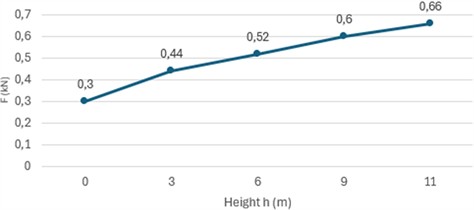
Table 2Inertial forces depending on seismic acceleration values
Seismic acceleration (m/s2) | Strength of inertia (kN) |
1.5 | 13.6 |
2.0 | 18.2 |
2.5 | 22.7 |
3.0 | 27.3 |
4. Conclusions
In this study, the dynamic and seismic properties of rooftop greenhouse structures were evaluated according to the normative document QMQ 2.01.03-19 “Construction in seismic zones.” The calculated total mass of the greenhouse structure was 910 kg, including 46 % metal frame elements, 23 % covering panels, and 31 % other structural components. Since the additional mass is located at the top of the building, seismic inertial forces increase. With seismic acceleration ranging from 1,5 to 3,0 m/s2, the inertial forces acting on the structure increase from 13,6 kN to 27,3 kN. The dynamic analysis also showed that the natural vibration frequency depends on the mass and stiffness of the structure. Therefore, when designing rooftop greenhouse structures in seismic regions, it is recommended to reduce structural mass, use lightweight covering materials, increase frame rigidity, and ensure structural symmetry. These measures improve the seismic stability of the structure and reduce deformation during earthquakes.
References
-
M. Paz and W. Leigh, Structural Dynamics: Theory and Computation. Springer, 2019.
-
B. S. Taranath, Structural Analysis and Design of Tall Buildings: Steel and Composite Construction. CRC Press, 2018.
-
H. Krawinkler and G. D. P. K. Seneviratna, “Pros and cons of a pushover analysis of seismic performance evaluation,” Engineering Structures, Vol. 20, No. 4-6, pp. 452–464, Apr. 1998, https://doi.org/10.1016/s0141-0296(97)00092-8
-
P. Fajfar, “A nonlinear analysis method for performance-based seismic design,” Earthquake Spectra, Vol. 16, No. 3, pp. 573–592, 2000, https://doi.org/10.1193/1.1586128
-
D. Vamvatsikos and C. A. Cornell, “Incremental dynamic analysis,” Earthquake Engineering and Structural Dynamics, Vol. 31, No. 3, pp. 491–514, 2001, https://doi.org/10.1002/eqe.141
-
N. M. Newmark, “A method of computation for structural dynamics,” Journal of the Engineering Mechanics Division, Vol. 85, No. 3, pp. 67–94, Jul. 1959, https://doi.org/10.1061/jmcea3.0000098
-
J. P. Moehle, “Performance-based seismic design of buildings,” Earthquake Spectra, Vol. 19, No. 2, pp. 403–418, 2003.
-
E. Miranda and V. V. Bertero, “Evaluation of strength reduction factors for earthquake-resistant design,” Earthquake Spectra, Vol. 10, No. 2, pp. 357–379, 1994, https://doi.org/10.1193/1.1585778
-
C. R. Farrar and K. Worden, “An introduction to structural health monitoring,” Philosophical Transactions of the Royal Society A: Mathematical, Physical and Engineering Sciences, Vol. 365, No. 1851, pp. 303–315, 2007, https://doi.org/10.1098/rsta.2006.1928
-
T. Paulay and M. J. N. Priestley, “Seismic design of reinforced concrete and masonry buildings,” Journal of Structural Engineering, Vol. 118, No. 10, pp. 2929–2931, 1992, https://doi.org/10.1016/0167-4730(93)90008-o
About this article

The authors have not disclosed any funding.
The datasets generated during and/or analyzed during the current study are available from the corresponding author on reasonable request.
The authors declare that they have no conflict of interest.

