Abstract
Historical monuments and cultural heritage objects play a fundamental role in ensuring the preservation of national identity and cultural continuity. The assessment of their structural condition using advanced computational technologies is an urgent scientific and practical task. This study investigates a XVI-century architectural monument – the Volaidai Abdulazizkhan Mosque located in the Bukhara region. A three-dimensional (3D) finite element model was developed using LIRA-SAPR software, and the structural behavior under static and dynamic loading conditions was analyzed. The stress-strain state, deformation characteristics, and seismic response of the structure were evaluated. The results reveal the presence of localized stress concentrations and deformation zones, particularly in the foundation and dome-wall connection areas. Despite these local effects, the overall structural stability remains within permissible limits. The obtained results provide a reliable basis for assessing structural safety and developing strengthening measures for historical monuments.
Highlights
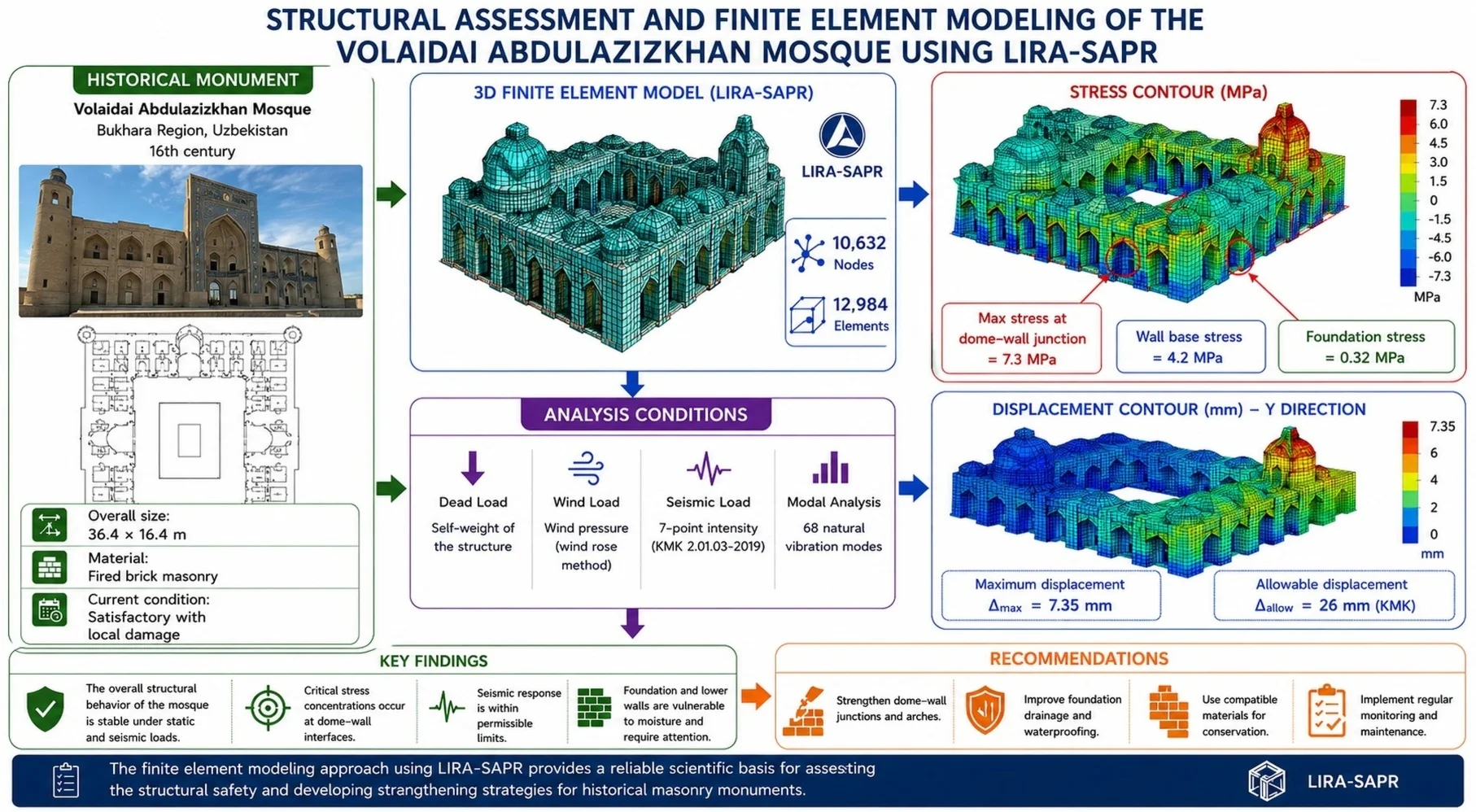
- A detailed 3D finite element model of the Volaidai Abdulazizkhan Mosque was developed using LIRA-SAPR to evaluate its structural behavior under static and seismic loads.
- Dynamic analysis identified 68 natural vibration modes, with the first five modes contributing approximately 68% of the total modal mass participation.
- The maximum seismic displacement reached 7.35 mm, remaining significantly below the allowable limit of 26 mm specified by KMK 2.01.03-2019.
- Critical stress concentrations up to 7.3 MPa were detected at dome–wall interfaces, indicating vulnerable structural zones requiring strengthening.
- The proposed finite element modeling approach provides a scientific basis for conservation planning and seismic strengthening of historical monuments.
1. Introduction
Historical monuments and cultural heritage objects occupy a significant place in the cultural and historical development of our country. These monuments embody the historical legacy and cultural identity of the nation and represent invaluable national assets and an integral part of public heritage. The study, preservation, and transmission of this heritage to future generations are considered essential civic responsibilities.
At present, the preservation of architectural monuments, their scientific investigation, and the assessment of their technical condition using modern information technologies have become one of the most urgent challenges. Extensive efforts are being undertaken to conserve and restore buildings and structures by applying advanced scientific and technological achievements. In this study, the XVI-century architectural monument – the Volaidai Abdulazizkhan Mosque, located in the Bukhara region – was selected as the research object.
Using the LIRA-SAPR software package, the structural behavior of the monument under static and dynamic loads was analyzed. Stress distribution diagrams and displacement mosaics were investigated, and the overall technical condition of the structure was evaluated.
Historical monuments and cultural heritage objects occupy a significant place in our country. These sites represent invaluable national assets that embody the rich history, culture, and identity of our people, forming an integral part of our spiritual heritage. The study, preservation, and transmission of such heritage to future generations constitute one of the most pressing responsibilities of modern society.
Currently, more than 7,000 cultural heritage sites are registered in the Republic, including approximately 2,500 architectural monuments, 2,700 archaeological sites, and 1,800 monumental objects. All of these are under state protection.
The preservation, scientific investigation, and restoration of architectural monuments – particularly through the application of modern information technologies and software-based tools for assessing their technical condition – have become one of the most urgent scientific and practical challenges. According to recent reports by the UNESCO and national cultural heritage authorities, the technical condition of architectural monuments can be classified as follows. Approximately 30-35 % of monuments are in good or excellent condition; this category mainly includes sites listed as World Heritage, regularly restored, and located in major tourist centers.
Around 40-45 % of monuments are in satisfactory condition, where the main structural components remain intact, but require cosmetic repairs or partial restoration. Meanwhile, approximately 20-25 % of monuments are in unsatisfactory or emergency condition, necessitating urgent conservation and comprehensive restoration measures. These are typically less-studied objects located in remote areas, such as mosques, mausoleums, and archaeological sites. The above analysis clearly indicates that the technical condition of a significant portion of architectural heritage is progressively deteriorating due to various natural and anthropogenic factors. Therefore, the assessment of their structural condition and the strengthening of load-bearing elements are of critical importance.
A review of the literature shows that architectural monuments have been extensively studied in the fields of archaeology, architecture, history, and art studies. In particular, researchers such as Galina Pugachenkova, Lev Rempel, and Nikolai Baklanov have conducted in-depth studies on historical planning solutions, proportions, and decorative features of monuments. Furthermore, studies by Tursun Rashidov and Murod Usmonov have focused on seismic stability, while international scholars such as Paulo Lourenço and Giorgio Croci have investigated the mechanical properties and interaction behavior of masonry materials, including stone and brick.
However, the application of advanced computational methods for modeling the technical condition of architectural monuments, analyzing stress-strain states of structural elements, and developing engineering recommendations remains insufficiently explored. Therefore, the present study is devoted to the assessment of the technical condition of an architectural monument using computer-based modeling techniques.
The scientific novelty of this research lies in the fact that, for the first time, the structural system of the 16th-century Volidai Abdulazizkhan Mosque has been analyzed, and a three-dimensional (3D) model has been developed using the LIRA-SAPR software package. The analysis takes into account the actual current mechanical properties of load-bearing materials and evaluates the structure under both static and dynamic loading conditions.
As a result, the overall stability characteristics of the monument and the stress state of its load-bearing elements have been determined and substantiated. In addition, 68 natural vibration modes of the structure were identified in the seismic analysis. Particular attention was given to critical zones, especially the junctions between the dome and walls, where the most critical points were quantified under a 7-point seismic intensity scenario. Based on the obtained results, scientifically grounded conclusions and practical recommendations regarding the technical condition and preservation of the monument have been formulated.
2. Methodology
The development of a three-dimensional (3D) model of an architectural monument requires a specialized approach, as each historical structure is unique. The mosque under consideration is located in the southwestern part of Bukhara and, in terms of its architectural composition, represents the classical style of Central Asian mosques. This congregational mosque was constructed by the Ashtarkhanid ruler Abdulazizkhan in honor of his mother.
The architectural layout of the mosque is based on the “square within a square” concept. The structure consists of a rectangular main prayer hall, an inner courtyard, and surrounding galleries (iwans) on two sides. A large central dome is positioned at the core of the building. The arches designed in the “swallow-tail” style and the muqarnas beneath the dome visually enhance the interior height and spatial perception.
The construction materials, building technologies, architectural style, and structural solutions applied in this monument are distinctive. Particular attention was given to proportional design when determining the building dimensions. Based on archival data, a 3D digital model of the monument was developed using the LIRA-SAPR software, and the effects of both static and dynamic loads were investigated.
Historical master builders possessed advanced knowledge of structural design, taking into account various seismic effects. In the Volaidai Abdulazizkhan Mosque, a special reed layer (“boyra”) was placed between the foundation and the ground to provide seismic damping and waterproofing. This layer consists of woven reed mats, serving as a primitive but effective isolation system.
The primary load-bearing elements of the model include the foundation, walls, columns, dome, and roof structures. For each structural component, material properties such as modulus of elasticity, Poisson’s ratio, and density were assigned based on their physical and mechanical characteristics.
The overall dimensions of the mosque are 36.4×16.4 m, comprising an inner courtyard, open galleries, and a domed prayer hall (Fig. 1). The dome diameter is 6.35 m. The load-bearing walls are constructed from traditional fired ceramic bricks with sizes ranging from 24 to 28 cm and thicknesses of 4.5-7 cm. The wall thickness varies between 100 and 130 cm.
Fig. 1General view of the 3D model
According to archival data and experimental studies, the water absorption of solid ceramic masonry ranges from 18 % to 30 %, depending on porosity. The compressive strength of the bricks varies between 50-300 kg/cm2 (5-30 MPa), while their frost resistance exceeds 50 cycles. The physical and mechanical properties of the ceramic bricks used in architectural monuments correspond to strength values of 8.0-11.5 MPa [2].
The compressive strength of the mortar ranges from 2.0 to 6.0 MPa. The bricks are bonded using gypsum-based mortar composed of calcined lime and soil. The average adhesion strength between brick and mortar ranges from 0.05 to 0.15 MPa.
According to the national standard KMK 2.03.07-98, the initial modulus of deformation of masonry is determined as follows: , where: 2 is a coefficient characterizing the type of masonry; 1000 is a coefficient reflecting the elastic properties of masonry; is the compressive strength of masonry.
Based on the adopted coefficients and calculation results, the modulus of elasticity of the brick masonry is taken as 176.5 MPa the Poisson’s ratio as 0.25, and the unit weight as 17,66 kN/m3 [9].
The open gallery is supported by wooden columns. In this study, the structure was subjected to the following loading conditions:
1) Permanent loads (self-weight of the structure).
2) Variable loads (snow and wind loads).
3) Special loads (seismic loads).
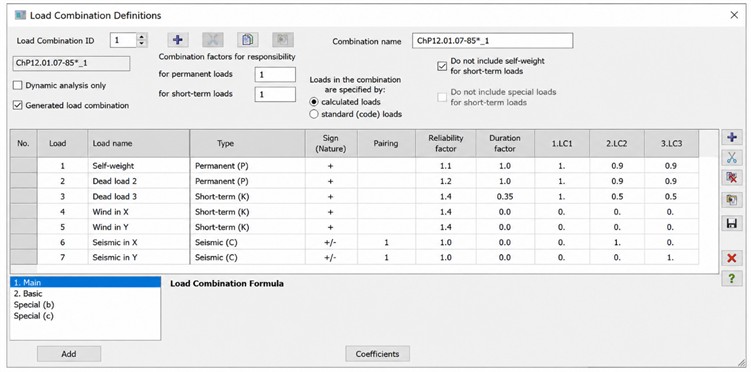
The applied load cases are illustrated in Fig. 2.
Fig. 2Applied loading conditions
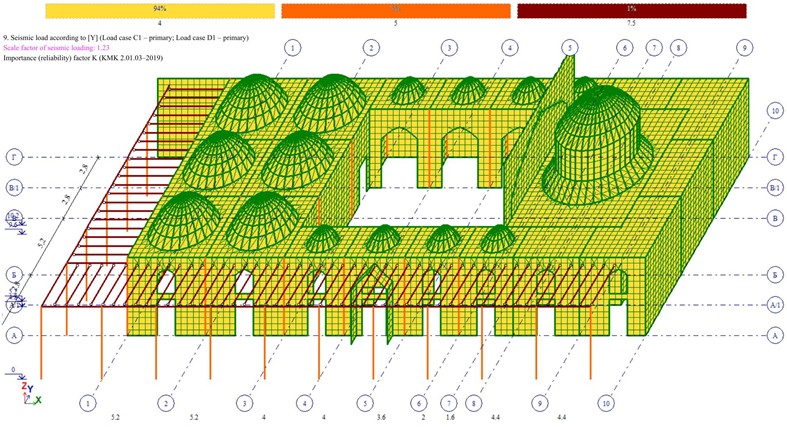
The permanent load, corresponding to the self-weight of the structure, was defined as 2710.38 kg/m2 (26.58 kN/m2). As a variable load, wind loading was applied based on the “wind rose” method in accordance with normative requirements, taking into account variation with height.
For example, at a height of 5 m, the wind pressure acting on the left column was 21.28 kg/m2 (0.209 kN/m2), while for the right column it was 15.96 kg/m2 (0.157 kN/m2). At a height of 10 m, these values increased to 27.66 kg/m2 (0.2713 kN/m2) and 20.75 kg/m2 (0.204 kN/m2), respectively.
Seismic loads acting on the structure were introduced based on accelerogram data. These accelerograms were obtained from engineering-seismological observations corresponding to earthquakes recorded in seismically active regions of the republic, with an intensity of 7 points on the MSK scale (Medvedev-Sponheuer-Karnik scale), which have a recurrence probability of once every 50 years.
The microseismic accelerograms of the ground were considered along the horizontal and axes, as well as the vertical axis. The peak ground acceleration (PGA) values were taken as 0.25 g in the horizontal directions ( and ) and 0.175 g in the vertical direction (). The time step of the accelerogram was 0.01 s, and the total duration of the seismic excitation was 10.06 s.
The foundation of the structure is composed of stone material and has undergone significant degradation due to prolonged moisture exposure. This condition was incorporated into the LIRA-SAPR model through the use of specific reduction coefficients.
Under static loading conditions, the maximum tensile stress in the foundation was 0.15 MPa, which is below the allowable soil resistance. However, in moisture-damaged zones at the base of the foundation, this value increased to 0.32 MPa, exceeding permissible limits and indicating the potential for localized settlement.
The deformation at the base of the foundation walls under static loading reached 5.7 mm. Although this value is lower than the allowable limit (/200 = 8.2 mm), the presence of progressive deformation risk should be taken into account.
In the 3D model, the stress in the dome roof structure located in the eastern part of the building reached 2.8 MPa, and its condition was assessed as “moderate.” Under static loading conditions, the resistance capacity of the wooden column elements was determined as 12 MPa, indicating a relatively safe margin.
However, at the junctions between the dome and the load-bearing walls, local stress concentrations reached up to 7.3 MPa, which may lead to localized crushing of the wooden elements. In these zones, deformations in the range of 1.5-2 mm were observed in the numerical model.
The seismic analysis was performed in full compliance with the national building code of the Republic of Uzbekistan – KMK 2.01.03-2019 “Construction in Seismic Regions.” The seismic zoning of the structure was defined for the Bukhara region, corresponding to a seismic intensity of 7 points.
The following key coefficients were adopted in the seismic load calculations:
1) 1.2 — earthquake recurrence factor.
2) 1.0 — number of storeys factor.
3) 1.0 — structural regularity coefficient.
4) 0.25 — seismic coefficient.
5) 0.30 — damping decrement.
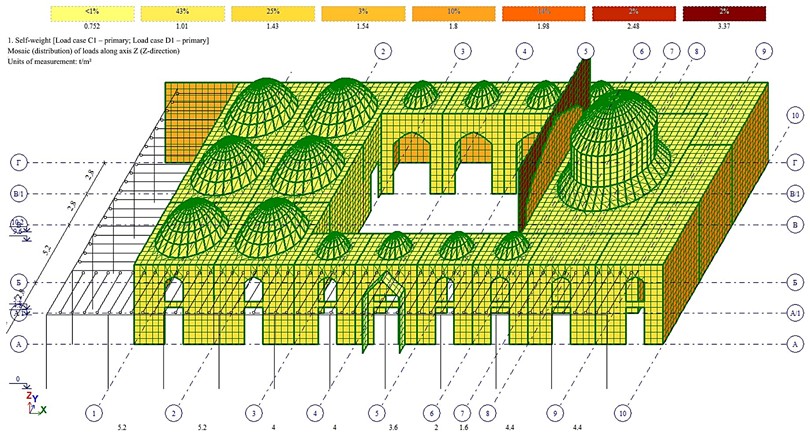
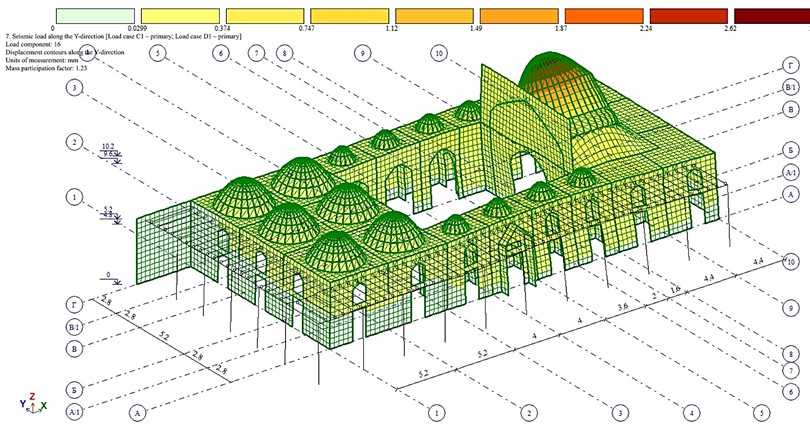
Under seismic loading, the most unfavorable displacements of the structure along the , , and axes are illustrated in Figs. 3-6.
Fig. 3Displacement contour along X-axis
3. Results
Based on the 3D model developed in the LIRA-SAPR environment, a dynamic analysis of the structure was performed, in which 68 natural vibration modes and their corresponding frequencies were calculated. The first five vibration modes accounted for approximately 68 % of the total modal mass participation, indicating that the primary seismic response of the building is concentrated within these modes.
Fig. 4Displacement contour along Y-axis
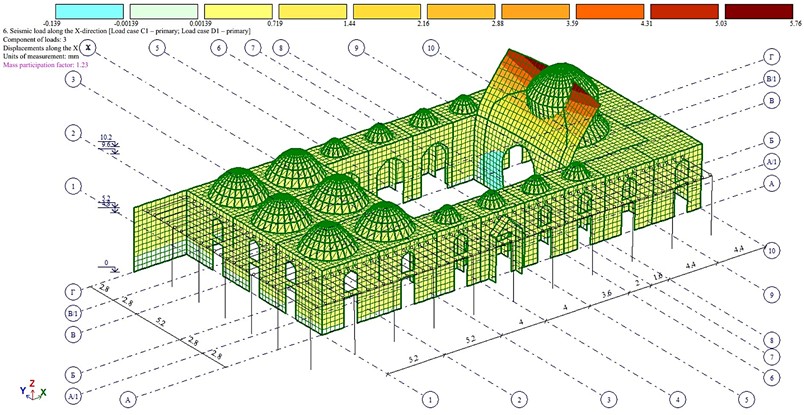
Fig. 5Displacement contour along Z-axis
The analysis results demonstrate that the main structural elements of the building – walls, domes, and columns – primarily exhibit horizontal vibrations under seismic excitation. This behavior leads to the development of significant stresses and deformations, particularly at the base of the walls and at the connection zones of the dome structures.
According to the numerical results obtained from the LIRA-SAPR analysis, the maximum deformation of the walls under seismic loading reached 8.7 mm. Local deformations at the joints of the dome structures were observed to reach up to 2.3 mm.
The following equivalent stresses were recorded in the structural elements under seismic loading:
1) Walls: up to 4.2 MPa.
2) Dome structures: up to 7.3 MPa (below the allowable limit for timber, 12 = 12= 12 MPa).
3) Foundation: up to 0.32 MPa (exceeding the allowable soil resistance of 0.25 MPa in certain regions, indicating the presence of potential risk zones).
Horizontal displacements along the principal axes were also evaluated. Under seismic loading, the maximum horizontal displacement along the -axis in the first vibration mode reached: 7.35 mm. This value does not exceed the permissible limit of: /200 = 5200/200 = 26.0 mm indicating that the overall lateral deformation of the structure remains within acceptable design limits.
4. Conclusions
The Volidai Abdulazizkhan Mosque was analyzed using a detailed three-dimensional finite element model developed in the LIRA-SAPR 2022 R1.1 environment. The numerical model, consisting of 10,632 nodes and 12,984 elements, enabled a comprehensive evaluation of the structural behavior of the monument under static and seismic loading conditions.
The results indicate that the maximum horizontal displacement of the structure (7.35 mm) remains significantly below the permissible limit of 26.0 mm specified by KMK 2.01.03-2019. This confirms that the global displacement response satisfies the standard requirements for seismic performance. However, compliance with displacement criteria alone does not ensure the overall structural safety of the monument.
A critical outcome of the analysis is the identification of significant local stress concentrations. In particular, compressive stresses at the base of load-bearing walls reached 4.2 MPa, exceeding the masonry compressive strength (1.8 MPa) by approximately 2.3 times. This behavior is primarily attributed to moisture-induced degradation, which significantly reduces the mechanical properties of both brick and mortar materials. Similar conclusions regarding the degradation of masonry strength and deformability under environmental exposure are reported in the studies of L. V. Dubrovskaya, N. M. Bachinsky, and N. S. Grazhdankina.
Furthermore, the deterioration of ganch mortar under moisture exposure reduces its adhesion capacity and increases its plasticity, resulting in a decrease of 30-50 % in the load-bearing capacity of masonry. Additional critical zones were identified in the foundation, where stresses reached up to 0.32 MPa, exceeding the allowable soil resistance (0.25 MPa), indicating a potential risk of localized settlement.
Dynamic analysis revealed 68 natural vibration modes, with the first five modes contributing approximately 68 % of the total modal mass, indicating that the structure is particularly sensitive to horizontal seismic effects. Under seismic loading, maximum deformations reached 8.7 mm in the walls and up to 2.3 mm in dome connection zones, while local stress concentrations of up to 7.3 MPa at dome-wall interfaces indicate a risk of localized damage.
Despite these localized deficiencies and material degradation effects, the global structural response remains within permissible limits. Considering stress redistribution, spatial behavior, and the composite interaction of masonry, the overall structural system maintains stability under the considered loading conditions.
Nevertheless, the identified critical zones require targeted strengthening measures, moisture protection strategies, and continuous structural monitoring to ensure long-term safety and durability of the monument. The presented approach demonstrates the effectiveness of advanced finite element modeling for the assessment of historical structures and provides a reliable scientific basis for developing restoration and conservation strategies in seismic regions.
References
-
Z. S. Xodjaeva, “Modeling and comparative analysis of strengthening methods of load-bearing walls of architectural monuments in Central Asia using computer programs,” (in Uzbek), in Challenges and Solutions in the Integration of Digital Technologies into the Graphic Education Process, pp. 579–588, Apr. 2025, https://doi.org/10.5281/zenodo.15245064
-
Z. S. Xodjaeva, “Development and calculation of historical monument models using computer technologies,” (in Uzbek), in Challenges and Solutions in the Integration of Digital Technologies into the Graphic Education Process, pp. 525–531, Apr. 2025, https://doi.org/10.5281/zenodo.15354962
-
Z. S. Xodjaeva and D. A. Samadova, “Structural solutions in the analysis of the technical condition of architectural monuments in Uzbekistan,” Me’morchilik va Qurilish Muammolari (Scientific-Technical Journal), No. 1, pp. 80–83, 2025.
-
“Construction in Seismic Regions,” State Committee for Architecture and Construction, Tashkent, Uzbekistan, KMK 2.01.03-2019, 2019.
-
R. Yusupov, K. Alimov, and M. Utegenova, “Application of laser scanning in examining and preserving historical monuments,” (in Russian), Universum: Tekhnicheskie Nauki, No. 11-6(116), pp. 59–65, 2023.
-
A. Khodjaev and M. Utegenova, “Engineering analysis of structures and assessment of the technical condition of architectural monuments,” Science and Innovation, Vol. 2, No. C1, pp. 21–28, 2023.
-
B. Axmedov, K. Shukurova, M. Utegenova, and D. Saydullayeva, “Analysis of defects, damage and deformation states in architectural monuments and problems of their restoration,” Texnika Fanlarining Dolzarb Masalalari, Vol. 3, No. 3, pp. 99–105, 2025.
-
M. A. Utegenova, “Some issues of analysis of the technical condition of historical monuments and buildings,” (in Russian), Universum: Tekhnicheskie Nauki, No. 11-3 (92), pp. 22–24, 2021.
-
G. Pugachenkova, “Architecture of Central Asia. 16th Century,” Gafur Ghulom Publishing House, Tashkent, 1976.
About this article

The authors have not disclosed any funding.
The datasets generated during and/or analyzed during the current study are available from the corresponding author on reasonable request.
The authors declare that they have no conflict of interest.

