Abstract
Aiming at the problem of insufficient stability of crawler drill rigs during construction under complex geological conditions in underground coal mines, this paper designs an auxiliary stabilizing device based on mechanical-hydraulic coupling. Through structural innovation, mechanical analysis and engineering verification, the role of this device in enhancing the anti-overturning capacity of the drill rig and reducing drilling deviation has been clarified. The research shows that this device can effectively expand the adaptability range of the drill rig’s operating angle and significantly reduce the drilling trajectory deviation, providing technical support for efficient and safe underground drilling. Its research results have important practical value for projects such as gas extraction and water hazard prevention and control in deep coal mining.
1. Introduction
Underground roadway drilling in coal mines is a core technical means for gas drainage, water hazard prevention, and geological exploration [1]. As China’s coal mining extends to greater depths (average depth exceeding 800 m), it faces challenges of complex strata, upgraded drilling parameters, and intelligent transformation. Despite domestic breakthroughs in maximum directional drilling depth (3353 m) [2], insufficient stability of drilling rigs under complex strata remains a key constraint on drilling efficiency and safety [3].
Foreign high-end rigs (e.g., Bauer, Germany; Schramm, USA) achieve full-hydraulic automatic leveling but have high costs (3-5 times those of domestic rigs) and their explosion-proof grades only meet European ATEX standards, incompatible with China’s high-gas mines. Domestic studies include hydraulic-mechanical composite support (force attenuation at > 25° inclination) and mast modal optimization (failed multi-condition adaptability), with common flaws: complex structure (> 80 components), heavy weight (> 500 kg), and poor terrain adaptability.
Targeting the ZDY6500LP rig developed by Xi’an Research Institute of China Coal Technology and Engineering Group, this paper designs a modular auxiliary stabilization device via mechanical limiting-hydraulic support synergy, forming a “rigid constraint + flexible compensation” system to solve stability issues under large inclinations/soft floors. Industrial tests verify its effect. Subsequent sections cover the device’s design, mechanical analysis, application effects, and conclusions.
2. Development status of underground coal mine drilling equipment
2.1. Industry demands and technical bottlenecks
With the increase in coal mining depth, underground drilling faces three core challenges:
a) Complex stratum conditions: Broken and soft coal seams, hard rock formations, and composite roofs account for over 60 % of mining areas, among these the borehole diameter reduction rate of soft coal seams with water content exceeding 25 % reaches 47 % [4].
b) Upgraded drilling parameters: High-level directional boreholes require a diameter of more than 300 mm and a depth of over 1000 m, thus increasing the requirement for the anti-overturning moment of the rig’s support system to more than 100 kN·m [5].
c) Demand for intelligent transformation: Unmanned operation and remote control technologies require the equipment to have real-time attitude monitoring and automatic leveling capabilities. The response delay of existing mechanical support systems ranges from 0.8 to 1.2 seconds, failing to meet the requirements of dynamic adjustment [6].
Existing rig stabilization systems have two major technical defects:
a) Insufficient stiffness of traditional pin connection: A sway of ±5 mm occurs due to the gap effect when adjusting the mast inclination angle, leading to a cumulative borehole azimuth deviation of ±3°/100 m.
b) High ground contact pressure of hydraulic outriggers: In floors with a compressive strength of < 15 MPa, the settlement of outriggers can reach 80-120 mm per shift, requiring frequent shutdowns for adjustment.
2.2. Domestic and foreign research progress
Foreign high-end rigs, such as those produced by Bauer (Germany) and Schramm (USA), have realized full-hydraulic automatic leveling [7]. They adopt a six-point parallel support structure with a leveling accuracy of ±0.5°, but their costs are 3-5 times higher than that of domestic rigs. Moreover, their explosion-proof grade only meets the European ATEX standard, making them difficult to adapt to the high-gas environment in China’s underground coal mines [8].
Domestic scholars have carried out a series of studies on stabilization devices: One study designed a hydraulic-mechanical composite support system that enhances stability through the linkage of a four-bar linkage, yet the supporting force attenuates significantly when the inclination angle exceeds 25°; Another study used finite element software to conduct modal analysis on the rig mast, optimized the layout of support points, and increased the first natural frequency from 28.5 Hz to 35.2 Hz, but failed to solve the problem of adaptability to multiple working conditions. Existing devices generally suffer from three major drawbacks: complex structures (comprising more than 80 components), heavy weight (exceeding 500 kg per set), and poor terrain adaptability (only suitable for working conditions where floor undulation is ≤ 50 mm). Therefore, there is an urgent need for innovative solutions featuring light weight and modularization.
3. Overall design of the auxiliary stabilization device
3.1. Design objectives and principles
Taking the ZDY6500LP drilling rig (with a total mass of 12 t and a maximum output torque of 6500 N·m) as the research platform, the core design objectives are outlined as follows:
a) Working condition adaptability: Adapt to working conditions with an inclination angle of ±30°, and the anti-overturning moment ≥ 120 kN·m.
b) Installation convenience: Modular design, on-site modification time ≤ 2 hours, no special tools required.
c) Precision control: Deformation of key components under working load < 1.5 mm, meeting the accuracy requirements of directional drilling.
The design follows three principles:
a) Compatibility principle: Utilize the original pin holes, hydraulic interfaces, and other structures of the drilling rig to reduce modification work by 60 %.
b) Rigid-flexible coupling principle: Adopt a composite structure of “rigid limiting + flexible support” to balance stability and terrain adaptability.
c) Lightweight principle: Control the total mass of the device within 300 kg, reducing weight by 40 % compared with traditional schemes.
3.2. Structural composition and working principle
The device comprises three components: a sleeve-insert rod limiting assembly, a strut adjustment assembly, and a chuck body support and fixing assembly (Fig. 1), forming a stable triangular support system.
Fig. 1Composition diagram of the auxiliary stabilization device: 1 – sleeve; 2 – insert rod; 3 – chuck body assembly; 4 – plug cover; 5 – extension rod; 6 – strut
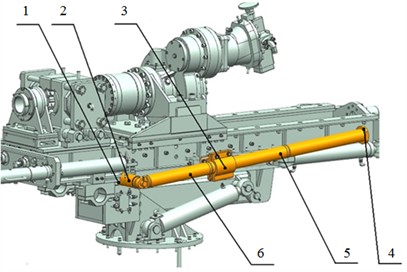
Working principle: When the drilling rig operates in an inclined stratum, first, the threaded connection between the insert rod and the sleeve forms a mechanical limit to restrict the horizontal displacement of the mast; the strut tightly supports the main machine to generate a vertical supporting force, constructing a spatial force system to jointly resist the overturning moment [9].
4. Key structural design and mechanical analysis
4.1. Optimization of sleeve-insert rod connection structure
The sleeve-insert rod connection adopts M36 high-strength bolts (performance grade 10.9), with a thread profile angle of 60° and a pre-tightening force 80 kN. Based on elastic theory, the contact stress of the thread pair is calculated as follows:
where: is the thread pitch diameter (34 mm), h is the thread profile height (3 mm), and is the number of meshing threads (6 threads).
The calculated contact stress 162 MPa, which is much smaller than the allowable stress 200 MPa of 40Cr material. The safety factor 1.23, meeting the strength requirements.
4.2. Mechanical modeling and stability analysis of the support system
The drilling rig is simplified as a rigid body, and the support system is treated as a planar truss. A Cartesian coordinate system - is established ( is the center of gravity of the rig).
a) Total mass of the rig 12 t, height of the center of gravity 1.8 m.
b) Working inclination angle 30°, floor friction coefficient 0.3.
c) Working pressure of the hydraulic strut 30 MPa, cylinder diameter 63.5 mm.
Calculation of overturning moment:
Calculation of anti-overturning moment.
Thrust of a single strut:
The moment arm of the support system 2.2 m, and the angle between the strut and the horizontal plane 15°. Then the anti-overturning moment is:
Safety factor for stability:
This meets the requirement of anti-overturning safety factor ≥ 1.2 specified in the Quality Standard for Installation of Coal Mine Mechanical and Electrical Equipment.
5. Engineering application and effect analysis
5.1. Installation process and standardized procedures
A “four-step standardized installation method” has been formulated (Fig. 2), accompanied by a dedicated supporting tool kit (including a torque wrench, a positioning template, etc.):
a) Disassembly and positioning: Remove the pin of the original angle adjustment device, install a long pin (exposed 5 mm), and mark the welding position of the sleeve with a positioning template.
b) Welding reinforcement: Weld the sleeve and 6 triangular ribs (10 mm thick) using CO2 gas shielded welding, with a weld height of 8 mm. Ultrasonic testing (UT) is conducted after welding.
c) Component assembly: Install the insert rod and pre-tighten it (torque: 200 N·m) and connect the hydraulic pipeline (pressure resistance: 40 MPa).
d) Commissioning and calibration: Start the hydraulic system, test the telescopic performance of the strut (stroke: 600 mm), and calibrate the inclination sensor (accuracy: ±0.5°).
On-site installation data from a coal mine in Huaibei indicates that 3 skilled workers can complete the installation of the device within 1.5 hours, increasing efficiency by 50 % compared with traditional schemes.
5.2. Industrial tests and data analysis
Industrial tests were conducted for 3 consecutive months in a coal mine in Huaibei (mining depth: 680 m, coal seam inclination angle: 22°-35°, floor compressive strength: 12 MPa), covering 50 directional boreholes (designed depth: 800-1000 m, diameter: 300 mm). The rig was operated continuously for 8 hours per shift, with real-time monitoring of rig attitude (via a dual-axis inclination sensor with accuracy ±0.1°) and strut base plate settlement (via displacement transducers). Drilling data before and after the device installation are compared in Table 1.
Test results confirmed: Maximum strut settlement ≤ 8 mm, maximum transient mast vibration amplitude ≤ 0.8 mm, and no stability-related shutdowns occurred, verifying the device’s adaptability to dynamic working conditions.
Fig. 2Four-Step Installation Diagram. Photos taken by Xin Gao at a coal mine in Huaibei in October 2023
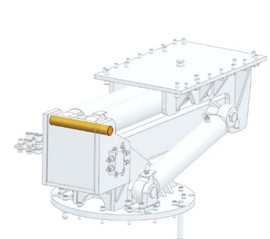
a) Disassembly and positioning
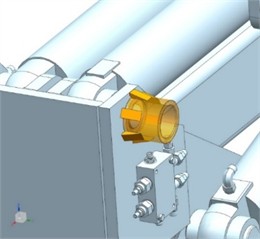
b) Welding reinforcement
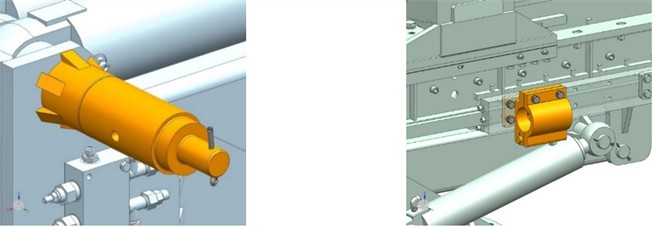
c) Component assembly
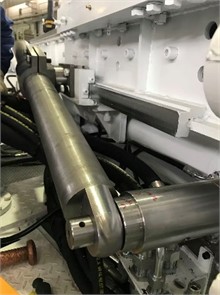
d) Commissioning and calibration
Table 1Comparison of drilling performance before and after device installation
Indicator | Before installation | After installation | Improvement ratio |
Azimuth deviation | ±3.0° | ±1.7° | 43 % |
Inclination deviation | ±2.0° | ±1.1° | 45 % |
Mechanical drilling speed | 1.2 m/h | 1.54 m/h | 28 % |
Sticking accident rate | 12 times/100 boreholes | 4 times/100 boreholes | 67 % |
5.3. Economic and social benefits
a) Direct economic benefits.
The cost of a single set of devices is 85,000 yuan. Based on annual savings of 450,000 yuan in accident losses and additional income of 750,000 yuan from efficiency improvement, the investment payback period is 1.2 months.
The qualification rate of boreholes increased from 82 % to 96 %, reducing rework costs by 220,000 yuan annually.
b) Social benefits.
It has reduced the labor intensity of workers, with the number of workers per shift decreasing from 5 to 3.
It has reduced safety accidents caused by drilling rig overturning, ensuring the safety of underground operators.
Provided technical support for gas drainage in deep coal seams.
6. Conclusions
To address the insufficient stability of crawler drilling rigs under complex geological conditions in underground coal mines, this study took the ZDY6500LP drilling rig as the research platform, designed a modular auxiliary stabilization device based on mechanical-hydraulic coupling, and verified its effectiveness through mechanical analysis and industrial tests, clarifying its role in improving drilling rig stability and drilling quality.
A rigid-flexible coupled stabilization system was built: Through the synergy of the “sleeve-insert rod” mechanical limit and “strut” hydraulic flexible support, the device forms a “rigid constraint + flexible compensation” system, restricting the horizontal displacement of the mast and providing stable vertical support, thereby solving the stability problems of traditional drilling rigs under large inclination angles and on soft floors.
The mechanical performance meets the requirements: The sleeve-insert rod adopts M36 high-strength bolts (grade 10.9), with a thread contact stress of 162 MPa (lower than the allowable stress of 40Cr) and a safety factor of 1.23; its anti-overturning moment reaches 132.5 kN·m (25 % higher than that of the original drilling rig), meeting the safety factor standard of ≥ 1.2.
Industrial tests demonstrated significant improvements: In a Huaibei coal mine (depth: 680 m, coal seam inclination angle: 22°-35°), the device expanded the working inclination range of the drilling rig from ±18° to ±30°, reduced borehole deviation by 43 %-67 %, increased the mechanical drilling speed by 28 %, reduced sticking accidents by 67 %, and increased the borehole qualification rate from 82 % to 96 %.
It has significant application value: featuring a modular design (on-site modification time ≤ 2 hours), lightweight (total mass ≤ 300 kg, 40 % lighter than traditional schemes), and compatibility with the original structure of the drilling rig (60 % less modification work); economically, the payback period is 1.2 months, while socially, it reduces labor intensity and overturning accidents, providing support for the safe drilling of deep coal mines.
References
-
Z. Shi et al., “40 years of development and prospect on underground coal mine tunnel drilling technology and equipment in China,” (in Chinese), Coal Science and Technology, Vol. 48, No. 4, pp. 1–10, 2020.
-
Y. Song, R. Bao, and B. Shi, “Experimental and theoretical study of the time-effect-based instability characteristics of the gas drainage borehole sealing section in a soft coal seam,” ACS Omega, Vol. 7, No. 11, pp. 9303–9309, Mar. 2022, https://doi.org/10.1021/acsomega.1c06078
-
S. Kumar Singh, B. Pratap Banerjee, and S. Raval, “A review of laser scanning for geological and geotechnical applications in underground mining,” International Journal of Mining Science and Technology, Vol. 33, No. 2, pp. 133–154, Feb. 2023, https://doi.org/10.1016/j.ijmst.2022.09.022
-
A. J. Das et al., “Evaluation of energy accumulation, strain burst potential and stability of rock mass during underground extraction of a highly stressed coal seam under massive strata-a field study,” Engineering Geology, Vol. 322, p. 107178, Sep. 2023, https://doi.org/10.1016/j.enggeo.2023.107178
-
M. Crabbe, J. Leader, H. M. Hall, and M. Burdett, “Technology adoption in the Canadian mining sector: A systematic scoping review,” Resources Policy, Vol. 103, p. 105566, Apr. 2025, https://doi.org/10.1016/j.resourpol.2025.105566
-
M. Shimaponda-Nawa and G. T. Nwaila, “Integrated and intelligent remote operation centres (I2ROCs): Assessing the human-machine requirements for 21st century mining operations,” Minerals Engineering, Vol. 207, p. 108565, Feb. 2024, https://doi.org/10.1016/j.mineng.2023.108565
-
Z. Xia, “Design and research of automatic drilling pressure control system for rescue drilling rigs,” (in Chinese), China University of Mining and Technology, China, 2024, https://doi.org/10.27623/d.cnki.gzkyu.2024.001271
-
A. Anani, S. O. Adewuyi, N. Risso, and W. Nyaaba, “Advancements in machine learning techniques for coal and gas outburst prediction in underground mines,” International Journal of Coal Geology, Vol. 285, p. 104471, Apr. 2024, https://doi.org/10.1016/j.coal.2024.104471
-
D. Cheng, “Mechanical design handbook,” (in Chinese), Choice Reviews Online, Vol. 34, No. 2, pp. 34–948-34-0948, Oct. 1996, https://doi.org/10.5860/choice.34-0948
About this article

The authors have not disclosed any funding.
The datasets generated during and/or analyzed during the current study are available from the corresponding author on reasonable request.
The authors declare that they have no conflict of interest.

