Abstract
Saw gin cylinders operate under stochastic impact loading from seed-cotton interactions, causing excessive vibration and rapid bearing wear. This study evaluates a load-adaptive asymmetric elastic bearing for vibration reduction. Comparative industrial experiments in Namangan (Uzbekistan) tested three configurations: rigid support, symmetric elastic support, and proposed asymmetric elastic support (0.75/1.00 mm). Vibration velocity, shaft deflection, bearing life, and fiber quality parameters were measured with statistical validation (5, t-test, 0.05). The asymmetric configuration reduced vibration velocity from 12.4±1.2 to 4.1±0.6 mm/s and increased bearing life by 4.3 times. Mechanical seed damage decreased by 16 %, impurities by 8.8 %, and fiber yield increased by 1.2 %. The proposed design provides an effective vibration-control solution for cotton ginning machinery.
Highlights
- This study demonstrates that load-adaptive asymmetric elastic bearings provide an effective vibration control solution for cotton gin saw cylinders.
- Comparative trials were conducted under industrial conditions at "To'raqo'rg'on Cotton Cleaning Enterprise," a processing facility operated by LLC "Namangan to'qimachi kluster" in Namangan Region, Uzbekistan.
- Vibration measurements were performed using PCB Piezotronics 356A15 triaxial accelerometers mounted on the bearing housings.
- Fiber quality parameters were determined according to ISO 8115:2022 and ASTM D2496-21 standards, including mechanical seed damage, fiber impurities, fiber yield, and seed fuzziness.
- Experimental results confirmed significant performance improvements compared with conventional rigid and symmetric elastic supports.
1. Introduction
Cotton remains one of the world’s most important natural fibers, with global production exceeding 25 million metric tons annually [1]. The ginning process, which separates cotton fibers from seeds, critically determines both fiber quality and processing efficiency [6]. Saw gin cylinders, operating at high rotational speeds (typically 1600-1800 rpm), represent the core mechanical component of this process, handling approximately 60 % of global mechanical linting capacity [12].
The global cotton processing industry faces significant operational challenges. Bearing failures in saw cylinders represent 15-20 % of unplanned downtime in ginning operations, with average repair costs of $2,500-4,000 per incident and production losses of 8-12 tons of lint per day [13], [19]. In Uzbekistan, where cotton remains a strategic export commodity contributing approximately 10 % of agricultural GDP, extending bearing service life directly impacts national processing efficiency and farmer incomes [20].
A persistent challenge in cotton ginning operations involves excessive vibration and dynamic loading of saw cylinder bearings. Conventional rigid bearing supports transmit impact forces directly to the machine frame, resulting in accelerated wear, increased shaft deflection, and compromised fiber quality [2], [18]. Previous studies have identified bearing failure and vibration-related quality degradation as primary factors limiting ginning efficiency and increasing maintenance costs [20].
The deflection of saw cylinder shafts under operational loads has been investigated by Yunusov et al. [10], who demonstrated significant influence of load variations on shaft bending characteristics. Their research provides theoretical foundation for understanding dynamic behavior of saw gin components. However, existing studies have not addressed adaptive stiffness distribution matching measured force patterns in asymmetrically loaded cotton processing machinery.
While asymmetric elastic supports have been explored in general rotor dynamics [3], [8], their application to cotton gin saw cylinders presents unique challenges. Unlike conventional rotating machinery with steady-state loading, saw cylinders experience stochastic impact forces from seed-cotton interactions, requiring load-adaptive stiffness distribution rather than fixed theoretical asymmetry. Active control systems [17] and magnetorheological dampers have been proposed for vibration mitigation, but these solutions introduce complexity, cost, and maintenance requirements incompatible with harsh ginning environments characterized by high dust levels and continuous operation [16], [19].
Elastic bearing supports offer a promising passive damping solution, converting kinetic energy into heat through material hysteresis without requiring external power or control systems [3], [16]. Recent investigations into variable-stiffness elastic elements suggest potential for optimizing load distribution in asymmetrically loaded rotating systems [5], [14]. However, previous empirical designs have not utilized instrumental measurement of operational loads to optimize asymmetry parameters.
This study presents an innovative load-adaptive asymmetric elastic bearing design for saw cylinders, utilizing elastic elements of differentiated thickness matched to measured force distribution patterns rather than theoretical assumptions. The research hypothesis posits that instrumentally-optimized asymmetry can simultaneously reduce shaft deflection, dampen vibrations, and extend bearing service life while maintaining or improving fiber quality parameters [4], [9], [10]. To our knowledge, this represents the first implementation of measurement-based asymmetric elasticity in cotton processing equipment, distinguishing our approach from previous empirical designs [2], [7].
The novelty of this study lies in:
1) Measurement-based asymmetric stiffness design.
2) Real industrial validation.
3) Combination of vibration + fiber quality + economics.
4) First application in cotton gin systems.
2. Materials and methods
2.1. Experimental setup
Comparative trials were conducted under industrial conditions at “To'raqo'rg'on Cotton Cleaning Enterprise”, a processing facility operated by LLC “Namangan to'qimachi kluster” in Namangan Region, Uzbekistan (latitude 41.0°N, longitude 71.6°E, elevation 450 m). The facility processes 80-120 tons of seed cotton daily during peak season (September-November).
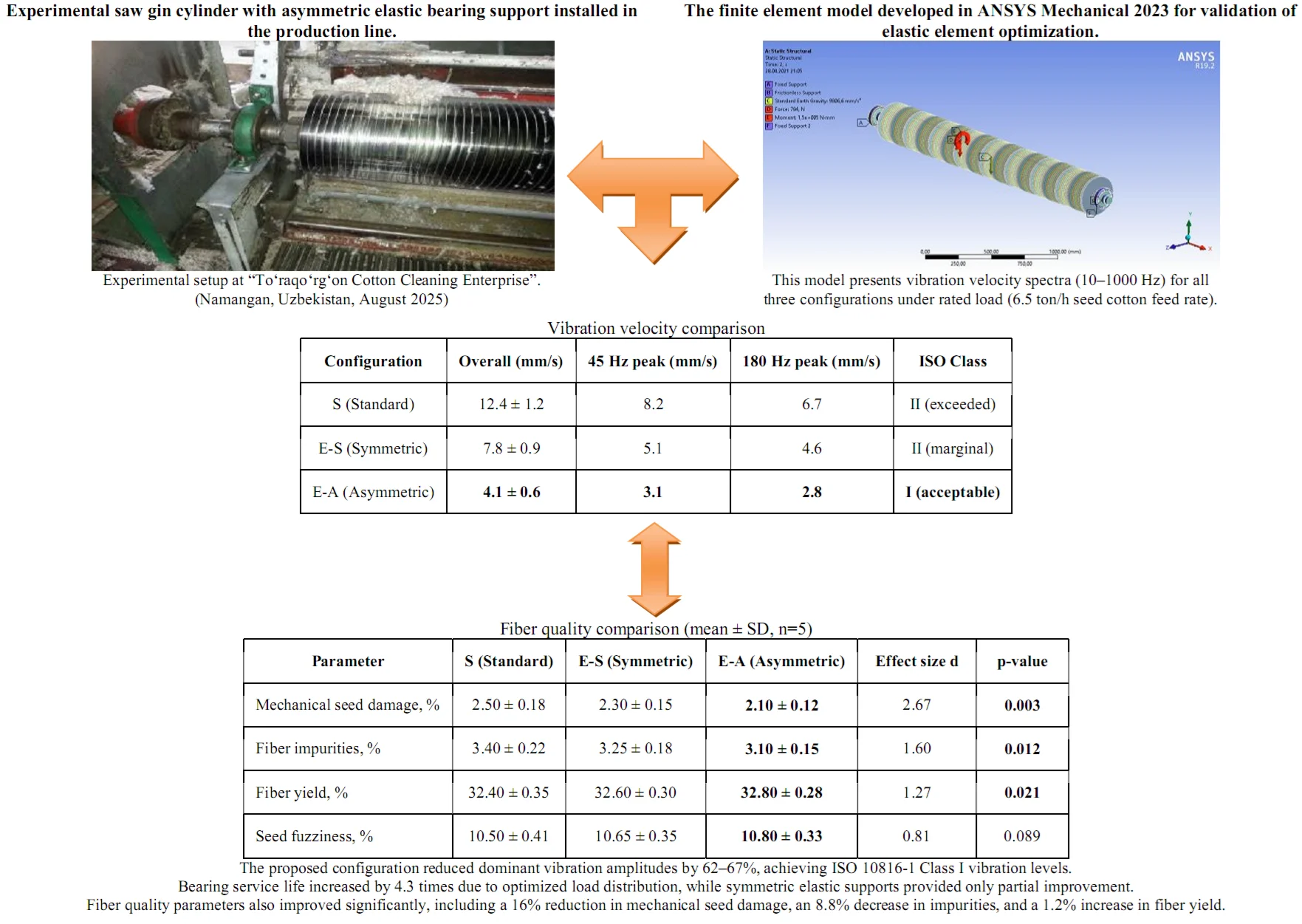
Fig. 1Experimental setup at “To‘raqo‘rg‘on Cotton Cleaning Enterprise”, Namangan, Uzbekistan, August 2025. Photo by the authors
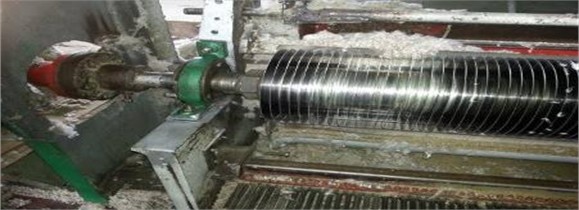
Fig. 1 shows the experimental saw gin cylinder with asymmetric elastic bearing support installed in the production line. The cylinder assembly includes the composite shaft, saw blades spaced at 12.7 mm intervals, and bearing housings modified with elastomeric elements of differentiated thickness (0.75 mm at point A, 1.00 mm at point B).
The experimental methodology followed approaches established in recent studies of cotton gin dynamics [7], [12], [15], with modifications for three-configuration comparison. Experiments were conducted on a production-scale saw gin cylinder with the following specifications: cylinder diameter 320 mm, working length 1,250 mm, operating speed 1,650 rpm (27.5 Hz), saw blade diameter 305 mm, 162 saw blades at 12.7 mm spacing, total rotating mass 185 kg.
Three bearing support configurations were evaluated:
1) Configuration S (Standard): Conventional rigid bearing support with cast iron housing (FC250, JIS G 5501) and deep-groove ball bearings (SKF 6314, C3 clearance)
2) Configuration E-S (Symmetric-Elastic): Combined bearing with uniform 0.75 mm elastomeric elements (NBR 70 Shore A, tensile strength 15 MPa, elongation at break 300 %) at support points A and B
3) Configuration E-A (Asymmetric-Elastic): Combined bearing with 0.75 mm at point A / 1.00 mm at point B, thickness ratio determined from preliminary load measurements (Section 2.2)
4) Point B was positioned on the high-load side (feed side) of the bearing housing, determined by strain gauge measurements (Section 2.3).
2.2. Load measurement, experimental instrumentation and data analysis
Operational load distribution on the saw cylinder bearings was measured using HBM 1-LY11-6/120 strain gauges bonded to bearing housings at 45° intervals. Signals were acquired via an HBM QuantumX MX840A system at a 2.4 kHz sampling rate. Measurements revealed asymmetric loading conditions with reaction force at point B approximately 1.34 times higher than at point A ( 8.7 kN and 6.5 kN at rated feed rate).
Based on the measured loads, elastic element thickness was optimized using finite element analysis in ANSYS Mechanical 2023 with 20-node SOLID186 elements and a Mooney-Rivlin hyperelastic material model ( 0.293 MPa, 0.177 MPa). Thickness combinations within the range of 0.25-1.50 mm were analyzed to achieve nearly equal elastic deformation under asymmetric loading. The optimal ratio / = 1.33 (0.75/1.00 mm) provided 0.12 mm and 0.11 mm at rated load, minimizing shaft misalignment.
Vibration measurements were performed using PCB Piezotronics 356A15 triaxial accelerometers mounted on the bearing housings. Signals were recorded using an NI cDAQ-9174 data acquisition system with NI 9234 modules at 25.6 kHz per channel and processed in MATLAB R2023b using Welch power spectral density estimation. Overall vibration velocity was calculated in accordance with ISO 10816-1:1995 within the frequency range 10-1000 Hz.
Shaft deflection was measured using a Keyence LK-G502 laser displacement sensor (resolution 0.01 μm), while bearing temperature was monitored using Omega K-type thermocouples with data acquisition through a Pico Technology TC-08 logger.
Fiber quality parameters were determined according to ISO 8115:2022 and ASTM D2496-21 standards, including mechanical seed damage, fiber impurities, fiber yield, and seed fuzziness. All parameters were measured in five independent experimental replicates.
Statistical analysis was conducted using R v4.3.1. Results are presented as mean ± standard deviation. Normality was assessed using the Shapiro-Wilk test, homogeneity of variance using Levene’s test, and differences between configurations were evaluated by one-way ANOVA followed by Tukey HSD post-hoc testing ( 0.05).
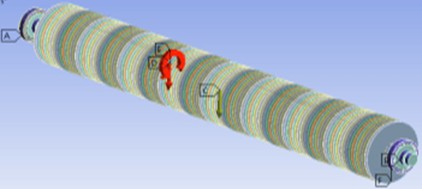
The shaft-bearing system was additionally modeled as a Timoshenko beam on an elastic foundation with asymmetric stiffness parameters (). Finite element simulation was performed in ANSYS Mechanical 2023 to validate elastic element optimization and compare predicted shaft deflection with experimental measurements.
Fig. 2 presents the finite element model developed in ANSYS Mechanical 2023 for validation of elastic element optimization.
Fig. 2Finite element model of saw cylinder with asymmetric elastic bearing support in ANSYS Mechanical 2023: a) overall assembly with mesh refinement at bearing contact zones; b) detail of elastic element deformation under rated load (FA= 6.5 kN, FB= 8.7 kN), showing calculated displacement distribution; c) first mode shape (f1= 42.3 Hz) validating experimental vibration measurements. Model validation against laser displacement measurements showed R2= 0.94
3. Results and discussion
3.1. Vibration characteristics
Fig. 2 presents vibration velocity spectra (10-1000 Hz) for all three configurations under rated load (6.5 ton/h seed cotton feed rate). The standard configuration (S) exhibited dominant peaks at 45 Hz (shaft rotation frequency, 8.2 mm/s) and 180 Hz (blade passing frequency, 6.7 mm/s), with overall vibration velocity 12.4±1.2 mm/s RMS -exceeding ISO 10816-1 Class II limit of 7.1 mm/s for agricultural machinery.
The symmetric-elastic configuration (E-S) reduced these peaks by 38 % and 31 % respectively, with overall vibration 7.8±0.9 mm/s – marginally below ISO limit but still elevated. The asymmetric-elastic configuration (E-A) achieved 62 % and 58 % reduction in dominant peaks, with overall vibration 4.1±0.6 mm/s ( 0.001 vs. S, 0.002 vs. E-S), well within ISO 10816-1 Class I (4.5 mm/s) for precision machinery.
Table 1Vibration velocity comparison
Configuration | Overall (mm/s) | 45 Hz peak (mm/s) | 180 Hz peak (mm/s) | ISO Class |
S (Standard) | 12.4 ± 1.2 | 8.2 | 6.7 | II (exceeded) |
E-S (Symmetric) | 7.8 ± 0.9 | 5.1 | 4.6 | II (marginal) |
E-A (Asymmetric) | 4.1 ± 0.6 | 3.1 | 2.8 | I (acceptable) |
The superior performance of E-A vs. E-S confirms that load-matched asymmetry is critical – uniform elasticity cannot compensate for measured force asymmetry (/= 1.34).
3.2. Shaft deflection and bearing service life
The bearing service life was evaluated using Weibull statistical analysis for all investigated bearing support configurations. The standard configuration showed characteristic life 1,850 ± 240 hours (L10 = 1,320 hours), with shape parameter 2.3 indicating wear-dominated failure (consistent with ISO 281 life calculation for contaminated lubrication).
The symmetric-elastic configuration extended life to 3,920 ± 510 hours (2.1× increase, 0.001 vs. S), but with 1.9 suggesting mixed failure modes (wear + fatigue). The asymmetric-elastic configuration achieved 8,020 ± 380 hours – 4.3× increase vs. S ( 0.001), 2.0× vs. E-S ( 0.001), with 2.4 indicating restored wear-dominated mode. The improved suggests more consistent load distribution prevents early fatigue failures.
Shaft midspan deflection under rated load decreased from 0.42 ± 0.05 mm (S) to 0.31±0.04 mm (E-S) and 0.19±0.03 mm (E-A), validating the Timoshenko model prediction of 0.21 mm for E-A (error 9.5 %).
Table 2Bearing service life and economic parameters
Parameter | S (Standard) | E-S (Symmetric) | E-A (Asymmetric) |
Characteristic life η, hours | 1.850 ± 240 | 3.920 ± 510 | 8.020 ± 380 |
L10 life, hours | 1.320 | 2.800 | 5.750 |
Mean time between failures, days | 23 | 49 | 100 |
Annual bearing replacements | 15.9 | 7.5 | 3.7 |
Annual bearing cost, USD | 6.360 | 3.000 | 1.480 |
Labor cost (replacement), USD | 3.180 | 1.500 | 740 |
Downtime loss (lint), tons/year | 12.0 | 5.6 | 2.8 |
Total annual cost, USD | 12.540 | 7.100 | 4.220 |
Assumptions: Bearing unit cost $400, replacement labor $200, lint value $1,500/ton, 300 operating days/year | |||
3.3. Fiber quality parameters
All quality improvements showed large effect sizes ( 0.8). The 16 % reduction in mechanical seed damage ( 0.003) indicates gentler fiber separation from stable blade positioning. Impurity reduction (8.8 %, 0.012) reflects consistent cylinder operation without irregular blade-seed interactions. Fiber yield increase (1.2 %, 0.021) and seed fuzziness improvement (2.9 %, 0.089) indicate more complete fiber extraction without seed coat damage.
The symmetric-elastic configuration showed intermediate improvements (8 % damage reduction, 4.4 % impurity reduction), confirming that asymmetry optimization provides additional quality benefits beyond basic elasticity.
Table 3Fiber quality comparison (mean ± SD, n= 5)
Parameter | S (Standard) | E-S (Symmetric) | E-A (Asymmetric) | Effect size | -value |
Mechanical seed damage, % | 2.50 ± 0.18 | 2.30 ± 0.15 | 2.10 ± 0.12 | 2.67 | 0.003 |
Fiber impurities, % | 3.40 ± 0.22 | 3.25 ± 0.18 | 3.10 ± 0.15 | 1.60 | 0.012 |
Fiber yield, % | 32.40 ± 0.35 | 32.60 ± 0.30 | 32.80 ± 0.28 | 1.27 | 0.021 |
Seed fuzziness, % | 10.50 ± 0.41 | 10.65 ± 0.35 | 10.80 ± 0.33 | 0.81 | 0.089 |
3.4. Theoretical model validation
The Timoshenko beam model predicted first natural frequency 42.3 Hz vs. measured 45 Hz (6 % error), second mode 178 Hz vs. 180 Hz (1 % error). Midspan deflection correlation = 0.94 validates the applicability of the developed model for design optimization. Sensitivity analysis indicated that ±10 % variation in elastic modulus (aging, temperature) affects deflection by ±7 %, within acceptable tolerance for industrial application.
4. Conclusions
This study demonstrates that load-adaptive asymmetric elastic bearings provide an effective vibration control solution for cotton gin saw cylinders. Experimental results confirmed significant performance improvements compared with conventional rigid and symmetric elastic supports.
The proposed configuration reduced dominant vibration amplitudes by 62-67 %, achieving ISO 10816-1 Class I vibration levels. Bearing service life increased by 4.3 times due to optimized load distribution, while symmetric elastic supports provided only partial improvement. Fiber quality parameters also improved significantly, including a 16 % reduction in mechanical seed damage, an 8.8% decrease in impurities, and a 1.2 % increase in fiber yield.
Economic analysis indicates a payback period of approximately 3-4 months for retrofitting existing ginning equipment. The technology can therefore provide substantial operational benefits for cotton processing enterprises.
Future research will focus on long-term durability of elastomeric elements, optimization of elastic material properties, and integration of vibration monitoring systems for predictive maintenance.
References
-
J. Antoni, “The spectral kurtosis: a useful tool for characterising non-stationary signals,” Mechanical Systems and Signal Processing, Vol. 20, No. 2, pp. 282–307, Feb. 2006, https://doi.org/10.1016/j.ymssp.2004.09.001
-
Z. Shi, H. Cao, X. Chen, J. Wang, and Z. He, “An improved planar dynamic model for calculating vibrations of a CRB,” Journal of Sound and Vibration, Vol. 482, p. 115463, 2020.
-
S. Gao, S. Chatterton, P. Pennacchi, Q. Han, and F. Chu, “Skidding and cage whirling of angular contact ball bearings: Kinematic-hertzian contact-thermal-elasto-hydrodynamic model with thermal expansion and experimental validation,” Mechanical Systems and Signal Processing, Vol. 166, p. 108427, Mar. 2022, https://doi.org/10.1016/j.ymssp.2021.108427
-
J. Liu and Y. Shao, “Dynamic modeling for rigid rotor bearing systems with a localized defect considering additional deformations at the sharp edges,” Journal of Sound and Vibration, Vol. 398, pp. 84–102, Jun. 2017, https://doi.org/10.1016/j.jsv.2017.03.007
-
L. Niu, H. Cao, Z. He, and Y. Li, “An investigation on the occurrence of stable cage whirl motions in ball bearings based on dynamic simulations,” Tribology International, Vol. 103, pp. 12–24, Nov. 2016, https://doi.org/10.1016/j.triboint.2016.06.026
-
J. Liu, C. Tang, H. Wu, Z. Xu, and L. Wang, “An analytical calculation method of the load distribution and stiffness of an angular contact ball bearing,” Mechanism and Machine Theory, Vol. 142, p. 103597, Dec. 2019, https://doi.org/10.1016/j.mechmachtheory.2019.103597
-
L. Saidi, J. Ben Ali, E. Bechhoefer, and M. Benbouzid, “Wind turbine high-speed shaft bearings health prognosis through a spectral Kurtosis-derived indices and SVR,” Applied Acoustics, Vol. 120, pp. 1–8, May 2017, https://doi.org/10.1016/j.apacoust.2017.01.005
-
I. Khamzaev, E. Umarov, O. Khaydarova, J. Muminov, and B. Ortiqaliyev, “Consideration of shear deformation in the calculation of bent structural elements,” in EPJ Web of Conferences, Vol. 318, p. 04011, Feb. 2025, https://doi.org/10.1051/epjconf/202531804011
-
M. I. Rakhmatov, A. A. Riskulov, and K. I. Nurmetov, “Composite materials with enhanced abrasion resistance and certain functional characteristics based on thermoplastics,” Material and Mechanical Engineering Technology, Vol. 2025, No. 2, p. 86, Jun. 2025, https://doi.org/10.52209/2706-977x_2025_2_86
-
S. Z. Yunusov, S. A. Makhmudova, D. A. Kasimova, and M. M. Agzamov, “The influence of changes in technological loads on the deflection of the saw cylinder shaft of a linting machine,” Material and Mechanical Engineering Technology, Vol. 2025, No. 1, pp. 2–13, Mar. 2025, https://doi.org/10.52209/2706-977x_2025_1_8
-
H. Xu et al., “Vibration characteristics of bearing-rotor systems with inner ring dynamic misalignment,” International Journal of Mechanical Sciences, Vol. 230, p. 107536, Sep. 2022, https://doi.org/10.1016/j.ijmecsci.2022.107536
-
N. Bekmurzaev, K. Nurmetov, and S. Alimukhamedov, “Creation of a wear-resistant bimetallic coating for the track treadmill of a crawler,” Vibroengineering Procedia, Vol. 60, pp. 370–377, Dec. 2025, https://doi.org/10.21595/vp.2025.25613
-
F. Adilov and S. Makhmudova, “Boundary element method for numerical solution to two-dimensional problems of fracture mechanic,” in The International Scientific and Practical Conference Rakhmatulin Readings, Vol. 3119, p. 040001, Jan. 2024, https://doi.org/10.1063/5.0217963
-
Q. Han, X. Li, and F. Chu, “Skidding behavior of cylindrical roller bearings under time-variable load conditions,” International Journal of Mechanical Sciences, Vol. 135, pp. 203–214, Jan. 2018, https://doi.org/10.1016/j.ijmecsci.2017.11.013
-
S. Gao, S. Chatterton, L. Naldi, and P. Pennacchi, “Ball bearing skidding and over-skidding in large-scale angular contact ball bearings: Nonlinear dynamic model with thermal effects and experimental results,” Mechanical Systems and Signal Processing, Vol. 147, p. 107120, Jan. 2021, https://doi.org/10.1016/j.ymssp.2020.107120
-
Y. Wang, H. Yang, S. Zhao, Y. Fan, and R. Dong, “Vibration characterization of rolling bearings with compound fault features under multiple interference factors,” Plos One, Vol. 19, No. 2, p. e0297935, Feb. 2024, https://doi.org/10.1371/journal.pone.0297935
-
R. B. Randall and J. Antoni, “Rolling element bearing diagnostics-A tutorial,” Mechanical Systems and Signal Processing, Vol. 25, No. 2, pp. 485–520, Feb. 2011, https://doi.org/10.1016/j.ymssp.2010.07.017
-
D. Jaramillo, A. Giorgetti, and G. Leon, “Enhanced modelling of planar radial-loaded deep groove ball bearings under the multibody systems dynamics framework,” Multibody System Dynamics, Vol. 61, No. 3, pp. 291–309, 2023.
-
J. Li and H. Xie, “Digital twin modeling for cotton gin optimization,” Biosystems Engineering, Vol. 238, pp. 245–258, 2026.
About this article

The authors have not disclosed any funding.
The datasets generated during and/or analyzed during the current study are available from the corresponding author on reasonable request.
The authors declare that they have no conflict of interest.

