Abstract
This paper examines the propagation of three-dimensional boundary waves in an infinite, thin, viscoelastic cylindrical shell. The governing equations are formulated using the three-dimensional theory of viscoelasticity in cylindrical coordinates. The problem is reduced to an eigenvalue problem using separation of variables and potential functions. A numerical solution is obtained using the Muller method, and dispersion relations are analyzed. The influence of viscoelastic parameters on natural frequencies is studied. The results indicate that material viscosity has a significant impact on wave attenuation and frequency characteristics. Comparisons with the classical Kirchhoff-Love theory demonstrate good agreement at low wave numbers, while deviations increase at higher frequencies.
1. Introduction
The dynamic properties of extended axially symmetrical structures are primarily dictated by the mechanical characteristics and geometric dimensions of the cylindrical shell [1]. However, several challenges remain regarding their geometric properties. The inherent axial symmetry and significant length of these structures allow for the derivation of theoretical dispersion relations in specific cases [2]. Previous studies based on the Kirchhoff-Love theory demonstrate that a natural boundary wave is not attenuated by propagating modes [3]. Numerical calculations have further shown that the frequencies corresponding to this wave consistently remain below the first cut-off frequency [4].
It is important to note that eigenwaves derived from both three-dimensional theory and Kirchhoff-Love theory accurately describe wave behavior only at low frequencies, while providing qualitatively inaccurate results at higher frequencies. For instance, in [5], the first mode value of the angular wave velocity for elastic cylindrical shells was determined. Despite these advancements, the viscoelastic properties of the material have received limited attention in existing literature. This study aims to address this gap by accounting for viscoelastic effects in the analysis.
2. Materials and methods
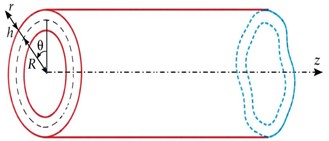
Let us consider the non-axially symmetrical harmonic oscillations of a semi-infinite hollow viscoelastic cylinder (cylindrical shell). To describe cylindrical oscillations, we adopt a three-dimensional viscoelastic framework, expressed in cylindrical coordinates (), in which the area occupied by the cylinder (see Fig. 2). 1) is determined by the inequalities.
Fig. 1Calculation scheme
, , . The dynamic equation of wave propagation in a viscoelastic cylindrical shell satisfies the Lame operator equation [6], which has the form:
where – displaced points of the cylindrical shell; – density of the shell material. The coefficients of the Lame operator have the following form:
where – an arbitrary function of time; and – relaxation kernel [7], – Poisson’s ratio of the shell, – instantaneous modulus of elasticity. Enter dimensionless variables:
Here , , , , , – components of the stress tensor. Enter the thickness parameter: , .
The thickness parameter is always less than one . On the composite surface, without stress b, conditions are established:
Conditions of the free edge at the end-of-shell free edge conditions: , , ; , meets nonhomogeneous boundary conditions at :
where, is a given function of the variable , where 1, 2,…. We choose the function so that the resonance of the wave of interest to us is excited most effectively. The condition of the absence of energy sources is established . Taking into account the perturbations, using the integral operators in Eq. (2), we define a slowly changing time function, – a real constant. The freezing technique [8] allows us to predict these relationships as follows: .
Introduction of the Fourier transforms of the relaxation nucleus of the material. We accept a three-parameter kernel for a viscoelastic medium, which requires that the kernel be integrable according to standard hereditary mechanics.
Here:
continuity (excluding), precision, and monotony:
, – layer medium displacement vector.
Then Eq. (1) takes the form:
where:
It is convenient to express displacements and stresses in terms of Lame’s elastic potentials and . We have the following relationships:
Consequently, we obtain the next set of partial differential equations in the form and with respect to:
where:
To satisfy the boundary Eq. (5), the solution of the system of differential Eq. (10) is taken as follows:
Substituting this expression into the wave equation and dividing the result by RZFT, we get:
Eq. (12) is formulated for the longitudinal displacement potentials. Other potentials are defined in a similar manner. The terms in the first and second parentheses depend on (, ) and , respectively, while the right-hand side depends only on . Consequently, Eq. (12) is satisfied for all independent variables , , , and only if each term is equal to a separation constant. Thus, we obtain the following system of ordinary differential equations:
Arbitrary constants , and are defined as the negative squares of the corresponding quantities. The resulting solutions are simplified and take a convenient form for the present analysis. We express Eq. (13) in the following form:
Here, the variables and are assumed to be independent of each other. Substituting Eq. (13) into the differential Eq. (12), we obtain the following separated equations:
The constants , and are interdependent. Substituting Eq. (13) into differential Eq. (12), we obtain the following relationship:
The general solution for the initial Eq. (13) is expressed as follows: .
The second and third governing relations in Eq. (13) give solutions determined by the following expressions:
The set of solutions Eq. (17) represents a standing wave formed by the superposition of two waves propagating in opposite directions along the -axis. The functions representing these waves take the following form: .
As observed from the previous expression, the constant-phase surface in this case does not move parallel to itself, unlike in planar structures; instead, it undergoes angular rotation over time. In this study, the velocity of the outer waves is determined by the formula , where represents the wave number [8]. Eq. (13) defines the solution involving Bessel and Neumann functions with complex arguments. Substituting the obtained solutions Eqs. (13-15) into the boundary conditions yields a homogeneous system of linear equations with nine unknown parameters [9]:
3. Results and discussion
For a solid cylindrical body of infinite length, the characteristic determinant Eq. (16) reduces to the third order. For elastic bodies, a similar equation was previously derived in [10]. Notably, the equations obtained by the proposed method demonstrate good agreement with the results presented in the work of V. T. Grinchenko.
The transcendental characteristic Eq. (17) is solved numerically using the Muller method [10]. The material parameters adopted for calculations are: 0.25, 0.75. The relaxation kernel is modeled using the Rzhanitsyn-Koltunov three-parameter weak singular kernel: , with 0.048, 0.05, and 0.1. The comparative numerical results are illustrated in Fig. 2.
Fig. 2Comparison of dispersion results between three-dimensional shell theory and Kirchhoff-Love hypothesis: 1, 3 – Kirchhoff-Love hypothesis; 2, 4 – three-dimensional theory; A= 0.1, A= 0.02
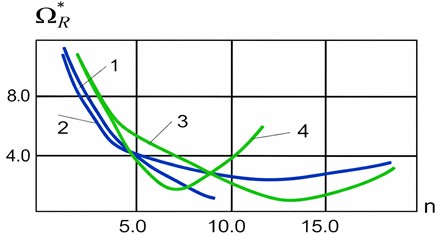
Fig. 2 distribution of natural frequencies, 0.1. As can be seen, natural frequencies initially decrease, and then increase with growth.
The numerical results, obtained for 0, 1, indicate that an increase in the wave number causes the real part of the wave frequency to initially decrease before subsequently increasing. This phenomenon aligns with the observations reported by Mikhail A. Koltunov for elastic thin and cylindrical shells. Furthermore, incorporating the material viscosity leads to a reduction in the real frequency components by up to 5 %. A comparison shows that the results based on the Kirchhoff-Love hypothesis and the three-dimensional theory are in close agreement for small wave numbers ( 5), with a discrepancy of approximately 2-3 %. However, this difference becomes more pronounced as the wave number increases.
Table 1Key parameters of three-dimensional boundary waves in a thin viscoelastic cylindrical shell
Parameter | Value / range | 3D viscoelastic theory | Kirchhoff-love theory | Remark |
Poisson’s ratio () | 0.25 | Applied in calculations | Applied in calculations | Shell material property |
Mean radius ratio () | 0.75 | Applied in calculations | Applied in calculations | |
Relaxation kernel parameters | 0.048, 0.05, 0.1 | Used in Rzhanitsyn-Koltunov kernel | Not applicable | 3-parameter weakly singular kernel |
Natural frequency behavior (low wave numbers) | Decreases first, then increases | Agrees within 2-3 % deviation | Low-frequency range | |
Natural frequency behavior (high wave numbers) | Provides accurate results | Deviation increases significantly | High-frequency range | |
Effect of viscosity on frequency | ≈ 5 % reduction | Real frequency reduced by ~5 % | Not accounted for | Due to material viscosity |
Complex frequency (damping) | Complex | Non-zero imaginary part present | Damping not considered | Viscoelastic attenuation |
Numerical method | Muller method | Solves transcendental characteristic equation | Corresponding method applied | Stable and accurate computation |
4. Conclusions
In this study, the propagation of three-dimensional boundary waves in a long viscoelastic cylindrical shell has been rigorously analyzed within the framework of the three-dimensional theory of viscoelasticity. The governing equations, formulated using the Lamé operator, were reduced to a spectral (eigenvalue) problem by employing potential functions and the method of separation of variables.
The analytical solutions, represented in terms of exponential functions and higher-order special functions (Bessel, Neumann, and Hankel functions with complex arguments), provide a comprehensive description of wave processes in cylindrical geometries. The viscoelastic behavior of the material was successfully incorporated using the Boltzmann-Volterra hereditary integral with a three-parameter weakly singular Rzhanitsyn-Koltunov relaxation kernel.
A robust numerical algorithm based on the Muller method was developed to solve the resulting transcendental characteristic equations. This approach enables an efficient transformation of complex functional determinants into polynomial forms, ensuring stable and accurate computation of complex eigenfrequencies.
The main quantitative and qualitative findings of the study can be summarized as follows:
The dispersion analysis shows that the real part of the natural frequency exhibits a non-monotonic behavior, decreasing at low wave numbers and increasing at higher values.
The inclusion of viscoelastic effects leads to a noticeable reduction in natural frequencies (up to approximately 5 %) and introduces damping, characterized by the emergence of a non-zero imaginary component of the frequency.
A comparative analysis demonstrates that the classical Kirchhoff-Love shell theory provides accurate results only in the low-frequency range , with deviations increasing significantly as the wave number grows.
The influence of the viscoelastic parameters on wave attenuation and dispersion characteristics is substantial, indicating the necessity of using three-dimensional models for accurate predictions in practical applications.
The proposed methodology and obtained results significantly extend existing models of wave propagation in cylindrical shells by incorporating viscoelastic effects and providing a reliable computational framework. The findings of this study have important implications for the design and analysis of engineering structures subjected to dynamic loading, including pipelines, aerospace shells, and mechanical systems where vibration control and wave attenuation are critical.
References
-
V. L. Beresin, L. Yu. Kossovich, and J. D. Kaplunov, “Synthesis of the dispersion curves for a cylindrical shell on the basis of approximate theories,” Journal of Sound and Vibration, Vol. 186, No. 1, pp. 37–53, Sep. 1995, https://doi.org/10.1006/jsvi.1995.0432
-
J. B. Lawrie and J. Kaplunov, “Edge waves and resonance on elastic structures: An overview,” Mathematics and Mechanics of Solids, Vol. 17, No. 1, pp. 4–16, Jul. 2011, https://doi.org/10.1177/1081286511412281
-
J. D. Kaplunov, L. Y. Kossovich, and M. V. Wilde, “Free localized vibrations of a semi-infinite cylindrical shell,” The Journal of the Acoustical Society of America, Vol. 107, No. 3, pp. 1383–1393, Mar. 2000, https://doi.org/10.1121/1.428426
-
J. D. Kaplunov and M. V. Wilde, “Free interfacial vibrations in cylindrical shells,” The Journal of the Acoustical Society of America, Vol. 111, No. 6, pp. 2692–2704, Jun. 2002, https://doi.org/10.1121/1.1474442
-
Y. Fu and J. Kaplunov, “Analysis of localized edge vibrations of cylindrical shells using the Stroh formalism,” Mathematics and Mechanics of Solids, Vol. 17, No. 1, pp. 59–66, Jul. 2011, https://doi.org/10.1177/1081286511412442
-
J. Kaplunov, D. A. Prikazchikov, and G. A. Rogerson, “On three-dimensional edge waves in semi-infinite isotropic plates subject to mixed face boundary conditions,” The Journal of the Acoustical Society of America, Vol. 118, No. 5, pp. 2975–2983, Nov. 2005, https://doi.org/10.1121/1.2062487
-
V. Zernov and J. Kaplunov, “Three-dimensional edge waves in plates,” Proceedings of the Royal Society A: Mathematical, Physical and Engineering Sciences, Vol. 464, No. 2090, pp. 301–318, Feb. 2008, https://doi.org/10.1098/rspa.2007.0159
-
B. K. Eshmatov, “Nonlinear vibrations of viscoelastic cylindrical shells taking into account shear deformation and rotatory inertia,” Nonlinear Dynamics, Vol. 50, No. 1-2, pp. 353–361, Aug. 2007, https://doi.org/10.1007/s11071-006-9163-4
-
D. E. Muller, “A method for solving algebraic equations using an automatic computer,” Mathematical Tables and Other Aids to Computation, Vol. 10, No. 56, p. 208, Oct. 1956, https://doi.org/10.2307/2001916
-
M. Talipov, “Computational modeling and analysis of mechanical power consumption in train assemblers’ work,” in Proceedings of the International Conference on Applied Innovations in IT, Vol. 13, No. 2, pp. 419–426, Jun. 2025, https://doi.org/10.25673/120513
About this article

The authors have not disclosed any funding.
The datasets generated during and/or analyzed during the current study are available from the corresponding author on reasonable request.
The authors declare that they have no conflict of interest.

