Abstract
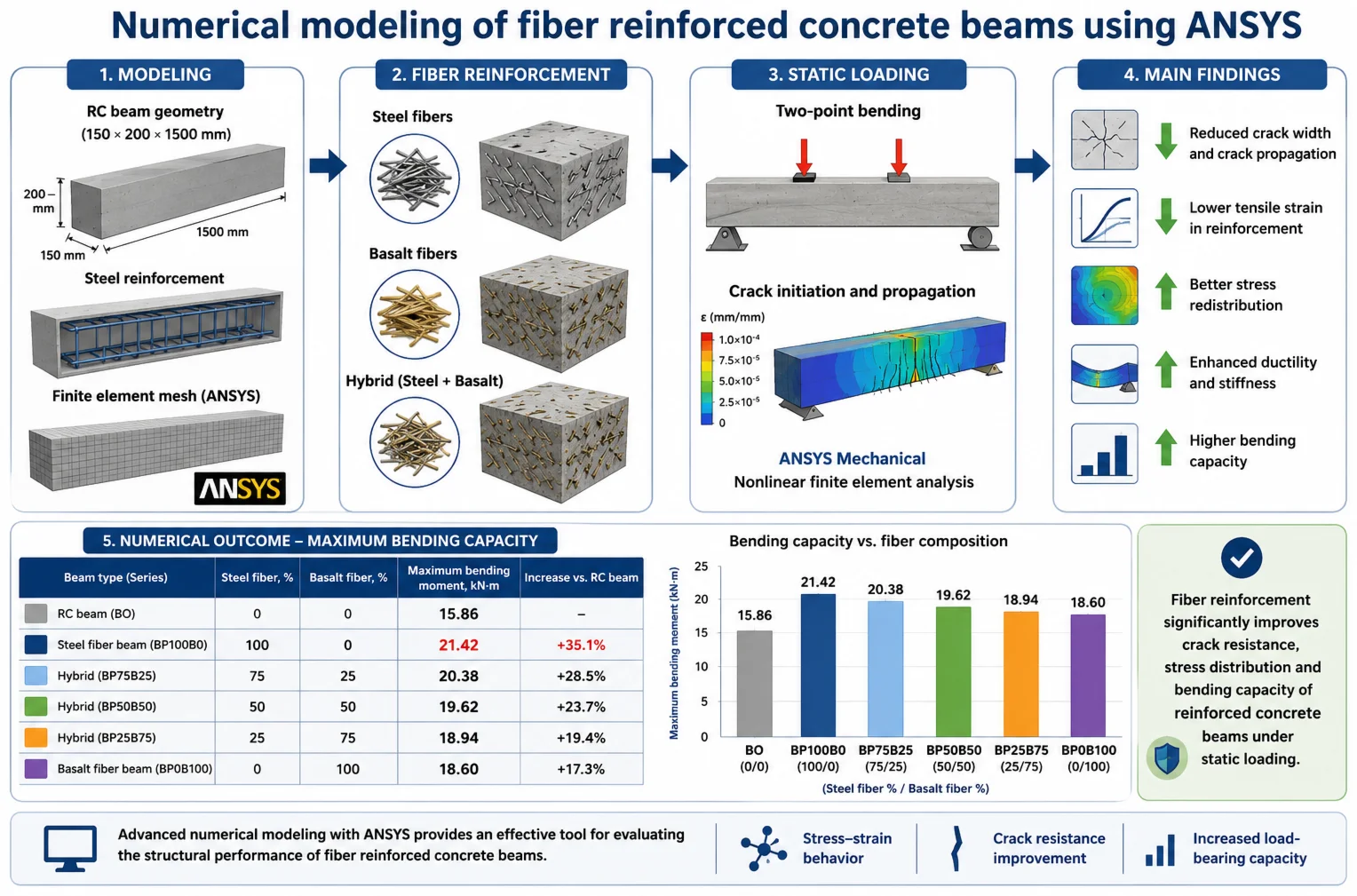
This paper provides a numerical analysis of reinforced concrete and fiber-reinforced concrete beams under a static loading using ANSYS Mechanical. The chief aim is to compare the stress-strain condition, crack formation, deformation behavior, and load-bearing ability of the ordinary reinforced concrete beams with beams reinforced with steel and basalt fibers. The three-dimensional finite element models have been developed with the consideration of the real beam geometry, nonlinearity of the material behavior, reinforcement action, and the boundary conditions. It was a model of concrete and fiber-reinforced concrete where the proper physical and mechanical properties were used, and the reinforcement was described with the help of an ideal elastic-plastic model. The quantitative findings indicate that fiber reinforcement enhances crack resistance, narrows crack width, and augments ultimate bending capacity of the beams. One of the series studied, a specimen with 100 percent steel fiber reinforcement, gave a high bending moment of 21.42 kN·m, as compared to 15.86 kN·m with the normal reinforced concrete beam, or a 35 percent increase. The findings support the idea that the dispersed fiber reinforcement can play an important role in promoting the structural performance of reinforced concrete beams and can be successfully implemented in engineering practice.
Highlights
- Numerical modeling of RC and fiber-reinforced concrete beams was performed using ANSYS Mechanical
- The beam with 100% steel fibers achieved a 35.1% higher bending capacity than the conventional RC beam
- Steel and basalt fibers improved crack resistance, stress redistribution, and structural ductility
1. Introduction
The reinforced concrete structures are common with the modern structural constructions due to their high strength, durability, and structural reliability [1-3]. Nevertheless, conventional reinforced concrete demonstrates good results in compression but has comparatively low tensile strength results, which frequently causes cracking and a brittle nature during loading [4, 5]. That is why a significant focus has been on enhancing the mechanical properties of concrete with the incorporation of dispersed fibers in recent years [6, 7]. It has been demonstrated that fiber-reinforced concrete and particularly concrete reinforced with steel and basalt fibers have great potential to enhance the properties of crack resistance, ductility, and load-bearing capacity [8, 9]. Randomly installed fibers assist in curbing the development and progression of microcracks, thus increasing the overall structural reaction of the beams under static loading [10, 11]. Numerical simulation is also a useful method to investigate the behavior of reinforced concrete beams, as it permits the stress-strain state, cracking pattern, and failure mechanisms to be assessed sufficiently accurately [12-15]. Specifically, ANSYS Mechanical offers nonlinear finite element processes of reinforced concrete and fiber-reinforced concrete buildings with advanced features [16, 17]. The current work is an attempt to numerically research the behavior of reinforced concrete and fiber-reinforced concrete under a static load through ANSYS Mechanical. Stress-strain behavior, crack development and deformation properties, and final bending strength of ordinary reinforced concrete beams are compared to those of steel and basalt fiber-reinforced beams. The effect of the fiber composition on the structural performance of the beams is also assessed in the study.
2. Method
A three-dimensional finite element analysis was carried out in ANSYS Mechanical to examine the structural performance of reinforced and fiber-reinforced concrete beams when subjected to the static loading. The objective of the numerical analysis was to determine the stress-strain condition, deformation behavior, crack propagation, and the final load-carrying capacity of the beams. The modeling process consisted of a series of steps beginning with the construction of the beam geometry, the definition of material properties, the definition of steel reinforcement, the definition of the boundary conditions and loading arrangement, the generation of the mesh, the nonlinear solution, and the post-processing of the final results retrieved. The geometric dimensions of the beams were taken as 150×200×1500 mm. The nonlinear behavior of a concrete material was included in the numerical models along with the elastic-plastic response of the steel reinforcement. Using an ideal constitutive model of elastic-plastic, the reinforcement was modeled. The physical and mechanical properties adopted to investigate the beam series were used to define the concrete matrix and the fiber-reinforced concrete. The arrangement of the loading and the boundary conditions were chosen in order to model the behavior of the beams during the condition of bending at rest. The gradual application of the external load was done to record the gradual build-up of stresses and strains and cracks during the load history. Each of the models was created as a finite element mesh that was numerically stable and had adequate accuracy of the response that was calculated. Stress and strain distributions in the concrete and reinforcement, crack propagation patterns, and maximum bending moment attained by every series of beam were the key output parameters of the analysis. No direct experimental testing was done in this work, as the current work is purely numerical. Thus, the models created were adopted to carry out a comparative evaluation of both the mechanical behavior of a normal reinforced concrete beam and a fiber-reinforced concrete beam subjected to the same loading condition.
3. Results and discussion
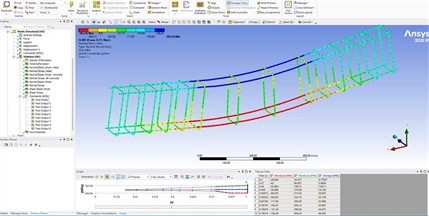
The numerical analysis enabled the assessment of the stress and deformation mechanisms of the ordinary reinforced concrete (RC) beams and fiber-reinforced concrete (FRC) beams when subjected to the constant increase of the static load. Particular attention was given to the development of relative strain (mm/mm) in the tensile reinforcement, stress distribution, and crack development. In Fig. 1, the strain development of the tensile reinforcement of the ordinary reinforced concrete beam is revealed. At the first loading, the deformation behavior of both RC and FRC beams was similar, which implies that the materials were elastic. But with the increased load, a clear distinction of the two types of beam became apparent.
Fig. 1Strain development in the tensile reinforcement of the beam
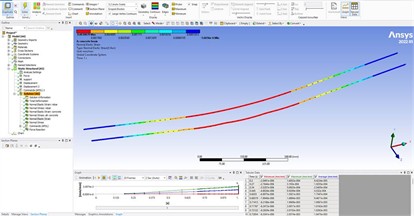
At a load of 60.8 kN, the strain in the tension of the reinforced concrete beam under ordinary conditions was 9.695×10⁻5, which was much higher than that in the fiber-reinforced concrete beam, which was 5.615×10⁻5. This amounts to a reduction of some 42 % and reflects the advantageous action of fiber reinforcement in the restraint of deformation.
Fig. 2 indicates that the reinforcement deformation in the ordinary concrete beam was almost linear until the elastic limit, and then, the strain began to rise rapidly at the yielding phase. Subsequently, plastic deformation occurred that had little change in load, implying that there was a decrease in the stiffness. On the contrary, the beam made of fiber-reinforced concrete showed a less pronounced growth in deformation due to better ductility and the late development of plastic behavior.
Fig. 2Permanent distortions in the working reinforcement of the fiber-reinforced concrete beam
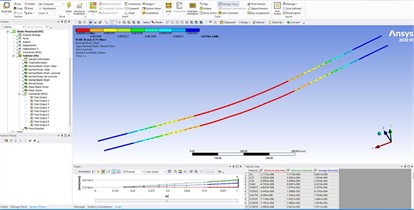
Fig. 3 shows the stress distribution of the tensile reinforcement of the ordinary reinforced concrete beam. The stresses also rose in proportion to the load applied during the elastic stage because of the composite action of concrete and reinforcement. But as cracks started to propagate in the tensile zone, the reinforcement was now made the main load-bearing element, and stress was rapidly built up until the yield point was achieved. At this point, additional loading caused plastic deformation with a low stress increment.
Fig. 3Stresses that appear during reinforced concrete beam reinforcement
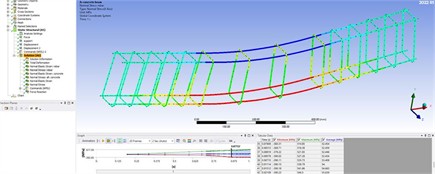
Comparatively, the fiber-reinforced concrete beam allowed an even spread of stress in the beam (Fig. 4) and remained stable during the entire loading process. The existence of the fibers made of steel and basalt helped to distribute the stress better in the concrete matrix. Fibers served as crack-bridging components, and this minimized stress concentration and abrupt crack propagation. Consequently, the load was better balanced between the concrete matrix, fiber, and reinforcement.
Fig. 4Stresses that occur in reinforcing the fiber-reinforced concrete beam
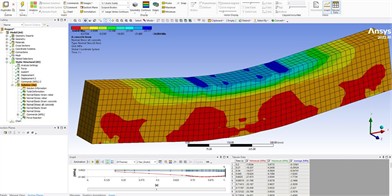
The two types of beams also had a significant difference in the stress behavior of the concrete matrix. The beam under ordinary reinforced concrete (Fig. 5) did not produce any cracks at an early stage, and during the testing, the stresses rose in a linear manner with the increase in load at the tensile region. This resulted in the decrease of stiffness and the concentration of stresses in the compression zone. As the reinforcement passed through to the plastic stage, crack propagation became more severe, leading to the reduction of the overall load-bearing capacity.
Fig. 5Stress distribution in the concrete of the ordinary reinforced concrete beam under increasing load
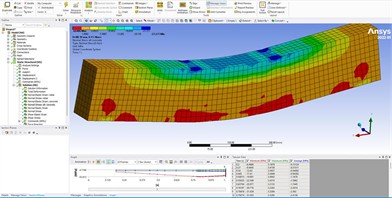
Conversely, the fiber-reinforced concrete beam (Fig. 6) exhibited improved crack initiation and propagation resistance. The fibers slowed down the cracks' formation and decreased their width, which enhanced a more stable distribution of stress and increased structural integrity during loading.
Fig. 6Stress developed at a beam of fiber-reinforced concrete
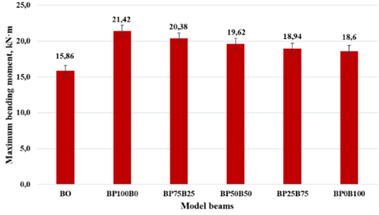
The maximum bending capacity of the investigated beam series is summarized in Table 1. The ordinary reinforced concrete beam (BO) had the highest bending moment of 15.86 kN·m. Comparatively, all fiber-reinforced beams had greater load-bearing capacity.
Table 1Peak load carrying of fiber reinforced concrete beams
No. | Series | Steel fiber, % | Basalt fiber, % | Maximum bending moment, kNˑm |
1 | BO | 0 | 0 | 15.86 |
2 | BP100B0 | 100 | 0 | 21.42 |
3 | BP75B25 | 75 | 25 | 20.38 |
4 | BP50B50 | 50 | 50 | 19.62 |
5 | BP25B75 | 25 | 75 | 18.94 |
6 | BP0B100 | 0 | 100 | 18.6 |
The beam that was reinforced with 100 % steel fibers (BP100B0) had the highest bending moment of 21.42 kN·m, which equated to about a 35.1 percent increase as compared to the reference beam. The hybrid fibers were also very much improved: 20.38 kN·m BP75B25 (+28.5), 19.62 kN·m BP50B50 (+23.7), and 18.94 kN·m BP25B75 (+19.4). The beam that was enhanced with 100 % basalt fibers (BP0B100) achieved a value of 18.60 kN·m, and this is approximately 17.3 percent more than the normal reinforced concrete beam. These findings are a clear indication that the presence of fibers improves the bending resistance of concrete beams. The most important improvement was achieved with steel fibers, as they had a high modulus of elasticity and tensile strength, and basalt fibers also increased the load-bearing capacity and crack resistance. Fig. 7 shows how the maximum bending capacity of fiber compositions varies with different fiber compositions. As it is seen, the higher the percentage of steel fibers, the greater the bending capacity, whereas combining steel and basalt produces a moderate effect of better strength and ductility.
Fig. 7Plot of the highest load bearing capacity of fiber-reinforced concrete beams
In general, the numerical evidence confirms that fiber reinforced concrete beams have better mechanical performances in terms of decreasing deformation, redistributing stress, slowing crack propagation and augmenting the ultimate load-carrying capacity.
4. Conclusions
The reinforced concrete and fiber-reinforced concrete beam, which was numerically modeled through ANSYS Mechanical, showed that the finite element analysis can be effective in terms of assessing stress-strain behavior, crack propagation, and load-bearing ability of beam elements under the action of a static load. The models developed used the realistic geometric size, material characters, and boundary conditions to give a uniform and credible numerical evaluation of the structural reaction.
As indicated in the analysis, standard reinforced concrete beams exhibited tensile cracking in the tensile zone rather rapidly, then crack propagation was uneven, and the stiffness decreased sharply following cracking. There was a pronounced decrease in load-bearing efficiency with increasing load because the transition to plastic behavior in the reinforcement occurred.
The beam with 100 % steel fiber had the greatest bending moment of 21.42 kN·m, which is about 35.1 % greater than that of the normal reinforced concrete beam (15.86 kN·m). The beam, which was strengthened with 100 percent basalt fibers, had a strengthening of approximately 17.3 percent, and hybrid fiber composites gave medium improvements based on the ratio of steel fiber and basalt fiber.
In general, the findings prove that dispersed fiber reinforcement is a promising technology for improving the mechanical characteristics of reinforced concrete beams. Fibers are used to improve crack resistance, enhance load-bearing capacity, and enhance structural reliability, rendering fiber-reinforced concrete a promising engineering material to be used in practice.
References
-
A. Akhmedov, B. Maksud Ugli, A. Martazaev, R. Mavlonov, and O. Fozilov, “Tensile strength of concrete reinforced with combined steel and basalt fibers,” Vibroengineering Procedia, Vol. 60, pp. 493–499, 2025, https://doi.org/10.21595/vp.2025.25372
-
F. Oudah and R. El-Hacha, “A new ductility model of reinforced concrete beams strengthened using fiber reinforced polymer reinforcement,” Composites Part B: Engineering, Vol. 43, No. 8, pp. 3338–3347, Dec. 2012, https://doi.org/10.1016/j.compositesb.2012.01.071
-
Y. M. Abbas and M. I. Khan, “Behavioral response of reinforced concrete beams with ultra-ductile fiber-reinforced cementitious composite layers – Experiments, models and reinforcement limits,” Journal of Building Engineering, Vol. 77, p. 107475, Oct. 2023, https://doi.org/10.1016/j.jobe.2023.107475
-
A. Juraeva, A. Martazaev, S. Razzakov, and A. Akhmedov, “The effect of the quantity and length of fibers on the mechanical properties of fiber-reinforced concrete based on polypropylene fibers,” Vibroengineering Procedia, Vol. 60, pp. 571–578, 2025, https://doi.org/10.21595/vp.2025.25363
-
A. Chithambar Ganesh, M. Muthukannan, M. Dhivya, C. B. Sangeetha, and S. P. Daffodile, “Structural performance of hybrid fiber geopolymer concrete beams,” IOP Conference Series: Materials Science and Engineering, Vol. 872, No. 1, p. 012155, Jun. 2020, https://doi.org/10.1088/1757-899x/872/1/012155
-
J. Liu, Y. He, G. Chen, and C. Mao, “Study on the bending-shear performance of sandwich insulation composite wall panels with GFRP connectors after fatigue damage,” Buildings, Vol. 15, No. 7, p. 1004, Mar. 2025, https://doi.org/10.3390/buildings15071004
-
O. Fozilov, A. Martazaev, S. Razzakov, R. Mavlonov, and B. Maksud Ugli, “Numerical modeling of reinforced concrete structures made of lightweight concrete using ANSYS,” Vibroengineering Procedia, Vol. 60, pp. 683–689, 2025, https://doi.org/10.21595/vp.2025.25511
-
R. A. Hawileh, “Finite element modeling of reinforced concrete beams with a hybrid combination of steel and aramid reinforcement,” Materials and Design (1980-2015), Vol. 65, pp. 831–839, 2015, https://doi.org/10.1016/j.matdes.2014.10.004
-
R. Mavlonov, K. Muminov, S. Numanova, A. Martazaev, O. Fozilov, and A. Akhmedov, “Analytical and experimental investigation of hybrid steel-FRP reinforced concrete beams,” Vibroengineering Procedia, Vol. 60, pp. 563–570, 2025, https://doi.org/10.21595/vp.2025.25488
-
A. Martazaev and S. Razzakov, “Stress-strain state and strength of fiber-reinforced concrete beams with basalt, steel, and polypropylene fibers,” Construction Materials, Vol. 6, No. 2, p. 19, Mar. 2026, https://doi.org/10.3390/constrmater6020019
-
V. Lusis et al., “Experimental study and modelling on the structural response of fiber reinforced concrete beams,” Applied Sciences, Vol. 12, No. 19, p. 9492, Sep. 2022, https://doi.org/10.3390/app12199492
-
A. Martazaev and S. Khakimov, “Dispersed reinforcement with basalt fibers and strength of fiber-reinforced concrete beams,” in AIP Conference Proceedings, Vol. 3317, p. 030011, 2025, https://doi.org/10.1063/5.0266797
-
R. Solhmirzaei and V. K. R. Kodur, “Modeling the response of ultra high performance fiber reinforced concrete beams,” Procedia Engineering, Vol. 210, pp. 211–219, Jan. 2017, https://doi.org/10.1016/j.proeng.2017.11.068
-
R. Mavlonov and S. Razzakov, “Numerical modeling of combined reinforcement concrete beam,” E3S Web of Conferences, Vol. 401, p. 03007, 2023, https://doi.org/10.1051/e3sconf/202340103007
-
P. Folino, M. Ripani, H. Xargay, and N. Rocca, “Comprehensive analysis of fiber reinforced concrete beams with conventional reinforcement,” Engineering Structures, Vol. 202, p. 109862, Jan. 2020, https://doi.org/10.1016/j.engstruct.2019.109862
-
S. Razzakov and A. Martazaev, “Mechanical properties of concrete reinforced with basalt fibers,” E3S Web of Conferences, Vol. 401, p. 05003, 2023, https://doi.org/10.1051/e3sconf/202340105003
About this article

The authors have not disclosed any funding.
The datasets generated during and/or analyzed during the current study are available from the corresponding author on reasonable request.
The authors declare that they have no conflict of interest.

