Abstract
This paper examines the interaction of a plane longitudinal elastic wave with a spherical body with physical and mechanical properties different from those of the host medium. The mathematical model is constructed using wave equations for scalar and vector potentials. The solution is presented as expansions in orthogonal spherical harmonics. The influence of the incident wave frequency on the stress-strain state of the interface is analyzed.
Highlights
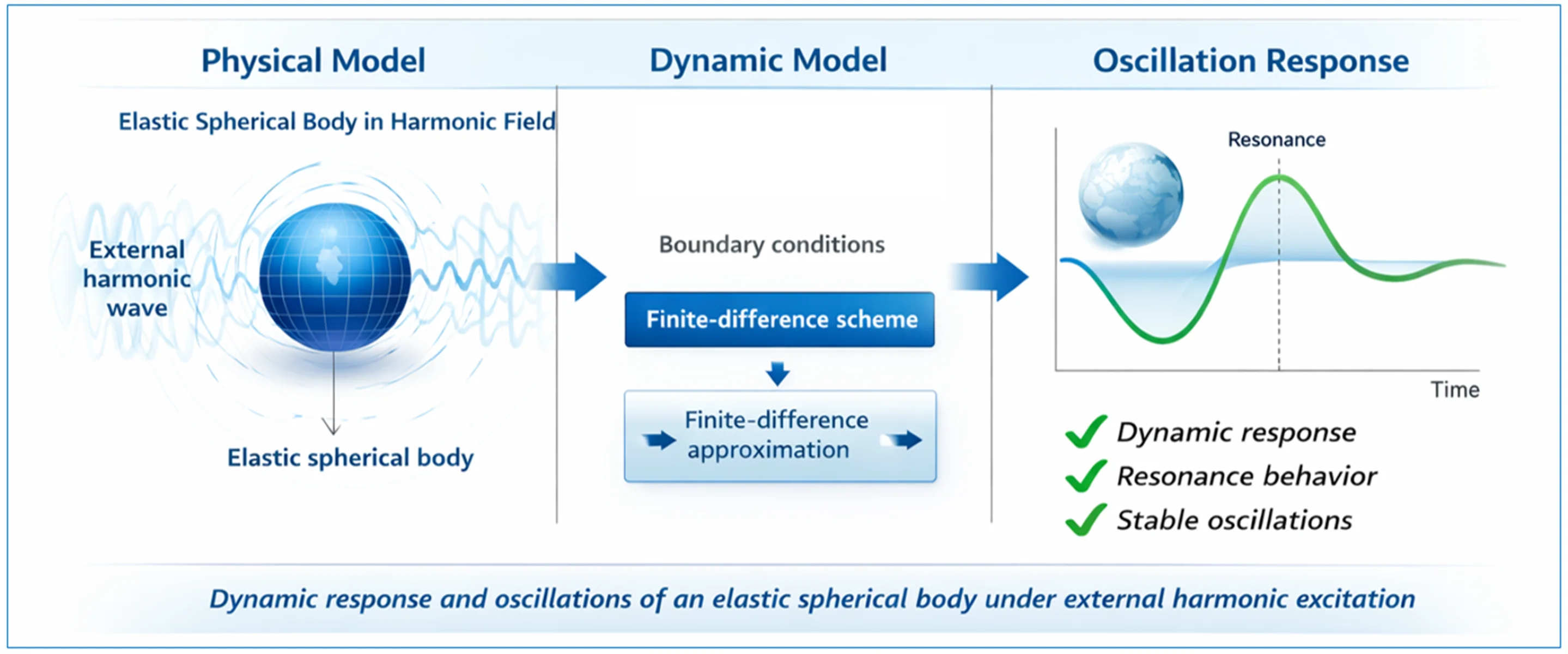
- This graphical abstract illustrates the dynamic response of an elastic spherical body subjected to an external harmonic wave.
- The physical model represents wave–structure interaction, while the mathematical model is formulated using a second-order differential equation and solved via a finite-difference scheme.
- The results demonstrate oscillatory behavior, including resonance effects and improved stability of the system response.
1. Introduction
The investigation of oscillatory processes in elastic bodies under the action of external harmonic waves is one of the fundamental problems of the theory of elasticity and wave dynamics. Spherical elastic bodies are often used as model objects because their geometrical symmetry allows the governing equations to be solved analytically. The interaction between an external harmonic wave and an elastic sphere leads to forced oscillations, wave scattering, and resonance effects, which are important in acoustics, seismology, and mechanics of deformable solids [1]. The classical theory of elastic wave propagation in continuous media shows that the response of an elastic body to harmonic excitation depends on the frequency of the incident wave and on the mechanical properties of the material. For spherical bodies, the displacement field can be represented using spherical coordinates and harmonic functions, which makes it possible to obtain exact solutions of the equations of motion. Such an approach is widely used in the study of scattering of elastic waves by spherical inclusions in an infinite medium [2]. The problem of wave scattering by a spherical body has been studied in many works using the expansion of the displacement field in spherical wave functions. These methods make it possible to describe both the internal oscillations of the sphere and the scattered wave field outside it. It was shown that when the frequency of the external harmonic wave approaches the natural frequencies of the sphere, resonance phenomena may occur, leading to a significant increase in the oscillation amplitude [3]. In addition to the classical rigid-body approximation, many authors considered deformable and elastic spheres. In this case, the dynamic response becomes more complicated because the external wave excites different vibration modes inside the sphere. The solution of such problems requires the use of the equations of elasticity together with boundary conditions on the spherical surface, which ensures continuity of stresses and displacements [4]. Modern investigations also consider more complex models, including anisotropic materials, layered spheres, and viscoelastic media. These studies show that the oscillation characteristics of the sphere depend not only on the frequency of the external harmonic wave but also on the internal structure and damping properties of the material. Analytical and numerical methods are used to determine resonance frequencies, vibration modes, and scattering parameters [5], [6].
The study of forced oscillations of elastic spherical bodies in a harmonic wave field is also important for many applied problems, such as seismic wave interaction with underground inclusions, acoustic diagnostics of materials, and vibration analysis of mechanical structures. When the external excitation is harmonic, the steady-state oscillations can be analyzed in the frequency domain, which allows one to obtain exact expressions for the displacement field and stress distribution [7].
2. Material and methods
Consider an isotropic elastic medium with density and Lame parameters and . A sphere of radius with parameters , , and is placed within the medium. A plane longitudinal wave propagating along the -axis is incident upon the sphere:
To describe the oscillations of a deformable body, displacement potentials (scalar) and (vector) are used. Under harmonic conditions, the equations of motion reduce to the Helmholtz equations:
where the wave numbers for longitudinal () and transverse () waves are defined as:
In the spherical coordinate system , the general solution for the potentials inside and outside the sphere is sought in the form of series expansions in terms of Legendre polynomials and spherical Bessel functions (for the internal region) or Hankel functions (for the scattered field):
The coefficients and are determined from a system of algebraic equations obtained by substituting the solutions into the boundary conditions at :
1) Continuity of displacements: and .
2) Continuity of stresses and .
The stress tensor components are expressed in terms of potentials according to Hooke’s law in operator form:
In an isotropic medium, the displacement vector is represented in terms of a scalar potential (longitudinal waves) and a vector potential (transverse waves): .
In this case, the vector potential is subject to the gauge condition . Due to the axial symmetry of the problem (the wave is incident along the -axis), the vector potential has only one significant component , which we will denote simply as .
Infinite Series Representation. The potentials of the incident, scattered, and refracted (inside the sphere) waves are expanded into series of eigenfunctions of the wave equation in spherical coordinates.
For the surrounding medium (index 1):
For the internal medium of the sphere (index 2):
where, are spherical Bessel functions of the first kind (regular at the origin), and are spherical Hankel functions of the first kind (describing outgoing waves).
Boundary conditions and operator form. For each harmonic number , there are four unknown coefficients: , , , and . These are determined from the conditions at the surface :
1) Radial displacements: .
2) Tangential displacements: .
3) Normal stresses: .
4) Shear stresses:.
Substituting the series into these conditions yields a system of linear algebraic equations of the form . A typical matrix element , representing the normal stress produced by a longitudinal wave, is given by:
This is the “heart” of the mathematical solution: the determinant of this matrix defines the characteristic equation for finding the natural frequencies of the sphere’s oscillations.
Energy Balance. After calculating and , the absorption or scattering coefficients can be determined. A crucial point is the mode transformation: even if only a longitudinal wave () is incident, the scattered field always contains a transverse component () due to the curvature of the boundary. This phenomenon is known as mode conversion.
3. Analysis of results
The analysis of the obtained solutions reveals that, at specific frequency values, pronounced resonance effects emerge. These resonances correspond to the intrinsic (natural) frequencies of the sphere’s oscillatory modes, at which the system exhibits a significant amplification of response even under relatively small external influences. Physically, this behavior is associated with the efficient transfer and accumulation of energy within the system when the excitation frequency aligns with its inherent dynamic characteristics.
From a mathematical standpoint, these resonance frequencies are identified through the spectral properties of the governing boundary value problem. In particular, they are determined by the condition under which the determinant of the system matrix – constructed from the imposed boundary conditions – vanishes. This requirement leads to a nontrivial solution of the homogeneous system, indicating the existence of Eigen frequencies and corresponding Eigen modes.
Such findings are highly relevant in both theoretical and applied contexts. In engineering and physical modeling, accurately identifying these frequencies is essential for predicting stability, avoiding destructive resonance, and optimizing the design of spherical structures and materials. Moreover, this approach provides a rigorous framework for studying wave propagation, vibration analysis, and acoustic or elastic behavior in bounded media.
4. Conclusions
This work examines the interaction of a plane longitudinal wave with a spherical inclusion in an isotropic elastic medium using potential functions and spherical wave expansions. By applying boundary conditions, the problem is reduced to a system of algebraic equations whose determinant defines the natural frequencies of the sphere.
The analysis shows that wave scattering is accompanied by mode conversion: even a purely longitudinal incident wave generates transverse components in the scattered field. Additionally, resonance occurs at specific frequencies corresponding to the sphere’s intrinsic oscillation modes, where the system response is significantly amplified.
These results are important for understanding wave propagation and resonance effects in elastic media and can be applied in fields such as materials science, acoustics, and geophysics.
References
-
V. A. Korneev and L. R. Johnson, “Scattering of elastic waves by a spherical inclusion-I. Theory and numerical results,” Geophysical Journal International, Vol. 115, No. 1, pp. 230–250, Oct. 1993, https://doi.org/10.1111/j.1365-246x.1993.tb05601.x
-
Y. Iwashimizu, “Scattering of elastic waves by a movable rigid sphere embedded in an infinite elastic solid,” Journal of Sound and Vibration, Vol. 21, No. 4, pp. 463–469, Apr. 1972, https://doi.org/10.1016/0022-460x(72)90830-9
-
M. T. Kamali and H. M. Shodja, “The scattering of electro-elastic waves by a spherical piezoelectric particle in a polymer matrix,” International Journal of Engineering Science, Vol. 44, No. 10, pp. 633–649, Jun. 2006, https://doi.org/10.1016/j.ijengsci.2006.02.008
-
J. V. Venås and T. Jenserud, “Exact 3D scattering solutions for spherical symmetric scatterers,” Journal of Sound and Vibration, Vol. 440, pp. 439–479, Feb. 2019, https://doi.org/https://doi.org/10.1016/j.jsv.2017.08.006
-
F. G. Mitri, “Acoustic radiation force acting on elastic and viscoelastic spherical shells placed in a plane standing wave field,” Ultrasonics, Vol. 43, No. 8, pp. 681–691, Aug. 2005, https://doi.org/https://doi.org/10.1016/j.ultras.2005.03.002
-
Q. Li, C. Wang, P. Wang, M. Luo, H. Wang, and Y. Lu, “Dynamic response behaviors of buried pipelines subjected to the impact of spherical falling objects in cold regions,” Journal of Vibroengineering, Vol. 27, No. 4, pp. 655–668, Jun. 2025, https://doi.org/10.21595/jve.2025.24679
-
A. Jafarzadeh, P. D. Folkow, and A. Boström, “Scattering of elastic waves by a sphere with orthorhombic anisotropy and application to polycrystalline material characterization,” Ultrasonics, Vol. 138, p. 107199, Mar. 2024, https://doi.org/10.1016/j.ultras.2023.107199
About this article

The authors have not disclosed any funding.
The datasets generated during and/or analyzed during the current study are available from the corresponding author on reasonable request.
The authors declare that they have no conflict of interest.

