Abstract
Effective ventilation in underground mines is essential to reduce hazardous dust concentrations. This study develops a non-stationary mathematical model of airflow velocity and dust transport in mine corridors based on momentum conservation and convection-diffusion equations. The results show that increasing the pressure difference from 30 to 45 Pa increases the airflow velocity from 2.8 m/s to 3.1 m/s (10-11 %). Correspondingly, the maximum dust concentration decreases from approximately 1 mg/m3 to 0.82-0.85 mg/m3 (15-20 %). Numerical simulations in MATLAB confirm the analytical results. The proposed model provides a basis for optimizing ventilation systems and improving safety in underground mines.
1. Introduction
The organization of an effective ventilation system in underground mines is one of the important factors in ensuring mine safety and production efficiency. The main task of the mine ventilation system is to supply a sufficient amount of clean air to the mine workings along the mine corridor, dilute harmful gases and dust, and ensure a safe microclimate for workers. In underground mines, ventilation systems remove methane, carbon dioxide, nitrogen oxides and other harmful gases, as well as reduce heat and dust concentrations. Therefore, the issues of mathematical modeling and optimization of mine ventilation systems are considered one of the important areas of modern mining engineering research.
In this regard, in recent years, mathematical models, computational fluid dynamics (CFD) and numerical simulation methods have been widely used in the study of ventilation processes. Through mathematical modeling and CFD-based analysis of gas diffusion processes in ventilation systems in underground coal mines, the efficiency of the ventilation system was evaluated not only by air quality and flow rate, but also by the total pressure loss indicator in the system [1]. An algorithm for assessing the stability of the airflow in mine ventilation networks using the criteria of guaranteed minimum air consumption and relative airflow deviation to determine the stability of the airflow in the ventilation network under random changes in air resistance has been proposed [2]. A three-dimensional ventilation model for two tunnels was built using the FLUENT program, and the airflow structure and factors affecting its formation were determined. The results of the study showed that the high-speed airflow generated in the transverse passages creates a “wind wall” effect, and the use of additional fans eliminates this situation. Ventilation systems used in the construction of long tunnels were analyzed based on CFD modeling [3]. The results of numerical modeling based on the use of coal cutter dust-absorbing fans during coal cutting at a fully mechanized coal mining site showed that the use of these devices significantly improves agrological conditions in the mine working area, brings dust concentration closer to the regulatory level, and is of great importance in increasing occupational safety. The results also serve as a reliable scientific and practical basis for improving dust suppression technologies and optimizing ventilation systems at fully mechanized coal mining sites [4-5].
The results of modern scientific research show that existing models have the following limitations: non-stationary processes are not sufficiently studied, convection-diffusion and deposition mechanisms are often considered separately, but the combined cases are not considered in detail. In real mining conditions, the process of dust formation is impulsive and time-varying. Therefore, there is a need to develop a mathematical model that describes how the amount of dust is distributed over time and space.
The novelty of this study lies in the development of a unified non-stationary mathematical model describing the dynamics of airflow and dust transport in underground mine ventilation corridors within a single framework. Unlike existing studies, the proposed model takes into account not only momentum conservation and convection-diffusion mechanisms, but also aerodynamic drag and local loss coefficients, providing a more detailed representation of airflow behavior under mining conditions. At the same time, an analytical solution of the nonlinear equation governing the airflow velocity is obtained, and its accuracy is confirmed by numerical simulations in MATLAB. The model establishes a quantitative relationship between pressure difference, airflow velocity, and dust concentration, which enables the analysis of transient ventilation regimes and their impact on dust reduction efficiency.
2. The problem statement
To mathematically describe the dust dispersion process in underground mines, it is necessary to idealize the physical system. The object of study is a mine shaft with a length and a constant cross- sectional area . Inside the shaft, there is an airflow generated by the ventilation system , which moves mainly in one direction (along the shaft).
Under the given initial and boundary conditions, the following quantities must be determined: – air speed, – dust concentration (kg/m3) of length as a control volume. The mass of dust inside this segment is:
According to the law of conservation of mass, the change in mass within a segment with time is defined as over time in the following form:
where is a constant (the weld cross section is constant) and is a constant (the elementary length of the control volume) are quantities , so the derivative only affects the concentration. This expression describes the rate of change of the mass of dust in the control volume per unit time and plays a key role in determining the process of dust migration in space and time.
Indicates how quickly the mass of dust changes within an elementary volume, i.e.: The dust concentration within the control volume increases when and decreases when .
Airflow and dust particle dispersion in underground mines are generally described by the three-dimensional Navier-Stokes and convection-diffusion equations. In elongated mine roadways, transport is predominantly governed by axial convection and diffusion processes [6]. Under such conditions, the governing equations can be simplified to one-dimensional, time-dependent models, which are commonly used in the analysis and simulation of mine ventilation systems [7].
The equation of conservation of mass:
In the one-dimensional case, , , , which means that the velocity is constant in space but varies with time.
The three-dimensional unsteady Navier-Stokes equation, derived from the law of conservation of momentum, is given as follows:
where air density , pressure , dynamic viscosity , – wall friction force.
In turbulent flow conditions, the wall friction force, i.e. the pressure resistance force resulting from the friction of the airflow, is expressed by the Darcy-Weisbach formula as follows:
Unlike traditional one-dimensional formulations, the proposed model additionally incorporates local resistance effects through the coefficient , accounting for energy losses caused by bends, intersections, and equipment. By substituting Eq. (5) into Eq. (4), the one-dimensional, space-invariant, non-stationary model can be written as follows:
where is the length of the passage, is the hydraulic diameter, is the resistance coefficient, is the local resistance coefficient, ir flow velocity in the initial state . The solution to Eq. (6), which determines the dynamics of a ventilation system satisfying the initial Eq. (7), is as follows:
In the course of the research, the general solution of the nonlinear differential equation describing the non-stationary motion of the airflow in the mine ventilation system was found analytically, and a particular solution was obtained taking into account the initial condition. The obtained analytical expression describes the pattern of change of the airflow velocity over time.
To clarify the physical meaning of the model, typical aerodynamic parameters of underground coal mines (Table 1) were used. This of parameters realistic mine to the conditions suitable values to the equation to put through airflow speed time according to change function analytical apparently as follows expressed:
Table 1Basic aerodynamic parameters for underground coal mines
No. | Parameters | Value |
1 | Air density 1.2 | 1.2kg/m3 |
2 | Mine corridor length 600 | 400-800 m |
3 | Corridor diameter 7 | 5-8 m |
4 | Friction coefficient 0.08 | 0.05-0.09 |
5 | Pressure difference 40 | 35-50 Pa |
6 | Local resistance coefficient 1 | 0.5-5 |
7 | Airflow velocity in the initial state 0.5 | 0.3-1 m/s |
Fig. 1Time-dependent airflow velocity ut as a function of pressure difference ΔP in an underground mine corridor, obtained by numerical simulation using the proposed model
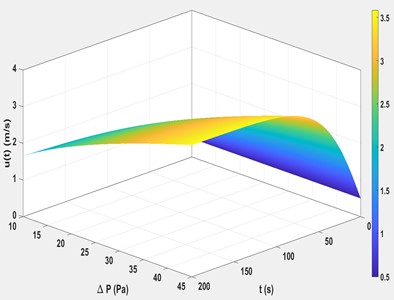
Fig. 2Comparison between analytical and numerical solutions of the airflow velocity ut
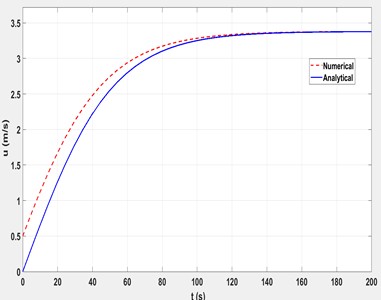
Fig. 1 shows that increasing the pressure difference from 30 Pa to 45 Pa leads to an increase in airflow velocity. At steady state (200 s), the velocity rises from approximately 2.8 m/s to 3.1 m/s, corresponding to an increase of about 10-11 %. This increase enhances ventilation efficiency in the mine corridor.
Fig. 2 shows a comparison between the analytical solution for the airflow velocity and the numerical solution obtained using MATLAB under the same conditions. The maximum deviation between the two approaches is less than 3 %, confirming the accuracy and reliability of the proposed model.
If the air is in motion, dust particles are transported with the airflow, and their mass flux is described accordingly:
The diffusive flux due to the concentration gradient is expressed as follows:
The total mass flow is expressed using Eq. (10) and (11) as follows:
The transport of dust particles in the airflow is described by the one-dimensional convection–diffusion equation [5]:
where is the dust concentration, is the time-dependent airflow, diffusion coefficient
To find the general solution of the Eq. (10), we convert it to canonical form, determine its type, and then simplify it by making appropriate changes of variables.
By substituting the variables of the convection-diffusion equation:
we can reduce the heat (diffusion) equation to its canonical form:
and boundary conditions for the example are as follows [8]:
We find the solution of the heat dissipation equation satisfying the given initial and boundary conditions using the Fourier method :
To solve the convection-diffusion equation, the problem is reduced to a canonical form. Due to non-homogeneous boundary conditions, the solution is expressed as the sum of steady-state and transient components. The steady-state part satisfies the imposed boundary conditions, while the transient component is obtained using the method of separation of variables and a Fourier sine series. The airflow velocity used in the model is determined from the previously obtained airflow analysis. The resulting analytical solution describes the transition of dust concentration from an initially dust-free state to a stable spatial distribution along the along the airway.
Fig. 3Spatiotemporal distribution of dust concentration Cx,t along the mine airway obtained from numerical simulation using the proposed model
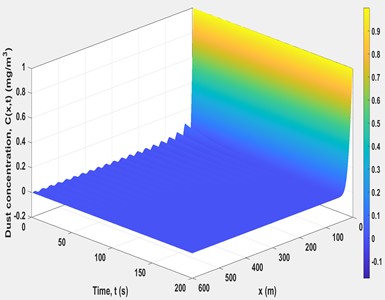
Fig. 4Comparison of analytical and numerical solutions of dust concentration Cx,t along the ventilation airway
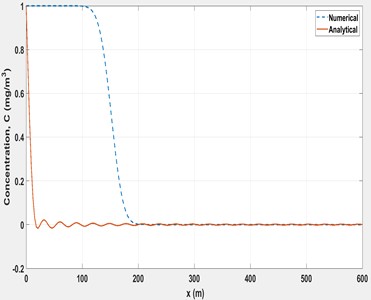
Fig. 3 illustrates the spatiotemporal evolution of dust concentration obtained from the analytical solution of the convection-diffusion equation. The solution was approximated using a Fourier series with 40 terms. The results show that the concentration evolves from an initially dust-free state toward a steady linear distribution. The parameters ( 1 mg/m3, 0.6 m2/s) correspond to realistic underground mine conditions.
3. Conclusions
In conclusion, a non-stationary mathematical model of airflow and dust transport in underground mine ventilation systems was developed based on the convection-diffusion equation and the law of conservation of momentum. The results show that the airflow velocity is strongly dependent on the pressure difference and aerodynamic drag. In particular, increasing the pressure difference from 30 Pa to 45 Pa leads to an increase in the steady-state velocity from 2.8 m/s to 3.1 m/s (10-11 %). Analysis of the dust concentration shows that the optimized airflow conditions reduce the maximum concentration from approximately 1 mg/m3 to 0.82-0.85 mg/m3, which corresponds to a reduction of approximately 15-20 %. This confirms that the increase in airflow velocity enhances convective transport and reduces dust accumulation along the mine corridor.
Numerical simulations performed in MATLAB show good agreement with the analytical solution, confirming the validity of the proposed model and reflecting the transient behavior of the system. The developed approach provides a reliable theoretical basis for optimizing ventilation systems, increasing air exchange efficiency, and reducing hazardous dust concentrations in underground mines. The calculation results showed that the optimal selection of the pressure difference and the hydraulic resistance coefficient in the ventilation system significantly stabilizes the airflow velocity.
References
-
A. P. Sasmito, E. Birgersson, H. C. Ly, and A. S. Mujumdar, “Some approaches to improve ventilation systems in underground coal mines environment – a computational fluid dynamic study,” Tunnelling and Underground Space Technology, Vol. 34, pp. 82–95, 2013, https://doi.org/10.1016/j.tust.2012.09.006
-
M. A. Semin and L. Y. Levin, “Stability of air flows in mine ventilation networks,” Process Safety and Environmental Protection, Vol. 124, pp. 167–171, Apr. 2019, https://doi.org/10.1016/j.psep.2019.02.006
-
S. Yang et al., “Study on optimization of tunnel ventilation flow field in long tunnels based on CFD simulation,” Sustainability, Vol. 14, No. 18, p. 11486, 2022, https://doi.org/10.3390/su141811486
-
G. Zhou, B. Feng, W. Yin, and J. Wang, “Numerical simulations on airflow-dust diffusion rules with the use of coal cutter dust removal fans and related engineering applications in a fully-mechanized coal mining face,” Powder Technology, Vol. 339, pp. 354–367, 2018, https://doi.org/10.1016/j.powtec.2018.07.078
-
W. Cheng, H. Yu, G. Zhou, and W. Nie, “The diffusion and pollution mechanisms of airborne dusts in fully-mechanized excavation face at mesoscopic scale based on CFD-DEM,” Process Safety and Environmental Protection, Vol. 104, pp. 240–253, 2016, https://doi.org/10.1016/j.psep.2016.09.004
-
H. K. Versteeg and W. Malalasekera, An Introduction to Computational Fluid Dynamics: the Finite Volume Method. Harlow, UK: Pearson Education, 2007.
-
O. O. Rodriguez Diaz, E. Franco-Mejía, and E. Rosero, “Modeling and control of small-scale underground mine ventilation networks,” Ingeniería e Investigación, Vol. 43, No. 1, p. e90968, Nov. 2022, https://doi.org/10.15446/ing.investig.90968
-
E. Zauderer, Partial Differential Equations of Applied Mathematics. Hoboken, NJ, USA: Wiley, 2006, https://doi.org/10.1002/9781118033302
About this article

The authors have not disclosed any funding.
The datasets generated during and/or analyzed during the current study are available from the corresponding author on reasonable request.
The authors declare that they have no conflict of interest.

