Abstract
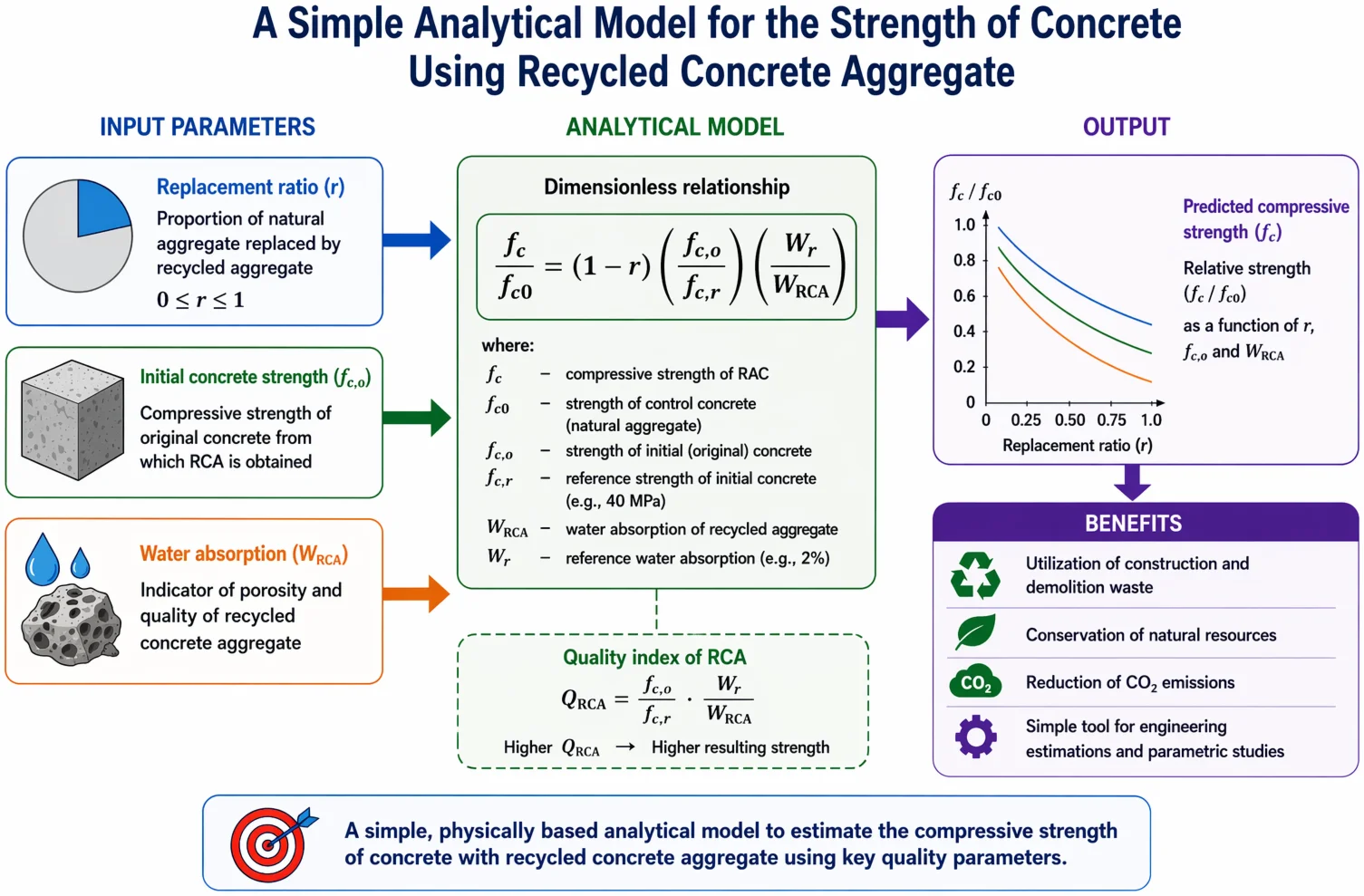
The use of recycled concrete aggregate obtained from construction and demolition waste is an effective way to reduce the negative environmental impact of construction and to preserve natural resources. However, concrete produced with recycled concrete aggregate (RCA) generally exhibits lower mechanical properties than conventional concrete made with natural aggregates due to the inferior characteristics of the recycled material. Most existing models for predicting the strength of recycled aggregate concrete (RAC) primarily consider the replacement ratio of natural aggregate, while the intrinsic properties of the recycled concrete aggregate (RCA) are not sufficiently accounted for. This paper proposes a simple analytical model for estimating the compressive strength of concrete with recycled concrete aggregate, which explicitly accounts for the replacement ratio, the strength of the original concrete ( 40 MPa), and the water absorption of the recycled aggregate (2 %). The proposed relationship has a dimensionless form, is based on physically justified parameters, and is intended for preliminary engineering estimations and parametric studies. The analytical and parametric analysis demonstrates that the obtained relationships are consistent with trends widely reported in the scientific literature.
Highlights
- A simple analytical model for predicting compressive strength of recycled aggregate concrete is proposed
- The model accounts for both replacement ratio and intrinsic quality of recycled aggregate
- A dimensionless quality index (QRCA) is introduced to characterize recycled aggregate performance
- Water absorption is identified as the most influential parameter affecting concrete strength
1. Introduction
In recent decades, the problem of disposal of construction and dismantling waste has become global. According to various studies, concrete accounts for up to 50-60 % of the total waste of the construction industry [1], [2]. In this regard, the recycling of concrete scrap to produce recycled concrete aggregate is considered as one of the key areas of sustainable construction development.
The use of recycled aggregate makes it possible to reduce the consumption of natural resources, reduce waste disposal and reduce the carbon footprint of construction. At the same time, the widespread use of concrete with recycled concrete aggregate is limited by the deterioration of its mechanical properties, primarily compressive strength [3]-[5].
The experimental results indicate that the decrease in the strength of concrete due to the use of secondary aggregate may amount to 10-40 % or more, depending upon the degree of substitution and the quality of the aggregate [3], [6], [7]. The main reasons for this are the presence of attached old cement stone, increased porosity, microcracks, and a weakened contact zone between the aggregate and the new cement stone [8], [9].
The results of numerous experimental studies confirm that the strength of concrete with secondary aggregate systematically decreases with an increase in the proportion of substitution of natural aggregate [3], [4], [10]. At the same time, for the same replacement ratio, different authors have reported significantly different strength values, indicating the important role of recycled aggregate quality.
Studies have shown that the secondary aggregate obtained from high-strength initial concrete can significantly reduce the loss of concrete strength [11], [12]. One of the most informative indicators of the quality of secondary concrete aggregate is its water absorption, reflecting porosity, the degree of micro-damage and the amount of cement stone attached [8], [13], [14].
Despite the large amount of available experimental data, analytical models that simultaneously account for the replacement ratio and key quality parameters of recycled aggregate remain limited in the literature [15], [16]. This justifies the relevance of developing a simple and physically based analytical dependency.
The aim of this study is to develop a simple physically based analytical model for estimating the compressive strength of concrete using a secondary concrete aggregate based on a minimal set of physically interpretable parameters.
To achieve this goal, the following tasks are being solved:
– Analysis of the main factors affecting the strength of recycled aggregate concrete.
– Formulation of a dimensionless analytical dependence.
– Study of the sensitivity of the model to changes in the main parameters.
– Analysis of marginal cases and physical correctness of the model.
2. Model concept and formulation
2.1. Basic assumptions
When developing the model, the following assumptions were made:
1. The compressive strength of concrete is largely determined by the quality of the coarse aggregate [7], [9].
2. The decrease in strength is proportional to the replacement ratio of natural aggregate by recycled concrete aggregate [3], [4].
3. The quality of the secondary aggregate can be characterized by the strength of the initial concrete and its water absorption [11], [14].
4. The combined influence of these factors can be expressed in a simple analytical form suitable for engineering assessments.
2.2. Mathematical formulation
The compressive strength of concrete using secondary concrete aggregate is proposed to be determined relative to the strength of control concrete fc0 using the following formula:
where – replacement ratio of natural aggregate by recycled concrete aggregate; – the strength of the initial concrete; – reference strength value (for example, 40 MPa); – water absorption of secondary aggregate; – reference value of water absorption (for example, 2 %).
The formula is dimensionless and contains only physically meaningful parameters.
Each multiplier in the formula has a clear physical justification:
– The multiplier reflects the reduction in load-bearing capacity associated with replacing natural aggregate with recycled concrete aggregate.
– The / ratio characterizes the mechanical quality of the secondary aggregate and the strength of the attached cement stone. The reference strength is introduced only for normalization purposes and does not affect the physical interpretation of the model.
– The / ratio takes into account the effects of porosity and microcracks, which worsen the contact zone and reduce the strength of concrete.
Thus, the model allows both quantitative and qualitative characteristics of recycled concrete aggregate to be taken into account.
2.3. Dimensionless quality index of recycled concrete aggregate
To simplify the analysis, we introduce a dimensionless index of the quality of recycled concrete aggregate:
Using this index, the basic strength formula takes on a compact form:
Based on the introduced dimensionless quality index QRCA, a conditional classification of recycled concrete aggregate quality can be proposed for engineering interpretation: high-quality: 0.9; medium-quality: 0.7 0.9; low-quality: 0.7.
These ranges are consistent with typical variations in water absorption and original concrete strength reported in the literature and are intended for preliminary design guidance rather than strict standardization.
Fig. 1 shows the dependence of the relative strength of concrete on the proportion of replacement of natural aggregate with secondary aggregate at different values of the secondary aggregate quality index . The calculations are based on the proposed analytical model.
It follows from the presented dependencies that with the same proportion of substitution, the strength of concrete can vary significantly depending on the quality of the secondary aggregate. Thus, at 0.3, the strength reduction for a low-quality aggregate ( 0.6) is almost twice the corresponding reduction observed when using high-quality aggregate ( 1.0). This highlights the need to take into account the quality characteristics of the secondary aggregate when designing concrete.
2.4. Theoretical justification of the effect of porosity
It is known that the strength of concrete is inversely proportional to its effective porosity [17]. In the simplest approximation, the dependence of strength on porosity can be expressed as:
where is the effective porosity and is the structural parameter.
Since the water absorption of the secondary aggregate is proportional to its open porosity, the / ratio in the proposed model can be considered as a linear approximation of this dependence. This confirms the physical correctness of the entered multiplier.
2.5. Sensitivity analysis of the model
To assess the effect of the main parameters, we consider partial derivatives of dimensionless strength:
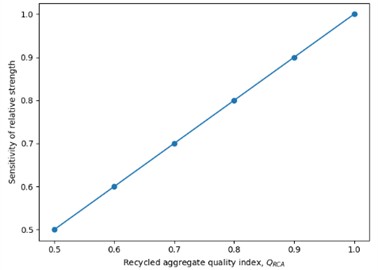
The negative sign of the derivative indicates a monotonous decrease in strength with an increase in the proportion of secondary aggregate. The modulus of the derivative is determined by the quality index of the secondary aggregate, which means a higher sensitivity of concrete strength to substitution when using a low-quality aggregate. Thus, the proposed model makes it possible to quantify the effect of the replacement ratio while taking into account the structural characteristics of recycled concrete aggregate:
Sensitivity analysis shows that the water absorption of the secondary aggregate has the greatest effect on the calculated strength, which is consistent with the experimental conclusions presented in [8], [9], [14].
Fig. 2 shows the dependence of the sensitivity of the relative strength of concrete to the proportion of substitution of natural aggregate on the quality index of the secondary aggregate. Sensitivity is defined as the modulus of the partial derivative of the dimensionless strength in terms of the substitution fraction.
Fig. 1Dependence of relative compressive strength on replacement ratio for different values of RCA quality index QRCA
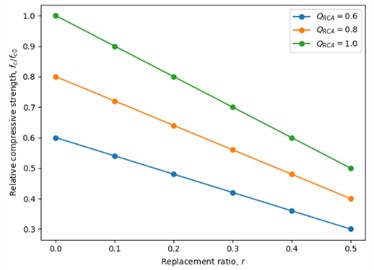
Fig. 2Sensitivity of relative compressive strength to replacement ratio as a function of RCA quality index
2.6. Analysis of marginal cases
In the absence of a secondary placeholder (0):
which corresponds to the reference concrete.
When using recycled concrete aggregate of perfect quality:
In this case, the model reduces to a classical linear relationship, which is widely used in the literature, which confirms the correctness of the proposed generalization.
Despite the lack of direct calibration based on experimental data, the model reproduces the main qualitative trends described in [3-6, 9], including: linear decrease in strength with an increase in the substitution rate, improved performance when using high-strength concrete aggregate, the negative impact of increased water absorption.
3. Discussion
The proposed analytical model is focused on identifying key patterns of the influence of secondary concrete aggregate on concrete strength, rather than on the exact reproduction of individual experimental results. This approach corresponds to the tasks of preliminary design and theoretical analysis, when detailed experimental information is missing or limited [3, 6, 9, 10].
A fundamental distinction between the proposed model and most existing empirical formulations lies in the separate consideration of quantitative and qualitative factors, namely the replacement ratio of natural aggregate and the intrinsic quality of recycled concrete aggregate (RCA). In many previously reported models, strength reduction is expressed solely as a function of the replacement ratio, which does not adequately explain the significant scatter observed in experimental results at identical replacement levels.
The introduction of the dimensionless recycled aggregate quality index enables an integrated representation of the mechanical and structural characteristics of RCA. This index combines the strength of the original concrete and the water absorption of the recycled aggregate, both of which are closely related to the amount of adhered mortar, porosity, and microcracking. As reported in numerous experimental studies, these microstructural features play a dominant role in determining the quality of the interfacial transition zone and, consequently, the overall mechanical performance of RAC.
The parametric analysis demonstrates that, for a fixed replacement ratio, the relative compressive strength of RAC may vary significantly depending on the quality of the recycled aggregate. This result supports the hypothesis that the use of high-quality RCA can substantially extend the feasible range of aggregate replacement without causing excessive strength degradation.
In the limiting case of ideal recycled aggregate quality, the proposed formulation reduces to the classical linear dependence on replacement ratio, which is commonly adopted in engineering practice. This confirms that the present model does not contradict existing approaches, but rather generalizes them by incorporating additional physically meaningful parameters. These observations are in good agreement with experimental studies that identify water absorption and adhered mortar content as critical parameters affecting RAC performance. The proposed model thus provides a rational explanation for these experimentally observed trends within a simple analytical framework.
To provide a simple empirical illustration of the proposed analytical model, its predictions were compared with representative experimental results reported in the literature. For example, Rahal [10] reported compressive strength reductions of approximately 15-25 % for concrete with a 50 % replacement of natural coarse aggregate by recycled concrete aggregate (RCA) with moderate water absorption. Using typical parameter values corresponding to these conditions (replacement ratio 0.5, original concrete strength 35-40 MPa, and 4-5 %), the proposed model predicts a strength reduction of about 18-22 %. The difference between predicted and experimental values therefore remains within approximately 5-8 %, which can be considered acceptable for a simplified analytical formulation intended for preliminary engineering assessments. This comparison demonstrates that the proposed model is capable of reproducing not only qualitative trends but also realistic quantitative estimates of strength reduction.
4. Conclusions
Based on the conducted analytical and theoretical analysis, the following conclusions can be drawn:
1) It is shown that the strength of recycled aggregate concrete (RAC) is determined not only by the proportion of substitution of natural aggregate, but also by the integral quality of the secondary aggregate, characterized by the strength of the initial concrete and its water absorption.
2) The introduced dimensionless index of the quality of secondary concrete aggregate makes it possible to compactly and visually take into account the influence of key structural factors without complicating the analytical model.
3) The theoretical substantiation of the effect of water absorption through effective porosity confirms the physical correctness of the proposed dependence and is consistent with experimental observations presented in the scientific literature.
4) The sensitivity analysis of the model showed that the water absorption of the secondary aggregate has the greatest effect on the calculated strength, which emphasizes the importance of its structural condition and the quality of the contact zone.
5) The analysis of marginal cases demonstrates that the proposed model correctly transforms into well-known particular dependencies widely used to describe the strength of concrete, which confirms its universality.
6) The developed analytical dependence can be used as a tool for preliminary assessment of the strength of concrete with secondary aggregate, as well as a basis for further development of semi-empirical and numerical models.
References
-
T. C. Hansen, “Recycled aggregates and recycled aggregate concrete second state-of-the-art report developments 1945-1985,” Materials and Structures, Vol. 19, No. 3, pp. 201–246, May 1986, https://doi.org/10.1007/bf02472036
-
V. W. Y. Tam and C. M. Tam, “Assessment of durability of recycled aggregate concrete produced by two-stage mixing approach,” Journal of Materials Science, Vol. 42, No. 10, pp. 3592–3602, Jan. 2007, https://doi.org/10.1007/s10853-006-0379-y
-
J. Xiao, W. Li, Y. Fan, and X. Huang, “An overview of study on recycled aggregate concrete in China (1996-2011),” Construction and Building Materials, Vol. 31, pp. 364–383, Jun. 2012, https://doi.org/10.1016/j.conbuildmat.2011.12.074
-
J. Xiao, J. Li, and C. Zhang, “Mechanical properties of recycled aggregate concrete under uniaxial loading,” Cement and Concrete Research, Vol. 35, No. 6, pp. 1187–1194, Jun. 2005, https://doi.org/10.1016/j.cemconres.2004.09.020
-
R. V. Silva, J. de Brito, and R. K. Dhir, “Properties and composition of recycled aggregates from construction and demolition waste suitable for concrete production,” Construction and Building Materials, Vol. 65, pp. 201–217, Aug. 2014, https://doi.org/10.1016/j.conbuildmat.2014.04.117
-
A. Katz, “Properties of concrete made with recycled aggregate from partially hydrated old concrete,” Cement and Concrete Research, Vol. 33, No. 5, pp. 703–711, May 2003, https://doi.org/10.1016/s0008-8846(02)01033-5
-
C. S. Poon, Z. H. Shui, and L. Lam, “Effect of microstructure of ITZ on compressive strength of concrete prepared with recycled aggregates,” Construction and Building Materials, Vol. 18, No. 6, pp. 461–468, Jul. 2004, https://doi.org/10.1016/j.conbuildmat.2004.03.005
-
L. Butler, J. S. West, and S. L. Tighe, “The effect of recycled concrete aggregate properties on the bond strength between RCA concrete and steel reinforcement,” Cement and Concrete Research, Vol. 41, No. 10, pp. 1037–1049, Oct. 2011, https://doi.org/10.1016/j.cemconres.2011.06.004
-
M. Etxeberria, E. Vázquez, A. Marí, and M. Barra, “Influence of amount of recycled coarse aggregates and production process on properties of recycled aggregate concrete,” Cement and Concrete Research, Vol. 37, No. 5, pp. 735–742, May 2007, https://doi.org/10.1016/j.cemconres.2007.02.002
-
K. Rahal, “Mechanical properties of concrete with recycled coarse aggregate,” Building and Environment, Vol. 42, No. 1, pp. 407–415, Jan. 2007, https://doi.org/10.1016/j.buildenv.2005.07.033
-
M. C. Limbachiya, T. Leelawat, and R. K. Dhir, “Use of recycled concrete aggregate in high-strength concrete,” Materials and Structures, Vol. 33, No. 9, pp. 574–580, Nov. 2000, https://doi.org/10.1007/bf02480538
-
J. Yang, Q. Du, and Y. Bao, “Concrete with recycled concrete aggregate and crushed clay bricks,” Construction and Building Materials, Vol. 25, No. 4, pp. 1935–1945, Apr. 2011, https://doi.org/10.1016/j.conbuildmat.2010.11.063
-
S. C. Kou and C. S. Poon, “Properties of self-compacting concrete prepared with recycled glass aggregate,” Cement and Concrete Composites, Vol. 31, No. 2, pp. 107–113, Feb. 2009, https://doi.org/10.1016/j.cemconcomp.2008.12.002
-
W. H. Kwan, M. Ramli, K. J. Kam, and M. Z. Sulieman, “Influence of the amount of recycled coarse aggregate in concrete design and durability properties,” Construction and Building Materials, Vol. 26, No. 1, pp. 565–573, Jan. 2012, https://doi.org/10.1016/j.conbuildmat.2011.06.059
-
B. González-Fonteboa and F. Martínez-Abella, “Shear strength of recycled concrete beams,” Construction and Building Materials, Vol. 21, No. 4, pp. 887–893, Apr. 2007, https://doi.org/10.1016/j.conbuildmat.2005.12.018
-
J. de Brito and N. Saikia, “Recycled aggregate in concrete,” in Green Energy and Technology, London: Springer London, 2013, https://doi.org/10.1007/978-1-4471-4540-0
-
A. M. Neville, “Properties of concrete,” in Concrete Mix Design, Quality Control and Specification, CRC Press, 2006, pp. 28–40, https://doi.org/10.4324/9780203967874-11
About this article

The authors have not disclosed any funding.
The datasets generated during and/or analyzed during the current study are available from the corresponding author on reasonable request.
The authors declare that they have no conflict of interest.

