Abstract
To improve the cleaning efficiency of the downhole hydraulic turbine rotary shoe, a simulation study was conducted using the Fluent module of ANSYS. The Euler-Euler method was employed to address the fluid-solid coupling between the fluid and the cuttings, in order to investigate the impact of different nozzle diameters on the cleaning performance of the rotary shoe. The results of the study indicate that a nozzle diameter of 22.5 mm achieves the best cleaning performance.
Highlights
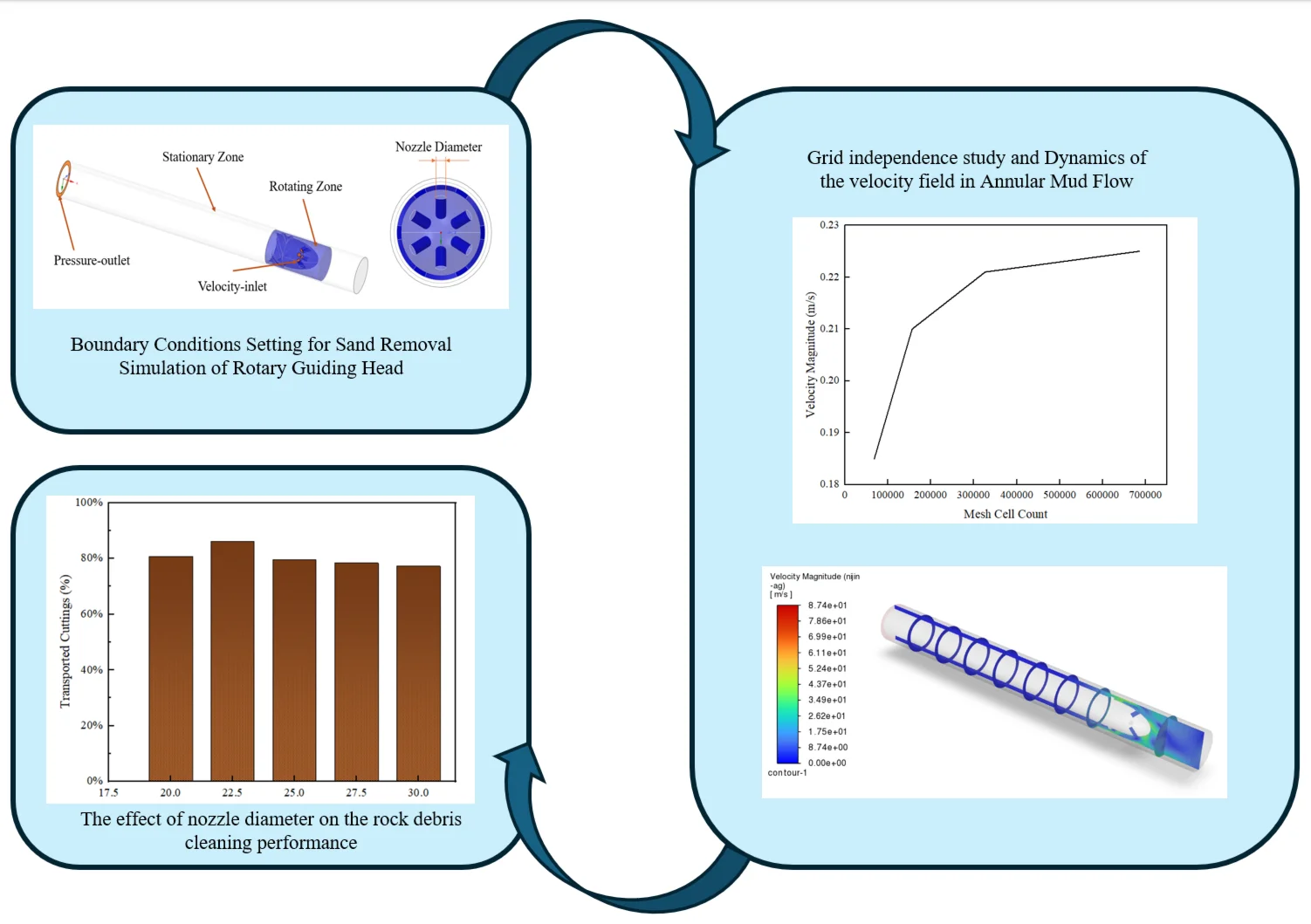
- Boundary Conditions Setting for Sand Removal Simulation of Rotary Guiding Head
- Grid independence study and Dynamics of the velocity field in Annular Mud Flow
- The effect of nozzle diameter on the rock debris cleaning performance
1. Introduction
In modern oil and gas field drilling engineering, complex wellbore types such as multi-lateral horizontal wells, extended reach horizontal wells, and ultra-deep horizontal wells are becoming increasingly common. These wells often suffer from poor hole cleaning [1], leading to the deposition of cuttings and the formation of cuttings beds, which in turn affect cementing quality and casing service life. To address these challenges, researchers both domestically and internationally have been engaged in the development and technological breakthroughs of hydraulically driven turbine rotary shoes.
In the numerical simulation study of rock debris displacement within a wellbore using CFD methods, Bilgesu et al. [2] were among the first to apply Computational Fluid Dynamics (CFD) techniques to investigate the rock debris transport issue. They simulated the effect of particle size and drilling fluid rheology on wellbore cleaning using a solid-liquid multiphase flow model. The results indicated that the flow velocity of the drilling fluid has a significant impact on the transport of rock debris. Mohammad et al. [3] conducted a study on the rock debris transport efficiency in horizontal well sections using a CFD model, which was validated with laboratory-scale data. Additionally, Wang et al. [4] employed an Euler-Euler two-fluid model to simulate the transport process of rock debris carried by drilling fluid within the wellbore. The simulation results showed that factors such as considering drill pipe eccentricity, well inclination, increasing drill pipe rotational speed, and drilling fluid inlet velocity can reduce the rock debris bed height within a certain range, thereby improving rock debris transport efficiency.
In the numerical simulation study of rock debris transport within the wellbore using the CFD-DEM coupling method, Siamak et al. [5] found that the rotation of the drill pipe causes an asymmetric distribution of rock debris along the wellbore. At low flow rates, this rotation significantly reduces the concentration of rock debris, whereas at high flow rates, the rotational effect becomes negligible. Hu J., Huang J., et al. [6] analyzed the effects of cuttings particle size, eccentricity, fluid velocity, drill pipe/bit rotational speed, and bit offset angle by studying the velocity of rock cuttings and their spatial distribution in the annulus and at the bottom hole. Zakeri A et al. [7] studied the impact of drill string rotation, inclination angle, cuttings size, mud rheology, and annular velocity on cleaning efficiency using the CFD-DEM method. Tie Yan, Jingyu Qu, et al. [8] investigated the impact of four-lobed drill pipe on rock cuttings transport behavior. The results show that, compared to conventional drill pipes, the hole cleaning efficiency of the four-lobed drill pipe increases by an average of 89.7 %. Bing Shao et al. [9] employed a multi-sphere method to construct non-spherical cuttings particles, including cubic and elongated flaky shapes. Comparison with experimental data verified the good applicability of the developed CFD-DEM model. The study provided a detailed discussion on the motion and sedimentation behaviors of the cuttings and examined the effects of fluid velocity and particle shape on cuttings transport efficiency, with particular emphasis on flaky particles.
Ozbayoglu et al. [10] employed a Computational Fluid Dynamics (CFD) approach combined with Support Vector Regression (SVR) to predict pressure losses of Newtonian and non-Newtonian fluids in concentric horizontal annuli.
Currently, there is extensive research on the transport of rock cuttings by drill rods in wellbores, but limited studies on rock cutting transport in more complex structures such as the shoe. This paper uses the mixture model in Computational Fluid Dynamics (CFD) to conduct numerical simulations, investigating the influence of the water-eye aperture parameter on the rock cutting cleaning performance of the shoe.
2. Model and methods
2.1. Physical model
The rotary shoe studied in this paper is designed to fit a casing with a diameter of 177.8 mm (7 inches) and is lowered into a wellbore with a diameter of 215.9 mm. Since the focus of this study is on investigating the relationship between the structural parameters of the rotary guide head and the cuttings cleaning performance, the relative position of the casing and the wellbore is not considered. Therefore, it is assumed that the casing is centered and well-aligned when lowered through this section of the wellbore, with no eccentricity.
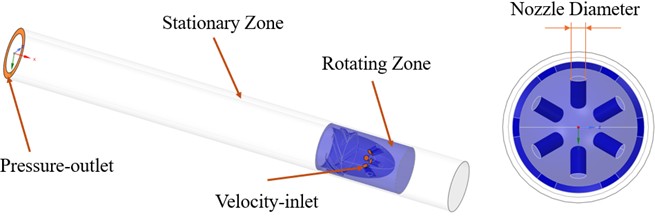
As shown in Fig. 1, the rear end surface of the rotary guide head is set with an inlet boundary condition as a velocity inlet. Based on the operational parameters of the rotary shoe, the flow rate of 20 L/s is selected, and the flow is converted into the initial velocity value using the physical model’s axial cross-sectional area of the nozzle. The rear end surface of the annular space is set with an outlet boundary condition as a pressure outlet, with the outlet pressure set to 30 MPa, corresponding to the bottomhole pressure at a depth of 3000 m. The wall boundary condition adopts a no-slip condition, with the wall remaining stationary and no heat exchange occurring on the wall surface.
Fig. 1Boundary conditions setting for sand removal simulation of rotary guiding head
2.2. Mathematical model
The fluid used for simulating cuttings cleaning with the rotary guide head is drilling mud, and the relevant parameters of the mud and cuttings particles are shown in Table 1. For rotary machinery, the SST - model provides the most accurate performance predictions when compared to experimental data. Therefore, the SST - model is selected as the turbulence model for the simulation in this study.
The simulation of rock debris cleaning by a rotary shoe falls under the category of solid-liquid two-phase flow problems. In Computational Fluid Dynamics (CFD), the computational theories for solid-liquid two-phase flow can be categorized into two types. The first type is the Euler-Lagrange method, which treats the fluid as the continuous phase and the solid as the discrete phase. This method solves the trajectories of the discrete phase and the mass and heat transfer caused by the particles, while also considering the interaction between the discrete phase and the continuous phase, thereby achieving phase coupling. The second type is the Euler-Euler method, which treats both the solid and liquid phases as continuous media, introducing the viscosity and pressure of the solid phase to ensure that the sum of the volume fractions of both phases is equal to 1.
Table 1Flow field parameter setting
Parameters | Values |
Mud density (kg/m3) | 2200 |
Mud viscosity (Pa·s) | 0.009 |
Cuttings particle density (kg/m3) | 2600 |
Cuttings particle diameter (mm) | 3 |
Guide head rotation speed (rpm) | 1000 |
Both methods have certain application limitations. Typically, the boundary for the solid phase volume fraction is between 10 % and 12 %. The Euler-Lagrange method is suitable for low volume fractions, while the Euler-Euler method is more appropriate for high volume fractions. In the simulation of rock debris cleaning by the rotary shoe, the solid phase volume fraction is 14.2 %. Therefore, the Euler-Euler method is chosen for the simulation of rock debris cleaning.
3. Results and discussion
3.1. Grid independence study
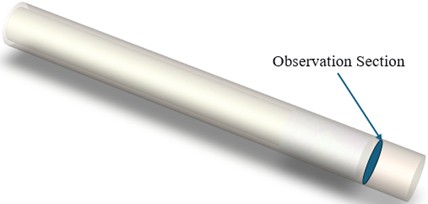
The number of grids plays a crucial role in the simulation of rock debris cleaning by the rotary shoe. A too-low grid count can reduce the accuracy of the simulation data, rendering the results unreliable and unsuitable for subsequent pattern analysis. On the other hand, an excessively high grid count can significantly increase the simulation time, leading to a waste of computational resources. Therefore, to eliminate the influence of the grid factor on the accuracy of the simulation model data, a mesh independence verification is necessary. At 4 seconds, the area-weighted average of the absolute velocity at the front section of the rotating domain has stabilized, as shown in Fig. 2. In this study, the velocity value at 4 seconds is used as the criterion for mesh independence evaluation.
Fig. 2Grid independence observation section
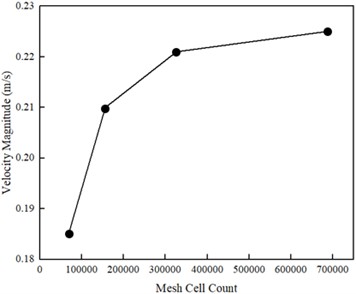
As shown in Fig. 3, four simulation models with grid numbers ranging from 68,471 to 685,437 were computed to observe the variation of the area-weighted average absolute velocity at different grid counts. As illustrated, the velocity change becomes stable after a grid count of 326,452. When the grid count increases from 326,452 to 685,437, the velocity change is only 1.8 %, with a very small error margin. Therefore, when using 326,452 grids or more for the simulation of rock debris cleaning by the rotary shoe, the computational error caused by the grid factor can be considered negligible. This effectively eliminates the influence of the grid factor on the simulation model, ensuring the accuracy of the simulation data, which can then be used for subsequent pattern analysis.
Fig. 3Variation of absolute velocity with grid number
3.2. The effect of nozzle diameter on the rock debris cleaning performance
In this study, five different simulation models with nozzle diameters of 20 mm, 22.5 mm, 25 mm, 27.5 mm, and 30 mm were selected for simulation calculations. The ratio of the mass of rock debris displaced by the simulation model to the mass of the initial rock debris bed was used as the evaluation criterion to investigate the effect of nozzle diameter on the rock debris cleaning performance of the rotary shoe. Prior to the fluid injection, 12 kg of particles were locally initialized, with the cross-sectional volume fraction shown in Fig. 4.
Fig. 4Initial particle volume fraction of the cross-section
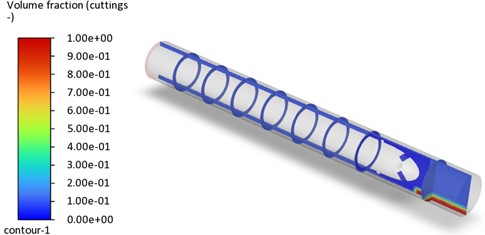
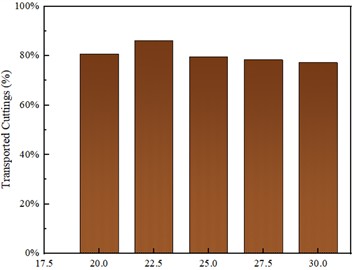
Fig. 5 shows the rock debris displacement results obtained after 4 seconds of simulation for rotary shoes with different nozzle diameters. As the nozzle diameter increases, the mass of rock debris transported out of the outlet exhibits a trend of initially increasing and then decreasing. The model with a nozzle diameter of 22.5 mm demonstrates the best cleaning performance, transporting 88.6 % of the rock debris out of the model.
The nozzle diameter significantly influences the impact force on the rock debris bed. A smaller nozzle diameter results in a higher fluid velocity, enhancing the cleaning effect on the debris bed. However, the fluid ejected from the nozzle is directed forward, opposite to the direction of rock debris lifting, which counteracts some of the energy used for lifting the particles, causing the debris to settle in the region in front of the rotary shoes. On the other hand, a larger nozzle diameter reduces the energy for scouring the debris bed, hindering the suspension of the rock debris particles and obstructing their upward displacement. Therefore, both excessively large and small nozzle diameters are unfavorable for the rock debris cleaning performance of the rotary shoes. Through the simulation analysis of the effect of nozzle diameter on the rock debris cleaning, a diameter of 22.5 mm is found to offer the best cleaning performance.
Fig. 5The mass proportion of transported cuttings for rotary shoes with different nozzle diameters
4. Conclusions
This study conducted a numerical simulation of a hydraulic rotary shoes adapted for 7-inch casing, using the mass of displaced rock debris as the evaluation criterion to assess the effect of different nozzle diameters on the rock debris cleaning performance. The results show that the nozzle diameter affects the fluid velocity ejected from the nozzle. The ejected fluid influences both the initiation of particle suspension and the upward flow of the fluid, indicating that the nozzle diameter should neither be too large nor too small. A diameter of 22.5 mm demonstrates optimal rock debris cleaning performance.
References
-
M. Hajipour, “CFD simulation of turbulent flow of drill cuttings and parametric studies in a horizontal annulus,” SN Applied Sciences, Vol. 2, No. 6, p. 1146, May 2020, https://doi.org/10.1007/s42452-020-2970-2
-
H. I. Bilgesu, M. W. Ali, K. Aminian, and S. Ameri, “Computational fluid dynamics (CFD) as a tool to study cutting transport in wellbores,” in SPE Eastern Regional Meeting, Oct. 2002, https://doi.org/10.2118/78716-ms
-
M. M. Huque, M. A. Rahman, S. Zendehboudi, S. Butt, and S. Imtiaz, “Experimental and numerical study of cuttings transport in inclined drilling operations,” Journal of Petroleum Science and Engineering, Vol. 208, p. 109394, Jan. 2022, https://doi.org/10.1016/j.petrol.2021.109394
-
S. Wang, L. Li, B. Shao, Z. Yuan, L. Xie, and J. Fan, “Simulation study on effect of drill pipe eccentricity on cuttings transportation in wellbores based on kinetic theory of granular flow,” Petroleum Science and Technology, Vol. 40, No. 16, pp. 1994–2024, Aug. 2022, https://doi.org/10.1080/10916466.2022.2034855
-
S. Akhshik, M. Behzad, and M. Rajabi, “CFD-DEM approach to investigate the effect of drill pipe rotation on cuttings transport behavior,” Journal of Petroleum Science and Engineering, Vol. 127, pp. 229–244, Mar. 2015, https://doi.org/10.1016/j.petrol.2015.01.017
-
J. Hu and J. Huang, “Study on cuttings transport behavior in annulus and bottom-hole using CFD-DEM,” Particulate Science and Technology, Vol. 42, No. 5, pp. 775–788, Jul. 2024, https://doi.org/10.1080/02726351.2023.2284210
-
A. Zakeri, M. Alizadeh Behjani, and A. Hassanpour, “Fully coupled CFD-DEM simulation of oil well hole cleaning: effect of mud hydrodynamics on cuttings transport,” Processes, Vol. 12, No. 4, p. 784, Apr. 2024, https://doi.org/10.3390/pr12040784
-
T. Yan et al., “Numerical investigation on horizontal wellbore hole cleaning with a four-lobed drill pipe using CFD-DEM method,” Powder Technology, Vol. 375, pp. 249–261, Sep. 2020, https://doi.org/10.1016/j.powtec.2020.07.103
-
B. Shao, Y. Yan, X. Yan, and Z. Xu, “A study on non-spherical cuttings transport in CBM well drilling by coupled CFD-DEM,” Engineering Applications of Computational Fluid Mechanics, Vol. 13, No. 1, pp. 579–590, Jan. 2019, https://doi.org/10.1080/19942060.2019.1615553
-
M. Sorgun, A. Murat Ozbayoglu, and M. Evren Ozbayoglu, “Support vector regression and computational fluid dynamics modeling of Newtonian and non-Newtonian fluids in annulus with pipe rotation,” Journal of Energy Resources Technology, Vol. 137, No. 3, p. 03290, May 2015, https://doi.org/10.1115/1.4028694
About this article

The authors have not disclosed any funding.
The datasets generated during and/or analyzed during the current study are available from the corresponding author on reasonable request.
The authors declare that they have no conflict of interest.

