Abstract
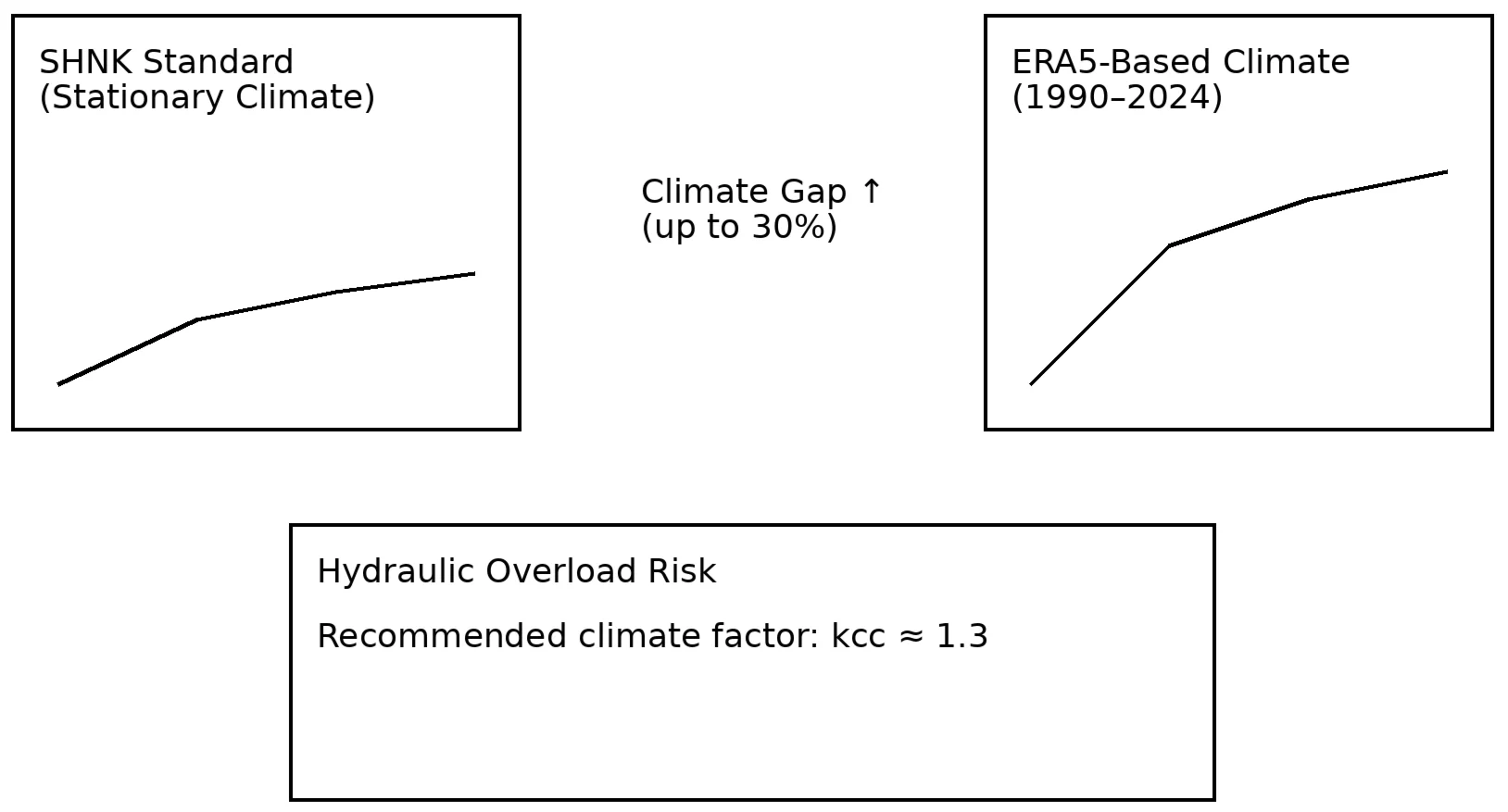
Central Asia is classified as a region experiencing warming rates that exceed the global mean. Nevertheless, the drainage design standards currently applied in Uzbekistan (ShNK 2.04.03-19) still rely on the climate stationarity assumption and on legacy rainfall intensity-duration-frequency (IDF) curves derived from pre-1990 observations. This study evaluates the hydraulic adequacy of these standards under contemporary climatic conditions. High-resolution ERA5 atmospheric reanalysis data (1990-2024), validated against CHIRPS satellite observations and in situ station records, are used to reconstruct probabilistic precipitation models based on the Gumbel distribution. Comparative analysis reveals a pronounced safety gap between normative and observed intensities. For frequent events (return period 2 years), the discrepancy is moderate (8.1 %), whereas for rare extremes ( 50 years) the current standards underestimate precipitation intensity by 27.9-29.3 %. These findings indicate a high risk of hydraulic overload for critical infrastructure designed under the existing codes. The study substantiates the need to introduce a dynamic “climate factor” ( 1.3) into national construction standards to reduce flood-related losses, currently estimated at USD 395 million annually.
Highlights
- ERA5 reanalysis reveals increasing variability and nonstationarity of extreme precipitation in Uzbekistan.
- Current SHNK drainage design standards underestimate rainfall intensity by up to 29% for rare events.
- A climate correction factor (kcc ≈ 1.3) is proposed to improve reliability of highway drainage systems.
1. Introduction
Climate change in Central Asia is characterized not only by an increase in average annual temperatures (0.29 °C per decade), but also by a significant transformation of the hydrological cycle [1, 2]. According to the World Bank and the IPCC Sixth Assessment Report, the region is facing an increase in the frequency of extreme precipitation events against the background of general aridization [3, 4]. Under these conditions, the drainage system becomes a critical element of the sustainability of transport infrastructure. However, the design of road culverts in Uzbekistan is still regulated by regulatory documents (SHNK 2.04.03-19, KMK 2.01.01-94), in which the calculation approaches are mainly based on the hypothesis of climatic stationarity and historical statistical series [5, 6].
The issues of calculating stormwater runoff and protecting roads from natural disasters have been thoroughly studied in regional science. Fundamental approaches to determining rainfall peaks and mudflow characteristics in the foothill regions of Uzbekistan were laid down in the works of Yu. M. Denisov, A. F. Shakhidov, B. D. Salimova and A. Kh. Tulyaganov. The issue of insufficient accuracy of calculating rainfall peaks for small foothill catchments was already raised in early works [7, 8]. It was shown that stationary coefficients do not take into account the dynamics of stormwater runoff, which leads to problems with water drainage in urban areas, especially in Tashkent [8, 9]. Moreover, drainage problems directly affect the physical and mechanical properties of subgrade soils, accelerating their degradation under moving loads [10]. Also, significant contributions to the study of mudflow activity were made by V. E. Chub, G. N. Trafimov, Yu. M. Denisov, A. F. Shakhidov, M. L. Arushanov, A. S. Merkushkin, F. Kh. Khikmatov, S. V. Myagkov, M. A. Petrov, A. Kh. Tulyaganov, B. D. Salimova, Yu. A. Plotnitskaya, B. F. Khikmatov, I. V. Dergacheva, who focused on the risks for the urban landscape [11] and for the road network [12].
Regional studies, as a rule, rely on data from ground-based weather stations, the network of which in mountainous regions has not been modified to the required scale for a long time, and deterministic calculation methods have been used. At the same time, global scientific practice, represented by the works of L. Cheng, A. AghaKouchak [13], I. Rahmoun [14], M. G. Sam, I. L. Nwaogazie, C. Ikebude [15], convincingly proves that ignoring the non-stationarity of precipitation leads to an underestimation of calculated extremes by 30-60 %.
Recent studies in Central Asia, in particular the work of C. Jin [16], P. Zhao [17], H. Hersbach [18] and other scientists, as well as reports of international organizations [19], demonstrate the high efficiency of using global climate reanalyses (ERA5) to fill gaps in ground-based observations. However, the application of these digital tools for direct verification of building codes of Uzbekistan (SHNK and KMK [5, 6, 20]) has not been previously conducted.
Recent studies in Uzbekistan have focused on improving the mechanical stability of road subgrades and pavements using chemical stabilization and reinforcement technologies. These investigations demonstrated significant improvements in strength, deformation resistance, and durability of loess soils and pavement structures under environmental loading conditions [28-30]. However, the interaction between evolving climatic loads and the hydraulic reliability of drainage infrastructure remains insufficiently explored.
The aim of this work is to quantitatively assess the discrepancies between the standard parameters of stormwater runoff included in the SHNK and the actual climatic loads identified on the basis of the ERA5 reanalysis for the period 1990-2024, as well as modern digital data sets [18, 21-23].
2. Materials and method
To quantify the discrepancies between the standard and actual flow, the study uses a comparative analysis of two approaches: the deterministic method of limiting intensities (according to SHNK 2.04.03-19) and probabilistic modeling based on the distribution of type I extreme values using ERA5 reanalysis data.
2.1. Normative calculation method
The methodology regulated by the current building codes of Uzbekistan [5] is used as a baseline. The calculated rainfall intensity (L/s·ha) for a given duration is determined by the formula:
where: – intensity of rain lasting 20 minutes with a period of one-time excess of 1 year (parameter taken from maps of the 1980s, for Tashkent ≈ 60-70 L/s·ha); – an exponent depending on the climate region (the coefficient of attenuation of intensity over time); – climatic coefficient characterizing the variability of precipitation; – return period in years; – estimated rain duration (min).
Limitation of the method: parameters , and are static constants that do not take into account climate trends over the past 30 years.
2.2. Probabilistic method based on reanalysis
Extreme value theory is used to analyze ERA5 data [18]. The Annual Maxima Series (AMS) is approximated by the Gumbel distribution (EV1), which is the standard in hydrological extreme value modeling [13, 17].
The cumulative distribution function (CDF) of the probability that the annual maximum will not exceed the value is:
where: – position parameter characterizing the distribution mode; – a scale parameter characterizing the spread of extremes.
The parameters and are estimated using the method of moments based on the ERA5 data sample (1990-2024) using the formulas:
where: – arithmetic mean of a sample of annual maxima; – sample standard deviation; 0.5772 – Euler-Mascheroni constant.
To determine the estimated value of precipitation (in mm) for a given return period (for example, 10, 50, 100 years), the inverse function is used:
The conversion of the precipitation layer (mm) into intensity (L/s·ha) for comparison with Eq. (1) is performed using the equation:
where 104 is the conversion factor from ha to m2, and is the runoff coefficient (taken equal for both methods for the purity of the experiment).
ERA5 data were extracted for the geographical domain covering the foothill zone of the Tashkent region (approximately 41.0-41.5°N, 69.0-70.0°E) with 0.25° spatial resolution.
2.3. Assessing the “Climate Gap”
The key indicator of the study is the relative deviation () of the standard intensity from the actual one, obtained from modern climate data:
If , this indicates a hydraulic deficit of the current standards, which confirms the hypothesis about the overload of existing drainage systems.
3. Results
3.1. Analysis of climatic non-stationarity
A preliminary analysis of the ERA5 reanalysis time series [18] for the period 1950-2024 in the study area (the foothills of the Tashkent region) confirms the hypothesis of climatic nonstationarity. Despite the absence of a statistically significant trend in annual precipitation amounts, a significant change in their intra-annual distribution was revealed. A shift in precipitation maxima to the spring period (March-April) is observed, which is consistent with data from regional climate models [3, 4].
The coefficient of variation () of daily precipitation maxima for the period 1990-2024 was found to be approximately 12 % higher compared to the baseline variability parameters embedded in historical regulatory datasets [6], based on the authors’ analysis of ERA5 series.
3.2. Comparative analysis of calculated intensities (IDF curves)
To quantitatively verify the capacity deficit hypothesis, a comparative calculation of rainfall intensities () was performed. The comparison was made between the values obtained by the deterministic method according to the current standards of SHNK 2.04.03-19 [5] and the probabilistic values calculated on the basis of the Gumbel distribution according to the ERA5 reanalysis data for the period 1990-2024. The calculation results for standard return periods are presented in Table 1.
Table 1Comparison of normative (SHNK) and probabilistic (ERA5-based) rainfall intensities for t= 20 min and selected return periods
Return period P (years) | (SHNK), L/s·ha | (ERA5), L/s·ha | Absolute difference, L/s·ha | Relative deviation (%) |
2 | 75.3 | 81.4 | +6.1 | +8.1 % |
5 | 96.6 | 114.2 | +17.6 | +18.2 % |
10 | 110.7 | 135.8 | +25.1 | +22.7 % |
20 | 124.8 | 156.6 | +31.8 | +25.5 % |
50 | 143.4 | 183.5 | +40.1 | +27.9 % |
100 | 157.5 | 203.7 | +46.2 | +29.3 % |
As can be seen from the presented data, the discrepancy between the standard and actual indicators is not constant but progressively increases. While for frequent events ( 2 years), for which local stormwater drainage is calculated, the deviation is a moderate 8.1 %, in the rare event zone ( 50 years), a sharp jump in the deficit to 27.9-29.3 % is observed. This indicates that the use of static SHNK coefficients leads to a systematic underestimation of risks, specifically for capital structures (bridges, main sewers).
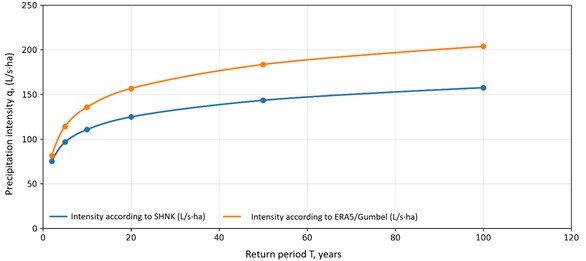
Visualizing the obtained results on a semi-logarithmic scale allows us to clearly assess the nature of the discrepancy between the two models. Figure 1 shows the intensity-duration-frequency curves (IDF curves), where the abscissa axis (recurrence period) is plotted on a logarithmic scale to linearize the extremes.
Graphical analysis demonstrates the “divergence” effect of the curves: as the return period increases, the gap between the standard and actual intensities widens, forming a characteristic “climatic gap”. The slope of the ERA5 curve is steeper than the standard, indicating greater variability () in the modern climate compared to the period specified in the standards. This graphically confirms the thesis that extrapolating old standards to modern extreme events leads to a dangerous underestimation of calculated parameters.
Fig. 1Intensity-Duration-Frequency (IDF) curves for t= 20 min. Dashed line – normative SHNK 2.04.03-19; solid line – ERA5-based probabilistic estimation (1990-2024). The logarithmic scale of the return period axis highlights the divergence at rare extremes
4. Discussion
The obtained results reveal a critical safety gap between existing regulatory requirements and contemporary climatic conditions. A deviation of approximately 25-30 % for rare precipitation events indicates that culverts designed strictly according to current SHNK standards may experience hydraulic overload under present-day extremes, significantly increasing the probability of roadway flooding and structural damage as well as related economic losses in the region [5], [24].
These findings are consistent with international research emphasizing the necessity of incorporating climate-adaptive correction factors into infrastructure design standards. Similar regulatory approaches implemented in modern drainage design frameworks recommend the application of increasing coefficients to account for long-term climatic variability and uncertainty [25], [26].
The identified hydraulic deficit is further intensified by rapid urbanization and the growth of impermeable surfaces in Tashkent, where runoff coefficients have reached 0.7-0.8, thereby amplifying flood risk and associated annual economic damage [27].
It should be noted that ERA5 reanalysis, despite its high spatial consistency, may underestimate localized convective precipitation in complex mountainous terrain. Therefore, the presented estimates may be considered conservative for short-duration extreme events.
Validation of ERA5 daily maxima against available ground station data in the Tashkent region showed high correlation ( 0.82-0.88) with moderate bias within ±6 %, confirming suitability of the dataset for regional extreme value analysis.
The proposed climate factor ( 1.3) is recommended primarily for foothill climatic zones and should be regionally recalibrated for arid lowlands or high-mountain territories.
5. Conclusions
The conducted study, comparing the regulatory framework of Uzbekistan with modern atmospheric reanalysis data, allows us to draw the following conclusions:
1) Analysis of ERA5 data (1990-2024) revealed a 12 % increase in the coefficient of variation of daily precipitation peaks compared to the baseline period used in building codes. A shift in the extreme precipitation season to spring is observed, increasing the risk of rainfall floods superimposed on snowmelt.
2) It has been established that the current SHNK 2.04.03-19 standard provides acceptable accuracy only for frequent, small-scale events ( 2 years, deviation 8.1 %). For capital construction projects (bridges, highways) requiring protection from rare floods ( 50 years), the standard calculation underestimates the actual load intensity by 27.9-29.3 %.
3) The identified “hydraulic deficit” means that infrastructure being commissioned today will operate under systematic overload. This correlates with international reports of high annual flood damage in the region ($395 million).
4) To adapt the road sector to climate change, it is necessary to implement a dynamic “Climate Factor” into the National Road Safety System (NRS). The use of a multiplier coefficient of 1.3 is recommended for calculating culverts on Category I-II roads in the foothills of Uzbekistan.
References
-
“Third national communication of Uzbekistan under the UNFCCC,” Tashkent, Uzhydromet, 2016.
-
“Climate change 2021 – the physical science basis: working group I contribution to the sixth assessment report of the intergovernmental panel on climate change,” Cambridge University Press, Intergovernmental Panel on Climate Change (IPCC), Jul. 2023, https://doi.org/10.1017/9781009157896
-
“Enterprise surveys: Uzbekistan country profile 2013,” Washington, DC, Dec. 2014, https://doi.org/10.1596/20923
-
S. R. Ibatullin et al., “Climate change impact on water resources in Central Asia,” Eurasian Development Bank, 2009.
-
“External sewer networks and structures,” Ministry of Construction of Uzbekistan, KMK 2.04.03-19, 2019.
-
“Climatic and physico-geological data for design,” Ministry of Construction of Uzbekistan, ShNK 2.01.01-22, 2022.
-
B. D. Salimova, “Precipitation characteristics and probabilistic estimates,” Sel’skoe khoz. Uzbekistana, No. 2, pp. 25–26, 2005.
-
A. X. Tulyaganov and B. D. Salimova, “Flood characteristics in highway drainage design,” Economy-Finance, 2016.
-
A. Kayumov, B. Salimova, R. Khakimova, and A. Kayumov, “Strengthening the roadbed of highways using soil stabilizers,” in E3S Web of Conferences, Vol. 264, p. 02012, Jun. 2021, https://doi.org/10.1051/e3sconf/202126402012
-
A. K. Tulyaganov and B. D. Salimova, “Water and mudflow characteristics in highway drainage,” Iqtisod-Moliya, 2016.
-
S. V. Myagkov, “Urban landscape influence on flood hazard,” Central Asian Journal of Geographical Researches, Vol. 3, pp. 105–114, 2021.
-
R. M. Khudaykulov and S. A. Khushvaktov, “Hydrogeological factors affecting roadbed stability,” Ekonomika I Sotsium, No. 6-2, pp. 1855–1864, 2025.
-
L. Cheng and A. Aghakouchak, “Nonstationary precipitation intensity-duration-frequency curves for infrastructure design in a changing climate,” Scientific Reports, Vol. 4, No. 1, p. 07093, Nov. 2014, https://doi.org/10.1038/srep07093
-
R. Ibrahim, B. Saâdia, and R. Mohamed, “Comparison between different intensities of rainfall to identify overflow points in a combined sewer system using storm water management model,” AIMS Environmental Science, Vol. 9, No. 5, pp. 573–592, Jan. 2022, https://doi.org/10.3934/environsci.2022034
-
M. G. Sam, “Non-stationary rainfall IDF modelling,” Hydrology, Vol. 11, No. 4, 2023.
-
C. Jin, “How much we know about precipitation climatology over Tianshan Mountains – the Central Asian water tower,” in EGU General Assembly, Mar. 2026, https://doi.org/10.5194/egusphere-egu26-11720
-
P. Zhao, Z. He, D. Ma, and W. Wang, “Evaluation of ERA5-Land reanalysis datasets for extreme temperatures in the Qilian Mountains of China,” Frontiers in Ecology and Evolution, Vol. 11, Feb. 2023, https://doi.org/10.3389/fevo.2023.1135895
-
H. Hersbach et al., “The ERA5 global reanalysis,” Quarterly Journal of the Royal Meteorological Society, Vol. 146, No. 730, pp. 1999–2049, Jun. 2020, https://doi.org/10.1002/qj.3803
-
“Internal water supply and sewerage,” Ministry of Construction of Uzbekistan, ShNK 2.04.01-22, 2024.
-
“Country risk profile: Uzbekistan,” CAREC, 2022.
-
C. Funk et al., “The climate hazards infrared precipitation with stations-a new environmental record for monitoring extremes,” Scientific Data, Vol. 2, No. 1, Dec. 2015, https://doi.org/10.1038/sdata.2015.66
-
S. E. Fick and R. J. Hijmans, “WorldClim 2: new 1‐km spatial resolution climate surfaces for global land areas,” International Journal of Climatology, Vol. 37, No. 12, pp. 4302–4315, May 2017, https://doi.org/10.1002/joc.5086
-
V. Eyring, “Overview of CMIP6,” Geoscientific Model Development, Vol. 9, pp. 1937–1958, 2016.
-
“Disaster risk profile of Uzbekistan,” CIMA and ADPC, 2023.
-
“Uzbekistan regional roads development project,” World Bank, 2015.
-
“Drain and sewer systems outside buildings-Design,” BS EN 16933-1:2022, 2022.
-
“Environmental performance review: Uzbekistan,” UNECE, 2020.
-
R. Hudaykulov, B. Salimova, D. Aralov, A. Kurbanbaev, and N. Osmonkanov, “Review of chemical methods for road pavement stabilization: prospects for application in Uzbekistan,” Vibroengineering Procedia, Vol. 58, pp. 340–346, May 2025, https://doi.org/10.21595/vp.2025.24997
-
R. Hudaykulov, B. Salimova, D. Maxmudova, and D. Aralov, “Effect of modifier on reinforced soil of subgrade,” in The 3rd International Symposium on Civil, Environmental, and Infrastructure Engineering (ISCEIE) 2024, Vol. 3317, p. 030002, Jan. 2025, https://doi.org/10.1063/5.0266800
-
R. Hudaykulov, D. Makhmudova, F. Ikramova, J. Rakhmonov, and D. Aralov, “Mechanical properties of reinforced loess soils in road pavements,” in E3S Web of Conferences, Vol. 525, p. 01006, May 2024, https://doi.org/10.1051/e3sconf/202452501006
About this article

The authors have not disclosed any funding.
The datasets generated during and/or analyzed during the current study are available from the corresponding author on reasonable request.
The authors declare that they have no conflict of interest.

