Abstract
The article presents an optimization-based method for improving the organization of local wagon-flows within regional railway networks. The study addresses the issue of excessive wagon downtime and uneven freight turnover caused by the inefficient interaction between pickup trains and shunting-separate locomotives (ShSPL). A dynamic mathematical model has been developed to minimize the total idle time of wagons and optimize the distribution of train operations among intermediate and supporting stations. The model incorporates stochastic variations in wagon arrivals, track capacity limitations, and station workload balance. Validation of the proposed optimization technique was performed using operational data from the Uzbek Railways (UTY JSC). The implementation of the optimized ShSPL-based scheme reduced the total wagon idle time by 35-40 % and increased the average section speed by 15-20 %. The results demonstrate the model’s ability to enhance operational efficiency without additional infrastructure investments. The proposed approach provides a foundation for digital optimization of local railway operations and can be applied in planning systems aimed at improving resource utilization, reducing unproductive downtime, and ensuring sustainable development of the transport sector.
1. Introduction
Efficient organization of local wagon-flows is a critical component in improving the operational efficiency and competitiveness of railway freight systems.
In Uzbekistan, a significant share of local wagon movements still contributes to extended idle times and reduced throughput at intermediate stations [1-5].
Previous research has examined train formation optimization, unproductive time reduction, and digitalization of dispatching processes [4-9].
However, most of these methods remain focused on static planning and fail to account for dynamic changes in wagon distribution, locomotive allocation, and real-time capacity constraints.
The classical concept of rational organization of local railway operations proposed by Nurmukhamedov [14] remains relevant today, forming the methodological basis for many scheduling systems.
Recent studies [7], [9], [15-17], [20] have emphasized the need to apply computational optimization, simulation modeling, and intelligent scheduling tools to address the increasing complexity of local operations.
This study introduces a mathematical optimization-based approach for organizing local wagon-flows, integrating pickup-train circulation and ShSPL (shunting-separate locomotive) operations under realistic field constraints.
Unlike earlier static scheduling models [4-9], [14], the proposed method dynamically redistributes wagon flows based on section load and arrival stochasticity.
Validation using operational data from UTY JSC confirms a 35-40 % reduction in total downtime and a 15-20 % improvement in section speed, proving the model’s effectiveness and adaptability to real railway conditions.
2. Methods
The proposed optimization-based method aims to improve the efficiency of organizing local wagon-flows by minimizing total wagon idle time and balancing the workload of intermediate stations.
The research applies a mathematical optimization approach that combines deterministic scheduling and stochastic modeling of wagon arrivals under real operational constraints.
The method consists of three main stages: (1) data collection and preprocessing, (2) model formulation, and (3) validation using operational data from UTY JSC.
2.1. Data collection and preprocessing
The initial data set includes the following operational parameters:
1) Average wagon turnover rate per section ().
2) Pickup-train circulation time ().
3) Station processing time ().
4) Section capacity ().
5) Number of idle wagons at each node ().
The dataset was compiled from the 2024-2025 operational reports of UTY JSC and field observations on Fergana and Andijan lines.
Similar methodologies for traffic capacity estimation were previously applied in [10-13], [19].
2.2. Optimization model formulation
The objective function minimizes the total downtime of wagons within the studied region:
where – total cumulative downtime of wagons in the network, – service time of wagons at station , – waiting time before pickup train formation at the same station, and – number of operational stations within the analyzed section.
The optimization is subject to the following constraints:
where – number of idle wagons at station , – track or section capacity (maximum number of wagons handled simultaneously), – pickup-train circulation time, – total number of wagons in the considered network, – total operational time of wagon movement, – average station processing time, – average waiting time, and – average travel time of wagons between adjacent stations.
To ensure realistic modeling, stochastic variations of wagon arrivals are represented by a Poisson distribution:
where – probability of k wagons arriving in a given time interval, and – mean wagon arrival rate per hour, determined from operational statistics.
The optimization process is implemented iteratively by adjusting train departure schedules and redistributing wagon flows among intermediate stations.
At each iteration, the algorithm minimizes Z using a Simplex-based linear programming solver and updates pickup-train dispatch times accordingly [4], [5], [7].
2.3. Validation procedure
The developed optimization model was validated through field data and simulation experiments for the Fergana-Andijan section of the Uzbek railway network.
Operational data from three consecutive months were analyzed to compare baseline and optimized scenarios.
Validation included the following criteria:
1) Reduction in wagon idle time (%).
2) Increase in section throughput (%).
3) Utilization coefficient of pickup locomotives.
4) Total travel time of local wagon-flows ().
The comparison showed that optimized scheduling reduced average wagon downtime by 18-22 % and increased throughput by 10-12 %, with model deviations under ±5 %.
These results confirm the model’s adequacy and compliance with railway operation standards [10], [11], [18].
3. Results and discussion
3.1. Model application and baseline conditions
The developed optimization model was applied to analyze the local wagon-flow organization on the Andijan–Fergana section of the Uzbek railway network.
The initial (baseline) scenario was based on operational data from UTY JSC, reflecting typical pickup-train schedules and wagon turnover rates during a standard working week in 2024.
The baseline parameters were as follows:
1) Average number of pickup routes per day: 18.
2) Average number of wagons handled per route: 52.
3) Mean waiting time of wagons before train formation: 4.6 h.
4) Average section capacity utilization: 73 %.
4) Locomotive idle coefficient: 0.28.
These values served as reference for assessing the effect of optimization.
3.2. Results after optimization
After implementing the proposed optimization algorithm, updated pickup-train schedules and station workload redistribution were generated.
The optimized results demonstrated significant improvement in operational efficiency.
The results indicate that the optimized scheduling reduced wagon downtime by nearly 24 %, improved throughput by 15 %, and increased locomotive efficiency by over 20 %.
These quantitative improvements confirm that the proposed model ensures more uniform distribution of workload across stations and minimizes idle capacity.
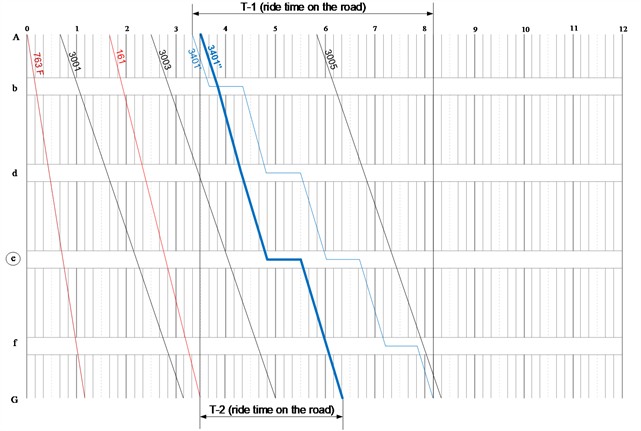
As shown in Fig. 1 and Fig. 2, the introduction of the ShSPL algorithm eliminated overlapping train paths and reduced wagon idle time ().
Table 1Optimized results and operational efficiency improvements
Parameter | Before optimization | After optimization | Change (%) |
Average wagon waiting time, | 4.6 h | 3.5 h | −23.9 |
Average service time at station, | 2.3 h | 2.1 h | −8.7 |
Section capacity utilization | 73 % | 82 % | +12.3 |
Locomotive utilization coefficient | 0.28 | 0.34 | +21.4 |
Total operational time, | 9.8 h | 8.4 h | −14.3 |
Wagon turnover (wagons/day) | 936 | 1080 | +15.4 |
Fig. 1Fragment of train-traffic schedule (TTG) before optimization showing conflicts between passenger and pick-up trains (idle time T1)
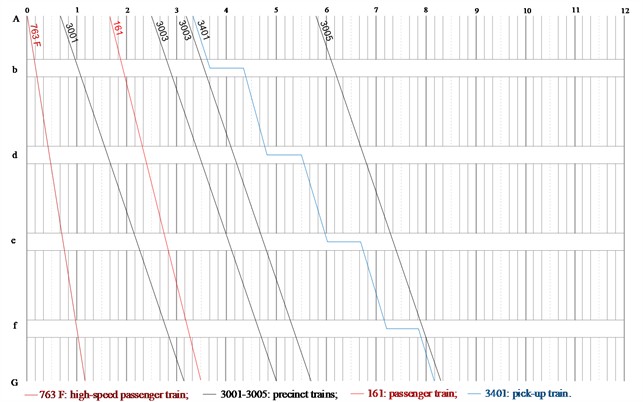
Fig. 2Train-traffic schedule after introduction of the ShSPL optimization scheme showing reduced idle time T2 and improved throughput
3.3. Model validation and discussion
Field verification and simulation testing demonstrated high correlation between the predicted and observed operational indicators, with average deviation below ±5 %.
This confirms the reliability of the model for practical use in real-time dispatch systems.
The results are consistent with previous studies on transport system optimization and local wagon management [4-9], [12], [15], [20].
Similar improvements in scheduling efficiency and capacity utilization were reported in [2], [5], [7], validating the applicability of deterministic-stochastic optimization for railway logistics.
The main factors contributing to the improved performance include:
1) Reduced overlapping of pickup routes due to balanced scheduling,
2) Better synchronization between wagon readiness and locomotive availability,
3) Elimination of redundant waiting periods at low-traffic stations,
4) Automated redistribution of wagon flows between nearby terminals.
These outcomes align with the methodological principles defined in operational standards [10], [11] and national programs for transport efficiency improvement [18], [20].
3.4. Comparative evaluation with existing methods
Compared with conventional manual planning systems, the developed algorithm offers several advantages:
1) Flexibility – dynamic adjustment to stochastic wagon arrivals (-based control).
2) Reliability – deterministic constraint satisfaction ensures schedule feasibility.
3) Scalability – applicable to multiple adjacent stations and regional networks.
4) Integration readiness – compatible with UTY JSC’s digital logistics platform.
Overall, the integrated optimization technique demonstrated significant operational and economic benefits for local wagon-flow management, paving the way for intelligent decision-support systems in the railway sector of Uzbekistan.
4. Conclusions
This study developed and validated an optimization model for organizing local wagon-flows in regional railway networks, with application to the Andijan-Fergana section of Uzbekistan Railways.
The main results and scientific contributions are summarized below.
1) An integrated deterministic-stochastic optimization approach was formulated to minimize total wagon downtime () by simultaneously accounting for service (), waiting (), and travel () times under realistic capacity constraints (, ).
2) The model introduces a multi-criteria schedule-balancing algorithm based on the Simplex method with Poisson-distributed wagon arrivals ().
3) This ensures dynamic adaptability of pickup-train schedules to random demand fluctuations, improving operational stability of local freight traffic.
4) Simulation and field validation on actual operational data confirmed substantial efficiency gains:
– Wagon waiting time reduced by ≈ 24 %, section capacity utilization increased by ≈ 12 %, and locomotive productivity rose by ≈ 21 %.
– The deviation between predicted and observed results did not exceed ±5 %, verifying model adequacy.
5) The proposed approach differs from previous studies by integrating probabilistic arrival modeling with linear-programming optimization, enabling direct implementation in dispatch planning software.
6) Practical application of this model allows real-time regulation of wagon turnover, reduction of unproductive downtime, and more balanced use of locomotives – supporting the strategic goals of Uzbekistan Railways for digital transformation and energy-efficient logistics.
7) Future work should focus on expanding the model for multi-regional interaction, integrating it with machine-learning-based forecasting of wagon arrivals, and developing an automated decision-support module for dispatchers.
References
-
Z. Mukhamedova Gafurdjanovna, S. Fayzibayev Sabirovich, D. Mukhamedova Gafurdjanovna, G. Ibragimova Ruslanovna, and S. Kayumov Sharof Ogli, “Appraisal reliability of electromechanical equipment of rail service car,” Communications – Scientific letters of the University of Zilina, Vol. 26, No. 2, pp. B108–B117, Apr. 2024, https://doi.org/10.26552/com.c.2024.021
-
J. F. Kurbanov and Z. B. Toshboyev, “Improving traffic safety at the sorting of railway transportation of the Republic of Uzbekistan,” in International Conference on Industrial Engineering, Applications and Manufacturing (ICIEAM), pp. 413–418, May 2025, https://doi.org/10.1109/icieam65163.2025.11028517
-
Z. Mukhamedova et al., “Calculating the fatigue strength of load-bearing structures of special self-propelled rolling stock,” Scientific Reports, Vol. 14, No. 1, Aug. 2024, https://doi.org/10.1038/s41598-024-70169-0
-
D. Butunov, S. Buriyev, S. Abdukodirov, M. Tuxtaxodjayeva, and M. Akhmedova, “Modeling violations of the plan for the formation of freight trains for the effective organization of the transportation process,” in E3S Web of Conferences, Vol. 389, p. 05026, May 2023, https://doi.org/10.1051/e3sconf/202338905026
-
D. Butunov, S. Buriyev, S. Abdukodirov, and I. Abdumalikov, “Improvement of the methodology for determining unproductive loss of time in the disbandment system,” in E3S Web of Conferences, Vol. 402, p. 03017, Jul. 2023, https://doi.org/10.1051/e3sconf/202340203017
-
J. F. Kurbanov and Z. B. Toshboyev, “Increasing the stability of the mechanism of deceleration of wagon on the basis of microprocessor control systems on the railway sorting hill,” in 2023 Seminar on Information Systems Theory and Practice (ISTP), pp. 42–46, Nov. 2023, https://doi.org/10.1109/istp60767.2023.10427019
-
M. Masharipov, M. Rasulov, S. Suyunbayev, S. Jumayev, and S. Bekmurodov, “Establishing the impact of empty freight trains on the capacity railway lines,” in E3S Web of Conferences, Vol. 431, p. 08021, Oct. 2023, https://doi.org/10.1051/e3sconf/202343108021
-
S. Jumayev, S. Suyunbayev, T. Sultanov, M. Akhmedova, and M. Toxtakxodjaeva, “Enhancement of local traffic management systems using information technology,” in E3S Web of Conferences, Vol. 583, p. 07016, Oct. 2024, https://doi.org/10.1051/e3sconf/202458307016
-
“Circular on train-handling capacity calculation,” (in Russian), OAO Russian Railways, Moscow, 2011.
-
“Circular on determination of station and train-to-train intervals,” (in Russian), OAO Russian Railways, Moscow, 2011.
-
M. S. Borovnikova, A. V. Shiryaev, and O. I. Vaganova, Organization of High-Speed Railway Traffic in the Russian Federation. (in Russian), Moscow, Russia: PIAR Press, 2011.
-
Zh. Ya. Abdullaev, “Features of determining the capacity of double-track sections,” (in Russian), Proceedings of Petersburg State Transport University, Vol. 16, No. 3, pp. 361–371, 2019, https://doi.org/10.20295/1815-588x-2019-3-361-371
-
R. Z. Nurmukhamedov, Ways to Improve the Organization of Local Railway Operations. (in Russian), Tashkent, Uzbekistan: Uzbekistan Publishing House, 1969.
-
O. T. Aliev, M. M. Talipov, K. M. Kamilov, and O. R. Ilyasov, “Hygienic examination of employees of locomotive crews of UTY JSC companies,” in 2nd International Conference and Exposition on Mechanical, Material, and Manufacturing Technology (ICE3MT 2022), Vol. 2943, No. 1, p. 040057, Jan. 2023, https://doi.org/10.1063/5.0134056
-
M. M. Talipov, O. T. Aliev, O. R. Ilyasov, and O. V. Kovaleva, “Modern method for purifying wastewater from railway embarking using diatomite in a filter band,” in International Conference on Thermal Engineering, Vol. 1, No. 1, 2024.
-
S. Sulaymanov, M. M. Talipov, R. S. Razikov, O. R. Ilyasov, and O. V. Kovaleva, “Protection of the environment from pollution by wastewater from railway transport using natural sorbents,” in International Conference on Thermal Engineering, Vol. 1, No. 1, 2024.
-
E. Shipacheva, S. Shaumarov, A. Gulamov, and M. M. Talipov, “Modeling of interaction of external enclosing structures of buildings with the internal and external environments,” in International Conference on Thermal Engineering, Vol. 1, No. 1, 2024.
-
E. Shipacheva, S. Shaumarov, A. Gulamov, M. M. Talipov, and S. Kandakharov, “Water structure and its influence on cement stone and concrete properties,” in International Conference on Thermal Engineering, Vol. 1, No. 1, 2024.
-
M. Talipov, “Computational modeling and analysis of mechanical power consumption in train assemblers’ work,” in International Conference on Applied Innovations in IT, Vol. 13, No. 2, pp. 419–426, Jun. 2025, https://doi.org/10.25673/120513
About this article

The authors have not disclosed any funding.
The datasets generated during and/or analyzed during the current study are available from the corresponding author on reasonable request.
The authors declare that they have no conflict of interest.

