Abstract
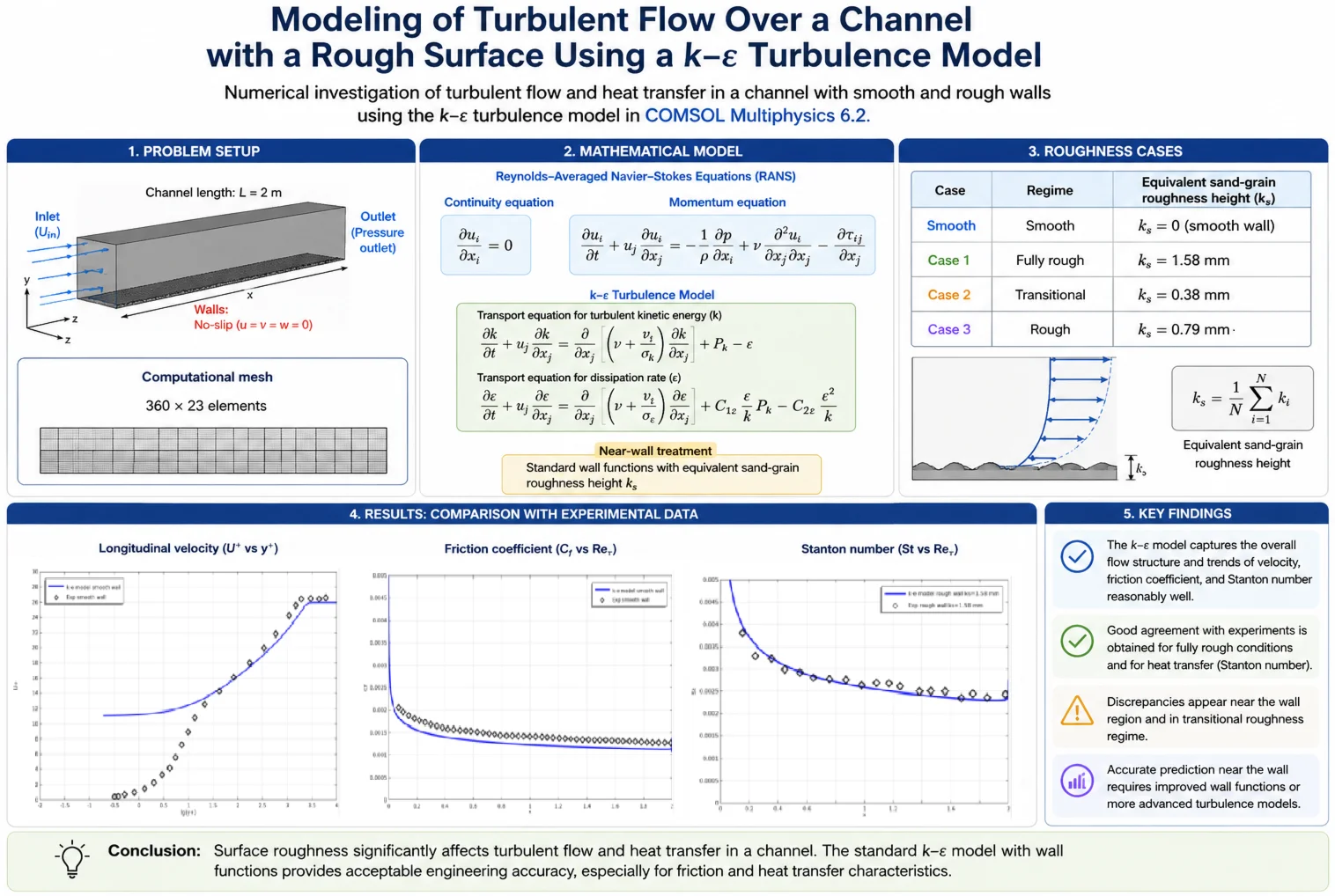
Surface roughness significantly affects aerodynamic and heat transfer processes by modifying the boundary layer structure and increasing turbulence intensity. This study presents a numerical investigation of turbulent flow in a channel with smooth and rough walls using the - turbulence model implemented in Comsol Multiphysics 6.2. Calculations were performed for different equivalent sand-grain roughness heights corresponding to smooth, transitional, and fully rough regimes. The velocity profile, friction coefficient, and Stanton number were analyzed and compared with experimental data. The results show that the standard - model provides satisfactory agreement for friction and heat transfer characteristics, while discrepancies appear near the wall and in transitional regions.
Highlights
- Numerical investigation of turbulent flow and heat transfer in a channel with varying surface roughness.
- Application of the $k-\epsilon$ turbulence model with standard wall functions in COMSOL Multiphysics 6.2.
- Comparative analysis of smooth, transitional, and fully rough regimes using equivalent sand-grain height.
- Validation of simulation results against experimental data for friction coefficient and Stanton number.
- Identification of accuracy limits in the near-wall region for transitional roughness regimes.
1. Introduction
Modeling turbulent flows is a key task in computational fluid dynamics (CFD) and heat transfer, as turbulence plays a crucial role in aerodynamics, hydrodynamics, energy systems, and industrial applications. One important factor influencing such flows is surface roughness, which alters boundary layer structure, increases friction, and affects heat transfer efficiency. Therefore, accurate modeling of rough surfaces is essential for pipes, channels, and aerodynamic profiles.
Among turbulence models, the Spalart-Allmaras (SA) and - models are widely used. The SA model is computationally efficient but requires additional modifications to account for surface roughness. In contrast, the - model, based on transport equations for turbulent kinetic energy () and its dissipation rate (), allows more direct consideration of roughness effects. It is particularly suitable for internal flows where wall roughness significantly influences velocity, pressure, and heat transfer. Roughness effects are typically incorporated through modified wall functions.
Numerous studies have focused on improving turbulence models for rough surfaces. Classical experiments by Nikuradse provided foundational data for rough pipe flows, while later works, including those using DNS and LES methods, demonstrated that even small roughness elements can significantly affect turbulent structure and transport processes.
Modern software such as Comsol Multiphysics 6.2 includes the - model with roughness support, enabling detailed numerical simulations. Comparative studies show that both SA and - models have advantages and limitations under roughness conditions, and various modifications have been proposed to improve their accuracy.
This study presents a numerical investigation of turbulent flow in a rough channel using the - model in Comsol Multiphysics 6.2. Wall functions were applied to account for roughness effects. Simulations were performed for different roughness parameters to evaluate their influence on flow structure and heat transfer. The results highlight the importance of roughness modeling in engineering design and contribute to the development of more accurate turbulence modeling approaches for complex surfaces.
2. Physical and mathematical formulation of the problem
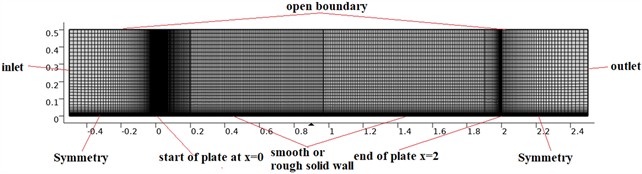
The numerical experiment was conducted as follows. The initial point of the channel is at 0, and the final point of the channel is at 2. The boundary conditions and the computational mesh are shown in Fig. 1. The inlet flow velocity is taken from experiments, and all velocities at the wall are set to zero. The computational mesh consists of 360×23 elements. The numerical experiment was performed for three different roughness values and for a smooth channel.
Fig. 1Boundary conditions and computational mesh
3. Mathematical model
To study the flow over smooth and rough plates, the Reynolds-averaged Navier-Stokes equations were used. These equations form the foundation of the mathematical modeling of incompressible fluid motion and represent a system of differential equations describing the changes in velocity and pressure within the fluid medium over time and in relation to coordinates.
The Reynolds-averaged Navier-Stokes equations take into account turbulent flows and are expressed as the following system of equations:
The mass conservation equation (continuity equation), which describes the law of mass conservation within the computational domain, is expressed as:
The motion equations (Navier-Stokes equations), which describe the law of conservation of momentum, are expressed as:
where – components of the mean velocity field, – mean pressure, – kinematic viscosity, – components of the stress tensor, – density. The first equation describes the change in fluid velocity over time, under the influence of external forces, viscosity, and pressure.
The Reynolds-averaged Navier-Stokes (RANS) equations are widely applied for turbulent flow modeling, as they account for turbulence effects and interactions with smooth and rough surfaces. By decomposing flow variables into mean and fluctuating components, RANS provides a simplified yet sufficiently accurate formulation.
4. - turbulence model
Turbulence models, such as the - model, they are widely used to describe the turbulent characteristics of the flow. This model includes two additional equations: one for turbulent kinetic energy () and the other for its dissipation rate ():
where is the production of turbulent kinetic energy, is the turbulent viscosity, and is an empirical constant, and are empirical constants, and is the Prandtl number for .
These additional equations improve the modeling of turbulent flow characteristics and increase the accuracy of simulations over smooth and rough surfaces. Although the - model is widely used in CFD, it has limitations, particularly in low Reynolds number and boundary layer flows where laminar effects are important. Since the standard - model was developed for high Reynolds number turbulence, it does not accurately capture transitional flow processes. To address this, various modifications of the model are available in software such as Comsol Multiphysics, including wall functions that account for surface roughness. In Comsol, the standard - model can be adapted for rough channels, enabling more accurate simulation of flows affected by wall roughness.
5. Research materials and methods
In this study, the - turbulence model in Comsol Multiphysics was used to analyze turbulent flows. The software provides flexible modeling tools, adaptive meshing, and advanced solvers for accurate simulation of aerodynamic and hydrodynamic processes. The - model, based on transport equations for turbulence kinetic energy () and its dissipation rate (), effectively describes energy transfer and dissipation in turbulent flows. Parametric studies were performed to evaluate the effects of wall roughness and flow conditions, enabling reliable results applicable to engineering design and optimization of hydrodynamic systems.
6. Research results and discussion
6.1. Experiment 1
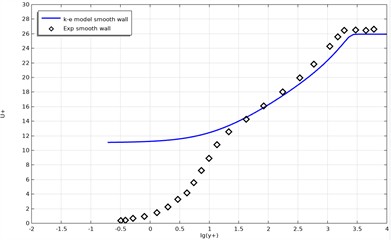
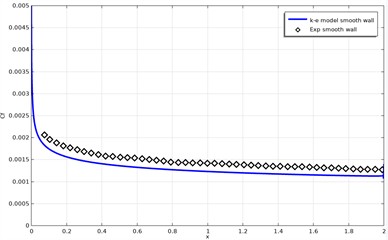
First, the flow in a smooth channel is considered. The inlet velocity is 58 m/s and the pressure is 101325 Pa. Fig. 2 presents the longitudinal velocity at 1 and the resistance coefficient. These inlet conditions correspond to a relatively high flow intensity at normal atmospheric pressure, both of which significantly influence the flow characteristics.
As shown in Fig. 2, the standard - model has limitations in describing the near-wall flow structure. In particular, it does not accurately capture the laminar and buffer layers because it is primarily designed for fully developed turbulent flows. Since the standard - model is not a low Reynolds number model, it cannot correctly reproduce transitional regions between laminar and turbulent flow. However, Fig. 2(b) indicates that the resistance coefficient values are predicted with satisfactory accuracy. Despite its near-wall limitations, the standard - model provides acceptable results for the turbulent region and can be applied in engineering calculations of fully developed turbulent flows. For more accurate near-wall predictions, especially for rough surfaces, advanced turbulence models or improved wall treatment methods may be required.
Fig. 2a) Longitudinal velocity at the section x= 1 and b) resistance coefficient
a)
b)
6.2. Experiment 2
In 1991 and 1993, M. Hosni and co-workers conducted experiments on heat transfer over a rough plate in a turbulent boundary layer. The plate length was 2 m. The inlet conditions were 58.0 m/s, 28.56 °C, and 101325 Pa, while the wall temperature was maintained at 45 °C. The equivalent sand-grain roughness height was 1.58 mm, corresponding to 300, which represents a fully rough regime.
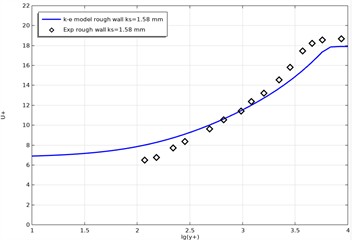
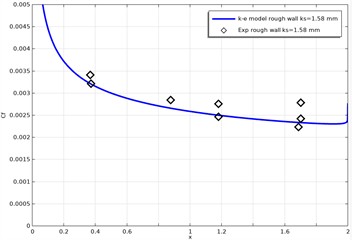
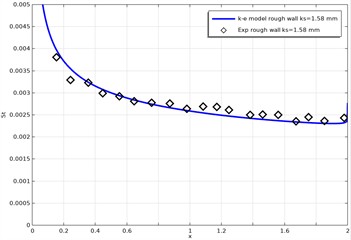
Fig. 3 shows three key parameters for the rough channel at section 1: longitudinal velocity, channel resistance coefficient, and Stanton number.
Fig. 3Compares numerical results obtained with the standard k-ε model and experimental data for a rough channel (ks= 1.58 mm)
a)
b)
c)
Fig. 3(a) shows the longitudinal velocity distribution versus . The model reproduces the general trend but deviates in the buffer layer and near-wall region. Fig. 3(b) presents the resistance coefficient , where good agreement with experimental data is observed, particularly at higher values, with minor deviations near the wall. Fig. 3(c) illustrates the Stanton number . The model predicts its overall behavior accurately, although small differences appear in some regions. Overall, the standard - model with roughness consideration provides acceptable results, but improvements are needed for more accurate prediction of laminar and transitional regions near the wall
6.3. Experiment 3
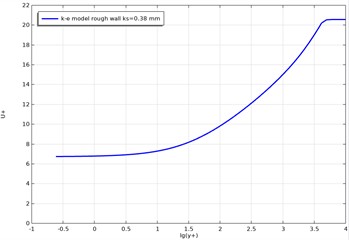
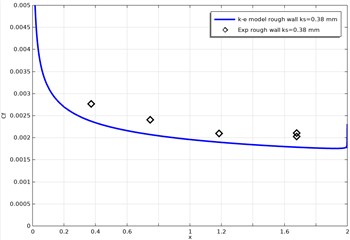
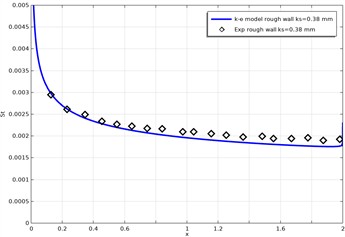
The third experiment was conducted on a plate with a length of 2 m. The equivalent sand-grain roughness height was 0.38 mm, corresponding to 60, which represents a transitional roughness regime. In this case, some roughness elements protrude into the flow, affecting the boundary layer structure and increasing resistance. The partial penetration of roughness elements generates additional vortices and turbulence, leading to a higher friction coefficient. Fig. 4 presents the longitudinal velocity, resistance coefficient, and Stanton number at 1.
Fig. 4Simulation results for a rough channel (ks= 0.38 mm) obtained using the standard k-ε model, compared with experimental data
a)
b)
c)
Fig. 4(a) shows the longitudinal velocity versus . The model captures the general trend but does not accurately describe the laminar and buffer layers, focusing mainly on the turbulent region. Fig. 4(b) illustrates the resistance coefficient . Although the overall trend agrees with the experiment, noticeable deviations are observed. Fig. 4(c) presents the Stanton number . The model predicts heat transfer reasonably well over most of the range, with larger discrepancies near the initial region. In general, the - model provides acceptable results for this case, but its accuracy decreases near the wall and in the transitional flow regime.
6.4. Experiment 4
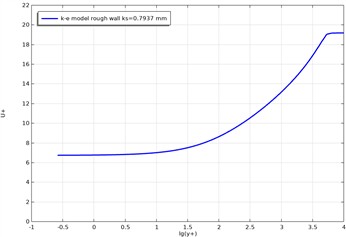
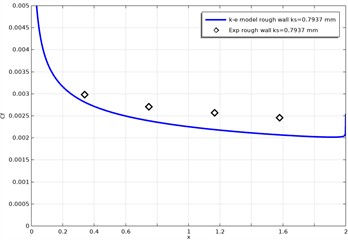
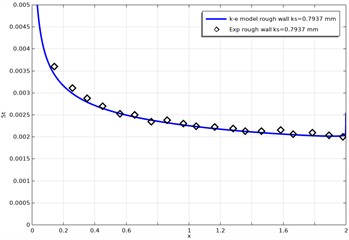
In 1974, J. Healer and colleagues investigated the turbulent boundary layer over a rough plate at different inlet velocities. In this study, the case with 73.88 m/s is considered, with other conditions similar to the Hosni experiment. Unlike previous cases, spherical roughness elements with a diameter of 0.635 mm were placed on the plate. The equivalent sand-grain roughness height was 0.79375 mm, corresponding to 175, which represents a fully rough regime. In this regime, roughness elements fully protrude beyond the viscous sublayer, significantly increasing resistance and modifying the turbulent boundary layer structure. Fig. 5 presents the longitudinal velocity, resistance coefficient, and Stanton number at 1.
Fig. 5Numerical and experimental results for a rough channel (ks= 0.7937 mm)
a)
b)
c)
Fig. 5(a) presents the longitudinal velocity versus . The - model reproduces the general trend but shows deviations in the buffer layer and near-wall region. Fig. 5(b) illustrates the resistance coefficient , where the model underestimates experimental values, particularly at high . Fig. 5(c) shows the Stanton number . Here, the model agrees well with experimental data, especially at higher values. Overall, with increasing roughness, the - model predicts the Stanton number more accurately, but noticeable discrepancies remain in the velocity profile and friction coefficient.
7. Conclusions
In this study, the - turbulence model was used to analyze the hydrodynamic and heat transfer characteristics of flow in a channel with different wall roughness levels. Numerical results were compared with experimental data. The velocity profile shows good agreement with experiments in regions far from the wall, but significant underestimation occurs near the wall and in transitional zones, indicating limited accuracy in modeling roughness effects. For the resistance coefficient , the model captures the overall trend but deviates from experimental values, especially at higher 𝑦. These discrepancies increase with wall roughness, likely due to limitations in near-wall turbulence modeling. The Stanton number is predicted with relatively good accuracy, particularly at higher , although some deviations appear at lower values. Overall, the - model provides satisfactory predictions of channel flow with rough walls but has limitations in near-wall and transitional regions. Improved wall functions and more detailed treatment of roughness and turbulent diffusion are required to enhance modeling accuracy.
References
-
H. Schlichting, “Experimentelle Untersuchungen zum Rauhigkeitsproblem,” Ingenieur-Archiv, Vol. 7, No. 1, pp. 1–34, Feb. 1936, https://doi.org/10.1007/bf02084166
-
“Form deviations; Concepts; Classification system,” DIN 4760:1982-06, Jun. 1982.
-
J. P. Bons, “A review of surface roughness effects in gas turbines,” Journal of Turbomachinery, Vol. 132, No. 2, Apr. 2010, https://doi.org/10.1115/1.3066315
-
M. Stripf, A. Schulz, and H.-J. Bauer, “Modeling of rough-wall boundary layer transition and heat transfer on turbine airfoils,” Journal of Turbomachinery, Vol. 130, No. 2, Apr. 2008, https://doi.org/10.1115/1.2750675
-
S. T. Mcclain, M. Vargas, J.-C. Tsao, and A. Broeren, “Influence of freestream temperature on ice accretion roughness,” SAE International Journal of Advances and Current Practices in Mobility, Vol. 2, No. 1, pp. 227–237, Jun. 2019, https://doi.org/10.4271/2019-01-1993
-
Y. Liu, K. Zhang, W. Tian, and H. Hu, “An experimental investigation on the dynamic ice accretion and unsteady heat transfer over an airfoil surface with embedded initial ice roughness,” International Journal of Heat and Mass Transfer, Vol. 146, p. 118900, Jan. 2020, https://doi.org/10.1016/j.ijheatmasstransfer.2019.118900
-
J. Shin, “Characteristics of surface roughness associated with leading-edge ice accretion,” Journal of Aircraft, Vol. 33, No. 2, pp. 316–321, Mar. 1996, https://doi.org/10.2514/3.46940
-
P. Forooghi et al., “DNS of momentum and heat transfer over rough surfaces based on realistic combustion chamber deposit geometries,” International Journal of Heat and Fluid Flow, Vol. 69, pp. 83–94, Feb. 2018, https://doi.org/10.1016/j.ijheatfluidflow.2017.12.002
-
P. Spalart and S. Allmaras, “A one-equation turbulence model for aerodynamic flows,” 30th Aerospace Sciences Meeting and Exhibit, No. 1, pp. 5–21, Jan. 1992, https://doi.org/10.2514/6.1992-439
-
Z. M. Malikov, M. E. Madaliev, S. L. Chernyshev, and A. A. Ionov, “Validation of a two-fluid turbulence model in Comsol multiphysics for the problem of flow around aerodynamic profiles,” Scientific Reports, Vol. 14, No. 1, p. 2306, Jan. 2024, https://doi.org/10.1038/s41598-024-52673-5
-
Z. M. Malikov, M. E. Madaliev, D. P. Navruzov, and K. Adilov, “Numerical study of an axisymmetric jet based on a new two-fluid turbulence model,” in International Conference on Actual Problems of Applied Mechanics – APAM-2021, Vol. 2637, No. 1, p. 040023, Jan. 2022, https://doi.org/10.1063/5.0118473
-
M. Madaliev, Z. Abdulkhaev, K. Kurpayanidi, A. Abdullayev, and A. Ilyosov, “Study of the SST turbulence model for the 2D NASA wall-mounted hump separated FLOW problem with plenum case,” in E3S Web of Conferences, Vol. 508, p. 06007, Apr. 2024, https://doi.org/10.1051/e3sconf/202450806007
-
M. Madaliev et al., “Numerical analysis of single SC-50-800 and SC-50-500x2-x4 group centrifugal cyclones: efficiency comparison,” in E3S Web of Conferences, Vol. 508, p. 06005, Apr. 2024, https://doi.org/10.1051/e3sconf/202450806005
-
E. Madaliev, M. Madaliev, S. Raxmankulov, and S. Raxmonkulova, “Turbulent mixing of two plane flows based on the SST turbulence model,” in E3S Web of Conferences, Vol. 452, p. 02012, Nov. 2023, https://doi.org/10.1051/e3sconf/202345202012
-
E. Madaliev, M. Madaliev, M. Tursunaliev, M. Shoev, and N. Tashpulatov, “Direct numerical simulation of flow in a flat suddenly expanding channel based on nonstationary Navier-Stokes equations,” in The 3rd International Scientific Conference Construction Mechanics, Hydraulics and Water Resources Engineering (CONMECHYDRO 2021 AS), Vol. 2612, No. 1, p. 030003, Jan. 2023, https://doi.org/10.1063/5.0113159
-
M. Madaliev, A. Usmanov, and N. Usmonova, “Numerical study of the efficiency of single and group centrifugal cyclones,” in E3S Web of Conferences, Vol. 452, p. 06016, Nov. 2023, https://doi.org/10.1051/e3sconf/202345206016
-
V. C. Patel, W. Rodi, and G. Scheuerer, “Turbulence models for near-wall and low Reynolds number flows – A review,” AIAA Journal, Vol. 23, No. 9, pp. 1308–1319, Sep. 1985, https://doi.org/10.2514/3.9086
-
V. C. Patel, “Perspective: flow at high Reynolds number and over rough surfaces-Achilles heel of CFD,” Journal of Fluids Engineering, Vol. 120, No. 3, pp. 434–444, Sep. 1998, https://doi.org/10.1115/1.2820682
-
Z. Q. Wang and N. S. Cheng, “Influence of secondary flow on distribution of suspended sediment concentration,” Journal of Hydraulic Research, Vol. 46, pp. 548–552, 2008, https://doi.org/10.3826/jhr.2008.3178
-
C. C. Shir, “A numerical computation of air flow over a sudden change of surface roughness,” Journal of the Atmospheric Sciences, Vol. 29, No. 2, pp. 304–310, Mar. 1972, https://doi.org/10.1175/1520-0469(1972)029<0304:ancoaf>2.0.co;2
About this article

The authors have not disclosed any funding.
The datasets generated during and/or analyzed during the current study are available from the corresponding author on reasonable request.
The authors declare that they have no conflict of interest.

