Abstract
The article discusses low-maintenance rail fasteners designed to ensure the reliability and safety of high-speed traffic. The influence of the fastener design on the pressure distribution on the under-rail gaskets and the improvement of the operational characteristics of the tracks during high-speed and heavy traffic is estimated. Studies have shown that elastic rail fasteners with high vertical rigidity of under-rail gaskets, such as Vossloh and Technoloy, increase the life of rails and reduce dynamic loads. The analysis of experimental data confirmed the effectiveness of plastic and rubber-based fasteners with a long service life. It is recommended to use fasteners with a stiffness of 150-200 tc/cm and a height of 6-8 mm to increase the durability of the track and reduce maintenance costs.
Highlights
- Low-maintenance elastic rail fasteners with gasket stiffness of 150–200 tc/cm improve track reliability, safety, and durability by optimizing stress distribution and reducing dynamic loads under high-speed traffic.
- Elastic gaskets providing 0.3–0.5 mm rail-seat deformation ensure uniform wheel-load distribution, reduce stress concentrations and material fatigue, and extend the service life of railway track components.
- The KZF-07 fastening system showed superior performance on curves (R < 600 m), while modern screw-dowel and anchor fasteners reduced maintenance, improved structural stability, and lowered life-cycle costs compared with conventional bolted systems.
1. Introduction
The development of high-speed passenger train traffic places high demands on the reliability and safety of the railway infrastructure, including the upper structure of the track. In the conditions of JSC NC “KTZ” (Kazakhstan). This requires taking into account the increase in axial load, the increase in heavy traffic, as well as adaptation to harsh climatic conditions. Modern research shows that effective interaction of track and rolling stock plays a key role in improving the operational characteristics of the railway network [1, 2].
In world practice, considerable attention is paid to the development of rail fasteners that have increased durability and require minimal maintenance. For example, studies in Europe and Japan demonstrate that the introduction of innovative rail fasteners makes it possible to increase the inter-repair time to 2-3 billion gross tons [3, 4]. In Canada and the USA, solutions based on improving the modular elasticity of track components are actively used, which reduces their wear and increases their resistance to climatic factors [5-7].
However, in Kazakhstan, the operational performance of the railway facilities remains significantly below the international level. The standard life of a track with R65 rails is only 700 million tons, and the inter–repair time is 1.5-2 times shorter than in countries with developed railway infrastructure. This is due to a number of factors: the lack of coordinated operation of track elements, poor quality of materials and structures, as well as insufficient adaptation of standards to the specific conditions of the region [2, 8, 9].
The relevance of the study is due to the need to improve the operational reliability and durability of the railway track, which is directly related to the requirements for the development of Kazakhstan's transport infrastructure by 2025 and 2030. The main goals are to increase the inter-repair time, reduce the cost of the life cycle of the track and reduce sections with speed limits.
The subject of the research is modern low–maintenance structures of intermediate rail fasteners. The purpose of the study is to develop and substantiate constructive solutions for low-maintenance rail fasteners to improve the reliability and safety of high-speed passenger train traffic.
To solve this problem, Russian scientists pay special attention to reducing operating costs and improving the reliability of railway infrastructure in Kazakhstan. At the same time, the objectives of the study are:
– Conducting an analysis of modern structural solutions for rail fasteners in world practice.
– Investigation of the operational features of rail fasteners in the conditions of JSC NC “KTZ”.
– Development of a rail fastener design optimized for the conditions of Kazakhstan.
– Assessment of economic efficiency and resource of low-maintenance rail fasteners.
Thus, the results of the study will allow us to solve the problem of increasing the inter-repair time between major repairs of the track and reducing the length of sections with speed limits in Kazakhstan.
2. Research methodology
Methods of theoretical analysis and experimental tests were used to study the reliability and safety of low-maintenance rail fasteners. The main objectives of the study were to evaluate the distribution of loads, deformations and stresses in the track structure with various types of rail fasteners [2, 4, 10].
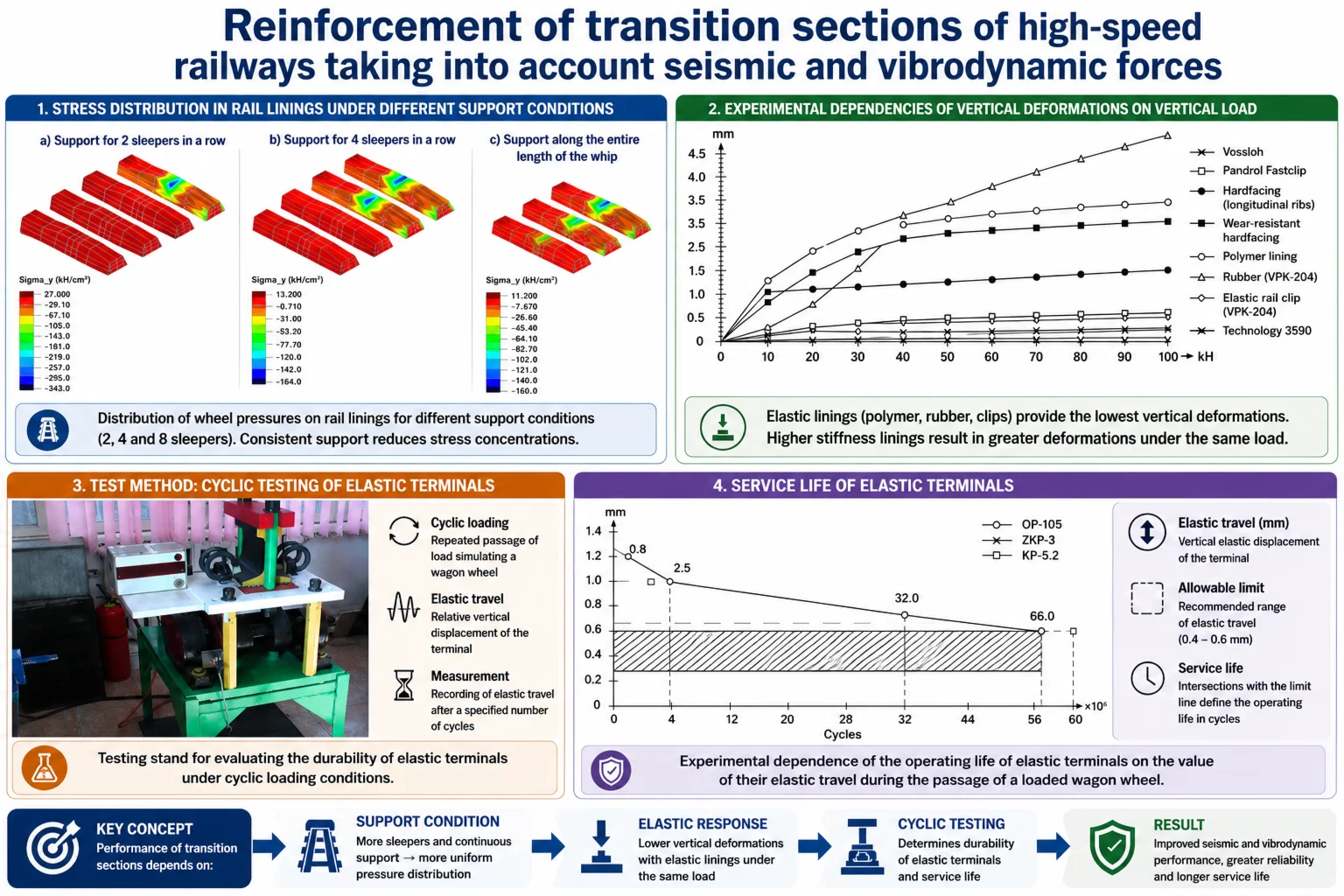
Finite element methods (FEA) were used to calculate the distribution of pressures and stresses on rail gaskets using specialized software ANSYS Mechanical with Modul: Static Structural for analyzing railway track structures. Finite element modeling is performed in a three-dimensional formulation using three-dimensional tetrahedral elements and Surface-to-Surface contact elements. The model included a rail, an under-rail gasket, a sleeper and an elastic ballast base. Linear elastic and hyperelastic models were used for the materials. The load was applied to the bottom of the rail in the form of vertical wheel force. The boundary conditions took into account the elastic operation of the ballast layer and the limitation of the model’s movements as a rigid body. Calculations were performed for various schemes of rail support on 2, 4 and 8-10 sleepers, as well as for continuous support along the length of the rail whip (Fig. 1) [11, 12].
The dynamic stiffness of the subgrade, which is interrupted at the bridge shore abutment, is significantly reduced and depends on the stiffness of the bridge span structure and the interface with the bridge abutment [14-17].
As can be seen from a comparison of the data in Fig. 1, when the rail is supported by two sleepers, the pressure on the under-rail gasket is 34 kg/cm2, when supported by four sleepers, 16.4 kg/cm2, and when supported along the entire length of the whip, 14 kg/cm2. Obviously, when the rail is supported by 8-10 sleepers, its deflection will be two times less than when supported by two sleepers. With rigid fasteners of the KB-65 type, due to gaps between the rail and the gasket or between the sleeper and the ballast, the pressure on the sleeper can increase 2-2.5 times and this significantly reduces the service life of the track [5, 13].
There are various deformations resulting from the increase of amplitude-frequency characteristics in the soils of the railway subgrade due to seismic forces. Under the action of seismic forces, the external forces increase significantly. Increased oscillatory motion of the subgrade leads to changes in the condition of the elements of the track top structure. Different deformations appear as a result of the increase in the active pressure of the subgrade soil under the action of seismic and vibrodynamic forces at the approaches to bridges.
The experience of the West Siberian Railway indicates the possibility of achieving solid operation of track structural elements and the possibility of doubling the planned operating time of tonnage when elastic rail fasteners with specified parameters are included in the track design. The research of V.K. Fink in Almaty, convinces of the technical feasibility of creating an equal-strength track structure with elastic rail fasteners with an operating time of at least 1.5 billion tons [13].
Fig. 1The distribution of wheel pressures on the rail linings in cases where the rail is supported by two, four and eight sleepers resting on a layer of rubble
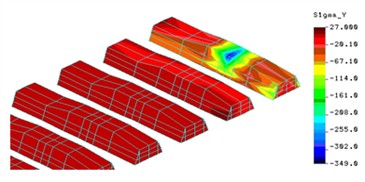
a) Support for 2 sleepers in a row
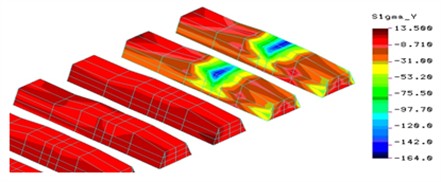
b) Support for 4 sleepers in a row
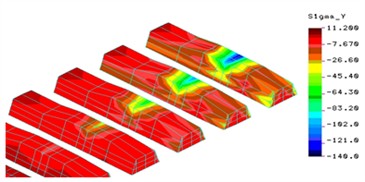
c) Support along the entire length of the whip
The second technical requirement for track construction, which has not yet been implemented on the railways of the CIS countries, is the property of the structure to evenly distribute train pressure with minimal accumulation of potential energy and residual deformations [14].
To implement this requirement, innovative design and technological solutions can be applied, which have already been tested in Kazakhstan during the construction of highways. The second technical requirement has been implemented on U.S. railways in areas of heavy train traffic by laying a layer of hot asphalt on top of the roadbed. In Kazakhstan, less costly constructive solutions are effective [7, 8, 15]. It has everything you need in terms of building materials and trained specialists. There are also precedents for the creation of durable waterproof soil mixtures during the construction of highways in Kazakhstan. It is necessary to use these technologies in the construction of a seamless railway track to strengthen the top of the roadbed and lay waterproof, durable ballast layers from a mixture of local soils with special additives. Then the above-mentioned second technical requirement, which is new for the CIS countries, will be fulfilled. The relevance of this requirement is caused by the increase in passenger train speeds, the increase in axial carriage loads and the introduction of heavy freight train traffic in Kazakhstan [16, 17].
To verify the theoretical data, tests were carried out on real sections of track using various types of rail fasteners, including KB-65, ZHBR65SHD, Pandrol and KZF-07. The tests included measurements of vertical and longitudinal deformations of the track linings, as well as the amplitude-frequency characteristics of track vibrations at different train speeds.
For a low–maintenance jointless track, practically maintenance-free intermediate rail fasteners are required - which do not contain threaded connections, have under-rail and staple gaskets made of linearly deformed plastic with a service life equal to the service life of the entire fastener. All fastening parts must have the same service life of the tonnage equal to the service life of the rail.
For a long time, the interlocking intermediate rail fastening with a rigid KB-65 terminal was used on the seamless track. The priority in the current maintenance of the joint-free track with this fastening was the maintenance of the intermediate rail fastening. The KB terminal-bolt fastener is highly reliable due to the metal lining, which also allows for level adjustment of the path. The main direction of further development of fastener designs is the transition to spring-loaded, elastic, low-maintenance fasteners, interlocked in straight lines and lined in curves with a radius of less than 600 m. Experimental dependences of vertical deformations of track linings on vertical load, obtained by V. K. Fink [18] Fig. 2.
Fig. 2Experimental dependences of vertical deformations of track linings on vertical load
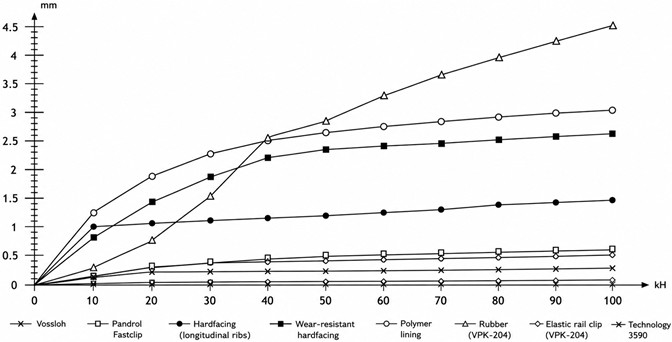
As can be seen from a comparison of the graphs in Fig. 2. The modern requirements of vertical rigidity are met by Vossloh gaskets, solid Savilene gaskets and Technoloy. The CP204 gasket has a vertical deformation of 4.5 mm at a vertical load of 10 kN, which is unacceptable from the perspective of reducing the life of the rail. Some of the gaskets have a non-linear load-strain graph Pandrol Fastclip, Sevylene pimple, CP204, which is similar to the presence of gaps in the fastening unit, leading to the impact interaction of the wheel and rail.
ARS-4, ZHBR65SHD, Vossloh, and Pandrol fasteners are considered effective for Russian railways today. ARS-4, ZHBRSHD and Vossloh fasteners are good on straight lines, where the lateral forces from the wheels usually do not exceed 2 tc and dowels working alone can withstand these forces in fatigue mode. Pandrol anchors also do not destroy the concrete of the sleeper if the anchor is sufficiently embedded in the concrete of the sleeper. However, in the curves in the fatigue mode, damage was noticed to the dowels of fasteners designed to withstand lateral forces up to 2 tc. Since the standard lateral forces on Russian railways are 5ts for sections of track in curves of small radii (600 m or less), taking into account the action of large transverse forces from the wheels of wagons, it is advisable to use lining rail fasteners, where two dowels work together combined with a metal lining. PTKB CPU offers a JBR65SHDM lining fastener for sections of curves. The disadvantages of this fastening are its high metal consumption and the high forces transferred when the embedded bolt is tensioned onto the concrete of the sleeper (3 tc instead of 2 tc in the fastening of the Vossloh).
Labor costs for the alignment of a jointless track with reinforced concrete sleepers in the longitudinal profile amount to 50 % of all work on the current maintenance of the track. With the lining structure, 60 % of the straightening work is carried out by adjusting shock-absorbing pads. The use of these gaskets, in comparison with the lining of ESP sleepers, reduces the complexity of work by 3 times. The non-slip fastening of the JBR-65, which has the possibility of straightening with gaskets, is recommended to use them in exceptional cases. The use of buttless structures in a jointless track increases the complexity of straightening work in winter.
In 2007, the KZF-07 bond was created for the sections of the track in curves, which was successfully tested on the Almaty and Ekibastuz distances of the Kazakhstan Temir Zholy route.
In this fastening, an elastic terminal of the SKL-14 type, a dowel for Vossloh fastening, a CP50 screw, under-rail and staple gaskets made of plastic according to Vossloh recipe and a shortened metal lining, through the edges of which screws are passed.
3. Results and discussion
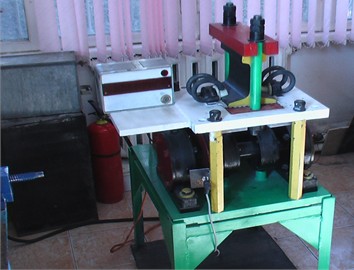
To assess the durability and wear resistance of rail fasteners, cyclic tests were used at the stand of the Magnetik trellis factory, where tests were carried out on the service life of elastic terminals under the conditions of real impact of wheel loads (Fig. 3).
Fig. 3Stand for cyclic testing of elastic terminals
The dependence of the cyclic operating time on the amplitude of the terminal during the passage of the wheel is shown in the graph in Fig. 4.
Fig. 4Experimental dependence of the operating life of the tonnage of elastic terminals on the value of their elastic travel during the passage of a loaded wagon wheel
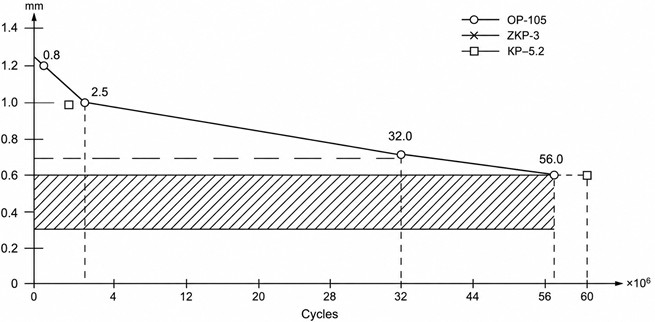
As can be seen from the graph in Fig. 4, with an elastic stroke of 0.6 mm, the terminal can withstand 56 million cycles, and with a stroke of 0.7 mm, it can withstand only 32 million cycles. For a low-maintenance, non-jointed path, the elastic stroke of the terminal (shaded rectangular area in Fig. 4) should be within 0.3-0.6 mm. This determines the necessary rigidity of the under-rail fastening gasket.
Some of the measurement results of track vibrations under train load are shown in Table 1. The data were obtained using vibration diagnostic hardware and software systems. The measuring complex includes: three-component sensors that are mounted on track elements and ground to measure vertical () and horizontal vibrations; a block recorder for collecting, amplifying and converting signals from sensors; a laptop with specialized software for visualization, spectral analysis and data storage. The condition of the sleeper rail, ballast prism and roadbed in the experimental sections can be described as “good”, corresponding to the current regulatory documents.
The experimental results showed that in sections using KZF-07 fasteners, the oscillation frequency of the rail is 127-139 Hz, which is significantly higher than that of traditional solutions such as KB-65 (27-39 Hz). This indicates better damping and stability of the path during high-speed movement.
Table 1Track vibrations under train
Train speed, km/h | Train type | The type of bond | The oscillation frequency of the rail, Hz |
42 | Freight | KB 65 | 27-39 |
56 | Passenger | JBR 65 | 51-62 |
54 | Freight | JBR 65 | 70-105 |
40 | Freight | KPP-5 | 124-178 |
64 | Freight | KZF-07 | 127-139 |
72 | Freight | Vossloh | 134-160 |
4. Conclusions
The study results comprehensively demonstrated that the implementation of modern low-maintenance rail fastening systems equipped with elastic gaskets having a vertical stiffness of 150-200 tc/cm significantly enhances the reliability, durability, and operational safety of railway tracks under high-speed traffic conditions. The use of elastic components in the fastening system plays a crucial role in optimizing the stress-strain behavior of the track structure and improving the interaction between the rail, sleeper, and substructure elements.
The analysis established that elastic gaskets with a vertical stiffness within the range of 150-200 tc/cm provide rail-seat deformations of approximately 0.3-0.5 mm. This deformation range can be considered optimal because it ensures a balanced distribution of wheel loads among adjacent sleepers, reduces localized stress concentrations in track components, and minimizes the occurrence of excessive dynamic impacts. As a result, the track structure operates under more favorable loading conditions, which contributes to reducing material fatigue, slowing degradation processes, and extending the overall service life of railway infrastructure elements.
The study also revealed the influence of track geometry on the efficiency of fastening systems. For curved track sections with radii below 600 m, the KZF-07 lining fastener demonstrated superior performance compared with conventional fastening systems. Its advantages include improved operational characteristics, reduced metal consumption, and enhanced durability under conditions of increased lateral forces and intensified dynamic loading typical for small-radius curves. The optimization of fastening design for such sections can significantly reduce maintenance requirements and operational expenditures while increasing track reliability.
Furthermore, the investigation confirmed the importance of the cooperative (solidary) behavior of continuous welded rails and sleepers in maintaining structural stability. The integrated operation of these elements promotes a more uniform transfer and redistribution of loads throughout the track structure, reducing rail deflections and limiting unfavorable stress concentrations. Such interaction improves the mechanical performance of the track system and contributes to increased resistance against deformation and deterioration during long-term operation.
An additional outcome of the study concerns the assessment of fastening system evolution. Traditional bolted intermediate rail fasteners were found to be insufficient for meeting the requirements of modern high-speed railway operation due to their higher maintenance demand and lower operational efficiency. The transition toward advanced low-maintenance systems, particularly screw-dowel and anchor fasteners, represents a more effective engineering solution. These systems provide increased reliability, reduced maintenance frequency, improved economic efficiency, and enhanced long-term operational performance.
Overall, the obtained results establish a set of engineering recommendations for improving railway track structures under high-speed traffic conditions. The integrated use of elastic rail fasteners, optimized fastening configurations for curved sections, and modern low-maintenance technologies creates favorable conditions for increasing track durability, reducing life-cycle costs, and improving the safety and efficiency of railway transportation systems.
References
-
“Technical regulations of the Customs Union TR CU 002/2011 On the safety of high-speed rail transport,” Customs Union Commission, Jul. 2011.
-
N. I. Karpushchenko and N. I. Antonov, Improvement of Rail Fasteners. Novosibirsk: SGUPS Publishing House, 2003, p. 300.
-
R. Smith and A. Kapoor, “Advancements in rail fastening systems for high-speed railways,” Journal of Railway Engineering, Vol. 34, No. 2, pp. 123–136, 2020.
-
K. Yamada and T. Tanaka, “Durability and maintenance-free rail fastening systems in Japan: innovations and applications,” Proceedings of the Japan Society of Civil Engineers, Vol. 56, No. 4, pp. 45–58, 2019.
-
K. Lesov, “Effectiveness management of construction production programs with changes in the facilities saturation with means of mechanization,” in AIP Conference Proceedings, Vol. 2612, p. 040022, Jan. 2023, https://doi.org/10.1063/5.0114462
-
D. Mcneil and P. Johnson, “Elasticity and resilience in rail track components: a North American perspective,” Journal of Transportation Engineering, Vol. 47, No. 5, pp. 212–224, 2021.
-
K. S. Lesov, Z. Z. Ergashev, M. K. Kenjaliyev, and S. A. Tadjibaev, “Quantitative characteristics of construction and reconstruction of railway sections in Uzbekistan,” E3S Web of Conferences, Vol. 401, p. 03024, Jul. 2023, https://doi.org/10.1051/e3sconf/202340103024
-
G.-A. Khalfin and K. Umarov, “The work of intermediate rail fasteners on mountain sections of railways,” in AIP Conference Proceedings, Vol. 2612, No. 1, p. 040023, Jan. 2023, https://doi.org/10.1063/5.0126396
-
S. A. Tadjibayev, G.-A. R. Khalfin, A. B. Yembergenov, and S. M. Umaraliyev, “Methods of increasing stability of slopes of embankment of roadbed of sand dunes,” in AIP Conference Proceedings, Vol. 3317, No. 1, p. 030042, Jul. 2025, https://doi.org/10.1063/5.0267389
-
K. S. Lesov, S. A. Tadjibayev, G. R. Khalfin, and M. M. Mirkhanova, “Reinforcement of the embankment slopes with volumetric geogrids of the roadbed and the study of their stability,” in AIP Conference Proceedings, Vol. 3317, No. 1, p. 030041, Jul. 2025, https://doi.org/10.1063/5.0267388
-
S. Dostanova, S. Shayakhmetov, K. Lesov, K. Umarov, and Z. Kalpenova, “Bearing capacity of road overpasses under dynamic influences,” in AIP Conference Proceedings, Vol. 3317, No. 1, p. 030037, Jan. 2025, https://doi.org/10.1063/5.0267571
-
S. Dostanova, S. Shayakhmetov, K. Lesov, K. Umarov, and K. Tokpanova, “Reliability of bridge structures under dynamic influence of load,” in AIP Conference Proceedings, Vol. 3317, No. 1, p. 030038, Jan. 2025, https://doi.org/10.1063/5.0267570
-
A. Y. Kogan, “Transverse horizontal forces arising from the action of longitudinal temperature forces in the rail weaves of a joint-less track and transmitted to the sleeper base,” Bulletin of VNIIZHT, No. 5, pp. 10–13, 2011.
-
G.-A. Khalfin, K. Umarov, I. Purtseladze, and M. Yembergenov, “System for determining state of continuous welded track,” E3S Web of Conferences, Vol. 401, p. 02050, Jul. 2023, https://doi.org/10.1051/e3sconf/202340102050
-
M. Muzaffarova and M. Mirakhmedov, “Physicochemical method of fixing mobile sands with local materials,” E3S Web of Conferences, Vol. 264, p. 02009, 2021, https://doi.org/10.1051/e3sconf/202126402009
-
K. S. Lesov and G. R. Khalfin, “Calculation and assessment of the stability of the rail whip of a seamless track for the conditions of Uzbekistan,” Journal of Advanced Research and Stability Special Issue, pp. 339–343, Apr. 2022.
-
S. B. Shayakhmetov, Z. D. Kalpenova, K. S. Lesov, and K. K. Umarov, “Rayleigh and love surface waves with regard to seismic stress state of earth bed,” E3S Web of Conferences, Vol. 401, p. 01077, Jul. 2023, https://doi.org/10.1051/e3sconf/202340101077
-
A. Bakytov and V. K. Fink, Investigation of the Dependence of the Coefficient of Friction of Under-Rail Gaskets Made of New Materials on the Temperature of the Rail. Education and Science s.r.o., 2010, p. 259.
About this article

The authors have not disclosed any funding.
The datasets generated during and/or analyzed during the current study are available from the corresponding author on reasonable request.
The authors declare that they have no conflict of interest.

