Abstract
In this article, research was conducted on the selection and calculation of the composition of polymer-sulfur asphalt concrete resistant to high-temperature operating conditions. In addition, scientific research was conducted on the granulometric composition and physical and mechanical properties of crushed stone, sand, and mineral powder, which are considered mineral fillers in polymer-sulfur asphalt concrete. As a result of the test processes, 7 different compositions of polymer-sulfur asphalt concrete were developed. This made it possible to determine the physical and mechanical properties of polymer-sulfur asphalt concrete.
1. Introduction
Currently, significant scientific research is being conducted in our country and in developed countries to improve the quality of pavement structures on highways. A large proportion of roads worldwide consist of asphalt concrete pavements. Improving the quality of asphalt concrete pavements largely depends on determining the optimal composition of the asphalt mixture. The selection and calculation of the optimal composition of asphalt concrete mixtures play an important role in increasing the durability, strength, and operational reliability of the pavement. The physical-mechanical and operational properties of asphalt concrete pavements are significantly influenced by mineral aggregates, binders, filler materials, and modifiers.
According to the reviewed studies, the composition of asphalt concrete mixtures mainly consists of mineral aggregates and bitumen, where aggregates account for more than 90 % of the total mass [1]. In addition, the porosity, strength, and overall quality of asphalt concrete mixtures are significantly influenced by the gradation of mineral aggregates, the viscosity and content of bitumen, as well as the amount of filler materials. The correct selection of these parameters makes it possible to achieve important performance characteristics of the pavement, such as resistance to cracking, deformation, and moisture-induced damage [2].
Over the past decade, significant progress has been achieved in improving the performance characteristics of asphalt concrete pavements through the use of various modifying additives. One of such approaches involves the modification of sulfur and its use as a partial substitute for bitumen, which acts as the main binder in asphalt concrete mixtures. The incorporation of sulfur into the bitumen composition not only enhances the physical and mechanical properties of asphalt concrete pavements but also makes it possible to reduce the consumption of expensive bitumen [3].
Another important advantage of sulfur-containing asphalt concrete mixtures is that the sulfur used in these mixtures is often a by-product obtained from gas processing plants. This contributes to the production of sustainable construction materials, reduces industrial waste, and helps improve environmental conditions by decreasing the emission of toxic gases associated with sulfur [4]. The proportion of sulfur in the mixture may vary depending on the mix design method and the required performance characteristics of the material. Modified sulfur can replace approximately 20-40 % of the binder, or about 30-35 % of the asphalt binder by weight, depending on the asphalt mixture design method [5].
The incorporation of sulfur into the composition of asphalt concrete mixtures affects the microstructure of the mixture by enhancing the interaction between mineral particles and the binder. As a result, the mechanical properties of the pavement, such as compressive strength, shear resistance, and internal friction, are improved [6]. In modern research, sulfur is often used together with polymer modifiers. Experimental studies have demonstrated that the combined use of sulfur and polymers can significantly improve the rheological properties of the binder and increase its resistance to deformation [7]. In addition, sulfur can also be polymerized using local modifiers without the addition of polymer additives. Studies have shown that polymer-sulfur bitumen obtained in this way exhibits superior properties compared to conventional bitumen [8].
2. Referencing
The physical and mechanical properties of granite crushed stone, which serves as the coarse aggregate in the polymer-sulfur asphalt concrete mixture, were determined in accordance with the requirements of GOST 8267-93 [9]. The test results are presented in Table 1.
Table 1Physical and mechanical properties of crushed stone in polymer-sulfur asphalt concrete
No. | Indicators | Requirement according to GOST 8267-93 | True value (granite) |
1 | Fineness grade | 1200 | 1400 |
2 | Penetration grade | I2 | I1 |
3 | Quantity of flaky and elongated particles, % | 15 | 8.17 |
4 | Content of dust and clay particles, % | 1.1 | 0.79 |
5 | Frost resistance grade | F50 | F50 |
6 | Bulk density, g/sm3 | – | 1.567 |
7 | Actual density, g/sm3 | – | 2.92 |
8 | Porosity, % | – | 46.33 |
The physical and mechanical properties of granite stone material are determined using the test method according to GOST 8269.0-97.
Among the mineral filler materials, the fine filler-sand - was also obtained from granite stone materials. The physical and mechanical properties of the sand were determined in accordance with the requirements of GOST 8736-93 [10]. The test results are presented in Table 2.
Table 2Physical and mechanical properties of sand in polymer-sulfur asphalt concrete mix
No. | Indicators | Requirement according to GOST 8736-93 | True value (granite) |
1 | Fineness grade | 1200 | 1400 |
2 | Size modulus | 2 | 2 |
3 | Bulk density, g/sm3 | – | 1.48 |
4 | Actual density, g/sm3 | – | 2.87 |
5 | Content of dust and clay particles, % | – | 0.32 |
6 | Porosity, % | – | 48.43 |
As a mineral powder in the polymer-sulfur asphalt concrete mix, mineral powder obtained from shaly rocks of Nurobod district, Samarqand region, was used. The physical and mechanical properties of the shaly mineral powder were tested under laboratory conditions and were found to comply with the requirements of GOST 16557-2005 [11]. The test results are presented in Table 3.
The physical and mechanical properties of the mineral powder were determined using the test method according to GOST 12784-78.
The essence of selecting the optimal asphalt concrete mix lies in choosing the mineral materials and the polymer-sulfur bitumen binder based on their physical and mechanical properties, as well as determining the component ratios that allow for achieving the optimal structure of the asphalt concrete.
Table 3Physical and mechanical properties of activated shaly mineral powder in polymer-sulfur asphalt concrete mix
No. | Name of indicators | Unit of measurement | Indicator value | ||
Standard value | Actual value | Compliance with the regulatory document | |||
1 | Granular composition | 1.25 mm | At least 100 % | 100 | Corresponds |
0.315 mm | At least 90 % | 92.6 | Corresponds | ||
0.071 mm | At least 80 % | 81.06 | Corresponds | ||
2 | Density | g/sm3 | – | 2.98 | – |
3 | Porosity | % | 30 | 29.19 | Corresponds |
The quality of the mineral materials used for the selection and production of the composition of the polymer-sulfur asphalt concrete mixture largely determines the entire complex of physical, mechanical, and operational properties of materials based on organic binders [12].
3. Results and discussion
During the experimental research, granite stone materials from the Oqtosh Stone Crushing Plant in the Samarqand region were used as mineral fillers in selecting the composition of polymer-sulfur asphalt concrete. In addition, the physical and mechanical properties of stone materials from other regions of the country were also studied.
The mix composition should be selected so that the designated curve lies within the permissible range without any breaks. In high-temperature regions, a mix is selected that ensures the minimum possible porosity.
In general, the selection of the asphalt concrete mix composition includes the following stages:
– Calculating the granulometric composition of the mineral mixture based on minimal voids.
– Determining the optimal amount of bitumen.
– Identifying the physical and mechanical properties of the materials in the mix.
– Making adjustments to the obtained mixture compositions.
Due to the high air temperatures in climate regions IV and V, it is necessary to select a pavement type with high strength. For the construction of the upper layer of the pavement in climate regions IV and V, the composition of a fine-grained hot asphalt concrete mix of Type A, Grade I, designed for dense asphalt concrete, should be selected.
The following materials are available for selecting the optimal composition of polymer-sulfur asphalt concrete:
– Granite crushed stone with sizes of 6-8 mm, 8-12 mm, and 12-16 mm.
– Granite sand with a size of 0-6 mm.
– Activated shaly mineral powder.
– Polymer-sulfur bitumen.
The calculation of the mineral part of the polymer-sulfur asphalt concrete mix begins with determining the exact mass ratio of crushed stone, sand, and mineral powder. The grain-size composition of the mixture of these materials must comply with Table 2.4 of GOST 9128-2013 for the upper layers of pavements. Table 4 shows the entered values of polymer-sulfur asphalt concrete according to standard requirements.
Table 4Grain-size composition of the mineral part of the polymer-sulfur asphalt concrete mix
Granular composition of the mineral part | |||||||||||
1 | Sieves | Sieve size | |||||||||
20 | 15 | 10 | 5 | 2.5 | 1.25 | 0.63 | 0.315 | 0.16 | 0.071 | ||
2 | Part that has passed through the sieve | 94.12 | 86.47 | 78.32 | 50.74 | 35.19 | 22.86 | 17.38 | 14.01 | 9.86 | 9.33 |
3 | Type A (according to GOST 9128-2013) | 90-100 | 75-100 (90-100) | 62-100 (90-100) | 40-50 | 28-38 | 20-28 | 14-20 | 10-16 | 6-12 | 4-10 |
The values given in column 2 are the percentage of mineral materials passing through sieves of the specified size. Based on this table, it is possible to determine whether the materials in the polymer-sulfur asphalt concrete mix fall within the ranges specified by GOST. Fig. 1 shows the grain-size distribution curve for Type A, Grade I polymer-sulfur asphalt concrete made from granite stone materials from the Samarkand TMZ (stone crushing plant).
Fig. 1Graph of the granular composition of type A polymer-sulfur asphalt concrete of grade I from granite stone materials of the Samarkand TMZ
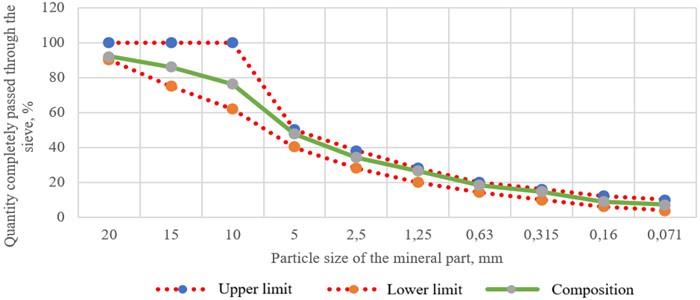
In this graph, the actual grain-size composition of the polymer-sulfur asphalt concrete mix is compared with the lower and upper limits established according to GOST 9128-2013. From this graph, it can be concluded that the curve of the actual composition lies within the specified limits, between the lower and upper boundaries, and the range has a continuous shape. The composition of the asphalt concrete mix can also be determined using mathematical calculations [13].
Using the graph above, 7 different compositions were developed for the optimal amount of binder for the polymer-sulfur asphalt concrete mixture made of granite stone and sand materials, activated shale mineral powder, polymer-sulfur bitumen, in the range from the lower limit of 0.2 % to the upper limit.
An increase in the binder content in the polymer-sulfur asphalt concrete composition did not significantly affect the granulometric proportion of the mixture; that is, the change in each particle-size fraction was within the range of about 0.02-0.3 %.
During the process of determining the composition of the polymer-sulfur asphalt concrete mix, seven different compositions were proposed. In this process, the content of polymer-sulfur bitumen was gradually increased from 3.9 % to 5.2 % [14].
The test results obtained for the selected compositions show that the mix containing 4.8 % bitumen can be considered the most optimal option, as it ensures mixture stability, uniform distribution, and minimal voids.
Table 5Compositions for selecting the optimal amount of binder in polymer-sulfur asphalt concrete
Composition 1 | Composition 2 | Composition 3 | Composition 4 | ||||
% | % | % | % | ||||
12-16 | 7.680 | 12-16 | 7.664 | 12-16 | 7.648 | 12-16 | 7.632 |
8-12 | 14.40 | 8-12 | 14.37 | 8-12 | 14.34 | 8-12 | 14.31 |
6-8 | 26.880 | 6-8 | 26.824 | 6-8 | 26.768 | 6-8 | 26.712 |
0-6 | 44.160 | 0-6 | 44.068 | 0-6 | 43.976 | 0-6 | 43.884 |
Mineral powder | 2.880 | Mineral powder | 2.874 | Mineral powder | 2.868 | Mineral powder | 2.862 |
Polymer-sulfur bitumen | 4.0 | Polymer-sulfur bitumen | 4.2 | Polymer-sulfur bitumen | 4.4 | Polymer-sulfur bitumen | 4.6 |
Total | 100 | Total | 100 | Total | 100 | Total | 100 |
Composition 5 | Composition 6 | Composition 7 | |||||
% | % | % | |||||
12-16 | 7.616 | 12-16 | 7.6 | 12-16 | 7.584 | ||
8-12 | 14.28 | 8-12 | 14.25 | 8-12 | 14.22 | ||
6-8 | 26.656 | 6-8 | 26.6 | 6-8 | 26.544 | ||
0-6 | 43.792 | 0-6 | 43.7 | 0-6 | 43.608 | ||
Mineral powder | 2.856 | Mineral powder | 2.85 | Mineral powder | 2.844 | ||
Polymer-sulfur bitumen | 4.8 | Polymer-sulfur bitumen | 5.0 | Polymer-sulfur bitumen | 5.2 | ||
Total | 100 | Total | 100 | Total | 100 | ||
4. Conclusions
In conclusion, the selection of the optimal composition of the polymer-sulfur asphalt concrete mixture is an important factor in improving the operational indicators of the pavement under high-temperature conditions. The correct selection of sulfur bitumen, which acts as a binder in the composition of asphalt concrete mix, and cubic crushed stone and sand in specified proportions serves to improve the physical, mechanical, and operational properties of the pavement. Therefore, the correct selection of the composition of the polymer-sulfur asphalt concrete mixture should be based on optimizing the amount of binding and mineral materials and the mixture preparation technology.
In general, the selected actual composition of polymer-sulfur asphalt concrete has a granulometric composition that provides the necessary mechanical strength, stability, and minimal void for the upper layers of the road surface. These results indicate the operational reliability of the polymer-sulfur asphalt concrete mixture based on granite stone materials in the Samarkand region.
References
-
A. Antonio Ruiz Pico, R. Noemi Salvador Reyes, and S. Estrella Espinal Bonilla, “Analysis of asphalt mixtures using construction and demolition wastes as filler,” in Civil Engineering, IntechOpen, 2025, https://doi.org/10.5772/intechopen.1007330
-
L. Wan, A. Garcia-Hernández, G. Cui, and P. Liu, “A novel performance-based method to design asphalt mixtures,” Construction and Building Materials, Vol. 400, p. 132792, Oct. 2023, https://doi.org/10.1016/j.conbuildmat.2023.132792
-
V. Rezvani, “Characteristics and preparation method of sulfur extended asphalt mixtures,” American Journal of Civil Engineering, Vol. 3, No. 2, p. 69, Jan. 2015, https://doi.org/10.11648/j.ajce.s.2015030202.24
-
M. U. Qureshi et al., “Utilisation of sulphur by-products in diverse civil engineering applications: a systematic review,” Materials, Vol. 19, No. 4, p. 784, Feb. 2026, https://doi.org/10.3390/ma19040784
-
T. Khedaywi, M. Haddad, R. Mujalli, and S. Shareef, “Effect of sulfur on the asphalt cement and asphalt concrete mixture: state of the art,” Innovative Infrastructure Solutions, Vol. 8, No. 11, p. 286, Oct. 2023, https://doi.org/10.1007/s41062-023-01264-w
-
V. Gladkikh, E. Korolev, D. Husid, and I. Sukhachev, “Properties of sulfur-extended asphalt concrete,” MATEC Web of Conferences, Vol. 86, p. 04024, Jan. 2016, https://doi.org/10.1051/matecconf/20168604024
-
E. A. González-García et al., “Stirring speed effect on processing of modified asphalt with Sebs-G-Ma copolymer and sulfur,” MRS Advances, Vol. 10, No. 5, pp. 630–635, Jan. 2025, https://doi.org/10.1557/s43580-025-01150-w
-
A. Mamatmuminov, S. Ibragim, and I. Xoshimov, “Technology for producing modified polymer sulfur bitumen and its properties,” Vibroengineering Procedia, Vol. 60, pp. 556–562, Dec. 2025, https://doi.org/10.21595/vp.2025.25364
-
“Gravel and crushed stone from dense rocks for construction work,” (in Russian), Moscow, GOST 8267-93, Jan. 2018.
-
“Construction sand,” (in Russian), Moscow, GOST 8736-93, Jan. 2018.
-
“Mineral powder for asphalt concrete mixtures. Technical conditions,” (in Russian), Moscow, GOST 16557-2005, Jan. 2005.
-
I. Sadikov, A. Mamatmuminov, I. Xoshimov, and F. Xolmuminov, “Hot regeneration of asphalt concrete using “ANT” organic regenerator for road surface,” in AIP Conference Proceedings, Vol. 3244, p. 040018, Dec. 2024, https://doi.org/10.1063/5.0242068
-
M. Mirsaburov and D. T. Mamatmuminov, “A problem with an analogue of the Bitsadze-Samarskii condition on the segment of degeneracy and an internal segment parallel to it in the domain for a certain class of degenerate hyperbolic equations,” (in Russian), Proceedings of Higher Educational Institutions. Mathematics., No. 3, pp. 25–29, Mar. 2025, https://doi.org/10.26907/0021-3446-2025-3-25-29
-
I. S. Sadikov, S. M. Tilakov, R. Soataliyev, and A. T. Mamatmuminov, “An effective technology for producing modified sulfur bitumen,” in AIP Conference Proceedings, Vol. 3045, p. 050035, Mar. 2024, https://doi.org/10.1063/5.0197372
About this article

The authors have not disclosed any funding.
The datasets generated during and/or analyzed during the current study are available from the corresponding author on reasonable request.
The authors declare that they have no conflict of interest.

