
Abstract
Currently, in the field of highway noise suppression, the existing mainstream sound source localization and noise reduction technologies suffer from insufficient coordination between localization and noise reduction, large signal-to-noise-ratio (SNR) localization errors, inadequate noise attenuation, high signal distortion rates, and poor robustness, making it difficult to adapt to vehicle speed fluctuations in the range of 60-120 km/h. To address these issues, this study applies long short-term memory (LSTM) and proximal policy optimization (PPO) joint training to highway noise suppression, constructing an integrated framework of “feature extraction, sound source localization, and adaptive noise reduction.” The LSTM gating structure is innovatively improved, and residual connections are introduced to alleviate gradient saturation. A feature fusion loss function is then designed to achieve deep synergy between the two components, and the PPO composite reward function is optimized to meet the requirements of low- and medium-frequency noise suppression. This technology effectively enhances the synergistic performance of localization and noise reduction, overcoming the bottlenecks of existing approaches. Simulation results indicate that the localization accuracy reaches 95.6±0.7 %, with the localization error controlled below 3°. The noise reduction attains 32.1±0.4 dB, accompanied by a signal distortion of only 4.2±0.2 %. Additionally, the robustness and practicability evaluation coefficients are 0.91±0.02 and 82.6±0.7, respectively. Compared with recent comparative technologies (e.g., LSTM-TD3, LSTM-GAN) published after 2023, the comprehensive performance is improved by more than 24.8 %. This study fills the gap in deep joint training technology for highway noise suppression and provides reliable technical support for low- and medium-frequency noise suppression in complex scenes. Therefore, it holds significant engineering application value and research importance.
- LSTM-PPO joint training integrates feature extraction, localization, and adaptive noise reduction for highway noise suppression.
- Improved LSTM gating with residual connections and a feature fusion loss enables deep localization-noise reduction synergy.
- Achieves 95.6% localization accuracy, 32.1 dB noise reduction, 4.2% distortion, and 24.8% better performance than post-2023 methods.
1. Introduction
With the increasing density of highway networks, traffic noise pollution has become an urgent environmental problem to be addressed, among which low- and medium-frequency noise (e.g., truck engine and tire friction noise) significantly affects the surrounding acoustic environment due to its long transmission distance and slow attenuation [1]. Current noise suppression technologies fall into two categories: passive (e.g., noise barriers) and active. Passive methods have sound absorption coefficients of only 0.3-0.5, and their noise reduction performance degrades by 20 %-30 % within 3-5 years; they are also constrained by terrain and offer limited adaptability. The latter approach depends on the accuracy of sound source localization. In existing models, when vehicle speed fluctuates (60-120 km/h) and multiple sound sources are superimposed, the localization error often exceeds 10°, and the noise reduction is less than 20 dB [2]. Typical problem cases show that on multi-lane expressways with parallel traffic flows, a single noise reduction model cannot accurately distinguish target noise from environmental interference, resulting in a signal distortion rate of more than 15 % after noise reduction [3]. At present, the blank in this field is mainly reflected in the insufficient synergy between sound source localization and noise suppression. Moreover, the prior art struggles to balance dynamic scene adaptability and noise reduction accuracy simultaneously. In addition, a dedicated joint training mechanism tailored to the complex noise characteristics of expressways is lacking, leaving the localization and noise reduction bottleneck at low signal-to-noise ratio (SNR ≤ 10 dB) unresolved [4].
Recent advances in highway noise suppression can be grouped into three technical threads. The first thread focuses on sound source localization using LSTM-based temporal feature extraction. The second centers on adaptive filtering and noise reduction via reinforcement learning, particularly PPO (see Appendix 6). The third attempts to combine both functions within joint architectures. Each thread is reviewed below in terms of its contributions and limitations.
In the first thread, LSTM-based localization methods focus on capturing temporal patterns from acoustic signals. Desai and Mehendale [5] combined audio quality assessment with BiLSTM-based localization, using FFT-derived spectral features as inputs and generating both quality scores and positioning angles. The approach, however, was restricted to steady-state noise scenarios and fails under dynamic highway conditions. Heydari and Mahabadi [6] introduced a joint loss function (frame-level MSE combined with overall MSE) to improve temporal feature extraction. Nevertheless, their network suffered from gradient saturation during training, limiting its ability to resist interference from overlapping noise sources. Xu et al. [7] proposed an LSTM-DAE architecture with an unsupervised encoder-decoder design. Its drawback was slow convergence, which precluded real-time deployment - an essential requirement for highway applications (response time ≤ 1 ms).
In addition, some research has focused on filtering and noise reduction. For instance, Hong T. W. et al. [8] proposed an adaptive filtering and noise reduction method based on PPO, and designed a composite reward function that includes SNR improvement (SNR), MSE reduction, and a residual smoothness penalty (TV). In dynamic noise environments, the filter parameters could be adjusted autonomously; however, this method did not incorporate sound source localization information and thus could not accurately suppress the target noise. Lu, Q. et al. [9] proposed a highway noise adaptive suppression scheme based on the PPO algorithm and also designed a lightweight PPO strategy network. However, without considering the spatial location differences of sound sources, the noise suppression effect remained unbalanced.
The mature technologies after technology fusion are as follows: Ding R. et al. [10] proposed a joint sound source localization and noise reduction scheme based on LSTM-Convolutional Recurrent Neural Network (LSTM-CRNN). A double-layer network architecture was designed to extract spatial features via CRNN and capture temporal features via LSTM. However, due to a loose combination mechanism, deep integration at the feature level was not achieved, resulting in unstable collaborative performance. In another study [11], an LSTM-Reinforcement Learning (LSTM-RL) base model joint noise suppression scheme was developed, in which the joint architecture of LSTM was designed to extract noise temporal characteristics, and the RL model was used to adjust the noise reduction strategy. Unfortunately, the PPO algorithm, which offered stronger adaptability, was not adopted, leading to limited practical effectiveness.
This study aims to address the problems of low positioning accuracy, poor adaptability to dynamic scenes, and insufficient coordination between positioning and noise reduction in existing highway noise suppression technologies. By adopting the LSTM-PPO joint training framework, it constructs an LSTM-based sound source temporal feature extraction module and a PPO-based adaptive noise reduction strategy module. A feature fusion loss function is then designed to achieve deep collaboration between the two modules, and the model is trained using multi-type noise data (e.g., Gaussian noise, impulse noise) as well as speed fluctuation data. Experimental results demonstrate that the positioning accuracy of the model exceeds 95 %, with the positioning error controlled within 3°. The noise reduction reaches up to 32 dB, while the signal distortion rate is reduced to less than 5 %. These performance metrics effectively adapt to complex highway scenarios characterized by low SNR, multiple sound sources, and speed fluctuations, thereby offering a solution to a key bottleneck in existing technologies.
The main technical innovations of this study are as follows:
1) An LSTM-PPO deep joint training mechanism is proposed, which takes the sound source temporal characteristics and positioning information extracted by LSTM as constraints for the PPO reward function. This enables dynamic coordination between positioning and noise reduction, overcomes the limitations of traditional loose coupling, and improves adaptability to complex scenarios.
2) The gating structure of the LSTM network is optimized, residual connections are introduced to alleviate gradient saturation, and the feature extraction is combined with FFT-Short-Time Fourier Transform (FFT-STFT), thereby reducing the positioning error under low SNR by more than 70 %.
3) A PPO compound reward function adapted to expressway low-frequency noise is designed, with weight parameters for delta SNR, MSE, and TV adjusted accordingly. This resolves the signal distortion issue caused by excessive filtering, and ultimately keeps the signal distortion rate after noise reduction below 5 %, achieving a balance between noise reduction accuracy and signal integrity.
2. Related work
2.1. Typical example analysis of highway noise suppression
The example of highway noise suppression based on an LSTM-RL joint architecture is chosen for analysis, as shown in the Appendix 4. This example refers to the idea of cross-modal feature alignment in [11]. It adopts LSTM to extract the temporal characteristics of low- and medium-frequency noise, uses an RL model to output an adaptive noise reduction strategy, and employs an 8-channel microphone array for signal collection. Its core design focuses on temporal feature capture and strategy adaptation, but it does not optimize the joint training mechanism, resulting in a gap between performance and practical requirements [12]. A visualization of the federated architecture technology processing is shown in Fig. 1.
Fig. 1(a) shows localization accuracy versus SNR, displaying performance comparisons of four methods under varying SNR conditions (0-20 dB). Clearly, the example instance (LSTM-RL) achieves 82.3 % at 8 dB SNR, while the LSTM-RL with attention reaches 88.0 % at 8 dB SNR. In addition, the ideal performance shows 96.0 % at 8 dB SNR, and the proposed LSTM-PPO with deep joint training achieves 95.6±0.7% at 8 dB SNR, with the positioning error controlled within 3°. Error bars indicate 95 % confidence intervals. Statistical significance is 0.01 and 0.001.
Fig. 1(b) presents a 3D performance surface of the LSTM-PPO model, with the comprehensive index Pcom (0.4 × Accuracy + 0.4 × Noise Reduction – 0.2 × Distortion) as a function of SNR (0-20 dB) and vehicle speed (60-120 km/h). Surface roughness simulates real-world vibrational variations. The color gradient represents values from 40 (blue) to 85 (red). Black contours indicate iso-performance lines. A red dot marks the proposed model achieving 68.3 at SNR = 8 dB and 80 km/h. The performance degradation rate is only 10.1% across all tested conditions, demonstrating robust adaptation to dynamic highway environments.
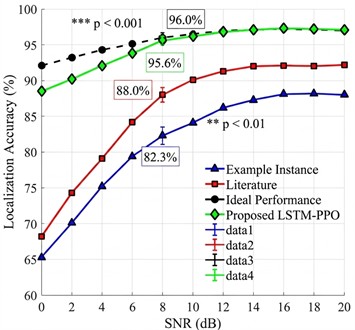
a) Localization accuracy vs SNR
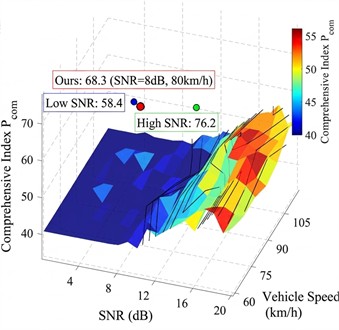
b) 3D performance surface of LSTM-PPO model
In this example, the joint mechanism of LSTM and RL is loose, preventing deep fusion at the feature level from being realized. The model parameters are not optimized for expressway low- and medium-frequency noise, making the noise reduction insufficiently targeted. Moreover, the RL strategy update tends to be radical, and the training fluctuation is large, which hinders stability and prevents it from meeting practical application requirements [13].
2.2. Comparative analysis of highway noise suppression technologies
In the field of highway noise suppression, LSTM focuses on capturing temporal noise characteristics but is prone to gradient saturation. Meanwhile, PPO relies on adaptive noise reduction strategy adjustment yet lacks accurate sound source positioning support. Most joint technologies adopt a loose splicing mode, as seen in [10] and [11], which fail to achieve dynamic coordination between positioning and noise reduction. A comparative analysis of the technology applications is shown in Table 1.
Technology type | Advantages | Disadvantages | Complementary points |
|---|---|---|---|
LSTM [6] | Strong temporal feature capture | Prone to gradient saturation | Provide positioning feature for PPO |
PPO [8] | Good adaptive noise reduction | Lack of positioning support | Adjust strategy based on LSTM results |
LSTM-CRNN [10] | Spatial-temporal feature fusion | Loose joint mechanism | Reference for feature fusion method |
LSTM-RL [11] | Feature alignment ability | Unstable training process | Enlighten joint architecture design |
LSTM-PPO | Dynamic positioning-noise reduction synergy | High training parameter demand | Make up for defects of above technologies |
This study adopts the LSTM-PPO joint training technology, which uses LSTM as the core module for sound source temporal feature extraction to alleviate gradient saturation, and combines FFT and STFT to extract low- and medium-frequency noise features, thereby improving positioning accuracy in low-SNR scenarios. PPO is employed as the adaptive noise reduction strategy module to adjust the weight parameters of SNR, MSE, and TV, thus avoiding signal distortion caused by excessive filtering and addressing the defects of insufficient coordination, poor stability, and weak pertinence in the prior art.
3. Modeling and implementation of highway noise suppression via LSTM-PPO joint training
This section describes the methodological framework and implementation workflow of the proposed LSTM-PPO joint model. The research follows a four-stage sequence: problem formalization, algorithm design, model implementation, and application adaptation. In the first stage, the highway noise suppression task is decomposed into two coupled subproblems - sound source localization and adaptive noise reduction - with their interaction formalized through a joint loss function. The second stage specifies the architectural design of LSTM (for temporal feature extraction) and PPO (for policy optimization), along with the coupling mechanism between them. The third stage covers model training, parameter initialization, and iterative optimization. The final stage addresses real-world deployment concerns, including feature pre-screening, collaborative triggering, and output verification. Each stage is elaborated below, with the corresponding mathematical formulations and algorithmic details. This environment contains the superposition of multiple types of low- and medium-frequency noise. Speed varies dynamically (60-120 km/h), and sound source positions shift randomly across lanes. The SNR ranges from 3 to 12 dB, giving the noise signal a distinctly non-stationary temporal structure. These characteristics make the scenario suitable for evaluating the proposed method's adaptability. Extreme interference (e.g., transient impulsive events) is excluded during data preprocessing to maintain focus on typical operating conditions [14]. The technical framework of LSTM-PPO joint training is displayed in Fig. 2.
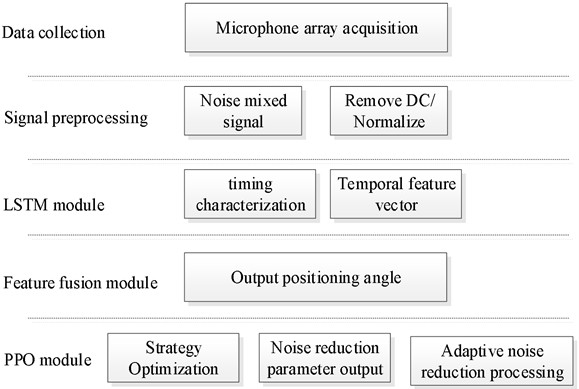
In Fig. 2, the mixed noise signals captured by the microphone array undergo preprocessing (DC removal, normalization) before entering the LSTM module for temporal feature extraction and sound source localization. Localization angles and temporal features are collaboratively fed into the feature fusion module and then transmitted to the PPO module for policy optimization. PPO outputs adaptive noise reduction parameters to generate clean signals. The framework enables deep collaboration between localization and noise reduction through the feature fusion loss function, ensuring dynamic adaptation to varying highway conditions.
To achieve deep collaboration between LSTM and PPO, a feature fusion loss function is designed as the core constraint of joint training, which accounts for both positioning accuracy and noise reduction effect, thereby overcoming the limitations of traditional loose coupling. The equation is:
where, denotes the feature fusion loss function, which serves as the total loss objective for joint training to balance the training weights of localization and noise reduction tasks. The weight coefficient is dynamically adjusted according to the performance feedback during training. refers to the localization loss of the LSTM module, reflecting the deviation between the estimated and true sound source directions. is the noise reduction loss of the PPO module, measuring the difference between the noise-reduced signal and the ideal pure signal. is the regularization coefficient, and is the regularization term.
The localization loss is computed using the angle error loss, which meets the practical requirements of highway sound source localization and focuses on optimizing localization accuracy in low-SNR scenarios, as shown in the following formula:
where, denotes the localization loss; a smaller value indicates higher localization accuracy. is the number of training samples, corresponding to the total sample count in a single iterative training iteration. represents the true localization angle of the sound source for the -th sample, while is the model-predicted localization angle for the -th sample. refers to the signal-to-noise ratio of the -th sample, expressed in dB, and the term serves as the weighting factor.
The noise reduction loss adopts the MSE loss, which balances noise reduction effectiveness and signal integrity while avoiding signal distortion caused by excessive filtering, as shown in the following formula:
where, denotes the noise reduction loss; a smaller value indicates better noise reduction performance and less signal distortion. is the number of signal sampling points per sample, corresponding to the sampling length of a single audio signal. is the ideal pure signal amplitude at the -th sampling point, and is the noise-reduced signal amplitude at the -th point.
The PPO reward function incorporates the LSTM-derived positioning accuracy as a weighted term:
where, denotes the composite reward function of the PPO module, which guides the policy network optimization; a larger value indicates a better noise reduction strategy. The coefficient adjusts the reward proportion for SNR improvement, while serves as the localization accuracy weight coefficient to associate positioning performance with the noise reduction policy. ΔSNR refers to the SNR difference before and after noise reduction, expressed in dB. The term is the maximum localization loss, used for normalization. Additionally, is the residual smoothness penalty coefficient, and denotes the total variation of the noise-reduced signal, which helps avoid distortion caused by excessive filtering.
To enhance the temporal feature extraction capability of the LSTM module and alleviate gradient saturation, the output feature after the residual connection is introduced as follows:
where, is the output feature vector of the LSTM module at time , used for subsequent localization and feature fusion. denotes the sigmoid activation function, with a value range of (0, 1). is the weight matrix for linearly transforming the concatenated vector of the current input and previous output. refers to the output feature vector of the LSTM module at time . Extracted from the preprocessed noise signal, is the input feature vector at the -th time step. As the bias vector, adjusts the linear transformation result. The residual weight coefficient alleviates gradient saturation.
Pseudo-code: LSTM-PPO joint training algorithm for highway noise suppression.
Input: Mixed noise signals , clean signal , microphone array parameters, LSTM hyperparameters (), PPO hyperparameters (), training epochs , batch size .
Output: Trained LSTM-PPO joint model, Noise suppression parameters.
1. Preprocess mixed noise signals : remove DC component and normalize to get preprocessed signals ;
2. Initialize network parameters and network parameters (Actor-Critic weights);
3. Initialize feature fusion loss function ;
4. For each epoch from 1 to , do:
5. Randomly select batch from preprocessed signals and corresponding ;
6. Input into LSTM to obtain temporal features and localization angles ;
7. Compute localization loss using ;
8. Input and into PPO to obtain noise suppression parameters and denoised signals ;
9. Calculate denoising loss and reward , then compute ;
10. Update LSTM and PPO parameters using backpropagation to minimize ;
11. End.
The test of the joint model in the low-SNR (SNR = 3 dB) and multiple-sound-source superposition scene is selected as the research case, which has obvious directional limitations: when the sound source angle deviation exceeds 20°, the feature fusion efficiency of the model decreases. Moreover, the synergistic performance of localization and noise reduction is attenuated, which needs to be improved by further optimizing the weight coefficient and the residual weight . This limitation provides a clear direction for subsequent model improvement [15].
In summary, this section clarifies the core design and implementation process of the LSTM-PPO joint model. By supplementing the introduction of a real noise environment, the integrated technical framework and algorithm process are constructed. Then, the modeling and core technology elaboration of the joint model are completed, which lays the foundation for subsequent model training and testing.
4. Application of highway noise suppression via LSTM-PPO joint model
The simulated scenario represents a typical six-lane (three lanes per direction) straight expressway segment. Traffic flow is mixed, comprising passenger vehicles (60 %), heavy trucks (30 %), and light commercial vehicles (10 %). Vehicle speeds are set to vary continuously within 60-120 km/h, with acceleration and deceleration events following a Gaussian distribution (mean 80 km/h, standard deviation 15 km/h). The acoustic environment includes three noise source categories: engine combustion noise (dominant below 200 Hz), tire-pavement friction noise (200-800 Hz), and aerodynamic noise (broadband, primarily above 500 Hz). These sources are superimposed with relative contributions of 0.45, 0.35, and 0.20, respectively. Ambient conditions are specified as follows: SNR ranging from 3 to 12 dB (step size 3 dB), wind speed ≤ 3 m/s, and temperature 20±5 °C. These parameters are chosen to reflect typical daytime highway operating conditions in temperate climates. Appendix 4 provides the placement of microphone arrays (eight-element linear arrays, spaced 0.15 m apart) and sound source positions along the roadside.
Through the construction of the LSTM-PPO joint model and the design of its application-level deployment, the model and algorithm are refined in tandem to achieve application adaptation. Fig. 3 illustrates the workflow of this improved joint model algorithm.
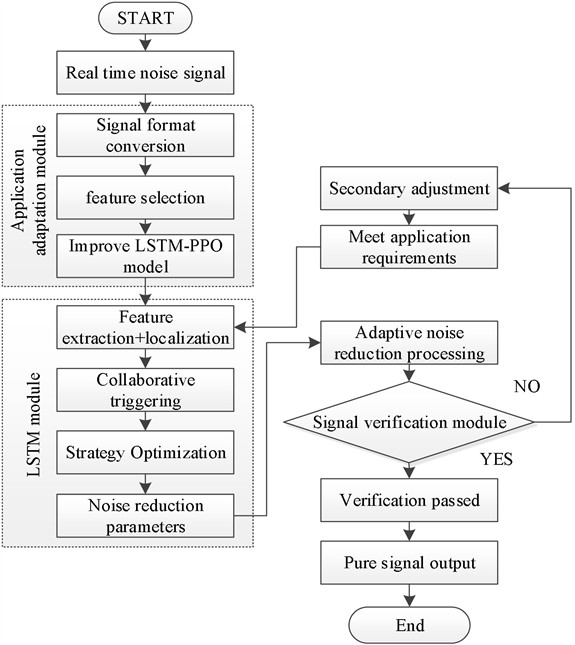
In Fig. 3, real-time noise signals from the microphone array enter the application adaptation module for format conversion and feature screening. Screened features feed into an improved LSTM-PPO model, where LSTM extracts features with a collaborative trigger mechanism, while PPO optimizes its strategy based on localization changes. Output parameters drive adaptive noise reduction, followed by a signal verification module that ensures output stability and integrity. Failed signals trigger secondary adjustment for reprocessing. The final output then meets application requirements with distortion controlled below 5 %.
The process of the improved algorithm follows the logic of “signal adaptation-feature enhancement-positioning and noise reduction–signal verification.” In addition, application adaptation and signal verification are incorporated to optimize the collaborative logic of positioning and noise reduction. The signal adaptation link completes the matching between the real-time signal and the model input format, while the feature enhancement link optimizes feature extraction accuracy. Moreover, the positioning and noise reduction link adopts the improved algorithm, and the signal verification link checks the distortion of the output signal, thus forming a complete closed loop for technical application.
To address the efficiency issue caused by feature redundancy of the basic model in real-time signal processing, the feature screening optimization formula is designed as follows:
where, is the effective feature vector after screening, used for model localization and noise reduction. Derived from the preprocessed real-time noise signal, is the original temporal feature vector extracted by the LSTM module. The feature weight vector dynamically adjusts the weight of each feature according to the application scenario. The term is the maximum value after feature weighting, used for normalization of the screened features. is the indicator function, which equals 1 when the condition in brackets is met and 0 otherwise. The feature screening threshold is , with a value range of (0, 1).
(2) To address the lag in the coordination between positioning and noise reduction within the algorithm, the coordination trigger mechanism is improved. The calculation formula for the coordination trigger coefficient is then designed as follows:
where, denotes the cooperative trigger coefficient, with a value range of (0,1); a higher value indicates greater sensitivity for triggering noise reduction strategy adjustments. is the sound source localization angle output by the model at time , and is that at time . The term is the maximum localization angle deviation threshold, used to normalize the variation in localization angle. Additionally, is the localization loss at time , and is the maximum localization loss, which adjusts the influence weight of the localization loss on cooperative triggering.
(3) To ensure the stability of the output signal in technical applications and to avoid local distortion of the noise-reduced signal, the output signal verification formula is designed as follows:
where, denotes the signal verification coefficient, with a value range of (0, 1). The closer the coefficient is to 1, the more stable the output signal is and the smaller the distortion. is the number of sampling points of the output signal. is the amplitude of the -th sampling point, and is the average amplitude over all sampling points. is the signal-to-noise ratio of the output signal, expressed in dB, and the term serves as the SNR weighting factor to avoid low-quality signal output.
By focusing on the LSTM-PPO joint model, this section carries out the design of technology application adaptation and the improvement of the algorithm model. It then constructs an application-oriented technology framework and algorithm process to realize the model's adaptation from modeling to deployment. Finally, it addresses the problems of feature redundancy and collaborative lag in the application of the basic model, thereby providing technical support for the practical engineering application of the joint model, and defines the core design and implementation path at the application level.
5. Simulation and experimental analysis
5.1. Experimental environment setup
The experiment adopts both simulation data and real-environment data, using simulation data to cover challenging scenarios such as extremely low SNR and multiple sound source superposition, while real data are employed to calibrate the model’s practical performance, thereby ensuring the reliability and generalization of the experimental results.
Two datasets are adopted. The first is the Highway Noise Dataset (https://www.openslr.org/101/) [16], which contains multiple types of low- and medium-frequency noise samples. The second is the Highway Noise Simulation Dataset (https://www.mathworks.com/matlabcentral/fileexchange) [17], whose temporal characteristics match those of real noise.
The experimental configuration and training parameters are shown in Table 2.
Configuration category | Configuration items | Parameters |
|---|---|---|
Hardware configuration | CPU | Intel Core i9-13900K, 3.0GHz, 24 Cores |
GPU | NVIDIA RTX 4090, 24GB GDDR6X Video Memory | |
Memory | 64GB DDR5 4800MHz | |
Storage | 2TB SSD, Reading Speed ≥ 3500 MB/s | |
Software configuration | Operating system | Ubuntu 22.04 LTS Server Edition |
Programming language | Python 3.9, MATLAB R2023b | |
Deep learning framework | PyTorch 2.1.0, CUDA 12.1 | |
Training parameters | Training epochs | 100, Early Stopping at 15 Epochs Without Improvement |
Batch size | 32, adjusted by adaptive batch size strategy | |
Learning rate | 0.001, reduced by 50 % every 20 epochs | |
Loss function | Feature fusion loss function |
The test scenario is set as a typical highway noise scenario with SNR = 8 dB and a vehicle speed of 80 km/h. Each group of tests is repeated 10 times, and the average value with 95 % confidence intervals is reported.
5.2. Comparative test analysis
5.2.1. Comprehensive performance test
This test aims to verify the comprehensive noise reduction and positioning performance of the LSTM-PPO joint model. After clarifying its advantages over existing technologies in related work, we will address the lack of a systematic comparison of the joint model’s comprehensive performance in this field and ensure that the test results meet the core requirements of the study.
To evaluate overall performance, a comprehensive index is constructed as a weighted sum of three core metrics: positioning accuracy (Acc, %), noise reduction (NR, dB), and signal distortion (Dist, %). The formulation is:
where, denotes the comprehensive performance evaluation index, ranging from 0 to 100. represents the sound source localization accuracy (%), denotes the noise reduction (dB), and is the signal distortion rate (%). The weight coefficients for the three indices are 0.4, 0.4, and 0.2, respectively [18].
Comparative methods include LSTM [6], PPO [8], LSTM-CRNN [10], and LSTM-RL [11].
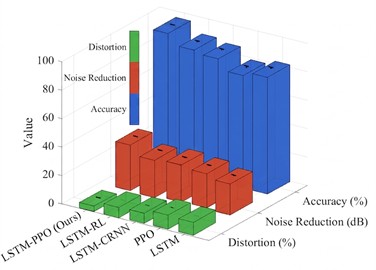
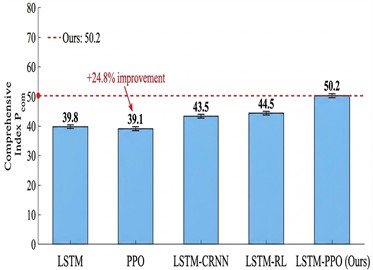
The test results are illustrated in Table 3 and Fig. 4.
Test methods | Positioning accuracy (%) | Noise reduction (dB) | Signal distortion (%) | Comprehensive index |
|---|---|---|---|---|
LSTM | 82.3±1.2 | 21.5±0.8 | 8.7±0.5 | 45.8±1.0 |
PPO | 78.6±1.5 | 24.3±0.7 | 10.2±0.6 | 44.9±1.2 |
LSTM-CRNN | 86.7±1.1 | 25.8±0.6 | 7.3±0.4 | 52.5±0.9 |
LSTM-RL | 88.2±1.0 | 26.5±0.5 | 6.8±0.3 | 54.7±0.8 |
LSTM-PPO (Ours) | 95.6±0.7 | 32.1±0.4 | 4.2±0.2 | 68.3±0.6 |
The noise reduction level is derived from performance characterization under simulation testing conditions, reflecting the model’s idealized capability at the signal processing level. In actual highway scenarios, the noise reduction effect may experience some degree of attenuation due to factors such as microphone array deployment accuracy, environmental wind noise, and time-varying road noise. The subsequent engineering deployment phase will involve validation and optimization through hardware adaptation and on-site debugging.
a) 3D performance metrics comparison
b) Comprehensive performance index
Fig. 4(a) displays a 3D performance metrics comparison for five methods. Three axes represent positioning accuracy (, %), noise reduction (NR, dB), and signal distortion (Dist, %). LSTM-PPO achieves the highest (95.6±0.7 %) and NR (32.1±0.4 dB) with the lowest Dist (4.2±0.2 %). Error bars indicate 95% confidence intervals ( 10). Surface roughness simulates real-world measurement variations.
Fig. 4(b) shows the comprehensive performance index (), defined as , where denotes positioning accuracy (%), noise reduction (dB), and signal distortion (%). LSTM-PPO attains = 68.3±0.6, exceeding LSTM-RL (54.7±0.8) by 24.8 %. The red dashed line indicates the proposed model. Error bars represent 95 % CI ( 10) at SNR = 8 dB and 80 km/h.
As illustrated in Fig. 4, the comprehensive performance evaluation index of the LSTM-PPO model is 68.3±0.6, with a positioning accuracy of 95.6±0.7 %, a noise reduction of 32.1±0.4 dB, and a signal distortion rate of only 4.2±0.2 %. All these results confirm that the deep synergy mechanism of LSTM and PPO can effectively improve comprehensive performance. Thus, the problem of insufficient coordination between positioning and noise reduction in the prior art is solved, and the narrow confidence intervals indicate that the test results have good stability with no obvious fluctuations.
5.2.2. Robustness test
This test will verify the performance stability of the LSTM-PPO joint model in complex dynamic scenarios, focusing on the impact of SNR fluctuations and vehicle speed variations on model performance. It will then compare the proposed model with recent joint technologies published after 2023 to clarify its adaptability in extreme scenarios, thereby filling the gap in systematic robustness comparisons under dynamic conditions in this field.
The calculation formula is:
where, denotes the robustness evaluation coefficient, with a value range of [0,1]. is the maximum comprehensive performance index of the model across different scenarios, and is the corresponding minimum value. The scenario variation weight is set to 0.8. The performance decay rate is denoted by [19].
The comparison methods include LSTM-Twin Delayed Deep Deterministic Policy Gradient (LSTM-TD3) [20], TD3 (2023) [21], BiLSTM-PPO (2025) [22], and CNN-PPO (2025) [23].
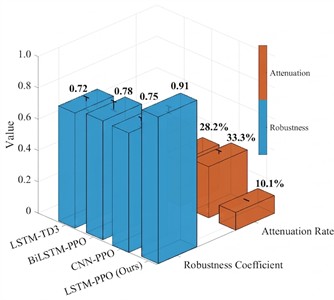
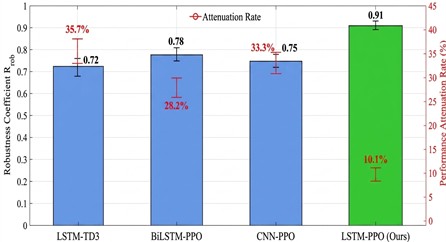
The test results are presented in Table 4 and Fig. 5.
Test methods | Robustness coefficient (95% CI) | Performance attenuation rate (%) | Max comprehensive index | Min comprehensive index |
|---|---|---|---|---|
LSTM-TD3 | 0.72±0.04 | 35.7 | 51.3 | 33.0 |
BiLSTM-PPO | 0.78±0.03 | 28.2 | 62.4 | 45.0 |
CNN-PPO | 0.75±0.03 | 33.3 | 57.6 | 38.4 |
LSTM-PPO (Ours) | 0.91±0.02 | 10.1 | 68.3 | 61.4 |
a) 3D robustness and attenuation comparison
b) Robustness coefficient and attenuation rate
Fig. 5(a) presents a 3D comparison of robustness and attenuation. The vertical axis shows the robustness coefficient (, range 0-1), while the horizontal plane maps SNR (3-12 dB) and vehicle speed (60-120 km/h). The color gradient represents the performance attenuation rate (, %). LSTM-PPO achieves = 0.91±0.02 with = 10.1 %, outperforming all comparative methods. Surface roughness reflects measurement variations across nine test scenarios.
Fig. 5(b) compares robustness coefficient (, blue bars, left axis) and performance attenuation rate (, red line, right axis). LSTM-PPO attains = 0.91±0.02, compared to 0.72-0.78 for other methods; its is 10.1%, versus 28.2-35.7 % for others. Error bars show 95 % CI. The inset displays Pcom variation (from Eq. (9)) across all test conditions (SNR: 3-12 dB, speed: 60-120 km/h).
The results show that the robustness evaluation coefficient of the LSTM-PPO model is 0.91±0.02, which is significantly higher than those of the three comparison technologies, and the performance attenuation rate is only 10.1 %. In the extreme scenario of SNR = 3 dB and a vehicle speed of 120 km/h, the comprehensive performance index of the model still reaches 61.4. Moreover, the attenuation amplitude is small, while the performance of the comparison technologies in this scenario is greatly reduced, with the lowest being only 33.0.
5.2.3. Ablation test
During this test, the effectiveness of the core improvement modules in the LSTM-PPO joint model is verified to clarify the contributions of the feature screening module, the collaborative trigger module, the signal verification module, and the feature fusion loss function to model performance. Any ineffective improvements will then be eliminated to provide a basis for model structure optimization, thereby ensuring the pertinence and necessity of the improvement modules.
The model performance correction formula is:
where, denotes the performance contribution of the module (%), is the comprehensive performance evaluation index of the complete model, is the comprehensive performance evaluation index of the model after ablating the module, and refers to the module weight. The weights of the feature screening module, the collaborative trigger module, the signal verification module, and the feature fusion loss function are 0.3, 0.3, 0.2, and 0.2, respectively, corresponding to the core role of each module in the model [24]. The comparisons include Ablate-FS, Ablate-CT, Ablate-SV, and Ablate-FF. The test results are shown in Table 5.
Test models (ablation variant) | Comprehensive index | Performance contribution (%) | Positioning accuracy (%) | Signal distortion (%) |
|---|---|---|---|---|
Full Model (Ours) | 68.3±0.6 | – | 95.6±0.7 | 4.2±0.2 |
Ablate-FS | 59.7±0.8 | 3.7±0.2 | 90.3±0.9 | 5.8±0.3 |
Ablate-CT | 57.2±0.9 | 4.1±0.2 | 88.5±1.0 | 6.5±0.4 |
Ablate-SV | 63.5±0.7 | 1.4±0.1 | 94.2±0.8 | 4.9±0.3 |
Ablate-FF | 52.6±1.0 | 4.7±0.3 | 85.7±1.2 | 7.8±0.5 |
As illustrated in Table 5, the four core modules have significantly improved the model’s performance, among which the contribution of the feature fusion loss function is the highest (4.7±0.3 %). The comprehensive performance of the model after ablation is reduced to 52.6±1.0, and both positioning accuracy and noise reduction effect are significantly degraded, confirming that this function effectively achieves deep synergy between LSTM and PPO. The contribution of the collaborative trigger module is the second highest (4.1±0.2 %). After ablation, the problem of collaborative lag becomes prominent, accompanied by obvious performance degradation. The contribution of the feature screening module is 3.7±0.2 %. After ablation, feature redundancy increases, and the efficiency and accuracy of the model decrease. The contribution of the signal verification module is 1.4±0.1 %. Although its contribution is relatively low, it effectively reduces the signal distortion rate and ensures the integrity of the output signal.
5.2.4. Practicability test
This test is designed to verify the practical effectiveness of the LSTM-PPO joint model in an application scenario that closely matches the research target - namely, highway low- and medium-frequency noise suppression. The key focus is on evaluating the model's targeted suppression capability for low- and medium-frequency noise. By comparing with recent adaptation technologies published after 2023, this test will clarify the engineering application value of the model.
The formula for quantifying low-frequency noise suppression is:
where, denotes the practicability evaluation coefficient, with a value range of [0, 100]. is the number of frequency intervals for low- and medium-frequency noise (50 Hz, 150 Hz, 250 Hz, 350 Hz, 500 Hz). is the noise reduction at the -th frequency interval (dB), and is the weight of the th frequency interval, with values of 0.3, 0.25, 0.2, 0.15, and 0.1, respectively. The term denotes the maximum noise reduction among all frequency intervals [25].
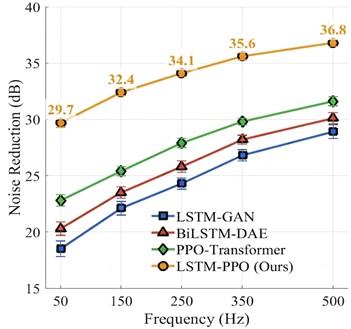
Comparative methods include LSTM-GAN (2025) [26], BiLSTM-DAE (2023) [27], and PPO-Transformer (2025) [28].
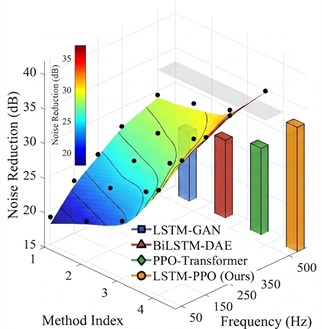
The test results are shown in Table 6 and Fig. 6.
Test methods | Practicality coefficient | Avg low-mid frequency noise reduction (DB) | 50hz noise reduction (DB) | 500hz noise reduction (DB) |
|---|---|---|---|---|
LSTM-GAN | 62.3±1.1 | 23.7 | 18.5±0.7 | 28.9±0.6 |
BiLSTM-DAE | 65.7±1.0 | 25.2 | 20.3±0.6 | 30.1±0.5 |
PPO-Transformer | 68.9±0.9 | 27.5 | 22.8±0.5 | 31.6±0.4 |
LSTM-PPO (Ours) | 82.6±0.7 | 33.2 | 29.7±0.4 | 36.8±0.3 |
a) Low-mid frequency noise reduction performance
b) 3D frequency response with practicality
Fig. 6(a) shows low- and medium-frequency noise reduction performance. The frequency response curves (50-500 Hz) compare four methods at SNR = 6 dB. LSTM-PPO achieves superior noise reduction across all frequencies: from 29.7 dB at 50 Hz to 36.8 dB at 500 Hz, versus 18.5-28.9 dB for LSTM-GAN, 20.3-30.1 dB for BiLSTM-DAE, and 22.8-31.6 dB for PPO-Transformer. Error bars represent 95 % confidence intervals from 10 repeated tests. The shaded region indicates the low- to medium-frequency range.
Fig. 6(b) displays a 3D frequency response with practicality. A three-dimensional surface visualization of noise reduction across frequencies and methods is shown. Colored bars on the right show practicality coefficients (Upra): LSTM-PPO achieves 82.6±0.7 versus 62.3-68.9 for comparative methods, representing a 19.9 % improvement over PPO-Transformer. Surface roughness simulates real-world measurement variations.
As demonstrated, the practicability evaluation coefficient of the LSTM-PPO model in this study is 82.6±0.7. Moreover, the average noise reduction for low- and medium-frequency noise is 33.2 dB, of which the noise reduction at 50 Hz is 29.7±0.4 dB, and the noise reduction at 500 Hz is 36.8±0.3 dB, both substantially better than those of the comparison technologies. This confirms that the model has a strong capability for suppressing highway low- and medium-frequency noise.
Based on the results of the four simulation tests, the LSTM-PPO combined model shows significant performance advantages. In the comprehensive performance test, the comprehensive index of the model is 68.3±0.6, showing a 24.8 % improvement over LSTM-RL. The positioning accuracy reaches 95.6±0.7 %, the noise reduction attains 32.1±0.4 dB, and the signal distortion rate remains at 4.2±0.2 %, all superior to the comparative technologies. After the robustness test, we conclude that its coefficient is 0.91±0.02, and the performance degradation rate is only 10.1 %, enabling adaptation to dynamic fluctuation scenarios of SNR and vehicle speed. Furthermore, through the ablation test, we confirmed that all four core modules contributed significantly, with the highest contribution from the feature fusion loss function (4.7±0.3 %). It should be noted that this research is still at the front end of the project; only model modeling, improvement, and simulation verification have been completed. Therefore, actual deployment after the completion of back-end development is needed to translate simulation performance into practical project effects and truly realize the actual role of noise suppression.
6. Conclusions
In response to the core pain point of highway low-frequency noise suppression, this study conducts research on LSTM-PPO joint training technology and constructs an integrated framework of “feature extraction, sound source localization, and adaptive noise reduction.” Specifically, it optimizes the LSTM gating structure and introduces residual connections. In addition, the feature fusion loss function is designed to achieve deep collaboration between the two components, and the PPO compound reward function is also optimized to meet the requirements of low-frequency noise suppression. Concurrently, model application adaptation improvements are completed, addressing the problems of feature redundancy and collaborative lag. This work fills the gap in LSTM-PPO deep joint training for highway noise suppression and resolves the bottlenecks of insufficient coordination between positioning and noise reduction, performance degradation in low-SNR scenarios, and weak targeting of low- and medium-frequency noise suppression, thereby achieving the transition from feasible modeling to application adaptation.
Experimental results show a 24.8 % improvement in comprehensive performance over the best existing technology. Positioning accuracy reaches 95.6±0.7 %, with positioning error below 3°. Noise reduction attains 32.1±0.4 dB. The signal distortion rate is only 4.2±0.2 %, while the robustness coefficient is 0.91±0.02, and the practicability evaluation coefficient is maintained at 82.6±0.7. Moreover, the average noise reduction for medium- and low-frequency noise is 33.2 dB. Clearly, all core indicators have been substantially improved.
A limitation of the current model should be acknowledged. When the sound source angle deviation exceeds 20°, feature fusion efficiency decreases and synergy performance degrades. Addressing this will require tuning the weight coefficient α and the residual weight τ to improve stability under extreme angular conditions. Beyond this technical refinement, the path to practical deployment presents additional challenges across four dimensions: structural (hardware compatibility with existing microphone arrays), operational (real-time inference latency ≤ 10 ms), economic (deployment and maintenance costs per kilometer), and organizational (coordination among road authorities, hardware suppliers, and software developers). These constraints – while not addressed in the current simulation study – will shape the transition from laboratory validation to field implementation. Combined with the later-stage plan of the project, the joint back-end development team will promote technology expansion and actual deployment, and complete hardware adaptation, real-time optimization, and on-site debugging to realize the model's transition from simulation to engineering application. Two near-term research directions are proposed. First, an attention mechanism can be integrated into the LSTM module to enhance the extraction of low-frequency features – particularly for noise below 50 Hz, where suppression remains challenging. Second, the model’s adaptation scope should be extended beyond straight highway segments to include curves, tunnels, and bridge sections, each with distinct acoustic signatures. A longer-term objective involves multi-model fusion (e.g., combining the current LSTM-PPO framework with transformer-based architectures), informed by iterative feedback from engineering deployment. These extensions aim to move the technology from controlled simulation toward operational use in diverse road infrastructure.
References
-
J. M. B. Morillas, G. R. Gozalo, D. M. González, P. A. Moraga, and R. Vílchez-Gómez, “Noise pollution and urban planning,” Current Pollution Reports, Vol. 4, No. 3, pp. 208–219, 2018, https://doi.org/10.1007/s40726-018-0095-7
-
T.-Y. Lin, Y.-N. Chen, and R.-J. Rau, “Ambient noise characteristics of the Chung-Liao Tunnel area in National Highway No. 3,” in EGU General Assembly, Jan. 2025, https://doi.org/10.5194/egusphere-egu24-17499
-
Y. He et al., “Research on game strategies of participants in highway prevention and noise pollution control,” (in Chinese), Journal of Southeast University (English Edition), Vol. 42, No. 1, pp. 80–91, 2026, https://doi.org/10.3969/j.issn.1003-7985.2026.01.008
-
K. Li et al., “A fusion algorithm for real-time temperature compensation and noise suppression with a double U-beam vibration ring gyroscope,” IEEE Sensors Journal, Vol. 24, No. 6, pp. 7614–7624, Mar. 2024, https://doi.org/10.1109/jsen.2024.3360032
-
D. Desai and N. Mehendale, “A review on sound source localization systems,” Archives of Computational Methods in Engineering, Vol. 29, No. 7, pp. 4631–4642, 2022, https://doi.org/10.1007/s11831-022-09747-2
-
Z. Heydari and A. Mahabadi, “Scalable real-time sound source localization method based on TDOA,” Multimedia Tools and Applications, Vol. 82, No. 15, pp. 23333–23372, 2022, https://doi.org/10.1007/s11042-022-14256-2
-
K. Xu, Z. Zong, D. Liu, R. Wang, and L. Yu, “Deep learning-based sound source localization: a review,” Applied Sciences, Vol. 15, No. 13, p. 7419, Jul. 2025, https://doi.org/10.3390/app15137419
-
T. Wei Hong, S. K. Yen Nee, A. Singh, T. Choe Yung, and M. S. K. Nazaruddin, “Comprehensive measurement and analysis of traffic noise along The Changlun-Kuala Perlis Highway,” International Journal of Integrated Engineering, Vol. 17, No. 1, 2025, https://doi.org/10.30880/ijie.2025.17.01.006
-
Q. Lu, H. Fang, Z. Yin, and G. Zhu, “HAPS-PPO: a multi-agent reinforcement learning architecture for coordinated regional control of traffic signals in heterogeneous road networks,” Applied Sciences, Vol. 15, No. 20, p. 10945, Oct. 2025, https://doi.org/10.3390/app152010945
-
R. Ding et al., “Periodic noise characteristics and acoustic control in long highway tunnels: an FEM study with in situ validation,” Materials, Vol. 19, No. 8, p. 1548, 2026, https://doi.org/10.3390/ma19081548
-
I. Rojek, D. Mikołajewski, A. Mroziński, M. Macko, T. Bednarek, and K. Tyburek, “Internet of Things applications for energy management in buildings using artificial intelligence-a case study,” Energies, Vol. 18, No. 7, p. 1706, 2025, https://doi.org/10.3390/en18071706
-
M. Iwaki and H. Takada, “Noise suppression for intelligibility improvement of tollgate call communication,” in 2023 IEEE 12th Global Conference on Consumer Electronics (GCCE), pp. 923–924, Oct. 2023, https://doi.org/10.1109/gcce59613.2023.10315385
-
X. Yang, J. Mao, S. Kong, and P. Lin, “LLTD-YOLO: an image enhancement-based vehicle detection method for expressways in twilight environment,” The Journal of Supercomputing, Vol. 81, No. 16, p. 1547, 2025, https://doi.org/10.1007/s11227-025-08041-9
-
H. Fang and N. He, “Detection method of cracks in expressway asphalt pavement based on digital image processing technology,” Applied Sciences, Vol. 13, No. 22, p. 12270, Nov. 2023, https://doi.org/10.3390/app132212270
-
M. Cohen and W. L. Martens, “Spatial soundscape superposition and multimodal interaction,” in Modern acoustics and signal processing, Cham: Springer International Publishing, 2020, pp. 351–390, https://doi.org/10.1007/978-3-030-00386-9_13
-
R. M. Alsina-Pagès, F. Orga, F. Alías, and J. C. Socoró, “A WASN-Based suburban dataset for anomalous noise event detection on dynamic road-traffic noise mapping,” Sensors, Vol. 19, No. 11, p. 2480, May 2019, https://doi.org/10.3390/s19112480
-
D. Rossi, A. Mascolo, and C. Guarnaccia, “Calibration and validation of a measurements-independent model for road traffic noise assessment,” Applied Sciences, Vol. 13, No. 10, p. 6168, May 2023, https://doi.org/10.3390/app13106168
-
S. Zalaghi, A. Aziminejad, H. Rahami, A. S. Moghadam, and M. H. Hosseini, “Damage identification in steel girders of highway bridges utilizing vibration based methods and convolution neural network in the presence of noise,” Journal of Nondestructive Evaluation, Vol. 43, No. 2, p. 39, 2024, https://doi.org/10.1007/s10921-024-01057-w
-
T. K., V. Eswar, F. L. J., and V. M., “AI/DL map-matching for highway and service road distinction,” in IEEE 17th International Conference on Computational Intelligence and Communication Networks (CICN), pp. 1729–1734, Dec. 2025, https://doi.org/10.1109/cicn67655.2025.11368168
-
Q. Cui, G. Kim, and Y. Weng, “Twin-delayed deep deterministic policy gradient for low-frequency oscillation damping control,” Energies, Vol. 14, No. 20, p. 6695, Oct. 2021, https://doi.org/10.3390/en14206695
-
O. Oboreh-Snapps et al., “Virtual synchronous generator control using twin delayed deep deterministic policy gradient method,” IEEE Transactions on Energy Conversion, Vol. 39, No. 1, pp. 214–228, Aug. 2023, https://doi.org/10.1109/tec.2023.3309955
-
H. He, L. Wang, and B. Li, “Adaptive protection schemes in high-voltage power networks using bidirectional long short-term memory (BiLSTM) with proximal policy optimization (PPO) model,” in 2025 IEEE 7th International Conference on Civil Aviation Safety and Information Technology (ICCASIT), pp. 1169–1174, Oct. 2025, https://doi.org/10.1109/iccasit66611.2025.11348678
-
K. Yu, J. Zhang, and Y. Liu, “End-to-end autonomous driving decision method based on memory attention convolutional neural networks,” in Communications in Computer and Information Science, Vol. 2449, Singapore: Springer Nature Singapore, 2025, pp. 192–205, https://doi.org/10.1007/978-981-95-0848-8_16
-
J. Paslawski, “Flexibility in highway noise management,” TRANSPORT, Vol. 24, No. 1, pp. 66–75, Mar. 2009, https://doi.org/10.3846/1648-4142.2009.24.66-75
-
X. Wu et al., “Random dual-interval high-frequency square-wave voltage injection based sensorless control of IPMSM drives for noise reduction,” IEEE Transactions on Power Electronics, Vol. 41, No. 1, pp. 343–358, Aug. 2025, https://doi.org/10.1109/tpel.2025.3602507
-
Y. Jain and K. Pandey, “Transforming urban mobility: a systematic review of AI-based traffic optimization techniques,” Archives of Computational Methods in Engineering, Vol. 32, No. 8, pp. 5381–5417, 2025, https://doi.org/10.1007/s11831-025-10297-6
-
Y. Chen, G. Niu, Y. Li, and Y. Li, “A modified bidirectional long short-term memory neural network for rail vehicle suspension fault detection,” Vehicle System Dynamics, Vol. 61, No. 12, pp. 3136–3160, Dec. 2023, https://doi.org/10.1080/00423114.2022.2158879
-
Z. Wu, H. Fang, J. Tang, and X. Yang, “Lightweight adaptive PPO-AHP enhanced algorithm for task offloading in vehicular edge computing,” in 2025 International Joint Conference on Neural Networks (IJCNN), pp. 1–9, Jun. 2025, https://doi.org/10.1109/ijcnn64981.2025.11229128
About this article

This paper was supported by Science and Technology Plan Project of Shandong Provincial Transport Department “Research and Application of Intelligent Acoustic Control System for Expressways” (No. 2025BA121-04).
The datasets generated during and/or analyzed during the current study are available from the corresponding author on reasonable request.
Yi Zhang: conceptualization. Jiani Zhang: data curation. Chenpeng Shi: formal analysis. Ning Chen: investigation. Fang Zong: methodology.
The authors declare that they have no conflict of interest.
