Abstract
This article presents the results of laboratory experiments investigating the influence of dynamic vibration frequency on changes in the cohesion and deformation of moistened loess soil. It is known that as the intensity of oscillations increases, the strength characteristics of moistened loess and other weakly cohesive soils decrease. This is primarily due to a reduction in cohesion, which in turn leads to an increase in soil deformation. It should also be noted that the vibration frequency plays the most significant role in structural degradation, cohesion reduction, and increased soil deformation. Analysis of the consequences of many destructive earthquakes shows that high-frequency earthquakes are the most dangerous for moistened loess and other weakly cohesive soils in terms of disrupting their dynamic stability.
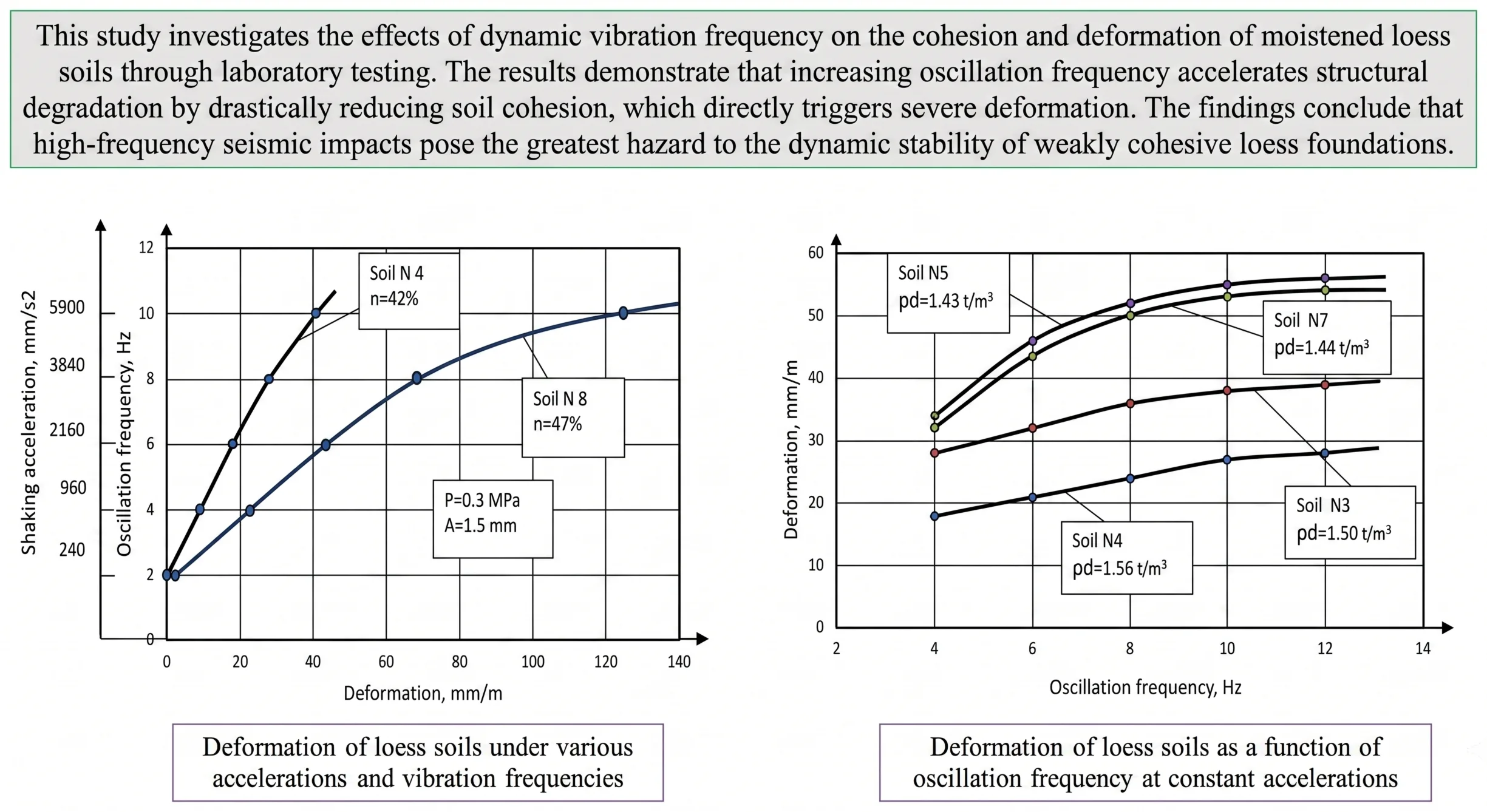
Highlights
- Frequency isolates as the primary driver of structural collapse in wet loess.
- A critical threshold of 12 Hz vanishes the cohesion of moistened loess.
- Dynamic soil deformation increases by 2 to 3 times as frequency rises from 2 to 12 Hz.
- High-frequency vibrations significantly enhance controlled construction compaction.
1. Introduction
It is known that the disruption of the stability, i.e., the deformation of loess soils under dynamic influence, is a very complex process occurring in the soil layer, which cannot be assessed by individual indicators. Internal factors play a significant role in this: soil density-moisture state, presence of colloidal minerals, granulometric composition, internal friction angle, cohesion forces, etc. On the other hand, external factors can also have significant importance in certain conditions: the magnitude of external load, duration, intensity, and nature of dynamic impact. Among these factors, special importance is given to the intensity and nature (by frequency and amplitude) of dynamic impact in the degree of deformability (compactibility) of loess soils [1-5].
The decrease in the seismic resistance of soils with an increase in the intensity of dynamic oscillations, i.e., oscillation accelerations, is unconditional. However, it is necessary to highlight the most significant influence of vibration frequency on the seismic resistance of soils. As construction practice and the analysis of the consequences of destructive earthquakes show, high-frequency earthquakes are the most dangerous (from the point of view of the disruption of dynamic stability) for the foundations of structures [2], [5-8].
In accordance with the task, a series of experiments was conducted on samples of loess-like soils to study the dependence of the disruption of the structure and deformability of moistened loess soils on the nature of dynamic fluctuations (by frequency and amplitude).
Unlike previous studies that emphasize acceleration (PGA), this research specifically isolates vibration frequency as the primary driver of structural collapse in moistened loess. We identify a critical threshold (12 Hz) where cohesion practically vanishes, providing a new basis for seismic risk assessment in loess-dominant regions.
Unlike previous studies that focus primarily on acceleration (PGA), this research specifically identifies vibration frequency as the dominant driver of structural collapse. We establish that a frequency of 12 Hz acts as a critical threshold where loess cohesion effectively vanishes, which is a vital finding for seismic risk assessment.
2. Main part
The disruption of the stability of loess soils under dynamic impact is a complex physical and mechanical process. This process is characterized by changes in the internal structure of the soil mass, weakening of interparticle bonding forces, and the occurrence of compaction or settlement. Therefore, deformation caused by dynamic loading cannot be evaluated using a single indicator; instead, the combined influence of multiple factors must be taken into account.
Among the internal factors affecting stability, the density–moisture condition of the soil plays a particularly important role. An increase in moisture weakens the structure of loess soils and reduces their resistance to dynamic loading. In addition, the presence of colloidal minerals, granulometric composition, internal friction angle, and cohesion forces directly influence the seismic resistance of the soil. These parameters determine the mechanism of interaction between soil particles.
External factors may also be decisive under certain conditions. In particular, the magnitude, duration, intensity, and nature of dynamic loading determine the degree of soil deformation. Especially significant is the influence of the frequency and amplitude of dynamic vibrations on the compaction and stability characteristics of loess soils. As vibration intensity increases, the seismic resistance of the soil decreases.
Construction practice and analyses of the consequences of strong earthquakes show that high-frequency vibrations are the most dangerous for the foundations of structures. Under such conditions, the soil structure deteriorates more rapidly, and deformation processes intensify.
In accordance with the research objectives, a series of laboratory experiments was conducted on moistened loess soil samples to study the dependence of structural degradation and deformability on the frequency and amplitude of dynamic vibrations. The results obtained indicate the necessity of considering vibration parameters when assessing the dynamic stability of loess soils.
3. Materials and methods
The laboratory experiment was conducted on a specially designed vibrating device. The vibration device allows for the reproduction of harmonic horizontal forced oscillations with an amplitude from 0.1 to 6.0 mm and a frequency of 1-12 Hz [6], [7].
The experimental setup utilizes a direct current (DC) motor combined with a crank-and-rod system to generate mechanical oscillations. Soil specimens are placed within compression units that are securely fixed to a vibrating platform, ensuring direct transmission of rhythmic vibrations to the samples. A load from a given vertical pressure can be applied to the surface of the tested soil sample within wide limits.
The testing process involved applying frequencies ranging from 2 to 12 Hz, with the oscillation amplitude varying between 0.1 and 3.0 mm. These parameters resulted in acceleration levels starting at 800 mm/s2, which corresponds to a magnitude 7 seismic intensity on the MSK-64 international scale.
Loess soils of undisturbed structure were studied. To analyze the settling characteristics, the standard single-curve technique was employed. The tests were sequentially performed, beginning with a static loading phase followed by dynamic stimulation. Either two twin samples were tested in parallel under static and dynamic conditions.
The change in vibration mode in these experiments was achieved through the oscillation frequency at a constant amplitude value. The registered parameter in this case was the soil cohesion before and after the experiment.
Soil structural integrity was assessed by measuring cohesion through the ball-immersion technique, originally proposed by N. A. Sitovich, adapted for the vibrating apparatus used in this study. For this purpose, experimental studies were conducted with various loess soils of undisturbed structure to study the factors influencing the disruption of cohesion of wet loess during vibration. The experiments were conducted according to the following methodology: for each test cycle, twin specimens were extracted from a unified soil block. After an initial stabilization period under specific pressure, the baseline cohesion of the first specimen was recorded. Simultaneously, the second specimen underwent vibration while remaining under the same static pressure to observe changes in its physical properties. All experiments were conducted in triplicate repetition. The immersion of the ball into the soil and its velocity during oscillations showed a decrease in the cohesion value of the soil under experimental conditions (disruption of structure, decrease in strength and compaction).
The structural integrity and deformation characteristics were calculated using the following analytical expressions. The dynamic cohesion () was determined using the ball-immersion method, a technique widely applied for assessing the structural strength of cohesive soils [12]. Based on the principles of soil mechanics established by Tsytovich, the cohesion value is calculated as follows:
where: is the applied vertical load (N); is the diameter of the ball (mm); is the depth of ball immersion into the soil (mm).
The relative dynamic deformation (settlement) of the loess soil under vibration is calculated using the formula:
where is the magnitude of dynamic settlement (mm); is the initial height of the soil specimen (mm).
4. Results and discussion
Let’s consider the results of the experiments (Table 1). Thus, at a frequency of 2 Hz, the initial soil cohesion 0.05 MPa decreased to 0.025 MPa; at 4 Hz, respectively: 0.05 MPa at 0.015 MPa; at 6 Hz - 0.05 MPa at 0.010 MPa; at 8 Hz - 0.05 MPa at 0.005 MPa; at 10 Hz - 0.05 MPa at 0.002 MPa; at 12 Hz - 0.05 MPa at 0.0005 MPa (here, is the soil cohesion before vibration, is the soil cohesion after vibration).
It was noted that at vibration frequencies above 12 Hz (high-frequency earthquakes), the cohesion value of water-saturated loess soil decreases to zero even with a 7-point earthquake (according to the international MSK-64 scale).
The author also conducted experiments to clarify the role of vibration frequency in changing the deformation of loess soil. Table 2 shows the dependence of soil deformation on vibration frequency. The experiments were conducted on four varieties of loess-like soils with the following parameters: acceleration 2000 mm/s2, load 0.3 MPa, amplitude 0.1-3 mm, moisture content Sr = 0.8. The conducted experiments show that the deformability of the investigated soil depends on the vibration frequency. When the dynamic oscillation frequency increases from 2 to 12 Hz, the deformability of moistened loess soil increases by 2-3 times. From this it follows that the influence of dynamic influence on soil deformability is more effective if, under all other equal conditions, this influence is characterized by a high frequency.
Table 1Change in the cohesion of moistened loess soil at different dynamic impact frequencies
No. | Vibration frequency , Hz | Initial cohesion , MPa | Bonding after vibration , MPa |
1 | 2 | 3 | 4 |
1. | 2 | 0.05 | 0.025 |
2. | 4 | 0.05 | 0.015 |
3. | 6 | 0.05 | 0.010 |
4. | 8 | 0.05 | 0.005 |
5. | 10 | 0.05 | 0.002 |
6. | 12 | 0.05 | 0.0005 |
Table 2Change in the deformation value of moistened loess soil at different dynamic impact frequencies
No. | Soil name | Dry soil density, in kg/cm3 | Soil deformation, in mm/m, at frequencies | |||||
2 | 4 | 6 | 8 | 10 | 12 | |||
1. | Loam | 1.45 | 21 | 34 | 45 | 52 | 55 | 57 |
2. | Loam | 1.46 | 20 | 32 | 42 | 50 | 52 | 54 |
3. | Sandy soil | 1.52 | 18 | 26 | 32 | 35 | 37 | 38 |
4. | Loam | 1.58 | 9 | 16 | 21 | 24 | 26 | 2 |
Fig. 1Deformation of loess soils under various accelerations and vibration frequencies
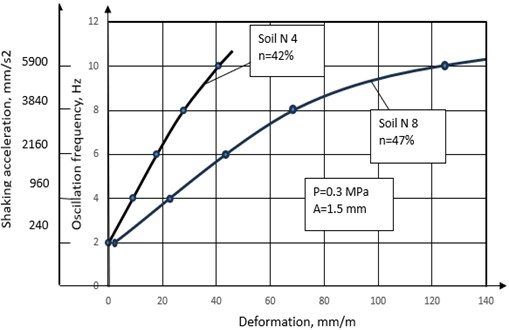
Fig. 1 shows the dependencies of loess soil deformation on various accelerations and vibration frequencies. Graphs of the dependence of the deformation value of loess soils with a stepped increasing vibration frequency (at the same acceleration) are shown in Fig. 2.
Fig. 2Deformation of loess soils as a function of oscillation frequency at constant accelerations
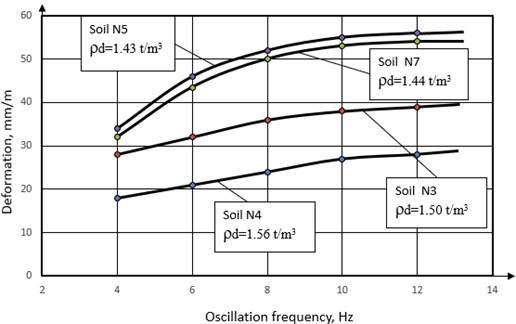
It is undeniable that the seismic resistance of soil decreases as acceleration increases. As studies by numerous specialists, as well as our own, have shown, an increase in oscillation amplitude has a relatively small effect on the development of soil deformability. However, it is necessary to highlight the most significant factor affecting the seismic resistance of soil: the frequency of oscillation. As shown by construction practices and the analysis of earthquake aftermaths, high-frequency earthquakes pose the greatest danger to the foundations of structures in terms of disrupting their dynamic stability.
It is important to distinguish between the effects of high-frequency vibrations on existing foundations versus soil compaction processes. In the case of moistened loess foundations, high-frequency oscillations (e.g., 12 Hz) lead to the rapid degradation of structural cohesion, which triggers dangerous seismic settlements. However, in the context of engineering soil improvement (compaction), high-frequency vibrations are beneficial for dry or optimally moist soils. These vibrations effectively overcome the internal friction between soil particles, allowing them to rearrange into a more stable and dense configuration. Therefore, while high frequency is a risk factor for seismic stability of wet soils, it is a highly efficient tool for controlled geotechnical compaction during construction.
5. Conclusions
By studying the influence of the frequency of dynamic oscillations on the change in cohesion and deformation of moistened loess soils, we came to the following conclusion:
1) Experiments have shown that the deformation of moistened loess soils develops depending on the intensity of vibration. Moreover, high-frequency oscillations play a significant role in the process. High-frequency oscillations increase the soil’s ability to transition to a dynamically disturbed state. Consequently, as construction practice and the analysis of the consequences of many destructive earthquakes show, high-frequency earthquakes are the most dangerous (from the point of view of disrupting dynamic stability) for the foundations of buildings and structures.
2) The dynamic stability of moistened loess soils decreases as they are exposed to high-frequency earthquakes for a sufficient duration.
3) The results of our experimental studies showed that at the same dynamic oscillation accelerations, the destruction of the structure and dilution of moistened loess soil occur mainly due to an increase in the frequency of oscillations. With an increase in the frequency of dynamic fluctuations, the strength characteristics of the moistened loess soil decrease proportionally (mainly due to cohesion). Also, with an increase in the frequency of dynamic oscillations, the deformation (density) of the loess soil increases.
4) From the above, it can be noted that in high-seismic regions, when compacting soils using a vibration machine, special attention should be paid to the vibration frequency. As our experimental studies have shown, high-frequency vibrations positively influence the increase in density, as well as the strength characteristics of soils.
5) The obtained results of studying the influence of dynamic impact intensity and its parameters (frequency and amplitude) on the development of soil deformation can be taken into account when recommending vibration compaction of soils, as well as when designing and constructing buildings and structures on moistened loess soils in seismic regions.
References
-
G. A. Khakimov, “The nature of the change in the connectivity of moistened loess soils during vibration,” American Journal of Applied Science and Technology, Vol. 2, No. 6, pp. 26–41, 2022.
-
G. A. Khakimov, “Changes in the strength characteristics of glinistx soils under the influence of dynamic forces International Journal of Engineering and Advanced Technology, IJEAT. Exploring innovation,” International Journal of Engineering and Advanced Technology, pp. 639–643, 2020.
-
H. Z. Rasulov, Seismic stability and seismic settlement of loess soils. (in Russian), Tashkent: Fan, 2020, p. 336.
-
H. Z. Rasulov, S. Sayfiddinov, Y. N. Chastoedov, G. A. Khakimov, and D. S. Badalov, “Seismic settlement of loess soils,” (in Russian), in Proceedings of the 7th All-Union Conference on Dynamics of Bases, Foundations and Underground Structures, pp. 179–180, 1989.
-
G. A. Khakimov, “Study of the calculation of the foundation for seismic effects,” in AIP Conference Proceedings, Vol. 2439, No. 1, p. 020015, 2022.
-
G. A. Khakimov and M. A. Muminov, “Construction of buildings on weak moist clay soils in seismically active zones of Uzbekistan,” Web of Scientist: International Scientific Research Journal, Vol. 3, No. 12, pp. 755–760, 2022.
-
G. A. Khakimov, “Deformation of loess soils under static and dynamic loads,” in E3S Web of Conferences, Vol. 264, p. 02016, 2021.
-
N. M. Khajiev, “Change in the consistency characteristics of the wetted lussic bases (grunts) of buildings under the influence of seismic forces,” Academic Research in Modern Science, Vol. 1, No. 13, pp. 261–267, 2022.
-
C. Raupov and G. Malikov, “Comparison of microcrack formation boundaries determined by complex of physical methods with long-term strength of expanded clay concrete under different types of stress state,” E3S Web of Conferences, Vol. 365, p. 02023, 2023, https://doi.org/10.1051/e3sconf/202336502023
-
P. Li, H. Jiao, and L. Wang, “Dynamic response and pore pressure evolution of saturated loess under different vibration frequencies,” Engineering Geology, Vol. 289, p. 106173, 2021.
-
J. Wang, P. Sun, and Y. Zhang, “Microstructural evolution and mechanical behavior of loess under cyclic loading,” Journal of Geotechnical Engineering, 2023.
About this article

The authors have not disclosed any funding.
The datasets generated during and/or analyzed during the current study are available from the corresponding author on reasonable request.
The authors declare that they have no conflict of interest.

