Abstract
Bridges located in seismic regions are subjected to strong dynamic actions that may cause excessive bending moments, shear forces, and displacements in piers and foundations. In conventional seismic design, the bridge span is commonly treated as a rigid inertial mass transmitting earthquake-induced forces to the supports, while the beneficial dynamic interaction between the span and the pier is not fully utilized. This study proposes a seismic protection approach in which the bridge span is considered as a tuned dynamic component capable of reducing the response of the pier. A coupled two-degree-of-freedom mathematical model of the span–pier system subjected to base excitation is developed, and a parametric analysis is carried out to determine rational stiffness and damping parameters of the span–support connection. The optimization procedure is performed under practical displacement constraints imposed by the deformation joints. The results show that the most efficient vibration reduction is achieved for properly selected stiffness and damping ratios, with the practical stiffness range lying near 0.12 and 0.2-0.3, depending on the adopted damping level. For the considered bridge, the permissible relative displacement of the span with respect to the support is 6-12 cm, and the bending moments in the pier can be reduced by up to 2.33 times compared with the conventional seismic design approach. The proposed method improves the seismic reliability of reinforced concrete bridge systems without introducing additional external damping masses.
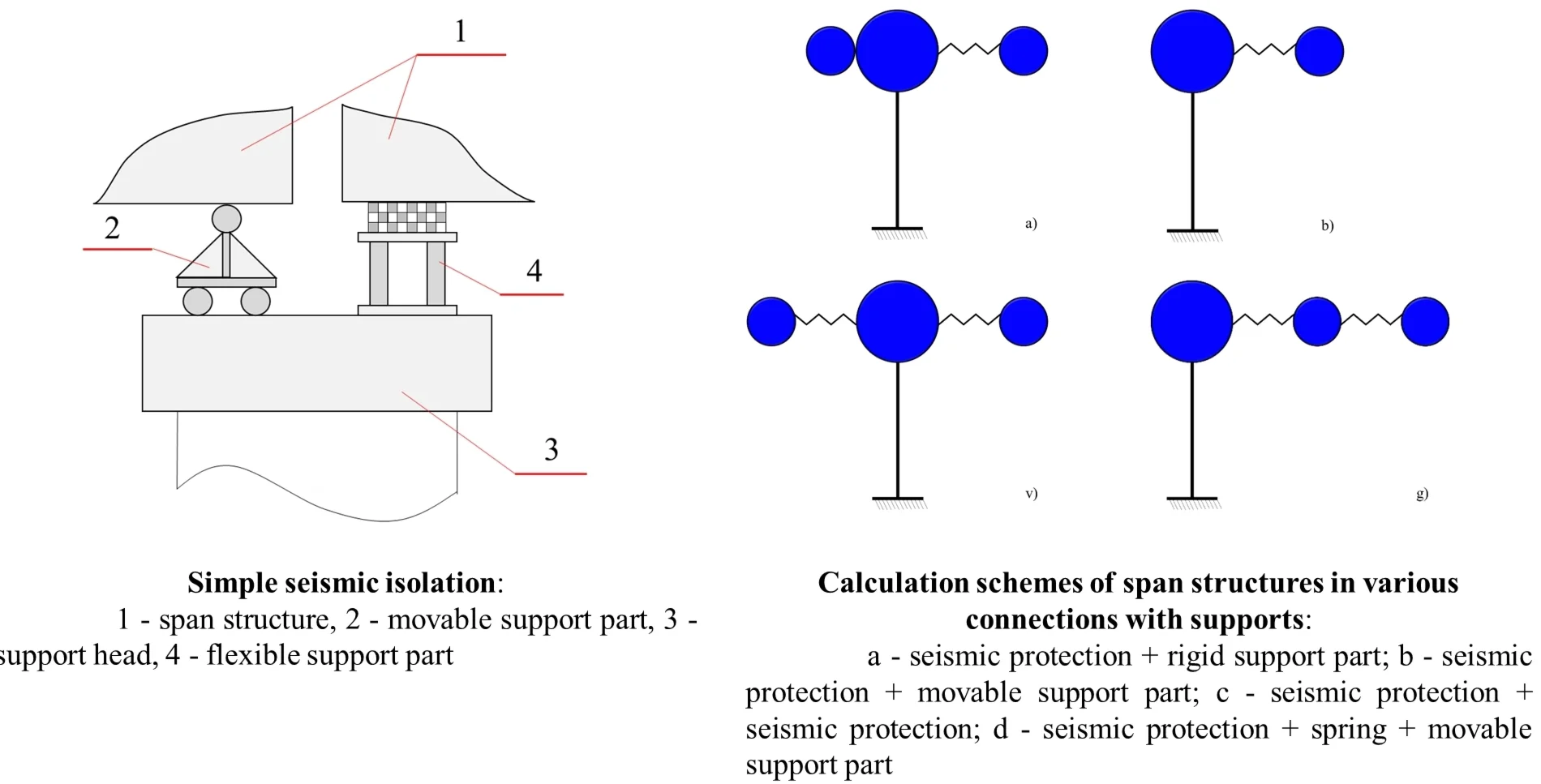
Highlights
- A tuned bridge span–pier interaction model for seismic load reduction was developed
- Optimal stiffness and damping parameters were determined for seismic isolation systems
- The proposed approach reduced bending moments in supports by about 2.3 times
1. Introduction
Bridges located in seismic regions are subjected to significant dynamic actions that may lead to large inertial forces, excessive bending moments, shear forces, and damage to piers, bearings, and foundations. In reinforced concrete bridge systems, the supports are often the most vulnerable structural elements because they concentrate seismic demand transmitted from the superstructure [3], [4], [15-18].
Regional studies in civil, transport, and infrastructure engineering have also addressed a wider range of problems relevant to structural performance and safety. These include the mechanical behavior and long-term strength of lightweight concrete and cement-based materials [1], [2], vibration effects in reinforced concrete bridges and bridge foundations [3], [4], engineering and economic aspects of transport infrastructure repair and structural layer interaction [5], [6], seismic and vibration response of engineering systems [7], comparative dynamic assessment methods [8], infrastructure design under demanding climatic conditions [9], the role of engineering-geological and hydrogeological conditions in infrastructure safety [10-12], vibration-sensitive soil behavior [13], and interaction modeling of building envelope systems [14]. In addition, recent pushover-based seismic analysis has confirmed the importance of reliable structural response assessment for systems located in seismic zones [15].
Traditional approaches to seismic protection of bridges are usually based on increasing structural strength, redistributing seismic forces, or introducing special seismic isolation and damping devices. In many conventional analytical schemes, the bridge span is mainly considered as an inertial mass that transfers earthquake-induced forces to the supports. However, recent studies have shown that the seismic response of isolated bridges depends not only on the isolation device itself, but also on the interaction among the deck, piers, supports, and foundation flexibility [16-18], [20], [21].
Recent international research has further demonstrated that bridge seismic response is highly sensitive to damping configuration, mass distribution, near-fault excitation, and the adopted modeling assumptions. The effectiveness of tuned mass dampers for isolated bridges has been confirmed when soil-structure interaction is taken into account [19]. More recent studies have emphasized the influence of pier-abutment-deck interaction, near-fault pulses, vertical ground motion, and friction-model selection on the behavior of isolated bridge systems [20-25].
At the same time, the available literature still pays limited attention to the possibility of using the existing span mass not merely as a source of inertial loading, but as an intentionally tuned dynamic component for reducing the response of the pier. This aspect is especially relevant for bridge systems in which relative movement between the span and support can be controlled within practical operational limits. Some regional studies have considered vibration effects in bridges, foundations, soils, and seismic behavior of engineering systems [3], [4], [7], [13], [15], yet the problem of rational tuning of the span-support interaction for seismic response reduction remains insufficiently developed.
The novelty of the present study lies in representing the bridge span and the pier as a coupled tuned system in which the existing span mass is used as a vibration-reducing component. Unlike conventional approaches that treat the span primarily as a passive inertial load, the proposed method investigates how the stiffness and damping of the span–support connection can be selected to minimize the displacement and bending moment response of the pier under seismic excitation while maintaining acceptable relative displacements of the span.
The objective of the study is to improve the seismic protection of reinforced concrete bridge systems by identifying effective stiffness and damping characteristics of the span-pier interaction. For this purpose, a coupled two-degree-of-freedom mathematical model is developed and a parametric analysis is carried out to determine rational values of the governing parameters.
2. Materials and methods
2.1. Bridge object and modeling assumptions
The proposed method is applied to a highway bridge over the Chirchik River located in a seismic region with intensities of 7-9 points. The analysis considers the span-pier system under seismic excitation, while the allowable relative displacement of the span with respect to the support is limited by the operating capacity of the deformation joints.
Fig. 1Simple seismic isolation: 1 – span structure, 2 – movable support part, 3 – support head, 4 – flexible support part
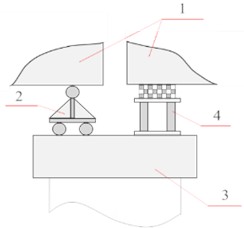
In the proposed approach, the bridge pier and the span are each represented by an equivalent single-degree-of-freedom subsystem characterized by a lumped mass, equivalent lateral stiffness, and damping. When these two subsystems are connected through the seismic-protection interface, the structural idealization becomes a coupled two-degree-of-freedom system. Such a representation makes it possible to study the mutual dynamic interaction between the pier and the span and to evaluate whether the span can act as a vibration-reducing component for the support during earthquake excitation.
Fig. 2Calculation schemes of span structures in various connections with supports: a) seismic protection + rigid support part; b) seismic protection + movable support part; c) seismic protection + seismic protection; d) seismic protection + spring + movable support part
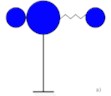
a)

b)
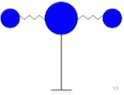
c)
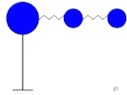
d)
2.2. Governing equations and seismic input
The pier is characterized by the equivalent mass , stiffness , and damping , while the span is described by the corresponding parameters , , and . In this study, the connecting element between the span and the support is treated as a controllable seismic-protection component whose stiffness and damping determine the dynamic interaction of the coupled system.
The governing equation of motion is written in matrix form as:
where is the vector of generalized displacements, is the ground acceleration, , , and are the mass, damping, and stiffness matrices, respectively, and is the influence vector describing the way the seismic base acceleration enters the system. Thus, seismic action is introduced as kinematic excitation at the support level.
2.3. Dimensionless parameters and optimization criteria
For the dimensionless description of the problem, the following governing parameters are introduced:
where is the mass ratio, is the stiffness ratio, and is the damping ratio.
The objective of the study is to determine rational stiffness and damping characteristics of the span-support connection by minimizing the amplitude-frequency response of the support under seismic excitation. At the same time, the optimization is performed under practical limits on the relative displacement of the span with respect to the support, as required by the deformation joints and serviceability considerations.
2.4. Calculation procedure
The analyzed support schemes are reduced to simplified dynamic models with two or three degrees of freedom depending on the connection type between the span and the support. The amplitude-frequency characteristic is used as the main criterion for parameter selection, and the preferred parameter set corresponds to the minimum support response within the admissible displacement range.
For the considered bridge, the dynamic characteristics of the individual support and the reduced support mass were determined using the adopted model. The limiting displacement was established through the corresponding static displacement relations, which made it possible to estimate the minimum acceptable stiffness of the protective support elements. The subsequent calculations were carried out by varying the stiffness and damping parameters and analyzing their influence on the relative displacement of the span and the bending moment in the pier.
3. Results
3.1. Dynamic characteristics of the span-pier system
The calculated dynamic parameters of the support system show that the reduced support mass is significantly smaller than the span mass, which leads to a large mass ratio for the considered bridge configuration. In the manuscript, the mass ratio was found to be 49.26, indicating that the span cannot be treated as a classical dynamic damper with the critical mass ratio close to 2. Therefore, the effectiveness of the proposed approach is governed primarily by displacement constraints and rational tuning of stiffness and damping rather than by the classical dynamic absorber condition alone.
3.2. Influence of stiffness and damping parameters
The analysis showed that the effectiveness of the proposed seismic-protection system depends strongly on the selected stiffness and damping parameters. When the stiffness of the isolation element is too small, the relative displacement of the span increases sharply. As the stiffness increases, the displacement decreases; however, excessively large stiffness gradually weakens the seismic-isolation effect because the span and the support begin to move almost together.
Fig. 3Amplitude-frequency characteristics of the span-pier system for two stiffness ratios of the seismic-isolation connection
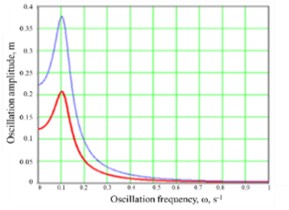
a)0.1
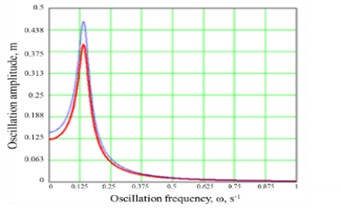
b)0.2
Fig. 4Relative displacement between the span and the upper part of the support versus stiffness ratio f at γ= 2
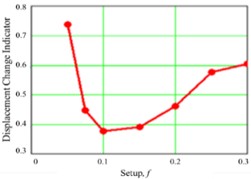
Fig. 5Dependence of the reduction in support stress response on the stiffness tuning parameter of the seismic-isolation system
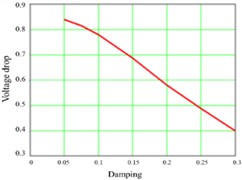
For the considered bridge, the permissible relative displacement of the span with respect to the support was taken in the range of 6-12 cm. Within this constraint, the most rational tuning corresponds to 0.12, while a practical engineering range of 0.2-0.3 provides substantial reduction of the support load with acceptable relative displacements. The calculations also showed that effective operation requires damping values above the critical level, approximately 1.
3.3. Dynamic characteristics after seismic protection
The dynamic characteristics of the support before and after introducing seismic protection demonstrate the efficiency of the proposed approach. The modal parameters presented in Table 1 confirm that the protected system behaves differently from the conventional non-isolated case and that the modification of stiffness and damping leads to a redistribution of the dynamic response.
Table 1Dynamic characteristics of the span support
Vibration patterns | 1 | 2 | 3 | |
Period, , s. | unprotected/protected | 0.862/1.011 | 0.076/0.205 | 0.020/0.059 |
Frequency , rad/s | unprotected/protected | 7.60/6.21 | 81.03/30.6 | 319.6/106.4 |
Inelasticity coefficient | unprotected/protected | 0.073/0.34 | 0.082/0.67 | 0.077/0.12 |
3.4. Reduction of bending moments in the pier
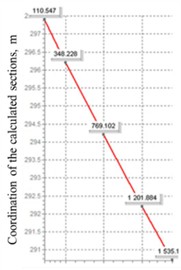
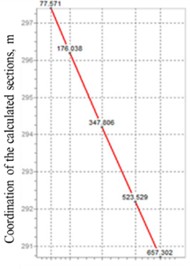
According to the bending moment diagrams obtained for the support with and without seismic isolation, the proposed tuned span–support system leads to a substantial decrease in seismic demand on the pier. In particular, the maximum bending moment in the support is reduced by up to 2.33 times compared with the conventional non-isolated solution.
Fig. 6Bending moment diagrams for the pier without seismic isolation and with seismic isolation, showing a reduction in the maximum bending moment by up to 2.33 times
4. Discussion
The obtained results show that the seismic response of the bridge support is governed not only by the total inertial mass of the span, but also by the way this mass is dynamically coupled to the pier through the stiffness and damping characteristics of the support connection. In this sense, the span should not be regarded solely as a source of additional seismic demand. Under properly selected parameters, it can act as an integrated vibration-reducing component of the bridge system.
The calculations indicate that the efficiency of the proposed approach is sensitive to both stiffness and damping. If the stiffness is too low, the relative displacement becomes excessive and may violate serviceability limits. If the stiffness is too high, the span and the support tend to move almost together, which reduces the beneficial vibration-isolation effect. Therefore, the optimal solution lies in a limited parameter region rather than at an extreme value of stiffness. This interpretation is consistent with the general tendency reported in recent studies on isolated bridges and tuned vibration control systems [16-25].
The engineering significance of the results lies in the fact that the proposed method makes it possible to reduce seismic demand on the pier without introducing additional external masses or highly complex damping devices. For practical bridge design and retrofitting, this means that the existing mass of the span may be used more efficiently if the span-support connection is properly tuned.
At the same time, the present study is based on a simplified coupled model and a parametric analysis framework. Therefore, the obtained results should be interpreted as rational design guidance rather than as a universal solution for all bridge types. Further studies may include more detailed spatial modeling, nonlinear behavior of support devices, and validation under recorded earthquake accelerograms.
5. Conclusions
This study investigated the dynamic interaction between a bridge span and a pier during earthquakes and demonstrated that the span can be used not only as an inertial load source but also as a tuned dynamic component for reducing the seismic response of the support. By idealizing the pier and the span as equivalent single-degree-of-freedom subsystems, a coupled two-degree-of-freedom model was developed for evaluating the effect of stiffness and damping on the span-support interaction.
The parametric analysis showed that the efficiency of the proposed system is governed by the stiffness ratio, damping ratio, and admissible relative displacement of the span. For the considered bridge, the permissible relative displacement of the span with respect to the support was taken as 6-12 cm, the most effective tuning was achieved near 0.12, and a practical range of 0.2-0.3 provided a marked reduction in support demand. Effective operation also required damping above the critical level, 1. Under these conditions, the bending moment in the pier was reduced by up to 2.33 times compared with the conventional design approach.
Therefore, the proposed method can improve the seismic safety and reliability of reinforced concrete bridges in earthquake-prone regions without the need for additional external masses or overly complex damping devices. The results confirm the practical potential of using the span-pier interaction itself as a controllable seismic-protection mechanism in bridge design and retrofitting.
References
-
C. Raupov, A. Karimova, F. Zokirov, and Y. Khakimova, “Experimental and theoretical assessment of the long-term strength of lightweight concrete and its components under compression and tension, taking into account the macrostructure of the material,” E3S Web of Conferences, Vol. 264, p. 02024, 2021, https://doi.org/10.1051/e3sconf/202126402024
-
S. Salikhanov, Z. Pulatova, F. Zakirov, Z. Rahimjonov, and A. Abdullayev, “Determination of deformations and self-stress in concrete on stress cement,” E3S Web of Conferences, Vol. 264, p. 02056, 2021, https://doi.org/10.1051/e3sconf/202126402056
-
M. Berdibaev, B. Mardonov, N. Nishonov, and Z. Rakhimjonov, “Beam vibration due movement of overweight cargoes on reinforced concrete bridges at different ground conditions,” E3S Web of Conferences, Vol. 401, p. 01075, 2023, https://doi.org/10.1051/e3sconf/202340101075
-
S. S. Salixanov, F. Z. Zokirov, Y. T. Xakimova, and G. B. Ismailova, “The effect of increasing loads on foundations of operating bridges,” E3S Web of Conferences, Vol. 401, p. 01080, 2023, https://doi.org/10.1051/e3sconf/202340101080
-
U. Shermukhammedov, G. Mustaeva, F. Zokirov, L. D. Artanti, A. Karimova, and M.M. Sobirova, “Model of evaluating the economic efficiency of resource selection in the repair of transport infrastructure,” in AIP Conference Proceedings, Vol. 3377, No. 1, p. 020006, 2025, https://doi.org/10.1063/5.0299541
-
S. Salikhanov and F. Zokirov, “Studying possibilities of joint operation of main beam and protective layer constructions,” in AIP Conference Proceedings, Vol. 3317, No. 1, p. 030029, 2025, https://doi.org/10.1063/5.0266815
-
N. Nishonov, D. Bekmirzaev, A. Ergashov, Z. Rakhimjonov, and A. Khurramov, “Underground polymeric l-shaped pipeline vibrations under seismic effect,” E3S Web of Conferences, Vol. 264, p. 02037, 2021, https://doi.org/10.1051/e3sconf/202126402037
-
T. Sulaksono, A. S. Ananto, and L. D. Artanti, “Comparative analysis of spectral and deterministic methods for estimating fatigue life in joint of fixed jacket platform in the Andaman Sea Myanmar,” E3S Web of Conferences, Vol. 479, p. 07018, 2024, https://doi.org/10.1051/e3sconf/202447907018
-
X. Qoraqulov, Z. Maxkamov, O. Zafarov, E. Mo’Minov, S. Musurmonov, and B. Alishov, “Innovative solutions for design and construction of modern cement concrete roads in dry-hot climate of Republic of Uzbekistan,” in AIP Conference Proceedings, Vol. 3317, No. 1, p. 040009, 2025, https://doi.org/10.1063/5.0275117
-
K. Mingboyev, E. Kurbanov, F. Oxunov, and O. Zafarov, “Evaluation of engineering-geological and hydrogeological conditions in mining industry facilities,” in AIP Conference Proceedings, Vol. 3317, No. 1, p. 040010, 2025, https://doi.org/10.1063/5.0267153
-
E. Qurbonov, A. Axunjanov, and O. Zafarov, “Analysis of engineering-geological and hydrogeological processes in underground mining (illustrated by Nilu coal mine),” E3S Web of Conferences, Vol. 583, p. 01004, 2024, https://doi.org/10.1051/e3sconf/202458301004
-
E. Qurbonov, O. Zafarov, A. Axunjanov, and O. Ashurov, “Assessment of engineering-geological conditions in the mining of deposits by the underground method,” in AIP Conference Proceedings, Vol. 3045, No. 1, p. 030094, 2024, https://doi.org/10.1063/5.0197336
-
A. Kayumov, A. Khisomiddinov, O. Zafarov, I. Ruziyev, and K. Ergashev, “Effect of vibration on the calculated resistance of sandy soils,” Vibroengineering Procedia, Vol. 60, pp. 68–74, Dec. 2025, https://doi.org/10.21595/vp.2025.25554
-
E. Shipacheva, S. Shaumarov, A. Gulamov, and M. M. Talipov, “Modeling of interaction of external enclosing structures of buildings with the internal and external environments,” in ICTEA: Int. Conf. on Thermal Engineering, Vol. 1, No. 1, 2024.
-
B. Harsono, F. M. Mahadiva, Tavio, T. M. Mirkadirovich, and H. Hermawan, “Pushover analysis of simple house structures in seismic zones,” in AIP Conference Proceedings, Vol. 3480, No. 1, p. 050035, Mar. 2026, https://doi.org/10.1063/5.0319164
-
Y.-P. Wang, L.-L. Chung, and W.-H. Liao, “Seismic response analysis of bridges isolated with friction pendulum bearings,” Earthquake Engineering and Structural Dynamics, Vol. 27, No. 10, pp. 1069–1093, 1998, https://doi.org/10.1002/(sici)1096-9845(199810)27:10<1069::aid-eqe770>3.0.co;2-s
-
R. S. Jangid, “Seismic response of isolated bridges,” Journal of Bridge Engineering, Vol. 9, No. 2, pp. 156–166, Mar. 2004, https://doi.org/10.1061/(asce)1084-0702(2004)9:2(156)
-
B. A. Olmos and J. M. Roesset, “Inertial interaction effects on deck isolated bridges,” Bulletin of Earthquake Engineering, Vol. 10, No. 3, pp. 1009–1028, Dec. 2011, https://doi.org/10.1007/s10518-011-9336-5
-
S. Elias and V. Matsagar, “Effectiveness of tuned mass dampers in seismic response control of isolated bridges including soil-structure interaction,” Latin American Journal of Solids and Structures, Vol. 14, No. 13, pp. 2324–2341, Jan. 2017, https://doi.org/10.1590/1679-78253893
-
E. Miceli and L. Giordano, “Influence of the pier-abutment-deck interaction on the seismic response of bridges equipped with FPS,” Procedia Structural Integrity, Vol. 44, pp. 1419–1426, Jan. 2023, https://doi.org/10.1016/j.prostr.2023.01.182
-
D. Gino, E. Miceli, and P. Castaldo, “Seismic reliability analysis of isolated deck bridges using friction pendulum devices,” Procedia Structural Integrity, Vol. 44, pp. 1435–1442, Jan. 2023, https://doi.org/10.1016/j.prostr.2023.01.184
-
Y.-X. Hui, J. Wang, J.-L. Lv, and T.-T. Xu, “Seismic responses of isolated bridges subjected to near-fault ground motions: simple pulses vs. whole records,” Frontiers in Built Environment, Vol. 10, Jul. 2024, https://doi.org/10.3389/fbuil.2024.1447454
-
J. Zhong, Y. Zhu, and Q. Han, “Impact of vertical ground motion on the statistical analysis of seismic demand for frictional isolated bridge in near-fault regions,” Engineering Structures, Vol. 278, p. 115512, Mar. 2023, https://doi.org/10.1016/j.engstruct.2022.115512
-
Z. Wei, B. Yang, Q. You, K. D. Tsavdaridis, and S. Jia, “Study on multi-parameter optimization of seismic isolation bearings for continuous girder bridges considering interactions among key parameters,” Scientific Reports, Vol. 15, No. 1, May 2025, https://doi.org/10.1038/s41598-025-02155-z
-
M. Borekci, “Influence of friction models on the seismic response of box-girder RC bridges with double concave friction pendulum bearings under varying deck aspect and mass ratios,” Buildings, Vol. 15, No. 4, p. 556, Feb. 2025, https://doi.org/10.3390/buildings15040556
About this article

The authors have not disclosed any funding.
The datasets generated during and/or analyzed during the current study are available from the corresponding author on reasonable request.
Dr. Fakhriddin Zokirov is a scientific committee member of the 76th International Conference on Vibroengineering and was not involved in the editorial review and/or the decision to publish this article.

