Abstract
This study investigates the development of Self-Compacting Fine-Grained Concrete (SCFGC) optimized for vibration-free technology. By utilizing polycarboxylate superplasticizers and mechanically activated mineral fillers, the research achieves precise control over rheological properties and structural viscosity (reducing it by up to 41 %). Based on Uzbekistan’s CEMI 32.5N Portland cement, the interaction within the “cement-filler-water” system enhances the cement stone microstructure, ensuring high durability and dense structure formation. This approach significantly improves energy efficiency, enables noise reduction, and lowers labor intensity, offering a sustainable solution for modern monolithic and prefabricated construction.
1. Introduction
In the context of the rapidly evolving construction industry, there is an increasing demand for materials that prioritize high performance, durability, and energy efficiency. A significant technological shift in concrete engineering is the transition toward vibration-free and low-vibration compaction methods, which not only enhance labor productivity but also significantly improve sanitary-hygienic working conditions by reducing noise and structural vibration impacts [1-4].
Self-compacting concretes (SCC) have gained global recognition due to their ability to achieve full consolidation under their own weight without the need for external mechanical energy. The development of self-compacting fine-grained concretes (SCFGC) is particularly critical for the construction of monolithic, thin-walled, and complex-configuration structural elements with dense reinforcement. To optimize the structure of such systems, a comprehensive approach is required, involving the precise management of the “cement-water-aggregate” system through the integration of complex modifiers, such as high-performance chemical admixtures and mineral fillers. These modifications are essential for regulating rheological behavior, preventing phase separation, and ensuring the formation of a dense, homogeneous cement matrix with minimal porosity [5-9].
While international practices often utilize high-activity cements (≥ CEMI 42.5H) in tandem with polycarboxylate superplasticizers for these applications, the limited availability of such grades in Uzbekistan necessitates alternative solutions. Consequently, this study addresses the pressing scientific and practical challenge of developing SCFGC compositions based on widely accessible CEMI 32.5N Portland cement that meet stringent operational requirements for vibration-free technology. Implementing these research findings will enhance the technological efficiency of construction workflows and support the transition of Uzbekistan’s construction sector toward sustainable, environmentally friendly, and energy-efficient practices that align with international standards.
The primary objective of this work is for the first time, vibration-free self-compacting fine-grained concrete compositions based on locally available CEMI 32.5N cement have been scientifically substantiated for Uzbekistan's construction industry by establishing the optimal mechanical activation duration of metallurgical waste filler (30 minutes), the optimal micro-filling regime (specific surface area ≈3000 cm2/g and 25 % filler content by binder weight), and demonstrating that the complex modifier reduces structural viscosity by up to 41 %, enabling self-compacting behavior at low water-cement ratios.
2. Research methods and applied materials
The experimental research focused on developing self-compacting fine-grained concrete (SCFGC) compositions using materials readily available in the Republic of Uzbekistan. The primary binder was Portland cement grade CEMI 32.5N, produced by Kizilkumsement LLC. Metallurgical waste, sourced from Uzbekistan Railways JSC, served as the mineral filler; it is characterized as a finely dispersed, grayish-brown material with a high specific surface area and notable amorphous phase content. Prior to utilization, the filler was dried at (105±5) °C until reaching a constant mass, followed by grinding in a SHLM-100 laboratory ball mill, with grinding and loading durations optimized experimentally to achieve the desired dispersity. The dispersity was controlled via the Kozeni-Karman air permeability method using a PSKh-11A device, while particle morphology and aggregation degrees were assessed using a No008 sieve.
A polycarboxylate ether-based superplasticizer (PRO500) was employed as a chemical additive, offering high water-reducing capacity (25-30 %) and enabling the necessary mobility of the cement systems with minimal water usage. This additive was introduced as an aqueous solution in precisely calculated dosages. To evaluate the complex modifier's impact on the binder, a comprehensive suite of physicochemical analysis methods was applied. Specifically, normal consistency and setting times were determined using a Vika apparatus in accordance with GOST 310.3-76 and GOST 310.4-81, facilitating the assessment of water demand and hydration kinetics. Rheological characteristics were investigated with a LAMYREOLOGY rotary viscometer to measure structural viscosity and determine optimal modifier dosages for ensuring self-compaction and mixture stability. Furthermore, the phase composition and structural transformations of the cement compositions were analyzed using X-ray diffractometry on an AL-27mini device, with patterns interpreted via the ICDD PDF-2 database to identify crystalline phases and hydrate compounds. This integrated experimental framework ensured the scientific validity of the findings regarding the binder's properties for vibration-free construction technologies [2, 3, 10].
3. Results and discussions
Mechanoactivation is a key technological process in transforming raw materials into high-performance products through mechanical energy. It induces structural and morphological changes, including particle refinement, increased density of active surface centers, and modification of particle shape. As a result, the specific surface area increases and the crystalline structure partially transitions to an amorphous state, significantly enhancing chemical reactivity.
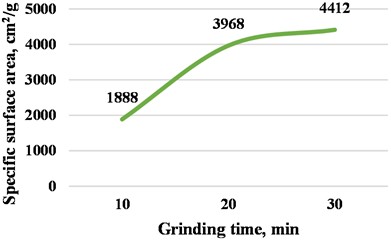
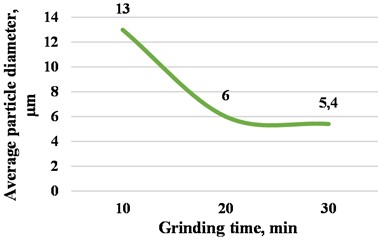
Given these fundamental mechanisms, the present study investigates the mechanoactivation of burnt form of waste (BWS) to optimize its application in cementitious systems. The experimental results regarding the grinding kinetics and efficiency of BWS are illustrated in Fig. 1, demonstrating the direct relationship between mechanical processing duration and the resulting physicochemical characteristics essential for vibration-free construction technologies [10].
scientific research and engineering practice have established that the material grinding process, particularly under conditions of mechanical activation, exhibits a non-linear behavior characterized by several sequential and distinct stages [11]:
1) The first stage, the material undergoes preliminary dispersion, characterized by the mechanical fragmentation of large structural agglomerates. Intensive mechanical stress – induced through impact, attrition, or a combination thereof – promotes pore opening, particle separation, and the formation of primary fragments with diverse size distributions. During this phase, the specific surface area exhibits a nearly proportional increase relative to the energy input, indicating high efficiency in energy conversion during the initial stage of activation [12].
2) The second stage is characterized by micro-grinding and the accumulation of crystal lattice defects. As the material's dispersity increases, breakdown occurs at the level of individual crystals and grains, necessitating higher energy inputs. During this phase, resistance to further destruction intensifies, and while the growth of the specific surface maintains a linear dependence on energy consumption, the overall efficiency coefficient decreases significantly.
3) The third stage, the system reaches its maximum dispersity, followed by the onset of particle aggregation. Highly dispersed products possess substantial surface energy, leading to a natural tendency for particles to agglomerate under the influence of intermolecular and electrostatic forces. Consequently, the formation of secondary aggregates diminishes the efficiency of continued grinding and results in a plateauing of the specific surface area. This stage defines the technological limit of dispersion, beyond which further refinement requires modifying process parameters or employing additional particle stabilization techniques [13-17].
Experimental results show that mechanical activation of BWS significantly improves its physicochemical and structural properties. Grinding for 30 minutes increases the specific surface area up to 4412 cm2/g, indicating enhanced reactivity and improved interaction with cement hydration products. This improvement is due not only to particle size reduction but also to the formation of new reactive centers caused by lattice disruption and structural defects.
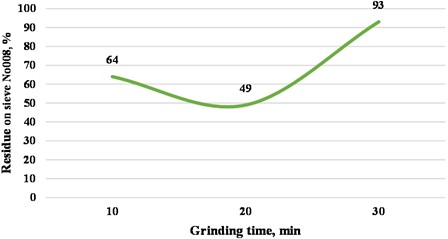
Granulometric analysis confirms the effectiveness of the activation process, with average particle size decreasing from 13 μm to 5.4 μm, indicating high dispersion and homogeneity. Grinding also promotes pore opening and agglomerate breakdown, increasing the active surface area. Sieve analysis (No. 008) supports these results, showing a reduction in residue from 64 % to 49 %, reflecting a higher proportion of fine particles.
However, grinding durations exceeding 30 minutes resulted in a sharp increase in residue on the No. 008 sieve, rising to 93 %. This phenomenon indicates the onset of particle agglomeration and adhesion, driven by intermolecular and electrostatic forces. This effect is a direct consequence of elevated surface energy, where the system tends to minimize its free energy through particle re-aggregation, thereby establishing the technological limit for optimal dispersion [9].
Experimental analysis shows that the optimal duration for BWS mechanical activation is about 30 minutes. Prolonged grinding leads to particle agglomeration, reducing effective surface area, pozzolanic activity, and energy efficiency, while negatively affecting matrix uniformity.
A key issue is surface passivation of activated fillers during storage, caused by adsorption of atmospheric moisture and gases. Moisture forms hydrate films, while oxygen and nitrogen alter surface electron density, leading to deactivation of active centers.
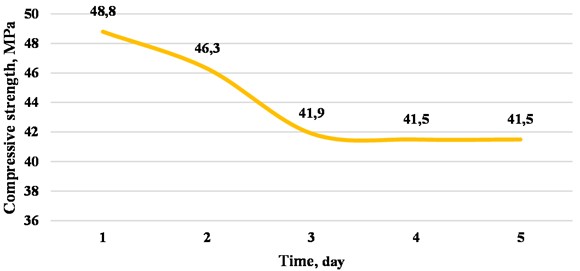
As a result, extended storage reduces filler reactivity and its interaction with cement hydration products. To evaluate this effect, additional experiments were conducted to assess the influence of storage duration on the mechanical strength of cement stone (Fig. 2).
The experimental data enable quantitative evaluation of mineral component activity and identification of optimal operational periods, reducing surface passivation and ensuring long-term stability of cement systems [18].
Increasing the dispersity of mineral fillers enhances Brønsted active centers, improving adsorption, ion exchange, and interaction with hydration products, which leads to a denser matrix and higher strength.
However, beyond a critical specific surface area, further grinding becomes inefficient due to particle agglomeration and surface passivation, reducing energy efficiency [19].
Experimental studies (1000-4000 cm2/g; 5-40 % filler) confirm an optimal range of dispersion and dosage, where compressive strength and filler efficiency reach maximum values.
Fig. 1Influence of BWS mechanoactivation in: a) the impact-rubbing mode of a ball mill on the specific surface, b) the change in the average diameter of the particles, c) the duration of grinding on the aggregation phenomenon
a)
b)
c)
Fig. 2Decrease in filler activity due to moisture adsorption over time after grinding
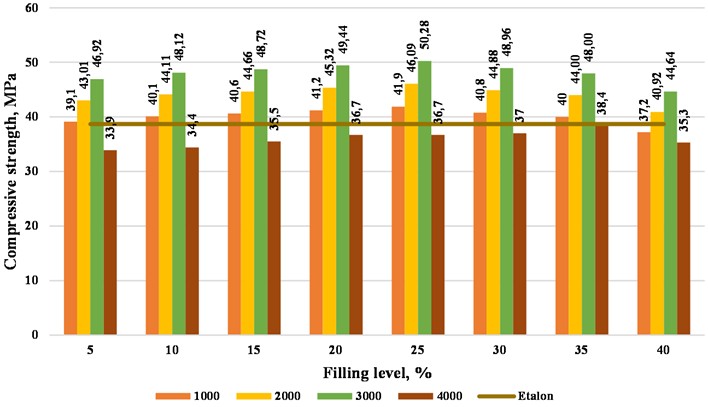
As illustrated in Figs. 3 and 4, there exists a critical ratio between the fineness of grinding and the filler dosage where a distinct synergistic effect emerges. This effect is manifested by enhanced mechanical strength, driven by the densification of the microstructure and a more homogeneous distribution of hydration products. Consequently, the identified parameters provide a robust scientific basis for determining the rational dispersion and optimal dosage of mineral fillers, thereby significantly improving the performance of cement-based systems and advancing vibration-free concreting technologies.
Experimental analysis indicates that the mechanical strength of the cement matrix – under both compressive and flexural loading – exhibits a consistent increase as the degree of micro-filling and the specific surface area of the mineral filler are optimized. The most pronounced enhancement in mechanical properties is observed at a specific surface area () of 3000 cm2/g with a filler concentration of 25 % by weight of the binder. This configuration represents the optimal balance between particle fineness, pozzolanic reactivity, and the volumetric concentration of the filler within the cementitious system [20-23].
Fig. 3Influence of specific surface area and degree of filling of BWS on the flexural strength of fine-grained concrete
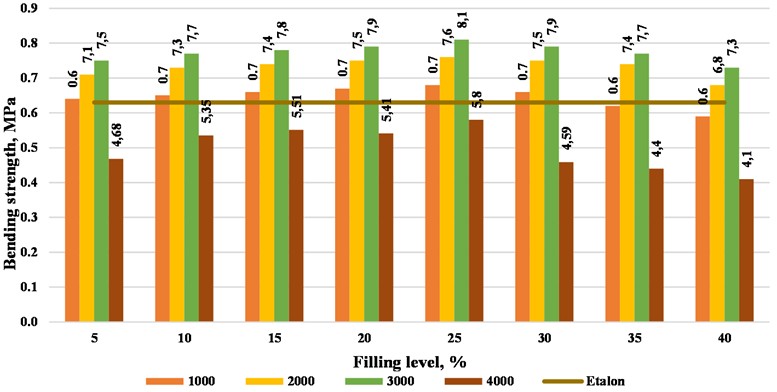
Conversely, exceeding the optimal degree of dispersion or dosage of the mineral component leads to a reduction in the mechanical strength of the cement matrix. This decline can be attributed to two primary factors: first, the reduced proportion of the clinker binder within the system, which restricts the formation of cementitious hydration products; and second, the intensification of particle aggregation in the ultra-dispersed range. The latter disrupts the structural uniformity of the matrix and compromises the integrity of interphase contacts, thereby negatively affecting the overall mechanical performance [24, 25].
Furthermore, excessive dispersion facilitates the formation of heterogeneous agglomerates, which compromise the matrix density and structural homogeneity while simultaneously impeding the effective interaction between the filler and the cementitious hydration phases. Consequently, the identified patterns validate the existence of an optimal micro-filling regime that ensures maximum synergy between system components, thereby optimizing the physical and mechanical performance of the resulting cementitious compositions.
Before setting, cement paste behaves as a coagulation-type dispersed system with thixotropic properties, showing reversible viscosity reduction under mechanical action and recovery at rest. This ensures shape stability in the pre-hardening stage [26-29].
Rheological properties were evaluated using a temperature-controlled rotary viscometer (Couette system). The study used CEM I 32.5N cement, BWS filler, and a polycarboxylate superplasticizer. Samples were prepared by staged water addition, homogenization, and resting. Measurements were conducted at 25±1 °C over a shear rate range of 0.1-200 s⁻1 with load-unload cycles; each test was repeated three times.
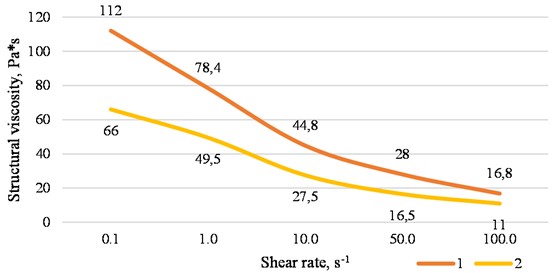
Results show that both control and modified systems exhibit pseudoplastic behavior, with viscosity decreasing as shear rate increases. The modified system (BWS+SP) showed consistently lower viscosity, reduced by about 41 % and 34 %.
Fig. 4Influence of specific surface area and degree of filling of BWS on the compressive strength of fine-grained concrete
This effect is explained by SP adsorption on particle surfaces, creating electrostatic and steric repulsion, preventing flocculation, and enhancing particle mobility. As a result, internal friction decreases, improving workability while maintaining structural density in low water-cement ratio systems.
Fig. 5Structural viscosity of complex modified and unmodified cement pastes
4. Conclusions
Mechanical activation of BWS increases its specific surface area and reduces particle size, with an optimal grinding time of about 30 minutes. Prolonged grinding and storage lead to agglomeration and surface passivation, reducing reactivity.
The optimal micro-filling regime (≈3000 cm2/g and 25 % filler) ensures maximum strength, while deviations decrease performance due to reduced clinker content and agglomeration.
The combined use of BWS and superplasticizer lowers structural viscosity and improves workability by reducing interparticle friction.
Overall, the complex modifier enhances strength and workability, supporting the development of high-performance, low-vibration concrete.
References
-
M. M. Begentayev et al., “The effect of mineral fillers on the rheological and performance properties of self-compacting concretes in the production of reinforced concrete products,” Journal of Composites Science, Vol. 9, No. 5, p. 235, May 2025, https://doi.org/10.3390/jcs9050235
-
A. Abduova, M. Aitugan, B. Baibatyrova, and F. Yunusova, “Creating a green infrastructure and optimizing the city’s territory in order to maintain sustainable development,” Sustainability, Vol. 17, No. 11, p. 5024, 2025, https://doi.org/10.3390/su17115024
-
A. I. Adilkhodzhaev, I. A. Kadirov, D. T. Azimov, and B. S. Kudratov, “Thermodynamic analysis of mineral powder grinding processes,” in AIP Conference Proceedings, Vol. 3045, No. 1, p. 060003, Jan. 2024, https://doi.org/10.1063/5.0197549
-
I. Cavusoglu, “Superplasticizer dosage effect on strength, microstructure and permeability enhancement of cementitious paste fills,” Minerals, Vol. 14, No. 12, p. 1242, Dec. 2024, https://doi.org/10.3390/min14121242
-
T. V. Kuznetsova and S. I. Abbasova, “Application of natural zeolite in the composition of plugging cement,” (in Russian), Technique and Technology of Silicates, Vol. 25, No. 3, 2018.
-
A. Muratov, “Innovative technology of vibration compaction of lightweight concrete mixtures,” in AIP Conference Proceedings, Vol. 2612, No. 1, p. 040018, Jan. 2023, https://doi.org/10.1063/5.0114324
-
J. Rashidov, R. Narov, K. Yusupov, and I. Kadyrov, “Unraveling the effects of compound additives on the strength of cast concrete,” Revista de Gestão Social e Ambiental, Vol. 18, No. 5, p. e05599, Mar. 2024, https://doi.org/10.24857/rgsa.v18n5-076
-
E. Sánchez, J. Bernal, A. Moragues, and N. León, “Rheological and mechanical properties of self-compacting concrete with the addition of nano-silica and microsilica,” Revista ALCONPAT, Vol. 6, No. 1, p. 111, 2021.
-
F. Yunusova and S. Djabbarova, “Fly ash of thermal power plant – micro fill for hydro technical concrete,” IOP Conference Series: Materials Science and Engineering, Vol. 883, No. 1, p. 012216, 2020, https://doi.org/10.1088/1757-899x/883/1/012216
-
D. Dyussembinov et al., “Self-compacting concrete with finely dispersed additives and superplasticizer,” Magazine of Civil Engineering, Vol. 123, No. 7, 2023, https://doi.org/10.34910/mce.123.6
-
O. Muratov, A. Muratov, Q. Yakubov, A. Khalimbetov, B. Bozorov, and F. Khikmatov, “Experimental estimation of the parameters of crack progression in concrete,” E3S Web of Conferences, Vol. 410, p. 02052, Aug. 2023, https://doi.org/10.1051/e3sconf/202341002052
-
D. M. Wang, Z. H. Liu, and W. F. Xiong, “Research on the effect of polycarboxylate superplasticizers on rheology properties of compound cementitious system,” Key Engineering Materials, Vol. 477, pp. 151–156, 2011, https://doi.org/10.4028/www.scientific.net/kem.477.151
-
C. Karakurt and M. Dumangöz, “Rheological and durability properties of self-compacting concrete produced using marble dust and blast furnace slag,” Materials, Vol. 15, No. 5, p. 1795, Feb. 2022, https://doi.org/10.3390/ma15051795
-
A. Adilkhodjaev, I. Kadyrov, B. Kudratov, D. Azimov, and U. Abdullayev, “Effect of binary microfiller on structure formation of cement stone,” in AIP Conference Proceedings, Vol. 3317, No. 1, p. 030033, Jan. 2025, https://doi.org/10.1063/5.0267410
-
H. Dilbas, “Rheology of superabsorbent polymer-modified and basalt fiber-reinforced cement paste with silica fume: Response surface methodology,” Journal of Sustainable Construction Materials and Technologies, Vol. 9, No. 1, pp. 60–71, Mar. 2024, https://doi.org/10.47481/jscmt.1338751
-
S. I. Abbasova. “Improving the efficiency of cement binders using a silica-containing modifier.” Scientific-Technical and Production Journal. http://rifsm.ru/u/fl/itm7829.pdf (accessed 2018).
-
R. B. Singh, N. Kumar, and B. Singh, “Effect of supplementary cementitious materials on rheology of different grades of self-compacting concrete made with recycled aggregates,” Journal of Advanced Concrete Technology, Vol. 15, No. 9, pp. 524–535, 2017, https://doi.org/10.3151/jact.15.524
-
A. Adilkhodjaev, I. Kadyrov, B. Khasanov, M. Radjabov, I. Umarov, and D. Tosheva, “Effect of binary microbrake based on “quartz+carbonate” additions on the properties of cement stone,” in AIP Conference Proceedings, Vol. 3317, No. 1, p. 030028, 2025, https://doi.org/10.1063/5.0267412
-
A. A. Guvalov and S. I. Abbasova, “Effect of complex modifiers on properties of cement systems,” Chemical Problems, Vol. 18, No. 1, pp. 26–32, Jan. 2020, https://doi.org/10.32737/2221-8688-2020-1-26-32
-
A. R. Muratov, F. Yunusova, and T. Muslimov, “Management of initial structuring in connection zones of concrete fillers in hydrotechnical construction,” E3S Web of Conferences, Vol. 401, p. 01019, Jul. 2023, https://doi.org/10.1051/e3sconf/202340101019
-
Y. Alrefaei, Y.-S. Wang, Y. Qian, and J.-G. Dai, “Effects of solid activator and fly ash on rheology and thixotropy of one-part alkali-activated pastes,” Journal of Advanced Concrete Technology, Vol. 20, No. 3, pp. 139–151, Mar. 2022, https://doi.org/10.3151/jact.20.139
-
U. Turgunbayev, D. Sharipova, N. Rakhimova, and F. Yunusova, “Development of technology for obtaining polymer cement glue (PCG) with use of chemical additives and industrial waste,” E3S Web of Conferences, Vol. 401, p. 05008, Jul. 2023, https://doi.org/10.1051/e3sconf/202340105008
-
J. A. Sainz-Aja et al., “Determination of the optimum amount of superplasticizer additive for self-compacting concrete,” Applied Sciences, Vol. 10, No. 9, p. 3096, Apr. 2020, https://doi.org/10.3390/app10093096
-
V. V. Yadykina, A. M. Gridchin, and A. Trautvain, “Research of the interaction of mechanically activated fillers based on silica and cement paste,” Key Engineering Materials, Vol. 722, pp. 121–125, Dec. 2016, https://doi.org/10.4028/www.scientific.net/kem.722.121
-
S. Djabbarova, F. Yunusova, U. Masharifo, and N. Bobojanova, “Impact of discharge structure carrying capacity on the velocity of water reservoir drawdown,” IOP Conference Series: Materials Science and Engineering, Vol. 869, No. 7, p. 072036, Jun. 2020, https://doi.org/10.1088/1757-899x/869/7/072036
-
A. Adilkhodjaev, S. Shaumarov, K. Umarov, and I. Kadyrov, “Some peculiarities of the process of preparing the zeolites containing breeds in a ball mill,” International Journal of Recent Technology and Engineering (IJRTE), Vol. 8, No. 4, pp. 7695–7698, 2019, https://doi.org/10.35940/ijrte.d5367.118419
-
A. Adilkhodzhaev, I. Makhamataliev, I. Kadyrov, S. Shaumarov, and F. Ruzmetov, “To the question of the influence of the intensity of active centers on the surface of mineral fillers on the properties of fine-grained concrete,” International Journal of Innovative Technology and Exploring Engineering, Vol. 8, No. 9S2, pp. 219–222, Aug. 2019, https://doi.org/10.35940/ijitee.i1044.0789s219
-
V. G. Batrakov, Modified concretes. (in Russian), Moscow, Russia: Stroyizdat, 1998.
-
L. I. Dvorkin and O. L. Dvorkin, Fundamentals of concrete science. (in Russian), St. Petersburg, Russia: Stroybeton, 2006.
-
Y. M. Bazhenov, “High-quality fine-grained concrete,” (in Russian), Construction Materials, No. 2, pp. 15–16, 2000.
-
P. A. Rebinder, Physico-Chemical Mechanics of Disperse Systems. (in Russian), Moscow, Russia: Nauka, 1966.
-
N. B. Uryev, Physico-Chemical Fundamentals of Technology of Disperse Systems and Materials. (in Russian), Moscow, Russia: Khimiya, 1988.
-
V. I. Solomatov and V. D. Kuzmenko, “Influence of the method of introducing C-3 on the strength and rheological characteristics of filled binder,” (in Russian), in Seminar on Resource Saving in the Production of Building Materials, pp. 18–21, 1990.
-
A. I. Adilkhodjaev, K. S. Umarov, and I. A. Kadirov, “Some features of rheological properties of cement pasts with zeolite-containing fillers,” in International Congress on Modern Education and Integration, Vol. 5, Oct. 2020.
About this article

The authors have not disclosed any funding.
The datasets generated during and/or analyzed during the current study are available from the corresponding author on reasonable request.
The authors declare that they have no conflict of interest.

