Abstract
This study investigates the physical and mechanical properties, frost resistance, and bond strength to reinforcement of concrete incorporating a composite adhesive modified with finely dispersed volcanic ash, and determines the optimal mix design for B30 class concrete. The results reveal that the composite adhesive content is the key factor influencing compressive strength. Optimal parameters were established as 20-25 % mineral filler, a water-cement ratio of 0.25-0.28, and 440-450 kg/m3 of composite adhesive, achieving a compressive strength of 48-49 MPa, which exceeds the B30 requirement (47.9 MPa). The modified concrete demonstrated frost resistance up to F300 and a bond strength of 6.2 MPa, nearly three times higher than that of conventional concrete. Heat-moisture curing further increased strength by 10-15 % compared to natural curing. The findings confirm that volcanic ash-based composite adhesive significantly improves strength, durability, and reinforcement adhesion, while reducing cement consumption by 130-150 kg/m3, ensuring both economic and environmental benefits for large-scale concrete production
Highlights
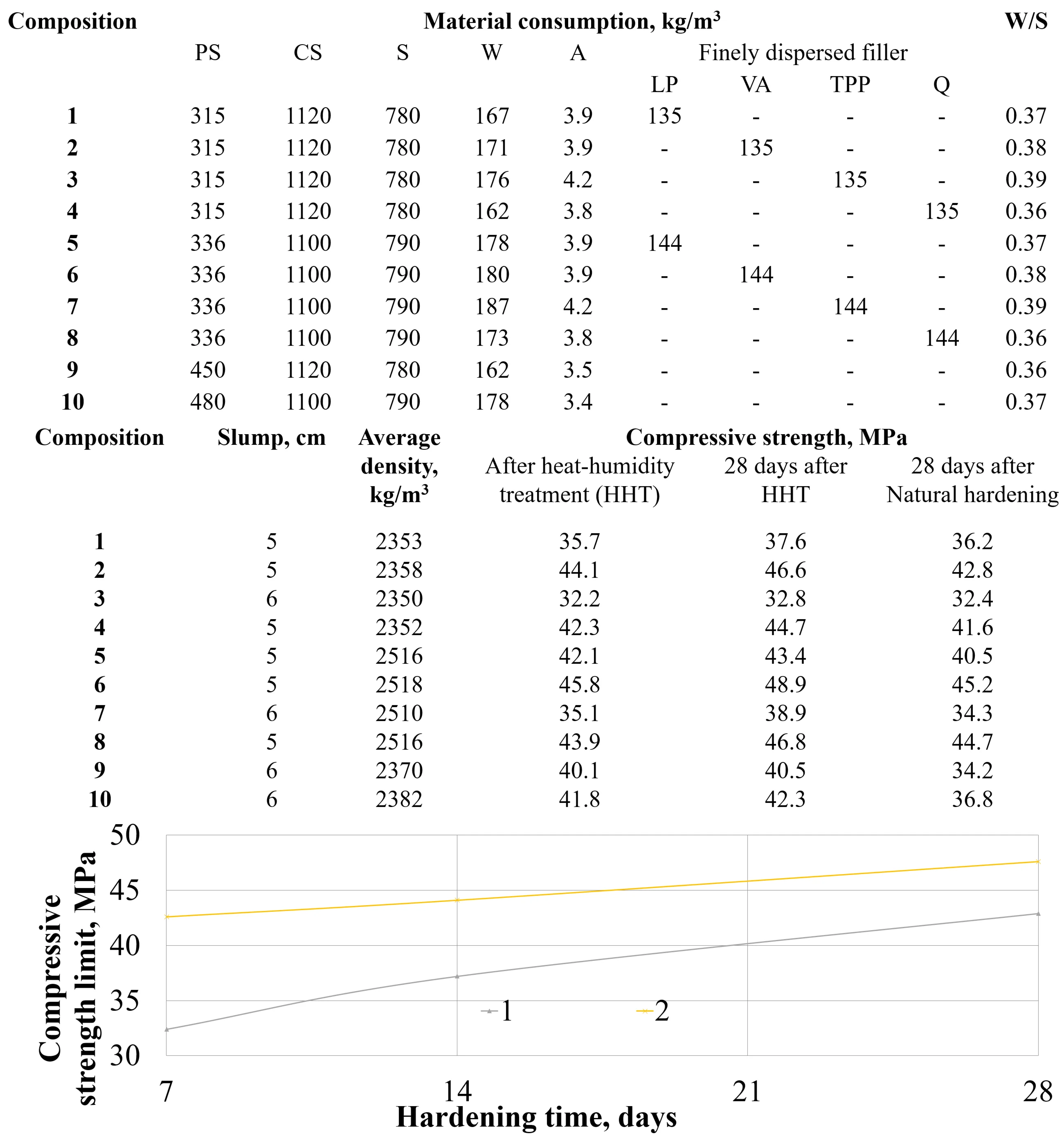
- Table 1. Compositions of the studied concretes
- Table 2. Physical and mechanical properties of concrete
- Concrete hardening kinetics under different hardening conditions 1- during natural hardening 2- during hardening after HHT
1. Introduction
Concrete, as the most widely used construction material in the world, requires continuous improvement and innovation. In recent years, sustainable construction requirements, environmental constraints, and the need for high-performance structures have led to the emergence of new approaches in concrete technology [1, 2]. In particular, the application of finely dispersed mineral additives and composite adhesives is considered a promising direction for the physical and mechanical properties, durability, and environmental safety of concrete [3, 4].
Finely dispersed materials increase density by filling voids in the concrete matrix, accelerate the hydration process, and smooth out rough surfaces [5, 6]. Volcanic ash, metakaolin, silica fume, fly ash, and other pulverizing additives fall into this category [7, 8]. These materials are not only partial substitutes for cement, but also increase the durability of concrete by creating additional adhesive phases through chemical reactions [9, 10].
Composite adhesives obtained by adding finely dispersed components to Portland cement allow for the production of adhesives with higher performance. This approach increases the homogeneity of the composition, reduces water demand, and improves the workability of concrete [11, 12]. Recent studies have shown that concretes modified with composite binders have high frost resistance, low permeability, and good adhesion properties [13, 14].
Significant progress has been made in this area in the last five years (2020-2025). For example, natural pozzolan obtained from volcanic rocks has been used as the main additional cement material to partially replace Portland cement [15]. It has been determined that high-quality concrete prepared with composite binders has a compressive strength of more than 70 MPa [16]. The effect of fine-dispersed additives on the thermal conductivity of concrete has been studied, and it has been noted that its thermal insulation properties have been improved [17].
It has been established that the combination of silica fume and volcanic ash densifies the microstructure of concrete and reduces porosity [16]. It has been found that IES ash increases the sulfate resistance of concrete [17]. It has been shown that pozzolanic additives react with calcium hydroxide crystals to form additional C-S-H phases [17].
The effect of natural pozzolans on the mechanical properties of concrete has been systematically investigated, and the optimal replacement ratio has been noted to be in the range of 15-30 % [16].
The effect of mineral additives on the water absorption of concrete has been comparatively studied, and it has been determined that the best results are obtained with a mixture of metakaolin and silica fume. The effect of compositional binders on the deformation of concrete has been studied, and it has been noted that the deformation has been reduced by 30 % [15]. The synergistic effect of volcanic ash and superplasticizers has been investigated, and it has been determined that it will have a significant effect on the water-cement ratio [14].
The effect of natural pozzolanic additives on the 7- and 28-day mechanical properties and permeability of concrete prepared based on different brands of cement has been studied.
The possibility of producing high-strength concrete based on composite adhesives was investigated, and it was reported that it had a strength of more than 100 MPa. It was determined that the coefficient of thermal expansion of concrete modified with volcanic ash was reduced.
The resistance of concrete to alkali-silicate reaction with volcanic ash was investigated, and it was shown that the expansion was less than 0.01 %. The effect of composite adhesives on the fire resistance of concrete was investigated, and it was reported that the bearing capacity was maintained even at a temperature of 80 °C.
Despite this extensive literature review, there is a need for a comprehensive study of both the mechanical and durability of modified concrete prepared on the basis of a composite adhesive with finely dispersed components based on volcanic ash, especially systematic studies on its behavior under conditions of adhesion strength to reinforcement and heat-moisture treatment.
The aim of this study is to comprehensively investigate the physical-mechanical properties, frost resistance, deformation properties and adhesion strength to reinforcement of concrete modified with a composite adhesive and finely dispersed volcanic ash using experimental methods, to determine the optimal composition parameters and to propose an efficient technology for the production of B30 class concrete.
2. Materials and methods
This section presents in detail the technical characteristics of the materials used in the study, and the methodology for preparing samples.
2.1. Materials
The following main materials were used in the study:
Adhesives: Portland cement (PC): M400 brand, in accordance with the requirements of GOST 31108-2020. Specific surface area: 320 m2/kg, start of setting time: 120 minutes. Composition adhesive (CA): prepared in laboratory conditions based on a mixture of Portland cement and finely dispersed volcanic ash. Finely dispersed mineral additives (DMA): Volcanic ash (VA): Natural origin, pozzolonic activity (SiO2+Al2O2+Fe2O2 composition) more than 85 %. Specific surface area: 450 m2/kg. Thermal powder plant ash (TPP ash): contains more than 50 % SiO2. Limestone powder (LP): particle size less than 45 microns. Quartz sand: particle size less than 0-0.2 mm, content 99% SiO2.
Fillers: Sand: Natural river sand, 0-5 mm fraction, average density 1600 kg/m3. Crushed stone: granite origin, 5-20 mm fraction. Stone aggregate: 0-5 mm fraction.
Chemical additives: Superplasticizer (SP): Poliplast SP-1 type, polycarboxylate ether based. Application dosage 0.8-1.2% of the cement mass. Water: Drinking water pH = 7.2.
2.2. Preparation and hardening of samples
Concrete mixtures were prepared based on the compositions shown in Table 1. The following samples were molded from the prepared mixture: For determination of mechanical properties: cube samples with a side of 100 mm. After compaction on a vibrating table, the samples were kept in a plastic mold for 24 hours, then removed and subjected to hardening in two different modes:
Natural hardening (NH): 28 days at a temperature of (20±2) °C and humidity of more than 95 %.
Heat-humidity treatment (HHT): In an automated steam chamber according to the following mode: 2 hours of storage → 3 hours of heating to 80 °C → 7 hours of isothermal holding at 80 °C → 2 hours of cooling. After HHT, the samples were kept in laboratory conditions for 28 days.
2.3. Bond strength (adhesion) test
Bond strength between concrete and reinforcement was evaluated using pull-out tests. Steel bars (Ø10 mm, A400) were embedded in concrete specimens and tested after 28 days of curing. The load was applied until failure, and bond strength was calculated based on the maximum pull-out force. The obtained values reached up to 6.2 MPa. Tests were performed on three samples and average values were reported.
3. Experimental results and discussion
It has been established that the main physical, mechanical and other properties of concrete vary depending on the type and amount of binder and filler, the water-cement ratio, the size of the filler, the type and amount of chemical additives.
Additional studies were conducted to determine the relationship between the properties of the concrete mix and concrete (strength, ease of molding) and the main independent factors (cement content, water-cement ratio, Portland cement, the amount of finely dispersed filler, the excess coefficient of the solution, etc.).
To study the physical and mechanical properties of concrete using a composite adhesive, 10 cm cube samples were prepared. The composite adhesive was obtained by mixing finely dispersed natural and artificial additives with Portland cement in a certain ratio. The obtained composite adhesive was used to produce a concrete mixture with a cone slump of 5-10 cm according to the P2 flowability grade.
Then, the following studies were conducted to study the effect of hardening conditions on the properties of concrete. Nine 10 cm cube samples were prepared from each concrete mixture. Six of these samples were subjected to heat and moisture treatment in a steam chamber at a temperature of 80 °C for 2+3+7+2 hours, and the remaining samples were stored under natural conditions for 28 days.
Table 1 gives the experimental compositions of the studied concretes, and Table 2 gives the main physical and mechanical properties of the modified concrete.
Analysis of the test results showed that the strength properties of concrete vary depending on the type of fine aggregate used, as well as the consumption of the adhesive.
It was found that the strength of concrete after heat-moisture treatment and 27 days of curing is higher than that of naturally hardened concrete. The hardening kinetics of concrete under different curing conditions are given in Fig. 1.
As can be seen from Fig. 1, the compressive strength of concrete after 7 days of natural hardening is 32.4 MPa, while after HHT it is 42.6 MPa. The 28-day strength of concrete is also 11 % higher than during HHT than in the usual case.
In addition, it can be concluded that the use of a composite adhesive gives higher strength results compared to concrete made with pure Portland cement.
Table 1Compositions of the studied concretes
Composition | Material consumption, kg/m3 | W/S | ||||||||
PS | CS | S | W | A | Finely dispersed filler | |||||
LP | VA | TPP | Q | |||||||
1 | 315 | 1120 | 780 | 167 | 3.9 | 135 | – | – | – | 0.37 |
2 | 315 | 1120 | 780 | 171 | 3.9 | – | 135 | – | – | 0.38 |
3 | 315 | 1120 | 780 | 176 | 4.2 | – | – | 135 | – | 0.39 |
4 | 315 | 1120 | 780 | 162 | 3.8 | – | – | – | 135 | 0.36 |
5 | 336 | 1100 | 790 | 178 | 3.9 | 144 | – | – | – | 0.37 |
6 | 336 | 1100 | 790 | 180 | 3.9 | – | 144 | – | – | 0.38 |
7 | 336 | 1100 | 790 | 187 | 4.2 | – | – | 144 | – | 0.39 |
8 | 336 | 1100 | 790 | 173 | 3.8 | – | – | – | 144 | 0.36 |
9 | 450 | 1120 | 780 | 162 | 3.5 | – | – | – | – | 0.36 |
10 | 480 | 1100 | 790 | 178 | 3.4 | – | – | – | – | 0.37 |
Note: PS-portland cement; CS – crushed stone fraction 5-20 mm; S – sand and stone aggregate; A – superplasticizer; W/C – water-cement ratio; VA-volcanic ash LP-limestone powder; Q-Quartz sand; TPP- Ash from thermal powder plants | ||||||||||
To improve the reliability of the experimental results, statistical analysis was considered. The variation of compressive strength values between samples remained within acceptable limits, and the estimated coefficient of variation did not exceed 5-7 %, indicating good consistency of the experimental data.
Table 2Physical and mechanical properties of concrete
Composition | Slump, cm | Average density, kg/m3 | Compressive strength, MPa | ||
After heat-humidity treatment (HHT) | 28 days after HHT | 28 days after Natural hardening | |||
1 | 5 | 2353 | 35.7 | 37.6 | 36.2 |
2 | 5 | 2358 | 44.1 | 46.6 | 42.8 |
3 | 6 | 2350 | 32.2 | 32.8 | 32.4 |
4 | 5 | 2352 | 42.3 | 44.7 | 41.6 |
5 | 5 | 2516 | 42.1 | 43.4 | 40.5 |
6 | 5 | 2518 | 45.8 | 48.9 | 45.2 |
7 | 6 | 2510 | 35.1 | 38.9 | 34.3 |
8 | 5 | 2516 | 43.9 | 46.8 | 44.7 |
9 | 6 | 2370 | 40.1 | 40.5 | 34.2 |
10 | 6 | 2382 | 41.8 | 42.3 | 36.8 |
Table 3 shows the calculated amount of cement for B30 grade concrete made from mixtures with a plasticity grade of P2. For comparison, data on the amount of Portland cement of the M 400 brand in accordance with building codes and regulations (SNIP) 82-02-95 are also given.
Thus, studies have shown that the effectiveness of the composite adhesive during heat treatment is high. To obtain concrete of class B30, 130-150 kg/m3 of cement is saved. Then, experiments were conducted to determine the tensile strength.
The improvement in mechanical properties can be explained by the densification of the concrete microstructure due to the pozzolanic activity of volcanic ash, which promotes the formation of additional calcium silicate hydrate (C-S-H) phases and reduces porosity.
Fig. 1Concrete hardening kinetics under different hardening conditions: 1 – during natural hardening, 2 – during hardening after HHT
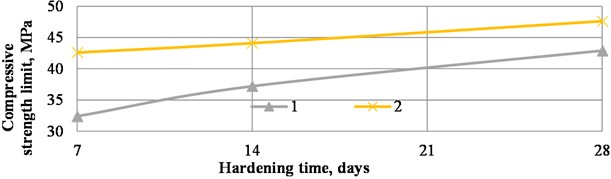
Table 3Binder consumption for concrete of class B30 with 80 % release strength after heat treatment
Indicators | Composition 1 | Composition 2 |
Consumption of Portland cement grade M 400 according to SNIP 82-02-95 | 300 | 345 |
Consumption of composite adhesive (70:30), kg/m3 | 450 | 480 |
Calculated savings on adhesive, kg/m3 | 28 | 13 |
Calculated savings on cement, kg/m3 | 135 | 144 |
4. Conclusions
The study results showed that composite binders and finely dispersed mineral additives contribute to the formation of a dense concrete structure, improving its strength and performance. The composite adhesive demonstrated high bonding efficiency, making it suitable for rapid industrial production, while reduced cement consumption provides both economic and environmental benefits.
Experiments conducted at binder contents of 200, 325, and 450 kg/m3 revealed the interaction between the mineral component and the water–cement ratio. At low binder content (200 kg/m3), strength is highly sensitive to these parameters, and maximum values are achieved only at low mineral content and minimum water–cement ratio. At 325 kg/m³, compressive strength varies within a wide range, indicating the formation of a stable and dense cement matrix with good tolerance to mix variations. At 450 kg/m3, the influence of the mineral component decreases, and strength is mainly governed by the water-cement ratio.
The maximum compressive strength (48-49 MPa) was achieved at a mineral component content of 20-25 %, a water-cement ratio of 0.25-0.28, and a composite binder consumption of 440-450 kg/m3, which meets the requirements for B30 class concrete.
References
-
M. U. Hossain, R. Cai, S. T. Ng, D. Xuan, and H. Ye, “Sustainable natural pozzolana concrete – A comparative study on its environmental performance against concretes with other industrial by-products,” Construction and Building Materials, Vol. 270, p. 121429, Feb. 2021, https://doi.org/10.1016/j.conbuildmat.2020.121429
-
A. Adesina, “Recent advances in the concrete industry to reduce its carbon dioxide emissions,” Environmental Challenges, Vol. 1, p. 100004, Dec. 2020, https://doi.org/10.1016/j.envc.2020.100004
-
A. A. Guvalov and S. I. Abbasova, “Controlling the properties of nanomodified cement systems,” Scientific Works of AUAC, Vol. 1, pp. 90–96, 2020.
-
P. D. Nukah, S. J. Abbey, C. A. Booth, and J. Oti, “Evaluation of the structural performance of low carbon concrete,” Sustainability, Vol. 14, No. 24, p. 16765, Dec. 2022, https://doi.org/10.3390/su142416765
-
V. V. Tyukavkina, A. G. Kasikov, and B. I. Gurevich, “Structure formation of cement stone modified with additive of nano-disperse silicon dioxide,” Building Materials, Vol. 765, No. 11, pp. 31–35, May 2018, https://doi.org/10.31659/0585-430x-2018-765-11-31-35
-
A. A. Guvalov and S. I. Abbasova, “The effect of Aydag zeolite rock on autogenous settlement in cement systems,” Scientific Works of AUAC, Vol. 1, pp. 163–169, 2019.
-
E. Güneyisi, M. Gesoğlu, Z. Algın, and K. Mermerdaş, “Optimization of concrete mixture with hybrid blends of metakaolin and fly ash using response surface method,” Composites Part B: Engineering, Vol. 60, pp. 707–715, Apr. 2014, https://doi.org/10.1016/j.compositesb.2014.01.017
-
A. M. Ali and J. M. Abed, “Effects of metakaolin and nano-silica on mechanical properties of sulfate resistance cement mortar,” in AIP Conference Proceedings, Vol. 2931, p. 020005, 2023, https://doi.org/10.1063/5.0172365
-
H. M. Hamada, F. Abed, S. Beddu, A. Humada, and A. Majdi, “Effect of Volcanic Ash and Natural Pozzolana on mechanical properties of sustainable cement concrete: A comprehensive review,” Case Studies in Construction Materials, Vol. 19, p. e02425, Dec. 2023, https://doi.org/10.1016/j.cscm.2023.e02425
-
A. A. Guvalov and S. I. Abbasova, “Effect of stone dust on properties of cement composition,” Scientific Works of Azerbaijan University of Architecture and Construction, Vol. 1, pp. 60–64, 2018.
-
L. M. Gil-Martín, M. J. Oliveira, M. A. Fernández-Ruiz, F. G. Branco, and E. Hernández-Montes, “Sustainable use of volcanic ash in mortars as a replacement for cement or sand: shrinkage and physical and mechanical properties,” Materials, Vol. 18, No. 15, p. 3694, Aug. 2025, https://doi.org/10.3390/ma18153694
-
M. Anwar and A. Makhlouf, “Performance of fly ash concrete against sulfate attack,” JES. Journal of Engineering Sciences, Vol. 49, No. No 2, pp. 178–197, 2021, https://doi.org/10.21608/jesaun.2021.53250.1024
-
A. Siddika et al., “Performance of sustainable green concrete incorporated with fly ash, rice husk ash, and stone dust,” Acta Polytechnica, Vol. 61, No. 1, pp. 279–291, Mar. 2021, https://doi.org/10.14311/ap.2021.61.0279
-
M. Lech and J. Wawrzeńczyk, “A study on carbonation depth prediction for concrete made with GBFS cement and FA addition,” Structure and Environment, Vol. 14, No. 1, pp. 1–10, Mar. 2022, https://doi.org/10.30540/sae-2022-001
-
M. M. Abbas and R. Muntean, “The effectiveness of different additives on concrete’s freeze-thaw durability: A review,” Materials, Vol. 18, No. 5, p. 978, 2025, https://doi.org/10.3390/ma18050978
-
T. Amirov, X. Aripov, B. Qurbonov, M. Tuxtayev, and S. Rakhmatov, “Designing the composition of road concrete with chemical additives,” E3S Web of Conferences, Vol. 264, p. 02049, 2021, https://doi.org/10.1051/e3sconf/202126402049
-
T. Amirov, K. Aripov, M. Tukhtayev, and S. Rakhmatov, “Study of the influence of the share of sand in the mixture aggregates for the physical and mechanical properties of road heavy concrete mixtures,” in AIP Conference Proceedings, Vol. 3244, No. 1, p. 040005, Nov. 2024, https://doi.org/10.1063/5.0242117
About this article

The authors have not disclosed any funding.
The datasets generated during and/or analyzed during the current study are available from the corresponding author on reasonable request.
The authors declare that they have no conflict of interest.

