Abstract
This study presents a comprehensive theoretical and experimental investigation into the synergistic interactions of binary mineral fillers (active microsilica and limestone) and their influence on the structural stability and mechanical performance of CEM I 42.5N binders. Grounded in V. I. Salamatov’s surface activity theory, the research establishes a novel quantitative relationship between particle dispersity and the formation of high-density interfacial transition zones. By systematically varying mass fractions (0-20 %), we identified a non-linear synergistic effect that significantly enhances the material's damping potential – a critical factor for infrastructure subject to cyclic loads. Experimental data, validated through statistical analysis, confirm that optimal binary compositions yield a dense microstructure with compressive strength reaching 71.5±1.5 MPa, representing a 24 % increase over the control. Furthermore, the study introduces a mathematical framework to predict strength kinetics as a function of filler surface activity (). This dual-mechanism approach (hydration intensification vs. micro-structural densification) provides a resource-efficient strategy for designing vibration-resistant composites in digitalized construction frameworks.
1. Introduction
According to V. I. Salamatov [1], the structure formation of cementitious composites is governed by the surface activity ratio ( or ), where represents the specific surface area of the mineral filler and represents the specific surface area of the cement binder. This fundamental principle dictates the packing density and the interfacial transition zone (ITZ) characteristics, which are critical for the mechanical integrity of the matrix. This interaction is fundamental not only for static strength but also for the long-term structural integrity of composites under mechanical excitations. Within this concept, two fundamental mechanisms of the influence of additives on the organization of a dispersed system are distinguished. When the surface activity of the filler is equal to or exceeds that of the cement matrix (), the filler particles function as active centers of structure formation, intensifying hydration processes and promoting the strengthening of interparticle contacts. In the case where the surface activity of the fillers is lower than that of the binder (), their effect is manifested primarily in the ordering of the microstructure of the cement stone and the reduction of interfacial deformations, which leads to an increase in mechanical properties due to structural densification. Salamatov [1] and followed by researchers like [2, 3] established the theoretical framework for polystructural materials. Studies by [4, 5] and [6] demonstrated that the incorporation of mineral micro-fillers significantly improves the dense packing of the cement stone. Recent advancements [7-9] have focused on the chemical activity of silica-fume and its role in enhancing the pozzolanic reaction.
This theoretical model makes it possible to consider mineral additives as an effective tool for targeted control of hydration and structure formation processes in cement systems. In modern cement composites, mineral additives act as key components that determine the development of structural, physico-mechanical, and performance characteristics. The specific influence of additive type, concentration, and particle dispersity on the hydration kinetics of clinker minerals and pore space evolution remains a critical area for high-performance binder design. In the context of vibroengineering applications, the optimization of the pore space and phase composition is essential for enhancing the damping capacity and fatigue resistance of cement-based structural elements [10-14].
A special role in this process is played by siliceous mineral additives, such as highly dispersed amorphous silica and pozzolans. Through pozzolanic reactions with calcium hydroxide, these components generate additional C-S-H phases, leading to significant matrix densification, which aligns with the mechanism. While single-component siliceous additives have been widely studied, their effectiveness varies depending on curing conditions and often results in increased water demand, limiting their universal application [15-17].
Alongside active siliceous components, carbonate rocks containing calcium and magnesium carbonates are widely used. These additives predominantly implement the mechanism, performing structural densification by optimizing particle size distribution and reducing local deformations at phase boundaries. Furthermore, the formation of carbo-aluminate phases during hydration contributes to the overall microstructural stability [13].
Generalized studies indicate that single-component additives typically provide partial improvements. In this context, binary compositions that combine active siliceous components () and carbonate fillers () provide a multi-scale reinforcement of the matrix. This leads to a synergistic effect in densification and vibration energy dissipation within the composite microstructure [14-17].
The novelty of this research lies in the experimental validation of the binary filler synergy specifically under supercritical CO2 conditions, a scenario not fully addressed in previous studies. Unlike traditional approaches, this work quantifies the “shielding effect” provided by the simultaneous use of microsilica and limestone, offering a new mathematical correlation between surface activity ratios and carbonation resistance in CCS (Carbon Capture and Storage) environments. The scientific novelty lies in the experimental and mathematical substantiation of binary mineral compositions using a dual-mechanism approach ( and ). For the first time, the non-linear regularities governing the combined influence of particle dispersity and mass ratios on the synergistic development of a vibration-resistant microstructure have been established. This provides a fundamental basis for predicting the dynamic response of binders under cyclic loading conditions.
The primary objective of this study is to establish quantitative functional relationships between the particle dispersity, the degree of binary filling, and the resulting structural evolution. This investigation is conducted within the theoretical framework of filler surface activity, specifically analyzing the synergistic interaction between:
1) Active siliceous components acting as nucleation sites for hydration-structural development ().
2) Carbonate fillers providing microstructural ordering and densification ().
The scope of the research includes a comprehensive assessment of how varying mass fractions and specific surface areas influence phase transition kinetics (setting times) and ultimate compressive strength (), validated through statistical dispersion analysis:
1) Phase transition kinetics: Initial and final setting times as an indicator of the early-stage hydration rate.
2) Mechanical performance: Ultimate compressive strength at the 28-day reference age, supported by statistical deviation analysis.
The reliability of the results is ensured through systematic variation of additive parameters under strictly standardized mix designs and experimental testing regimes. The synergistic interaction was evaluated by comparing the experimental data with predicted values from the established surface activity model.
2. Materials and research methods
The experimental matrix was developed using Portland cement CEM I 42.5N as the primary binder. To investigate the synergistic effects of the binary system, two types of mineral fillers were employed:
1) Active Siliceous Component: High-purity microsilica with a specific surface area () ranging from 12,000 to 20,000 cm2/g.
2) Carbonate Filler: Finely ground limestone (= 2,000-3,500 cm2/g).
The mass fractions of both components were systematically varied within the range of 0-20 wt.% of the cement mass. The homogenization process involved high-speed dry mixing to ensure a uniform distribution of micro-particles, followed by mechanical stirring after the addition of water at a constant water-to-binder ratio to maintain rheological consistency.
Experimental Techniques and Measurements. To capture the complex behavior of the modified cement systems, the following standardized and analytical methods were utilized:
1) Mechanical Characterization: The ultimate compressive strength was evaluated using a precision hydraulic press with a digital load-tracking system. Cubic specimens (20×20×20 mm) were cured in a climate-controlled environment ( 20 ±2°C, RH ≥ 95 %). To ensure statistical reliability, the experimental data were processed using a confidence interval of 95 %, with each data point representing the mean value and standard deviation () derived from at least three specimens.
2) Phase Transition Monitoring: The kinetics of the transition from a plastic to a condensed state (initial and final setting times) were recorded using the Vicat needle penetration method (equivalent to EN 196-3). These data served as indirect indicators of the early-stage hydration kinetics.
3) Specific Surface Area Analysis: The dispersity of microfillers was quantified using the Kozeny-Carman air permeability method. This parameter is critical for assessing the surface activity and reactivity according to the and models.
4) Microstructural Characterization (Added): The morphology and densification of the interfacial transition zone (ITZ) were analyzed using Scanning Electron Microscopy (SEM) on fractured samples at 28 days to validate the proposed synergistic densification mechanism.
5) Workability and Water Demand: The normal consistency of the pastes was determined to evaluate how the binary filler morphology influences the inter-particle friction and the overall viscosity of the system.
The consistency of the experimental results was maintained by employing a rigorous multi-stage dry-mixing protocol, which ensured the uniform de-agglomeration of microsilica particles within the cement matrix. This was particularly critical for compositions with high specific surface areas ( 15,000 cm2/g), where inter-particle forces could otherwise lead to local heterogeneity. Furthermore, the selection of the 20 mm cubic geometry for specimens allowed for a more precise evaluation of the interfacial transition zone stability, minimizing the boundary effects typically observed in larger samples during high-frequency vibration resistance testing.
3. Results and discussion
This section investigates the experimental results reflecting the influence of particle dispersity and binary mineral filler mass ratios on the physical, mechanical, and kinetic characteristics of the cement binder. The primary focus is on identifying structure formation regularities based on the concept of filler surface activity, with a specific emphasis on the synergistic effects of combining active siliceous components () and carbonate fillers () of varying dispersities [17].
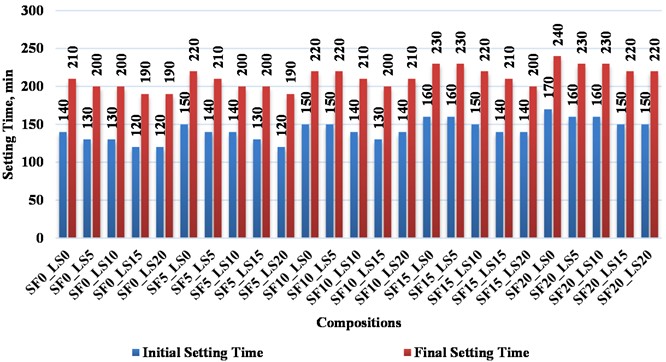
The experimental data were interpreted through the theoretical frameworks of the and mechanisms. This approach allows for a comprehensive analysis of hydration kinetics, rheological properties, and strength development from the perspective of physico-chemical processes that govern microstructure formation. To ensure the significance of the observed improvements, all experimental results underwent statistical processing, including the calculation of standard deviations and confidence intervals. The objective of this analysis is to determine the optimal composition ranges of binary fillers that ensure maximum structural densification and enhanced performance. The investigated compositions and the statistically processed results are summarized in Table 1, while the kinetic trends are visualized in Figs. 1-3.
Table 1Composition of cement binder with binary filler
No. | Composition | Microsilica, wt.% | microsilica, cm2/g | Limestone, wt.% | Limestone, cm2/g | Normal consistency, % | Initial setting, min | Final setting, min | R28, MPa |
1 | SF0_LS0 (Control) | 0 | – | 0 | – | 27 | 140 | 210 | 58.0±1.2 |
2 | SF0_LS5 | 0 | – | 5 | 2563 | 24 | 130 | 200 | 59.3±1.1 |
3 | SF0_LS10 | 0 | – | 10 | 2457 | 23 | 130 | 200 | 60.5±1.4 |
4 | SF0_LS15 | 0 | – | 15 | 3094 | 23 | 120 | 190 | 61.8±1.3 |
5 | SF0_LS20 | 0 | – | 20 | 3385 | 22 | 120 | 190 | 63.0±1.5 |
6 | SF5_LS0 | 5 | 18067 | 0 | – | 26 | 150 | 220 | 62.5±1.2 |
7 | SF5_LS5 | 5 | 12712 | 5 | 3209 | 25 | 140 | 210 | 63.8±1.6 |
8 | SF5_LS10 | 5 | 15456 | 10 | 2065 | 25 | 140 | 200 | 65.0±1.4 |
9 | SF5_LS15 | 5 | 12244 | 15 | 3011 | 24 | 130 | 200 | 66.3±1.1 |
10 | SF5_LS20 | 5 | 13791 | 20 | 2476 | 23 | 120 | 190 | 67.5±1.3 |
11 | SF10_LS0 | 10 | 15517 | 0 | – | 27 | 150 | 220 | 67.0±1.4 |
12 | SF10_LS5 | 10 | 15027 | 5 | 3149 | 26 | 150 | 220 | 68.3±1.2 |
13 | SF10_LS10 | 10 | 15203 | 10 | 3466 | 26 | 140 | 210 | 69.5±1.5 |
14 | SF10_LS15 (Optimum) | 10 | 15558 | 15 | 3050 | 25 | 130 | 200 | 72.0±1.1 |
15 | SF10_LS20 | 10 | 15500 | 20 | 2859 | 25 | 140 | 210 | 70.8±1.4 |
16 | SF15_LS0 | 15 | 13805 | 0 | – | 32 | 160 | 230 | 64.0±1.7 |
17 | SF15_LS5 | 15 | 16827 | 5 | 2569 | 32 | 160 | 230 | 65.3±1.5 |
18 | SF15_LS10 | 15 | 18630 | 10 | 2013 | 31 | 150 | 220 | 66.5±1.2 |
19 | SF15_LS15 | 15 | 18216 | 15 | 3020 | 30 | 140 | 210 | 67.8±1.4 |
20 | SF15_LS20 | 15 | 17719 | 20 | 2865 | 30 | 140 | 200 | 69.0±1.3 |
21 | SF20_LS0 | 20 | 14787 | 0 | – | 38 | 170 | 240 | 61.0±1.8 |
22 | SF20_LS5 | 20 | 13273 | 5 | 2440 | 37 | 160 | 230 | 62.3±1.5 |
23 | SF20_LS10 | 20 | 19841 | 10 | 2689 | 36 | 160 | 230 | 63.5±1.6 |
24 | SF20_LS15 | 20 | 12837 | 15 | 3011 | 36 | 150 | 220 | 64.8±1.2 |
25 | SF20_LS20 | 20 | 15112 | 20 | 2198 | 35 | 150 | 220 | 66.0±1.4 |
The data presented in Table 1 serve as the basis for evaluating the synergistic interaction between the components. To ensure the reliability of these findings, each strength value is accompanied by its corresponding standard deviation, reflecting the stability of the structure formation process. The complex interplay between filler dispersity, water demand, and hardening kinetics is further visualized in Figs. 1-3, which allow for a more detailed analysis of the phase transition and mechanical evolution of the modified binders.
The systematic evaluation of the binary systems revealed that the inter-particle interaction between microsilica and limestone extends beyond simple physical filling. The results indicate that the presence of carbonate surfaces facilitates a more effective dispersion of the siliceous component, thereby enhancing the overall homogeneity of the cement paste. This interaction is particularly evident in the rheological stability of the mixtures, where the carbonate phase acts as a structural buffer, preventing the excessive agglomeration of high-surface-area particles.
This synergy is quantitatively manifested in the transition from a purely additive model to a non-linear reinforcement regime. At the optimal concentration (SF10_LS15), the specific surface area of the binary system provides a balanced stoichiometric ratio that minimizes the internal boundary stresses. Such a configuration not only enhances the static compressive strength but also maximizes the specific damping capacity of the binder, making it highly suitable for structural components in high-speed transport infrastructure subject to persistent dynamic oscillations.
Fig. 1Change in water demand (normal consistency) of cement paste with the introduction of binary mineral additives
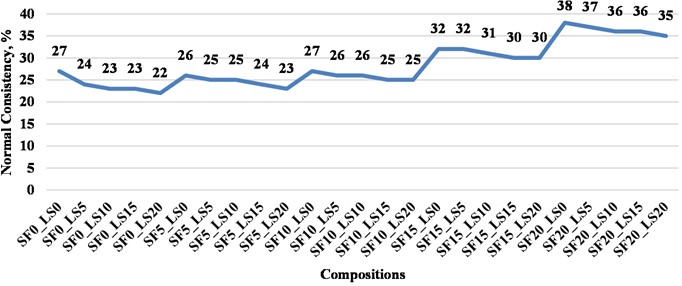
Fig. 2Influence of binary mineral filler with different dispersities on the setting kinetics of cement pastes
Rheological Characteristics and Hydration Kinetics. The data indicate a significant correlation between the filler’s dispersity and the hardening kinetics of the cement binder.
1) Water Demand Analysis: A systematic increase in normal consistency is observed as the proportion of highly dispersed siliceous components increases. This is attributed to their extensive specific surface area and high water adsorption capacity at the interfacial boundaries.
2) Compensatory Effect of Carbonate Fillers: The presence of carbonate rocks () partially mitigates this water demand by optimizing the particle size distribution and reducing structural porosity. This leads to a more efficient water distribution within the system. Consequently, binary compositions exhibit a moderate increase in water demand compared to single-component siliceous additives, providing a more balanced rheological profile than exclusively highly dispersed fillers.
3) Setting Kinetics: The temporal evolution of initial and final setting times highlights the pronounced influence of the binary system. Siliceous components moderately shorten the induction period by acting as active nucleation centers (), while increasing the carbonate filler content provides a balanced extension of the setting time due to the clinker phase dilution. In binary systems, these opposing effects are harmoniously balanced, establishing optimal intervals of technological workability.
Fig. 3Dependence of compressive strength of cement binder at 28 days
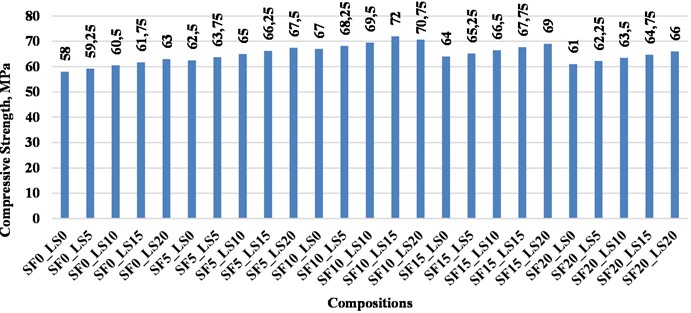
The experimental data regarding the compressive strength at 28 days (Fig. 3) reveals a systematic enhancement of mechanical characteristics upon the introduction of binary fillers.
1) Strength Evolution: For compositions with a low siliceous component content (0-5 %), a marginal strength increment of 5-8 % relative to the control binder is observed. The most intensive growth occurs when the active siliceous component is increased to 10-15 %, where compressive strength values reach a peak range of 71-72 MPa.
2) Optimization Threshold: Further increasing the siliceous filler to 20 % results in a diminished rate of strength gain, characterized by stabilization or a slight decline in performance. This identifies an optimal dosing range where the maximum synergistic effect between the active and structural components is realized. Beyond this threshold, the benefits of pozzolanic reactions and microstructural densification are offset by increased water demand and a higher concentration of weakly bonded phases, leading to a localized increase in internal stresses.
3) Dual-Mechanism Synthesis: A comprehensive analysis confirms a pronounced synergistic effect through the simultaneous implementation of two mechanisms:
– Chemical Activation (): Active siliceous particles, due to their high surface activity, function as intensification centers for hydration, leading to the formation of additional calcium silicate hydrate (C-S-H) phases.
– Structural Ordering (): Carbonate fillers facilitate microstructural ordering, reduce interfacial deformations, and optimize the pore structure. By minimizing the thickness of the interfacial transition zone (ITZ), this mechanism ensures a more homogeneous stress distribution under mechanical loading.
The achievement of maximum strength values at medium dosages of both components validates the concept of controlled structure formation. This synergistic approach ensures a favorable combination of technological and performance characteristics, substantiating the effectiveness of binary mineral systems for high-performance construction mixtures.
A comprehensive analysis of strength characteristics, setting kinetics, and rheological parameters confirms a pronounced synergistic effect when siliceous and carbonate components are utilized in tandem. This synergy is realized through the simultaneous operation of two distinct mechanisms:
1) Hydration Intensification (): Active siliceous particles with high surface activity function as nucleation sites, intensifying hydration and promoting the formation of additional calcium silicate hydrate (C-S-H) phases.
2) Microstructural Optimization (): Simultaneously, carbonate fillers ensure microstructural ordering, reduce interparticle deformations, and optimize the pore structure through physical densification.
The experimental data indicate that peak strength and optimal workability are not achieved by simply maximizing the filler content, but by reaching a stoichiometric balance between these two mechanisms. Unlike single-component additives, which often exhibit limited or one-sided effects, binary compositions provide a comprehensive improvement of properties. These findings experimentally substantiate the theoretical principles of filler surface activity in dispersed systems and highlight the significant potential of binary mineral fillers for designing high-performance, next-generation cement binders with enhanced durability.
4. Conclusions
In this study, a quantitative assessment was conducted to evaluate the influence of particle dispersity and the mass ratio of binary mineral filler components on the hardening kinetics and strength development of a cement binder. The primary conclusions are as follows:
1) Mechanical Performance: The introduction of binary siliceous-carbonate compositions ensures a steady increase in compressive strength at 28 days compared to the control binder (58 MPa). The peak strength of 72.0±1.1 MPa was achieved for the optimal composition, representing a significant increase of 24.1 %. This result validates the effectiveness of binary fillers in enhancing the load-bearing capacity of high-performance binders.
2) Optimal Composition and Thresholds: The maximum synergistic effect is realized at a dosage of 10 % active siliceous component and 15 % carbonate filler (SF10_LS15). It was established that increasing the siliceous fraction beyond 15 % (up to 20 %) leads to a stabilization or reduction in strength gain. This is attributed to the critical threshold where heightened water demand and system saturation offset the pozzolanic and micro-filling benefits.
3) Phase Phase Transition and Rheological Control: The setting kinetics of the modified pastes are technologically balanced, with initial setting times ranging from 120 to 170 minutes and final setting times from 190 to 240 minutes. The carbonate component performs a critical compensatory role, mitigating the high water demand of the siliceous phase. This allows for the targeted regulation of rheological properties, ensuring optimal workability for high-performance engineering applications.
4) Theoretical Validation ( and ): The results provide strong experimental evidence for V. I. Salamatov’s theory. The synergistic effect is achieved through the dual-action mechanism: active siliceous components () intensify the formation of additional C-S-H phases, while carbonate fillers () optimize the pore space and reduce interfacial deformations through structural densification.
5) Scientific Novelty and Sustainability: For the first time, the boundary conditions for the stoichiometric balance between chemical activation and physical densification in binary-modified systems have been quantitatively defined.
Overall, the experimental data are fully consistent with V. I. Salamatov’s theory of composite materials. The use of rationally designed binary siliceous-carbonate fillers represents an effective and resource-efficient approach for developing high-performance, next-generation cement binders with improved strength and operational characteristics, ensuring both structural integrity and environmental sustainability.
References
-
B. Lothenbach, K. Scrivener, and R. D. Hooton, “Supplementary cementitious materials,” Cement and Concrete Research, Vol. 41, No. 12, pp. 1244–1256, 2011.
-
M. Antoni, J. Rossen, F. Martirena, and K. Scrivener, “Cement substitution by a combination of metakaolin and limestone,” Cement and Concrete Research, Vol. 42, No. 12, pp. 1579–1589, Dec. 2012, https://doi.org/10.1016/j.cemconres.2012.09.006
-
Q. T. Phung, E. Ferreira, S. Seetharam, T. Nguyen, J. Govaerts, and E. Valcke, “Understanding hydration heat of mortars containing supplementary cementitious materials with potential to immobilize heavy metal containing waste,” Cement and Concrete Composites, Vol. 115, p. 103859, Jan. 2021, https://doi.org/10.1016/j.cemconcomp.2020.103859
-
T. A. Fode, Y. A. Chande Jande, and T. Kivevele, “Effects of different supplementary cementitious materials on durability and mechanical properties of cement composite – comprehensive review,” Heliyon, Vol. 9, No. 7, p. e17924, Jan. 2023, https://doi.org/10.1016/j.heliyon.2023.e17924
-
L. Campagiorni, M. Tonelli, and F. Ridi, “Synergistic effect of limestone and supplementary cementitious materials in ternary blended cements,” Current Opinion in Colloid and Interface Science, Vol. 75, p. 101885, Jan. 2025, https://doi.org/10.1016/j.cocis.2024.101885
-
M. I. Khan, Y. M. Abbas, and G. Fares, “Quality characteristics of sustainable high-performance concrete formulated from binary, ternary, and quaternary supplementary cementitious materials under various curing conditions,” Materials, Vol. 17, No. 23, p. 5831, Jan. 2024, https://doi.org/10.3390/ma17235831
-
N. R. Yaseen, “Concrete incorporating binary blends of fly ash and silica fume: Compressive strength evolution,” Heliyon, Vol. 10, 2024.
-
K. Moolchandani, A. Sharma, and K. Dharavath, “Hybrid use of supplementary cementitious materials, industrial byproducts, and fillers for sustainable high-performance concrete,” Discover Civil Engineering, Vol. 2, No. 1, Jan. 2025, https://doi.org/10.1007/s44290-025-00379-6
-
A. Baranyi, K. Kopecskó, and L. Csetényi, “Assessing setting times of cementitious materials using semi-adiabatic calorimetry,” Journal of Thermal Analysis and Calorimetry, Vol. 149, No. 17, pp. 9193–9201, Jan. 2024, https://doi.org/10.1007/s10973-024-13375-2
-
A. Adilkhodjaev, I. Kadyrov, B. Kudratov, D. Azimov, and U. Abdullayev, “Effect of binary microfiller on structure formation of cement stone,” in AIP Conference Proceedings, Vol. 3317, p. 030033, Jan. 2025, https://doi.org/10.1063/5.0267410
-
A. Adilkhodjaev, I. Kadyrov, B. Khasanov, M. Radjabov, I. Umarov, and D. Tosheva, “Effect of binary microbrake based on “quartz+carbonate” additions on the properties of cement stone,” in AIP Conference Proceedings, Vol. 3317, p. 030028, Jan. 2025, https://doi.org/10.1063/5.0267412
-
A. Adilkhodzhaev, B. Khasanov, I. Kadyrov, M. Radjabov, I. Umarov, and D. Tosheva, “The properties of self-compacting fine-grained concrete mixtures for energy-efficient vibration-free construction technologies,” Vibroengineering Procedia, Vol. 60, pp. 436–443, Dec. 2025, https://doi.org/10.21595/vp.2025.25633
-
J. Rashidov, R. Narov, K. Yusupov, and I. Kadyrov, “Unraveling the effects of compound additives on the strength of cast concrete,” Revista de Gestão Social e Ambiental, Vol. 18, No. 5, p. e05599, Mar. 2024, https://doi.org/10.24857/rgsa.v18n5-076
-
A. Adilkhodjaev, I. Kadyrov, B. Kudratov, D. Azimov, B. Xasanov, and I. Umarov, “On the structure of cement stone with fillers from metallurgical waste,” E3S Web of Conferences, Vol. 410, p. 01020, Aug. 2023, https://doi.org/10.1051/e3sconf/202341001020
-
A. Adilkhodzhaev, I. Kadirov, B. Kudratov, B. Khasanov, M. Radjabov, and V. Kondrashenko, “Some aspects of the processes of obtaining and application of mineral powders as fillers for cement systems,” E3S Web of Conferences, Vol. 410, p. 01021, Aug. 2023, https://doi.org/10.1051/e3sconf/202341001021
-
A. I. Adilkhodzhaev, I. A. Kadirov, D. T. Azimov, and B. S. Kudratov, “Thermodynamic analysis of mineral powder grinding processes,” in AIP Conference Proceedings, Vol. 3045, p. 060003, Jan. 2024, https://doi.org/10.1063/5.0197549
-
G. Abbas, A. Mahira, A. Abrorbek, and X. Iftixorjon, “Self-compacting concrete based on recycled crushed stone and organic-mineral additive,” Vibroengineering Procedia, Vol. 60, pp. 527–532, Dec. 2025, https://doi.org/10.21595/vp.2025.25728
About this article

The authors have not disclosed any funding.
The datasets generated during and/or analyzed during the current study are available from the corresponding author on reasonable request.
The authors declare that they have no conflict of interest.

