Abstract
This study investigates the mechanical performance, durability, and bond behavior of concrete modified with a composite adhesive incorporating finely dispersed volcanic ash. The objective is to determine optimal mixture parameters for B30 class concrete using a three-factor Box-Behnken experimental design, considering filler content (20-60 %), water-to-binder ratio (0.25-0.45), and adhesive consumption (200-450 kg/m3). Concrete specimens were evaluated in terms of compressive and flexural strength, elastic properties, frost resistance, and bond strength to reinforcement under both natural curing and heat-moisture treatment (80 °C). The results show that adhesive consumption is the dominant factor influencing compressive strength. Optimal parameters (20-25 % filler, water-binder ratio of 0.25-0.28, and adhesive consumption of 440-450 kg/m3) ensure a compressive strength of 48-49 MPa, exceeding the requirements of class B30. Frost resistance increased up to F300, while bond strength reached 6.2 MPa, approximately three times higher than that of conventional concrete. Heat-moisture treatment further improved strength by 10-15 %. The observed improvements are attributed to the synergistic interaction between the composite adhesive and volcanic ash, leading to pore refinement and the formation of additional secondary C-S-H phases. The proposed approach enables a reduction in cement consumption by 130-150 kg/m3, contributing to improved economic efficiency and reduced environmental impact.
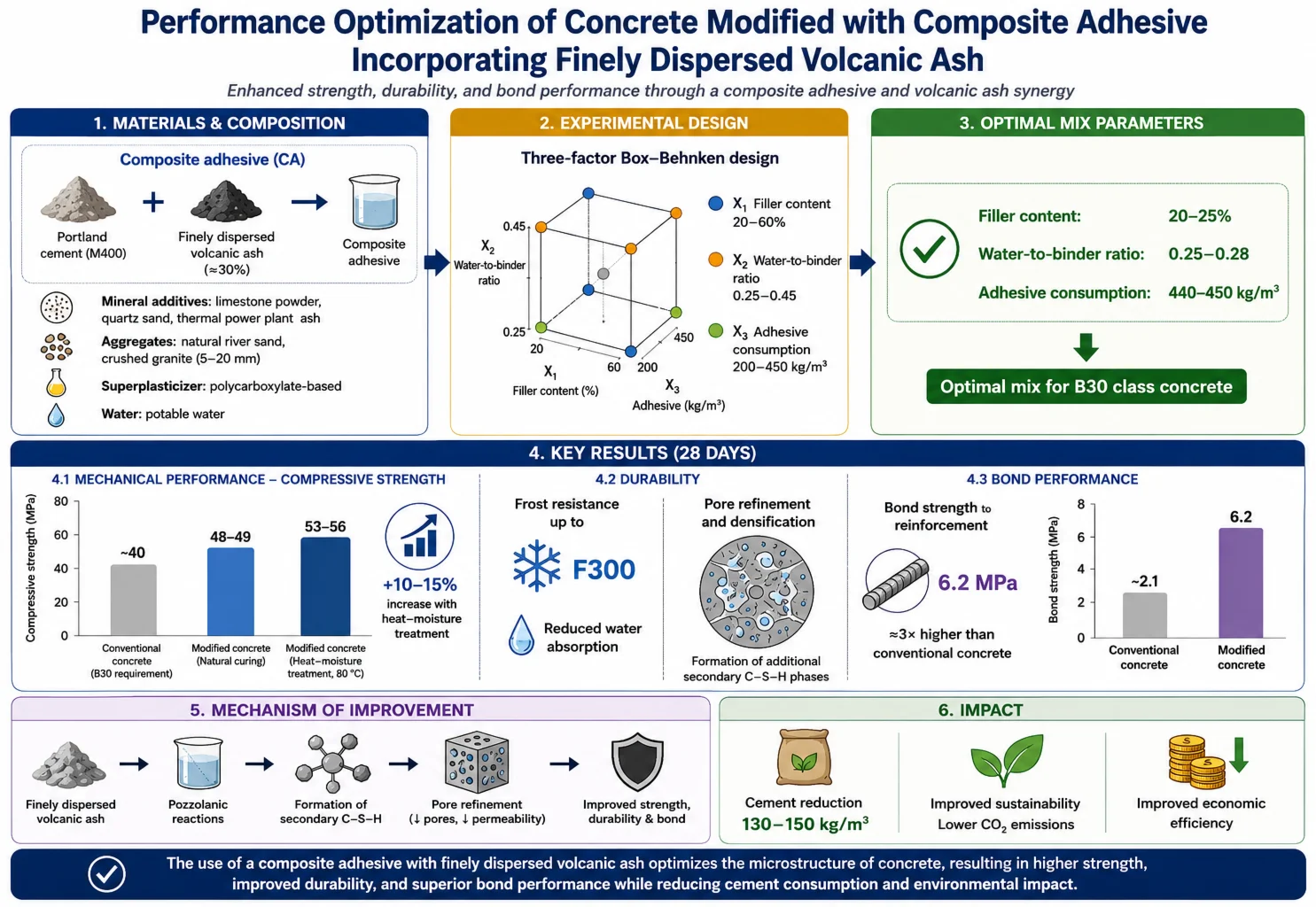
Highlights
- Composite adhesive with finely dispersed volcanic ash significantly enhances compressive strength of concrete up to 48–49 MPa, exceeding B30 class requirements.
- Optimal mixture parameters (20–25% filler, W/B 0.25–0.28, adhesive 440–450 kg/m³) provide maximum mechanical performance and structural stability.
- Modified concrete exhibits improved durability, achieving frost resistance up to F300 due to pore refinement and reduced water absorption.
- Bond strength between concrete and reinforcement increases up to 6.2 MPa, approximately three times higher than conventional concrete.
- Use of volcanic ash enables reduction of cement consumption by 130–150 kg/m³, improving economic efficiency and reducing environmental impact.
1. Introduction
Concrete, as the most widely used construction material, requires continuous improvement to meet modern sustainability and performance demands [1-3]. In recent years, the use of finely dispersed mineral additives and composite binders has become an effective approach to enhance mechanical properties, durability, and environmental performance of concrete [4-6]. Finely dispersed materials such as volcanic ash, metakaolin, silica fume, and fly ash improve the microstructure of concrete by filling pores, accelerating hydration, and promoting the formation of additional C-S-H phases [7-10]. Their incorporation into composite binders increases mixture homogeneity, reduces water demand, and improves workability and long-term performance [11-13]. Previous studies have shown that modified concretes exhibit increased strength, frost resistance, reduced permeability, and improved adhesion properties [14-17]. Particular attention has been paid to natural pozzolans derived from volcanic materials as partial cement replacements, which contribute to microstructure densification, reduced porosity, and enhanced durability [18-21]. It has also been reported that the optimal replacement level of mineral additives typically ranges from 15 % to 30 %, depending on composition and curing conditions [22-24]. In addition, recent studies highlight the positive effects of composite binders on thermal properties, corrosion resistance, permeability, and fire resistance of concrete [25-30]. Despite extensive research, there remains a need for a comprehensive evaluation of concrete modified with volcanic ash-based composite binders, particularly regarding deformation behavior, frost resistance, and bond strength with reinforcement under different curing regimes. The present study addresses the evaluation of mechanical performance, durability, and reinforcement bond behavior of concrete modified using composite adhesive with finely dispersed volcanic ash, aiming to determine optimal mixture parameters and propose an efficient production approach for B30 class concrete.
2. Material and method
The study utilized Portland cement (M400) and a composite adhesive (CA) based on cement and finely dispersed volcanic ash. The composite adhesive consisted of Portland cement blended with volcanic ash in an approximate ratio of 70:30 by mass, forming a mineral-based binder with enhanced pozzolanic activity. Mineral additives included volcanic ash, limestone powder, quartz sand, and thermal power plant ash. Natural river sand and crushed granite (5-20 mm fraction) were used as aggregates. A polycarboxylate-based superplasticizer and potable water were also incorporated into the mixtures.
Concrete mixtures were prepared by first homogenizing dry components, followed by the addition of water and superplasticizer, and mixing until a uniform consistency was achieved. Workability of fresh concrete was determined using the slump test. Compressive strength was evaluated using 100 mm cube specimens, while flexural strength was assessed on prismatic specimens measuring 100×100×400 mm. Mechanical properties were determined at the age of 28 days. Each reported value represents the average of three specimens, and the variation between results did not exceed 5 %.
To evaluate bond behavior, reinforced concrete specimens were prepared using steel reinforcement bars with a diameter of 12 mm and an embedded length of 150 mm. Bond strength was determined using a pull-out test, where the maximum load at slip initiation was recorded. After casting, samples were kept in molds for 24 hours and then cured under two regimes: natural curing (28 days at 20±2 °C and relative humidity above 95 %) and heat-moisture treatment (HHT) involving a temperature cycle up to 80°C, followed by standard curing. Additional tests included modulus of elasticity, water absorption, and frost resistance. Frost resistance was evaluated based on cyclic freezing and thawing, assessing durability through changes in physical properties.
A three-factor Box-Behnken experimental design was applied with the following variables: filler content (20-60 %), water-to-binder ratio (0.25-0.45), and adhesive consumption (200-450 kg/m3). Regression analysis was performed to model compressive strength as a function of these variables.
3. Results and discussion
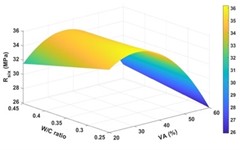
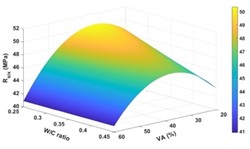
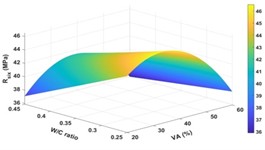
The experimental findings indicate that filler type and composite adhesive content play a key role in determining the mechanical response of concrete. Heat-moisture treatment (HHT) significantly increased compressive strength compared to natural curing (42.6 MPa vs. 32.4 MPa after 7 days), with a further gain of 10-11 % observed at 28 days. This improvement can be attributed to accelerated hydration kinetics and enhanced formation of cementitious phases under elevated temperature conditions. A second-order regression model was developed to describe compressive strength as a function of filler content (), water-binder ratio (), and adhesive consumption (). Response surface analysis (Fig. 1) demonstrates that adhesive consumption has the most pronounced effect on strength development, while lower water-binder ratios and reduced filler content contribute to improved performance due to increased matrix density and more efficient particle packing. At low adhesive consumption (200 kg/m3), compressive strength remains limited and highly sensitive to variations in both filler content and water-binder ratio, indicating insufficient formation of a continuous and dense cementitious matrix. At medium consumption (325 kg/m3), a relatively stable optimum region is observed, which can be associated with improved particle packing and more efficient hydration processes. At high adhesive consumption (450 kg/m3), strength becomes primarily governed by the water-binder ratio, reflecting the formation of a denser and more homogeneous matrix structure.
Fig. 13D response surfaces of compressive strength as a function of water-cement ratio and volcanic ash content at different composite adhesive consumptions (200, 325, and 450 kg/m3)
This behavior can be explained by microstructural evolution within the cementitious system. The incorporation of finely dispersed volcanic ash promotes the formation of additional secondary C-S-H phases through pozzolanic reactions, while simultaneously acting as nucleation sites that accelerate cement hydration. As a result, a refined pore structure (pore refinement) develops, where larger capillary pores are progressively replaced by finer gel pores, leading to reduced permeability and increased density. Indirect evidence of this densification is also reflected in the increased density and reduced water absorption values presented in Table 2.
Optimization of the model showed that the parameters = 20-25 %, = 0.25-0.28, and = 440-450 kg/m3 ensure compressive strength of 48-49 MPa, corresponding to B30 class concrete. Experimental results confirm that the use of composite adhesive not only improves strength compared to conventional concrete but also enables a reduction in cement consumption by 130-150 kg/m3, enhancing both economic and environmental efficiency. Flexural and tensile strength increased by 19-60 %, while deformation characteristics remained within standard ranges, indicating stable structural behavior and effective stress distribution within the matrix. Frost resistance tests demonstrated improved durability of the modified concrete, with optimal compositions reaching up to F300.
This enhancement is attributed to reduced water absorption and microstructural densification resulting from pore refinement. Bond strength between concrete and reinforcement also increased significantly, reaching 6.2 MPa compared to 2.1 MPa for conventional concrete. This substantial improvement highlights the synergistic effect of the composite adhesive and volcanic ash: the polymer-modified matrix enhances interfacial adhesion, while the densified interfacial transition zone (ITZ) reduces microcracking and improves load transfer. The compositions of the studied concretes and their main physical and mechanical properties are presented in Tables 1-2, confirming that strength characteristics are strongly dependent on filler type and composite adhesive consumption.
Axial tensile strength of the modified concrete exceeded standard values by 19-60 %, confirming the effectiveness of the composite adhesive and finely dispersed fillers in enhancing crack resistance and stress distribution within the cement matrix. This improvement can be attributed to the formation of a denser microstructure and improved interfacial bonding. Frost resistance tests demonstrated that the modified concrete exhibits significantly improved durability, with optimal compositions reaching up to F300. This behavior is associated with reduced porosity and water absorption, resulting from pore refinement and the formation of additional secondary C-S-H phases, which limit moisture ingress and mitigate freeze-thaw damage. Bond strength between concrete and reinforcement increased substantially, reaching 6.2 MPa compared to 2.1 MPa for conventional concrete. This pronounced enhancement reflects the synergistic effect of the composite adhesive and volcanic ash, where the polymer-modified matrix improves adhesion, and the densified interfacial transition zone (ITZ) enhances load transfer and reduces microcrack formation. These mechanisms are consistent with established findings on pozzolanic materials reported in the literature (Mehta and Monteiro, 2014).
Table 1Compositions of the studied concretes
Composition | Material consumption, kg/m3 | W/S | ||||||||
PS | CS | S | W | A | Finely dispersed filler | |||||
LP | VA | TPP | Q | |||||||
1 | 315 | 1120 | 780 | 167 | 3.9 | 135 | – | – | – | 0.37 |
2 | 315 | 1120 | 780 | 171 | 3.9 | 135 | – | – | 0.38 | |
3 | 315 | 1120 | 780 | 176 | 4.2 | – | – | 135 | – | 0.39 |
4 | 315 | 1120 | 780 | 162 | 3.8 | – | – | – | 135 | 0.36 |
5 | 336 | 1100 | 790 | 178 | 3.9 | 144 | – | – | – | 0.37 |
6 | 336 | 1100 | 790 | 180 | 3.9 | – | 144 | – | – | 0.38 |
7 | 336 | 1100 | 790 | 187 | 4.2 | – | – | 144 | – | 0.39 |
8 | 336 | 1100 | 790 | 173 | 3.8 | – | – | – | 144 | 0.36 |
9 | 450 | 1120 | 780 | 162 | 3.5 | – | – | – | – | 0.36 |
10 | 480 | 1100 | 790 | 178 | 3.4 | – | – | – | – | 0.37 |
Note: PS – Portland cement; CS – crushed stone fraction 5-20 mm; S – sand and stone aggregate; A – superplasticizer; W/C – water-cement ratio; VA – volcanic ash; LP – limstone powder; Q – quartz sand; TPP – ash from thermal power plants | ||||||||||
Table 2Physical and mechanical properties of concrete
Composition | Slump (CS), sm | Average density, kg/m3 | Compressive strength, MPa | ||
After heat-humidity treatment (HHT) | 28 days after HHT | 28 days after Natural hardening | |||
1 | 5 | 2353 | 35.7 | 37.6 | 36.2 |
2 | 5 | 2358 | 44.1 | 46.6 | 42.8 |
3 | 6 | 2350 | 32.2 | 32.8 | 32.4 |
4 | 5 | 2352 | 42.3 | 44.7 | 41.6 |
5 | 5 | 2516 | 42.1 | 43.4 | 40.5 |
6 | 5 | 2518 | 45.8 | 48.9 | 45.2 |
7 | 6 | 2510 | 35.1 | 38.9 | 34.3 |
8 | 5 | 2516 | 43.9 | 46.8 | 44.7 |
9 | 6 | 2370 | 40.1 | 40.5 | 34.2 |
10 | 6 | 2382 | 41.8 | 42.3 | 36.8 |
4. Conclusions
This study demonstrates that the combined use of a composite adhesive and finely dispersed volcanic ash significantly enhances the mechanical and durability performance of concrete. The results confirm that adhesive consumption is the dominant factor governing compressive strength, while optimal performance is achieved at low water–binder ratios and moderate filler content. The key scientific contribution of this work lies in the synergistic interaction between the composite adhesive and volcanic ash, which leads to pore refinement and additional secondary C-S-H formation. As a result, a denser cementitious matrix is formed, providing improved mechanical properties and durability. A threefold increase in bond strength (up to 6.2 MPa) compared to conventional concrete represents a particularly significant finding, highlighting the effectiveness of the proposed modification approach for reinforced concrete applications. The optimized mixture (20-25 % filler, water-binder ratio 0.25-0.28, adhesive consumption 440-450 kg/m3) ensures compressive strength of 48-49 MPa (B30 class), while reducing cement consumption by 130-150 kg/m3, contributing to improved economic and environmental efficiency. It should be noted that the present study is limited by the absence of direct microstructural analysis (e.g., SEM or XRD) and long-term durability testing beyond 28 days. These aspects will be addressed in future research.
References
-
M. U. Hossain, R. Cai, S. T. Ng, D. Xuan, and H. Ye, “Sustainable natural pozzolana concrete – A comparative study on its environmental performance against concretes with other industrial by-products,” Construction and Building Materials, Vol. 270, p. 121429, Feb. 2021, https://doi.org/10.1016/j.conbuildmat.2020.121429
-
A. Adesina, “Recent advances in the concrete industry to reduce its carbon dioxide emissions,” Environmental Challenges, Vol. 1, p. 100004, Dec. 2020, https://doi.org/10.1016/j.envc.2020.100004
-
A. A. Guvalov and S. I. Abbasova, “Controlling the properties of nanomodified cement systems,” Scientific Works of AUAC, Vol. 1, pp. 90–96, 2020.
-
P. D. Nukah, S. J. Abbey, C. A. Booth, and J. Oti, “Evaluation of the structural performance of low carbon concrete,” Sustainability, Vol. 14, No. 24, p. 16765, Dec. 2022, https://doi.org/10.3390/su142416765
-
M. S. Felix, R. U. H. Zamora, M. A. A. Rubio, C. C. Gallardo, and J. M. H. Ramirez, “Sustainable low-carbon cement: performance enhancement with calcined natural pozzolans through compressive strength, porosity, and microstructural analysis,” Materials, Vol. 18, No. 8, p. 1776, Apr. 2025, https://doi.org/10.3390/ma18081776
-
V. V. Tyukavkina, A. G. Kasikov, and B. I. Gurevich, “Structure formation of cement stone modified with additive of nano-disperse silicon dioxide,” Building Materials, Vol. 765, No. 11, pp. 31–35, 2018, https://doi.org/10.31659/0585-430x-2018-765-11-31-35
-
A. A. Guvalov and S. I. Abbasova, “The effect of Aydag zeolite rock on autogenous settlement in cement systems,” Scientific Works of AUAC, Vol. 1, pp. 163–169, 2019.
-
E. Güneyisi, M. Gesoğlu, Z. Algın, and K. Mermerdaş, “Optimization of concrete mixture with hybrid blends of metakaolin and fly ash using response surface method,” Composites Part B: Engineering, Vol. 60, pp. 707–715, Apr. 2014, https://doi.org/10.1016/j.compositesb.2014.01.017
-
R. Prashanth, S. Senthil Selvan, and M. Balasubramanian, “Experimental investigation on durability properties of concrete added with nano-silica,” Rasayan Journal of Chemistry, Vol. 12, No. 2, pp. 685–690, 2019, https://doi.org/10.31788/rjc.2019.1225165
-
A. M. Ali and J. M. Abed, “Effects of metakaolin and nano-silica on mechanical properties of sulphate resistance cement mortar,” in AIP Conference Proceedings, Vol. 2931, p. 020005, 2023, https://doi.org/10.1063/5.0172365
-
H. M. Hamada, F. Abed, S. Beddu, A. Humada, and A. Majdi, “Effect of volcanic ash and natural pozzolana on mechanical properties of sustainable cement concrete: A comprehensive review,” Case Studies in Construction Materials, Vol. 19, p. e02425, Dec. 2023, https://doi.org/10.1016/j.cscm.2023.e02425
-
F. Darwis, I. Banggu, and M. A. Sultan, “The effects of volcanic ash on the strength and permeability mortar,” in Proceedings of the International Conference on Science and Technology (ICST 2018), Vol. 1, pp. 372–375, 2018, https://doi.org/10.2991/icst-18.2018.78
-
A. A. Guvalov and S. I. Abbasova, “Effect of stone dust on properties of cement composition,” Scientific Works of Azerbaijan University of Architecture and Construction, Vol. 1, pp. 60–64, 2018.
-
L. M. Gil-Martín, M. J. Oliveira, M. A. Fernández-Ruiz, F. G. Branco, and E. Hernández-Montes, “Sustainable use of volcanic ash in mortars as a replacement for cement or sand: shrinkage and physical and mechanical properties,” Materials, Vol. 18, No. 15, p. 3694, Aug. 2025, https://doi.org/10.3390/ma18153694
-
S. Ahmad, O. S. Baghabra Al-Amoudi, S. M. S. Khan, and M. Maslehuddin, “Effect of silica fume inclusion on the strength, shrinkage and durability characteristics of natural pozzolan-based cement concrete,” Case Studies in Construction Materials, Vol. 17, p. e01255, Dec. 2022, https://doi.org/10.1016/j.cscm.2022.e01255
-
M. Anwar and A. Makhlouf, “Performance of fly ash concrete against sulfate attack,” JES. Journal of Engineering Sciences, Vol. 49, No. No 2, pp. 178–197, 2021, https://doi.org/10.21608/jesaun.2021.53250.1024
-
S. Aslan and I. H. Erkan, “The effects of fly ash, blast furnace slag, and limestone powder on the physical and mechanical properties of geopolymer mortar,” Applied Sciences, Vol. 14, No. 2, p. 553, Jan. 2024, https://doi.org/10.3390/app14020553
-
A. Siddika et al., “Performance of sustainable green concrete incorporated with fly ash, rice husk ash, and stone dust,” Acta Polytechnica, Vol. 61, No. 1, pp. 279–291, Mar. 2021, https://doi.org/10.14311/ap.2021.61.0279
-
L. Wang, W. Wei, J. Zhang, Y. Hu, and L. Zhang, “Effect of curing regime on the mechanical properties and durability of steam cured-concrete,” Buildings, Vol. 13, No. 7, p. 1697, Jul. 2023, https://doi.org/10.3390/buildings13071697
-
A. A. Guvalov and S. I. Abbasova, Composite materials technology. Baku, 2018.
-
M. Lech and J. Wawrzeńczyk, “A study on carbonation depth prediction for concrete made with GBFS cement and FA addition,” Structure and Environment, Vol. 14, No. 1, pp. 1–10, Mar. 2022, https://doi.org/10.30540/sae-2022-001
-
M. M. Abbas and R. Muntean, “The effectiveness of different additives on concrete’s freeze-thaw durability: a review,” Materials, Vol. 18, No. 5, p. 978, Feb. 2025, https://doi.org/10.3390/ma18050978
-
A. Hallal, E. H. Kadri, K. Ezziane, A. Kadri, and H. Khelafi, “Combined effect of mineral admixtures with superplasticizers on the fluidity of the blended cement paste,” Construction and Building Materials, Vol. 24, No. 8, pp. 1418–1423, Aug. 2010, https://doi.org/10.1016/j.conbuildmat.2010.01.015
-
F. Pirmohammadi Alishah and M. Mohammad Razaei, “Effect of natural pozzolan on concrete’s mechanical properties and permeability in various grades of cement,” Journal of Geotechnical Geology, Vol. 16, No. 2, pp. 425–434, 2020.
-
Z. Yu and G. Ye, “The pore structure and water permeability of cement paste blended with fly ash over a long period up to one year,” in Concrete Repair, Rehabilitation and Retrofitting III, Cape Town, South Africa: CRC Press, 2012, pp. 130–131, https://doi.org/10.1201/b12750-48
-
A. S. Alqarni, “A comprehensive review on properties of sustainable concrete using volcanic pumice powder ash as a supplementary cementitious material,” Construction and Building Materials, Vol. 323, p. 126533, Mar. 2022, https://doi.org/10.1016/j.conbuildmat.2022.126533
-
A. Yusra, M. Hasan, T. B. Aulia, and F. Fachruddin, “Investigation of strength concrete materials using pozzolanic additives,” Applied Mechanics and Materials, Vol. 922, pp. 23–34, Aug. 2024, https://doi.org/10.4028/p-xeokr9
-
E. O. Fanijo, J. T. Kolawole, and A. Almakrab, “Alkali-silica reaction (ASR) in concrete structures: Mechanisms, effects and evaluation test methods adopted in the United States,” Case Studies in Construction Materials, Vol. 15, p. e00563, Dec. 2021, https://doi.org/10.1016/j.cscm.2021.e00563
-
Y. Yu, Z. Hang, W. Zhao, and X. Zhao, “Fire-resistance mechanism and residual bearing capacity of prestressed concrete beams after fire exposure,” Journal of Structural Engineering, Vol. 147, No. 8, Aug. 2021, https://doi.org/10.1061/(asce)st.1943-541x.0003070
-
P. K. Mehta and P. J. M. Monteiro, Concrete: Microstructure, Properties, and Materials. McGraw-Hill Education, 2014.
About this article

The authors have not disclosed any funding.
The datasets generated during and/or analyzed during the current study are available from the corresponding author on reasonable request.
The authors declare that they have no conflict of interest.

