Abstract
The conducted scientific research has shown that the waterproofing index of fiber-reinforced concrete samples with modified adhesive polypropylene fiber is higher than that of fiber-reinforced concrete samples with polyethylene terephthalate fiber. The possibility to improve of these indicators using ultra-fine mineral additives was experimentally studied. It was found out that after applying these ultra-fine mineral additives (aluminum oxide production waste) the waterproofing index of fiber-reinforced concrete increases significantly. The results of waterproofing index tests conducted on fiber-reinforced concrete samples with modified adhesive polypropylene fiber show that the samples are resistant to the impact of a water jet under a pressure of 10-12 atm (45.87 MPa), while fiber-reinforced concrete samples with modified adhesive polyethylene terephthalate fiber are resistant to a pressure of 9-11 atm (45 MPa).
Highlights
- The conducted scientific research has shown that the waterproofing index of fiber-reinforced concrete samples with modified adhesive polypropylene fiber is higher than that of fiber-reinforced concrete samples with polyethylene terephthalate fiber.
- The possibility to improve of these indicators using ultra-fine mineral additives was experimentally studied. It was found out that after applying these ultra-fine mineral additives (aluminum oxide production waste) the waterproofing index of fiber-reinforced concrete increases signficantly.
- The results of waterproofing index tests conducted on fiber-reinforced concrete samples with modified adhesive polypropylene fiber show that the samples are resistant to the impact of a water jet under a pressure of 10-12 atm (45.87 MPa)
1. Introduction
Concrete is used in the construction of buildings and structures for various purposes. The significant increase in the role of concrete in modern construction has inspired researchers to seek the ways for improving of its composition. Concrete now turned from the traditional 4-component system into a multi-component system. At the same time, the variety of operational indicators of the applied concrete also led to the expansion of concrete application areas [1-6].
Currently, depending on the specific characteristics of construction objects, dictate producing and using different types of concrete such as refractory, chemical-resistant, hydrotechnical, applied in road constructionroad-targeted, etc. concretes are produced and applied. Therefore, one of the urgent issues facing researchers and manufacturers in the modern era is how to Iimprovinge the quality of ordinary heavy concrete used in road construction is one of the urgent issues facing researchers and manufacturers in the modern era. One of the directions for improving the operational indicators of such concretes is the reinforcement of concrete with various fibers.
The feasibility of utilizing aluminum oxide production waste (APW) from the Ganja industrial association “Gil-Soil” (Republic of Azerbaijan) as an active mineral additive was experimentally substantiated. It was established that the incorporation of APW in amounts up to 10 % of the cement content leads to a notable improvement in the strength characteristics of cement-sand composites compounds. In particular, after 28 days of curing, the flexural strength increased by 6.2-6.4 MPa, while the compressive strength reached 39.5-41.4 MPa. A comparative analysis with reference compositions compounds without additives revealed that the activity of the modified binder increased by 3.2 % and 4.8 %, respectively.
Further investigations focused on the application of the modified binder in heavy concrete as well as in polymer fiber-reinforced concrete systems. The design of Modified concrete compositions compounds was carried out were developed using methods of mathematical-statistical analysis, which enabled the development of to create predictive models for determining compressive strength parameters. Optimization of the composition compound was achieved optimized through experimental planning techniques which considering the influence of key factors.
As a result, experimental mixtures of modified S520 fiber-reinforced concrete with a compressive strength of 46.51 MPa and HP777 polypropylene fiber-reinforced concrete with a compressive strength of 48.49 MPa were obtained. Compared to conventional fiber-reinforced concrete without additives, the compressive strength of these modified mixtures increased by 7.01 % and 11.5 %, respectively [1].
The issue of the feasibility of using fibers made from polyethylene terephthalate-containing plastic bottles in the production of concrete was considered. It is known that polyethylene terephthalate-containing fibers have a smooth surface, which prevents them from adhering to the cement mortar. For this purpose, a technology for the preparation of polyethylene terephthalate-containing fibers was developed in the current paper.
The surface of PET fibers was roughened by 2 methods. In the 1st method, the fibers cut into fiber form were ground in a mill with small gravel, making the surface rough. In the 2nd method, the surface shape (visual appearance) of the fibers was changed by exposing them to different temperatures. Experiments showed that the compressive strength of fiber concrete produced with fibers made from polyethylene terephthalate-containing household waste, whose surface was roughened by mechanical processing for 2 hours, is 35.80 % higher than that of concrete made from not mechanically processed fibers, and its average density is 1.29 %.
Compared to fiber concrete samples produced by changing their appearance and increasing surface adhesion through thermal treatment, the average density of these fiber concrete samples made of 6 cm long fibers increased by 6.25 % and their compressive strength increased by 25.64 %. The average density of fiber concrete samples made of 18 cm long fibers that were not subjected to deformation increased by 6.46 %, and their compressive strength increased by 26.12 %. The results show that the proposed modified polyethylene terephthalate fiber concrete is 27 % more cost-effective than conventional concretes of similar class [7].
This study explores the production fiber-reinforced concrete with improved ductility through microstructure modification to use it in transport infrastructure. It was found that to create high-performance transport infrastructure, it is necessary to modify fiber mixtures with complex additives, and to increase the strength of fiber-reinforced concrete at the micro-level.
To obtain a denser structure of the concrete matrix, complex additives (ultrafine additive (silica fume) and Master Air 200B air-entraining additive) were used. It was experimentally proved that using such additives reduces the water-cement ratio and further strengthens the concrete matrix structure [8].
This paper presents an experimental and applied study dedicated to the development of artificial stone materials from limestone dust waste, which accumulates in large quantities at quarries in the Absheron region of Azerbaijan.
The territory of Azerbaijan is rich in limestone deposits. Stone from these deposits is widely used in construction for walling and cladding.
At the same time, a large amount of limestone dust waste, polluting the environment, is formed. In order to improve the properties of artificial stone and limestone dust waste-based materials , special chemical additives were introduced to optimize the amount and granulometric composition of cement. It was experimentally established that the use of 15-23 % Portland cement allows obtaining an artificial stone material with high technical properties.
Also, the use of the hyper plasticizer Master Gluonium ACE 450 has a significant effect on the strength of cement by reducing the water-cement ratio. By regulating the granulometric composition of stone dust waste, it became possible to increase its strength by 30-35 %. Thus, high-quality artificial stone material can be obtained from limestone dust waste. By promoting waste recycling and natural resource conservation, the study holds significant environmental relevance and ensures technical value for the construction industry [9].
2. Study purpose
This study investigated improving the properties of concrete reinforced with polypropylene and polyethylene terephthalate fibers, including water permeability. The effect of various additives on fiber-reinforced concrete reinforced with polypropylene and polyethylene terephthalate fibers was studiedinvestigated. The physical and mechanical properties of the prepared samples, including water permeability, were determined [9].
Test Method. Water permeability tests on the prepared samples were conducted in accordance with the current valid state standards of the Republic of Azerbaijan. Tests were conducted using a UDF-6/04 No. #195 device. Cylindrical samples were prepared for this purpose. The cylindrical samples were placed in special zones (grooves) of the device. The space between the sample and the groove was filled with paraffin (to prevent the passage of water and air). Water pressure was applied and maintained for a time interval of 1-5 minutes in increments of 0.2 MPa [10].
Materials used. In the experiments, Holcim Expert 42.5 R cement produced in the Republic of Azerbaijan, natural and fine-grained sand, crushed stone, ultra-finely ground aluminum oxide waste, HP 777 hyper plasticizer as a plasticizer, as well as polypropylene and polyethylene terephthalate fibers were used to prepare the fiber concrete mixture. A sample of the ultrafine waste was taken for analysis, and its chemical composition was determined using the X-ray spectral method.
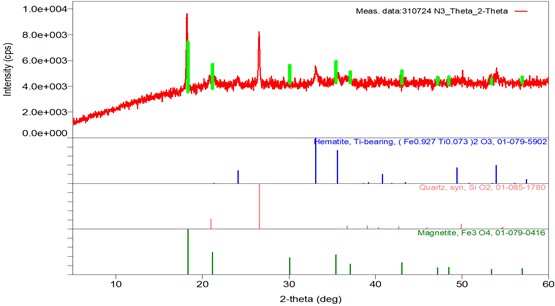
Based on the X-ray spectral analysis results, it can be concluded that the chemical composition of this additive is as follows: SiO2 – 17.44 %; Al2O3 – 15.60 %; Fe2O3 – 46.79 %; CaO – 1.67 %; Na2O – 2.31 %; MgO – 0.28 %; P2O5 – 0.18 %; SO3 – 0.49 %; K2O – 0.39 %; TiO2 – 3.21 %; MnO – 0.43 %; Cl – 0.06 %, and the amount of volatile components at 950 °C is 10.20 % [1].
To study the mineralogical composition of aluminum smelting industry waste, an ultra-fine ground sample of ultra finely ground material was taken and analyzed by X-ray analysis. An X-ray image of the aluminum smelting industry waste was obtained and presented the resulting diffractogram is shown in Fig. 1 [1].
Fig. 1Diffractogram of waste from alumina industry
In the experiments, fibers were prepared from various types of carbonated and non-carbonated beverage bottles, which are plastic household waste, and polypropylene fibers Sika Fiber T-60s, and fiber-reinforced concrete composites were developed based on these fibers. Various types of carbonated and non-carbonated beverage bottles are plastic household waste and are produced from polyethylene terephthalate polymer. Based on this waste, fibers of various lengths were cut and prepared into samples of: 60, 120, and 180 mm. The used fiber parameters of the fibers used are given specified in Tables 1-2 [9].
Table 1SikaFiber T-60s polypropylene fiber performance
Brand | Sika |
Country of origin | Swiss |
Color | black |
Length | 60 mm |
Diameter | 0.9 mm |
Tensile strength | > 500 MPa |
Density | 0.91 kg/dm3 |
Moisture absorption | none |
Chemical resistance | high |
Melting temperature | +280 °C |
Resistance to molds | high |
Modulus of elasticity | 20 MPa |
Maximum elongation | 25 % |
Table 2Characteristics of fibers made from polyethylene terephthalate-based waste
Color | transparent |
Length | 60 mm |
Width | 0.92 mm |
Thickness | 0.012-0.021 mm |
Tensile strength | > 480 MPa |
Density | 0.89 kg/dm3 |
Moisture absorption | none |
Chemical resistance | high |
Melting temperature | +290 °C |
Resistance to abrasion | high |
Modulus of elasticity | 18 MPa |
Maximum elongation | 25 % |
Fig. 2Appearance of fibers used in experiments; a) polypropylene fibers; b) fibers made from polyethylene terephthalate-based waste. Photo by Rakhmatov S, laboratory in Tashkent city, 2025
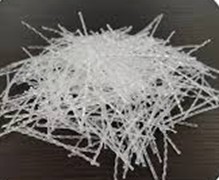
a)
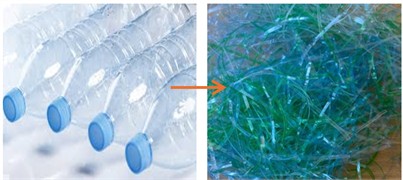
b)
3. Testing procedure
Cylindrical samples (150×150 mm) were from fiber concrete mixtures and cured for 28 days under normal conditions. After the samples were placed in the UDF-6/04 #195 device in accordance with the requirements, they were initially exposed to water at a pressure of 0.2 MPa. The water pressure was increased until moisture was felt on the sample surface. The water used during the test was degassed by boiling for at least 1 hour and cooled to 25±5 °C. After the samples were prepared for testing, the required pressure of degassed water was applied to them. Degassed water was applied for 1 hour, whose pressure was increased by 0.2 MPa every 1-5 minutes. The process was continued until 1 drop of water was visible on the other surface of the sample. The test results are specified in Table 3.
As shown in Table 3, the samples withstood a water pressure of 6-8 atmospheres. For this reason, W6 was adopted as the waterproofing class for conventional heavyweight concrete. Waterproofing test results for modified polypropylene fiber-reinforced concrete samples show that they withstood a water jet pressure of 10-12 atm (45.87 MPa), while modified polyethylene terephthalate fiber-reinforced concrete samples withstood a pressure of 9-11 atm (45 MPa).
Table 3Determination of water resistance of fiber concrete samples
No | Sample name | Sample number | Water resistance | Compressive strength (MPa) | |
Water pressure (atm) | Water resistance brand | ||||
1 | 2 | 3 | 4 | 5 | 6 |
1 | Conventional heavy-duty concrete | 1 | 8 | W6 | 39.02 |
2 | 8 | 38.92 | |||
3 | 8 | 38.29 | |||
4 | 6 | 39.96 | |||
5 | 8 | 39.85 | |||
6 | 8 | 39.01 | |||
Modified adhesive polypropylene fiber-reinforced concrete | 1 | 11 | W8 | 44.90 | |
2 | 12 | 44.87 | |||
3 | 11 | 45.20 | |||
4 | 12 | 45.05 | |||
5 | 11 | 45.87 | |||
6 | 10 | 44.29 | |||
3 | Modified adhesive polyethylene terephthalate fiber-reinforced concrete | 1 | 10 | W8 | 44.78 |
2 | 10 | 44.70 | |||
3 | 11 | 45.00 | |||
4 | 10 | 45.00 | |||
5 | 10 | 45.07 | |||
6 | 9 | 44.10 | |||
Fig. 3Waterproofing test of fiber concrete samples
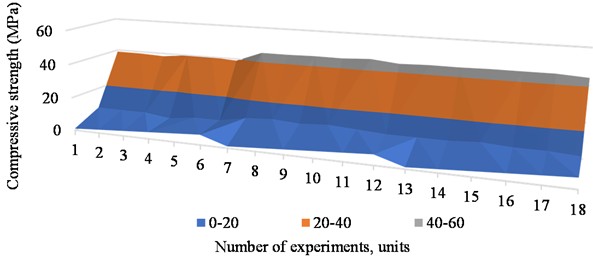
The superior waterproofing performance of concrete reinforced with modified polypropylene fibers can be attributed to the more effective interaction between these fibers and the cementitious matrix, which promotes a denser and more homogeneous internal structure while limiting the continuity of capillary pores. Although modified polyethylene terephthalate (PET) fibers also improved the performance of concrete, their contribution to water resistance was comparatively lower, most likely due to less effective interfacial bonding with the cement matrix. In addition, the ultrafine mineral additive derived from aluminum oxide production waste played a significant role in enhancing the concrete structure by refining the pore system, reducing capillary porosity, and increasing matrix compactness. The combined action of modified fibers and mineral additive therefore contributed not only to improved compressive strength, but also to greater resistance to water penetration. Overall, the results indicate that modified polypropylene fibers, particularly when used together with ultrafine mineral additives, provide a more efficient approach for producing durable and water-resistant fiber-reinforced concrete.
The present study investigated the development of water-resistant modified fiber-reinforced concrete using polypropylene and polyethylene terephthalate fibers together with ultrafine mineral additives. Experimental results demonstrated that the incorporation of modified adhesive polypropylene fibers significantly improved the waterproofing performance of fiber-reinforced concrete compared with polyethylene terephthalate fibers.
The addition of ultrafine mineral additives derived from aluminum oxide production waste contributed to the densification of the concrete matrix and enhanced both mechanical strength and water resistance. The findings also confirm the potential of utilizing recycled polyethylene terephthalate waste as reinforcing fibers in concrete, which improves material performance while supporting environmental sustainability.
Water permeability tests indicated revealed that modified polypropylene fiber-reinforced concrete samples can could withstand water pressures of up to 10-12 atm, showing superior durability characteristics. Furthermore, the developed compositions exhibited improved compressive strength and structural integrity compared to conventional concrete. The results highlight proved the effectiveness of combining polymer fibers and mineral additives to optimize the microstructure of concrete. Overall, the proposed modified fiber-reinforced concrete demonstrates promising potential for use in construction applications requiring that demand high emhanced durability and water resistancelow permeability.
References
-
T. A. Hagverdiyeva and K. B. Jamalova, “Artificial SiO2-containing mineral-active adhesive material and concrete purchase research,” International Journal on Technical and Physical Problems of Engineering (IJTPE), Vol. 16, No. 3, pp. 213–219, Sep. 2024.
-
T. Amirov, X. Aripov, B. Qurbonov, M. Tuxtayev, and S. Rakhmatov, “Designing the composition of road concrete with chemical additives,” E3S Web of Conferences, Vol. 264, p. 02049, Jun. 2021, https://doi.org/10.1051/e3sconf/202126402049
-
T. Amirov, K. Aripov, M. Tukhtayev, and S. Rakhmatov, “Study of the influence of the share of sand in the mixture aggregates for the physical and mechanical properties of road heavy concrete mixtures,” in AIP Conference Proceedings, Vol. 3244, p. 040005, 2024, https://doi.org/10.1063/5.0242117
-
T. J. Amirov and S. S. Rakhmatov, “Improving the durability of road concrete and ferroconcrete products,” in Transport Problems, 2019.
-
T. Amirov, A. Urakov, X. Aripov, B. Qurbonov, and M. Tuxtayev, “Forecasting model of strength indicators of gravel-sand mixture treated with cement,” in AIP Conference Proceedings, Vol. 2612, No. June, p. 040028, 2023, https://doi.org/10.1063/5.0115578
-
A. Mamatmuminov, S. Ibragim, and I. Xoshimov, “Technology for producing modified polymer sulfur bitumen and its properties,” Vibroengineering Procedia, Vol. 60, pp. 556–562, Dec. 2025, https://doi.org/10.21595/vp.2025.25364
-
T. A. Hagverdiyeva and K. B. Jamalova, “Recycling polyethylene terephthalate waste into functional fibers for sustainable fiber-reinforced concrete,” International Journal on Technical and Physical Problems of Engineering (IJTPE), Vol. 17, No. 4, pp. 308–314, Dec. 2025.
-
N. Ahmadov and I. Shirinzade, “Development of effective fiber-reinforced concrete compositions used in transportation structures,” Eastern-European Journal of Enterprise Technologies, Vol. 2, No. 1 (110), pp. 6–11, Apr. 2021, https://doi.org/10.15587/1729-4061.2021.227139
-
Y. N. Yusifov and I. N. Shirinzade, “Sustainable production of high-strength artificial stone using limestone dust waste and hiperplasigizers,” International Journal on Technical and Physical Problems of Engineering (IJTPE), Vol. 17, No. 4, pp. 423–427, Dec. 2025.
-
“Methods for determining water resistance,” Standartinform, Moscow, ISO 12730.5-2018, 2019.
About this article

The authors have not disclosed any funding.
The datasets generated during and/or analyzed during the current study are available from the corresponding author on reasonable request.
The authors declare that they have no conflict of interest.

