Abstract
This study investigates the nonlinear bending behavior of circular thin reinforced concrete (RC) and steel-reinforced concrete (SRC) plates under short-term and long-term loading, with particular attention to the influence of support contour compliance. A calculation framework is developed for the stress-strain analysis of axisymmetrically loaded circular plates by accounting for geometric nonlinearity, material nonlinearity, reinforcement effects, and time-dependent deformation. Experimental studies were carried out on circular RC plate models interacting with a support ring, and the measured deflections were compared with theoretical predictions. The results show that the proposed model captures the main features of plate deformation, including the nonlinear increase in deflection with load and the redistribution of the stress-strain state near the contour. For the considered loading cases, the discrepancy between calculated and experimental deflections did not exceed 17 %, which confirms the engineering applicability of the developed approach. It is also shown that support contour compliance significantly affects the long-term behavior and load-bearing response of the plates. The obtained results can be used to improve the design and assessment of circular RC and SRC plates, especially in structures where nonlinear effects and contour deformability must be taken into account.
1. Introduction
Thin-walled spatial structural systems, including plates, shells, and membrane-type structures, are widely used in civil engineering because of their favorable load-bearing efficiency, material economy, and structural adaptability [1-4], [13]. Classical and modern studies of plates and shells have established the theoretical basis for analyzing bending, stability, and nonlinear deformation of thin structural elements under different loading and boundary conditions [1-4].
At the same time, the practical application of circular reinforced concrete (RC) and steel-reinforced concrete (SRC) plates requires more refined analytical approaches than those provided by simplified linear models. In such structures, the stress-strain state is influenced not only by geometry and load level, but also by material nonlinearity, cracking, yielding of reinforcement, and the deformability of the support contour [5-9], [15]. These factors significantly affect deformability, crack resistance, and load-bearing capacity during service and near the ultimate state.
For reinforced concrete members, long-term loading effects are also of major importance. Time-dependent deformation, creep-related deflection growth, and stiffness degradation may substantially change structural response over time, especially in thin bending elements [10], [12], [14]. In addition, material-related factors influencing the behavior of cement-based systems should be considered when interpreting the long-term performance of RC and SRC plates [16], [17].
A number of studies have addressed the behavior and limit states of circular and shell-type reinforced concrete systems, including steel-reinforced concrete round plates and composite reinforced concrete spatial structures [7], [9], [11]. However, the influence of support contour compliance on the nonlinear bending of circular thin RC and SRC plates under short-term and long-term loading still requires further clarification. This issue is especially important for structures in which the plate and the contour ring interact as a single deformable system.
The present study investigates the stress-strain state of circular thin reinforced concrete and steel-reinforced concrete plates under short-term and long-term loading, with special attention to geometric and physical nonlinearities and the deformability of the support contour. The study combines theoretical modeling and experimental validation in order to assess plate deformability, load-bearing capacity, and the adequacy of the proposed calculation methodology.
Despite these studies, the combined influence of support contour compliance, reinforcement effects, geometric nonlinearity, material nonlinearity, and long-term loading on circular RC and SRC thin plates still requires further clarification.
The novelty of this study lies in the integrated consideration of nonlinear bending, long-term deformation, reinforcement effects, and support contour compliance for circular RC and SRC thin plates. Unlike previous approaches focused mainly on idealized boundary conditions or separate aspects of nonlinear behavior, the proposed formulation explicitly accounts for the deformability of the support contour and its influence on stress redistribution, stiffness, deflection development, and load-bearing capacity [7], [9-12], [14]. The proposed methodology is also validated by experimental data, which makes it possible to assess its engineering applicability for circular plate systems operating under short-term and long-term loading [6], [8], [15].
2. Materials and methods
2.1. Nonlinear deformation of axisymmetric bending of a flexible circular plate
In the axisymmetric bending of a flexible circular thin plate, the problem is reduced to solving a system of nonlinear ordinary differential equations for the deflection function w and the stress function . The nonlinearity arises from accounting for the deformation of the middle surface, which is essential for the analysis of large deflections and nonlinear plate response:
where, is the cylindrical stiffness of the plate, is the elastic modulus, is the plate thickness, and is Poisson’s ratio.
The radial and circumferential stresses are expressed through the stress function as follows:
The adopted formulation follows the general theory of geometrically nonlinear plates and shells, where large deflections cause additional membrane forces in the middle surface of the plate [1-4]. In Eqs. (1) and (2), w denotes the plate deflection, is the stress function, is the radial coordinate, is the cylindrical stiffness of the plate, is the elastic modulus, is the plate thickness, is Poisson’s ratio, and represents the external loading function in the axisymmetric formulation. The operator denotes the axisymmetric Laplace operator. The stresses and are the radial and circumferential stresses, respectively. This formulation makes it possible to describe the nonlinear redistribution of internal forces in circular thin plates under increasing load levels [3], [4], [15].
The resulting nonlinear system is solved using the small-parameter method together with the initial creep parameter method. This formulation makes it possible to evaluate the stress-strain state of circular thin plates under axisymmetric loading while accounting for nonlinear deformation effects.
Two distinct sources of nonlinearity are retained in the model, and they act in opposite directions. Geometric nonlinearity originates from the coupling between the plate deflection and the in-plane membrane forces of the middle surface, which appears explicitly in Eqs. (1): once the central deflection becomes comparable to the plate thickness, the membrane forces stiffen the plate, so that the deflection no longer grows in proportion to the load. Physical (material) nonlinearity originates from concrete cracking in tension, the nonlinear compressive response of concrete, and yielding of the reinforcement, which progressively reduce the effective bending stiffness as the load increases. A linear small-deflection model neglects both effects and therefore cannot reproduce either the membrane stiffening or the cracking-induced loss of stiffness. Retaining the two nonlinearities is consequently essential for the thin, highly flexible plates considered in this study, in which the central deflection reaches several times the plate thickness, and it is the feature that distinguishes the present model from the simplified linear formulations used in routine design.
2.2. Calculation of a flexible circular reinforced concrete and steel-reinforced concrete slab accounting for contour ring compliance
Consider a uniformly loaded flexible circular plate interacting with a deformable support contour. Previous analysis shows that the zone of zero and compressive circumferential forces does not exceed 1/10 to 1/5 of the plate radius. As the distance from the contour increases, this zone decreases and gradually changes to tensile forces.
Fig. 1Stress-strain state regions of a circular thin plate under uniformly distributed loading for non-deformable a), b) and deformable c), d) support contours
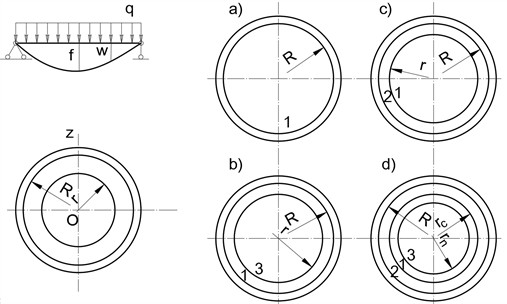
Among the investigated parameters, the compliance of the support contour has the greatest influence on the behavior of long-term loaded plates and membranes. For a deformable support contour, the compatibility condition is obtained by equating the circumferential deformations of the plate and the contour ring:
Based on Eq. (3), the conditions for long-term loaded plates can be written as follows:
where, and denote the stiffnesses of the support contour and the plate, while and are parameters accounting for the development of non-elastic long-term deformation in the plate and in the support contour within the nonlinear deformation region.
The theoretical analysis of the long-term stress-strain state in a geometrically nonlinear formulation shows that three characteristic regions can be distinguished in a thin plate with a compliant support contour, as illustrated in Fig. 1.
For the considered case of long-term loading, the ultimate load corresponding to the yielding of reinforcement is determined by the following expression:
At this load level, the stresses in the near-contour zones do not yet reach their ultimate values. It should also be noted that the long-term strength of the material is lower than that of short-term loaded structures. In the adopted formulation, is an empirical parameter, while the remaining coefficients characterize the reinforcement, stiffness ratios, and the elastic-plastic properties of concrete.
The compatibility condition between the circular plate and the support contour is introduced in order to account for their joint deformation. This is important because the deformability of the support ring changes the boundary conditions of the plate and affects the distribution of circumferential forces in the near-contour region [7], [9], [11]. In Eqs. (3-5), and are the cross-sectional areas of the support contour and the plate, respectively; and are the elastic moduli of the contour material and concrete; and are the circumferential strains of the contour and the plate; and denote the stiffnesses of the support contour and the plate; and and characterize the development of non-elastic long-term deformation in the support contour and the plate. The coefficient is an empirical parameter, while , , , and describe reinforcement, stiffness ratio, and elastic-plastic deformation effects.
The use of these parameters allows the support contour to be considered not as an absolutely rigid boundary, but as a deformable structural element interacting with the circular plate. This approach is consistent with the analysis of reinforced concrete and steel-reinforced concrete circular plate systems, where long-term loading, stiffness degradation, and reinforcement behavior significantly affect the stress-strain state [7], [10-12], [14].
The calculation procedure consisted of several consecutive stages. First, the geometric and mechanical parameters of the circular plate and the support contour were defined. Second, the nonlinear axisymmetric bending equations were formulated according to the theory of flexible plates [1-4]. Third, the compatibility condition between the circumferential deformation of the plate and the support ring was introduced. Fourth, the deflections and stress resultants were calculated under increasing load levels. Fifth, long-term deformation effects were included using parameters describing non-elastic deformation development in concrete and the support contour [10], [12], [14]. Finally, the calculated deflections were compared with experimental values in order to verify the adequacy of the proposed methodology [6], [8], [15].
3. Results and discussion
3.1. Experimental validation
Experimental studies were carried out on circular reinforced concrete thin slabs interacting with a support ring. Physical models were implemented using scale ratios of 1:10, 1:15, and 1:20. The tested slabs had a diameter of 1200 mm and a thickness of 5 mm, while the support ring dimensions were 100×50 mm.
The experimental program was aimed at verifying the applicability of the proposed nonlinear calculation approach. The circular reinforced concrete plate models were tested in interaction with a deformable support ring. The loading was applied stepwise in order to trace the nonlinear development of deflections and to compare the measured values with theoretical predictions. At each loading stage, vertical displacements were measured at the plate center and along the symmetry axis. Particular attention was paid to the near-contour zones, where the influence of support contour compliance was expected to be most significant.
Such experimental validation is necessary because nonlinear reinforced concrete slabs may demonstrate a complex load-deflection response due to cracking, stiffness reduction, reinforcement action, and geometric nonlinearity [6], [8], [15]. In addition, long-term loading may further increase deflections and change the stress-strain state of reinforced concrete bending members [10], [12], [14]. Therefore, the comparison between calculated and experimental deflections provides an important basis for evaluating the reliability of the proposed calculation model.
The reinforcement arrangement and material properties corresponded to the adopted model design and were used consistently in both experimental testing and theoretical calculations. These parameters were taken into account when comparing the calculated and measured deflections of the circular plate models.
The test results confirmed the feasibility of manufacturing and operating such structures under realistic loading conditions. As the load increased, the slab exhibited both geometric nonlinearity, associated with large deflections, and physical nonlinearity, associated with nonlinear material behavior.
Fig. 2Deflections of the circular thin plate model: a) load-deflection curve; b) variation of the plate surface shape along the symmetry axis
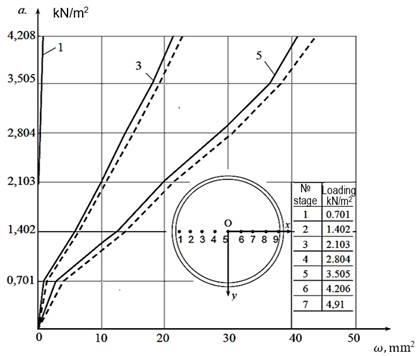
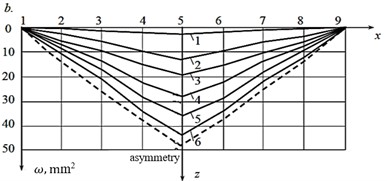
The analysis of deflections in the most stressed sections showed that the deflection profile in the axisymmetric direction was close to a parabolic form. The maximum deflection was observed at the plate center, whereas the minimum values occurred in the near-contour zones.
For numerical modeling, an algorithm and calculation program were developed to account for support contour deformation. Calculations were performed for slabs with spans of 1.2 m and 12 m under different loading levels.
To quantify the benefit of the nonlinear formulation, the measured deflections were also compared with the predictions of a linear-elastic reference model. The reference model keeps the same initial elastic flexural stiffness but assumes small deflections, so that the deflection grows in proportion to the load; its compliance was calibrated on the first, essentially uncracked loading stage. Because the tested plate has a diameter of 1200 mm and a thickness of only 5 mm, the central deflection reaches about eight times the plate thickness at the highest load, which is well beyond the range of validity of small-deflection theory.
Table 1Experimental and calculated deflections of the circular thin plate at mid-span
Indicator | Unit of measurement | Loading stage | |||||
1 | 2 | 3 | 4 | 5 | 6 | ||
Load | kN/m2 | 0.701 | 1.402 | 2.103 | 2.301 | 3.505 | 4.206 |
Experimental deflection | mm | 2.3 | 12.09 | 19.54 | 28.09 | 35.97 | 40.45 |
Calculated deflection | mm | 2.76 | 14.1 | 21.17 | 28.22 | 34.28 | 42.34 |
Exp./Calc. ratio | – | 0.833 | 0.856 | 0.923 | 0.993 | 1.019 | 0.955 |
Table 2Comparison of the nonlinear model and a linear-elastic reference model with the experimental deflections at successive loading stages
Indicator | 1 | 2 | 3 | 4 | 5 | 6 |
Load, kN/m2 | 0.701 | 1.402 | 2.103 | 2.301 | 3.505 | 4.206 |
Experimental deflection, mm | 2.3 | 12.09 | 19.54 | 28.09 | 35.97 | 40.45 |
Nonlinear model, mm | 2.76 | 14.10 | 21.17 | 28.22 | 34.28 | 42.34 |
Nonlinear model error, % | 20.0 | 16.6 | 8.3 | 0.5 | 4.7 | 4.7 |
Linear-elastic model, mm | 2.76 | 5.52 | 8.28 | 9.06 | 13.80 | 16.56 |
Linear-elastic model error, % | 20.0 | 54.3 | 57.6 | 67.7 | 61.6 | 59.1 |
As shown in Table 2, the linear-elastic model underestimates the experimental deflections by a factor of more than two at the higher loads, with a mean absolute error of about 53 % and a maximum error close to 68 %. The nonlinear model reduces the mean absolute error to about 9 % and keeps the discrepancy below 17 % in the high-load range. This more than fivefold reduction in error provides direct computational evidence that both the geometric and the material nonlinearity must be retained, and that the proposed model reproduces the observed plate behavior substantially better than a linear formulation.
The comparison between calculated and experimental deflections confirms that the proposed model adequately reflects the nonlinear deformation behavior of circular thin reinforced concrete plates. The load-deflection curves show a nonlinear increase in deflection with increasing load, which is consistent with the general behavior of geometrically and physically nonlinear plate systems [3], [4], [6], [8]. The maximum deflection was observed at the plate center, while the near-contour zones demonstrated lower vertical displacements but a more pronounced redistribution of internal forces.
The compliance of the support contour has a significant influence on the stress-strain state, stiffness, and deformability of the circular plate. If the support contour is assumed to be ideally rigid, radial and circumferential deformations near the boundary are strongly restrained. In contrast, a deformable support ring allows additional boundary displacement, which changes the distribution of circumferential forces and affects the stiffness of the entire plate-contour system [7], [9], [11]. This effect becomes especially important under long-term loading, because creep-related deformation and stiffness degradation may increase the difference between rigid-contour and deformable-contour assumptions [10], [12], [14].
Therefore, neglecting support contour compliance may lead to an inaccurate assessment of deflection, stiffness, crack resistance, and load-bearing capacity. The obtained experimental agreement supports the practical applicability of the proposed approach for circular RC and SRC plates in which nonlinear deformation and contour flexibility must be considered [6-8], [14], [15].
Overall, the comparison of experimental and calculated data demonstrated satisfactory agreement. The discrepancy in deflections under high loads did not exceed 17 %, which is acceptable for nonlinear structural analysis.
For the considered model plate, the calculated failure load was 4.63 kN/m2, whereas the experimental value was 4.91 kN/m2, corresponding to a discrepancy of 6.04 %. These results confirm the adequacy of the proposed methodology for predicting the stress-strain state of circular thin plates with a deformable support contour.
For structures subjected to high operational loads, the use of steel-reinforced concrete slabs is recommended because of their increased stiffness and improved load-bearing capacity.
3.2. Load-bearing capacity of steel-reinforced concrete circular plates in the operational stage
To estimate the load-bearing capacity of steel-reinforced concrete circular plates in the operational stage, the internal and external forces acting in the cross-section are considered:
From this expression, the corresponding transformed relation is obtained:
The equation of moments relative to the neutral axis is then written as follows:
In Eqs. (6-8), is the height of the compressed concrete zone at time , is the design compressive stress in concrete under long-term loading, is the stress in reinforcement, as is the reinforcement area, is the effective depth of the section, and is the ultimate bending moment. These expressions are used to describe the equilibrium of internal forces and moments in the normal section of a steel-reinforced concrete circular plate at the operational stage [7], [9], [11].
For the case of a uniformly distributed long-term load, the work of external forces is expressed by:
For a long-term centrally applied concentrated force, the work of external forces is written as follows:
The work of internal forces from long-term loading is expressed by:
By equating the work of external and internal forces, expressions for the ultimate long-term load corresponding to slab failure along the normal cross-section can be obtained:
For the case of a long-term centrally applied concentrated force, the corresponding expression is:
If the plate is clamped along the contour, the work formula must also include the work of forces in the contour hinges. As a result, the expressions for distributed and concentrated long-term loads may be represented in the form:
where, is the ultimate bending moment of the plate, and is the ultimate bending moment in the contour hinge.
The developed expressions make it possible to estimate the ultimate load-bearing capacity of steel-reinforced concrete circular plates while accounting for long-term loading, nonlinear deformation effects, and the deformability of the support contour.
4. Conclusions
This study developed and experimentally validated a nonlinear calculation approach for circular thin reinforced concrete and steel-reinforced concrete plates resting on a compliant support contour. The novelty of the approach is that geometric nonlinearity, material nonlinearity, reinforcement action, long-term (creep) deformation, and support-contour compliance are treated together as a single coupled problem, rather than as the separate or idealized effects considered in earlier formulations. The deformability of the support ring is introduced through a compatibility condition between the circumferential strains of the plate and the ring, so that the contour acts as a deformable structural element instead of an ideally rigid boundary.
Because the tested plates reached central deflections of the order of several times their thickness, small-deflection linear theory is not applicable: the large-deflection membrane action and the progressive loss of stiffness caused by concrete cracking and reinforcement yielding jointly govern the response, and accounting for both is the decisive feature of the proposed model. Within this framework, support-contour compliance redistributes the circumferential forces near the boundary and increases plate deflections, an effect that becomes most pronounced under long-term loading. Assuming an ideally rigid contour therefore leads to an unsafe underestimation of deflection and to an inaccurate assessment of stiffness, crack resistance, and load-bearing capacity.
The predictive advantage of the nonlinear formulation was confirmed quantitatively. Over the full loading range the nonlinear model reproduced the measured deflections with a mean error of about 9 % and a maximum discrepancy below 17 % at high loads, and it predicted the failure load to within 6.04 %. A linear-elastic reference model, by contrast, underestimated the experimental deflections by a factor of more than two and gave a mean error above 50 %, which shows that the nonlinear effects cannot be neglected if engineering-accurate predictions are required.
The developed methodology can therefore be applied to the design and assessment of circular RC and SRC plates whenever nonlinear deformation and contour flexibility must be taken into account. For structures subjected to high operational loads, steel-reinforced concrete solutions remain preferable because of their greater stiffness and improved load-bearing capacity. Future work will extend the formulation to non-axisymmetric loading and to the coupled influence of cracking patterns on the long-term plate-contour interaction.
References
-
S. Timoshenko and S. Woinowsky-Krieger, Theory of Plates and Shells. New York, NY, USA: McGraw-Hill, 1959.
-
A. S. Volmir, Stability of Deformable Systems. Part 1. Moscow, Russia: Yurait, 2019, p. 526.
-
J. N. Reddy, Theory and Analysis of Elastic Plates and Shells. Boca Raton, FL, USA: CRC Press, 2006, https://doi.org/10.1201/9780849384165
-
V. V. Karpov, Geometrically Nonlinear Problems for Plates and Shells and Methods for Their Solution. Moscow, Russia; St. Petersburg, Russia: ASV; SPbGASU, 1999, p. 154.
-
D. A. Ivanychev, “Modeling the stress-strain state of anisotropic plates by the boundary states method,” Ecological Bulletin of Research Centers of the Black Sea Economic Cooperation, Vol. 19, No. 2, pp. 17–28, 2022.
-
G. R. Fernandes and W. S. Venturini, “Non-linear boundary element analysis of plates applied to concrete slabs,” Engineering Analysis with Boundary Elements, Vol. 26, No. 2, pp. 169–181, Feb. 2002, https://doi.org/10.1016/s0955-7997(01)00091-1
-
S. R. Razzakov, K. S. Razzakov, and J. S. Razzakov, “Limit state of steel reinforced concrete round plates in the operational stage,” Journal of Physics: Conference Series, Vol. 1425, No. 1, p. 012101, Dec. 2019, https://doi.org/10.1088/1742-6596/1425/1/012101
-
R. Wang, Z. Fang, M. Lezgy-Nazargah, and H. Khosravi, “Nonlinear analysis of reinforced concrete slabs using a quasi-3D mixed finite element formulation,” Engineering Structures, Vol. 294, p. 116781, Nov. 2023, https://doi.org/10.1016/j.engstruct.2023.116781
-
G. L. Vatulya and A. A. Shevchenko, “Limit state of steel-concrete circular plates at normal section,” Building Structures, Vol. 78, No. 78, pp. 137–143, 2013.
-
D. Bacinskas, G. Kaklauskas, V. Gribniak, W.-P. Sung, and M.-H. Shih, “Layer model for long-term deflection analysis of cracked reinforced concrete bending members,” Mechanics of Time-dependent Materials, Vol. 16, No. 2, pp. 117–127, 2011, https://doi.org/10.1007/s11043-011-9138-9
-
S. R. Razzakov, Composite Reinforced Concrete Shells of Building Coatings under Conditions of Long-Term Operation and Seismic Effects. Tashkent, Uzbekistan: Fan, Publishing House of the Academy of Sciences of the Republic of Uzbekistan, 2004, p. 380.
-
A. Fuzail Hashmi, M. Shariq, and A. Baqi, “Successive sustained loading effect on the long-term deflection of flat slab,” SN Applied Sciences, Vol. 2, No. 11, p. 1896, Oct. 2020, https://doi.org/10.1007/s42452-020-03703-0
-
A. R. Tusnin and M. V. Postarnak, “Membrane structures: application experience and development prospects,” Vestnik MGSU, Vol. 18, No. 3, pp. 401–415, Mar. 2023, https://doi.org/10.22227/1997-0935.2023.3.401-415
-
H. A. Kader and S. A. Daud, “Numerical validation of reinforced concrete one-way slabs under long-term loading using nonlinear finite element analysis,” Innovative Infrastructure Solutions, Vol. 9, No. 9, p. 347, Aug. 2024, https://doi.org/10.1007/s41062-024-01665-5
-
N. I. Dedov and V. N. Isutkina, “Elastoplastic deformation of geometrically nonlinear plates and shallow shells,” Bulletin of the Samara Scientific Center of the Russian Academy of Sciences, Vol. 20, No. 4(2)(84), 2018.
-
E. Shipacheva, S. Shaumarov, A. Gulamov, and M. M. Talipov, “Modeling of interaction of external enclosing structures of buildings with the internal and external environments,” in ICTEA: International Conference on Thermal Engineering, Vol. 1, No. 1, 2024.
-
E. Shipacheva, S. Shaumarov, A. Gulamov, M. M. Talipov, and S. Kandakharov, “Water structure and its influence on cement stone and concrete properties,” in ICTEA: International Conference on Thermal Engineering, Vol. 1, No. 1, 2024.
About this article

The authors have not disclosed any funding.
The datasets generated during and/or analyzed during the current study are available from the corresponding author on reasonable request.
The authors declare that they have no conflict of interest.

