Abstract
This paper presents a modular lower-limb exoskeleton concept fo4r early rehabilitation after hip and knee endoprosthesis. The system combines a cable-driven (Bowden) mechanism, a Hip-Knee modular architecture, and an adaptive Assist-as-Needed control strategy. The “one motor – two functions” principle reduces system weight and improves energy efficiency. Real-time control based on IMU and force sensors ensures accurate and safe motion. The proposed solution provides a lightweight and adaptive approach for simultaneous rehabilitation of the hip and knee joints.
Highlights
- A lightweight modular cable-driven lower-limb exoskeleton was developed for early rehabilitation after hip and knee endoprosthesis.
- The integrated Bowden cable transmission and "one motor – two functions" concept reduce system weight while improving energy efficiency.
- An adaptive Assist-as-Needed control strategy based on IMU and force sensors enables safe and personalized rehabilitation of the hip and knee joints.
- The modular architecture supports simultaneous rehabilitation of both joints while facilitating future system customization and clinical development.
- Patient after hip and knee replacement → Modular cable-driven exoskeleton → IMU + Force Sensors → Assist-as-Needed Controller → Bowden Cable Drive ("One Motor – Two Functions") → Hip & Knee Rehabilitation (Improved Mobility, Lightweight Design, Energy Efficiency)
1. Introduction
The number of joint replacement surgeries is steadily increasing due to the growing prevalence of musculoskeletal disorders, particularly in the hip and knee. In Kazakhstan, more than 8,000 such procedures are performed annually, while globally the demand continues to rise, with millions of cases reported each year [1-2].
Despite advances in surgical techniques, postoperative rehabilitation remains insufficiently automated and largely dependent on passive devices and manual therapy. This limits early patient activation and prolongs recovery, especially during the critical early stage when muscle strength, coordination, and range of motion must be restored.
Robotic exoskeletons have emerged as a promising solution; however, most existing systems are limited to single-joint rehabilitation, primarily targeting the knee, which reduces their effectiveness in combined hip-knee recovery scenarios.
To address these limitations, this study proposes a novel modular cable-driven lower-limb exoskeleton that enables simultaneous rehabilitation of the hip and knee joints. The main innovations include a lightweight Bowden-based actuation system, a modular architecture for multi-joint adaptability, and a “one motor – two functions” principle combined with an Assist-as-Needed control strategy, providing energy-efficient and patient-adaptive rehabilitation.
2. Clinical background and problem statement
Hip and knee endoprosthesis are an effective surgical procedure that restores joint function by replacing damaged joint surfaces with artificial components. It is widely used for osteoarthritis, trauma, and degenerative conditions, significantly improving patients’ quality of life.
However, successful surgery does not guarantee full recovery. The main challenge lies in the postoperative rehabilitation phase, during which muscle strength, coordination, and range of motion must be restored.
The main stages of hip and knee joint replacement are illustrated in Fig. 1. In hip arthroplasty (a), the femoral head and acetabulum are replaced, restoring load-bearing and rotational functions. In knee arthroplasty (b), the joint surfaces are covered with metallic components and a polyethylene insert, ensuring smooth motion and stability.
Fig. 1Schematic representation of a) hip and b) knee joint replacement [1, 2]
![Schematic representation of a) hip and b) knee joint replacement [1, 2]](https://static-01.extrica.com/articles/26477/26477-img1.jpg)
a)
![Schematic representation of a) hip and b) knee joint replacement [1, 2]](https://static-01.extrica.com/articles/26477/26477-img2.jpg)
b)
The first weeks after surgery are critical for recovery. In current clinical practice, rehabilitation is mainly based on passive mechanotherapy or manually assisted exercises, which do not provide precise control of motion or accurate load regulation.
As a result, several limitations arise:
1) Lack of precise and repeatable motion control.
2) Limited ability to regulate loading.
3) Delayed patient activation in early stages.
4) Increased physical workload for therapists.
The absence of active mechanical support leads to slower recovery and increases the risk of complications, including joint contractures, implant displacement, movement asymmetry, and re-injury.
Thus, the main limitation is not the surgical procedure itself, but the lack of effective rehabilitation systems capable of ensuring safe and controlled movement in the early postoperative stage. To address this issue, robotic exoskeleton systems that provide physiological motion, precise load control, and patient-adaptive assistance are required.
3. Analysis of existing rehabilitation systems
Robotic rehabilitation systems and exoskeletons are widely used after joint replacement surgery and have demonstrated clinical effectiveness, particularly in knee rehabilitation. These systems improve motion control, enable early muscle activation, and reduce the risk of contractures. One of the most well-known systems is the HAL (Hybrid Assistive Limb) exoskeleton [3-6], which utilizes bio-signals such as electromyography and ground reaction forces to synchronize movement with the patient’s intention. Although HAL supports both hip and knee motion, its complexity limits practical clinical use. The HAL-SJ (Single-Joint) version [7] is designed specifically for the knee joint and is suitable for early-stage rehabilitation. However, its functionality is restricted to a single joint. The Lokomat system (Hocoma AG) [8-10] is widely used for gait training. It combines an exoskeleton with a body-weight support system, improving movement symmetry and coordination. However, it is a stationary device and is not well suited for early joint-specific rehabilitation. Other systems, such as AVATAR-M [11], provide bilateral support during walking, while RAW-T (Robot-Assisted Walking Training) [12] uses sensor-based feedback to control motion parameters.
Despite their advantages, these systems share common limitations. Most are designed for single-joint rehabilitation, primarily targeting the knee. Even multi-joint systems do not provide fully synchronized control of hip and knee motion.
In addition, many systems are either stationary or structurally complex and heavy. Locally mounted actuators increase inertia on the limbs, which is a critical limitation in the early postoperative stage. A comparison of representative systems is presented in Table 1.
Table 1Exoskeleton and robotic systems used after endoprosthesis
No. | System | Country / manufacturer | Key features |
1 | HAL (Hybrid Assistive Limb) [3-6] | Japan, Cyberdyne | Bio-signal-based control, high accuracy |
2 | HAL-SJ [7] | Japan | Single-joint system, lightweight |
3 | Lokomat [8-10] | Switzerland | Robotic gait training system |
4 | AVATAR-M [11] | China | Bilateral lower-limb support |
5 | RAW-T [12] | China | Sensor-based motion control |
Thus, existing systems do not provide an effective solution for simultaneous hip and knee rehabilitation. This highlights the need for a new generation of lightweight, adaptive exoskeletons based on modular architecture, cable-driven (Bowden) transmission, and advanced control strategies.
4. Concept of the proposed exoskeleton
This work proposes a modular lower-limb exoskeleton for early rehabilitation after hip and knee endoprosthesis, enabling simultaneous support of both joints.
The system employs a cable-driven (Bowden) transmission, where motors and power units are located at the waist, and force is transmitted via flexible cables. This approach significantly reduces limb inertia and improves safety during early-stage rehabilitation.
The design consists of two modules (hip and knee), which can operate independently or synchronously, allowing adaptation to different stages of patient recovery.
Fig. 2 illustrates the engineering concept of the proposed exoskeleton, including its structural configuration, actuator placement, and cable routing strategy. The system is based on a lightweight wearable frame attached to the waist, thigh, and shank segments. Remote actuation is implemented through Bowden cables, which transmit forces from the waist-mounted actuators to the hip and knee joints.
Fig. 2Conceptual design of the modular cable-driven lower-limb exoskeleton (AlmatyHipKneeRehabExo)
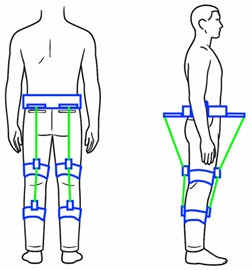
A distinctive feature of the design is the cable routing geometry, which enables efficient force transmission while maintaining kinematic compatibility with natural human motion. The triangular cable arrangement (side view in Fig. 2) ensures stable force direction and minimizes undesired joint loading.
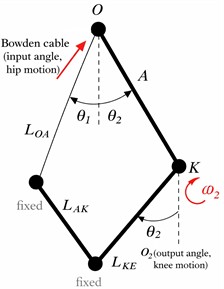
The proposed kinematic scheme (Fig. 3) is considered as a planar multi-link mechanism, where points , , , and represent revolute joints: is the fixed base (hip level), is the driving link, corresponds to the knee joint, and is the lower fixed support. The structure consists of three main rigid links: (thigh segment), (intermediate link), and (shank segment). The system motion is defined by the input angle , which is generated by the actuator via a Bowden cable and causes rotation of link . This motion is transmitted through the kinematic chain to link , resulting in the output angle , which describes the rotation of link (knee motion). Thus, a functional relationship , is established within the mechanism, while the angular velocity at point characterizes the dynamic behavior of the output motion. This scheme demonstrates the “one motor – two functions” principle, enabling synchronized motion of two joints using a single actuator.
Fig. 3Kinematic scheme of the proposed hip-knee exoskeleton (AlmatyHipKneeRehabExo)
A key contribution is the “one motor – two functions” principle, enabling control of both flexion and extension with a single actuator, reducing system weight by approximately 40-50 %. Structural components are manufactured using FDM with PEEK material, providing a balance between mechanical strength, low weight, and biocompatibility.
Control is based on an adaptive Assist-as-Needed strategy. IMU and cable tension sensors provide real-time feedback, enabling precise and safe motion assistance depending on the patient’s condition.
The proposed concept follows current trends toward lightweight, energy-efficient, and modular exoskeletons and represents a compact and adaptive solution for multi-joint rehabilitation.
5. Control system, electronics, and motion characteristics
The conducted experimental study evaluated the capability of the developed IMU-based system to monitor lower-limb motion during dorsiflexion and plantarflexion. The results demonstrated that the system reliably captures angular velocity, linear acceleration, and segment orientation in real time.
Analysis of the recorded data showed that the dominant motion component occurs along the Pitch axis, corresponding to dorsiflexion–plantarflexion movement, while Roll and Yaw components remain comparatively small. The measured angular range of motion (–28° to 27°) is consistent with physiological ankle kinematics, confirming the validity of the sensing approach.
From a dynamic perspective, the system exhibits stable and smooth motion behavior within the measured range. The angular displacement follows a continuous profile without abrupt changes, indicating proper actuator response and effective transmission of motion. The obtained results suggest that the proposed system can ensure controlled joint movement with sufficient amplitude for rehabilitation tasks.
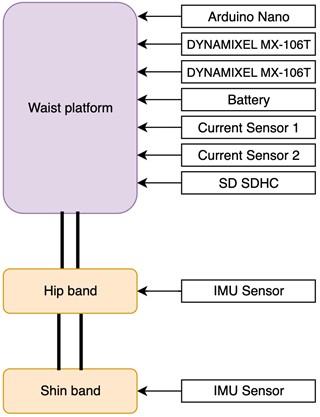
Fig. 4Functional diagram of the exoskeleton control system.
In addition, the use of cable-driven transmission reduces distal mass and inertia, which is critical for minimizing undesired dynamic effects such as oscillations and joint overloading during early rehabilitation.
At the current stage, the study focuses on kinematic evaluation; however, preliminary observations indicate low structural deflection due to the rigid frame design and distributed load transfer through the cable system.
Future work will include detailed dynamic modeling, force analysis, and experimental validation of joint torque, stiffness, and interaction forces between the user and the exoskeleton.
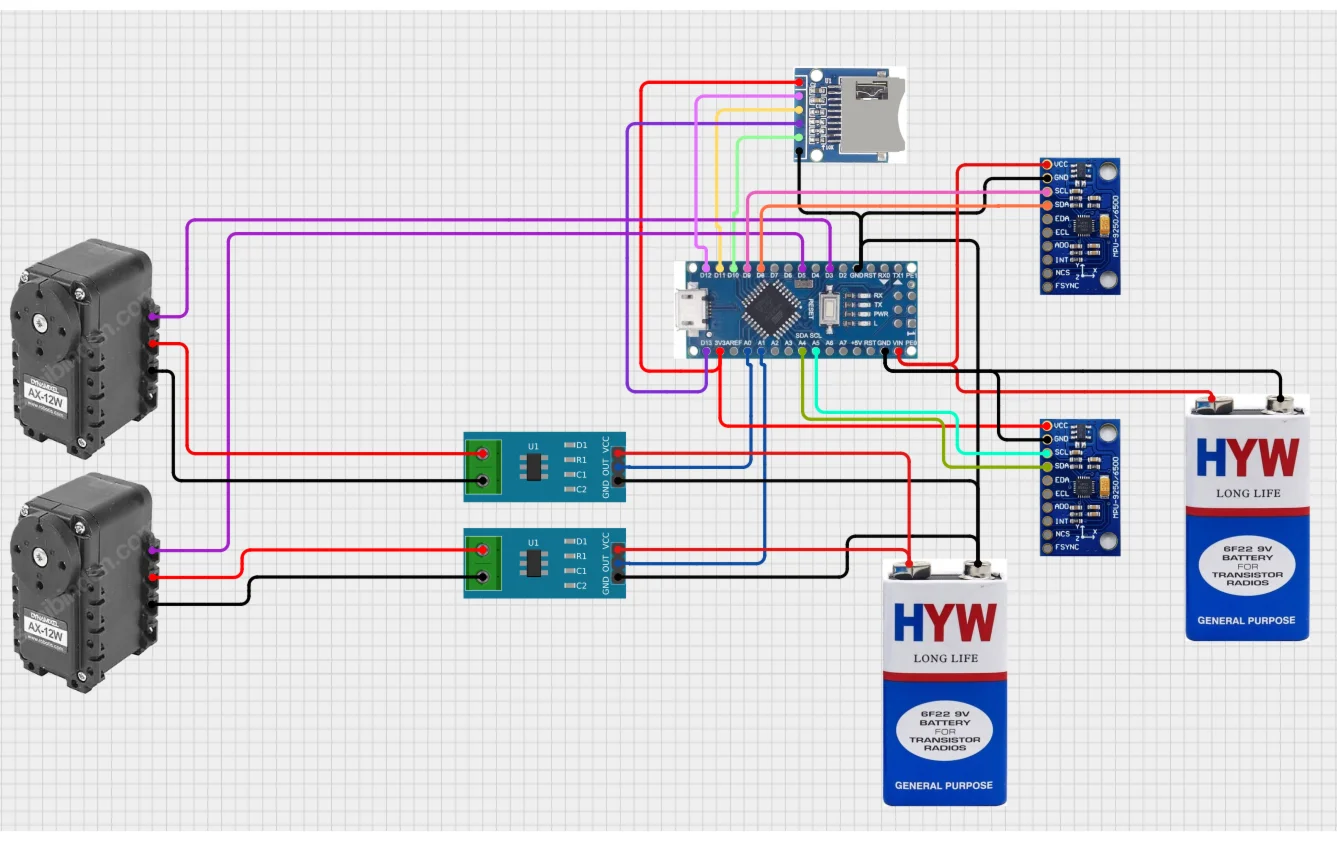
The control architecture integrates sensors, actuators, and processing units, enabling real-time feedback-based operation and adaptive assistance.
Fig. 5Electrical scheme of the exoskeleton control system
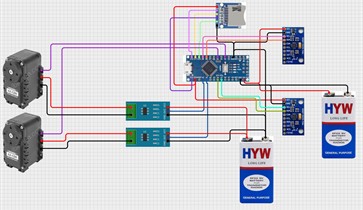
The hardware implementation follows the electrical architecture shown in Fig. 4, where the Arduino Nano interfaces with actuators, sensors, and data storage modules, enabling real-time distributed control.
6. Discussion and conclusion
Existing robotic rehabilitation systems show clinical effectiveness but are limited by single-joint functionality, high weight, or stationary design, restricting their use in early-stage rehabilitation.
The proposed modular exoskeleton addresses these limitations by enabling simultaneous hip-knee rehabilitation. The cable-driven (Bowden) transmission relocates heavy components to the waist, reducing limb inertia and improving safety. The “one motor – two functions” concept decreases actuator count and reduces system weight, improving energy efficiency. The Assist-as-Needed control strategy provides adaptive support, promoting active patient participation and more effective recovery. The use of PEEK materials further enhances structural strength and biocompatibility.
However, the current study is limited to conceptual design and laboratory validation. Clinical trials are required to confirm effectiveness, and cable-related issues such as friction and backlash may affect control accuracy.
Overall, the proposed system represents a lightweight and adaptive solution for early rehabilitation after endoprosthesis, with the potential to reduce recovery time, decrease clinical workload, and improve patient outcomes
References
-
“Health at a glance 2023: oecd indicators,” OECD Publishing, Paris, 2023.
-
“American joint replacement registry surpasses 4 million captured hip and knee arthroplasty procedures,” American Academy of Orthopaedic Surgeons (AAOS), Nov. 2024.
-
“Hal (hybrid assistive limb) – the world’s first wearable cyborg.” Cyberdyne Inc., https://www.cyberdyne.jp/english/products/hal
-
Y. Sankai, “Hal: hybrid assistive limb based on cybernics,” in Springer Tracts in Advanced Robotics, Vol. 66, Berlin, Heidelberg: Springer Berlin Heidelberg, 2010, pp. 25–34, https://doi.org/10.1007/978-3-642-14743-2_3
-
M. Koda et al., “Robotic rehabilitation therapy using Hybrid Assistive Limb (HAL) for patients with spinal cord lesions: a narrative review,” North American Spine Society Journal (NASSJ), Vol. 14, p. 100209, 2023, https://doi.org/10.1016/j.xnsj.2023.100209
-
T. Nakajima et al., “Cybernic treatment with wearable cyborg Hybrid Assistive Limb (HAL) improves ambulatory function in patients with slowly progressive rare neuromuscular diseases: a multicentre, randomised, controlled crossover trial for efficacy and safety (NCY-3001),” Orphanet Journal of Rare Diseases, Vol. 16, No. 1, p. 304, 2021, https://doi.org/10.1186/s13023-021-01928-9
-
E. W. Tan, S. C. Chai, Y. Sankai, M. Shingu, N. A. Razaob, and H. Hussain, “Single joint hybrid assistive limb (HAL-SJ) robotic exoskeleton therapy in improving functional outcomes among workers with wrist fractures: Study protocol for a randomized controlled trial,” PLOS One, Vol. 20, No. 4, p. e0322191, Apr. 2025, https://doi.org/10.1371/journal.pone.0322191
-
M. E. Cabrera-Brito et al., “Effect of Lokomat® robotic rehabilitation on balance, postural control, and functional independence in subacute and chronic stroke patients: a quasi-experimental study,” Medical Sciences, Vol. 13, No. 3, p. 157, 2025, https://doi.org/10.3390/medsci13030157
-
L. Wu, G. Xu, and Q. Wu, “The effect of the Lokomat® robotic-orthosis system on lower extremity rehabilitation in patients with stroke: a systematic review and meta-analysis,” Frontiers in Neurology, Vol. 14, 2023, https://doi.org/10.3389/fneur.2023.1260652
-
F. Baronchelli, C. Zucchella, M. Serrao, D. Intiso, and M. Bartolo, “The effect of robotic assisted gait training with Lokomat® on balance control after stroke: systematic review and meta-analysis,” Frontiers in Neurology, Vol. 12, 2021, https://doi.org/10.3389/fneur.2021.661815
-
Mert et al., “Comparative efficacy and precision of robot-assisted vs. conventional total knee arthroplasty: a systematic review and meta-analysis of randomized controlled trials,” Journal of Clinical Medicine, Vol. 14, No. 9, p. 3249, 2025, https://doi.org/10.3390/jcm14093249
-
H. Wang, H. Shen, Y. Han, W. Zhou, and J. Wang, “Effect of robot-assisted training for lower limb rehabilitation on lower limb function in stroke patients: a systematic review and meta-analysis,” Frontiers in Human Neuroscience, Vol. 19, 2025, https://doi.org/10.3389/fnhum.2025.1549379
-
“Rehabilitation robots market size, share and trends analysis report, 2024-2033.” Nova One Advisor, 2024, https://www.novaoneadvisor.com/report/rehabilitation-robots-market
-
“Exoskeleton market size and share, industry report, 2030.” Grand View Research Inc., 2025, https://www.grandviewresearch.com/industry-analysis/exoskeleton-market
-
S. Yu et al., “Quasi-direct drive actuation for a lightweight hip exoskeleton with high backdrivability and high bandwidth,” IEEE/ASME Transactions on Mechatronics, Vol. 25, No. 4, pp. 1794–1802, 2020, https://doi.org/10.1109/tmech.2020.2995134
-
G. G. Muscolo, M. Conconi, L. Chiari, A. Del Felice, and N. Sancisi, “Conceptual and functional design of a new sustainable cable-driven hip exoskeleton,” in Mechanisms and Machine Science, Vol. 180, Cham: Springer Nature Switzerland, 2025, pp. 265–272, https://doi.org/10.1007/978-3-031-91179-8_28
-
M. Xiloyannis, L. Cappello, K. D. Binh, C. W. Antuvan, and L. Masia, “Preliminary design and control of a soft exosuit for assisting elbow movements and hand grasping in activities of daily living,” Journal of Rehabilitation and Assistive Technologies Engineering, Vol. 4, 2017, https://doi.org/10.1177/2055668316680315
-
D. Archangeli, B. Ortolano, R. Murray, L. Gabert, and T. Lenzi, “A lightweight powered hip exoskeleton with parallel actuation for frontal and sagittal plane assistance,” IEEE Transactions on Robotics, Vol. 41, pp. 1711–1727, 2025, https://doi.org/10.1109/tro.2025.3539172
-
L. Yu, H. Leto, and S. Bai, “Design and gait control of an active lower limb exoskeleton for walking assistance,” Machines, Vol. 11, No. 9, p. 864, Aug. 2023, https://doi.org/10.3390/machines11090864
-
J. de Miguel-Fernández, J. Lobo-Prat, E. Prinsen, J. M. Font-Llagunes, and L. Marchal-Crespo, “Control strategies used in lower limb exoskeletons for gait rehabilitation after brain injury: a systematic review and analysis of clinical effectiveness,” Journal of NeuroEngineering and Rehabilitation, Vol. 20, No. 1, p. 23, 2023, https://doi.org/10.1186/s12984-023-01144-5
-
J. Bermejo-García, D. Rodríguez Jorge, F. Romero-Sánchez, A. Jayakumar, and F. J. Alonso-Sánchez, “Actuation strategies for a wearable cable-driven exosuit based on synergies in younger and older adults,” Sensors, Vol. 23, No. 1, p. 261, Dec. 2022, https://doi.org/10.3390/s23010261
About this article

This research has been funded by the Ministry of Science and Higher Education of the Republic of Kazakhstan, Grant No. AP32316445.
The datasets generated during and/or analyzed during the current study are available from the corresponding author on reasonable request.
Dr. Nursultan Zhetenbayev is a scientific committee member of the 77th International Conference on Vibroengineering and was not involved in the editorial review and/or the decision to publish this article.

