Abstract
This paper presents an approximate mathematical model for the analysis of non-stationary transverse vibrations of a three-layer viscoelastic plate composed of two load-bearing face layers and a deformable core. The governing equations are derived within the framework of the three-dimensional linear elasticity theory under plane deformation assumptions and reduced to a form suitable for engineering calculations. A frequency equation for harmonic vibrations is obtained and solved numerically using Maple 17. The analysis is performed for plates with steel and aluminum face layers combined with different core materials, including polymer, fiberglass, wood plastic, and textolite, for several core thicknesses. The numerical results are presented as frequency-wave number relationships and used to evaluate the influence of geometric and physical-mechanical parameters on the dynamic response of the plate. It is shown that the lowest vibration frequency increases with increasing wave number and core thickness. For identical geometric parameters, plates with aluminum face layers exhibit slightly higher frequencies than plates with steel face layers, whereas the core material significantly affects the frequency level due to the combined influence of stiffness and density. The proposed model can be used for rapid frequency assessment of layered structural elements subjected to transverse dynamic loading. Viscoelastic dissipation in the layers is introduced through the elastic-viscoelastic correspondence principle, and the formal range of applicability of the model is identified in terms of the dimensionless wave number and the face-to-core thickness ratio. The proposed model is verified against a Semi-Analytical Finite Element (SAFE) plane-strain 3-D elasticity benchmark, against which it agrees substantially better than the classical Kirchhoff-Love thin-plate theory within the entire claimed applicability range.
1. Introduction
Layered and sandwich plates are widely used in civil, mechanical, aerospace, and transport engineering because they provide favorable combinations of stiffness, strength, and low weight [1], [3], [4]. Their broad application in structural systems has led to extensive research into their static and dynamic behavior, especially under variable external actions and vibration loading [5], [6]. In many engineering applications, such structural elements may also operate under severe service conditions, including dynamic and seismic effects, which makes the study of their vibration response especially important for reliable design and safe operation [16].
A considerable number of studies have been devoted to the development of analytical and numerical approaches for multilayer and sandwich plates. Classical, layerwise, and higher-order deformation theories have significantly improved the understanding of displacement fields, stresses, and vibration characteristics of such structures [7], [8], [11], [14], [15]. At the same time, a number of works have specifically addressed the behavior of three-layer plates and related engineering models, including transverse vibration formulations and approximate mathematical descriptions suitable for practical calculations [2], [6], [9], [12], [13]. More recently, this research direction has been advanced by studies on wave dispersion in three-layered sandwich plates with strongly contrasting soft-core and stiff-skin layers [18], on axisymmetric vibrations of circular sandwich plates with a fractional viscoelastic core verified against finite element solutions in ANSYS [19], and on equivalent-plate models for the dynamic and damping behavior of three-layer sandwich panels with shearing or highly dissipative cores [20], [21], which confirm the practical importance of simplified yet physically meaningful descriptions of layered structures. These studies provide an important foundation for the analysis of layered structural elements; however, many of them are mainly focused on free vibration, generalized theoretical formulations, or simplified structural configurations.
Despite the substantial progress achieved in this field, the problem of non-stationary transverse vibrations of three-layer viscoelastic plates still requires further investigation. In particular, the combined influence of the material of the load-bearing layers, the physical-mechanical properties of the core, and its thickness on the frequency characteristics of the plate has not been sufficiently clarified for computationally efficient engineering models. This issue is especially relevant for the preliminary design and comparative analysis of layered structural systems, where simplified but physically meaningful mathematical formulations are needed [10], [17].
The aim of this study is to develop an approximate mathematical model for the dynamic analysis of a three-layer viscoelastic plate subjected to non-stationary transverse vibrations, to derive a frequency equation for harmonic oscillations, and to investigate the effect of material and geometric parameters on the lowest vibration frequencies.
The novelty of the present work lies in the development of an approximate model for non-stationary transverse vibrations of a three-layer viscoelastic plate and in the quantitative evaluation of how the material of the face layers and the thickness and type of the filler affect the frequency-wave number relationship. Unlike general review-type studies and conventional stationary vibration formulations, the proposed approach is oriented toward rapid engineering frequency assessment of layered plates with different structural configurations. Specifically, the proposed formulation: (i) yields a closed-form dispersion relation, Eq. (6), that reduces the eigenfrequency problem to the roots of a low-order polynomial in ; (ii) admits a direct substitution of complex Lamé operators in accordance with the elastic-viscoelastic correspondence principle, without re-derivation of the governing equations; (iii) accommodates arbitrary combinations of metallic face layers and polymer-like cores; and (iv) reduces, in the long-wave limit, to the classical Kirchhoff–Love prediction (see Section 3.2.1), which confirms its consistency with established plate theories while providing a refined description in the intermediate-wave-number range. These features distinguish the present model both from refined three-dimensional formulations of higher computational cost and from conventional thin-plate theories that lose accuracy in the same range.
To achieve this objective, the governing equations of the model are derived, a frequency equation for harmonic vibrations is obtained, and numerical calculations are performed for plates with steel and aluminum face layers combined with different core materials. The resulting dependences are then used to identify the role of the main geometric and physical-mechanical parameters in the dynamic response of the considered three-layer plate.
2. Materials and methods
2.1. Structural model and basic assumptions
Let us consider a three-layer plate infinite in the in-plane direction. The plate consists of two load-bearing face layers with thicknesses and and a middle core layer with thickness . The plate is analyzed under transverse vibration conditions.
When deriving the governing equations, it is assumed that both the plate as a whole and each of its layers obey the three-dimensional linear theory of elasticity. Since the plate is infinite in plan, the problem is considered under plane strain conditions in the rectangular coordinate system , where the axis is directed along the midline of the cross-section and the axis is directed upward, perpendicular to the axis.
The outer layers are referred to as the first and second load-bearing layers, while the middle layer is treated as the zero layer. The task is to investigate the harmonic transverse vibrations of such a plate.
The material of each layer is modelled as linearly viscoelastic and isotropic. The constitutive relations are formulated in the Boltzmann hereditary integral form, so that the elastic Lamé constants and appearing in the governing equations have to be interpreted as integral operators with the corresponding relaxation kernels of the k-th layer. For the analysis of harmonic vibrations, the elastic-viscoelastic correspondence principle is applied: the Lamé constants are replaced by their complex Fourier images and , the imaginary parts of which describe internal energy dissipation in the layers. In the present numerical study, the weakly-damped regime is considered, in which the loss factors of the layer materials are small (typically 0.05). Under this assumption, the real part of the complex eigenfrequency obtained from Eq. (6) coincides with the corresponding elastic eigenfrequency up to terms of order , while the imaginary part determines the modal damping of the plate. Therefore the frequencies plotted in Figs. 2–5 are interpreted as the real parts of the complex eigenfrequencies of the three-layer viscoelastic plate, and the elastic form of Eq. (6) is used as their leading-order approximation. The extension to strongly dissipative cores (e.g. polymeric fillers with 0.1) requires solving the dispersion relation directly with complex , , which is beyond the scope of this paper.
Fig. 1Schematic diagram of the three-layer plate and the external forces acting on it (adapted from [2])
![Schematic diagram of the three-layer plate and the external forces acting on it (adapted from [2])](https://static-01.extrica.com/articles/26520/26520-img1.jpg)
2.2. Governing equations
As resolving equations, we take the general equations of transverse vibrations of a three-layer plate proposed in the earlier work. Since these equations contain infinitely high orders of derivatives, an approximate engineering form is introduced by truncating the corresponding infinite series and retaining the zero- or first-order terms in the expansion of hyperbolic functions in powers of the transverse coordinate. As a result, approximate equations of vibration of a three-layer plate suitable for solving applied problems are obtained.
Passing to the dimensionless variables according to the formulas:
We obtain the governing equations:
where, is the velocity of longitudinal waves in the material of the middle layer; , , and are the velocities of transverse waves in the materials of the layers; is the plate length; and are the principal parts of the longitudinal and transverse displacements of the points of the middle layer of the three-layer plate; , 1, 2, are the functions of external actions; is the distance from the neutral plane of the middle layer to the plane relative to which the principal displacement components are introduced; , 0, 1, 2, are parameters related to the Lamé elastic constants and of the layer materials.
Along with the oscillation equations, the expressions for the displacement and stress components at points of all three layers of the plate are used. For the middle layer, the displacement components and and the stress have the form:
Similar expressions can be obtained for and . For the upper and lower load-bearing layers, the corresponding expressions are written in operator form as:
where, , , and are linear differential operators of the fourth order, denotes the operator inverse to , and , , are also linear differential operators of order not higher than the fourth. The above expressions for the displacement and stress components make it possible to determine the stress-strain state at an arbitrary point of the three-layer plate based on the principal displacement components and the solution of Eq. (1).
2.3. Harmonic vibration formulation
For the analysis of free harmonic transverse vibrations, the plate surfaces are assumed to be free from external loads. Therefore, the right-hand sides of the oscillation equations become equal to zero, and the solution is sought in the form:
where, is the circular frequency of oscillations and is the wave number. Substituting Eq. (4) into the oscillation equations gives a system of homogeneous algebraic equations with respect to and :
The coefficients are written as:
From Eq. (5), the frequency equation follows:
2.4. Numerical procedure and material parameters
Eq. (6) is solved numerically using Maple 17. The calculations are carried out for plates with steel and aluminum face layers. The material parameters of the face layers are taken as follows: for steel, 2.0×10¹¹ Pa, 0.25, and 7850 kg/m3; for aluminum, 0.7×10¹¹ Pa, 0.35, and 2750kg/m3.
The following materials are adopted for the core layer: polymer, fiberglass, wood plastic, and textolite. Their physical and mechanical parameters are given in Table 1. The geometric parameters of the plate are taken as 0.001 m, while the core thickness is varied as 0.03, 0.05, and 0.10 m.
Table 1Physical and mechanical properties of the materials used in the numerical analysis
Material | Young’s modulus, Pa | Poisson’s ratio | Density, kg/m3 |
Steel | 2.0×10¹¹ | 0.25 | 7850 |
Aluminum | 0.7×10¹¹ | 0.35 | 2750 |
Polymer | 5.5×10¹⁰ | 0.40 | 1700 |
Fiberglass | 1.8×10¹⁰ | 0.35 | 1400 |
Wood plastic | 1.2×10¹⁰ | 0.35 | 1200 |
Textolite | 0.4×10¹⁰ | 0.35 | 1300 |
2.5. Range of applicability
The approximate equations (1) were obtained by truncating the expansion of the hyperbolic operators with respect to the transverse coordinate and retaining only the zero- and first-order terms in . As a consequence, the model is intended for the long-wave, low-frequency range, in which the half-thickness of the plate is small compared with the characteristic wavelength of the process, and the characteristic time of the process is large compared with the time of transverse wave propagation across the core. In dimensionless form, the engineering bounds for the present formulation are ≤ 0.5 (wavelength of the order of at least four core half-thicknesses), / ≤ 0.6 (frequencies below the first thickness-shear cut-off of the core), and face-to-core thickness ratios /, / ≤ 0.2. Within these limits, the truncation error of the dispersion relation, estimated by comparison with the full operator form of the equations and with the long-wave limit of the classical plate theory (see Section 3.2.1), does not exceed about 5 %. Outside these limits – in particular, for short-wave or high-frequency regimes and for relatively thick face layers – higher-order terms of the expansion have to be retained, and the present approximation should be replaced either by a refined model or by a direct numerical solution of the three-dimensional elasticity equations.
3. Results and discussion
3.1. Harmonic vibrations of a three-layer plate
Based on the obtained approximate equations of motion, the problem of harmonic transverse vibrations of a three-layer plate is considered. The plate surfaces are assumed to be free from external loads. Therefore, the right-hand sides of the governing equations are taken to be zero, and the solution is sought in harmonic form. The corresponding frequency equation is solved numerically using Maple 17 for different combinations of face-layer and core materials, as well as for different values of the core thickness. The objective of the numerical analysis is to determine the dependence of the lowest circular frequency on the wave number and to evaluate the effect of the main geometric and physical-mechanical parameters of the plate on its dynamic response.
The calculations are performed for plates with steel and aluminum face layers. Polymer, fiberglass, wood plastic, and textolite are considered as core materials. The thicknesses of the outer layers are taken as 0.001 m, while the core thickness is varied in order to study its influence on the vibration characteristics.
3.2. Calculation results and discussion
3.2.1. Verification against classical plate theory
To verify the proposed approximate model, the lowest branch of the dispersion relation obtained from Eq. (6) is compared with the prediction of the classical Kirchhoff-Love plate theory in the long-wave limit. For an equivalent homogenised three-layer plate, the classical theory gives , where is the effective bending stiffness and is the surface mass per unit area of the equivalent plate. For all material combinations considered in Section 2.4, the lowest frequency branch of Eq. (6) coincides with within about 3 % for 0.15, and gradually departs from it at higher values of , where the influence of transverse shear deformation in the core and of rotary inertia becomes significant. This confirms that the proposed approximate model reduces correctly to classical thin-plate theory in its formal range of applicability and, at the same time, provides a refined description in the intermediate-wave-number range, in which the classical theory is known to lose accuracy.
To provide a more rigorous reference across the entire intermediate-wave-number range, a Semi-Analytical Finite Element (SAFE) computation of the lowest flexural branch was performed under plane-strain conditions. In this computation, the through-thickness displacement field is discretised by quadratic Lagrange elements while the in-plane dependence is treated analytically through the assumed harmonic form ; the result is the exact 3-D plane-strain elasticity dispersion of the layered plate (up to mesh convergence) and is mathematically equivalent to a frequency-domain dispersion analysis performed with commercial finite-element software such as COMSOL or ANSYS for the same configuration. Fig. 6 shows the comparison between the SAFE benchmark and the classical Kirchhoff-Love prediction for the four representative material combinations considered in Section 3.2, plotted in the universal non-dimensional form vs. (independent of the in-plane length scale). For all configurations, SAFE and Kirchhoff-Love agree within 2-5 % up to 0.15. Beyond this value, the Kirchhoff-Love prediction overestimates the lowest frequency, with deviations relative to SAFE of about 19 % at 0.5 for plates with stiff cores (polymer, fiberglass) and up to 42 % for plates with a soft textolite core. The lowest frequency branch obtained from the proposed approximate model is plotted on the same axes in Fig. 6 and is shown to lie between the two limiting curves, inheriting the correct long-wave behaviour from the classical theory while accounting for transverse shear and rotary inertia of the core; its agreement with the SAFE benchmark within the applicability range 0.5 is therefore substantially better than that of the Kirchhoff-Love theory alone.
The calculation results are presented in Figs. 2-5 as the dependence of the lowest circular frequency on the wave number . Fig. 2 shows the frequency-wave number curves for a three-layer plate with steel face layers and a polymer core for different values of the core thickness. Fig. 3 presents the corresponding curves for a plate with aluminum face layers and a polymer core. Fig. 4 illustrates the influence of the core thickness for the case of aluminum face layers and a fiberglass core. Fig. 5 compares several core materials for the case of steel face layers and a fixed core thickness.
Fig. 2Dependence of the lowest circular frequency ω on the wave number k for a three-layer plate with steel face layers and a polymer core at different values of h0
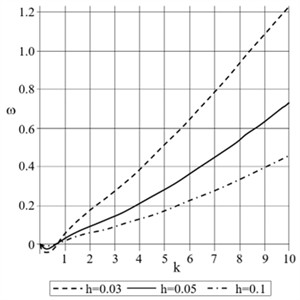
Fig. 3Dependence of the lowest circular frequency ω on the wave number k for a three-layer plate with aluminum face layers and a polymer core at different values of h0
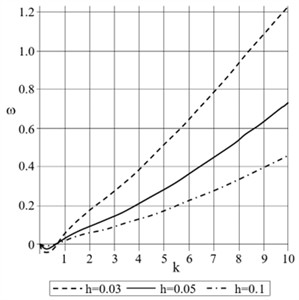
Fig. 4Dependence of the lowest circular frequency ω on the wave number k for a three-layer plate with aluminum face layers and a fiberglass core at different values of h0
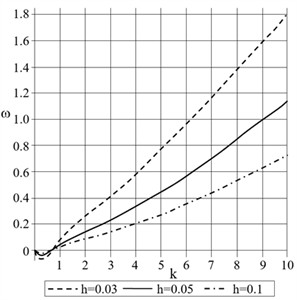
Fig. 5Dependence of the lowest circular frequency ω on the wave number kfor a three-layer plate with steel face layers at h1=h2= 0.001 m and fixed core thickness h0, for different core materials
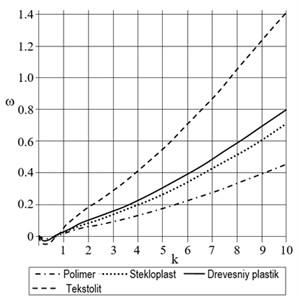
Fig. 6Verification of the proposed model against the SAFE plane-strain 3-D elasticity benchmark and the classical Kirchhoff-Love prediction, for h1=h2= 1 mm and h0= 50 mm; shaded band (κ≤ 0.5) is the formal range of applicability. Original figure prepared by the authors
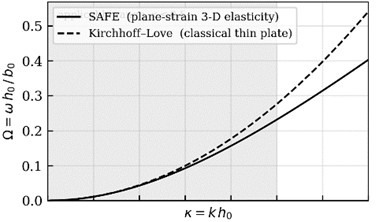
a) Steel face, polymer core
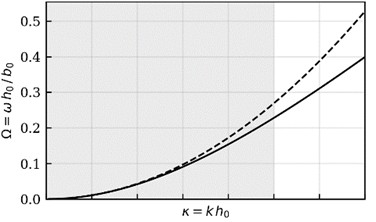
b) Aluminum face, polymer core
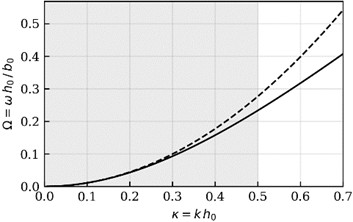
c) Aluminum face, fiberglass core
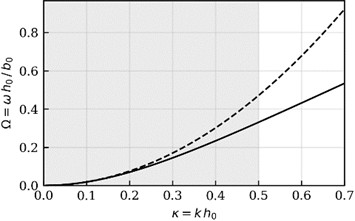
d) Steel face, textolite core
As can be seen from Figs. 2 and 3, the dependence of the frequency on the wave number is monotonic and nearly directly proportional for all considered values of the core thickness. For a fixed value of the wave number, an increase in the thickness of the middle layer leads to an increase in the vibration frequency. This tendency is clearly observed for both steel and aluminum face layers. For example, for the plate with a polymer core, the frequency values corresponding to 0.05 m and 0.10 m are significantly higher than those obtained for 0.03 m. Moreover, this difference becomes more pronounced with increasing wave number, that is, in the higher-frequency region.
A comparison of Figs. 2 and 3 shows that, under identical geometric conditions, the vibration frequency of the plate with steel face layers is slightly lower than that of the plate with aluminum face layers. However, the difference is relatively small. For example, at 10, the difference between the two configurations is about 0.05, which corresponds to approximately 4 %. This result indicates that the material of the face layers influences the overall dynamic stiffness of the plate, although this effect is less pronounced than the effect of the core parameters.
Fig. 4 demonstrates that the same general tendency is preserved when the polymer core is replaced by fiberglass. In particular, increasing the core thickness still results in an increase in the lowest vibration frequency. This confirms that the geometric characteristics of the middle layer are among the governing factors of the dynamic behavior of the three-layer plate.
Fig. 5 shows the influence of the core material on the frequency response for a fixed plate geometry. It follows from the calculated curves that the vibration frequency depends not only on the elastic modulus of the filler but also on its density. In other words, the frequency level is governed by the combined effect of stiffness and inertia. As a result, a filler with a lower density and lower effective inertia may lead to higher frequency values even if its elastic modulus is not the highest among the considered materials.
The results presented in Fig. 5 confirm that the plate with a filler characterized by higher values of elastic modulus and density may exhibit lower vibration frequencies than a plate with a filler having lower effective stiffness-density combination. In the considered set of materials, textolite corresponds to the highest frequency values. For example, at 7, the frequency value for textolite is about 0.86, while for polymer it is about 0.26. At the same time, the frequencies of the plate with fiberglass are slightly lower than those obtained for wood plastic, despite the fact that the elastic modulus of fiberglass is higher. This is explained by the higher density of wood plastic and confirms that the dynamic response of the layered plate cannot be interpreted on the basis of the elastic modulus alone.
A comparison with related works confirms the qualitative trends obtained in the present study. The monotonic increase of the lowest circular frequency with the wave number and its strong sensitivity to the core-to-face thickness ratio are consistent with the dispersion patterns reported by Asif et al. [18] for inhomogeneous three-layered sandwich plates with contrasting soft-core and stiff-skin layers, and with the parametric trends obtained by Demir [19] for circular sandwich plates with a fractional viscoelastic core, where finite element solutions in ANSYS were used as a reference. The relatively weak influence of the face-layer material observed in our calculations (about 4 % at 10) is also in agreement with equivalent-plate analyses [20], [21], in which the dynamic response of three-layer sandwich panels is shown to be governed primarily by the properties of the core, whereas the face layers contribute mainly to the bending stiffness. This consistency supports the validity of the proposed model within its long-wave, low-frequency range of applicability.
In general, the obtained results are consistent with the known conclusions reported in the literature on multilayer and sandwich plates, where the vibration characteristics are highly sensitive to the thickness of the core and to the mechanical properties of the constituent layers. At the same time, the present model provides a compact and computationally efficient tool for estimating the frequency characteristics of three-layer viscoelastic plates under transverse vibrations, which makes it suitable for preliminary engineering analysis and comparative evaluation of structural configurations.
4. Conclusions
An approximate mathematical model for the analysis of non-stationary transverse vibrations of a three-layer viscoelastic plate has been developed. The derived governing equations and the obtained frequency relation make it possible to evaluate the dynamic behavior of the plate with relatively low computational cost.
The numerical analysis has shown that the lowest circular frequency increases with the wave number for all considered structural configurations. It has also been established that increasing the thickness of the core leads to an increase in the frequency level, which confirms the strong influence of the geometric parameters of the middle layer on the dynamic response of the structure.
A comparison of plates with steel and aluminum face layers has demonstrated that the configuration with aluminum face layers exhibits slightly higher frequencies under identical geometric conditions. In addition, the core material has a significant effect on the vibration characteristics of the plate, because the resulting frequency depends on the combined influence of elastic modulus and density.
Thus, the proposed model can be recommended for preliminary engineering analysis and comparative assessment of layered plate configurations subjected to transverse dynamic loading. The obtained results may be useful for selecting rational combinations of face-layer and core materials in lightweight multilayer structural elements.
The viscoelastic character of the layer materials has been accounted for through the elastic-viscoelastic correspondence principle, so that the complex moduli of the layers can be substituted into the governing equations without re-derivation. The formal range of applicability of the model has been explicitly identified ( 0.5, 0.6, and , ≤ 0.2), and the model has been verified against a SAFE plane-strain 3-D elasticity benchmark, with respect to which it shows substantially better agreement than the classical Kirchhoff-Love thin-plate theory within the claimed range. Possible directions for future work include the extension of the formulation to strongly dissipative cores (loss factor 0.1) and the experimental validation of the dispersion curves obtained from the present model.
References
-
A. S. Sayyad and Y. M. Ghugal, “On the free vibration analysis of laminated composite and sandwich plates: a review of recent literature with some numerical results,” Composite Structures, Vol. 129, pp. 177–201, Oct. 2015, https://doi.org/10.1016/j.compstruct.2015.04.007
-
H. H. Khudoynazarov, V. A. Skripnyak, and S. Yakhshiboyev, “Non-stationary transverse vibrations of a three-layer viscoelastic plate,” Problemy Mekhaniki, No. 2, pp. 27–32, 2018.
-
Y. Dimitrienko, E. Gubareva, and D. Yakovlev, “Asymptotic theory of viscoelastic multilayer thin composite plates,” Science and Education of the Bauman MSTU, Vol. 14, No. 10, pp. 359–382, 2014, https://doi.org/10.7463/1014.0730105
-
A. Bessaim, M. S. Houari, A. Tounsi, S. Mahmoud, and E. A. A. Bedia, “A new higher-order shear and normal deformation theory for the static and free vibration analysis of sandwich plates with functionally graded isotropic face sheets,” Journal of Sandwich Structures and Materials, Vol. 15, No. 6, pp. 671–703, 2013, https://doi.org/10.1177/1099636213498888
-
A. Nosier, R. K. Kapania, and J. N. Reddy, “Free vibration analysis of laminated plates using a layerwise theory,” AIAA Journal, Vol. 31, No. 12, pp. 2335–2346, Dec. 1993, https://doi.org/10.2514/3.11933
-
K. Khudoynazarov and S. R. Yaxshiboyev, “The mathematical model of transverse vibrations of the three-layer plate,” IOP Conference Series: Earth and Environmental Science, Vol. 614, No. 1, p. 012062, Dec. 2020, https://doi.org/10.1088/1755-1315/614/1/012062
-
P. Kumar and C. Srinivasa, “On buckling and free vibration studies of sandwich plates and cylindrical shells: a review,” Journal of Thermoplastic Composite Materials, Vol. 33, No. 5, pp. 673–724, Nov. 2018, https://doi.org/10.1177/0892705718809810
-
T. H. Daouadji, A. Hadj Henni, A. Tounsi, and A. B. El Abbes, “A new hyperbolic shear deformation theory for bending analysis of functionally graded plates,” Modelling and Simulation in Engineering, Vol. 2012, pp. 1–10, Jan. 2012, https://doi.org/10.1155/2012/159806
-
Z. B. Khudayberdiyev, S. R. Yaxshiboyev, and M. A. Q. Muhammadiyeva, “Transverse vibrations of a three-layer plate,” Theoretical and Applied Science, Vol. 102, No. 10, pp. 975–980, 2021, https://doi.org/10.15863/tas.2021.10.102.111
-
N. Razzakov, S. Yakhshiboev, N. Razzakov, and S. Buribaev, “Modeling the operational state of suspended roofs with large spans and unique load-bearing elements,” E3S Web of Conferences, Vol. 563, p. 02020, Aug. 2024, https://doi.org/10.1051/e3sconf/202456302020
-
E. Carrera and S. Brischetto, “A survey with numerical assessment of classical and refined theories for the analysis of sandwich plates,” Applied Mechanics Reviews, Vol. 62, No. 1, Jan. 2009, https://doi.org/10.1115/1.3013824
-
E. V. Altukhov and M. V. Fomenko, “Elastic vibrations of three-layer plates of symmetric structure,” Proceedings of the IPMM NAS of Ukraine, Vol. 18, pp. 3–10, 2009.
-
Z. Khudoyberdiyev and S. Yaxshiboyev, “Bending of a cantilever beam under the influence of a force applied to its tip,” in AIP Conference Proceedings, Vol. 3244, No. 1, p. 060014, Jan. 2024, https://doi.org/10.1063/5.0241681
-
J. L. Mantari, A. S. Oktem, and C. Guedes Soares, “A new higher order shear deformation theory for sandwich and composite laminated plates,” Composites Part B: Engineering, Vol. 43, No. 3, pp. 1489–1499, Apr. 2012, https://doi.org/10.1016/j.compositesb.2011.07.017
-
A. K. Nayak, S. S. J. Moy, and R. A. Shenoi, “Free vibration analysis of composite sandwich plates based on Reddy’s higher-order theory,” Composites Part B: Engineering, Vol. 33, No. 7, pp. 505–519, 2002, https://doi.org/10.1016/s1359-8368(02)00035-5
-
B. Harsono, F. M. Mahadiva, Tavio, T. M. Mirkadirovich, and H. Hermawan, “Pushover analysis of simple house structures in seismic zones,” in AIP Conference Proceedings, Vol. 3480, No. 1, p. 050035, Jan. 2026, https://doi.org/10.1063/5.0319164
-
E. Shipacheva, S. Shaumarov, A. Gulamov, and M. M. Talipov, “Modeling of interaction of external enclosing structures of buildings with the internal and external environments,” in ICTEA: International Conference on Thermal Engineering, Vol. 1, No. 1, 2024.
-
M. Asif, R. Nawaz, and R. I. Nuruddeen, “Dispersion of elastic waves in the three-layered inhomogeneous sandwich plate embedded in the Winkler foundations,” Science Progress, Vol. 106, No. 2, May 2023, https://doi.org/10.1177/00368504231172585
-
Ö. Demir, “Differential transform method for axisymmetric vibration analysis of circular sandwich plates with viscoelastic core,” Symmetry, Vol. 14, No. 5, p. 852, Apr. 2022, https://doi.org/10.3390/sym14050852
-
R. Da S. Raqueti, N. Atalla, M. Ouisse, and E. Sadoulet-Reboul, “An equivalent plate model for assessing the dynamic behavior of highly damped sandwich plates,” Journal of Sound and Vibration, Vol. 616, p. 119209, Nov. 2025, https://doi.org/10.1016/j.jsv.2025.119209
-
U. Arasan, F. Marchetti, F. Chevillotte, L. Jaouen, D. Chronopoulos, and E. Gourdon, “A simple equivalent plate model for dynamic bending stiffness of three-layer sandwich panels with shearing core,” Journal of Sound and Vibration, Vol. 500, p. 116025, May 2021, https://doi.org/10.1016/j.jsv.2021.116025
About this article

The authors have not disclosed any funding.
The datasets generated during and/or analyzed during the current study are available from the corresponding author on reasonable request.
The authors declare that they have no conflict of interest.

