Abstract
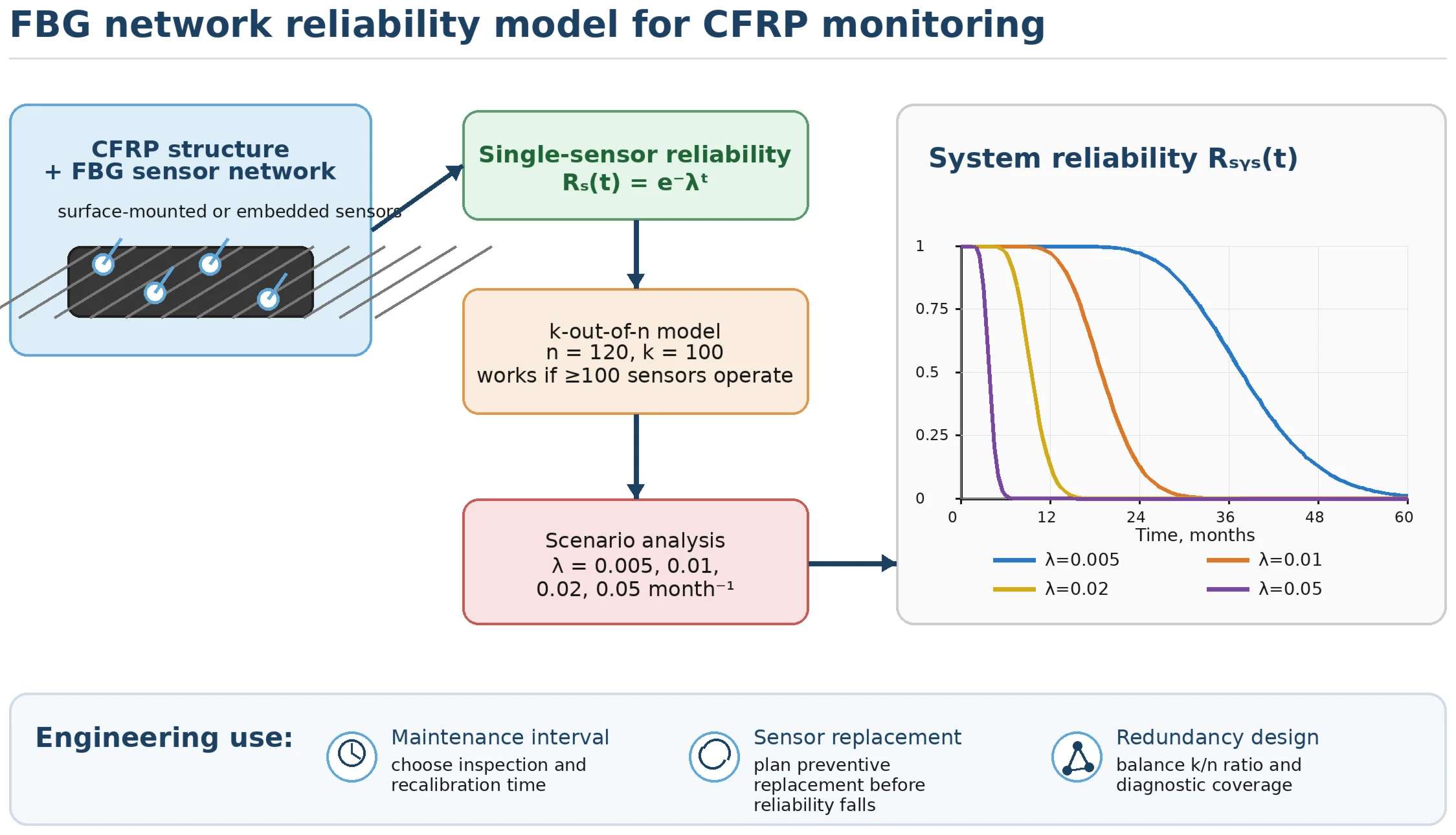
In this paper, an analytical assessment of the long-term operability of the FBG multi-sensor network used for monitoring defects in CFRP structures was carried out. The main focus of the article is devoted to assessing the reliability level of a generalized FBG sensor network, and not the effectiveness of experimental detection of a defect in a specific CFRP sample. For this reason, the study does not consider the diagnostic sensitivity of the structural health monitoring system or the probability of detecting a defect, but the functional stability of the network in the event of sensor failure. The system reliability was calculated using the k-out-of-n model, and the time-dependent reliability of an individual sensor was characterized by an exponential law. The configuration 120 and 100 was chosen as the main calculation scenario. This configuration was considered a representative redundancy model that characterized the system’s operability even in the event of a failure of about 16.7 % of the sensors. Calculations were carried out for 0-60 months for failure intensities 0.005, 0.01, 0.02 and 0.05 months-1. The results showed that as the degradation intensity of an individual sensor increases, system reliability decreases dramatically. At the same time, a sensitivity analysis of k/n configurations was performed, demonstrating an engineering trade-off between redundancy and the minimum number of operating sensors. The results obtained enable the selection of the maintenance interval, sensor replacement strategy, and level of redundancy on a scientific basis when designing SHM systems based on FBG.
Highlights
- An analytical k-out-of-n reliability model was applied to assess the long-term operability of an FBG multi-sensor network for CFRP structural monitoring.
- For the representative configuration n=120, k=100, system reliability strongly depended on the individual sensor failure intensity λ.
- Sensitivity analysis showed that the k/n ratio creates a trade-off between mathematical reliability and diagnostic coverage.
- The results support reliability-based selection of maintenance intervals, sensor replacement strategy, and redundancy level in FBG-based SHM systems.
1. Introduction
Structures made of polymer composites reinforced with carbon fiber, i.e., carbon fiber reinforced polymer (CFRP) elements, are widely used in aviation, transportation technology, energy, and other critical engineering industries due to their high specific strength, low weight, and corrosion resistance. However, in such composites, shock loads, inter-layer detachment, microcracks, and internal damage that is not clearly noticeable to the eye can occur. The danger of these damages is due to the fact that they are not immediately detectable by external visual observation. Therefore, the importance of structural health monitoring systems is growing, which allows real-time monitoring of the technical condition of CFRP structures.
Optical fiber Bragg grating, i.e., FBG sensors, are one of the most widely considered sensor technologies in such monitoring systems. Their main advantages include high sensitivity, small geometric size, resistance to electromagnetic interference, and the ability to multiplex multiple sensors along a single optical fiber [1]. These properties make FBG sensors suitable for monitoring the deformation state of CFRP structures and recording post-impact changes. Recent studies have shown that FBG sensors can provide useful information when detecting barely noticeable impact damage to the eyes in CFRP elements [2]. At the same time, the depth of location of the sensor inside the structure, the quality of fixation, and mutual mechanical contact with the material have a significant impact on the measurement result [3]. For FBG sensors coated with CFRP or embedded in the structure, the reliability issue should also be considered individually, as sensor damage, signal destabilization, or poor communication quality can affect the outcome of the entire monitoring system [4].
In Multi-Sensor Systems, a failure of one sensor does not necessarily lead to a complete shutdown of the entire system. If a sufficient number of working sensors are stored in the network, the system can continue the structural monitoring function to a certain extent. To evaluate systems based on such redundancy, the k-out-of-n model is used. This model assumes that a system consisting of n elements will remain functional if at least k elements work [5]. Therefore, this approach is methodologically appropriate for assessing the long-term operability of FBG Multi-Sensor Networks.
The novelty of this work lies in the fact that the reliability of the FBG multi – sensor network for monitoring CFRP structures is considered not as a result of direct detection of a defect, but as a problem of system operability. That is, the article does not analyze the probability of detecting a defect in a specific CFRP sample, the accuracy of localization, or experimental signals. On the contrary, it analytically shows how the intensity and redundancy level of sensor failure affect the stability of a long-term SHM system. Such refinement is important from a peer-reviewed point of view, because reliability curves are not a direct indicator of the quality of finding a defect, but describe the probability that the monitoring network will remain operational for a certain period of time.
The study aims to evaluate the reliability of the FBG multi – sensor network based on the k-out-of-n model and determine the effect of the failure intensity of individual sensors on system reliability. In accordance with this goal, the reliability of an individual sensor was characterized by an exponential law, and a basic calculation was made for the configuration 120 and 100. Additionally, sensitivity analysis has been proposed on how changes in the / ratio affect system reliability.
2. Methodology
2.1. Object of study and main limitations
This study was performed not as an experimental test, but as an analytical-scenario work. The object of the study was considered a generalized FBG multi-sensor network for monitoring CFRP structures. In such networks, sensors can be attached to the surface of the structure or embedded inside the composite material [6], [7]. However, this article does not calculate the amplitude, frequency composition, localization accuracy, or probability of detecting a defect of specific fault signals. The main evaluation magnitude of the work is systematic reliability. It describes the probability that the FBG network will retain its monitoring function if a certain part of the sensors fails. Therefore, the results obtained should not be considered as an indicator of the accuracy of detecting a defect in a particular CFRP model, but as an initial analytical basis for designing a SHM system in terms of reliability. In the model, several compactness assumptions were adopted: all sensors were considered as elements of the same type. The intensity of their failure was taken as the same and mutually independent, the cross-sensitivity of temperature and deformation was not included in the main report. This effect was assumed to be at a compensated or constant level, and the temperature-strain cross-sensitivity in FBG sensors is an important factor that needs to be studied separately [8].
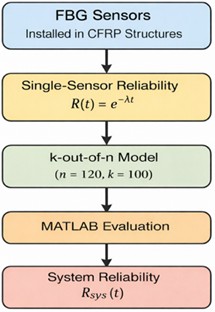
Fig. 1Algorithm for analytical assessment of the reliability of the FBG multi-sensor network
2.2. Individual sensor reliability model
The exponential reliability law was used to describe the time-dependent operability of an individual FBG sensor. This model is used as a common initial approximation in engineering reliability analysis under conditions of constant failure Intensity [4]. Individual sensor reliability is written as:
where is the reliability of the individual sensor at time ; is the intensity of sensor failure, month-1; is the time of use, month. According to this expression, as the value increases, the probability that the sensor will remain operational decreases rapidly. The parameter may depend on the specific sensor batch, its installation technology, environment, mechanical load, and mode of use.
2.3. k-out-of-n system reliability model
The multi-sensor FBG network was evaluated on the k-out-of-n principle. According to this principle, the system is assumed to be functional in the event that at least sensors of are working [5]. If the individual sensors have the same reliability and are mutually independent, then the system reliability is determined by the following binomial sum:
where is the reliability of the multi – sensor system at time; is the total number of sensors; is the minimum number of sensors required for the system to be operational; is the number of sensors in Operation; and is the binomial coefficient. Although this model does not fully cover all physical degradation mechanisms, it provides a clear and computationally convenient approach for assessing the system-level operability of a redundancy-based sensor network.
2.4. Justification for choosing the configuration 120 and 100
The basic calculation scenario used the configuration 120 and 100. These values were chosen not as the number of sensors necessarily installed in a specific single CFRP model, but as a representative multi-sensor network model for monitoring a complex or large CFRP structure. FBG technology has the ability to combine several sensors along a single optical fiber and multi-point monitoring of different areas [1, 6, 7]. Therefore, a large number of sensors in large structures can be considered as a possible scenario from an engineering point of view.
A value of 100 means that the system is considered fully functional only if about 83.3 % of the sensors are working. In other words, the system can bear the failure of 20 sensors, which indicates the presence of a reserve of 16.7 % redundancy. Such a choice is explained by the need to localize the defect or maintain the spatial distribution of sensors for regional control. If is chosen too low, the system reliability may appear mathematically high, but the adequacy of measurement points across the structure is likely to deteriorate. And if is too high, the system will be assessed as not functional when only a small number of sensors fail. Therefore, the 120 and 100 configurations were used to show a balance between redundancy and diagnostic coverage.
This configuration is not recommended as the only correct solution. In a practical project, the values of and must be re-selected depending on the size of the structure, the number of control zones, the layout scheme of the sensors, the level of permissible risk, and the maintenance policy. For this reason, additional sensitivity analysis was introduced in the work, and it was shown how changes in the k/n ratio affect system reliability.
2.5. Scenario rationale for failure intensities
The calculations used the values 0.005, 0.01, 0.02, and 0.05 months-1. These values were taken as scenario parameters for comparing the behavior of the FBG system in low, medium, high, and very high degradation conditions, and not measured parameters applied to a specific manufacturer’s sensor. In reliability theory, the value is associated with the average failure time MTTF = 1/. From this point of view, 0.005 months⁻1 corresponds to the average failure time of about 200 months, 0.01 months⁻1 100 months, 0.02 months⁻1 50 months, and 0.05 months⁻1 20 months. Such a range allows you to compare possible operational scenarios, ranging from stable environments with high sensor quality to situations with low installation quality or severe load impact. In a specific application, these parameters must be clarified by FMEA/FTA analysis, long-term testing, manufacturer data, or field monitoring statistics [4].
Table 1Scenario explanation of λ values
, months-1 | MTTF = 1/, months | Script commentary |
0,005 | 200 | Low degradation, stable working condition |
0,01 | 100 | Moderate degradation, normal risk of use |
0,02 | 50 | High degradation, a situation in which the load or medium effect is enhanced |
0,05 | 20 | Scenario with very high degradation, heavy use or low installation quality |
3. Results and discussion
3.1. Reliability results on the basic configuration
Calculations carried out in the MATLAB environment have shown that in the FBG multi-sensor network with 120 and 100 configurations, the intensity of individual sensor failure has a decisive effect on system reliability. Fig. 2 shows the confidence curves obtained for the values 0.005, 0.01, 0.02, and 0.05 months-1. To improve the readability of the graph, an additional logarithmic view was introduced, which allowed for distinguishing low reliability values along with the main linear scale.
In the case of 0.005 months-1, the system maintains a high level of reliability for the first two years. In this scenario, after 24 months, it was 0.97189. And at 36 months, system reliability drops to 0.58192, because the expected number of working sensors approaches the 100 limit. At 0.01 months-1, Confidence drops sharply to a value of 0.12608 at 24 months, although it is still high at 12 months. This suggests that doubling individual sensor degradation significantly weakens the long-term stability of a multi-sensor system.
The 0.02 and 0.05 months-1 scenarios describe high degradation conditions. In such a situation, the reserve of redundancy will not be enough to maintain long-term employability. For example, at 0.02 months-1, the system confidence for 24 months decreased to the level of 2.5685×10⁻⁷. And at 0.05 months-1, the system confidence even in 12 months was 4.1303×10⁻¹¹. These results prove that the initial quality and operational stability of sensors are no less important than redundancy.
Fig. 2System reliability curves at different values of λ for configurations n= 120 and k= 100
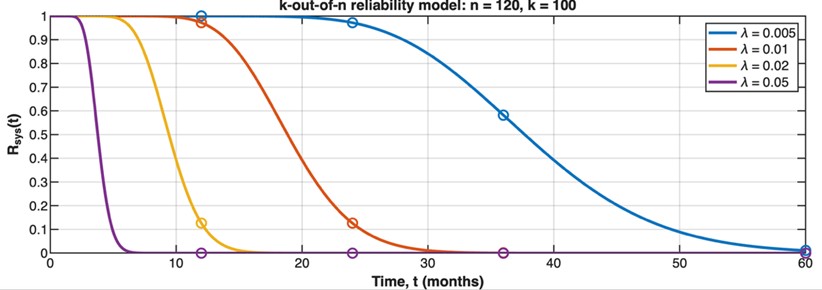
Table 2System reliability values for configuration n= 120 and k= 100
Time, (months) | 0.005 months-1 | 0.01 months-1 | 0.02 months-1 | 0.05 months-1 |
12 | 0.99999 | 0.97189 | 0.12608 | 4.1303×10⁻¹¹ |
24 | 0.97189 | 0.12608 | 2.5685×10⁻⁷ | 1.9036×10⁻³³ |
36 | 0.58192 | 0.00049432 | 3.1305×10⁻¹⁵ | 5.5489×10-58 |
60 | 0.01103 | 4.1303×10⁻¹¹ | 1.9036×10⁻³³ | 5.5191×10-109 |
3.2. k/n configuration sensitivity analysis
Taking into account the peer-review requirement, the study considered not only the scenario 120 and 100, but also the change in the / ratio. This analysis shows that system reliability is very sensitive to the minimum number of operating sensors. Selecting the value of at the levels of 90, 100, and 110 in the case of the same 120 changes the engineering interpretation of the system. The 90 configuration gives high redundancy, but spatial diagnostic coverage may not be sufficient in the actual structure. The 110 configuration requires maintaining most of the measurement points, but evaluates the system much more rigorously in terms of reliability. Table 3 presents the comparative results of three / configurations for a 24-month time point. at 0.01 months-1, when 90, the system confidence decreases to 0.86166, at 100 to 0.12608, and at 110 to 0.00011378. This difference indicates that the value of cannot be chosen without justifying it according to engineering requirements.
Table 3Effect of K/n configuration on system reliability, t= 24 months
Configuration | /, % | 0,005 months-1 | 0,01 months-1 | 0,02 months-1 |
120, 90 | 75.0 | 0.99999 | 0.86166 | 0.00164 |
120, 100 | 83.3 | 0.97189 | 0.12608 | 2.5685×10⁻⁷ |
120, 110 | 91.7 | 0.19011 | 0.00011 | 1.0305×10⁻¹³ |
3.3. Discussion from the point of view of practical SHM design
The resulting reliability curves can be used in several ways when designing a practical SHM system. First, they will help you choose the maintenance interval. If the minimum acceptable confidence threshold for the project is set at 0.95, for the configuration 120 and 100, this limit decreases to about 25.6 months at 0.005 months-1, 12.8 months at 0.01 months-1, 6.4 months at 0.02 months-1, and 2.6 months at 0.05 months-1. Therefore, the higher the sensor degradation rate, the more frequent the technical inspections and recalibrations.
Secondly, the results will allow you to plan a sensor replacement strategy. For example, the 120 and 100 system has a failure reserve of up to 20 sensors. At 0.005 months-1 and 24 months, the individual sensor reliability will be ≈ 0.887, meaning that, on average, 106 sensors will be operational. This is above the limit of 100. But at 36 months, the expected number of working sensors approaches about 100, so the system reaches the limit state. Such information is useful for choosing a preventive replacement period.
Third, / sensitivity analysis allows you to optimize redundancy. If the value of is taken too low in the system, the actual diagnostic coverage may deteriorate, although the mathematical reliability is high. If the k value is set too high, the system will be too sensitive to slight sensor degradation. Therefore, when designing an FBG network, the reliability calculation must be considered together with the requirements of sensor location, hazardous areas in the structure, measurement accuracy, and fault localization [2, 3, 9, 10].
Fourth, the results obtained indicate the importance of sensor quality. Although increasing the number of sensors increases system reliability to a certain extent, if the degradation intensity of individual sensors is high, this redundancy cannot fully ensure long-term monitoring stability. Therefore, in a practical system, the quality of sensor installation, protective layer, fiber guidance, temperature compensation, and the stability of the interrogator system also need to be considered together.
3.4. Limitations of the study
The presented model has several limitations. First, this work does not include experimental validation carried out on a specific CFRP sample. Therefore, the resulting curves are not a direct indicator of the probability of detecting a real defect or the accuracy of localization. Secondly, the failure of the sensors was perceived as independent and equally widespread. In a specific structure, common mechanical impacts, temperature cycles, moisture, cable damage, or interrogator failure can cause dependent degradation between sensors. Third, values are taken as scenario parameters; they must be clarified with experimental data for a specific system or reliability statistics provided by the manufacturer. Despite these limitations, the model can be a useful tool in the initial reliability-oriented design phase of a multi-sensor FBG network. It allows you to quantify the relationship between the number of sensors, the minimum operating sensor limit, the maintenance interval, and the sensor quality requirements.
4. Conclusions
In this article, the reliability of the FBG multi-sensor network for monitoring CFRP structures was analytically evaluated based on the k-out-of-n model. The work considered the long-term operability of a generalized sensor network, and not the experimental detection of a defect in a specific CFRP sample. Thus, it was shown that the scope of the article should be clearly defined, and the reliability results should not be interpreted as a direct indicator of the effectiveness of detecting a defect. The results obtained for configurations 120 and 100 showed that the intensity of failure of an individual sensor has a very strong effect on system reliability. At 0.005 months-1, the system maintained a high level of reliability for the first 24 months, while at values 0.01 months-1 and higher, reliability decreased much faster. The scenarios 0.02 and 0.05 months-1 proved that the redundancy alone may not be sufficient to provide long-term functional stability under high degradation conditions.
Additional / sensitivity analysis showed that the number of sensors operating at a minimum has a significant impact on the reliability of the system. Therefore, when designing an FBG multi-sensor network, not only the number of sensors, but also the limit, the spatial location of the sensors, the maintenance interval, and the sensor replacement strategy must be justified together. In practical SHM systems, it is necessary to determine the acceptable reliability limit in advance and plan the timing of verification, recalibration, and preventive replacement accordingly.
In future studies, it is important to test the proposed model with experimental data on specific CFRP samples, determine the parameter from actual use conditions, take into account temperature-deformation cross-sensitivity, and consider dependent failure mechanisms between sensors. These areas allow for a more complete design of FBG-based structured health monitoring systems in terms of reliability.
References
-
J. K. Sahota, N. Gupta, and D. Dhawan, “Fiber Bragg grating sensors for monitoring of physical parameters: a comprehensive review,” Optical Engineering, Vol. 59, No. 6, p. 06090, Jun. 2020, https://doi.org/10.1117/1.oe.59.6.060901
-
S. Goossens et al., “A global assessment of barely visible impact damage for CFRP sub-components with FBG-based sensors,” Composite Structures, Vol. 272, p. 114025, Sep. 2021, https://doi.org/10.1016/j.compstruct.2021.114025
-
H. Rocha, U. Lafont, and J. P. Nunes, “Optimisation of through-thickness embedding location of fibre Bragg grating sensor in CFRP for impact damage detection,” Polymers, Vol. 13, No. 18, p. 3078, Sep. 2021, https://doi.org/10.3390/polym13183078
-
Z. Liu, Y. Li, N. Zhang, Z. Liang, and F. Li, “Reliability analysis of CFRP-packaged FBG sensors using FMEA and FTA techniques,” Applied Sciences, Vol. 11, No. 22, p. 10859, Nov. 2021, https://doi.org/10.3390/app112210859
-
Y. Song and X. Wang, “Reliability analysis of the multi-state k-out-of-n: F systems with multiple operation mechanisms,” Mathematics, Vol. 10, No. 23, p. 4615, Dec. 2022, https://doi.org/10.3390/math10234615
-
S. M. A. Musa, M. H. Dzulkifli, A. I. Azmi, and S. A. Ibrahim, “Embedded and surface-mounted Fiber Bragg grating as a multiparameter sensor in fiber-reinforced polymer composite materials: a review,” IEEE Access, Vol. 11, pp. 86611–86644, Jan. 2023, https://doi.org/10.1109/access.2023.3304679
-
M. Gabardi et al., “Embedding Fiber Bragg grating sensors in carbon composite structures for accurate strain measurement,” IEEE Sensors Journal, Vol. 23, No. 15, pp. 16882–16892, Aug. 2023, https://doi.org/10.1109/jsen.2023.3285408
-
H. Qin, P. Tang, J. Lei, H. Chen, and B. Luo, “Investigation of strain-temperature cross-sensitivity of FBG strain sensors embedded onto different substrates,” Photonic Sensors, Vol. 13, No. 1, Sep. 2022, https://doi.org/10.1007/s13320-022-0668-3
-
W. Li, H. Huang, B. Wan, X. Pang, and G. Yan, “Structural health monitoring of defective carbon fiber reinforced polymer composites based on multi-sensor technology,” Sensors, Vol. 25, No. 17, p. 5259, Aug. 2025, https://doi.org/10.3390/s25175259
-
S. Huan, L. Lu, T. Shen, and J. Du, “Low velocity impact monitoring of composite tubes based on FBG sensors,” Sensors, Vol. 24, No. 4, p. 1279, Feb. 2024, https://doi.org/10.3390/s24041279
About this article

The authors have not disclosed any funding.
The datasets generated during and/or analyzed during the current study are available from the corresponding author on reasonable request.
The authors declare that they have no conflict of interest.

