Abstract
This paper addresses the problem of vibration transmission from the propulsion system to the hull of unmanned underwater vehicles (UUVs), which is one of the primary sources of acoustic radiation and vehicle detectability. Conventional passive vibration isolation methods exhibit limited effectiveness in suppressing low-frequency vibrations generated by rotating machinery. To overcome this limitation, a compact hybrid active-passive vibration isolation mount is proposed, combining a rubber vibration isolator with piezoelectric actuators. To investigate vibration transmission characteristics, a coupled dynamic model of the “vibration source-isolation mount-hull” system was developed using the finite element method (FEM). The parameters of the passive isolator were determined based on stiffness requirements and finite element simulations, while active vibration suppression was implemented through a multichannel MIMO control system employing the adaptive filtered-x least mean squares (Fx-LMS) algorithm. The results demonstrate that the proposed active-passive isolation system effectively reduces vibration transmission within the frequency range of 10-500 Hz. A maximum vibration reduction of 26 dB was achieved, providing significantly better suppression of low-frequency vibrations than conventional passive isolation solutions. The proposed approach can be applied to enhance the acoustic stealth performance of unmanned underwater vehicles and other compact underwater platforms.
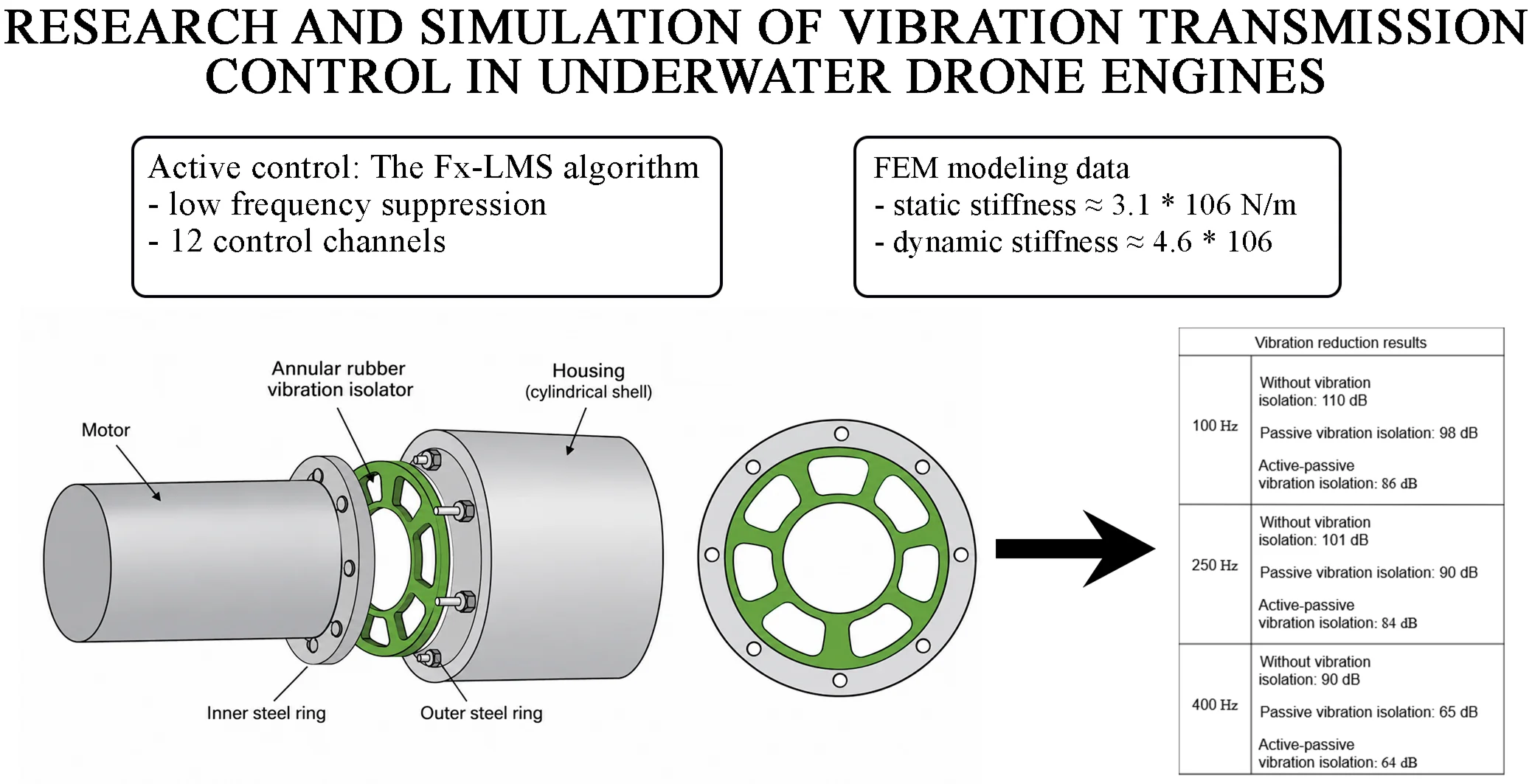
Highlights
- A compact hybrid active–passive vibration isolation mount was developed
- A coupled FEM model of the propulsion system–hull vibration was established
- Adaptive MIMO Fx-LMS control effectively suppresses low-frequency vibrations
- The proposed system achieved up to 26 dB vibration attenuation
1. Introduction
Unmanned underwater vehicles (UUVs) are widely used for environmental monitoring, marine infrastructure inspection, scientific research, and defense applications. One of the most critical requirements for such systems is acoustic stealth, as their detection is primarily based on acoustic signatures. Vibrations generated by the propulsion system and auxiliary equipment are transmitted through supporting structures to the hull, causing structural oscillations and acoustic radiation into the surrounding water. According to previous studies, a 10 dB reduction in radiated noise can decrease the detection range of an underwater vehicle by approximately 32 % [1].
At low operating speeds, the dominant source of the acoustic signature is mechanical vibration generated by the propulsion system. These vibrations are characterized by pronounced low-frequency tonal components associated with shaft rotation and periodic excitation forces [2]. Such vibrations propagate efficiently through the hull structure and significantly increase the acoustic detectability of the vehicle.
Various passive vibration isolation techniques have been developed to reduce vibration transmission, including rubber isolation mounts, viscoelastic damping materials, composite structures, and optimized support configurations [3]. However, the effectiveness of passive methods is limited in the low-frequency range due to structural stiffness requirements and the occurrence of resonance phenomena. Consequently, low-frequency vibration components continue to be transmitted to the hull and remain a major source of underwater noise.
To address this issue, active vibration control techniques based on the generation of compensating control forces have received increasing attention. Nevertheless, their implementation in unmanned underwater vehicles is challenging because of limited installation space and the need for integration into existing structural configurations.
In this study, a compact hybrid active-passive vibration isolation mount for underwater propulsion systems is proposed. The mount combines a rubber vibration isolator with integrated piezoelectric actuators. The main contributions and scientific novelty of this work are as follows:
– Development of a compact hybrid active-passive vibration isolation mount for unmanned underwater vehicles.
– Establishment of a coupled finite element model of the vibration source-mount-hull system.
– Implementation of a multichannel active vibration control strategy based on the Fx-LMS algorithm.
The performance of the proposed system was evaluated through numerical simulations. The obtained results demonstrate a significant reduction in vibration transmission to the hull and highlight the advantages of the proposed approach compared with conventional passive vibration isolation systems.
2. Referencing
Research on vibration isolation in underwater vehicles is primarily focused on reducing the transmission of vibrations from propulsion systems and shafting assemblies to hull structures. Most existing studies investigate passive vibration isolation approaches based on elastic elements, damping materials, and optimization of supporting structures.
In study [3], a dynamic model of a shaft–hull coupled system was developed, taking into account the elastic properties of both the shaft line and the hull structure. The authors demonstrated that the application of a dynamic vibration absorber can effectively reduce vibration amplitudes near resonance frequencies. In [4], an improved support structure was proposed, achieving a reduction in hull vibration levels of up to 7 dB compared with conventional mounting configurations.
Composite vibration-isolation structures for marine equipment were investigated in [5]. Finite element analysis showed that the use of composite materials reduced vibration levels by 2-4 dB compared with conventional steel support components. In [6], vibration isolation performance was enhanced through the use of flexible couplings and metal-rubber elements, which reduced vibration transmission from the propulsion system to the hull.
Despite these advances, most existing solutions rely exclusively on passive vibration isolation techniques. In [7], vibration reduction was achieved through the use of rubber damping mounts, while in [8] improvements were obtained by optimizing the materials of structural components. However, the effectiveness of passive systems decreases significantly in the low-frequency range, where tonal spectral components generated by engines and rotating machinery are dominant.
A review of the published literature indicates that the suppression of low-frequency vibrations under space-constrained installation conditions remains insufficiently investigated. Therefore, this paper proposes a novel hybrid active-passive vibration isolation mount that combines the advantages of passive damping and active vibration control through the integration of piezoelectric actuators.
3. Materials and methods
Dynamic loads are transmitted from the propulsion system to the hull of an unmanned underwater vehicle through supporting elements. Conventional designs typically employ flange-mounted supports that provide sufficient structural strength but exhibit limited effectiveness in reducing vibration transmission. To address this issue, a compact hybrid active-passive vibration isolation mount was developed, as illustrated in Fig. 1.
The passive component of the mount consists of a ring-shaped rubber vibration isolator positioned between inner and outer steel rings. Owing to the viscoelastic properties of rubber, vibration energy is dissipated, thereby reducing the transmission of high-frequency oscillations. The active component is based on piezoelectric actuators which, through a mechanical amplification mechanism, convert axial deformations into radial control forces, enabling vibration suppression in the low-frequency range [9].
The parameters of the passive vibration isolator were determined according to the operating conditions of a propulsion system with a rotational speed of 1500 rpm (25 Hz) and a total mass of 200 kg, including the motor and auxiliary equipment. To avoid resonance conditions, the required dynamic stiffness was calculated using classical vibration isolation theory. Considering the geometric constraints of the design, the thickness of the rubber layer was selected as 13 mm.
Fig. 1Proposed hybrid active-passive vibration isolation mount for connecting the propulsion motor to the underwater vehicle hull (developed by the authors)
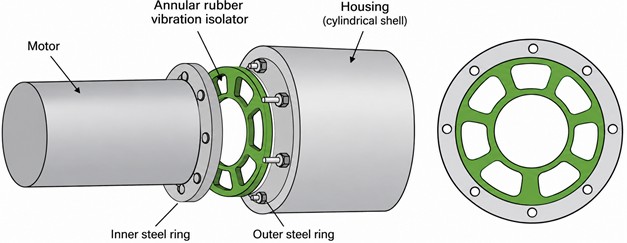
To determine the stiffness characteristics, finite element analysis (FEA) was employed. The rubber layer was modeled using the Mooney-Rivlin hyperelastic material model, whereas the steel components were assumed to be linear elastic with a Young’s modulus of 210 GPa, a density of 7850 kg/m3, and a Poisson’s ratio of 0.3. The outer ring was assumed to be rigidly fixed, while the inner ring was connected to a reference point (RP) where a static load ranging from 700 to 1600 N, with increments of 100 N, was applied.
Based on the simulation results, a load-displacement relationship was obtained. The analysis showed that rubber with a hardness of 45 Shore A provided a static stiffness of approximately 3.1×10⁶ N/m and a dynamic stiffness of approximately 4.6×10⁶ N/m, satisfying the design requirements.
To investigate vibration transmission, a finite element model of the coupled vibration source-isolation mount-hull system was developed. The hull was modeled as a cylindrical shell with a length of 1.2 m, a diameter of 533 mm, and a wall thickness of 6.5 mm under free-boundary conditions. Twelve mounting locations corresponding to the control channels were incorporated into the model, and the control points were positioned at the interfaces between the active vibration isolators and the supporting structure [10].
To simulate excitation from the propulsion system, harmonic forces were applied at the excitation point along the - and -axes with a phase difference of 90°. Frequency-domain analysis was performed over the range of 0.5-500 Hz with a frequency resolution of 0.5 Hz.
To suppress vibration transmission, a multichannel MIMO (Multi-Input Multi-Output) active vibration control system was employed. The adaptive Filtered-x Least Mean Squares (Fx-LMS) algorithm was selected as the control strategy because of its high stability, relatively low computational complexity, and ability to adapt to variations in the dynamic characteristics of the system.
The algorithm iteratively updates the coefficients of the control filter based on the measured error signal and the reference excitation signal. Its objective is to minimize vibration levels at the control points by generating compensating control forces through the piezoelectric actuators.
Harmonic disturbance signals with frequencies of 30 Hz and 70 Hz, corresponding to the dominant tonal vibration components of the propulsion system, were used as excitation inputs. To monitor vibration characteristics on the hull surface, twenty-four acceleration measurement points were uniformly distributed over the structure.
Numerical simulations were performed under harmonic excitation at frequencies of 100, 250, 350, and 400 Hz. The system was evaluated under three operating conditions:
1. Without vibration isolation.
2. With passive vibration isolation only.
3. With the proposed hybrid active-passive vibration isolation system.
The obtained results were used to assess the effectiveness of the developed system and to compare its performance with the numerical predictions [11].
4. Results
The finite element simulation results demonstrated that the developed hybrid active-passive vibration isolation mount effectively reduces vibration transmission from the propulsion system to the hull of the unmanned underwater vehicle over a wide frequency range.
The analysis of the passive vibration isolator revealed high effectiveness in suppressing medium- and high-frequency vibrations due to the damping properties of the rubber element. However, its performance decreases in the low-frequency range, which is consistent with the well-known limitations of conventional passive vibration isolation systems.
The implementation of active vibration control based on the Fx-LMS algorithm provided an additional vibration reduction of up to 20 dB. A decrease in vibration amplitudes was observed not only at the control points but also across the entire cylindrical hull surface, indicating effective attenuation of vibrational energy throughout the structure. Frequency-response analysis further confirmed the capability of the proposed system to suppress the dominant low-frequency and resonant vibration components.
For validation purposes, the coupled vibration source-isolation mount-hull system was analyzed under three operating conditions: without vibration isolation, with passive vibration isolation only, and with the proposed hybrid active-passive vibration isolation system. The corresponding results are presented in Table 1.
Table 1Vibration reduction results
Frequency, Hz | Without vibration isolation, dB | Passive vibration isolation, dB | Active-passive vibration isolation, dB |
100 | 110 | 98 | 86 |
250 | 101 | 90 | 84 |
400 | 90 | 65 | 64 |
The results indicate that passive vibration isolation reduced vibration levels by up to 12 dB, while active control provided an additional reduction of up to 12 dB. The maximum overall vibration attenuation achieved by the hybrid system reached 26 dB.
A comparison of the calculated results showed good agreement between the different analysis approaches, confirming the accuracy of the developed finite element model and the effectiveness of the proposed control algorithm.
Overall, the combination of passive damping and active vibration control enables efficient vibration suppression within the frequency range of 10-500 Hz. The proposed vibration isolation mount can be applied in unmanned underwater vehicles and other compact underwater platforms to reduce structure-borne noise and enhance acoustic stealth performance.
5. Conclusions
This paper investigated the problem of vibration transmission from a propulsion system to the hull of an unmanned underwater vehicle, which represents one of the primary sources of structure-borne noise and acoustic detectability in underwater platforms. Particular attention was devoted to the suppression of low-frequency tonal vibration components, which propagate efficiently through hull structures and significantly contribute to the acoustic signature of underwater vehicles.
To address this issue, a novel compact hybrid active–passive vibration isolation mount was developed for applications with limited installation space. The proposed design combines a ring-shaped rubber vibration isolator, providing passive damping, with piezoelectric actuators that enable active vibration control. A coupled finite element model of the vibration source-isolation mount-hull system was established to investigate vibration transmission characteristics.
The conducted analysis made it possible to determine the optimal parameters of the passive vibration isolator and justified the selection of rubber with a hardness of 45 Shore A, which provides the required stiffness and vibration isolation performance. For active vibration suppression, a multichannel adaptive Fx-LMS control algorithm was implemented, ensuring stable operation and effective compensation of low-frequency disturbances.
The numerical simulation results demonstrated that the proposed system provides a significant reduction in vibration transmission within the frequency range of 10-500 Hz. The study confirmed both the validity of the developed numerical model and the effectiveness of the proposed vibration control approach. It was found that passive vibration isolation reduced vibration levels by up to 12 dB, while the implementation of active control provided an additional reduction of up to 12 dB. The maximum overall vibration attenuation achieved by the proposed system reached 26 dB for the dominant tonal vibration components.
The obtained results indicate that the combination of passive damping and active vibration control offers substantially higher performance than conventional passive vibration isolation systems, particularly in the low-frequency range. The proposed vibration isolation mount can be applied to enhance the acoustic stealth performance of unmanned underwater vehicles, autonomous underwater vehicles, and other marine systems for which the reduction of structure-borne noise is of critical importance.
Future research should focus on further optimization of the control system parameters, extension of the effective vibration suppression bandwidth, and experimental validation under conditions representative of real underwater vehicle operating environments.
References
-
Z. Shen, L. Wang, R. Qi, X. Geng, H. Feng, and C. Zhao, “A novel ring piezoelectric vibration isolator for wideband vibration control of underwater vehicles: concept, analysis and verification,” Mechanical Systems and Signal Processing, Vol. 239, p. 113344, 2025, https://doi.org/10.1016/j.ymssp.2025.113344
-
H. Song, X. Shan, W. Hou, C. Wang, K. Sun, and T. Xie, “A novel piezoelectric-based active-passive vibration isolator for low-frequency vibration system and experimental analysis of vibration isolation performance,” Energy, Vol. 278, No. Part A, p. 127870, 2023, https://doi.org/10.1016/j.energy.2023.127870
-
W. Li, Z. Yang, K. Li, and W. Wang, “Hybrid feedback PID-FxLMS algorithm for active vibration control of cantilever beam with piezoelectric stack actuator,” Journal of Sound and Vibration, Vol. 509, p. 116243, 2021, https://doi.org/10.1016/j.jsv.2021.116243
-
Y. Yang, G. Pan, S. Yin, and Y. Yuan, “Vibration transmission path analysis of underwater vehicle power plant based on TPA power flow,” Proceedings of the Institution of Mechanical Engineers, Part M: Journal of Engineering for the Maritime Environment, Vol. 236, No. 1, pp. 150–159, 2021, https://doi.org/10.1177/14750902211024068
-
Q. Yang, Z. Ma, and R. Zhou, “A two-DOF active-passive hybrid vibration isolator based on multi-line spectrum adaptive control,” Machines, Vol. 10, No. 10, p. 825, 2022, https://doi.org/10.3390/machines10100825
-
K. Chai, Y. S. Liu, and B. J. Hu, “Multi-channel decentralized decoupling FxLMS algorithm and active vibration control experiment,” Journal of Low Frequency Noise, Vibration and Active Control, Vol. 43, No. 4, pp. 1732–1760, 2024, https://doi.org/10.1177/14613484241253096
-
J. Jin, X. Sun, Y. Liu, and Z. Chen, “Research on active-passive integrated vibration isolator based on metal rubber and piezoelectric actuator,” Smart Materials and Structures, Vol. 33, No. 9, p. 095036, 2024, https://doi.org/10.1088/1361-665x/ad6ed0
-
N. Duan, C. Wu, Y. Huang, Z. Zhang, and H. Hua, “Lateral vibration analysis and active control of the propeller-shafting system using a scaled experimental model,” Ocean Engineering, Vol. 267, p. 113285, 2023, https://doi.org/10.1016/j.oceaneng.2022.113285
-
Y. Tian, C. Zhang, and L. Yang, “Active control of vibration and radiated noise in the shaft-shell coupled system of an underwater vehicle,” Applied Ocean Research, Vol. 154, p. 104324, 2025, https://doi.org/10.1016/j.apor.2024.104324
-
Y. Du et al., “The low frequency multi-linear spectrum vibration control study of cylindrical shell through a semi-analytical method,” Thin-walled Structures, Vol. 196, p. 111521, 2024, https://doi.org/10.1016/j.tws.2023.111521
-
K. Yelikbai et al., “Improving intelligent reflective surface efficiency using ENG-metamaterials and L-shaped patch antennas in a dynamic radio environment,” EUREKA: Physics and Engineering, No. 4, pp. 99–109, 2025, https://doi.org/10.21303/2461-4262.2025.003914
About this article

We express our acknowledgement to the Science Committee of the Ministry of Science and Higher Education of the Republic of Kazakhstan (Grant No. AP19679190 “Research and optimization of technology of intelligent reflective surfaces using artificial intelligence”).
The datasets generated during and/or analyzed during the current study are available from the corresponding author on reasonable request.
Prof. Gulzada Musapirova is a scientific committee member of the 77th International Conference on Vibroengineering and was not involved in the editorial review and/or the decision to publish this article.

