Abstract
To reduce the damage easily caused to multi-storey buildings by natural disasters such as earthquakes and improve the seismic performance of buildings, a damping mitigation scheme was proposed. By adopting the numerical simulation method and taking the multi-storey frame structure as the prototype, two sets of refined finite element models were established, including one without dampers and the other equipped with viscous dampers. Taking modal analysis and random vibration analysis as the core methods, the suppression mechanism of dampers on structural vibration was revealed, and the dynamic characteristics of the structure were optimized. Through random vibration analysis, key indicators such as acceleration, displacement amplitude and inter-story drift angle of the two models were compared, and the damping effect of the dampers was verified. The research results indicated that structural vibration of buildings could be significantly suppressed, resonance effect could be effectively weakened, and structural vibration amplitude as well as inter-story drift angle could be greatly reduced by the dampers.
Highlights
- A numerical model of the multi-storey building with and without dampers is established.
- Modal analysis is adopted to reveal the suppression mechanism of dampers on structural vibration.
- Random vibration analysis is used to compare key indicators such as vibration amplitude and inter-story drift angle of the structure with and without dampers.
1. Introduction
With the advancement of urbanization, multi-storey buildings have been widely constructed in the fields of residential buildings and public facilities, whose structural safety is directly related to people’s lives and property as well as social stability. As a natural disaster characterized by sudden occurrence and strong destructiveness, earthquakes tend to induce significant vibration responses in multi-storey buildings, resulting in structural damage, excessive inter-story displacement and other problems [1]. Therefore, improving the seismic performance of multi-storey buildings and reducing earthquake losses has become an urgent research topic in the field of civil engineering.
As an efficient and economical passive vibration reduction device, dampers feature simple structure, convenient installation and remarkable damping effect, and have been widely applied in seismic reinforcement and structural design of buildings. Scholars have carried out extensive studies on the application of dampers in building seismic resistance and established relevant design methods and calculation models [2-5]. With the improvement of seismic design codes and the popularization of vibration reduction technology, related research has become increasingly extensive. However, existing studies still have deficiencies including poor universality, insufficient in-depth analysis of damping mechanism, and lack of comparative research on damping performance under seismic excitation. On this basis, this paper investigates the influence of dampers on the seismic performance of multi-storey buildings by adopting numerical simulation methods [6-8]. A numerical model of the multi-storey building with and without dampers is established. Modal analysis is adopted to reveal the suppression mechanism of dampers on structural vibration, and random vibration analysis is used to compare key indicators such as vibration amplitude and inter-story drift angle of the structure with and without dampers. This research possesses both theoretical and engineering application values. It can enrich the theoretical system of passive vibration reduction technology applied to multi-storey buildings, provide a scientific basis for the seismic design of such buildings, effectively enhance structural seismic performance and mitigate earthquake losses, and further promote the popularization of damping vibration reduction technology and the development of building seismic engineering.
2. Modal analysis
2.1. Working principle of damper
Dampers operate mainly relying on their inherent energy dissipation characteristics. Under the action of earthquake or wind loads, the building structure produces reciprocating relative deformation, which drives the dampers to undergo tensile and compressive motion. Through the hysteretic effect of internal viscous fluid, elastic materials or friction components, dampers convert the kinetic energy generated by structural vibration into heat energy for continuous dissipation. This rapidly attenuates the structural vibration response, effectively reduces the vibration amplitude of the building, restrains the inter-story drift ratio, and weakens the resonance effect. Consequently, it mitigates the impact and damage of earthquakes on the main structure of multi-storey buildings and achieves the effect of vibration reduction and seismic resistance.
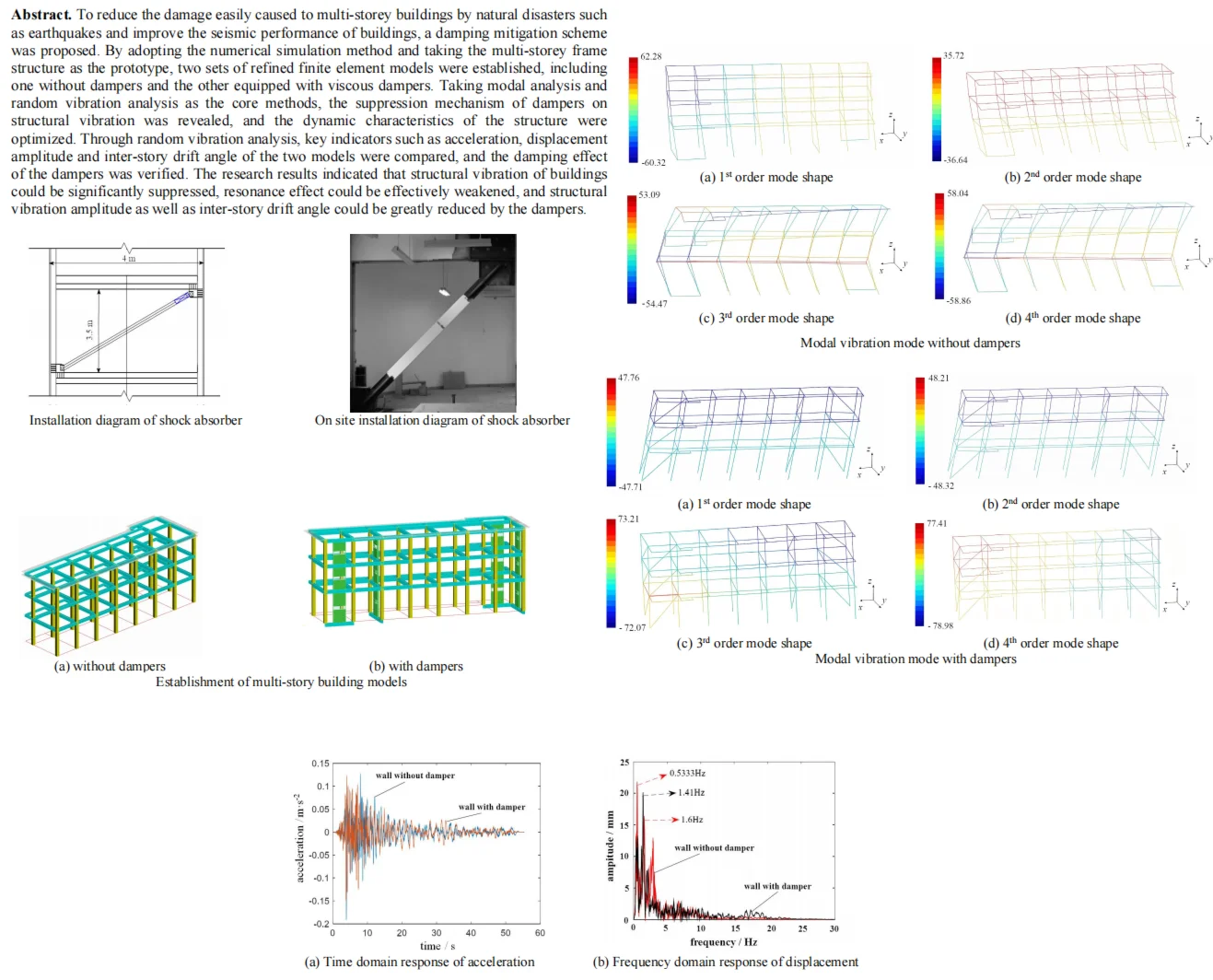
The installation form of dampers is shown in Fig. 1. Before installation, the layout position shall be reasonably planned according to the modal characteristics and force law of the building structure, and priority should be given to areas with large inter-story deformation and clear force transfer paths to give full play to the damping performance. During installation, the perpendicularity and coaxiality of components shall be strictly controlled to avoid additional bending moment caused by eccentric force. The welding quality and bolt tightening of connection joints shall comply with seismic code requirements to ensure reliable anchorage with the main structure. Meanwhile, construction accuracy and later maintenance space should be taken into account, and anti-corrosion and rust prevention treatment shall be implemented. It is necessary to prevent construction errors, structural settlement and environmental corrosion from affecting the mechanical performance and service life of dampers. After installation, force checking and commissioning shall be carried out to ensure normal coordinated operation under vibration working conditions. For the performance parameters of dampers, its damping coefficient is 2500 kN·s/m, the velocity exponent equals 0.4, and the maximum allowable stroke is ±80 mm.
Fig. 1Installation of damping shock absorber
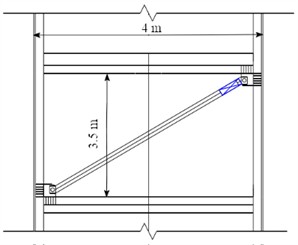
a) Installation diagram of shock absorber
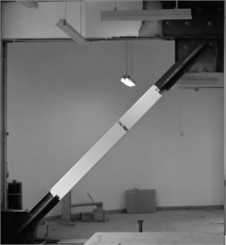
b) On site installation diagram of shock absorber. Photo by the author in Qingdao on March 10, 2026
2.2. The establishment of finite element model
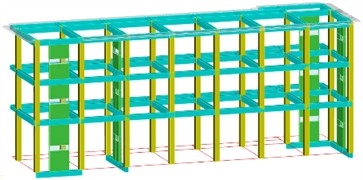
The model structure studied is a 3-story reinforced concrete frame. The storey height of each floor is 3.5 m. Beam and column members are simulated by BEAM188 beam elements, and the floor slabs are meshed with SHELL181 shell elements. The concrete material is C30, with an elastic modulus of 3.0×10⁴ MPa, Poisson’s ratio of 0.2, and density of 2500 kg/m3. The steel reinforcement is HRB400, whose elastic modulus is 2.06×10⁵ MPa. Viscous dampers are modeled using the COMBIN14 element. All boundary constraints are applied at the bottom of the columns, where all translational degrees of freedom are fully fixed. To verify the reliability of the finite-element models, a mesh-convergence study and a numerical-stability check were carried out prior to the modal and seismic-response analyses. For the beam members (BEAM188), three mesh schemes with characteristic element lengths of 0.50 m, 0.35 m and 0.20 m were tested; for the floor slabs (SHELL181), the corresponding element sizes were 0.60 m, 0.40 m and 0.25 m. The first four natural frequencies were taken as the convergence indicators. When the mesh was refined from the coarse to the medium scheme, the maximum relative change of the first four frequencies was 4.8 %, whereas further refinement from the medium to the fine scheme produced a change below 1.2 %, which is less than the 5 % convergence criterion adopted in this study. Accordingly, the medium mesh (0.35 m for beams, 0.40 m for slabs) was selected, ensuring solution accuracy while controlling computational cost.
Fig. 2Establishment of multi-story building models
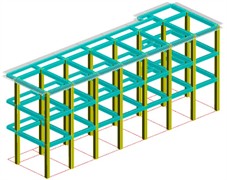
a) Without dampers
b) With dampers
To conduct the modal analysis on the influence of damping dampers on the seismic performance of multi-storey buildings, two sets of refined finite element models are established in this study, as shown in Fig. 2. Taking a multi-storey frame structure as the prototype, the beams and columns are discretized using beam-bar elements, and the geometric dimensions, material properties and boundary conditions of the structure are accurately reproduced to ensure that the mechanical characteristics of the model are consistent with those of the actual structure. The undamped model completely retains the main force-bearing system of the frame beams and columns, while the comparative model embeds viscous damping damper units at key positions with large inter-story displacements in accordance with engineering design specifications. By defining key parameters such as stiffness and damping coefficient of the dampers, the collaborative modeling of the damping device and the main structure is realized. The meshing and element types of the two models are kept consistent, which effectively eliminates the interference of modeling errors on the modal analysis results and lays a foundation for the accurate solution of natural frequencies and mode shapes in the subsequent steps. This dual-model system provides a direct comparison benchmark for modal analysis, which can clearly reveal the influence law of damping dampers on the dynamic characteristics of the structure. The core objective of modal analysis is to solve the natural frequencies, damping ratios and mode shapes of the structure. The undamped model can directly reflect the inherent dynamic characteristics of the frame structure, serving as the benchmark data for the undamped state. The model with dampers changes the overall damping matrix and stiffness matrix of the structure through the energy dissipation characteristics of the additional damping units, and its modal analysis results can intuitively reflect the regulation effect of the damping device on the natural vibration period and vibration modes of the structure. By comparing the mode shapes, the suppression mechanism of damping dampers on the structural vibration response can be clarified, and whether they can effectively avoid the resonance risk under seismic excitation can be judged, providing theoretical support at the dynamic characteristic level for the comparison of vibration amplitudes and inter-story drift ratios in the subsequent random vibration analysis.
3. Result analysis and discussion
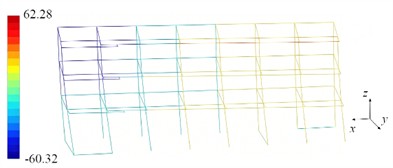
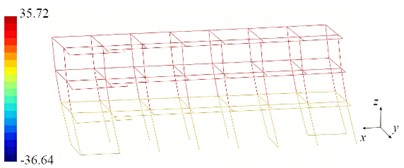
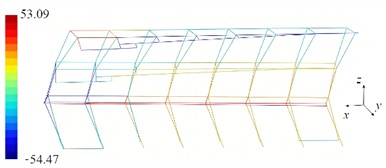
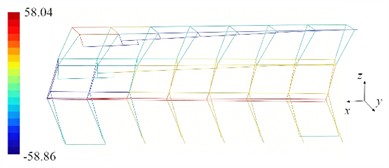
The first four mode shapes of the multi-story frame structure without damping dampers are shown in Fig. 3. The first-order mode shape is dominated by overall translation, with the maximum displacement amplitude occurring at the left floors, exhibiting typical shear-type vibration characteristics where inter-story deformation increases from top to bottom, indicating obvious weak regions in the structural stiffness distribution. The second-order mode shape is still dominated by horizontal translation, with a more uniform vibration pattern. The third and fourth-order mode shapes show significant torsional effects, with asymmetric displacement distribution, reflecting that the structure is prone to torsional coupled vibration in higher-order modes.
Fig. 3Modal vibration mode without dampers
a) 1st order mode shape
b) 2nd order mode shape
c) 3rd order mode shape
d) 4th order mode shape
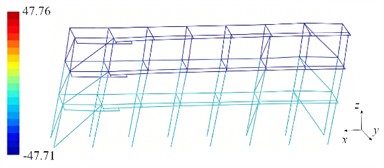
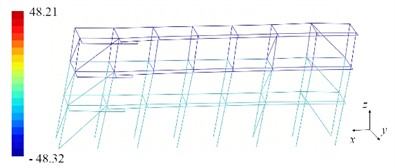
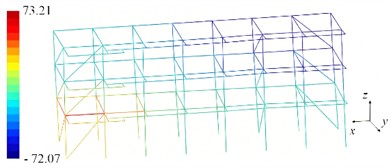
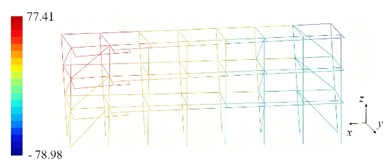
The first four mode shapes of the structure with damping dampers are shown in Fig. 4, presenting significant differences compared with the undamped model. The torsional effects in higher-order modes are significantly suppressed, and the displacement distribution becomes more uniform. Meanwhile, the additional stiffness and energy dissipation effect of the dampers alter the overall dynamic characteristics of the structure, resulting in more regular mode shapes, weakened coupling effects between torsion and translation, and effectively reduced structural vibration amplification effects.
Table 1The comparison results of natural frequencies
Mode order | 1st | 2nd | 3rd | 4th | |
Frequency (Hz) | Without dampers | 2.12 | 5.47 | 8.63 | 11.52 |
With dampers | 1.86 | 4.93 | 7.81 | 10.44 |
The comparison results of natural frequencies are shown in Table 1. It can be seen that after the installation of viscous dampers, the natural frequencies of each order of the structure decrease while the natural periods increase. The first-order natural frequency is reduced by 12.26 %. The variation of modal parameters indicates that the additional dampers alter the overall stiffness-damping characteristics of the frame structure. The increase in the fundamental period helps the structure stay away from the dominant frequency band of seismic excitation, which numerically explains the phenomenon that the torsional-coupled vibration observed from the mode-shape diagrams is suppressed.
Fig. 4Modal vibration mode with dampers
a) 1st order mode shape
b) 2nd order mode shape
c) 3rd order mode shape
d) 4th order mode shape
4. Seismic response analysis
4.1. Analysis condition setting
The seismic response calculation adopts deterministic time-history analysis. A real recorded seismic wave is applied as the base excitation at the bottom of the finite-element model. The acceleration and displacement time histories of each floor are solved by direct integration in the time domain. Fast Fourier Transform (FFT) is further performed on the computed time-history responses to obtain the displacement amplitude spectrum in the frequency domain, so as to detect resonance frequency peaks of the structure. It should be noted that the frequency-domain results are post-processed from time-history outputs, rather than a standalone power-spectral-based random response analysis. Key response indicators including acceleration peak, displacement amplitude and inter-story drift ratio are extracted for quantitative comparison [9, 10]. The core objective of random vibration analysis is to quantify the improvement effect of damping dampers on the seismic performance of multi-storey buildings through the comparison of dynamic responses under real seismic wave excitation. The random vibration analysis adopts the seismic wave shown in Fig. 5 as the base excitation, which covers the main natural frequency range of multi-storey buildings and can effectively excite the structural dynamic response. During the analysis, the seismic wave is input at the bottom of the finite element model. By quantitatively comparing the response differences between the two groups of models, the actual vibration reduction efficiency of damping dampers is evaluated.
Fig. 5Variation law of seismic wave
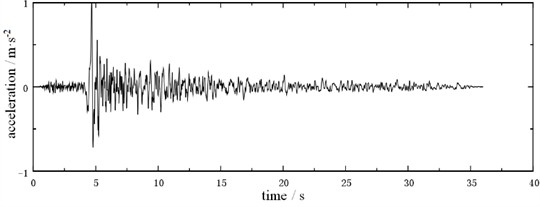
Through seismic response analysis, it can verify the suppression effect of damping dampers on structural vibration amplitude and inter-story drift ratio, and clarifies their seismic energy dissipation efficiency. On the other hand, it identifies the response distribution law of different floors, reveals the weak parts of the structure, and provides a basis for the optimal layout of dampers. Meanwhile, combined with the modal analysis results, it verifies the mechanism by which damping dampers achieve vibration reduction by increasing the structural damping ratio and optimizing dynamic characteristics, providing direct numerical support for the seismic design of multi-storey buildings.
4.2. Result analysis and discussion
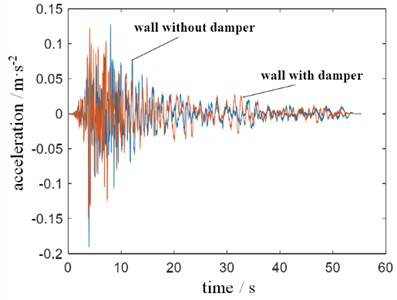
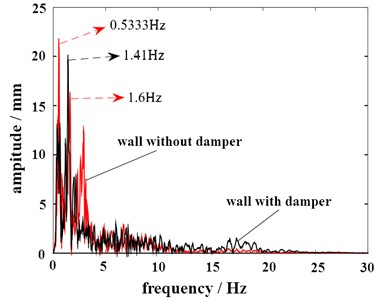
The results of the random vibration analysis are shown in Fig. 6. It can be seen that damping dampers have a significant suppression effect on the dynamic response of multi-story buildings. The acceleration time-domain response shows that the peak acceleration of the wall without dampers reaches ±0.15 m/s2 with slow vibration attenuation, while the peak acceleration drops to within ±0.05 m/s2 after installing dampers, and the vibration energy is rapidly dissipated. The displacement frequency-domain response further verifies that the wall without dampers has obvious resonance peaks at 0.533 Hz, 1.41 Hz, and 1.6 Hz, with a maximum displacement amplitude of 20 mm. After installing dampers, the resonance peaks are significantly weakened and the displacement amplitude is greatly reduced, indicating that dampers effectively suppress the coupling amplification effect between seismic excitation and the natural frequencies of the structure by increasing the structural damping ratio.
Fig. 6Results of random vibration response analysis
a) Time domain response of acceleration
b) Frequency domain response of displacement
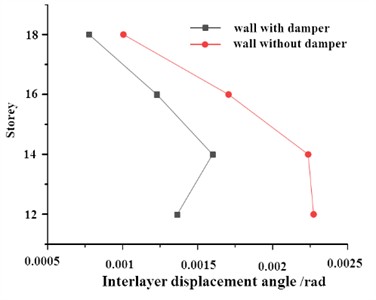
c) Comparison of inter-story drift angle
The comparison results of inter-story drift angle quantify the engineering value of the damping effect. The inter-story drift angle of the wall without dampers increases significantly with the rise of floors. After installing dampers, the inter-story drift angle of each floor is significantly reduced by more than 50 %, and the displacement distribution among floors is more uniform without stress concentration in local weak layers. Overall, damping dampers not only reduce the vibration amplitude through energy dissipation but also weaken the resonance effect by optimizing dynamic characteristics, significantly improving the overall seismic performance of multi-story buildings. This verifies their effectiveness in reducing inter-story drift angle and avoiding structural damage.
5. Conclusions
1) Modal analysis and random vibration analysis were conducted on the finite element models of multi-storey buildings with and without dampers, and the influence law and action mechanism of dampers on the seismic performance of buildings were clarified. Obvious weak stiffness regions were found in buildings without dampers, and torsional coupled vibration was easily generated in high-order modes. After dampers were installed, the torsional effects of high-order modes were remarkably suppressed, the dynamic characteristics of the structure were optimized.
2) It was confirmed by random vibration analysis that vibration energy could be rapidly dissipated by dampers; the structural acceleration, displacement amplitude and inter-story drift angle were significantly reduced, presenting an obvious seismic reduction effect. Through energy dissipation and optimization of structural dynamic characteristics, the seismic performance of multi-storey buildings was effectively improved by dampers.
3) The numerical simulation study adopts several simplifying assumptions. The beam-column joints are assumed to be fully rigid, and the influence of material degradation and environmental corrosion on the performance of viscous dampers during long-term service is not considered. In practical engineering, corrosion, ageing and construction errors may degrade the mechanical behaviour of dampers. Therefore, there are certain differences between the numerical results and the real-world seismic responses of the structure. Further experimental research is required to calibrate the simulation predictions.
References
-
H. Ahmadi Taleshian, A. Mirzagoltabar Roshan, and J. Vaseghi Amiri, “Seismic pounding mitigation of asymmetric-plan buildings by using viscoelastic links,” Structures, Vol. 36, pp. 189–214, Dec. 2021, https://doi.org/10.1016/j.istruc.2021.11.036
-
M. Dey and S. Debnath, “Energy based design of friction damped vertically irregular buildings,” Earthquake Engineering and Resilience, Vol. 4, No. 4, pp. 534–550, Dec. 2025, https://doi.org/10.1002/eer2.70027
-
M. Roozbahan, C. Masnata, G. Turan, and A. Pirrotta, “Efficiency evaluation of optimal TLCD and TMD for the seismic response reduction of buildings considering soil-structure interaction effect,” Meccanica, Vol. 60, No. 10-11, pp. 3365–3386, May 2025, https://doi.org/10.1007/s11012-025-01981-9
-
H. Liu, Z. Tang, Y. Chen, and X. Du, “Frequency domain transfer function based multimodal design method for seismic mitigation of building structures,” Structures, Vol. 51, pp. 1539–1552, Mar. 2023, https://doi.org/10.1016/j.istruc.2023.03.135
-
R. K. Bhamu, A. Shukla, S. C. Sharma, and S. P. Harsha, “Vibration response of steam turbine healthy and cracked blade under the stress stiffening and spin softening effects,” Proceedings of the Institution of Mechanical Engineers, Part K: Journal of Multi-body Dynamics, Vol. 236, No. 2, pp. 224–243, Feb. 2022, https://doi.org/10.1177/14644193221078656
-
S. de Carolis, A. Messina, and L. Soria, “Modal analysis through response-based FRFs: Additional modes for local diagnoses,” Journal of Sound and Vibration, Vol. 549, No. 1, p. 117574, Jan. 2023, https://doi.org/10.1016/j.jsv.2023.117574
-
J. M. Jara, C. García-Calzada, B. A. Olmos, and G. Martínez, “Seismic response and reliability index of RC weak story buildings on soft soils of Mexico City,” Journal of Building Engineering, Vol. 50, No. 2, p. 104199, Feb. 2022, https://doi.org/10.1016/j.jobe.2022.104199
-
I. Hafner, D. Lazarević, T. Kišiček, and M. Stepinac, “Post-earthquake assessment of a historical masonry building after the Zagreb earthquake-case study,” Buildings, Vol. 12, No. 3, p. 323, Mar. 2022, https://doi.org/10.3390/buildings12030323
-
L. Guo, Z. Huang, D. Zhang, K. Pitilakis, D. Lu, and Z. Yao, “Seismic response of soil-shield tunnel system considering spatial variability of multivariate soil properties via random field theory,” Tunnelling and Underground Space Technology, Vol. 174, p. 107726, Jun. 2026, https://doi.org/10.1016/j.tust.2026.107726
-
L. Guo, Y. Shen, M. Lyu, D. Zhang, and Z. Huang, “Non-parametric seismic fragility assessment of underground structures incorporating stochastic ground motion,” Soil Dynamics and Earthquake Engineering, Vol. 200, No. B, p. 109893, Jan. 2025, https://doi.org/10.1016/j.soildyn.2025.109893
About this article

The authors have not disclosed any funding.
The datasets generated during and/or analyzed during the current study are available from the corresponding author on reasonable request.
The authors declare that they have no conflict of interest.

