Abstract
The possibility of obtaining stable vertical oscillations of a biharmonic vibration platform with four unbalanced vibration exciters, not connected by kinematic transmissions, is demonstrated. For such a dynamic system, the validity of the well-known conditions for the existence and stability of synchronous motions of two vibration exciters rotating in opposite directions at identical frequencies is confirmed. It is shown that the biharmonic regime consists of two independent steady-state monoharmonic regimes, each with its own synchronous frequency, resulting in the excitation of biharmonic oscillations with variable motion asymmetry. The attainment of stable biharmonic oscillations is corroborated through numerical simulations and experimental validation.
Highlights
- A simple and reliable method for generating biharmonic oscillations of the working body of a vibration machine equipped with unbalanced vibration exciters not interconnected by kinematic transmissions has been substantiated.
- The generation of stable translational oscillations of the working body according to a biharmonic law with varying motion asymmetry has been confirmed.
- The proposed dynamic system makes it possible to: 1. substantially simplify the design of the biharmonic vibration drive, expand the possibilities for drive configuration, and increase its durability and reliability;
- The proposed dynamic system makes it possible to: 2. implement both biharmonic and monoharmonic laws of working-body oscillation without any readjustment;
- The proposed dynamic system makes it possible to: 3. facilitate the passage through resonance zones by using sequential start-up of pairs of vibration-exciter motors.
1. Introduction
Vibration machines with unbalanced vibration exciters are widely employed across various industrial sectors. Vibration machines exhibiting a biharmonic law of oscillation of the working body (WB) are characterized by higher efficiency. However, monoharmonic vibration machines are more common. This prevalence is due to the complexity of biharmonic vibration drives requiring kinematic synchronization of the exciters. The utilization of self-synchronization allows for a simplification of the drive design. To date, the phenomenon of self-synchronization has been thoroughly studied, primarily owing to the works of Prof. Blechman [1]. At the same time, new applied research tasks continually arise concerning specific vibration machines. In particular, studies [2] have obtained important practical results regarding the self-synchronization process of inertial vibration exciters with a limited energy source using numerical modeling. The research and engineering application of self-synchronization theory on a two-mass dynamic system with two inertial vibration exciters is presented in [3]. Reference [4] examines the possibility of self-synchronization for two pairs of unbalanced vibration exciters with multiple rotational frequencies. Work [5] investigates controlled synchronization of inertial vibration exciters. The feasibility of solving applied self-synchronization tasks for vibration exciters using the methodology of vibration capture of an unbalanced rotor’s rotation is substantiated in [6-8].
The prospects and challenges of exciting biharmonic oscillations are addressed in works [9-14]. For instance, study [9] investigates the effectiveness of multi-frequency oscillations in vibrating screens. The use of an unbalanced vibration exciter and an automatic balancer for the excitation of biharmonic oscillations is discussed in [10, 11]. In [15, 16], the excitation of two-frequency oscillations of the WB is proposed using an inertial vibration exciter consisting of two coaxial exciters. Partial self-synchronization of vibration exciters in a biharmonic vibration drive for horizontal oscillations is examined in [17].
The aim of the present study is to confirm the practical feasibility of achieving stable vertically directed biharmonic oscillations of a vibration platform equipped with unbalanced exciters without kinematic transmissions.
2. Description and equations of motion of the system
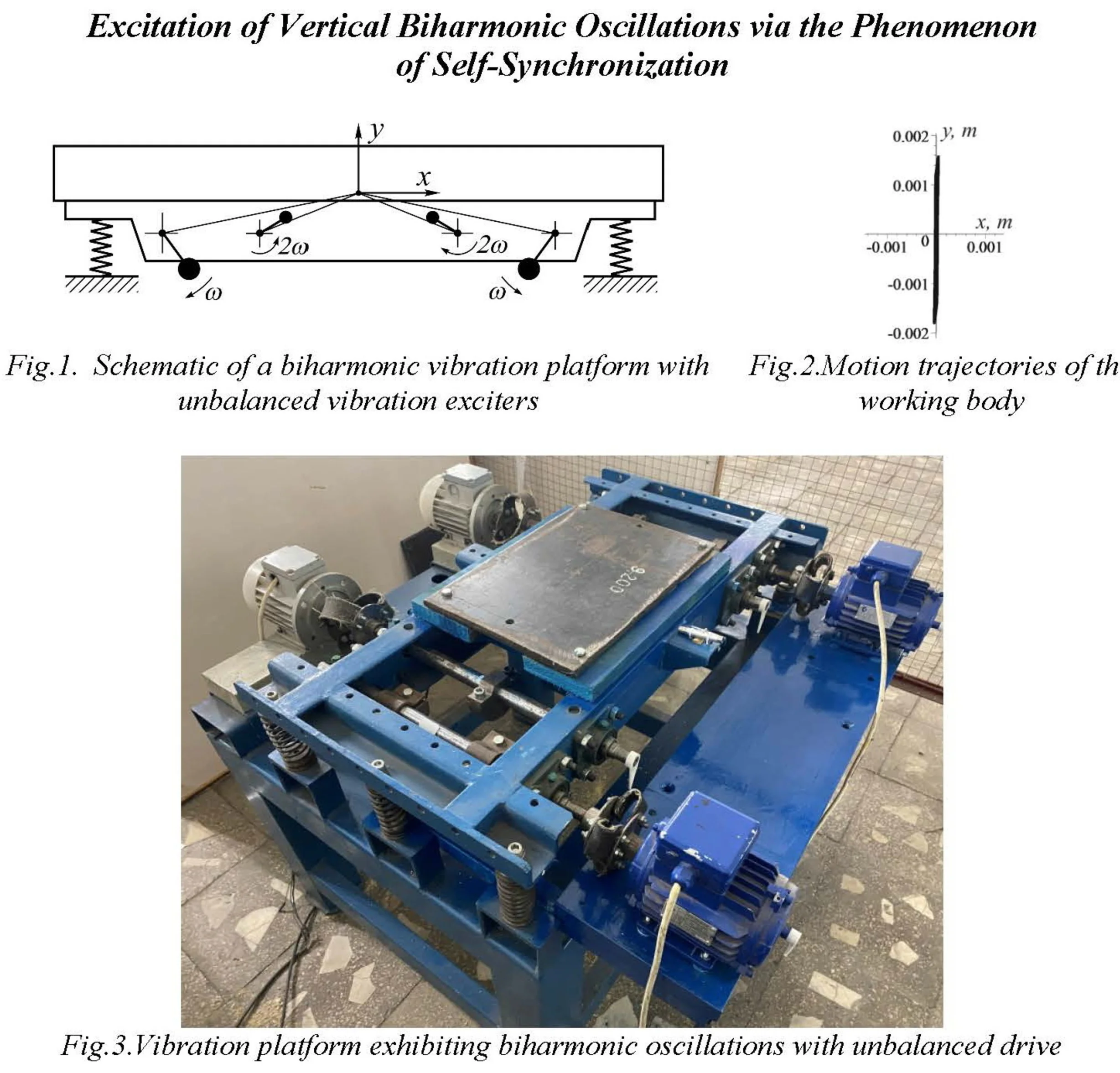
The dynamic model of the vibration platform is represented as a single-mass scheme with “soft” vibration isolation and inertial excitation of oscillations. The rigid WB is mounted on a fixed base via linear elastic and damping elements (Fig. 1). In the general case, the WB can perform small planar oscillations. Two pairs of unbalanced vibration exciters are symmetrically mounted on it, with axes parallel to each other and located in a single horizontal plane perpendicular to the plane of platform oscillations. The axes of each pair of exciters are equidistant from the center of mass of the WB. The vibration exciters are driven by independent asynchronous-type electric motors; the synchronous frequencies of the motors of different pairs are in a ratio of 1:2; within each pair, the exciters rotate in opposite directions.
Fig. 1Vibration platform exhibiting biharmonic oscillations with unbalanced drive
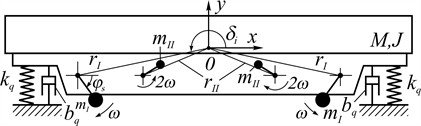
The equations of motion of the system can be derived from the general equations of motion for a vibration machine with planar motion and inertial vibration exciters presented in [1]:
where , are the moments of inertia and the rotation angle of the vibration exciters; , are the driving torque and the resistance torque of the electric motors; , , , are the mass, eccentricity, and polar coordinates of the axes of the exciters; are the generalized coordinates of the WB; is the gravitational acceleration; , are the total mass and moment of inertia of the WB; , are the coefficients of viscous damping and stiffness of the elastic elements.
Let us consider the practically important case in which the vibration exciters within each pair are identical: , , , , , . It is assumed that the partial angular velocities of the vibration exciters (i.e., the velocities of the exciters when mounted on a stationary base) are equal within each pair. Let us determine the conditions for the existence and stability of solutions to system (1) of the form: , where , ; , ; – are constants.
3. Conditions for the existence and stability of synchronous rotation modes of vibration exciters
In the case of above-resonance vibration machines, where energy dissipation during oscillations of the WB can be neglected, it is convenient to employ the integral stability criterion for synchronous motions [1]. According to this criterion, the phase differences between the vibration exciters in possible stable synchronous motions are determined from the conditions of minimum of potential function . In the case under consideration, the function D may be taken as the mean value of the kinetic energy of the elastically suspended WB (the potential energy and the corresponding terms in the equations of motion of the WB are neglected when determining ) [1]: . Here, the angle brackets denote the averaging operation over fast time. After averaging, we obtain:
where , , , , , are the synchronous rotation frequencies of the vibration exciters within each pair.
In the approximation under consideration (which is sufficient for applied problems), Eq. (3) couples only the phases of vibration exciters having equal rotation frequencies. This indicates that, in practice, self-synchronization is possible only between vibration exciters within the same pair, and that exciters belonging to different pairs will not appreciably influence each other's dynamics. By applying the methodology of the integral criterion, it can readily be established that, for any combination of parameters, only the anti-phase rotation of the vibration exciters within each pair is stable. The exciters of each pair will rotate at the synchronous frequency of their respective pair, , . The conditions for the existence of synchronous rotation modes of the exciters within each pair can be expressed in the form [1]:
where , are the damping coefficients obtained by linearization of the torques , ; , are the partial frequencies of the vibration exciters [1].
It should be noted that conditions Eq. (4) coincide with the corresponding conditions for the same dynamic system with two vibration exciters [1]. It is well known that for above-resonance vibration machines, conditions Eq. (4) are generally satisfied with ease. It is also important that the expressions for the magnitudes of the vibrational torques coincide with the corresponding expressions for a dynamic system with two exciters. Such a dynamic system is characterized by high stability of synchronous rotation of the vibration exciters. Consequently, high stability of synchronous rotation of the exciters can be expected for the vibration platform with the proposed dynamic scheme (Fig. 2). In the steady-state regime, the WB will undergo vertical rectilinear two-frequency oscillations according to the law:
where , are the amplitudes of the vertical oscillations of the WB at the fundamental and higher harmonics, respectively; is the phase shift angle between the harmonics.
According to Eq. (5), in the steady-state motion, biharmonic oscillations of the WB with a variable motion asymmetry will occur. For a number of technological processes such oscillations are desirable (in particular, for vibration compaction processes in the production of reinforced concrete products). Of course, the theoretically determined conditions for the existence and stability of synchronous motions do not in themselves guarantee their onset in real dynamic systems. The results obtained will therefore be verified by means of numerical and full-scale experiments.
4. Computer simulation of the dynamics of the biharmonic vibration platform
For the numerical integration of the system (1-2) and the equations of the socalled A-model of asynchronous electric motors [18, 19], the parameters of the experimental vibration platform (Fig. 2) were specified: 70 kg; 6.4 kg⋅m2; 4.8×10⁴ N/m; 5.5×10³ Nm; 3.6 kg; 0.14m; 0.005 kg⋅m2; 0.0034 kg⋅m2; 0.327 m; 0.217 m; 0.12 kW, 157 rad/s, where , are the rated power and synchronous frequency of the motors. The run-up of the “fast” pair of vibration exciters to twice the nominal frequency of the primary exciters was achieved by means of a frequency converter. Initial conditions: /2 rad, –3/2 rad, all other initial conditions are zero.
Fig. 2Experimental vibration platform. The photos were taken at the machine dynamics testing laboratory of the Department of Industrial engineering, Lutsk National Technical University, during the experimental study conducted by N. Yaroshevych on May 22, 2026
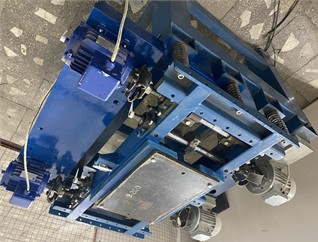
Fig. 3Time histories of the phase differences between the vibration exciters: 1 – φ12; 2 – φ34
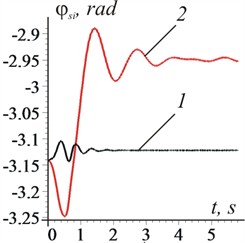
The simulation results confirm the feasibility of exciting stable vertical biharmonic oscillations of the WB of the vibration platform. Self-synchronization of the vibration exciters within each pair is evidenced by the constancy of the phase differences between the rotors (Fig. 3): 3.12 rad, 3.37 rad. The fluctuations in the phase shift magnitude are negligible. The resulting phase shifts between vibration exciters with multiple rotational frequencies (, , …) is variable.
According to the graphs of the oscillations of the WB center of mass in the steady-state motion (Fig. 4 and Fig. 5), biharmonic translational oscillations occur along the axis with a varying motion asymmetry. The motion trajectories of other points of the WB exhibit essentially the same pattern (Fig. 5(b)).
Fig. 4Motion trajectories of the WB (t= 6.8,..., 7.8 s-1)
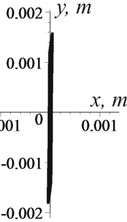
a) Center of mass
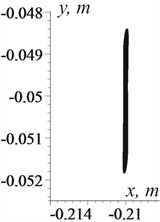
b) Rotation axis of the third exciter
5. Experimental investigation of the steady-state oscillation regime of the vibration platform
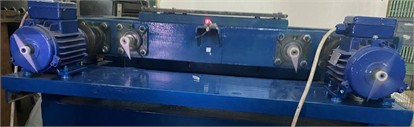
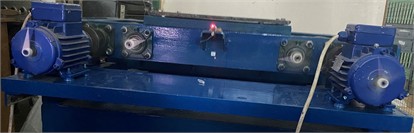
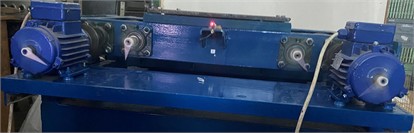
The experimental vibration platform (Fig. 2), corresponding to the dynamic scheme shown in Fig. 1, was used for the investigations. In the course of the experiments, the rotation frequencies of the vibration exciters were determined, their instantaneous positions were recorded, and the motion trajectories of characteristic points of the WB were tracked. The exciter frequencies and inter-exciter phase shifts were determined using a stroboscope with an adjustable flash frequency. The motion trajectory was determined by projecting onto a screen the beam of a laser pointer mounted on the WB.
Fig. 5Time histories of the horizontal (1) and vertical (2) oscillations of the WB over different time intervals
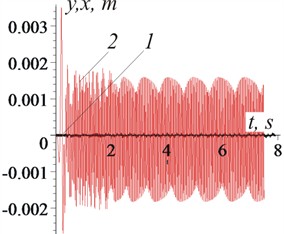
a) 0,..., 8 s-1
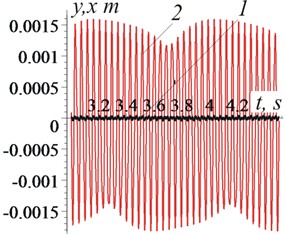
b) 3,..., 4.5 s-1
In all experiments, the establishment of stable synchronous rotation modes of the vibration exciters within each pair, as well as a steady-state regime of vertical translational oscillations of the WB, was confirmed. Analysis of the instantaneous positions of the vibration exciters indicates that: the exciters within each pair rotate synchronously; the synchronous frequencies of the pairs are not harmonically related ( 148.5 s-1, 289.3 s-1); the phase shifts between the exciters within each pair are constant and correspond to anti-phase rotation; the phase differences between exciters of different pairs vary continuously (Fig. 6). According to Fig. 7, the trajectory of the WB center of mass forms a vertical stripe. It should be noted that the trajectories traced by other points of the WB are approximately similar in shape.
Fig. 6Photographs of the instantaneous positions of the exciter rotor pointers. Photos by N. Yaroshevych on May 22, 2026
It should be noted that this motion regime of the vibration platform was also established under small variations (within 3 %…15 %) of the baseline system parameters and motor startup conditions.
Fig. 7Motion trajectory of the WB of the vibration platform

6. Conclusions
The practical feasibility of exciting stable vertically directed biharmonic oscillations of a vibration platform equipped with four unbalanced vibration exciters, without the use of kinematic couplings between them, has been confirmed.
It has been shown that the WB of the vibration platform will undergo biharmonic translational oscillations with a varying motion asymmetry, which is advantageous for a range of technological processes.
The proposed dynamic scheme allows for a simplification of the biharmonic vibration drive design, an increase in its durability and reliability, as well as the implementation of various machine startup modes and WB oscillation patterns.
The results obtained demonstrate the promising nature of the proposed vibration platforms and call for more thorough full-scale experimental investigations.
References
-
I. I. Blekhman, Vibrational Mechanics – Nonlinear Dynamic Effects. General Approach, Applications. Singapore: World Scientific, 2000.
-
J. M. Balthazar, J. L. P. Felix, and R. M. Brasil, “Some comments on the numerical simulation of self-synchronization of four non-ideal exciters,” Applied Mathematics and Computation, Vol. 164, No. 2, pp. 615–625, Dec. 2004, https://doi.org/10.1016/j.amc.2004.06.010
-
Y. Liu, X. Zhang, D. Gu, L. Jia, and B. Wen, “Synchronization of a dual-mass vibrating system with two exciters,” Shock and Vibration, Vol. 2020, pp. 1–12, Jan. 2020, https://doi.org/10.1155/2020/9345652
-
N. Yaroshevich, V. Puts, T. Yaroshevych, O. Shovkomud, and V. Martyniuk, “Study of self-synchronization of unbalanced vibration exciters of a biharmonic vibration drive,” Vibroengineering Procedia, Vol. 59, pp. 96–102, 2025, https://doi.org/10.21595/vp.2025.25204
-
X. Kong, X. Zhang, X. Chen, B. Wen, and B. Wang, “Phase and speed synchronization control of four eccentric rotors driven by induction motors in a linear vibratory feeder with unknown time-varying load torques using adaptive sliding mode control algorithm,” Journal of Sound and Vibration, Vol. 370, pp. 23–42, 2016, https://doi.org/10.1016/j.jsv.2016.02.013
-
N. Yaroshevich, V. Grabovets, T. Yaroshevich, I. Pavlova, and I. Bandura, “On the effect of vibrational capture of rotation of an unbalanced rotor,” Mathematical Models in Engineering, Vol. 9, No. 2, pp. 81–93, Jun. 2023, https://doi.org/10.21595/mme.2023.23273
-
N. Yaroshevich, V. Gursky, V. Puts, O. Yaroshevych, and V. Martyniuk, “On the dynamics of vibrational capture of rotation of an unbalanced rotor,” Vibroengineering Procedia, Vol. 42, pp. 1–6, May 2022, https://doi.org/10.21595/vp.2022.22413
-
N. Yaroshevich, T. Yaroshevich, and M. Yevsiuk, “On nonlinear effects during the vibration of an unbalanced rotor axis,” in Mechanisms and machine science, Vol. 142, Cham: Springer Nature Switzerland, 2025, pp. 203–214, https://doi.org/10.1007/978-3-031-84449-2_13
-
A. F. Bulat and H. O. Shevchenko, “Influencing polyfrequency oscillations of sieving surfaces of vibrating screens on separation of bulk materials is reviewed,” Naukovyi Visnyk Natsionalnoho Hirnychoho Universytetu. Dnipropetrovsk, Vol. 4, pp. 92–97, 2010.
-
V. Yatsun, G. Filimonikhin, K. Dumenko, and A. Nevdakha, “Experimental research of rectilinear translational vibrations of a screen box excited by a ball balancer,” Eastern-European Journal of Enterprise Technologies, Vol. 3, No. 1(87), pp. 23–29, Jun. 2017, https://doi.org/10.15587/1729-4061.2017.101798
-
V. Yatsun, G. Filimonikhin, A. Nevdakha, and V. Pirogov, “Experimental study into rotational-oscillatory vibrations of a vibration machine platform excited by the ball auto-balancer,” Eastern-European Journal of Enterprise Technologies, Vol. 4, No. 7 (94), pp. 34–42, Aug. 2018, https://doi.org/10.15587/1729-4061.2018.140006
-
V. Symoniuk, V. Denysiuk, Y. Lapchenko, V. Strutinsky, and A. Permyakov, “Modeling of pseudoharmonic oscillations of vibration container with working mixture,” in Lecture notes in mechanical engineering, Cham: Springer International Publishing, 2021, pp. 176–185, https://doi.org/10.1007/978-3-030-68014-5_18
-
A. Stelmakh et al., “Improvement of operational parameters for precision rolling bearings by cleaning working surfaces from micro pollution of various nature,” Journal of Engineering Sciences, Vol. 10, No. 1, pp. A31–A40, 2023, https://doi.org/10.21272/jes.2023.10(1).a5
-
O. Lanets, O. Kachur, V. Korendiy, P. Dmyterko, S. Nikipchuk, and I. Derevenko, “Determination of the first natural frequency of an elastic rod of a discrete-continuous vibratory system,” Vibroengineering Procedia, Vol. 37, pp. 7–12, May 2021, https://doi.org/10.21595/vp.2021.21981
-
V. Gursky, P. Krot, V. Korendiy, and R. Zimroz, “Dynamic analysis of an enhanced multi-frequency inertial exciter for industrial vibrating machines,” Machines, Vol. 10, No. 2, p. 130, Feb. 2022, https://doi.org/10.3390/machines10020130
-
V. Gurskyi, V. Korendiy, P. Krot, R. Zimroz, O. Kachur, and N. Maherus, “On the dynamics of an enhanced coaxial inertial exciter for vibratory machines,” Machines, Vol. 11, No. 1, p. 97, Jan. 2023, https://doi.org/10.3390/machines11010097
-
N. Yaroshevich, V. Puts, T. Yaroshevych, and V. Martyniuk, “Self-synchronisation of vibration exciters of a biharmonic vibration drive,” Vibroengineering Procedia, Vol. 55, pp. 27–32, 2024, https://doi.org/10.21595/vp.2024.24416
-
V. Lyshuk et al., “Modeling dynamic and static operating modes of a low-power asynchronous electric drive,” Informatyka, Automatyka, Pomiary W Gospodarce I Ochronie Środowiska, Vol. 15, No. 2, pp. 118–123, 2025, https://doi.org/10.35784/iapgos.6794
-
N. Yaroshevich, O. Lanets, and O. Yaroshevych, “About oscillations in drives of vibration machines with unbalanced vibration exciters during passage through the resonance zone,” in Mechanisms and Machine Science, Vol. 116, 2022, pp. 29–42.
About this article

The authors have not disclosed any funding.
The datasets generated during and/or analyzed during the current study are available from the corresponding author on reasonable request.
The authors declare that they have no conflict of interest.

