Abstract
Heterogeneous nanocatalysts encode compositional and structural information in complex spectroscopic patterns that are difficult to quantify with single-scale analysis. In this work, a wavelet-based multiscale descriptor framework is applied to the X-ray diffraction (XRD) patterns of pure and cation-substituted hydroxyapatite nanocatalysts (Ag-, Co-, and Sr-HAP) previously reported for the selective hydration of aromatic nitriles to amides. The Discrete Wavelet Transform (DWT) and the Wavelet Scattering Transform (WST) are computed for each diffractogram and compared in terms of feature dispersion, translation invariance, and inter-sample discriminability. The DWT captures localized peak-intensity variations but retains a wide dynamic range (variance ≈ 6.2×10¹²) that is sensitive to amplitude and translation. The WST compresses the descriptor space by roughly ten orders of magnitude (variance ≈ 1.2×10²) while preserving the sample ordering induced by cation substitution and remaining stable under small deformations. These properties yield a compact, mathematically defined, translation-invariant representation of doped-HAP diffraction fingerprints that is directly compatible with downstream chemometric and supervised-learning workflows. Because the descriptors are deterministic and fully reproducible, the framework is proposed as a candidate approach for future batch-to-batch quality assessment during doped-nanocatalyst production – a materials-processing concern relevant to manufacturing quality control – though this application remains untested against actual production-scale batch-variation data. The novelty of the present work lies in the systematic construction and quantitative comparison of DWT and WST descriptors for a family of doped nanocatalysts, providing a reproducible feature-extraction pipeline for structurally similar catalyst systems. The main limitation is the small number of samples analyzed (four catalyst compositions), which restricts the present study to descriptor characterization rather than predictive modelling; extension to larger catalyst libraries is required for full data-driven prediction of catalytic activity.
Highlights
- First systematic DWT and WST descriptor comparison for doped hydroxyapatite nanocatalyst XRD fingerprints.
- DWT captures sharp diffraction features but shows large dispersion (variance ≈ 6.2 × 10¹²) and sensitivity to amplitude/translation.
- WST compresses descriptor variance by ~10 orders of magnitude while preserving cation-substitution sample ordering.
- WST total energy ordering (Co > Ag > Sr) matches catalytic yield and reaction-time ordering of doped HAP catalysts.
- Provides a reproducible, translation-invariant feature pipeline for chemometric/supervised learning and future batch-quality screening.
1. Introduction
Heterogeneous catalysis underpins a wide range of environmentally motivated chemical transformations, in which catalyst composition and operating conditions jointly determine the reaction outcome [1-3]. Hydroxyapatite (HAP), Ca10(PO4)6(OH)2, has attracted sustained interest as a catalytic support because its lattice tolerates equivalent and aliovalent cation substitution, which enables systematic tuning of surface acid-base character, defect density, and the local coordination environment of the active sites [4-6]. Substituted HAP systems have consequently been applied to a range of structure-sensitive transformations, including selective oxidations, hydrogenations, and base-catalyzed condensations [7-10].
Among these transformations, the catalytic hydration of nitriles to primary amides is an industrially relevant benchmark reaction whose selectivity depends sensitively on catalyst composition and reaction temperature. Precious-metal catalytic systems based on palladium, silver, and ruthenium have been widely explored for this transformation [1, 2, 11-14], but generally face limitations in catalyst separation and reusability. Cation-substituted HAP nanocatalysts provide a heterogeneous alternative that combines high selectivity, straightforward separation, and multi-cycle reusability [35]. Nevertheless, deriving systematic structure-performance relationships for these materials remains difficult because the catalytic response depends on several interacting variables – cation identity, dopant loading, reaction temperature, and substrate class – while the underlying structural information is distributed across multiscale spectroscopic fingerprints (X-ray diffraction, FTIR, elemental mapping) that are not well summarized by single-scale metrics.
The extraction of quantitative descriptors from structural data has become a central component of both catalyst design and coordination chemistry. In molecular crystals, Hirshfeld surface analysis and the associated two-dimensional fingerprint plots provide translation-invariant descriptors of intermolecular contacts and have been used to relate crystal packing to thermal and physicochemical behavior, including in organotin (IV) coordination compounds where the descriptor space cleanly separates families of related complexes [42]. In heterogeneous catalysis, machine-learning and chemometric methods have been used to identify structure–activity descriptors, screen catalyst compositions, and reduce the experimental burden of catalyst discovery [15-21]; recent applications range from the design of Ni-based steam-reforming catalysts [31] and iron-based peroxymonosulfate activators [32] to task-decomposed catalyst-optimization frameworks [34] and multivariate feature-extraction pipelines for spectroscopic sensors [28-30]. Wavelet-based multiscale signal analysis has emerged in parallel as a mathematically defined, non-trainable alternative to fully learned representations, offering hierarchical decomposition, translation invariance, and controlled stability under small deformations [36, 37], with recent uptake in materials sensing and cross-domain data-driven analysis [29, 30].
Despite the maturity of both directions, wavelet-based multiscale descriptors have not been systematically applied to the X-ray diffraction fingerprints of doped-nanocatalyst families. The present study addresses this gap. Building on the synthesis and catalytic evaluation of Ag-, Co-, and Sr-substituted hydroxyapatite nanocatalysts for the selective hydration of aromatic nitriles that we recently reported [35], and drawing methodologically on the use of quantitative descriptors for structural characterization in coordination chemistry [42], we compute Discrete Wavelet Transform (DWT) and Wavelet Scattering Transform (WST) descriptors of the XRD patterns of pure and cation-substituted HAP nanocatalysts and quantitatively compare their dispersion, translation invariance, and inter-sample discriminability. The novelty of the present work lies in (i) the first systematic construction of DWT and WST descriptors for a doped-HAP nanocatalyst family, (ii) the quantitative demonstration that WST compresses the descriptor space by roughly ten orders of magnitude relative to DWT while preserving the sample ordering induced by cation substitution, (iii) the provision of a reproducible, mathematically defined descriptor pipeline that can serve as the input layer for downstream supervised-learning or chemometric models of catalytic performance, and (iv) the identification of this descriptor pipeline as a candidate approach for future batch-to-batch quality assessment during doped-nanocatalyst production, a potential connection to materials-processing quality control that remains to be validated in manufacturing contexts.
From a manufacturing standpoint, the reproducibility of doped-nanocatalyst production is itself a materials-processing concern: batch-to-batch variation in dopant incorporation, crystallinity, and phase purity during co-precipitation synthesis can affect downstream catalytic performance, yet is conventionally assessed only qualitatively by visual inspection of raw diffractograms. The compact, low-dispersion, translation-invariant descriptors demonstrated here are proposed as a candidate quantitative screening metric for such batch-to-batch consistency, offering a potential basis for future process monitoring and quality evaluation during nanocatalyst production. This application is not tested in the present study, which analyzes four catalyst compositions rather than a production batch series, and would require validation against production-scale batch-variation data before the framework could be considered a validated quality-control tool.
The scope of this study is deliberately restricted to descriptor characterization rather than to full predictive modelling. Its main limitation is dataset size: only four catalyst compositions are analyzed at the diffraction level, so the wavelet descriptors are demonstrated as a feature-extraction step and not as a validated predictor of catalytic activity. Extension of the framework to larger catalyst libraries, to complementary spectroscopies, and to explicit supervised regression on yield–time data is identified as the natural next step.
2. Methodology
2.1. Overview
The methodology comprises three sequential stages: (i) acquisition of the X-ray diffraction (XRD) patterns of the four nanocatalysts (pure HAP and Ag-, Co-, Sr-substituted HAP) reported in our previous study [35]; (ii) computation of Discrete Wavelet Transform (DWT) and Wavelet Scattering Transform (WST) descriptors for each pattern; and (iii) quantitative comparison of the two descriptor families in terms of dynamic range, dispersion, translation invariance, and inter-sample discriminability. All wavelet computations were performed in MATLAB, and the code is available on GitHub.
2.2. Continuous Wavelet Transform
The CWT decomposes a real-valued signal onto a family of scaled and translated copies of a mother wavelet :
where 0 is the scale parameter that controls the frequency resolution of the analyzing wavelet, is the translation parameter that localizes it along the signal axis, and denotes the complex conjugate of . The CWT provides a joint scale–position representation of the signal and forms the analytical basis on which the discrete and scattering variants are constructed.
2.3. Discrete wavelet transform
The discrete wavelet transform (DWT) restricts the scale and translation parameters to a dyadic grid, and , with , :
Orthogonal and biorthogonal wavelet bases, such as the Daubechies family used in this work, allow an exact and non-redundant reconstruction of the signal from its DWT coefficients. At each decomposition level , the DWT separates a smoothed approximation from the corresponding detail coefficients , which encode localized, scale-specific variations. In the present analysis the first two detail levels ( and ) were retained, since these concentrate the sharp peak-related information most relevant to the phase-purity and dopant-driven structural variations of the samples.
2.4. Wavelet scattering transform
The WST was introduced and developed further by [36, 37], constructs translation-invariant and deformation-stable representations of signals by alternating wavelet convolutions with modulus non-linearities and a final low-pass averaging step. The formulation can be viewed as a deep convolutional network in which the filters are analytically defined complex wavelets rather than learned parameters, thus the resulting descriptors are deterministic, reproducible across implementations, and independent of training data. A family of complex wavelets , is generated by dilations of the mother wavelet :
where indexes the scale. The zeroth-order scattering coefficient captures the low-frequency envelope of the signal through convolution with a low-pass filter at scale :
This operation preserves the global energy of the signal while discarding fine-scale detail. First-order scattering coefficients recover the high-frequency information removed by the initial averaging: the signal is convolved with each wavelet , a modulus is applied to remove phase sensitivity, and the result is low-pass filtered:
Therefore, each coefficient encodes a localized oscillatory pattern of the signal with translation invariance up to the scale . Higher-order coefficients recover the high-frequency content lost at each averaging step by iterating the wavelet-modulus operation before the final low-pass filtering:
Subject to the monotonic ordering , which prevents redundant paths in the decomposition. The energy of the scattering coefficients decays rapidly with the order ; empirical studies show that truncation at 2 preserves the majority of the signal energy while keeping the computational cost tractable [37]. Accordingly, only and coefficients were retained in the present work. The two mathematical properties that make the WST particularly suited to structural fingerprints of nanocatalysts are translation invariance and stability under small deformations. Convolution with the low-pass filter confers translation invariance up to the scale , so that small shifts of the input signal – such as minor calibration offsets between XRD measurements – leave the descriptors essentially unchanged. Stability under small deformations follows from a Lipschitz continuity condition on the scattering operator [36]:
where is a smooth diffeomorphism representing a small-amplitude warping of the signal axis. This bound guarantees that mild distortions of the pattern – such as those arising from peak broadening, instrument response, or dopant-induced lattice strain – produce proportionally small variations in the descriptor space, rather than the discontinuous jumps that can affect single-scale or amplitude-based features. Together with the analytically defined nature of the wavelet filters, these properties provide a stable, compact, and mathematically transparent descriptor space that is directly compatible with downstream regression, classification, and inverse-problem formulations, and that bridges classical multiscale signal processing and modern data-driven modelling for physical systems whose structural information is distributed non-stationarily across scales.
2.5. Computational implementation
All computations were carried out in MATLAB using the Wavelet Toolbox. Each XRD pattern was treated as a one-dimensional intensity signal over the recorded range, sampled on the instrumental grid, and normalized prior to decomposition. Daubechies wavelets were used as the mother wavelet family, with two retained detail levels (, ) for the DWT. For the WST, the maximum scattering order was set to 2 and only the and coefficients were used in the subsequent quantitative comparison. Statistical descriptors of the DWT energy and of the total WST energy (mean, standard deviation, range, variance) were then computed across the four samples to compare the two representations, as reported in Section 4. The complete implementation and the input data required to reproduce the reported results are available on GitHub.
3. Experimental method
3.1. Catalyst Synthesis
Pure hydroxyapatite (HAP) and its Sr-, Ag-, and Co-substituted analogues (Sr-HAP, Ag-HAP, Co-HAP) were prepared by aqueous co-precipitation following the procedure previously reported [35]. In a typical preparation of pure HAP, 2.36 g of Ca(NO3)2·4H2O and 0.79 g of (NH4)2HPO4 were dissolved separately in 100 mL of distilled water to give 0.1 M and 0.6 M solutions, respectively. The phosphate solution was added dropwise to the stirred calcium solution while the pH was maintained at 10 by dropwise addition of 0.2 M NaOH. The resulting white precipitate was stirred at room temperature for 3 h, filtered, washed thoroughly with distilled water, and dried at 70 °C for 6 h. The Sr-, Ag-, and Co-substituted analogues were prepared by the same route with the incorporation of a 0.0002 M solution of the corresponding dopant precursor – Sr(NO3)2, AgNO3, or CoCl2·2H2O (1.7 mg in 100 mL of distilled water) – added to the calcium solution prior to the dropwise addition of the phosphate solution. The pH was raised to 11 with aqueous NaOH, the mixture was stirred at room temperature for 3 h and then left undisturbed for a further 24 h at room temperature, and the precipitate was recovered, washed with distilled water, and dried at 70 °C for 6 h as above. The full phase and morphological characterization of the four samples (XRD, FTIR, FESEM, EDX, and elemental mapping) is provided in [35] and summarized in Section 4.
3.2. Catalytic evaluation
The four nanocatalysts were used for the selective hydration of aromatic nitriles to the corresponding primary amides at 25 °C (RT), 50 °C, and 100 °C, following the protocol described in [35]. Reaction efficiency was assessed jointly through the isolated product yield and the reaction time required to reach it. Across all four catalysts and all aromatic substrates surveyed, 100 °C consistently afforded the best combination of yield and reaction time, whereas the runs performed at 50 °C and at room temperature gave lower yields under otherwise comparable conditions. The yield-time data at the optimal 100 °C condition, comprising seven aromatic nitrile substrates evaluated over HAP/Ag, HAP/Co, and HAP/Sr, are compiled in Table 1 of Section 4 and constitute the catalytic-performance dataset against which the wavelet-descriptor analysis of section 4 is discussed. The XRD patterns of the four catalysts, recorded as described in [35], serve as the input signals for the DWT and WST computations reported in Section 4.
4. Results and discussion
4.1. Structural and morphological characterization
The four nanocatalysts were characterized prior to the wavelet analysis to confirm phase purity and successful dopant incorporation; the full experimental characterization is reported in [35] and the salient features are summarized here because the X-ray diffraction (XRD) patterns constitute the input signals for the subsequent descriptor analysis.
Fig. 1XRD patterns of HAP, HAP/Sr, HAP/Co, and HAP/Ag, showing characteristic hydroxyapatite reflections at 2θ≈ 26.2°, 32.2°, 39.9°, 49.6°, and 64.0° (JCPDS No. 84-1998) with no secondary or impurity phases, confirming phase-pure synthesis of the doped nanocatalysts
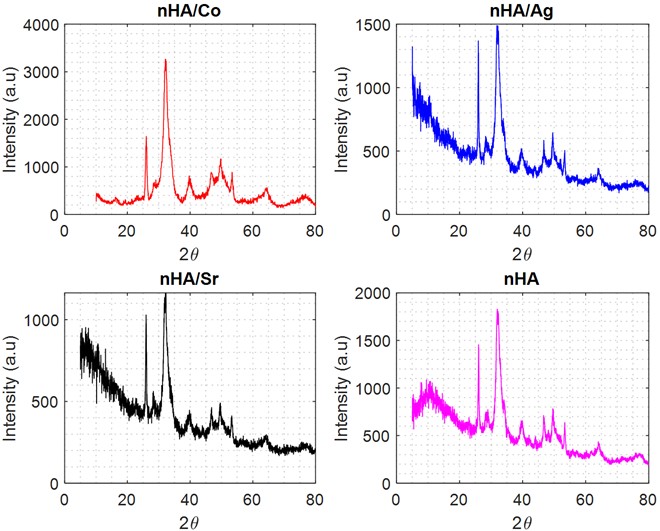
Fig. 1 shows the XRD patterns of HAP, HAP/Sr, HAP/Co, and HAP/Ag. All four patterns exhibit the reflections of well-crystallized hydroxyapatite, with the characteristic peaks at 26.2°, 32.2°, 39.9°, 49.6°, and 64.0° matching the standard reference pattern (JCPDS No. 84-1998). No secondary phases or impurity reflections are observed, confirming that pure HAP and its doped analogues were obtained as single-phase materials. The close correspondence of the doped patterns to that of pure HAP indicates that Sr, Co, and Ag are accommodated within the apatite lattice without collapse of the host structure, while the subtle differences in relative peak intensity and width between samples – precisely the features that single-peak indexing does not capture quantitatively – motivate the multiscale descriptor analysis developed in Section 4.2.
The FTIR spectra of the four materials are shown in Fig. 2. The broad band near 3470 cm-1 is assigned to O-H stretching of surface-adsorbed water, and the peak at 1600 cm-1 to H-O-H bending of molecular water. The doublet at 1459 and 871 cm-1 indicates the presence of carbonate, most plausibly from dissolution of atmospheric CO2 during synthesis. The intense absorption at 1064 cm-1 corresponds to the asymmetric stretching of PO43- groups, with associated bending modes at 612 and 563 cm-1; these may reflect partial protonation of surface phosphate to preserve charge balance in calcium-deficient hydroxyapatite. The spectral profiles of the doped materials closely follow that of pure HAP, confirming that the hydroxyapatite framework and its bonding network are preserved upon substitution [38-41].
Fig. 2FTIR spectra of HAP, HAP/Sr, HAP/Co, and HAP/Ag, showing O-H stretching (3470 cm-1), H-O-H bending (1600 cm-1), carbonate bands (1459 and 871 cm-1), and the asymmetric PO43- stretching and bending modes (1064, 612, and 563 cm-1) characteristic of the hydroxyapatite framework
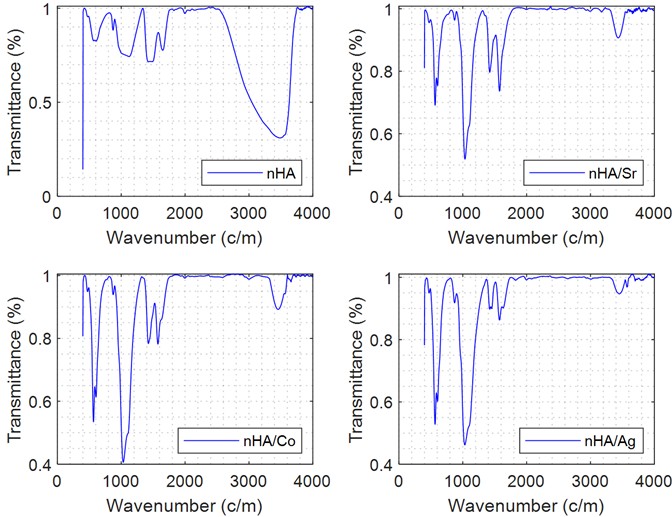
Fig. 3EDX spectra of a) HAP, b) HAP/Sr, c) HAP/Co, and d) HAP/Ag, confirming the elemental composition of each nanocatalyst and the successful incorporation of the respective dopant
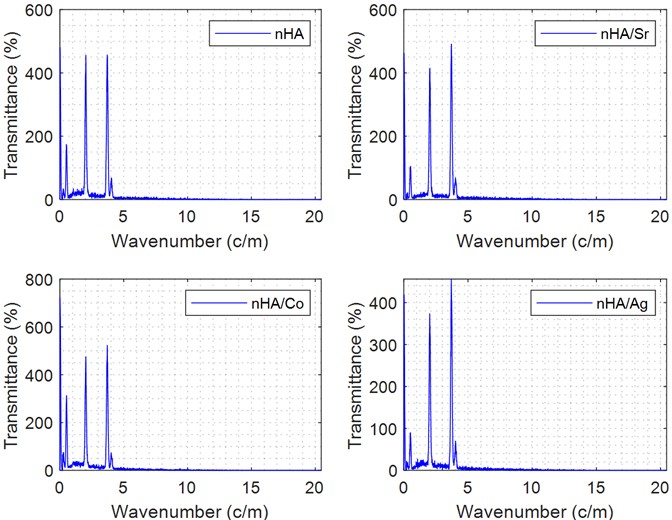
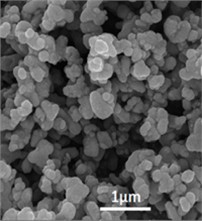
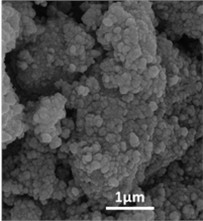
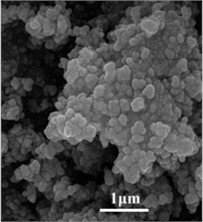
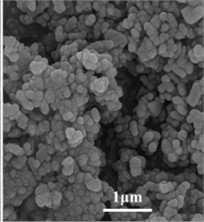
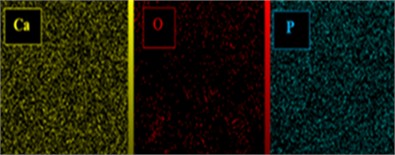
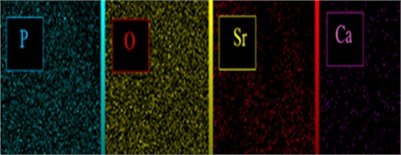
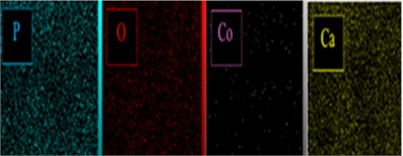
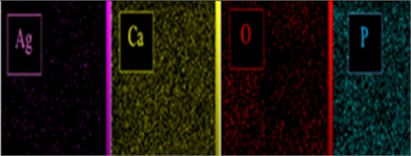
The energy-dispersive X-ray (EDX) spectra in Fig. 3 confirm the elemental composition of the four materials. Pure HAP shows the expected Ca, P, and O signals, while the successful incorporation of dopants is evidenced by the appearance of Sr signals in HAP/Sr, Co signals in HAP/Co, and Ag signals in HAP/Ag. Field-emission scanning electron microscopy (FE-SEM, Fig. 4) shows that both pure and doped HAP consist predominantly of spherical nanoparticles; the mean particle size decreases from approximately 20-35 nm for pure HAP to 10-25 nm for the doped materials, and a well-developed mesoporous texture is evident, consistent with a high surface area and accessible active sites. The complementary elemental mapping in Fig. 5 shows that Ca, P, O, and the respective dopants (Sr, Co, Ag) are uniformly distributed across the nanocomposite surfaces, confirming homogeneous dopant dispersion within the HAP host rather than surface segregation.
Fig. 4FE-SEM micrographs of a) HAP, b) HAP/Sr, c) HAP/Co, and d) HAP/Ag, showing predominantly spherical nanoparticles with a mesoporous texture; mean particle size decreases from approximately 20-35 nm for pure HAP to 10-25 nm for the doped materials
a)
b)
c)
d)
Fig. 5Elemental mapping of a) HAP, b) HAP/Sr, c) HAP/Co, and d) HAP/Ag, showing uniform distribution of Ca, P, O, and the respective dopant across the nanocomposite surface, confirming homogeneous dopant dispersion within the HAP host
a)
b)
c)
d)
4.2. Catalytic performance
The four nanocatalysts were evaluated for the selective hydration of aromatic nitriles to primary amides (Fig. 6). Table 1 summarizes the yields and reaction times obtained for seven aromatic nitrile substrates over HAP/Ag, HAP/Co, and HAP/Sr under the optimal reaction temperature of 100 °C.
Across the substrate set, all three doped catalysts afford high yields (87-98 %) within short reaction times (3-6 h). HAP/Co is the most consistently active catalyst, reaching 98 % yield for the electron-rich 4-methoxybenzonitrile substrate (entry 5e) and maintaining yields at or above 90 % for every substrate examined. Electron-withdrawing substituents (entries 6 g, 7 h) and electron-donating substituents (entry 5e) are both tolerated, indicating that the reaction is not narrowly substrate-specific. These performance data provide the catalytic context against which the structural descriptors of section 4.3 are interpreted; they are drawn from the experimental study [35] and are not re-derived here.
Fig. 6General reaction scheme for the catalytic hydration of aromatic nitriles (R-CN) to the corresponding primary amides (R–CONH₂) over the HAP-based nanocatalysts

Table 1Product yield and reaction time for the selective hydration of seven aromatic nitriles to the corresponding amides over HAP/Ag, HAP/Co, and HAP/Sr at the optimal reaction temperature of 100 °C
Entry | Substrate | Product | Yield (%)-Time (hour) | ||
HAP/Ag | HAP/Co | HAP/Sr | |||
1a | C6H5CN | C6H5CONH₂ | 96-3 | 93-6 | 93-3 |
2b | C6H5CH2CN | C6H5CH2CONH2 | 91-4 | 95-3 | 94-4 |
3c | ClC6H4CN | ClC6H4CONH2 | 88-6 | 90-5 | 91-5 |
4d | C10H₇CN | C10H₇CONH2 | 91-4 | 93-6 | 87-5 |
5e | 4-MeOC6H4CN | 4-MeOC6H4CONH2 | 92-5 | 98-4 | 94-6 |
6g | 4-BrC6H4CN | 4-BrC6H4CONH2 | 89-6 | 94-3 | 88-5 |
7h | 4-O2NC6H4CN | 4-O2NC6H4CONH2 | 95-5 | 96-3 | 93-6 |
Fig. 7Product yield of HAP/Co over four consecutive reaction cycles in the amide-synthesis reaction at 100 °C, demonstrating catalyst recyclability with negligible loss of activity. The reusability of the best-performing catalyst, HAP/Co, is shown in Fig. 7, the product yield remains high over four consecutive reaction cycles at 100 °C, confirming that the catalyst can be recovered and reused with negligible loss of activity
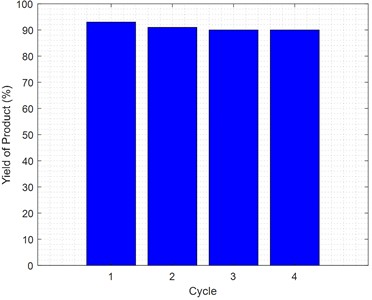
Fig. 8 depicts the proposed mechanism for the HAP-catalyzed conversion of benzonitrile to benzamide. Coordination of the nitrile to a surface-active site activates the bond toward nucleophilic attack by water, generating an iminol intermediate that tautomerizes to the amide, after which product release regenerates the active site.
4.3. Wavelet descriptor analysis
The four-sample dataset analyzed here corresponds to the complete set of catalyst compositions – pure HAP and its Ag-, Co-, and Sr-substituted analogues – synthesized and structurally characterized in the parent experimental study [35]; no additional compositions or replicate batches were available for reanalysis. The descriptor comparison that follows should accordingly be read as a preliminary demonstration of the framework rather than a statistically powered benchmark. The XRD patterns of Fig. 1 were treated as one-dimensional intensity signals and decomposed using the DWT and the WST as described in Section 2. This subsection compares the two descriptor families qualitatively (Figs. 9-12) and quantitatively (Tables 2 and 3).
Fig. 8Proposed reaction mechanism for the HAP-catalyzed hydration of nitriles to amides, showing nitrile coordination to the catalyst surface, nucleophilic attack by water, formation of the iminol intermediate, and tautomerization to the amide product
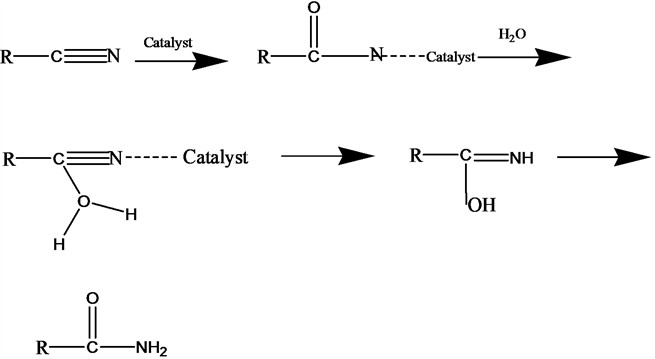
Fig. 9Experimental XRD intensity profile overlaid with its discrete wavelet transform (DWT) reconstruction for Ag-HAP, Co-HAP, HAP, and Sr-HAP, showing that the large-amplitude coefficients are concentrated in the early data points, corresponding to the principal diffraction peaks
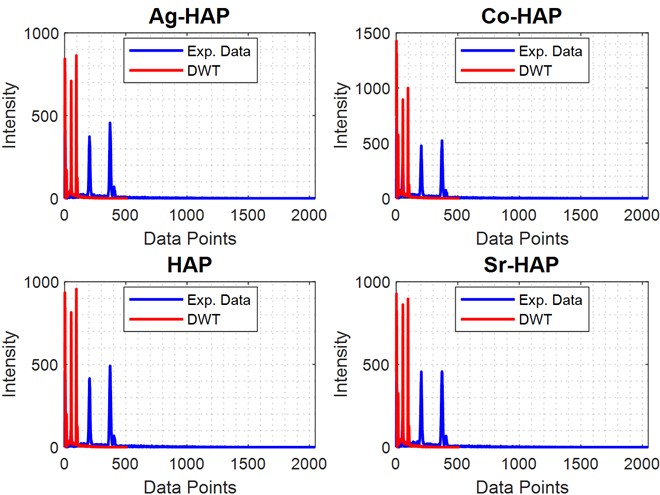
Fig. 9 overlays the experimental XRD signal and its DWT reconstruction for each of the four catalysts. In every case, the large-amplitude coefficients are concentrated in the early portion of the signal, followed by extended low-amplitude regions. This indicates that the discriminative structural information of each pattern is localized in a small number of coefficients, while the remainder of the signal corresponds to smooth, low-frequency background.
Fig. 10 shows the first- and second-level DWT detail coefficients ( and ) for the four samples. The initial large-amplitude detail coefficients capture the sharp diffraction features of each pattern, whereas the near-constant behavior in the later regions reflects the stable, low-frequency baseline. The differences in the and envelopes between samples encode the dopant-dependent variations in peak sharpness and position.
Fig. 10First- and second-level DWT detail coefficients (D₁ and D₂) for Ag-HAP, Co-HAP, HAP, and Sr-HAP, showing large-amplitude coefficients at low data-point indices that capture the sharp diffraction features, followed by near-constant behavior corresponding to the low-frequency baseline
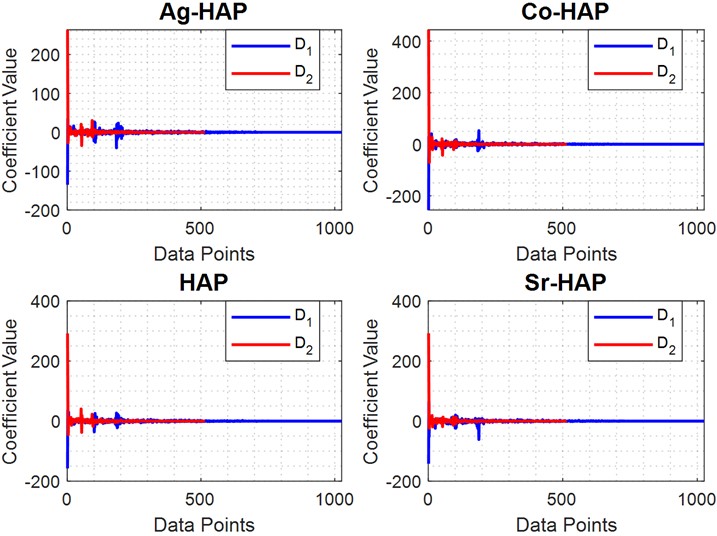
Fig. 11 presents the WST energy distributions across the scattering path index for each catalyst, resolved into first-order () and second-order () contributions. The dominant energy resides in a limited number of low-index paths, and the distribution of energy across paths differs systematically with dopant identity, indicating that the WST captures dopant-dependent multiscale structure in a compact set of coefficients.
Fig. 12 compares the four catalysts in three representations side by side: the original XRD signal, its DWT, and its WST. The raw signals span a wide dynamic range with strong local fluctuations that can obscure small but discriminative structural differences. The DWT reduces high-frequency content and emphasizes the principal multiscale features, but the resulting coefficients remain sensitive to small translations and local variations. The WST embeds each signal into a compact, non-linear, translation-invariant feature space; the pronounced compression of dynamic range and smoothing of local irregularities are evident in the WST panel, where the four samples remain cleanly separated despite the reduced spread. This behavior is the qualitative signature of the translation invariance and deformation stability established in Section 2.4.
The quantitative comparison is given in Tables 2 and 3. Table 2 lists, for each sample, the total DWT energy and the WST energy resolved into , , and total contributions.
Fig. 11Wavelet scattering transform (WST) energy distributions for Ag-HAP, Co-HAP, HAP, and Sr-HAP, resolved into first-order (S1) and second-order (S2) coefficients across the scattering path index, showing that energy is concentrated in a small number of low-index paths
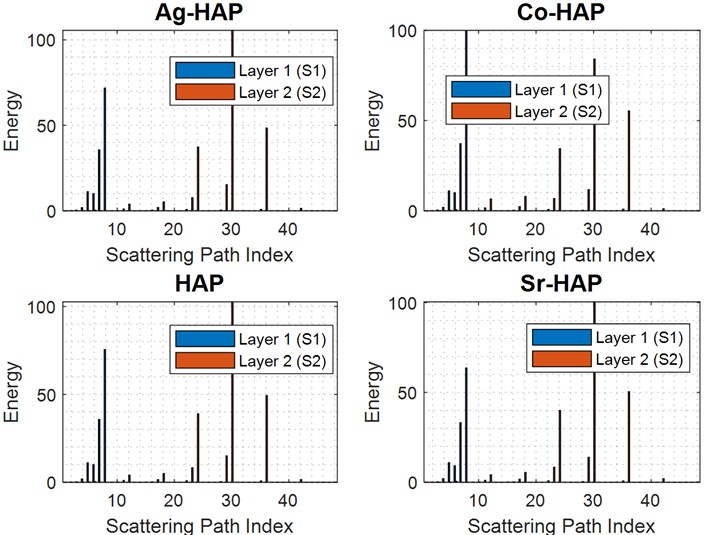
Fig. 12Comparison of the original XRD signal, its DWT, and its WST for Ag-HAP, Co-HAP, HAP, and Sr-HAP, illustrating the progressive compression of dynamic range and smoothing of local fluctuations from the raw signal to the translation-invariant WST representation
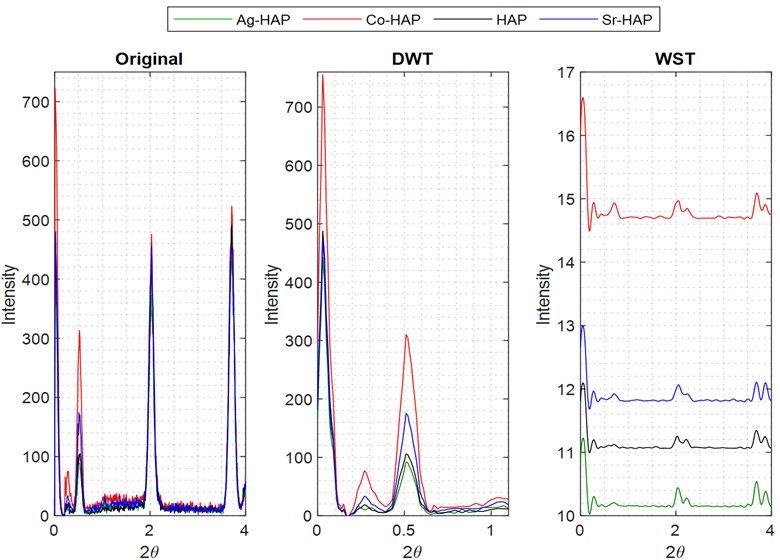
Table 2DWT energy and WST energy (first-order S1, second-order S2, and total) computed for each of the four nanocatalysts, quantifying the compression of the descriptor space achieved by the WST relative to the DWT
Sample | DWT Energy | WST S1 | WST S2 | WST Total |
Ag-HAP | 5.16×10⁶ | 130.97 | 231.34 | 362.65 |
Co-HAP | 1.08×10⁷ | 160.45 | 216.09 | 376.90 |
HAP | 6.30×10⁶ | 134.81 | 231.13 | 366.28 |
Sr-HAP | 6.34×10⁸ | 119.39 | 231.11 | 350.85 |
Table 3Mean, standard deviation, range, and variance of the DWT energy and WST total energy across the four nanocatalysts, quantifying the approximately ten-order-of-magnitude reduction in feature dispersion achieved by the WST relative to the DWT
Parameter | Mean | Std | Range | Variance |
DWT Energy | 7.15×10⁶ | 2.49×10⁶ | [5.16×10⁶, 1.08×10⁷] | 6.22×10¹² |
WST Total | 364.17 | 10.74 | [350.85, 376.90] | 115.4 |
The DWT energy spans a wide interval, from 5.16×10⁶ (Ag-HAP) to 1.08×10⁷ (Co-HAP), so that Co-HAP carries roughly twice the DWT energy of the least-energetic sample. This spread reflects the strong sensitivity of the DWT coefficients to absolute signal magnitude and local intensity variations. The statistical summary in Table 3 makes this explicit: the DWT energy has a mean of 7.15×10⁶, a standard deviation of 2.49×10⁶, and a variance of 6.22×10¹², i.e. a large dispersion across the feature space. In a predictive-modelling context, feature dispersion of this magnitude is undesirable, as it tends to destabilize fitting and increases the risk of overfitting. The WST total energy, in contrast, is confined to the narrow interval 350.9–376.9 while preserving the relative ordering of the samples (Co-HAP > HAP > Ag-HAP > Sr-HAP). The corresponding statistical descriptors – mean 364.17, standard deviation 10.74, variance 115.4 – confirm the dramatically reduced dispersion. The variance is thus reduced by approximately ten orders of magnitude relative to the DWT (from ≈ 6.2×10¹² to ≈ 1.2×10²) while the samples remain distinguishable. This compression is a direct consequence of the translation-invariant and non-linear smoothing properties of the scattering transform (Section 2.4): amplitude- and shift-sensitive variations that dominate the DWT energy are suppressed, leaving a compact, variance-controlled descriptor space. Such a representation is well suited as an input layer for downstream chemometric or supervised-learning models, since a low-dispersion, deformation-stable feature space improves numerical conditioning and generalization relative to raw or DWT-based descriptors. To assess whether the wavelet descriptors relate systematically to catalytic performance, the WST total energy and DWT energy of the three doped catalysts (Table 2) were compared against their mean yield and mean reaction time averaged across the seven substrates in Table 1. The rank order of WST total energy – Co-HAP (376.90) > Ag-HAP (362.65) > Sr-HAP (350.85) – coincides exactly with the rank order of both mean yield (94.1 % > 91.7 % > 91.4 %) and mean reaction time (4.3 h < 4.7 h < 4.9 h) for these catalysts. The raw DWT energy does not preserve this ordering (Co-HAP > Sr-HAP > Ag-HAP), placing Sr-HAP above Ag-HAP despite its lower observed activity. This correspondence is necessarily qualitative – with only three doped compositions a statistically meaningful correlation cannot be established – but it is consistent with the WST total energy carrying performance-relevant structural information that is partly obscured in the amplitude-dominated DWT representation. Testing this relationship quantitatively across a larger, more systematically sampled catalyst library is identified as the natural extension in section 5.1.
5. Conclusions
This study applied a wavelet-based multiscale descriptor framework to the X-ray diffraction fingerprints of pure and cation-substituted hydroxyapatite nanocatalysts (Ag-, Co-, and Sr-HAP) previously reported for the selective hydration of aromatic nitriles to primary amides. The Discrete Wavelet Transform (DWT) and the Wavelet Scattering Transform (WST) were computed for each diffractogram and compared quantitatively in terms of dynamic range, dispersion, translation invariance, and inter-sample discriminability. The DWT captured the localized, high-amplitude features of each pattern but retained a wide dispersion across the sample set (variance ≈ 6.2×10¹²), reflecting its sensitivity to signal magnitude and to small translations. The WST, in contrast, compressed the descriptor space by approximately ten orders of magnitude (variance ≈ 1.2×10²) while preserving the relative ordering of the samples induced by cation substitution and remaining stable under small deformations. The scattering representation therefore yields a compact, mathematically defined, and reproducible feature space in which structurally similar doped-HAP catalysts remain cleanly separated. The principal contribution of this work is the systematic construction and quantitative benchmarking of DWT and WST descriptors for a family of doped nanocatalysts, together with the demonstration that the analytically defined, non-trainable WST provides a lower-dispersion and deformation-stable alternative to conventional wavelet descriptors. Because the scattering coefficients are deterministic and independent of any training procedure, the resulting pipeline is fully reproducible and can serve directly as an input layer for downstream chemometric or supervised-learning models of catalytic performance, bridging classical multiscale signal processing and modern data-driven modelling of structure–performance relationships. By providing a reproducible, quantitative metric for structural consistency across synthesis batches, the framework also suggests a potential materials-characterization approach for future production quality monitoring in nanocatalyst manufacturing, though this application would require validation against actual batch-to-batch production data, which lies beyond the scope of the present study.
5.1. Limitations and future work
Several limitations define the scope of the present study and indicate clear directions for future development. First, the analysis is based on four catalyst compositions and their single XRD patterns; this sample size is sufficient to characterize and benchmark the descriptor space but is too small to train or validate a predictive model, and no supervised model is claimed here. Second, the wavelet descriptors were derived from XRD data alone; incorporating complementary spectroscopies (FTIR, EDX mapping) as additional signal channels would enrich the descriptor space and test the generality of the approach. Third, the descriptors have not yet been linked quantitatively to the catalytic yield-time data through an explicit regression or classification model with defined training/testing partitions, cross-validation, performance metrics, and baseline comparison. Establishing that link – by assembling a larger, more evenly sampled catalyst library across compositions, dopant loadings, and reaction temperatures, and coupling the WST descriptors to a rigorously validated supervised-learning model – is the natural next step. Such an extension would convert the reproducible feature-extraction framework demonstrated here into a validated, data-driven tool for rational catalyst screening and optimization, reducing the experimental burden of catalyst discovery without replacing the experimental validation on which it ultimately depends.
Beyond nitrile hydration catalysis, substituted hydroxyapatite is also processed as a feedstock material in additive manufacturing, where it is combined with biodegradable polymers and printed into three-dimensional bone-scaffold structures by fused-deposition, extrusion-, and digital-light-processing-based routes, with X-ray diffraction routinely used to confirm feedstock and part crystallinity and phase purity [43]. In such contexts, the relationship between diffraction peak intensity and hydroxyapatite content has been used directly as a predictive indicator of scaffold composition [44], illustrating that compact descriptors of XRD fingerprints already play a quality-relevant role in additive-manufacturing workflows for this material family. A translation-invariant, low-dispersion descriptor of the kind demonstrated here could in principle extend this role to automated feedstock screening ahead of printing, particularly where dopant-induced batch-to-batch variability needs to be tracked without manual peak-fitting. Testing this directly, on HAP feedstocks characterized specifically for additive-manufacturing rather than catalytic use, falls outside the scope of the present study and is noted here only as a possible direction connecting the descriptor framework to manufacturing-oriented materials processing.
References
-
F.-E. Essebbar, H. Ben El Ayouchia, A. Ghaleb, H. Anane, and S.-E. Stiriba, “Synthesis and characterization of magnetic palladium/carbon as effective heterogenous catalyst for the transformation of nitriles into amides in water,” Applied Organometallic Chemistry, Vol. 39, No. 6, 2025, https://doi.org/10.1002/aoc.70188
-
A. Rai, M. Pandey, P. K. Gupta, S. H. Basha, V. Srinivasadesikan, and K. V. S. Ranganath, “Visible-light-mediated hydration of benzonitriles catalysed by silver nanoparticles on triazine,” Applied Organometallic Chemistry, Vol. 40, No. 2, 2026, https://doi.org/10.1002/aoc.70504
-
A. M. Obalalu et al., “Insight into the Hamilton and Crosser model for ternary hybrid nanofluid flow over a Riga wedge with heterogeneous catalytic reaction,” The European Physical Journal Special Topics, Vol. 234, No. 8, pp. 2271–2292, 2024, https://doi.org/10.1140/epjs/s11734-024-01319-8
-
H. Tang, S. Chen, Q. Liu, G. Bai, B. Qiao, and F. Liu, “Stabilized Rh/hydroxyapatite catalyst for furfuryl alcohol hydrogenation: application of oxidative strong metal-support interactions in reducing conditions,” Acta Physico-Chimica Sinica, Vol. 41, No. 4, p. 100036, 2024, https://doi.org/10.3866/pku.whxb202408004
-
D. Yan and C. Bai, “High-selective dehydration of bio-alcohols to olefins over vanadium-doped hydroxyapatite catalyst with engineered defect sites,” Journal of Alloys and Compounds, Vol. 1036, p. 181853, 2025, https://doi.org/10.1016/j.jallcom.2025.181853
-
H. Yook et al., “Design strategies for hydroxyapatite-based materials to enhance their catalytic performance and applicability,” Advanced Materials, Vol. 35, No. 43, 2023, https://doi.org/10.1002/adma.202204938
-
Y. Peng et al., “Co-doped hydroxyapatite as photothermal catalyst for selective CO2 hydrogenation,” Applied Catalysis B: Environment and Energy, Vol. 333, p. 122790, 2023, https://doi.org/10.1016/j.apcatb.2023.122790
-
X.-H. Pham, Q.-N. Pham, and D. Pham Minh, “Tri-reforming of methane over a hydroxyapatite-supported nickel catalyst prepared by cation exchange,” ChemPlusChem, Vol. 90, No. 8, 2025, https://doi.org/10.1002/cplu.202500082
-
O. V. Larina et al. “Carbon-supported hydroxyapatite hybrid catalysts for butan-1-ol conversion: effect of the nature of carbon support on process selectivity.” Carbon N. Y., 2024.
-
T. Jose, J. Ftouni, and P. C. A. Bruijnincx, “Structured hydroxyapatite composites as efficient solid base catalysts for condensation reactions,” Catalysis Science and Technology, Vol. 11, No. 10, pp. 3428–3436, 2021, https://doi.org/10.1039/d1cy00102g
-
N. N. N. Kumar Reddy, S. Nageswara Rao, R. D. Patil, and S. Adimurthy, “Transition metal-free hydration of nitriles to amides mediated by NaOH,” Advanced Material Science, Vol. 3, No. 1, 2018, https://doi.org/10.15761/ams.1000137
-
S. Yadav and R. Gupta, “Hydration of nitriles catalyzed by ruthenium complexes: role of dihydrogen bonding interactions in promoting base-free catalysis,” Inorganic Chemistry, Vol. 61, No. 39, pp. 15463–15474, 2022, https://doi.org/10.1021/acs.inorgchem.2c02058
-
Y. Xia, D. He, and W. Wu, “Recent advances for hydration reaction of nitriles in different catalytic systems,” Chinese Journal of Organic Chemistry, Vol. 41, No. 3, pp. 969–982, 2021, https://doi.org/10.6023/cjoc202007020
-
K. Yamaguchi, M. Matsushita, and N. Mizuno, “Efficient hydration of nitriles to amides in water, catalyzed by ruthenium hydroxide supported on alumina,” Angewandte Chemie International Edition, Vol. 43, No. 12, pp. 1576–1580, 2004, https://doi.org/10.1002/anie.200353461
-
K. T. Butler, D. W. Davies, H. Cartwright, O. Isayev, and A. Walsh, “Machine learning for molecular and materials science,” Nature, Vol. 559, No. 7715, pp. 547–555, Jul. 2018, https://doi.org/10.1038/s41586-018-0337-2
-
S. Singh and R. B. Sunoj, “Molecular machine learning for chemical catalysis: prospects and challenges,” Accounts of Chemical Research, Vol. 56, No. 3, pp. 402–412, 2023, https://doi.org/10.1021/acs.accounts.2c00801
-
L. Zhu et al., “Machine learning-guided design of multi-metal catalysts for methane dry reforming: structure-activity insights and experimental validation,” Applied Energy, Vol. 403, p. 127072, 2025, https://doi.org/10.1016/j.apenergy.2025.127072
-
S. Tamilarasan, C.-K. Wang, Y.-D. Kuan, Y.-C. Shih, and I. Stachiv, “Machine learning as a catalyst for PEMFC optimization: a comprehensive review from flow fields to system integration with a multiscale perspective on research and applications,” Renewable and Sustainable Energy Reviews, Vol. 226, p. 116274, 2025, https://doi.org/10.1016/j.rser.2025.116274
-
K. M. Jablonka, D. Ongari, S. M. Moosavi, and B. Smit, “Big-data science in porous materials: materials genomics and machine learning,” Chemical Reviews, Vol. 120, No. 16, pp. 8066–8129, 2020, https://doi.org/10.1021/acs.chemrev.0c00004
-
C. Bozal-Ginesta, S. Pablo-García, C. Choi, A. Tarancón, and A. Aspuru-Guzik, “Developing machine learning for heterogeneous catalysis with experimental and computational data,” Nature Reviews Chemistry, Vol. 9, No. 9, pp. 601–616, 2025, https://doi.org/10.1038/s41570-025-00740-4
-
L. G. de Araujo, L. Vilcocq, P. Fongarland, and Y. Schuurman, “Recent developments in the use of machine learning in catalysis: a broad perspective with applications in kinetics,” Chemical Engineering Journal, Vol. 508, p. 160872, 2025, https://doi.org/10.1016/j.cej.2025.160872
-
M. Wu, Z. Wei, Y. Zhao, and Q. He, “Recent applications of theoretical calculations and artificial intelligence in solid-state electrolyte research: a review,” Nanomaterials, Vol. 15, No. 3, p. 225, Jan. 2025, https://doi.org/10.3390/nano15030225
-
P. Zhou et al., “Machine learning in solid-state hydrogen storage materials: challenges and perspectives,” Advanced Materials, Vol. 37, No. 6, 2024, https://doi.org/10.1002/adma.202413430
-
L. Zhang, Q. Bing, H. Qin, L. Yu, H. Li, and D. Deng, “Artificial intelligence for catalyst design and synthesis,” Matter, Vol. 8, No. 5, p. 102138, May 2025, https://doi.org/10.1016/j.matt.2025.102138
-
A. Omranpour, J. Elsner, K. N. Lausch, and J. Behler, “Machine learning potentials for heterogeneous catalysis,” ACS Catalysis, Vol. 15, No. 3, pp. 1616–1634, 2025, https://doi.org/10.1021/acscatal.4c06717
-
X. Dai et al., “Machine-learning-accelerated discovery of high-performance TM-NM dual-atom catalysts on 2D GaAs for hydrogen evolution,” International Journal of Hydrogen Energy, Vol. 203, p. 153187, 2025, https://doi.org/10.1016/j.ijhydene.2025.153187
-
E. Casillo, T. Scattolin, and S. P. Nolan, “Catalysis meets machine learning: a guide to data-driven discovery and design,” Chemical Communications, Vol. 61, No. 93, pp. 18247–18272, 2025, https://doi.org/10.1039/d5cc05274b
-
A. Martini et al., “Assessing the influence of zeolite composition on oxygen-bridged diamino dicopper(II) complexes in Cu-CHA DeNOx catalysts by machine learning-assisted X-ray absorption spectroscopy,” The Journal of Physical Chemistry Letters, Vol. 13, No. 26, pp. 6164–6170, 2022, https://doi.org/10.1021/acs.jpclett.2c01107
-
W. Ding, J. Wang, H. Zhao, Z. Zhang, D. Wei, and K. Zhang, “Enhanced selectivity of platinum-modified tungsten oxide gas sensor through multivariate feature extraction and machine learning algorithms,” Journal of Colloid and Interface Science, Vol. 701, p. 138800, 2025, https://doi.org/10.1016/j.jcis.2025.138800
-
Y. Yu, X. Jian, D. Won, and A. Jahanger, “Breaking the carbon bind: how digitalization and energy transformation reshape carbon dependency based on wavelet and machine learning approaches,” Environmental Development, Vol. 55, p. 101226, 2025, https://doi.org/10.1016/j.envdev.2025.101226
-
N. Wang et al., “Machine learning-driven optimization of Ni-based catalysts for catalytic steam reforming of biomass tar,” Energy Conversion and Management, Vol. 300, p. 117879, 2023, https://doi.org/10.1016/j.enconman.2023.117879
-
R. Bao, J. Hu, Q. Guo, Z. Wang, and Q. Yang, “Machine learning-guided optimization of iron-based catalysts toward minimal-resource and efficient peroxymonosulfate activation for hazardous organic pollutants degradation,” Journal of Hazardous Materials, Vol. 501, p. 140818, 2025, https://doi.org/10.1016/j.jhazmat.2025.140818
-
L.-H. Mou, T. Han, P. E. S. Smith, E. Sharman, and J. Jiang, “Machine learning descriptors for data-driven catalysis study,” Advanced Science, Vol. 10, No. 22, 2023, https://doi.org/10.1002/advs.202301020
-
W. Zhuang et al., “Task decomposition strategy based on machine learning for boosting performance and identifying mechanisms in heterogeneous activation of peracetic acid process,” Water Research, Vol. 267, p. 122521, 2024, https://doi.org/10.1016/j.watres.2024.122521
-
F. Moghaddar and F. Heshmatpour, “Selective hydration of nitriles to amides with Ag, Co, and Sr doped hydroxyapatite as nanocatalyst,” Polyhedron, Vol. 283, p. 117809, Oct. 2025, https://doi.org/10.1016/j.poly.2025.117809
-
S. Mallat, “Group invariant scattering,” Communications on Pure and Applied Mathematics, Vol. 65, No. 10, pp. 1331–1398, 2012, https://doi.org/10.1002/cpa.21413
-
J. Bruna and S. Mallat, “Invariant scattering convolution networks,” IEEE Transactions on Pattern Analysis and Machine Intelligence, Vol. 35, No. 8, pp. 1872–1886, 2013, https://doi.org/10.1109/tpami.2012.230
-
F. Heshmatpour and S. Haghbin, “Nanohydroxyapatite/graphene oxide nanocomposites modified with synthetic polymers: promising materials for bone tissue engineering applications,” International Journal of Polymeric Materials and Polymeric Biomaterials, Vol. 70, No. 8, pp. 585–591, 2021, https://doi.org/10.1080/00914037.2020.1740990
-
F. Heshmatpour, S. H. Lashteneshaee, and M. Samadipour, “A new approach for synthesis of the comb-shaped Poly(ε-Caprolactone) brushes on the surface of nano-hydroxyapatite by combination of ATRP and ROP,” J. Inorg. Organomet. Polym. Mater, Vol. 28, pp. 2063–2068, 2018.
-
Z.-L. Mao, X.-J. Yang, S.-L. Zhu, Z.-D. Cui, and Z.-Y. Li, “Effect of Na+ and NaOH concentrations on the surface morphology and dissolution behavior of hydroxyapatite,” Ceramics International, Vol. 41, No. 3, pp. 3461–3468, 2014, https://doi.org/10.1016/j.ceramint.2014.10.162
-
J.-X. Hu, J.-B. Ran, S. Chen, X.-Y. Shen, and H. Tong, “Biomineralization-inspired synthesis of chitosan/hydroxyapatite biocomposites based on a novel bilayer rate-controlling model,” Colloids and Surfaces B: Biointerfaces, Vol. 136, pp. 457–464, 2015, https://doi.org/10.1016/j.colsurfb.2015.09.027
-
B. Z. Momeni, F. Shirvani, and J. Janczak, “Synthesis, structural characterization, Hirshfeld surface analysis and thermal properties of dibutyltin(IV)-based complexes containing thiocyanate and pyridyl ligands,” Journal of Molecular Structure, Vol. 1317, p. 139155, 2024, https://doi.org/10.1016/j.molstruc.2024.139155
-
M. S. Raziyan, G. Janusas, W. Grodzki, E. Borucińska-Parfieniuk, S. Urbaite, and D. M. Perkowski, “3D printing and characterization of HA/Mg-reinforced PLA-PHA-PHB composite scaffolds for biomedical applications,” Applied Sciences, Vol. 16, No. 8, p. 3647, 2026, https://doi.org/10.3390/app16083647
-
S. Pérez-Davila et al., “Physicochemical properties of 3D-printed polylactic acid/hydroxyapatite scaffolds,” Polymers, Vol. 15, No. 13, p. 2849, Jun. 2023, https://doi.org/10.3390/polym15132849
About this article

The authors have not disclosed any funding.
The authors thank their home institution for giving them access to the research facilities and computer resources they used in this study.
The MATLAB code and XRD input data used to compute the wavelet and scattering transform descriptors reported in this study are openly available at GitHub. The synthesis and catalytic performance data underlying Table 1 are available in the original report [35] or from the corresponding author upon reasonable request.
The authors declare that they have no conflict of interest.

