Abstract
This paper presents an improved technology for the replacement of continuous welded rail strings using road-rail excavators equipped with dual-roller rail grippers. Existing methods for the installation and replacement of continuous welded rail strings are reviewed, and their shortcomings are identified, including limited productivity and the need for a significant amount of manual operations. The proposed technology makes it possible to replace rail strings without dismantling rail joints, to perform work at the optimal rail fastening temperature, and to reduce the risk of rail damage during handling and installation. The sequence of operations for the use of one, two, and four excavators is presented, and a comparative analysis of the effectiveness of each option is carried out. The results show that the proposed technology makes it possible to reduce the duration of work windows while simultaneously increasing the level of mechanization and improving the operational safety of continuous welded rail track maintenance.
1. Introduction
In recent years, Uzbekistan has expanded its fast and high-speed railway traffic network [1-3]. To achieve high train speeds and ensure safety and comfort, railway infrastructure requires reliable, low-maintenance and cost-effective track superstructure solutions, including continuous welded rail systems.
The transition to longer continuous welded rail sections creates technical and technological challenges. One of the central tasks is the installation of continuous rails and the replacement of worn rail lengths with new ones. The technology proposed in this paper focuses on reducing manual operations during rail replacement and improving the efficiency of mechanized work.
Global research on continuous welded rail systems addresses both operational stability and monitoring. Atapin et al. [4] developed methods for monitoring lateral stability using track-measuring data. Han et al. [5] investigated the influence of solar radiation and rail orientation on rail temperature distribution. Tverdomed et al. [6] studied the operation of continuous welded rail on curves of small radius, considering the stress-strain state of the rail grid and dynamic effects of rolling stock.
Fadhil et al. [7] proposed a non-destructive method for evaluating thermal stresses in rails using birefringence. Khalfin et al. [8] developed a system for determining the state of continuous welded track and monitoring rail thermal conditions. Knopf et al. [9] presented a non-contacting system for measuring rail neutral temperature and stress, while Wu et al. [10] investigated rail neutral temperature estimation using impulse vibration and machine learning.
Khalfin and Umarov [11] investigated the behavior of intermediate rail fasteners on mountain railway sections, emphasizing the relationship between fastening forces and longitudinal rail displacement. Savin et al. [12] considered the technology for recovery of defective rail bars and the restoration of welded rail connections.
The above studies demonstrate that safe operation of continuous welded track depends on the control of thermal, mechanical and geometric conditions. The present work addresses a complementary technological problem: how to replace long continuous rail lengths efficiently while reducing the duration of the track work window.
Unlike approaches devoted primarily to rail inspection, thermal-stress monitoring or restoration, this paper proposes and examines a replacement technology using road-rail excavators equipped with dual roller rail grippers. The method is intended to improve the efficiency and safety of handling continuous rail lengths and to reduce labor requirements.
2. Materials and methods
The proposed technology is based on the use of road-rail excavators equipped with a dual roller rail gripper. The main feature of the gripper is the possibility of moving along a rail length while passing a splice-plate area without requiring the removal of the fishplates. This reduces the number of auxiliary manual operations and makes the work sequence more continuous.
The process of replacing stock rails with continuous welded rail lengths begins with lifting the rail string containing the stock rails using an auxiliary gripper. After the initial lift, the excavator switches to the main gripper mounted on the rail base. The machine then moves along the work area while the rail string is smoothly shifted from the sub-rail base toward the ballast section.
The controlled movement of the boom is intended to prevent excessive bending loads and damage to track components. At the end of the work area, the auxiliary gripper moves the end of the rail string. After the stock rails have been removed, the continuous rail string is positioned in the prepared location. The rail is then shifted sequentially into its designed position along the track.
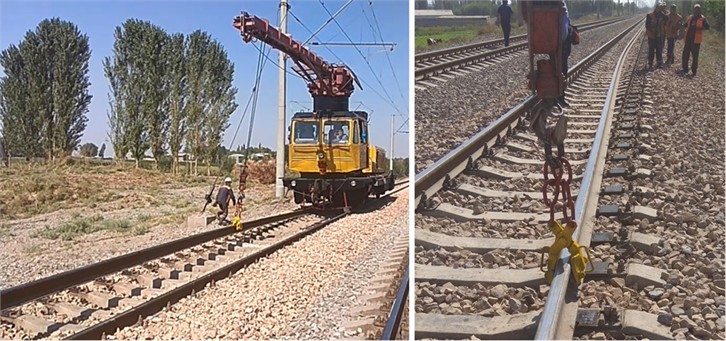
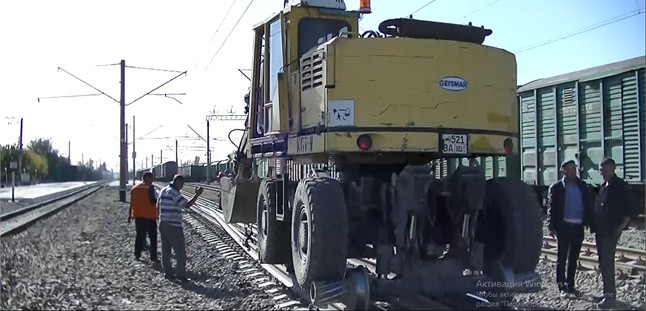
To determine the rail-string sliding speed, the time required for attaching and detaching the mounted equipment, and to verify the operability of the proposed technology, field tests were carried out on active railway lines of JSC Uzbekiston Temir Yollari. The experiments were conducted on the Nazarbek–Dalaguzar section using an MPT-4 railway maintenance vehicle (Fig. 1) and at Rakhimova station using a road-rail excavator (Fig. 2).
Fig. 1The process of sliding the rail length on the Nazarbek–Dalaguzar section
Depending on the length and volume of the work area, rail replacement can be performed using one (T1), two (T2), or four (T4) excavators. This makes it possible to adapt the work organization to the required production conditions and to compare different levels of mechanization.
The safety of the proposed process also depends on avoiding excessive stresses during lifting and sliding. Ergashev and Begmatov [13] investigated safe conditions for track-laying operations using an excavator equipped with a rail grab. Their finite-element analysis established operating parameters that limit rail stresses during lifting and sliding. Begmatov and Ergashev [14] investigated the modulus of elasticity of railway track with BF70 sleepers, providing an additional basis for assessing the mechanical behavior of the track structure.
Fig. 2The process of sliding the rail lengths on the Rakhimov station
For the comparative assessment, the work area was taken as 2,400 m. Before replacement, the track consisted of section rails, BF70 sleepers and Pandrol Fastclip elastic fastenings with a sleeper density of 1,840 sleepers/km. After replacement, the track was considered as continuous track with continuous rails 2,400 m long.
Continuous rail lengths are prepared for installation and transported to the work site using specialized railway equipment. Preparatory operations include transferring a portion of the Pandrol Fastclip clamps from the working position to a waiting position before the track span is closed. After rail replacement, the sequence is reversed so that the fastening system is restored to the working position.
3. Results and discussion
Three technological options were compared: T1, using one excavator; T2, using two excavators; and T4, using four excavators. The principal indicator was the duration of the work window required for replacement over the 2,400 m work area. Table 1 summarizes the key technical and economic indicators of the proposed technologies, as determined from the results of experimental investigations. The comparison shows that increasing the number of excavators significantly reduces the duration of the work window from 207 min (T1) to 76 min (T4). However, labor input, expressed as total person-time, decreases from 20,079 man-min (T1) to 12,500 man-min (T2) and then increases to 14,592 man-min (T4). Therefore, the T2 configuration provides the best labor efficiency, while T4 ensures the shortest work window.
Table 1Main technical and economic indicators of the compared replacement technologies
No | Parameters names | Technologies | ||
Т1 | Т2 | Т4 | ||
1 | Duration of time, min. | 207 | 125 | 76 |
2 | Number of excavator operators, persons | 1 | 2 | 4 |
3 | Number of track fitters, persons | 96 | 98 | 188 |
4 | Labor input, man-min. | 20079 | 12500 | 14592 |
Fig. 3 shows the schedules for the main process operations performed during the “window” when replacing stock rails with continuous rails using different numbers of excavators: one (Fig. 3(a)), two (Fig. 3(b)), and four (Fig. 3(c)).
The work conditions were as follows:
Work area: 2,400 m.
Track structure:
– Before replacement: section track, BF70 sleepers, Pandrol Fastclip elastic fastenings, sleeper density diagram: 1,840 sleepers/km.
– After replacement: continuous track with continuous rails 2,400 m long.
Welding of 800 m of continuous rails is performed in stationary conditions on the rail welding train.
The continuous rails are transported to the laying site by a specialized train equipped with devices for handling and unloading the continuous rails.
Rail lengths ranging from 800 m to 2,400 m in length are welded directly on-site using track welding machines.
Fig. 3Schedule of work performance in the “window”: a) using one excavator (T1); b) using two excavators (T2); c) using four excavators (T4); 1 – arranging the closure of the section, driving the machines to the work site and de-energizing the contact network; 2 – installing Pandrol Fastclip fastening clamps from the working position to the “waiting” position (50 %); 3 – loosening joints with removing catch plates, loading (unloading) the excavator pushing the rail thread with the inventory rails; 4 – sliding the rail thread with the inventory rails onto the ballast prism shoulder; 5 – bolting the initial (end) joints of the continuous rails with the joints of the equalizer rails, loading (unloading) the excavator pushing the continuous rail; 6 – sliding the continuous rails into their working position; 7 – setting the Pandrol Fastclip fastening clamps from the “waiting” position to the working position (50 %)
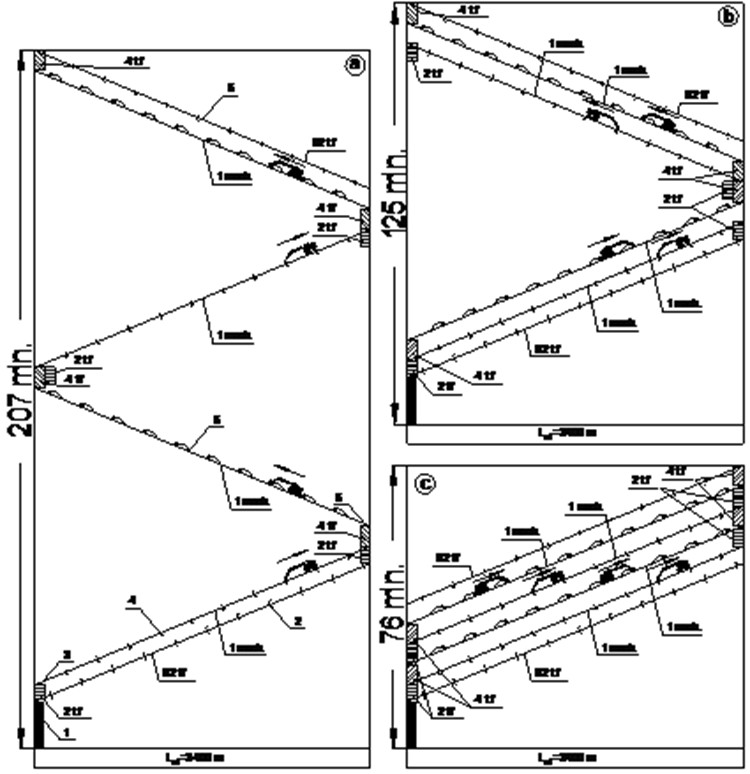
The comparative results show a clear reduction in the work-window duration as the number of excavators increases. With one excavator, the duration is 207 min. With two excavators, the duration decreases to 125 min, while four excavators reduce the duration to 76 min.
For T1, one excavator operator and the track-fitting crew required for the principal operations are involved, with a total of 96 track fitters participating in the process. For T2, the work window decreases to 125 min and the total number of track fitters is 98. The T4 option provides the shortest work window, 76 min, but requires four excavator operators and a larger total number of track fitters.
The results indicate that the number of machines has a strong influence on the duration of the work window. However, increasing the number of excavators also increases the personnel and organizational requirements. Therefore, the choice of T1, T2 or T4 should be made according to the available machinery, labor resources, track possession duration and operational conditions.
In all three options, a significant share of the labor input is associated with the removal and installation of Pandrol Fastclip elastic fastening clamps. This operation remains one of the most labor-intensive stages and affects the overall duration of the work window.
The main technological sequence consists of: arranging the track closure and bringing machines to the work site; transferring fastening clamps to the waiting position; loosening joints and moving the rail string with stock rails; sliding the stock rail string onto the ballast shoulder; preparing and connecting the continuous rails; sliding the continuous rails into their working position; and returning the fastening clamps to the working position.
The dual roller gripper provides an important technological advantage because the rail can be moved through the work zone without repeated interruption at splice-plate locations. This simplifies the work sequence and reduces the need for manual repositioning of the gripper. The resulting process is more suitable for mechanized replacement of long rail lengths.
The proposed technology is also compatible with the objective of maintaining the required fastening conditions during replacement. The ability to perform the principal rail-handling operations with road-rail excavators reduces the amount of manual handling and supports a more controlled work process.
The comparison of T1, T2 and T4 shows that the shortest work window is achieved with four excavators. Nevertheless, the T4 configuration has a substantially higher labor requirement. The T2 option provides an intermediate solution, reducing the work window from 207 to 125 min without the full machine and labor requirements of T4.
From an operational point of view, the selection of the technological option should therefore consider not only the minimum work-window duration but also the availability of machines and qualified personnel. A final economic comparison should include machine operating costs, labor costs, preparation time and the consequences of reducing the track possession period.
4. Conclusions
The developed technology for replacing continuous welded rails using road-rail excavators and dual roller rail grippers improves the mechanization of track maintenance operations. The proposed gripper allows the rail string to be moved through the work zone with fewer interruptions and reduces the need for manual handling.
For a 2,400 m work area, the calculated work-window duration decreases from 207 min with one excavator to 125 min with two excavators and 76 min with four excavators. Thus, increasing the number of excavators can substantially reduce the duration of rail replacement operations.
At the same time, the increase in machine numbers leads to higher organizational and labor requirements. The two-excavator configuration can therefore be considered an intermediate technological solution, while the four-excavator configuration is preferable when the principal objective is to minimize the work-window duration.
The proposed approach can contribute to safer and more efficient replacement of continuous welded rail lengths. Further work should focus on a detailed cost-effectiveness assessment of the three options under the technical, organizational and operational conditions of railway track facilities.
References
-
S. Djabbarov, “Prospects for raising passenger train speed on the reconstructed section of the Uzbekistan railways,” Transport Problems, Vol. 11, No. 4, pp. 103–110, Feb. 2017, https://doi.org/10.20858/tp.2016.11.4.10
-
S. Djabbarov, M. Mirakhmedov, and A. Sładkowski, “Potential and problems of the development of speed traffic on the railways of Uzbekistan,” in Studies in systems, decision and control, Cham: Springer International Publishing, 2018, pp. 369–421, https://doi.org/10.1007/978-3-319-78295-9_9
-
N. Begmatov, U. Ergashev, K. Lesov, and S. Shayakhmetov, “Bearing capacity of the subgrade for high-speed train traffic,” E3S Web of Conferences, Vol. 531, p. 02006, Jun. 2024, https://doi.org/10.1051/e3sconf/202453102006
-
V. Atapin, A. Bondarenko, M. Sysyn, and D. Grün, “Monitoring and evaluation of the lateral stability of CWR track,” Journal of Failure Analysis and Prevention, Vol. 22, No. 1, pp. 319–332, Dec. 2021, https://doi.org/10.1007/s11668-021-01307-3
-
S. H. Han, S. H. Hwang, H. J. Kim, S. J. Cho, and N. H. Lim, “Numerical study on the characteristics of temperature distribution in continuous welded rail by solar radiation and rail orientation,” Journal of Mechanical Science and Technology, Vol. 34, No. 11, pp. 4819–4829, Nov. 2020, https://doi.org/10.1007/s12206-020-1038-y
-
V. Tverdomed, V. Tkachenko, S. Sapronova, O. Aharkov, and L. Drahiieva, “Arrangement of the continuous welded rail on the curved tracks of short radius,” in Lecture Notes in Intelligent Transportation and Infrastructure, Cham: Springer International Publishing, 2020, pp. 203–210, https://doi.org/10.1007/978-3-030-38666-5_21
-
A. Fadhil, G. Washer, and A. Poudel, “Birefringence technique for evaluating thermal stresses in railroad rails,” Materials Evaluation, Vol. 82, No. 1, pp. 79–87, Jan. 2024, https://doi.org/10.32548/2024.me-04382
-
G.-A. Khalfin, K. Umarov, I. Purtseladze, and M. Yembergenov, “System for determining state of continuous welded track,” E3S Web of Conferences, Vol. 401, p. 02050, Jul. 2023, https://doi.org/10.1051/e3sconf/202340102050
-
K. Knopf, D. C. Rizos, Y. Qian, and M. Sutton, “A non-contacting system for rail neutral temperature and stress measurements: concept development,” Structural Health Monitoring, Vol. 20, No. 1, pp. 84–100, May 2020, https://doi.org/10.1177/1475921720923116
-
Y. Wu, X. Zhu, C.-L. Huang, S. Lee, M. Dersch, and J. Popovics, “Rail neutral temperature estimation using impulse vibration and machine learning,” in Nondestructive Characterization and Monitoring of Advanced Materials, Aerospace, Civil Infrastructure, and Transportation XV, Vol. 11592, p. 18, 2021, https://doi.org/10.1117/12.2581798
-
G.-A. Khalfin and K. Umarov, “The work of intermediate rail fasteners on mountain sections of railways,” in AIP Conference Proceedings, Vol. 2612, No. 1, p. 040023, Mar. 2023, https://doi.org/10.1063/5.0126396
-
A. Savin, A. Loktev, V. Korolev, and I. Shishkina, “Technology for recovery of defective rail bars,” in Lecture Notes in Mechanical Engineering, Cham: Springer International Publishing, 2021, pp. 441–455, https://doi.org/10.1007/978-3-030-85057-9_37
-
U. Ergashev and N. Begmatov, “Ensuring safety of track-laying works while long-welded rails replacement,” Discover Applied Sciences, Vol. 7, No. 5, p. 470, May 2025, https://doi.org/10.1007/s42452-025-07049-3
-
N. Begmatov and U. Ergashev, “Determination of the modulus of elasticity of railway track with BF70 sleepers,” E3S Web of Conferences, Vol. 515, p. 02003, Apr. 2024, https://doi.org/10.1051/e3sconf/202451502003
About this article

The authors have not disclosed any funding.
The datasets generated during and/or analyzed during the current study are available from the corresponding author on reasonable request.
The authors declare that they have no conflict of interest.

