Abstract
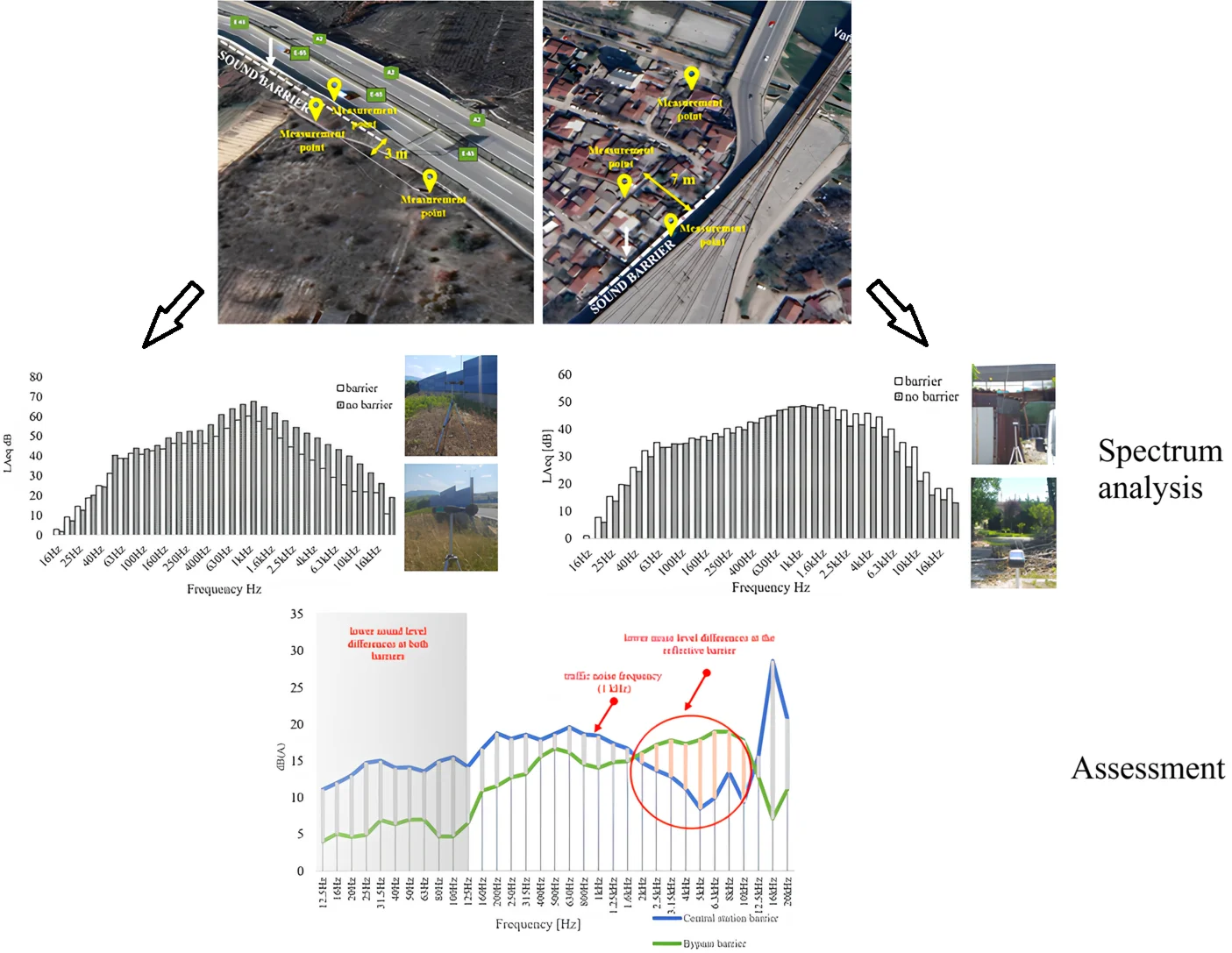
Noise is considered a major environmental problem in urban areas, which in recent years has seriously affected people’s health and quality of life. One of the most important solutions for noise mitigation, especially for traffic noise, is the installation of noise barriers. In this paper, an assessment of the acoustic performance of noise barriers in the city of Skopje is presented. The methodology proposes using the ISO 10847:1997 indirect method (measurement technique for determining the insertion loss of a noise barrier).The experimental results from the conducted in-situ measurements have proven that the existing noise barriers, even though with different characteristics, achieve notable insertion loss across the entire noise frequency range, with significant reductions of over 10 dB in the dominant traffic noise frequency band. The research insights confirm that the noise barriers provide an effective solution for traffic noise control, but their advantage is limited against low-frequency noise components and urban noise coming from combined (human made or natural) noise sources. The results provided in this paper fill an important research gap into the noise pollution control in the city. This research provides valuable conclusions that serve as a baseline for improving urban noise action plans and development of further noise reduction strategy in the city.
Highlights
- This study investigates the effectiveness of existing noise barriers in Skopje, North Macedonia, using in-situ field measurements, which is underrepresented in the research of local noise control aspects.
- The novelty of this paper implies fulfillment of an important research gap in the local noise control methods and crucial step in establishing compliance with EU and national regulations for noise mitigation measures.
- The acoustic performance of noise barriers, as passive mitigation systems is confirmed along the traffic noise frequency spectrum, but their efficiency is limited in the frequency range of urban noise.
1. Introduction
In recent years, as infrastructure in the cities has grown and cities have become more crowded, people are regularly exposed to high daily levels of noise. Noise control involves a variety of methods and techniques aimed at ensuring acceptable levels of noise in the environment, in accordance with economic, operational and technical aspects [1]. Noise control does not only deal with the direct reduction of noise emissions at the source location but also refers to ensuring acceptable levels of ambient noise, i.e. the sound level reaching the receiver [2]. The solutions for the purpose of noise control can be generally divided into passive and active (Fig. 1). Passive control is the most applied solution and aims to reduce the excess acoustic energy generated by the source through absorption, transmission or diffusion of the sound wave.
Fig. 1Methods of noise control
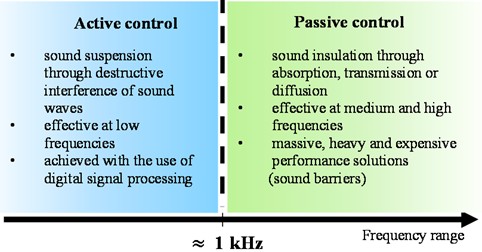
On the other hand, active noise control involves adding an acoustic signal to the primary noise source to create destructive interference of the waves, thereby providing direct control of the original sound signal [3].
In urban areas, road traffic is the main noise source and is considered the second most serious health risk after air pollution. It is estimated that In Europe, about one in five people are exposed to road traffic noise levels that are dangerous to their health [4]. To address this, the European Union introduced Directive 2002/49/EC [5], which requires countries to create noise maps for predicting noise dispersion. These maps are widely used across Europe to plan and implement ways to assess and control noise from major noise sources like traffic [6]. To improve accuracy of the noise maps, the EU's WG3 guidelines [7] recommend doing field measurements to confirm the predictions [8]. Today, laws that regulate environmental noise levels result in a range of noise reduction measures of various kinds [9].
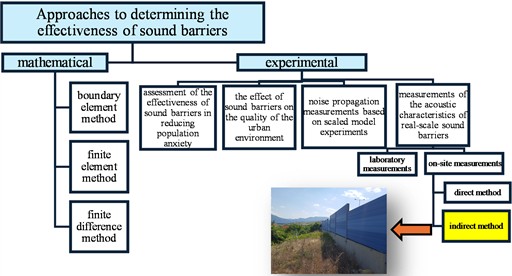
The most used passive method for reducing noise in residential areas is the installation of noise barriers, therefore a wide range of experimental, simulation and mathematical methodologies have been analyzed to assess their effectiveness [10-11]. Experimental studies dedicated to noise barriers are based on various approaches: assessment of the effectiveness of sound barriers in reducing population anxiety [12], the effect of sound barriers on the quality of the urban environment [13], noise propagation measurements based on scaled model experiments [14]. Two types of measurement methods are mostly used to assess the acoustic characteristics of real-scale sound barriers: laboratory methods using diffuse sound fields and on-site field measurement methods of the acoustic properties of barriers [15]. A breakdown of the approaches to assessing the effectiveness of sound barriers is given in Fig. 2.
Fig. 2Diagram of approaches for determining the effectiveness of sound barriers
Many research studies to date have been based on evaluating the effectiveness of barriers by calculating the post-installation IL factor, which is defined as the difference in noise levels before and after barrier installation [16]. Recent research continues to deepen understanding of how sound barrier performance is influenced by variables such as speed, barrier height, material vibration, and proximity, especially in real-world field tests. In a field study of an elevated urban rail transit viaduct [17], it has been found that IL ranged from up to 10.5 dB at 7.5 m from the track, depending on train speed, but only 1.5 to 2.5 dB at 25 m for slower speeds. The vertical barriers attenuated mid-to-high frequency noise well but showed increased low-frequency noise (20-63 Hz) due to structural vibration of the barrier itself. Similarly, [18] examined how being close to the source and barrier height affects IL. The authors found that for low barriers (~3.5 m) installed near railway tracks, IL is strongly dependent on receiver distance. From a road context, a comparative study of IL of traffic noise barriers measured several barrier types and reported IL between 7.0 and 13.6 dB, exceeding many regulatory design goals [19]. Optimization and modelling are also widely researched, for example [20] introduced a transforming sound barrier with material optimization with a semi analytical meshless method that optimized both shape and material distribution of barriers, showing improved attenuation‐performance. Moreover, [21] explored how airborne and structure-borne paths contribute to indoor noise behind traffic and found that at higher floors, effectiveness of barrier attenuation is weaker. These studies collectively conclude that while traditional solid barriers remain effective for mid and high frequencies and under certain geometries, low frequency performance and structural vibration, barrier placement, and distance are significant aspect of their real effectiveness [22].
The international standard ISO 10847:1997 proposes two methods for effectiveness assessment of barriers through field measurement, namely the direct and the indirect method [23]. The direct method is used when the barrier is not installed on-site or can be removed [24]-[26]. In such cases, measurements of the noise levels before and after the barrier is installed are proposed to be conducted to determine the loss factor after installation. The indirect method is used when the barrier is already installed. In this instance, the noise level quantity before the barrier is installed should be obtained by measuring at a location considered equivalent to the measurement location. As explained in [27], new system according to EN 1793-5 and EN 1973-6 is developed to compare to the standard measurement system used at University of Bologna. The study research in Sakarya, Turkey [28] investigates the effectiveness of noise management strategies, focusing on installing barriers to reduce urban noise pollution, particularly around hospitals. The research employs comprehensive noise measurements and modeling techniques to evaluate barrier interventions. In paper [29] is discussed the efficiency of noise barrier application in two sections of extremely busy traffic roads in Belgrade. In [30], noise barriers’ effectiveness in Slovakia has been evaluated by three methods: the direct and indirect method in accordance with the standard ISO 10847, by simulation modelling according to the CNOSSOS method and in accordance with the standard EN 1793-6.
Contemporary research on noise barriers has increasingly focused on advanced materials [31] (e.g., metamaterials [32], photovoltaics [33], sonic crystals [34]), predictive modelling [35] and multi-functional infrastructure [36-37]. These trends are in alignment with technological innovation, but they are often conducted in controlled laboratory conditions, simulations, or prototype installations.
This study investigates the effectiveness of existing noise barriers in Skopje, North Macedonia, using in-situ field measurements, which is underrepresented in the research of local noise control aspects. Although several studies in North Macedonia have addressed general environmental noise levels, research specifically focused on the standardized validation of performance of installed noise barriers in Skopje is limited. This paper provides a novel comprehensive case study in Skopje that applies the ISO 10847 methodology for the determination of insertion loss across the full frequency spectrum. The study develops information on the acoustic effectiveness of existing barriers in the city by combining standardized field measurements with a detailed frequency-dependent analysis of barriers operating under local conditions. In these terms, this study delivers systematically documented performance insights for the barriers, such as including differences in the 1/3 frequency spectrum attenuation, depending on the noise sources frequency nature at the locations of interest. The novelty of this paper implies fulfillment of an important research gap in the local noise control methods and crucial step in establishing compliance with EU and national regulations for noise mitigation measures. The results provide recommendations for future noise control planning, barrier design improvements, and decision-making in Skopje’s urban environment. The research will serve as an initial point for further strategic methodology development to improve the noise mitigation measures in the city.
2. Acoustic calculation of noise barrier effect on sound levels
Noise barriers prevent the direct transmission of airborne sound produced by a particular source and redistribute the sound energy. The reflected sound path is formed so that the sound wave reaching the exposed side towards the roadway is partially reflected from it. The sound barrier can also absorb other parts of the sound energy. The goal of designing and installing an effective sound barrier is to keep the transmitted sound as low as possible. A diffraction path limits the top and all ends of a barrier, so that the barrier acts as a barrier to the propagation of noise, diffracting the sound waves (Fig. 3).
Fig. 3Parameters for determining the effectiveness of a sound barrier
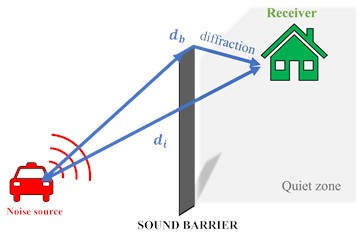
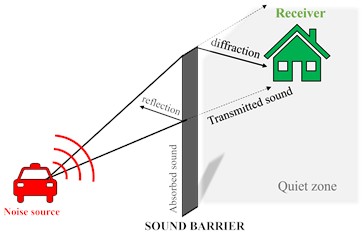
The diffraction of noise is largely determined by the difference between the direct path distance between the source and the receiver and the length of the extended path due to the presence of the barrier. Noise barriers form a zone of reduced sound energy behind the barrier (also called a "shadow zone") that is a combination of diffraction, reflection, and losses in the sound energy transmission. Due to the nature of sound, not all sound frequencies disperse equally. Lower frequencies are diffracted deeper into the "shadow zone" behind the barrier. Therefore, noise barriers are generally considered to be more effective at attenuating higher frequencies.
2.1. Calculation of direct and reflected sound levels from the traffic flow in the estimated point
During sound propagation from the source to the estimated point, the noise is reduced due to the following factors: losses from the surface of the protected territory, losses in the Ambiental air, losses due to wind conditions, losses due to the limited barrier length, atmosphere turbulence, influence of wood lines, and divergence of sound waves:
where represents noise characteristics of the traffic flow, is the noise reduction by noise barrier and is the sum of all sound energy losses on the sound propagation path from source to the estimated point.
The influence on the noise level at the estimated point of reflected sound can be considered by introducing three imaginary sources, each of which creates a sound level in the estimated point:
where which is the noise reduction of imaginary source when the traffic noise is reflected from a reflecting object, is the sound reflection coefficient (for reinforced concrete barriers 0.97, for asphalt and asphalt-concrete road surfaces 0.955), is the sum of acoustic energy losses during propagation of sound from the imaginary source to the estimated point and describes the noise barrier reduction of sound from imaginary sources.
The total sound level in the estimated point created by three considered imaginary sources is given by:
The sound level in the estimated point created by the direct and reflected sound can be calculated with:
The increase of the sound level in the estimated point due to reflected sound is given by:
2.2. Calculation of reduction of the sound reflected from the road surface
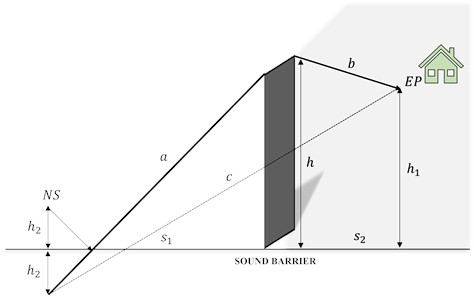
The acoustic performance of the barriers highly depends on a set of inherent and external characteristics. Inherent characteristics refer to the properties of the barrier, such as the type, thickness and design of the used materials. External characteristics consider the effect of the barrier when placed on the location. These characteristics are influenced by a set of conditions, such as: position of the barrier relative to the source and receiver, its effective height and length to relative to propagation paths, the nature of the noise source relative to the volume of traffic, the speed of traffic, the types of vehicles and the road surface, the characteristics of the sound transmission medium, i.e. wind conditions, air temperature and relative humidity, and the nature of the terrain between the road and the receiver (the acoustic impedance of the ground surface). Calculation diagram for determining the difference of the path lengths of the sound ray (Eq. (6)) during reflection from the road surface is shown in Fig. 4:
where is the difference of path lengths of the sound rays and can be calculated with:
where is the distance between the acoustic center of the imaginary noise source and the upper edge of the barrier, is the distance from the highest edge of the barrier to the estimated point and is the shortest distance from the acoustic center of the imaginary source to the estimated point.
where is the noise barrier height, is the height of the estimated point above the surface of the terrain, height of the NS acoustic center above the road surface, and are the distances from the noise barrier to axis of the far lane and the estimated point, accordingly.
Fig. 4Parameters for determining the path lengths of the sound ray δ
The combined influence of these factors determines the insertion loss of the barrier. Insertion loss (IL) is defined as the difference in sound pressure level at the receiver location before and after the barrier installation, expressed in Eq. (11):
Higher IL values indicate greater attenuation, because diffraction around the barrier edge is strongly dependent on the frequency range. These conditions also modulate the frequency spectrum of reduced noise, with greater IL typically achieved at higher frequencies and reduced performance at lower frequencies where diffraction effects are dominant.
3. Methodology for standardized and applied assessment of noise barrier effectiveness
3.1. ISO 10847 methodology for assessing sound barrier performance
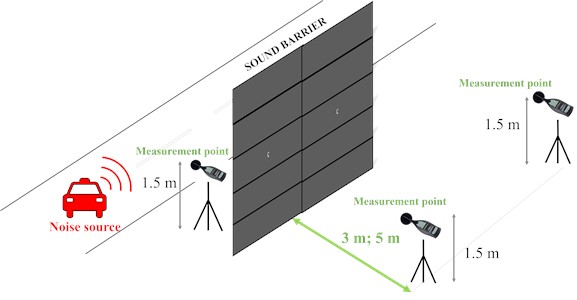
The international standard ISO 10847:1997 suggests two methods for assessing the effectiveness of a barrier through field measurements, direct and indirect. According to the standard, the indirect method is a standardized approach for determining the acoustic performance of noise barriers when they are already installed and cannot be removed. This method is particularly relevant for already constructed roadways, where barriers are integrated during the construction phase, which makes it impossible to perform pre-installation measurements under representative traffic conditions. ISO 10847 specifies methodological requirements and boundary conditions to ensure that the measured IL at receiver positions before and after barrier installation accurately reflects the barrier’s effectiveness. The standard outlines general criteria concerning the used instrumentation, acoustic environment of the measurement sites, and meteorological conditions, as well as the geometry and positioning of microphone and background noise. To approximate pre-installation noise levels, the method requires identification of a location acoustically comparable to the location where a barrier is installed. According to the standard, the measurements must be conducted at a minimum of three receiver positions: behind the barrier, at an equivalent no barrier position, and in front of the barrier as shown in Fig. 5. The sites must have similar traffic flow characteristics (volume, composition, and speed), same meteorological conditions (wind direction and speed, temperature, humidity), same acoustic conditions, including the relative geometry of source, barrier, and receiver, as well as presence of reflecting surfaces and surrounding infrastructure. In addition, ground impedance equivalence must be ensured, referring to comparable acoustic properties of the ground (e.g., asphalt, concrete, grass, or gravel) along the noise propagation path. The standard further specifies that the surrounding environment within a 30 meters radius behind and to the sides of the receiver locations should be acoustically similar to avoid influences on the results. To minimize variability in time and ensure the statistical validity of the results, the standard recommends that simultaneous measurements be performed at the barrier and no barrier site nearby whenever possible, while maintaining equivalent meteorological and traffic conditions during data acquisition.
Fig. 5Measurement points according to ISO 10847
3.2. Implementation of ISO 10847 on local context
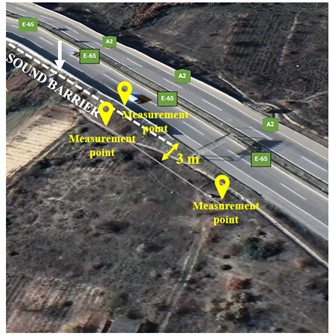
In Skopje, the capital city in the Republic of North Macedonia, noise barriers have been installed at two locations in the city, as part of environmental noise mitigation measures. A reactive noise barrier is positioned along the Skopje Bypass road (Fig. 6(a)), and reflective noise barrier is positioned around the Skopje Central railway and bus station (Fig. 6(b)). To evaluate the acoustic effectiveness of these two existing noise barriers, the standardized methodology of ISO 10847 indirect method has been implemented. For the two existing noise barriers, ISO 10847 measurements have been adapted to the infrastructural conditions at each site.
Measurements have been carried out 3 days in a row, and each measurement has been repeated 3 times consecutively, with a measuring time interval of 10 minutes. The measurements have been conducted with a Bruel & Kjaer 2250 Class 1 measuring instrument, accordingly calibrated, as well as other instrumentation for determination of the meteorological conditions. The recommended noise indicator is the equivalent A-weighted sound pressure level (LAeq).
Fig. 6Measurement locations in the city of Skopje Bypass Road and Skopje Central station). (source: Google Maps)
a) Bypass Road
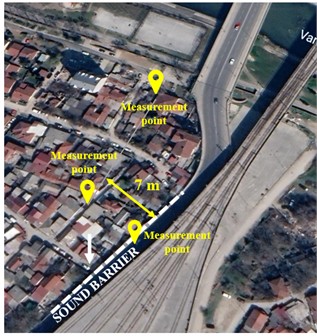
b) Skopje Central station
3.2.1. Skopje Bypass Road noise barrier
The Skopje Bypass barrier is a long reactive noise barrier that is constructed along the Bypass Road in the city, with a total length of approximately 2700 m and typical heights of about 4 m above ground. The barrier is a combination of embankments and vertical screens, placed 14 m from the road axis. Currently at the measurement location, the main source of noise is the traffic on the Bypass road. Along the Skopje Bypass, traffic flow is dominated by motorway noise with relatively high and stable speeds that influence the annoyance of the residents in that area. Measurement positions have been strategically chosen to be sufficiently far and avoid secondary reflections from retaining walls and open embankments. The Bypass Road passes through mostly open terrain where wind exposure is significant, therefore, the measurements have been performed during low-wind periods, with carefully selected meteorological condition to avoid refraction effects.
In Fig. 7 the photographic documentation from the in-situ noise measurements conducted at the Skopje Bypass noise barrier is illustrated, showing microphone setups behind the barrier, in a location near the barrier and in front of the barrier, according to ISO 10847 recommendations. For each of the measurement positions, below are given the collected 1/3 octave-band spectrum.
3.2.2. Skopje Central station noise barrier
The Central (railway) station reflective barrier is shorter, more complex installation placed in a dense urban zone in the city Center near the railway and bus station. For this barrier, no technical information (geometry or panel material type) is available, and no laboratory or in-situ experimental observations have been previously conducted. In this area, dominant noise levels come mainly from the intermittent train and traffic sources. Near the Railway Station, the environment is more complex: reflective nearby buildings, dense urban surfaces and continuous train traffic. Therefore, in cases where trains are the dominant sound source, the measurements have been synchronized with passages of similar type and speed to ensure comparability. The surrounding infrastructure in this area has been fully analyzed because they can increase reverberant energy and influence IL values.
Fig. 7Measurement locations on the city’s Bypass Road and 1/3-octave band frequency in the measured time intervals. The photos were taken by the authors, on 04.08.2025, on the Bypass Road in the city of Skopje
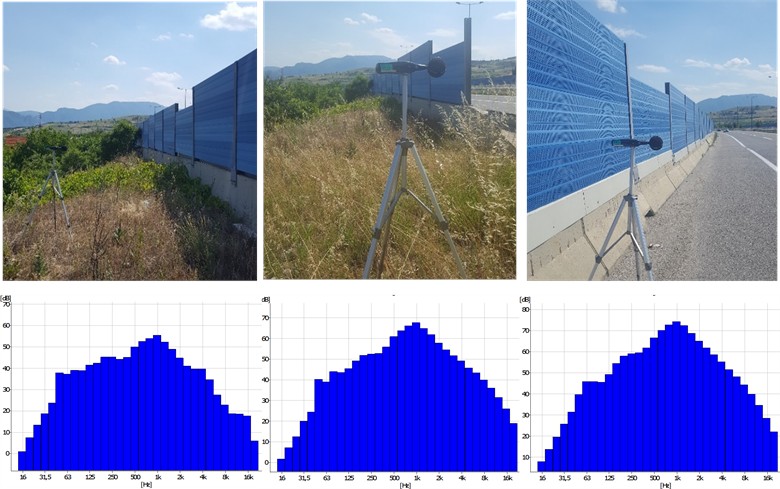
Fig. 8Measurement locations in the Skopje Central station and 1/3-octave band frequency in the measured time intervals. The photos were taken by the authors, on 12.08.2025, on “Belasitsa” Street in the city of Skopje
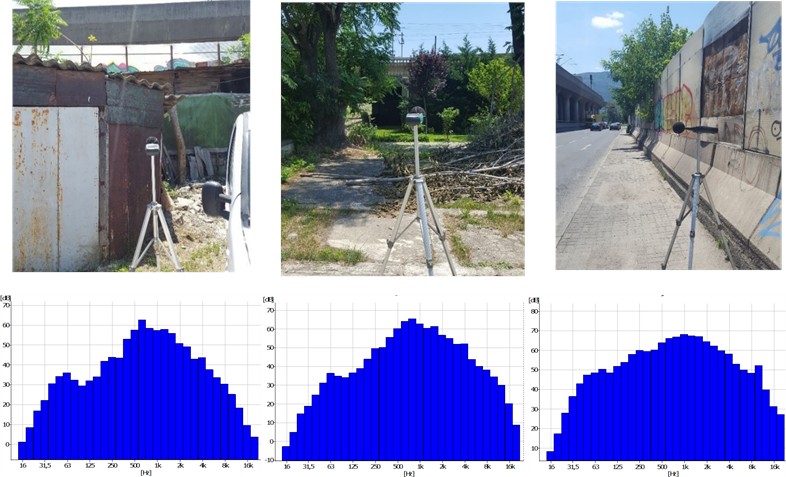
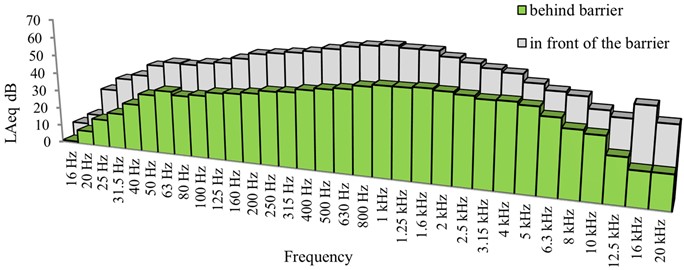
The photographic documentation and 1/3 octave-band spectrum from the measurements at the Skopje Central station barrier are accordingly shown in Fig.8. The figure shows in-situ noise-measurement setups positioned around the noise barrier and illustrate three representative microphone locations used to characterize the acoustic environment: behind the barrier, in a location near the barrier and in front of the barrier.
4. Results
4.1. Spectrum analysis of Skopje Bypass Road noise barrier effectiveness
The noise levels for the measurement points behind the barrier and at the equivalent location where no sound barrier is installed are compared in the 1/3 octave spectrum in Fig. 9. The results indicate that the IL provided by the barrier shows strong frequency dependence, with lower noise level attenuation at low frequencies (≤ 160 Hz) compared to the noise level attenuation achieved at higher frequencies, especially above 1 kHz. The spectrum curve shows a clear indication of the characteristics of the dominant road traffic noise, with maximum sound energy occurring between 400 Hz and 1 kHz. The barrier demonstrates attenuation in the mid-frequency range, as well as significant attenuation in high-frequency range above 2.5 kHz, where diffraction and surface absorption are most effective. Reductions are smaller at low frequencies, as expected due to the longer wavelengths and limited shielding efficiency in this region.
Fig. 9Octave spectrum results of the noise level measurement at the measurement points without and with a sound barrier on the Skopje Bypass Road. The photos were taken by the authors, on 04.08.2025, on the Bypass Road in the city of Skopje
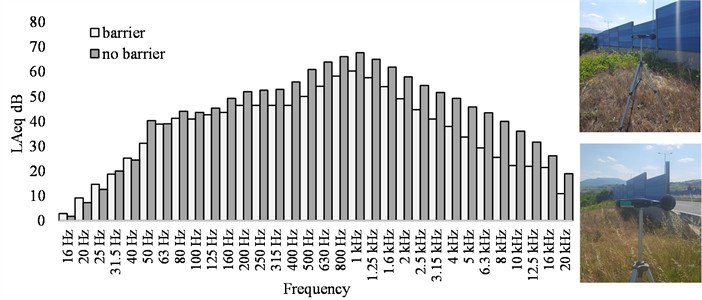
In Fig.10 is presented the 1/3 octave spectrum noise levels measured at the Skopje Bypass barrier, comparing spectrum recorded in front of the barrier (source side) with those measured behind the barrier (receiver side). This comparison highlights the barrier’s in-situ acoustic performance and quantifies its ability to attenuate broadband traffic noise. The overall spectrum shape follows the typical distribution of road traffic noise, with dominant energy concentrated between approximately 250 Hz and 1 kHz. Across nearly the entire frequency range, the levels behind the barrier are consistently lower. The greatest reductions occur in the higher frequencies (above 4 kHz), where the combined influence of geometric diffraction and the barrier’s surface properties leads to measurable insertion loss. At very low frequencies, differences in noise levels at the source and at receiver sides are smaller, again showing the limited attenuation of the barrier achievable for long wavelengths.
4.2. Spectrum analysis of Skopje Central station noise barrier effectiveness
The noise levels at the measurement point behind the barrier, as well as at the equivalent point where no sound barrier is installed for the measurement location in the city Center are given in Fig. 11. The photographs document the measurement locations, characterised by mixed residential surroundings and complex reflective surfaces.
Fig. 10Measured noise values in front of and behind the barrier installed on the Skopje Bypass Road
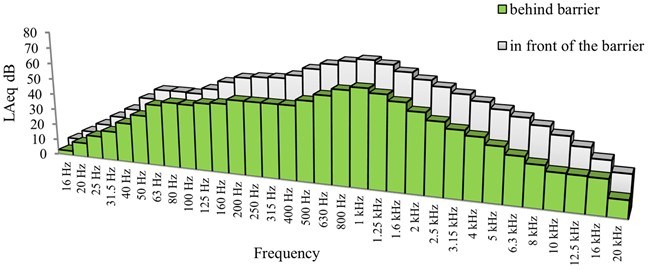
Fig. 11Octave spectrum results of the noise level measurement at the measurement points without and with a sound barrier in the Center of Skopje. The photos were taken by the authors, on 12.08.2025, on “Belasitsa” Street in the city of Skopje
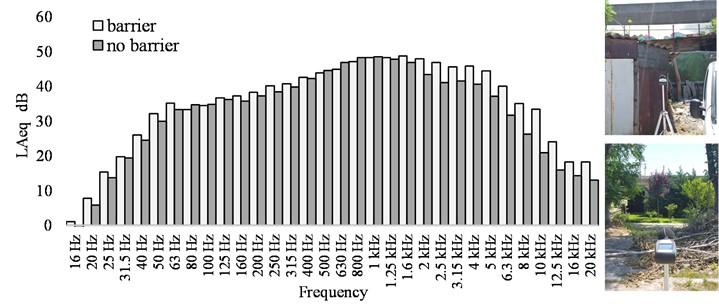
From the results it can be noticed that the differences in noise levels are small, even negative for frequencies up to 1 kHz, which leads to a conclusion that barrier is not effective for low frequency sounds. The frequency spectrum shows the typical noise level distribution of urban railway and traffic noise, with dominant energy concentrated between 630 Hz and 6.3 kHz. Across the high frequency bands, the attenuation is evidently pronounced, but the differences in low-frequency noise levels remain smaller due to limited diffraction control at long wavelengths. At the city center measurement points, the sound field is influenced by multiple concurrent noise sources interfering with road traffic and railway noise, including construction activity, intermittent animal noise (e.g., barking dogs), which contributes to a more spectral diverse and complex acoustic environment.
Fig. 12 presents the 1/3 octave-band sound pressure levels measured at the central Skopje railway-station barrier, comparing the spectrum recorded in front of the barrier with those measured behind the barrier. Across nearly all frequency bands, the levels behind the barrier are consistently lower. Even though the reductions are slightly higher in the mid-frequency region, it can be concluded that the barrier provides almost equal distribution of noise attenuation in the whole frequency spectrum.
Fig. 12Measured noise values in front of and behind the barrier installed near the central station in the city of Skopje
4.3. Comparison results
Based on the previously discussed measurement results, the observations lead to a general conclusion that the noise barriers installed at both sites in the city of Skopje show evident effect in mitigating the environmental noise. However, the comparison analysis of IL for the two evaluated noise barriers demonstrates clear differences in their frequency-dependent performance (Fig. 13). The results confirmed that the barriers show significantly higher attenuation efficiency in the middle to high frequency range (from 100 Hz to 2000 Hz), while their efficiency decreases significantly at lower frequencies (≤ 200 Hz). Differences in noise levels are evident from the analysis, but here significant differences can also be observed at other lower frequencies such as 31.5 Hz where the difference is approximately 18 dB and at higher frequencies such as 16 kHz where the deviations are up to 28 dB. This variation in the frequency-dependent noise level deviations between the two locations is due to the differences in the acoustic sources at the two locations.
Fig. 13Comparison results of the IL of both barriers
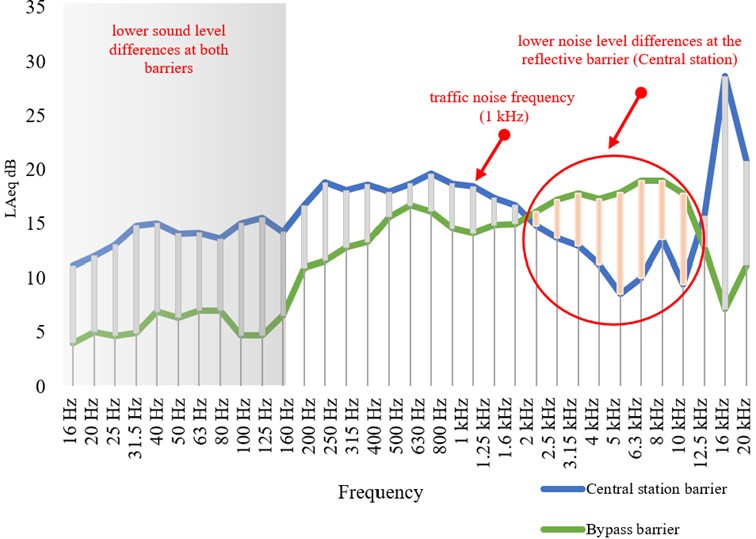
As the frequency increases towards the mid-range, the Bypass barrier shows a more continuous increase of the IL, indicating a stable efficiency. The maximum IL exceeds 10 dB, especially around the dominant frequency range of traffic noise near 1 kHz. In contrast, the reflective barrier at the Central Station gives similar results in the mid-frequency range, but shows significantly reduced IL at higher frequencies, which is due to its reflective surface that limits its attenuation efficiency. On the other hand, the train lines in the city of Skopje have an older rolling stock, which operate at relatively low to mid-frequency speeds. The dominant frequency range of the trains is usually between 250 Hz and 630 Hz, which agrees well with the measurement results where the mid-frequency peaks in 1/3 of the frequency spectrum. As shown in Fig. 13, large differences in the IL for the two barriers are evidently appearing in the range between 2 kHz and 12.5 kHz. This dissimilarity is due to the high frequency nature of the various sound sources at the location in the Center, that the reflective barrier cannot effectively control. At this location, in addition to train noise, other noise sources occur, such as noise caused by people, traffic horns and work activities, that do not occur at the Bypass Road environment.
In summary, the acoustic performance of noise barriers, as passive mitigation systems, is confirmed along the traffic noise frequency spectrum, but their efficiency is limited in the frequency range of urban noise.
5. Conclusions
The conducted research provides experimental evidence on the acoustic performance of two existing noise barriers in the city of Skopje, using the methodology proposed as an indirect method for measurement technique for determining the IL of a noise barrier in ISO 10847:1997. These findings verify the role of both noise barriers as an effective passive mitigation measure for traffic noise. The results suggest that sound barriers are an appropriate solution where reduction in traffic noise is needed, which is dominant at frequencies of 1 kHz. Nevertheless, for locations where different noise sources occur, their application is not sufficient for complete noise protection. Their limited performance at low frequencies emphasizes the need to integrate additional mitigation measures such as hybrid passive/active control systems or low frequency optimized barrier designs when formulating comprehensive and predictive urban noise management strategies for the given residential areas.
This scientific research is directed towards establishing initial findings on the noise mitigation measures in the city. The conclusions will serve towards development of targeted noise mitigation measures and development of an urban noise action plan in the city. The study has several limitations that should be acknowledged. First, the absence of detailed technical documentation on the geometric and material properties of the existing noise barriers has been a restriction on the scope of the quantitative and cost analysis. Additionally, the fact that only two noise barriers are currently installed in the urban city area, restricts generalization and indicates the fact that knowledge about the noise pollution in the city is seriously limited. In these terms, future work will include more in-depth qualitative and quantitative analysis based on numerical modeling for assessment of barrier configuration models and location in the city. The extended research will propose optimized mitigation measures, noise protection strategy and possibilities of using alternative barrier designs.
References
-
D. Ouis, “Annoyance from road traffic noise: a review,” Journal of Environmental Psychology, Vol. 21, No. 1, pp. 101–120, Mar. 2001, https://doi.org/10.1006/jevp.2000.0187
-
A. Elizabeth González, Noise Control. IntechOpen, 2023, https://doi.org/10.5772/intechopen.104608
-
M. J. Crocker and A. J. Price, Noise and Noise Control. CRC Press, 2018, https://doi.org/10.1201/9781351075008
-
B. Berglund, T. Lindvall, and D. H. Schwela, “Guidelines for community noise,” World Health Organization, Geneva, Switzerland, 1999.
-
“Directive 2002/49/EC of the European Parliament and of the Council of 25 June 2002 relating to the assessment and management of environmental noise,” Official Journal of the European Communities, Vol. L189, pp. 12–26, 2002.
-
G. Meller, W. M. de Lourenço, V. S. G. de Melo, and G. de Campos Grigoletti, “Use of noise prediction models for road noise mapping in locations that do not have a standardized model: a short systematic review,” Environmental Monitoring and Assessment, Vol. 195, No. 6, May 2023, https://doi.org/10.1007/s10661-023-11268-9
-
G. Licitra and E. Ascari, The Good Practice Guide, Version 2. Noise Mapping in the EU: Models and Procedures. 2012.
-
H. Negahdari, S. Javadpour, and F. Moattar, “Designing, constructing and testing of a new generation of sound barriers,” Journal of Environmental Health Science and Engineering, Vol. 17, No. 2, pp. 507–527, Jul. 2019, https://doi.org/10.1007/s40201-019-00357-y
-
M. Masullo, R. A. Toma, M. Yang, G. Brambilla, and L. Maffei, “Noise annoyance and application of the Harmonica index at short time intervals,” in INTER-NOISE and NOISE-CON Congress and Conference Proceedings, Vol. 270, No. 5, pp. 6357–6363, Oct. 2024, https://doi.org/10.3397/in_2024_3720
-
M. E. Nilsson, T. Kaczmarek, and B. Berglund, “Perceived soundscape evaluation of noise mitigation methods,” in Institute of Noise Control Engineering, INTER-NOISE and NOISE-CON Congress and Conference Proceedings, Vol. 2004, No. 5, pp. 2683–2688, Aug. 2004.
-
H. Wang, P. Luo, and M. Cai, “Calculation of noise barrier insertion loss based on varied vehicle frequencies,” Applied Sciences, Vol. 8, No. 1, p. 100, Jan. 2018, https://doi.org/10.3390/app8010100
-
J. Y. Hong, H. S. Jang, and J. Y. Jeon, “Evaluation of noise barriers for soundscape perception through laboratory experiments,” in Acoustics, Nantes Conference, pp. 1–6, 2012.
-
Q. Li, D. Duhamel, Y. Luo, and H. Yin, “Analysing the acoustic performance of a nearly-enclosed noise barrier using scale model experiments and a 2.5-D BEM approach,” Applied Acoustics, Vol. 158, p. 107079, Jan. 2020, https://doi.org/10.1016/j.apacoust.2019.107079
-
J. Li, Y. Li, J. Tan, and Z. Yang, “Optimized design research of fully enclosed noise barrier,” in MATEC Web of Conferences, Vol. 355, p. 02061, Jan. 2022, https://doi.org/10.1051/matecconf/202235502061
-
L. Song, Y. Zhang, Q. Liu, Y. Luo, and R. Bi, “Experimental study on noise reduction performance of vertical sound barrier in elevated rail transit,” Buildings, Vol. 15, No. 10, p. 1621, May 2025, https://doi.org/10.3390/buildings15101621
-
A. Tumavičė and L. Žalimienė, “Insertion loss value dependency of the low height noise barriers distance from railway track,” The Baltic Journal of Road and Bridge Engineering, Vol. 19, No. 4, pp. 50–68, Dec. 2024, https://doi.org/10.7250/bjrbe.2024-19.648
-
S. Bouguerra et al., “Performance of zigzag photovoltaic noise barriers near a Belgian highway,” Solar RRL, Vol. 8, No. 24, p. 24005, Oct. 2024, https://doi.org/10.1002/solr.202400519
-
H. Liu, F. Wang, and C. Zhang, “Performance analysis and material distribution optimization for sound barriers using a semianalytical meshless method,” International Journal of Mechanical System Dynamics, Vol. 3, No. 4, pp. 331–344, Oct. 2023, https://doi.org/10.1002/msd2.12087
-
J. Chen et al., “Experimental investigation on building sound environment: traffic-induced air noise and structure-borne noise,” Buildings, Vol. 14, No. 8, p. 2380, Aug. 2024, https://doi.org/10.3390/buildings14082380
-
W. A. Ilonka, D. Handayani, and K. Soeryodarundio, “A systematic review of sustainable materials for railway activity noise barriers in Indonesia,” The 8th Mechanical Engineering, Science and Technology International Conference, Vol. 84, No. 1, p. 23, Jan. 2025, https://doi.org/10.3390/engproc2025084023
-
X. Wu, Y. Zhu, L. Xian, and Y. Huang, “Fatigue life prediction for semi-closed noise barrier of high-speed railway under wind load,” Sustainability, Vol. 13, No. 4, p. 2096, Feb. 2021, https://doi.org/10.3390/su13042096
-
X. Fan et al., “Environmental noise pollution control of substation by passive vibration and acoustic reduction strategies,” Applied Acoustics, Vol. 165, p. 107305, Aug. 2020, https://doi.org/10.1016/j.apacoust.2020.107305
-
V. Koukounian, “Investigating the correlation between the acoustic performance of solid and louvered acoustic screens for outdoor applications,” in INTER-NOISE and NOISE-CON Congress and Conference Proceedings, Vol. 271, No. 2, pp. 970–979, Jul. 2025, https://doi.org/10.3397/nc_2025_0165
-
V. Laxmi, C. Thakre, and R. Vijay, “Evaluation of noise barriers based on geometries and materials: a review,” Environmental Science and Pollution Research, Vol. 29, No. 2, pp. 1729–1745, Oct. 2021, https://doi.org/10.1007/s11356-021-16944-2
-
P. Tinnam, N. Yodpijit, S. Junsupasen, M. Sappakittipakorn, and M. Jongprasithporn, “Reduction of sound pressure levels with noise barriers containing agricultural residues: Case study,” ASEAN Journal of Scientific and Technological Reports, Vol. 28, No. 3, p. e257762, May 2025, https://doi.org/10.55164/ajstr.v28i3.257762
-
H. P. Lee, K. M. Lim, and S. Kumar, “Noise assessment of elevated rapid transit railway lines and acoustic performance comparison of different noise barriers for mitigation of elevated railway tracks noise,” Applied Acoustics, Vol. 183, p. 108340, Dec. 2021, https://doi.org/10.1016/j.apacoust.2021.108340
-
M. Garai, P. Guidorzi, A. Osele, and C. Costa, “Advancement of the European method for in-situ measurements on road traffic noise barriers,” in 10th Convention of the European Acoustics Association Forum Acusticum 2023, pp. 4231–4238, Jan. 2024, https://doi.org/10.61782/fa.2023.0218
-
B. Eren, S. Likos, and A. Çelebi, “Effectiveness of noise barriers in sensitive urban areas: a comprehensive study on noise reduction strategies and public health implications,” Environmental Science and Pollution Research, Vol. 31, No. 50, pp. 60093–60107, Oct. 2024, https://doi.org/10.1007/s11356-024-35229-y
-
D. Savković, A. Milenković, D. Boljević, and S. Baralić, “Effectiveness of the construction of sound barriers on two highly busy roads in Belgrade,” Facta Universitatis, Series: Working and Living Environmental Protection, p. 283, Jan. 2025, https://doi.org/10.22190/fuwlep241009027s
-
A. Pultznerová, J. Šimo, and J. Grenčík, “Possibilities of evaluating the effectiveness of noise barriers in Slovakia,” Applied Sciences, Vol. 11, No. 21, p. 10206, Oct. 2021, https://doi.org/10.3390/app112110206
-
A. Barba and J. M. Martinez-Orozco, “Approaches for noise barrier effectiveness evaluation based on in situ ‘IL’ determination,” in Noise Control, London, U.K.: IntechOpen, 2022.
-
X. Zhang et al., “Modular reverse design of acoustic metamaterial and sound barrier engineering applications: High ventilation and broadband sound insulation,” Thin-Walled Structures, Vol. 196, p. 111498, Mar. 2024, https://doi.org/10.1016/j.tws.2023.111498
-
K. Zhang et al., “Integrating photovoltaic noise barriers and electric vehicle charging stations for sustainable city transportation,” Sustainable Cities and Society, Vol. 100, p. 104996, Jan. 2024, https://doi.org/10.1016/j.scs.2023.104996
-
D. Ramírez-Solana et al., “Sonic crystal noise barrier with resonant cavities for train brake noise mitigation,” Applied Sciences, Vol. 14, No. 7, p. 2753, Mar. 2024, https://doi.org/10.3390/app14072753
-
N. Babazadeh, J. Teizer, H.-J. Bargstädt, and J. Melzner, “Predictive simulation of construction site noise emissions from heavy equipment,” Smart and Sustainable Built Environment, Vol. 14, No. 3, pp. 715–739, Apr. 2025, https://doi.org/10.1108/sasbe-08-2023-0226
-
A. Hołtra and D. Zamorska-Wojdyła, “Application of individual and integrated pollution indices of trace elements to evaluate the noise barrier impact on the soil environment in Wrocław (Poland),” Environmental Science and Pollution Research, Vol. 30, No. 10, pp. 26858–26873, Nov. 2022, https://doi.org/10.1007/s11356-022-23563-y
-
P. Guidorzi and M. Garai, “Repeatability of the European standardized method for measuring sound reflection and sound insulation of noise barriers,” Environments, Vol. 10, No. 8, p. 139, Aug. 2023, https://doi.org/10.3390/environments10080139
About this article

The authors have not disclosed any funding.
The datasets generated during and/or analyzed during the current study are available from the corresponding author on reasonable request.
Maja Anachkova: conceptualization, data curation, investigation, methodology, project administration, writing-original draft, writing-review and editing, validation. Simona Domazetovska Markovska: conceptualization, methodology, formal analysis, software, data curation. Dejan Shishkovski: formal analysis, investigation, data curation, validation. Damjan Pecioski: data curation, validation, visualization. Anastasija Angjusheva Ignjatovska: visualization, writing-Original Draft Preparation, writing- Review and Editing.
The authors declare that they have no conflict of interest.

