Abstract
The purpose of this study is to analyze the prospects for transitioning the city from automobile-dominated mobility to a public transport-oriented system. The methodological framework is based on the analysis of transport infrastructure. The research is conducted on the example of Tashkent – the capital of Uzbekistan – characterized by a high level of motorization and significant commuter migration. The study concludes that a successful transition to public transport requires a phased implementation, involving infrastructure modernization, digitalization, regulation of motorization, and transformation of citizens’ mobility behavior. The novelty of this study lies in developing a digital transition model for Tashkent that integrates international best practices (Berlin, London, Singapore) with the local transport and socio-economic conditions.
Highlights
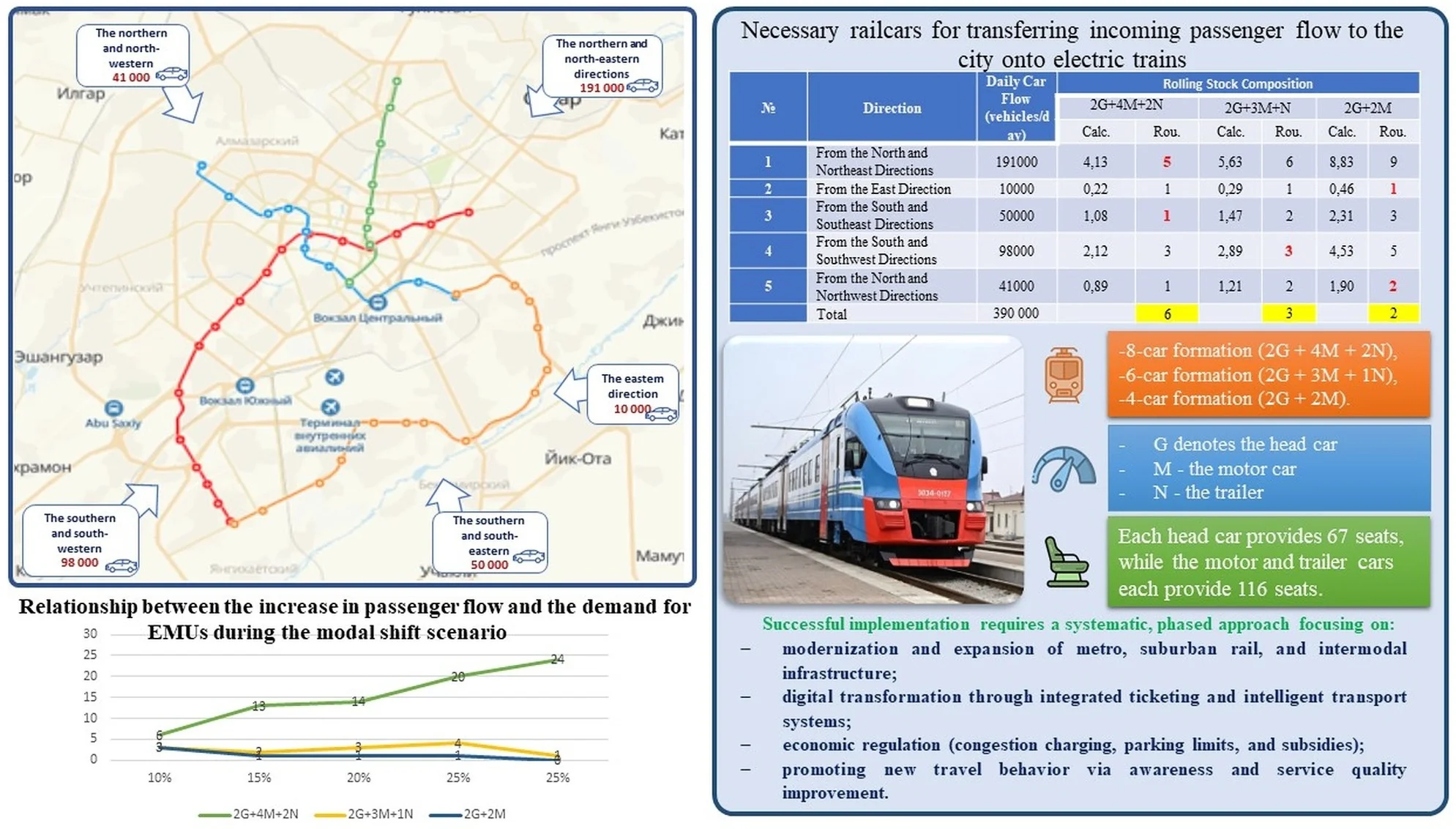
- Successful implementation requires a systematic, phased approach focusing on: modernization and expansion of metro, suburban rail, and intermodal infrastructure; digital transformation through integrated ticketing and intelligent transport systems.
- Economic regulation (congestion charging, parking limits, and subsidies); promoting new travel behavior via awareness and service quality improvement.
- Relationship between the increase in passenger flow and the demand for EMUs during the modal shift scenario.
- Necessary railcars for transferring incoming passenger flow to the city onto electric trains.
1. Introduction
Tashkent, as the largest metropolis in Central Asia, has faced accelerated rates of motorization in recent decades. The increasing number of private vehicles is perceived by residents as an indicator of social status and convenience, which has led to severe traffic congestion, a decline in road network capacity, and growing environmental risks. Under these circumstances, the capital’s transport system experiences critical overload during peak hours, necessitating strategic and systemic solutions.
In this context, the priority development of public transport – including metro, suburban electric trains, light rail, and electric or low-emission buses – becomes a fundamental direction of transport policy. International experience (Berlin, London, Singapore) demonstrates that only comprehensive approaches combining infrastructural, economic, and digital instruments can effectively reduce public dependence on private automobiles and ensure sustainable transport development.
The purpose of this research is to assess the potential for shifting a portion of the city’s population from private car use to suburban rail transport and to determine optimal directions for implementing an integrated transport system.
Unlike studies conducted for Berlin, London, and Singapore, this research proposes a digital transition model adapted to post-Soviet urban structures and socio-economic realities.
2. Literature review
The issue of shifting from automobile to suburban railway transport has been examined by numerous domestic and international researchers.
Eliasson analyzed the impact of integrated ticketing systems and mobile applications on passenger loyalty, showing that a 25 % reduction in travel cost increases suburban rail demand by about 18 % [1]. Timofeeva studied “Park & Ride” hubs and found that with sufficient parking capacity (over 500 vehicles), up to 40 % of users switch from private cars to public transport [2].
Diana Marco explored psychological barriers to using public transport, such as driving habits and perceived comfort and reliability of private vehicles [3]. She also demonstrated that improving station accessibility and pedestrian infrastructure can raise the share of rail trips by 15-25 %. A Dutch study [4] examined access to railway stations, analyzing both access modes and the influence of car ownership on travel choice. Yakimov and Prokofieva applied mathematical modeling to predict the impact of fare and travel time on suburban rail usage [5].
Mehbub Anwar and Jie Yang assessed the role of transport policy in promoting modal shift to public transport, particularly buses [6]. The topic has also been addressed by international scholars such as Urbanek A., Moerman J., Chaudhury P., and Ratanawaraha H. [7-11]. In domestic research, emphasis is placed on improving infrastructure and the attractiveness of rail transport. Notable contributors include Ilesaliev D., Kabulov Zh., Mukhamedova Z., Rasulov M., Khadjimekhametova M., Suyunbaev Sh., Abduvakhitov Sh., and Saidivaliev Sh. [12-20].
Overall, the literature review shows that recent studies focus on integrated approaches for coordinating transport modes, reducing travel costs, and encouraging a sustainable behavioral shift toward suburban rail transport.
3. Methods
The analysis of the transport system of the capital city was carried out using a comprehensive methodological framework that integrated several complementary research approaches:
1) Assessment of the current transport infrastructure - based on empirical data concerning congestion levels, vehicle ownership rates, and passenger flow distribution across major corridors of Tashkent.
2) Comparative analysis - drawing upon international best practices from major metropolitan areas (Berlin, London, Singapore) that have successfully implemented transition models from private car dominance to public transport prioritization.
3) Application of modern transport planning principles - including the Transit-Oriented Development (TOD) concept, multimodal integration, and the use of smart mobility technologies for optimizing transport efficiency.
The empirical basis of the study relied on field observations and data collection performed along the main entry routes into the city. The results of these observations revealed that during peak hours, the capital’s road network operates at near-maximum capacity, with congestion levels consistently reaching critical thresholds.
According to official statistics, approximately one million people commute to capital daily, of whom around 275,000 reside in surrounding suburban areas. This daily oscillatory (pendulum) migration generates intense private car flows entering the city in the morning and exiting in the evening, producing severe congestion at entry and exit points and reducing the overall efficiency of the transport network. For comparative purposes, the study analyzed transport flow management models in leading metropolitan areas.
In Berlin, transport policy follows a holistic approach emphasizing public and eco-friendly mobility. The integrated network of metro, suburban rail (S-Bahn), tram, and bus services ensures extensive accessibility. Cycling infrastructure has been expanded through the conversion of temporary pandemic lanes into a permanent network. Environmental zones restrict access to vehicles without “green” emission stickers, encouraging modal shift. Digital integration is achieved through the Jelbi platform, which unites metro, bus, bicycle, car-sharing, and micromobility services within one digital ecosystem.
In London, congestion is managed mainly through regulatory instruments. Since 2003, the Congestion Charge has required a daily fee for vehicles entering the central zone, supplemented by the Ultra Low Emission Zone (ULEZ), which limits access for high-emission vehicles. Infrastructure projects such as the Crossrail (Elizabeth Line) expansion and programs like Santander Cycles promote modal shift and active mobility.
Singapore represents the most advanced example, integrating Transit-Oriented Development (TOD), multimodal coordination, and smart mobility. High-density development around MRT and bus stations reduces car dependency, while unified fare systems (EZ-Link card, mobile apps) enable seamless transfers. Intelligent traffic management and Electronic Road Pricing (ERP) regulate congestion through dynamic pricing, maintaining efficiency and low car ownership levels.
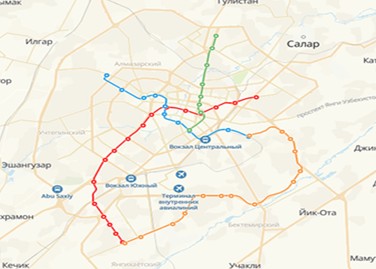
International experience shows that the development of suburban and regional express rail systems - such as Berlin’s S-Bahn, Paris’s RER, and London’s Thameslink - plays a decisive role in reducing congestion in major cities. According to the results of field observations, the average daily inflow of vehicles into the city is distributed as follows: approximately 191,000 vehicles arrive from the northern and north-eastern directions, 41,000 vehicles from the northern and north-western, 98,000 vehicles from the southern and south-western, 50,000 vehicles from the southern and south-eastern, and about 10,000 vehicles from the eastern direction.
Fig. 1Stations where roads entering the city can be connected to the metro
The average vehicle occupancy, i.e., the number of people per car, is typically estimated between 1.2 and 1.4 persons per vehicle; for modeling purposes, a baseline value of 1.3 was adopted. The modal-shift coefficient () was introduced into the model, representing the share of the automobile flow that can be converted to rail usage. This coefficient ranges from 0 to 1, corresponding to 0-100 % of potential modal shift.
The number of passengers potentially shifting from private cars to commuter trains per day can be estimated using the following formula: , passengers, where – average daily automobile flow (vehicles per day); – average vehicle occupancy (persons per vehicle); – share of the automobile flow that shifts to rail transport.
The proportion of the total population represented by this modal shift can be calculated as: ⋅100 %, passengers, where – population within the suburban catchment area.
According to statistical data, the composition of daily vehicle traffic consists of approximately 90 % private cars and taxis, and 10 % minibuses, trucks, and buses. Based on international experience (e.g., Moscow, Warsaw, Berlin), it is estimated that 10-30 % of the population could realistically transition from private vehicles to suburban rail transport.
For a given automobile flow along a specific corridor, during peak hours (where a 14 % temporal load factor is applied in the calculations), the model assumes a potential transfer of 10 % to 30 % of passengers to rail transport.
The effective implementation of this transition requires a gradual, adaptive approach, enabling flexible alignment with demand and minimizing operational risks. The proposed transition plan consists of three sequential stages, each including specific measures and expected outcomes designed to ensure the reliability and scalability of the transport system.
In modeling the potential capacity of suburban trains, several configurations of electric multiple-unit (EMU) compositions were considered:
– 8-car formation (2G + 4M + 2N), 6-car formation (2G + 3M + 1N), 4-car formation (2G + 2M). Here, G denotes the head car, M – the motor car, and N – the trailer. Each head car provides 67 seats, while the motor and trailer cars each provide 116 seats.
When considering standing capacity, assuming 3 standing passengers per square meter, the total capacity is approximately 130 passengers per head car and 178 per motor/trailer car. Under denser conditions, with 7 standing passengers per square meter, the capacity rises to 216 and 258 passengers, respectively. For modeling purposes, the average value between seated and standing capacity was adopted to represent realistic loading scenarios under peak-hour conditions.
4. Results
A gradual transition supported by phased expansion of transport infrastructure and related services will minimize systemic risks and lead to a significant reduction in automobile traffic congestion. Calculations were carried out for a population shift from private car use to suburban rail transport within a range of 10 % to 30 %, with increments of 5 %. The analytical results are presented for three different capacity configurations of multiple-unit electric rolling stock.
Table 1Necessary railcars for transferring incoming passenger flow to the city onto electric trains
No. | Direction | Daily car flow (vehicles/day) | Rolling stock composition | |||||
2G+4М+2N | 2G+3М+N | 2G+2М | ||||||
Calc. | Rou. | Calc. | Rou. | Calc. | Rou. | |||
1 | From the north and northeast directions | 191000 | 4.13 | 5 | 5.63 | 6 | 8.83 | 9 |
2 | From the east direction | 10000 | 0.22 | 1 | 0.29 | 1 | 0.46 | 1 |
3 | From the south and southeast directions | 50000 | 1.08 | 1 | 1.47 | 2 | 2.31 | 3 |
4 | From the south and southwest directions | 98000 | 2.12 | 3 | 2.89 | 3 | 4.53 | 5 |
5 | From the north and northwest directions | 41000 | 0.89 | 1 | 1.21 | 2 | 1.90 | 2 |
Total | 390 000 | 6 | 3 | 2 | ||||
Based on the conducted analysis and the author’s expert evaluation, the optimal number of train pairs for each suburban direction during peak hours has been determined. This configuration ensures a balanced distribution of passenger flows and promotes efficient utilization of available transport resources.
Fig. 2Relationship between the increase in passenger flow and the demand for EMUs during the modal shift scenario
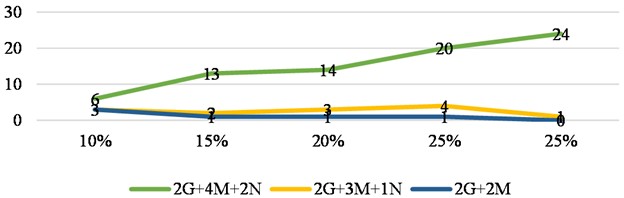
A fundamental planning principle applies here: “Demand first – infrastructure later”. This approach implies that excessive capacity should not be constructed in advance; instead, infrastructure expansion should be implemented dynamically, in response to verified growth in transport demand.
5. Discussion
Based on the obtained results, a practical transition framework can be developed, including the following strategic steps:
1) Infrastructure development: expansion of the metro network, modernization of suburban railway lines, procurement of electric buses, and restoration of tram systems.
2) Park and Ride system: establishment of parking facilities near metro and railway stations with preferential tariffs.
3) Integrated ticketing system: implementation of a unified transport card and mobile applications for multimodal connectivity.
4) Social measures: public awareness campaigns, service comfort enhancement, and promotion of the “green transport” concept.
6. Conclusions
The study confirms that prioritizing public transport in the capital is a strategic necessity amid rapid urbanization and demographic growth. The analysis shows that shifting a portion of suburban automobile traffic to electric trains can significantly reduce highway congestion, improve environmental conditions, and enhance travel time reliability. Transitioning from six-car to eight-car trains increases transport capacity by about 27 %.
Successful implementation requires a systematic, phased approach focusing on:
1) Modernization and expansion of metro, suburban rail, and intermodal infrastructure.
2) Digital transformation through integrated ticketing and intelligent transport systems.
3) Economic regulation (congestion charging, parking limits, and subsidies).
4) Promoting new travel behavior via awareness and service quality improvement.
References
-
D. Hopkins, “Book review,” Journal of Transport Geography, Vol. 55, pp. 189–190, Jul. 2016, https://doi.org/10.1016/j.jtrangeo.2016.08.005
-
E. V. Timofeeva, Evaluation of the Efficiency of Transport Hubs in St. Petersburg. (in Russian), St. Petersburg: St. Petersburg State University Publishing House, 2019.
-
D. Marco, “From mode choice to modal diversion: A new behavioral paradigm,” Transportation Research Part A: Policy and Practice, Vol. 44, No. 8, pp. 620–629, 2010.
-
M. Givoni and P. Rietveld, “The access journey to the railway station and its role in passengers’ satisfaction with rail travel,” Transport Policy, Vol. 14, No. 5, pp. 357–365, Sep. 2007, https://doi.org/10.1016/j.tranpol.2007.04.004
-
M. R. Yakimov and T. A. Prokofieva, “Modeling the redistribution of passenger flows between automobile and railway transport in suburban traffic,” Integral, No. 2, pp. 45–47, 2021.
-
A. H. M. M. Anwar and J. Yang, “Examining the effects of transport policy on modal shift from private car to public bus,” Procedia Engineering, Vol. 180, pp. 1413–1422, Jan. 2017, https://doi.org/10.1016/j.proeng.2017.04.304
-
A. Urbanek, “Potential of modal shift from private cars to public transport: A survey on the commuters’ attitudes and willingness to switch – A case study of Silesia Province, Poland,” Research in Transportation Economics, Vol. 85, p. 101008, Mar. 2021, https://doi.org/10.1016/j.retrec.2020.101008
-
J.-J. Moerman, S. van Heusden, B. Matheussen, and A. Martinetti, “Encouraging a modal shift to passenger railway transportation: a case study in adaptable rolling stock interior design,” Sustainability, Vol. 14, No. 15, p. 9701, Aug. 2022, https://doi.org/10.3390/su14159701
-
P. D. Chaudhury, “Modal split between rail and road modes of transport in India,” Vikalpa: The Journal for Decision Makers, Vol. 30, No. 1, pp. 17–34, Jan. 2005, https://doi.org/10.1177/0256090920050103
-
A. Ratanawaraha, S. Chalermpong, and C. Chullabodhi, “Walking distance of commuters after modal shift to rail transit in Bangkok,” Journal of the Eastern Asia Society for Transportation Studies, Vol. 11, pp. 1467–1478, 2015.
-
A. Hong, “Effect of mode shift from car to light rail on personal exposure: A controlled experiment,” Atmospheric Environment, Vol. 196, pp. 53–65, Jan. 2019, https://doi.org/10.1016/j.atmosenv.2018.10.004
-
M. Rasulov, M. Masharipov, S. E. Bekzhanova, and R. Bozorov, “Measures of effective use of the capacity of twotrack sections of JSC “Uzbekistan Railways”,” in E3S Web of Conferences, Vol. 401, p. 05041, Jul. 2023, https://doi.org/10.1051/e3sconf/202340105041
-
J. A. Shihnazarov, D. S. Boboev, E. S. Shermatov, and R. S. Bozorov, “Comparison of technical and economic performance of wire and chain tracks used in strengthening loads in open traffic,” in The 3rd International Scientific Conference Construction Mechanics, Hydraulics and Water Resources Engineering (CONMECHYDRO 2021 AS), Vol. 2612, p. 060024, Jan. 2023, https://doi.org/10.1063/5.0130838
-
S. Abduvakhitov and A. Merganov, “The establishment of the container terminals classification according to the level of development,” in Asia-Pacific Conference on Applied Mathematics and Statistics, Vol. 2471, p. 030048, Jan. 2022, https://doi.org/10.1063/5.0089821
-
A. Rustam and A. Shakhboz, “Fundamental and Applied Scientific Research in the Development of Agriculture in the Far East,” in BIO Web of Conferences, Vol. 173, p. 04009, 2025.
-
M. Khadjimuhametova, A. Merganov, and R. Egamberdiev, “An innovative method of designing the surface and elements of the hump profiles,” in Asia-Pacific Conference on Applied Mathematics and Statistics, Vol. 2471, p. 030046, Jan. 2022, https://doi.org/10.1063/5.0089818
-
J. Barotov, J. Kobulov, S. Saidivaliyev, S. Sattorov, G. Fayzullayev, and A. Kibishov, “Effective organization of acceleration of local train movement at railway transport departments,” in E3S Web of Conferences, Vol. 515, pp. 02002–2002, 2024.
-
S. Saidivaliev, S. Sattorov, R. Tursunkhodjaeva, and R. Abdullaev, “Analysis of the movement of an empty railcar on the longitudinal profile of the sorting slide,” in E3S Web of Conferences, Vol. 376, p. 04036, Mar. 2023, https://doi.org/10.1051/e3sconf/202337604036
-
D. Ilesaliev, J. Kobulov, N. Svetasheva, R. Tursunkhodjaeva, and S. Abduvakhitov, “Optimization of transport flows of the grain storage,” in E3S Web of Conferences, Vol. 402, p. 01004, Jul. 2023, https://doi.org/10.1051/e3sconf/202340201004
About this article

The authors have not disclosed any funding.
The datasets generated during and/or analyzed during the current study are available from the corresponding author on reasonable request.
The authors declare that they have no conflict of interest.

