Abstract
This study presents a multi-scale finite-discrete element modeling approach for blasting-induced fracture in polycrystalline granite, with explicit consideration of grain boundary effects, to accurately reproduce the mesoscopic heterogeneity and dynamic fracture responses of granite under ultra-small diameter borehole blasting. A Voronoi-based polycrystalline geometric model is established via Neper software to characterize mineral distribution and microstructural anisotropy. Cohesive elements are simultaneously inserted into intragranular and grain boundary regions in Abaqus with differentiated mechanical parameters, and the Jones-Wilkins-Lee (JWL) equation of state is used to apply the dynamic blasting load of PETN explosive. Numerical results agree well with laboratory blasting tests, showing typical failure zones including a crushing zone, a radial fracture zone, and a circumferential tensile fracture zone. The polycrystalline model exhibits prominent non-uniformity and dynamic anisotropy in crack propagation, which is strongly governed by grain morphology and grain boundary properties. Grain boundary strength is identified as a key factor controlling the dynamic fracture mode: with decreasing grain boundary strength, the failure pattern gradually shifts from transgranular fracture to mixed fracture and then to intergranular fracture. Under moderate grain boundary strength, blasting energy is first transmitted inside grains and then released and dissipated at weak grain boundaries, forming a chain-type dynamic failure mechanism: intragranular energy transfer to grain boundary fracture. The proposed method reveals the micro-dynamic evolution mechanism of granite damage under ultra-small diameter blasting and provides a reliable theoretical basis for blasting parameter optimization, rock fragmentation control, and blast-induced vibration prediction in precision rock blasting engineering.
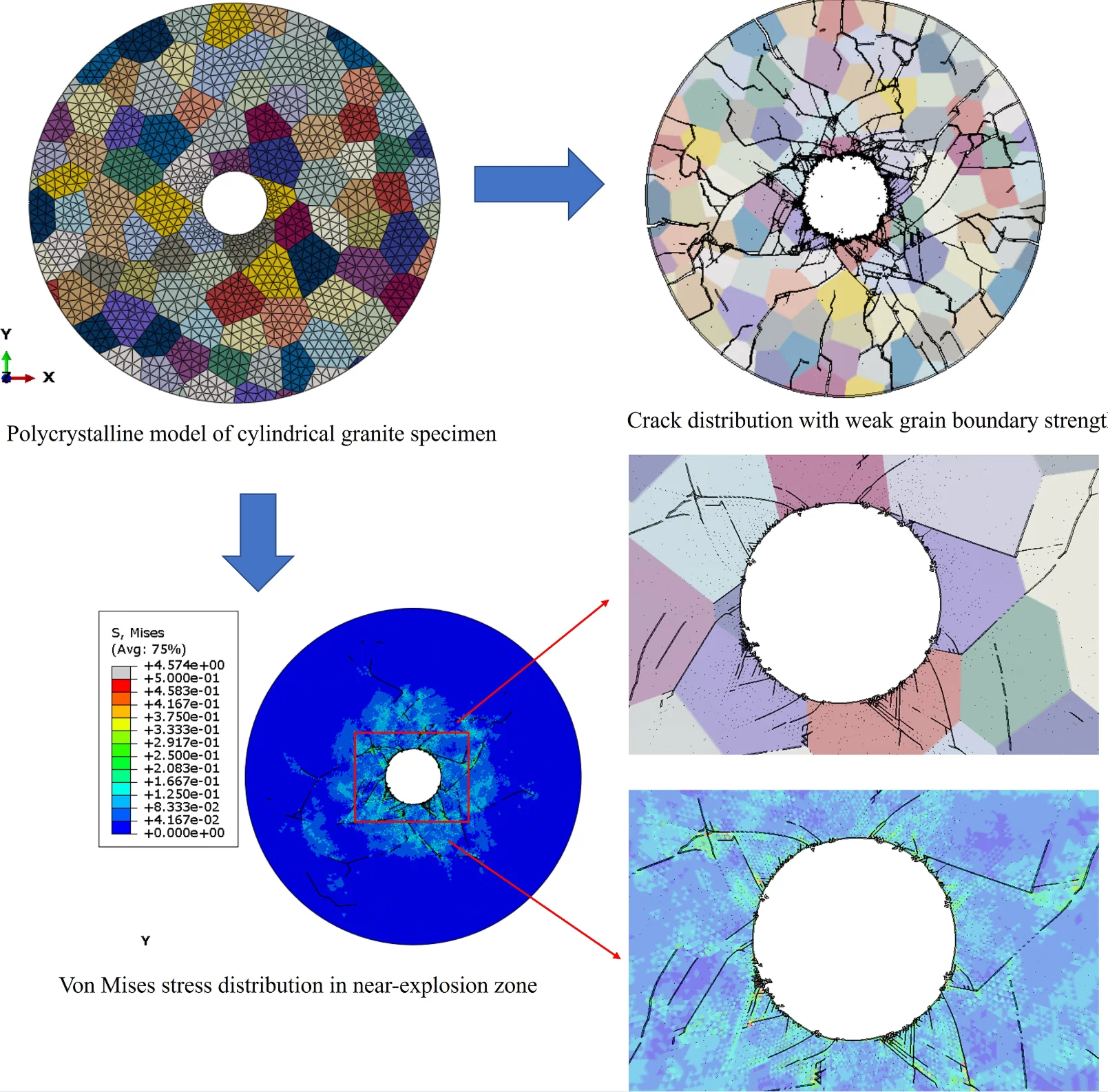
Highlights
- A multi-scale FDEM polycrystalline granite model with grain boundary effects is established using Neper and Abaqus. Intragranular and grain boundary cohesive elements are synchronously embedded to precisely capture granite meso-heterogeneity and dynamic fracture under ultra-small diameter blasting.
- Grain boundary strength dominates granite blasting fracture modes. With the reduction of grain boundary strength, rock failure evolves sequentially from transgranular fracture to mixed fracture and complete intergranular fracture.
- A chain-type dynamic failure mechanism is uncovered: blasting energy firstly transfers within mineral grains, then releases and dissipates at weak grain boundaries, resulting in anisotropic crack growth and unique blast vibration features.
- The proposed multi-scale numerical method achieves great consistency with lab blasting tests, providing solid theoretical and technical basis for blasting parameter optimization, rock fragmentation regulation and blast vibration prediction in precision blasting engineering.
1. Introduction
Finite-Discrete Element Method (FDEM) is a hybrid numerical approach that bridges macroscopic mechanical responses and microstructural evolution, enabling quantitative analysis of the progressive transition from local damage to global failure in crystalline geomaterials. It has become a mainstream tool for simulating the dynamic fracture and failure processes of granite under complex loading conditions. For instance, Li et al. [1] and Liu et al. [2] adopted FDEM to reproduce crack initiation, propagation, and sample failure of polycrystalline granite in uniaxial compression and Brazilian disc tests, verifying the capability of FDEM in capturing grain-scale mechanical behaviors.
Ultra-small diameter drilling and blasting (borehole diameter approximately 1 cm) is widely applied in laboratory blasting tests and precision rock fragmentation engineering. For phanerocrystalline granite, the borehole size is comparable to the mineral grain scale, making the microstructural heterogeneity and anisotropy dominated by crystal morphology and mineral composition dominant factors controlling blasting-induced dynamic responses, fracture evolution, and vibration characteristics [3-5]. However, conventional blasting simulations often treat granite as a homogeneous continuum, ignoring the grain-scale microstructural effects, which leads to large deviations in predicting crack propagation paths, dynamic stress distributions, and blast-induced vibration features.
Numerical simulation serves as a critical approach to reveal the dynamic mechanisms of rock blasting and has been extensively explored by scholars [6]. Han et al. [7], Wang & Li [8], and Wu et al. [9] implemented FDEM to model rock dynamic fracture under blasting and impact loads, focusing on macro-fracture patterns and damage distributions. Nevertheless, existing studies rarely couple grain boundary effects with multi-scale dynamic fracture evolution, and fail to characterize the micro-heterogeneity induced by crystal grains and grain boundaries during blasting. More importantly, the dynamic energy transfer, crack propagation kinetics, and vibration-related fracture responses under ultra-small borehole conditions – which are highly relevant to the scope of vibration and dynamics engineering – have not been fully revealed.
To fill the above gaps and align with the research scope of vibration, oscillation, and dynamics, this study proposes a multi-scale modeling method of blasting-induced fracture in polycrystalline granite with grain boundary effects based on FDEM. The core novelty of this work lies in three aspects: (1) Constructing a macro-micro multi-scale polycrystalline model that integrates rock macroscopic mechanical parameters and grain-scale mineral characteristics, realizing the accurate representation of granite micro-heterogeneity; (2) Realizing the synchronous insertion of intragranular and grain boundary cohesive elements, and quantifying the regulatory effect of grain boundary strength on blasting fracture modes and dynamic crack propagation; (3) Revealing the dynamic energy transfer mechanism and anisotropic fracture evolution law under ultra-small diameter blasting, providing a micro-mechanical basis for blast-induced vibration control and fragmentation optimization.
Through refined dynamic numerical analysis, this study clarifies the micro-damage evolution mechanism of hard rock under ultra-small borehole blasting, enhances the relevance of numerical modeling to vibration and dynamics engineering, and provides a theoretical and methodological support for the optimization of blasting parameters, vibration reduction, and precise rock breakage in engineering practice.
2. Methodology
2.1. Microscopic simulation method of granite crystal minerals
The mineral composition, content, and grain morphology of granite were determined via petrographic analysis, X-ray diffraction (XRD), and scanning electron microscopy (SEM). In this study, Barre Granite was adopted as the representative material [10]. Its main mineral components are feldspar and quartz, accounting for about 65 % and 35 %, respectively. Barre Granite is characterized by a fine-grained structure, with average grain sizes of approximately 1.25 mm for quartz and 1.0 mm for feldspar.
Fine-grained and coarse-grained granites share highly similar mineral composition, structural characteristics, and geological formation history; their primary difference lies in grain size and crystallization conditions [11]. Therefore, the grain size of Barre Granite was scaled up by a factor of four to represent medium-grained granite, giving average grain sizes of 5.0 mm for quartz and 4.0 mm for feldspar. This scaling method is reasonable because the mineralogical and textural properties remain consistent among different grain-size granite types, and only the crystallization kinetics differs. The scaling factor is also supported by empirical grain-size distribution statistics in granitic rocks [12].
The microstructural anisotropy of granite can be effectively represented by the Voronoi tessellation. The Voronoi diagram discretizes the mineral grains of granite into discrete seed points, and the generated polygonal network reasonably reflects the spatial distribution and contact mode of grains. It can well characterize the crack propagation path, mechanical behavior, and multi-field coupling response, making it widely used in microstructural analysis, fracture simulation, and engineering applications [13-15].
In this work, Neper software [16] was used to generate the polycrystalline microstructure of granite. The grain growth morphology was assigned to the cells, which provides a wider grain size distribution and higher grain sphericity than the standard Poisson–Voronoi tessellation. A square model with a side length of 50 mm was generated, containing 168 grains in total, including 109 feldspar grains and 59 quartz grains, as shown in Fig. 1(a). The geometric shape and mosaic structure of the generated grains are consistent with the actual granite section [3], as shown in Fig. 1(b).
Fig. 1Voronoi model of granite grains and cross-section of granite sample: a) Voronoi model with dimensions of 50 mm × 50 mm; b) cross-section of granite sample
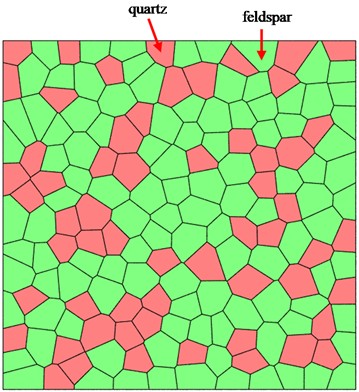
a)
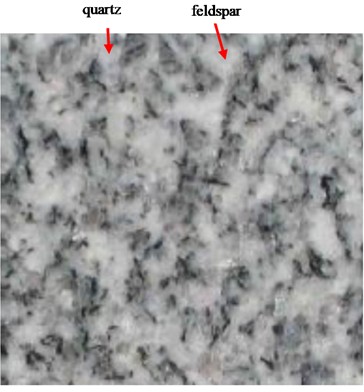
b)
2.2. Finite-discrete simulation method with inserted cohesive elements
To accurately reproduce the dynamic fracture process of granite subjected to blasting loads, cohesive elements must be inserted both within mineral grains and along grain boundaries simultaneously. Traditional numerical methods struggle to realize synchronous insertion of intragranular and grain boundary cohesive elements and realize local mesh refinement near the borehole, which restricts the accurate characterization of dynamic crack propagation and blasting vibration responses.
To overcome this limitation, Neper2CAE software [17] was used to convert the two-dimensional granite microstructure into a three-dimensional geometric model in Abaqus, completing the reconstruction of the polycrystalline numerical model (Fig. 2). The established Abaqus model retains complete grain set information, which provides a prerequisite for the targeted insertion of intragranular and grain boundary cohesive elements.
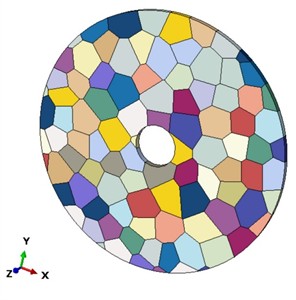
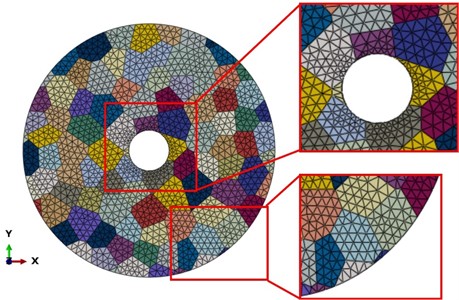
On this basis, the polycrystalline model was further cut and trimmed to obtain a cylindrical granite blasting model, as shown in Fig. 3(a). The inner bore diameter is 3.225 mm, the outer diameter of the cylinder is 20 mm, and the radial thickness is 16.775 mm. The model was meshed with 2989 six-node linear triangular prism elements (C3D6), as shown in Fig. 3(b). The element size near the borehole wall is refined to 0.5 mm and gradually transitions to 1 mm toward the outer boundary, which ensures computational accuracy and efficiency for dynamic blasting simulation.
Fig. 2Abaqus polycrystalline model and grain assembly
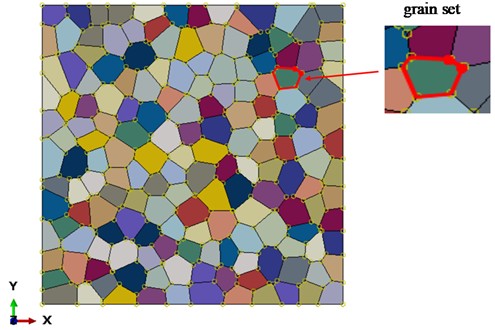
Fig. 3Polycrystalline model and mesh division of cylindrical granite specimen: a) polycrystalline model of cylindrical granite specimen; b) mesh division of blasted granite specimen model
a)
b)
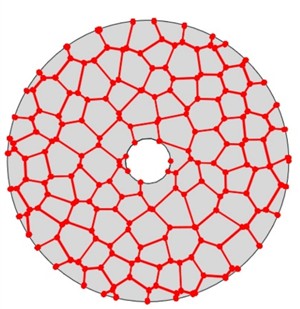
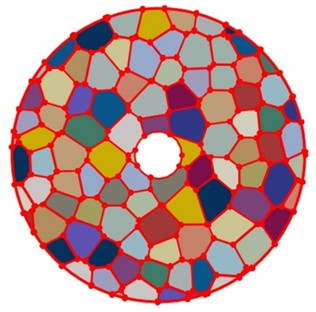
Fig. 4Cohesive sets of models: a) Sets of grain interface; b) whole sets of grains
a)
b)
A mesh convergence study was conducted with three density levels to verify numerical robustness. The baseline mesh (inner wall 0.5 mm, outer 1 mm) contains 2989 C3D6 elements. Compared with finer mesh (0.3/0.6 mm) and coarser mesh (0.7/1.4 mm), the baseline mesh yields stable results: the maximum principal stress difference is less than 1.8 % between medium and fine meshes, and crack initiation positions remain consistent. The coarse mesh causes an 8.3 % deviation in peak stress and distorts crack paths at grain boundaries. The minimum element size of 0.5 mm (about 15.5 % of the borehole diameter) effectively maintains the circular borehole shape and matches the grain size characteristics (quartz 5.0 mm, feldspar 4.0 mm). This mesh density (4-10 elements per grain) achieves the best balance between geometric fidelity, dynamic response resolution, and computational efficiency.
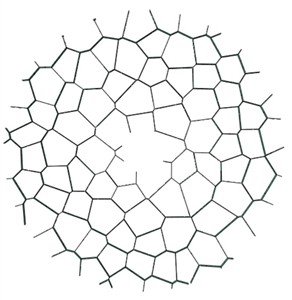
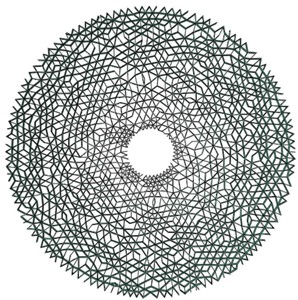
In the Abaqus Part module, two key sets were established: a grain interface set and a full grain set, as shown in Figs. 4(a-b). Using the Cohesive Insertion V4.1 plugin with the Special Set function, cohesive elements were generated separately for grain boundaries and intragranular interfaces, as shown in Figs. 5(a-b), respectively. This synchronous insertion strategy enables independent parameter assignment and accurate characterization of intragranular fracture and intergranular fracture under dynamic blasting loads.
Fig. 5Cohesive elements at grain boundaries and intragranular regions: a) grain boundary cohesive elements; b) intragranular cohesive elements
a)
b)
The traction-separation constitutive model was adopted to describe the mechanical behavior of cohesive elements, which is characterized by initial linear elasticity followed by damage initiation and evolution. for simulating blasting-induced progressive failure, the Maximum Nominal Stress Criterion (MAXS) [18] was used, as it can reliably capture tensile-shear mixed failure dominated by stress waves under blasting dynamics.
The MAXS criterion is defined as Eq. (1):
where , , and represent normal and tangential stress components, and , , are corresponding critical strengths. Damage initiates when the ratio reaches 1. This criterion is suitable for dynamic rock fracture because it independently evaluates stress components, highlights tensile failure dominated by blast stress waves, and ensures high computational efficiency for dynamic simulation.
Cohesive element parameters and rock mechanical parameters were taken from Liu et al. (2025) [2], as listed in Table 1.
To apply dynamic blasting loads, PETN (pentaerythritol tetranitrate) explosive was adopted [19], with key Jones-Wilkins-Lee (JWL) equation-of-state parameters given in Table 2. The initial explosion pressure was set to 1.6 GPa. a pressure-time curve consistent with the JWL equation was applied as the borehole boundary condition to realistically reproduce the dynamic evolution of blasting pressure. The total simulation time was 0.032 ms, which sufficiently captures the dynamic response and early-stage crack propagation of granite under ultra-small diameter blasting.
Table 1Cohesive element mechanical properties
Parameter | Value | |
Elastic-coupled traction | (Pa) | 3.00E+10 |
(Pa) | 3.00E+10 | |
(Pa) | 3.00E+10 | |
Maxs damage | (Pa) | 2.00E+07 |
(Pa) | 4.00E+07 | |
(Pa) | 4.00E+07 | |
(J/m2) | 5.00E-01 | |
(J/m2) | 5.00E-01 | |
(J/m2) | 5.00E-01 |
Table 2JWL EOS parameters for PETN
Density | Unit | Value |
Parameter | Pa | 5.86E+11 |
Parameter | Pa | 2.16E+10 |
Parameter | 5.81 | |
Parameter | 1.77 | |
Parameter | 0.282 | |
pressure | Pa | 1.60E+10 |
detonation velocity | m/s | 6690 |
energy per volume | Pa | 7.38E+09 |
Reference density | kg/m3 | 1320 |
3. Results and discussion
3.1. Influence of crystal microstructure on blasting dynamic responses and fracture characteristics
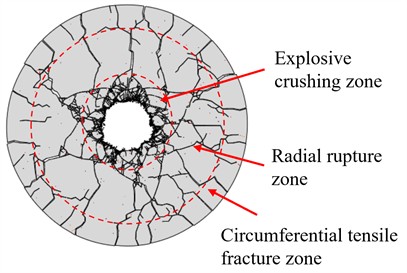
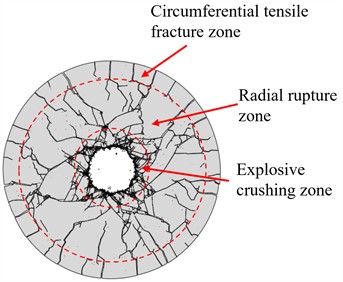
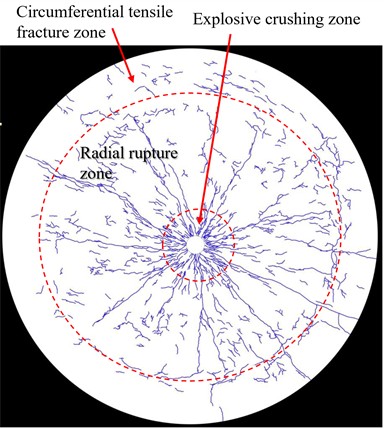
The numerical results in this study show good qualitative agreement with laboratory blasting test observations. The simulated failure zones include a crushing zone near the explosive source, a radial fracture zone in the middle region, and an outer circumferential tensile fracture zone induced by reflected stress waves, as presented in Figs. 6(a-c). Although direct quantitative comparison is limited by experimental measurement accuracy and material variability, the overall failure morphology is consistent with physical test results [3].
Compared with the homogeneous continuum model, the polycrystalline granite model exhibits obvious non-uniformity and anisotropic characteristics in crack propagation, which can better reflect the real dynamic fracture behavior of granite under blasting. This qualitative verification method is consistent with previous studies [20, 21] that focus on fracture pattern consistency under dynamic loading.
Fig. 6Crack propagation and granite blasting test results: a) crack propagation diagram of the amorphous model; b) crack propagation diagram of the polycrystalline model; c) results of granite blasting test
a)
b)
c)
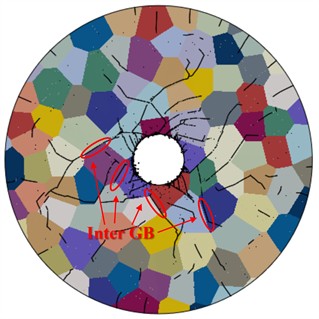
In the polycrystalline model, initial cracks can initiate both inside grains and at grain boundaries [22, 23]. Even if identical mechanical parameters are assigned to intragranular and grain-boundary cohesive elements, a large number of intergranular cracks still occur. This indicates that crack propagation is significantly controlled by grain morphology and shows strong dynamic anisotropy, as illustrated in Fig. 7(a).
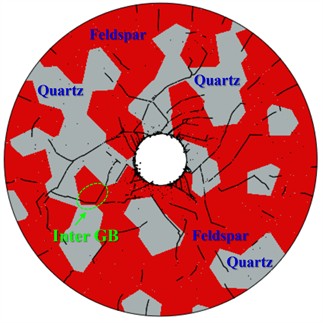
In addition, blast-driven cracks pass through adjacent quartz and feldspar grains without obvious obstruction (Fig. 7(b)). This phenomenon reveals that the difference in mineral mechanical properties has limited influence on crack evolution under blasting dynamics. in other words, the mechanical parameters of cohesive elements play a more dominant role in controlling dynamic crack propagation paths than the bulk properties of mineral grains in the FDEM model.
Fig. 7Crack distribution and mineral distribution in polycrystalline model: a) crack distribution in the polycrystalline model during blast wave propagation; b) mineral distribution in the polycrystalline fracture model
a)
b)
3.2. Influence of grain boundary strength on dynamic fracture type under blasting
A parametric study was carried out to investigate the dynamic fracture mode transition regulated by grain boundary strength in granite under blasting load. Three groups of cohesive element parameters were designed to represent different grain boundary strengths, while the intragranular parameters remained unchanged.
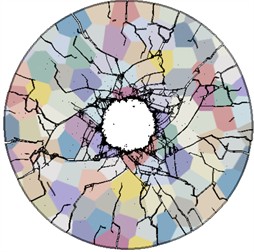
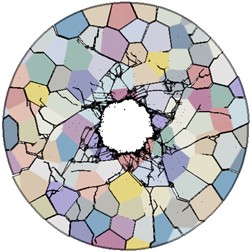
In the baseline case, identical strength parameters were applied to both intragranular and grain boundary cohesive elements (30 MPa, 60 MPa, 60 MPa). the results show that transgranular fracture dominates the failure pattern, with cracks propagating directly through mineral grains and only local intergranular cracking occurring at individual boundaries (Fig. 8(a)).
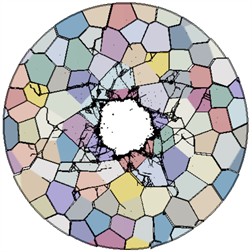
When grain boundary strength is moderately reduced (25 MPa, 55 MPa, 55 MPa), intergranular fracture increases noticeably. Cracks tend to propagate along relatively weak grain boundaries, forming a mixed transgranular-intergranular failure mode (Fig. 8(b)).
When grain boundary strength is further decreased to approximately two-thirds of the original level (20 MPa, 40 MPa, 40 MPa), the failure mode changes significantly. The rock mass is dominated by intergranular fracture, with cracks extensively developing and extending along grain boundaries (Fig. 8(c)).
These results demonstrate that grain boundary strength serves as a key controlling parameter for determining the dominant fracture type under dynamic blasting load. With decreasing grain boundary strength, the failure mode gradually transforms from transgranular fracture to mixed fracture and finally to intergranular fracture, which directly affects the dynamic energy dissipation, crack propagation path and blasting-induced fracture characteristics of granite.
Fig. 8Crack distribution under different grain boundary strengths: a) crack distribution with grain boundary strength tn= 30 MPa, ts= 60 MPa, tt= 60 MPa; b) crack distribution with grain boundary strength tn= 25 MPa, ts= 55, tt= 55; c) crack distribution with grain boundary strength tn= 20 MPa, ts= 40 MPa, tt= 40 MPa
a)
b)
c)
3.3. Dynamic stress transfer and crack initiation in the near-borehole region
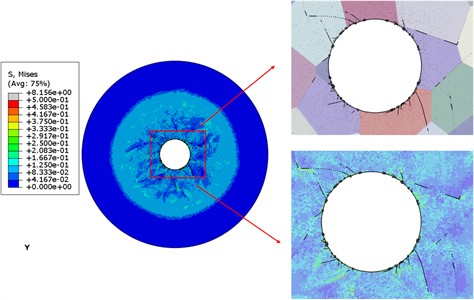
Dynamic stress distribution and energy transfer near the ultra-small borehole are critical to understanding the blasting-induced fracture mechanism. at the early stage of blasting ( 3.4 µs), the ultra-small borehole causes severe stress concentration within the mineral grains immediately surrounding the explosive. To accurately characterize the complex dynamic stress state under blast loading, the Von Mises equivalent stress () is adopted as the evaluation indicator, since it comprehensively reflects the combined effect of normal and shear stresses under dynamic conditions.
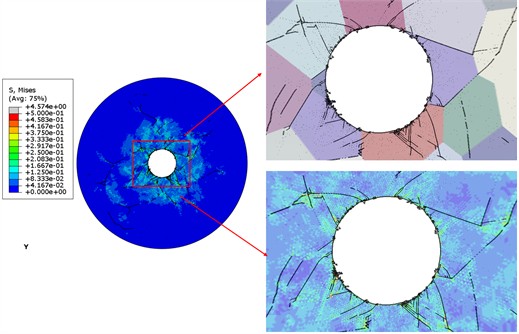
As shown in the Von Mises contour (Fig. 9(a)), widespread intragranular cohesive cracks initiate inside the highly stressed grains near the borehole wall. at the later moment 7.3 µs, significant stress concentration zones appear at partial grain boundaries, where the Von Mises stress can reach up to 200 MPa (Fig. 9(b)). These high-stress regions coincide exactly with the initiation sites of new grain-boundary cracks and the tips of propagating cracks, revealing the key role of dynamic stress redistribution in controlling crack initiation and propagation.
This phenomenon indicates that under moderate grain boundary strength, the blast energy is first transmitted intragranularly in the near-field, and then released and dissipated at the weaker grain boundaries. Such a mechanism forms a typical chain-type dynamic failure path: intragranular energy transfer to grain boundary fracture, which dominates the anisotropic fracture evolution and energy dissipation characteristics of granite under ultra-small diameter blasting.
Fig. 9Von Mises stress distribution in near-explosion zone: a): Von Mises stress distribution contour plot of the near-explosion zone at t= 3.4 µs, illustrating element-averaged stress magnitudes within the range of 0-200 MPa. the color gradient from blue (low stress) to red (high stress) indicates the intensity of the equivalent stress state; b): Von Mises stress distribution contour plot of the near-explosion zone at t= 7.3 µs, also illustrating element-averaged stress magnitudes within the same range. High-stress zones (red regions) align with crack initiation sites at grain boundaries
a)
b)
4. Discussion
4.1. Mechanisms of anisotropic dynamic crack propagation
The anisotropic and non-uniform dynamic crack propagation observed in the polycrystalline model (Section 3.1) originates from the inherent meso-heterogeneity of mineral grains and grain boundaries. Grain boundaries naturally act as weak planes with distinct mechanical properties (strength, fracture energy) compared with the intragranular crystal lattice [22, 23]. When a blast-induced stress wave or crack front impinges on a grain boundary under dynamic loading, several typical responses may occur: crack arrest, deflection, transmission across the boundary, or new crack initiation along the boundary itself.
The final propagation behavior is jointly governed by the boundary orientation relative to the principal stress, the strength contrast between grain interior and boundary, and the local dynamic stress state. The present numerical results confirm that the properties of cohesive elements assigned at grain interfaces play a more decisive role in dynamic crack propagation paths than the bulk mechanical properties of mineral grains, which is consistent with the fundamental understandings in computational dynamic fracture mechanics.
This mechanism explains the significant anisotropic fracture characteristics in polycrystalline granite under ultra-small borehole blasting, and provides a micro-scale theoretical basis for analyzing the dynamic stress wave propagation, crack evolution, and blast-induced vibration responses from a mesoscopic viewpoint.
4.2. The role of grain boundary strength in dynamic energy dissipation and fracture path
The parametric analysis on grain boundary strength (Section 3.2) clearly demonstrates that this parameter dominates the dynamic fracture mode and energy dissipation behavior of granite under blasting. The transition from transgranular to intergranular failure with decreasing grain boundary strength is physically consistent and mechanically reasonable.
Stronger grain boundaries force dynamic cracks to propagate through mineral grains, while weaker boundaries provide preferential paths for crack growth and induce interfacial debonding along grain boundaries.
This difference significantly affects dynamic energy dissipation during blasting. Transgranular fracture typically dissipates more energy due to the breaking of strong intragranular crystal bonds. in contrast, intergranular fracture along weak boundaries represents a more energy-efficient failure mode under dynamic loading.
The chain-type dynamic failure path revealed in Section 3.3 further highlights this energy transfer mechanism: blast energy is first absorbed and transferred inside grains near the explosion source, then released efficiently by fracturing weaker grain boundaries.
This energy transfer and dissipation routine directly determines the dynamic fragmentation efficiency, crack distribution, and blast-induced vibration characteristics of granite under ultra-small diameter blasting. It also provides a mesoscopic mechanism for understanding and regulating the dynamic fracture behavior and vibration response in polycrystalline rock blasting.
4.3. Implications for dynamic blasting mechanics and engineering practice of ultra-small diameter boreholes
The multi-scale FDEM model established in this study, which considers explicit grain microstructure and distinguished grain boundary properties, provides an effective tool for revealing the dynamic micromechanics of ultra-small diameter blasting in crystalline granite. The sensitive response of fracture mode to grain boundary strength indicates that the mineral composition, microstructure, and especially grain boundary characteristics of actual granite will significantly affect its dynamic blasting response and vibration generation mechanism. This understanding breaks through the traditional assumption that rock is a homogeneous continuum.
For engineering applications including rock fragmentation, blasting vibration control, and dynamic disaster prevention, the main implications are as follows:
1) Blasting parameter optimization. Clarifying the dominant fracture mode controlled by grain boundary strength can help optimize explosive type, charge concentration, and initiation timing. by promoting a favorable energy dissipation path, it is possible to achieve expected fragmentation quality and simultaneously reduce unfavorable blast-induced vibration.
2) Blast-induced vibration control. The anisotropic crack propagation and the interaction between stress waves and microstructure directly affect the amplitude, frequency distribution and propagation law of blasting vibration. the multi-scale dynamic model proposed in this study can improve the prediction accuracy of blasting vibration and provide a theoretical basis for vibration reduction design.
3) Dynamic rock characterization. The key role of grain boundary properties highlights the necessity of using advanced microscopic testing methods to obtain key meso-parameters for specific rock masses, so as to realize more accurate dynamic fracture and vibration response prediction.
This study shows that incorporating grain boundary effects into multi-scale dynamic modeling is crucial for revealing the micro-mechanism of granite blasting, and provides a reliable method for dynamic response analysis, vibration prediction and parameter optimization of ultra-small diameter blasting in engineering practice.
5. Conclusions
This study proposes a multi-scale FDEM modeling method for blasting-induced fracture in polycrystalline granite with grain boundary effects, aiming to accurately capture the mesoscopic heterogeneity and dynamic fracture responses of granite under ultra-small diameter borehole blasting. by integrating macro-micro multi-scale coupling, a polycrystalline model that reflects the real heterogeneity of granite is established, providing a new approach for revealing the dynamic damage and vibration generation mechanism of hard rock under blasting. The main conclusions are as follows:
1) The numerical results are in good agreement with laboratory blasting tests. The simulated failure includes a crushing zone, a radial fracture zone, and a circumferential tensile fracture zone, which verifies the effectiveness of the proposed method. Compared with the homogeneous model, the polycrystalline model shows obvious non-uniformity and dynamic anisotropy in crack propagation, which can better characterize the real dynamic fracture behavior of granite.
2) Grain boundary strength significantly regulates the dynamic fracture mode of granite under blasting. When grain boundary strength is equal to intragranular strength, transgranular fracture is dominant. As grain boundary strength decreases, the proportion of intergranular fracture gradually increases. When grain boundary strength is reduced by about one-third, the rock failure is dominated by intergranular fracture.
3) Near-borehole dynamic stress analysis shows that under moderate grain boundary strength, blasting energy is first transferred intragranularly and then released and dissipated at weak grain boundaries, forming a typical chain-type dynamic failure path: intragranular energy transfer to grain boundary fracture, which dominates the anisotropic fracture evolution and energy dissipation characteristics.
This study reveals the micro-dynamic mechanism of granite damage evolution under ultra-small diameter blasting from the mesoscale, and provides a reliable theoretical and methodological support for rock mass damage prediction, blasting parameter optimization, and blast-induced vibration control in precision blasting engineering. The proposed multi-scale dynamic modeling framework can effectively make up for the shortage of traditional methods in capturing micro-mechanical effects and anisotropic vibration responses, and has important reference value for dynamic fracture and vibration-related research of crystalline rocks.
References
-
X. F. Li, H. B. Li, and J. Zhao, “Transgranular fracturing of crystalline rocks and its influence on rock strengths: insights from a grain-scale continuum-discontinuum approach,” Computer Methods in Applied Mechanics and Engineering, Vol. 373, p. 113462, Jan. 2021, https://doi.org/10.1016/j.cma.2020.113462
-
W. Liu, H. Deng, X. Zhu, Y. Lv, and Y. Luo, “The rock cutting simulation of heterogeneous granite using FDEM method,” Petroleum, Vol. 11, No. 1, pp. 1–12, Feb. 2025, https://doi.org/10.1016/j.petlm.2023.04.002
-
M. M. Dehghan Banadaki, “Stress-wave induced fracture in rock due to explosive action,” University of Toronto, Canada, 2010.
-
C. Ding, R. Yang, Z. Lei, C. Chen, and C. Zheng, “Experimental study on blasting energy distribution and utilization efficiency using water jet test,” Energies, Vol. 13, No. 20, p. 5340, Oct. 2020, https://doi.org/10.3390/en13205340
-
Z. Wang, H. Wang, J. Wang, and N. Tian, “Finite element analyses of constitutive models performance in the simulation of blast-induced rock cracks,” Computers and Geotechnics, Vol. 135, p. 104172, Jul. 2021, https://doi.org/10.1016/j.compgeo.2021.104172
-
M. Kamran, H. Liu, D. Fukuda, P. Jia, G. Min, and A. Chan, “State-of-the-art review and prospect of modelling the dynamic fracture of rocks under impact loads and application in blasting,” Geosciences, Vol. 15, No. 8, p. 314, Aug. 2025, https://doi.org/10.3390/geosciences15080314
-
H. Han et al., “FDEM simulation of rock damage evolution induced by contour blasting in the bench of tunnel at deep depth,” Tunnelling and Underground Space Technology, Vol. 103, p. 103495, Sep. 2020, https://doi.org/10.1016/j.tust.2020.103495
-
B. Wang and H. Li, “Contribution of detonation gas to fracturing reach in rock blasting: insights from the combined finite-discrete element method,” Computational Particle Mechanics, Vol. 11, No. 2, pp. 657–673, Apr. 2024, https://doi.org/10.1007/s40571-023-00645-3
-
D. Wu, H. Li, D. Fukuda, and H. Liu, “Development of a finite-discrete element method with finite-strain elasto-plasticity and cohesive zone models for simulating the dynamic fracture of rocks,” Computers and Geotechnics, Vol. 156, p. 105271, Apr. 2023, https://doi.org/10.1016/j.compgeo.2023.105271
-
M. H. B. Nasseri and B. Mohanty, “Fracture toughness anisotropy in granitic rocks,” International Journal of Rock Mechanics and Mining Sciences, Vol. 45, No. 2, pp. 167–193, Feb. 2008, https://doi.org/10.1016/j.ijrmms.2007.04.005
-
J. P. Hogan, M. C. Gilbert, and J. D. Price, “Crystallisation of fine – and coarse-grained A-type granite sheets of the Southern Oklahoma Aulacogen, U.S.A,” in the Fourth Hutton Symposium on the Origin of Granites and Related Rocks, Vol. 91, Geological Society of America, 2000, pp. 139–150, https://doi.org/10.1130/0-8137-2350-7.139
-
R. H. Vernon, a practical guide to rock microstructure. Cambridge: Cambridge University Press, 2018, https://doi.org/10.1017/9781108654609
-
F. Amiri, N. Bahrani, A. Lisjak, O. Mahabadi, J. Ha, and Y. Li, “Influence of unloading-induced brittle damage on laboratory properties and behavior of hard rocks: insights from the hybrid Finite-Discrete Element Method (FDEM),” Computers and Geotechnics, Vol. 176, p. 106766, Dec. 2024, https://doi.org/10.1016/j.compgeo.2024.106766
-
X. Hu et al., “Modeling crack propagation in heterogeneous granite using grain-based phase field method,” Theoretical and Applied Fracture Mechanics, Vol. 117, p. 103203, Feb. 2022, https://doi.org/10.1016/j.tafmec.2021.103203
-
J.-C. Zhang and J.-M. Chen, “An anisotropic weighted Voronoi method for mesostructure reconstruction in rock materials and its application to Brazilian test simulations,” Computational Particle Mechanics, Vol. 12, No. 6, pp. 5007–5024, Dec. 2025, https://doi.org/10.1007/s40571-025-00978-1
-
R. Quey, P. R. Dawson, and F. Barbe, “Large-scale 3D random polycrystals for the finite element method: generation, meshing and remeshing,” Computer Methods in Applied Mechanics and Engineering, Vol. 200, No. 17-20, pp. 1729–1745, Apr. 2011, https://doi.org/10.1016/j.cma.2011.01.002
-
N. Grilli, E. Tarleton, and A. C. F. Cocks, “Neper2CAE and PyCiGen: scripts to generate polycrystals and interface elements in Abaqus,” SoftwareX, Vol. 13, p. 100651, Jan. 2021, https://doi.org/10.1016/j.softx.2020.100651
-
W. Li et al., “Numerical simulation of fracture patterns in roof strata with different thicknesses,” Scientific Reports, Vol. 14, No. 1, p. 28899, Nov. 2024, https://doi.org/10.1038/s41598-024-80478-z
-
M. M. Dehghan Banadaki and B. Mohanty, “Numerical simulation of stress wave induced fractures in rock,” International Journal of Impact Engineering, Vol. 40-41, pp. 16–25, Feb. 2012, https://doi.org/10.1016/j.ijimpeng.2011.08.010
-
J. Kan et al., “Effect of initiation pattern on rock damage and blasting seismic under multi-hole blasting,” Geomatics, Natural Hazards and Risk, Vol. 14, No. 1, p. 21923, Dec. 2023, https://doi.org/10.1080/19475705.2023.2192334
-
L. X. Xie, W. B. Lu, Q. B. Zhang, Q. H. Jiang, M. Chen, and J. Zhao, “Analysis of damage mechanisms and optimization of cut blasting design under high in-situ stresses,” Tunnelling and Underground Space Technology, Vol. 66, pp. 19–33, Jun. 2017, https://doi.org/10.1016/j.tust.2017.03.009
-
Z. Cui, J. Zhang, P. G. Ranjith, and X. Li, “Crystallographic constraints on microcrack dynamics in granite: insights from in-situ microscopic characterization of crack network propagation,” International Journal of Rock Mechanics and Mining Sciences, Vol. 195, p. 106278, Nov. 2025, https://doi.org/10.1016/j.ijrmms.2025.106278
-
J. Guo, G. Li, and F. Ma, “Experimental characterization and grain-based numerical modeling of multiscale fracture mechanisms in pre-fractured granite,” Scientific Reports, Vol. 15, No. 1, p. 26240, Jul. 2025, https://doi.org/10.1038/s41598-025-12159-4
About this article

The authors have not disclosed any funding.
The datasets generated during and/or analyzed during the current study are available from the corresponding author on reasonable request.
Jian Wang was responsible for writing the text; Shudong Zhou was responsible for collecting data and organizing images; Wenyuan Zhang was responsible for on-site testing; and Weijia Li was responsible for polishing the text.
The authors declare that they have no conflict of interest.

