Abstract
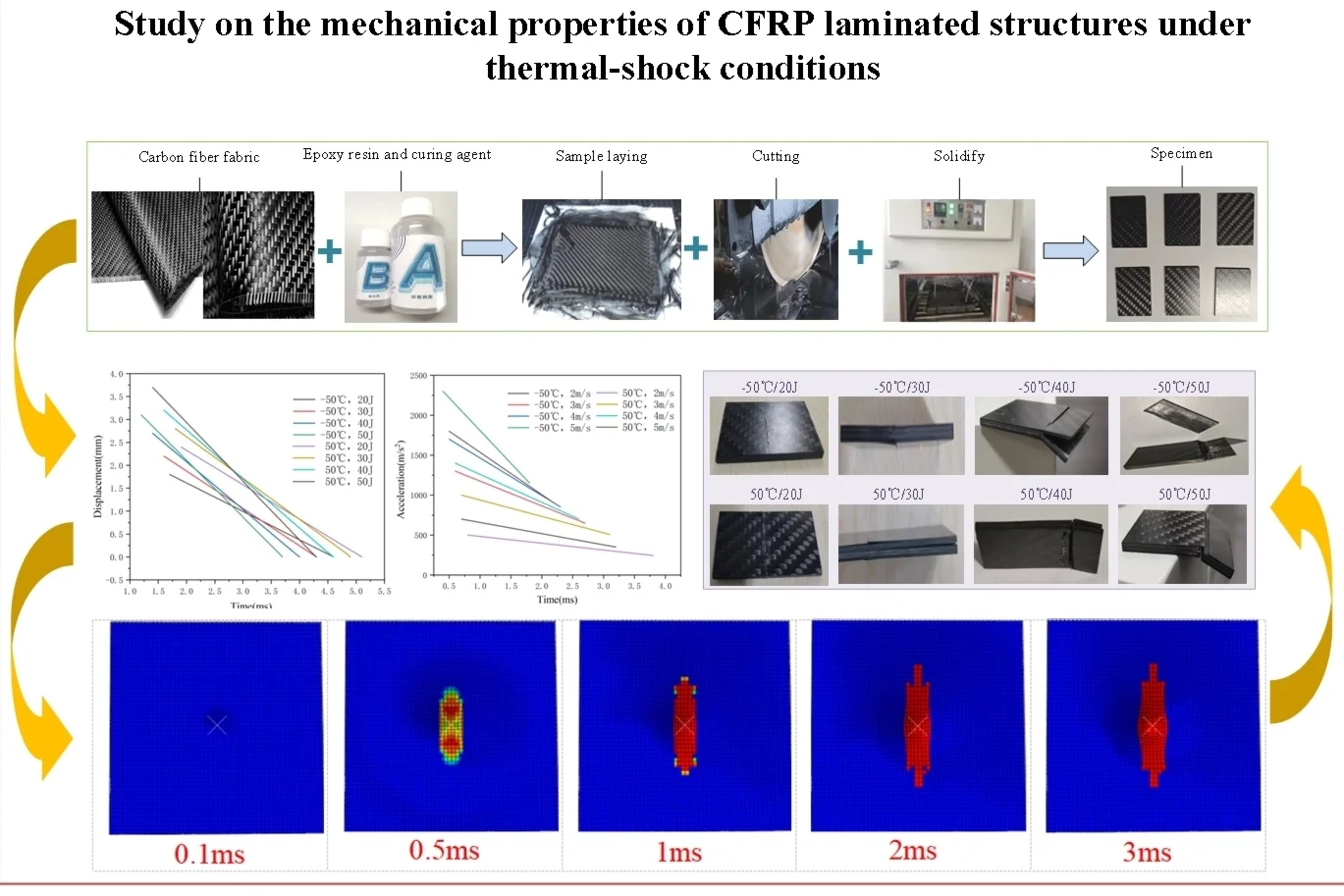
This study investigates the mechanical properties and dynamic damage characteristics of CFRP laminates under coupled thermal and impact loads. Through thermal environment simulation, impact loading, and multidimensional data acquisition, experimental data on velocity, acceleration, stress-strain, and energy absorption were obtained. The results show that the heat-impact coupling effect significantly degrades the material’s mechanical performance. This study provides a research foundation for enhancing the structural performance of CFRP under thermal shock, and lays a scientific basis for its engineering application under complex service conditions.
Highlights
- Revealing that thermal shock coupling significantly reduces the mechanical properties of CFRP.
- Establish multidimensional experimental data (velocity, acceleration, stress-strain, energy).
- Provide scientific basis for the application of CFRP engineering under complex working conditions.
1. Introduction
Carbon fiber reinforced polymer (CFRP) is a lightweight and high-strength material with carbon fibers and their products as the reinforcement and resin as the matrix, which is widely used in various fields such as aerospace and new energy vehicles. With technological development, research on its properties has become increasingly in-depth, and improving its durability and reliability under specific application environments remains a research focus. Temperature and impact can affect the interfacial properties of fiber and matrix in composite laminate structures, leading to microcracks and delamination, thereby degrading material properties [1]. Han et al. [2] explored the low-temperature impact resistance of engineering geopolymer composites (EGC); Choudhury et al. [3] evaluated the performance of glass fiber reinforced polymer (GFRP) at different temperatures. Mu et al. [4], Zhu et al. [5], Swart et al. [6], and Zhou et al. [7] studied the mechanical properties, dynamic response, and impact behavior of different composites at different temperatures, respectively. The results indicate that temperature has a significant impact on the properties of composites, and some studies have established failure models considering temperature effects [8, 9]. Impact energy also has a significant impact on the mechanical properties of composites. Bhudolia et al. [10] analyzed energy conversion and dissipation under low-velocity impact, Yudhanto et al. [11] studied the impact energy-time curve, and Habibi [12] explored the relationship between impact energy and residual tensile strength.
In summary, studying the mechanical property variation and dynamic damage characteristics of CFRP laminated structures under thermal-shock coupling effects holds significant importance. This paper aims to explore the response patterns of their mechanical properties through experimental research, phenomenon analysis, and summarization, providing a basis for material optimization design and performance prediction.
2. Experiment overview
2.1. Experiment piece preparation and working condition design
CFRP specimens were prepared using the hot pressing process, with dimensions of 40mm x 30 mm. The carbon fiber woven material used for specimen preparation was designated as T300, with a diameter tolerance of ±0.3 micrometers. The material parameters are listed in Table 1. The main process for specimen preparation is shown in Fig. 1.
In this study, high-performance epoxy resin was selected as the matrix material. Given its characteristics of gel time at room temperature of approximately 3.5 hours and optimal curing temperature range of 130 °C to 145 °C, a self-made heating plate and stirring rod device were utilized to measure the gel time through constant temperature heating and continuous stirring. Additionally, a polarizing microscope was employed to observe the optical properties of the samples under different temperature fields, in order to clarify the curing process parameters.
This experiment primarily employs an orthogonal experimental design, supplemented by single-factor and uniform experiments. The design variables for the experimental conditions include temperature (–50 ℃/50 ℃), impact energy (20 J/30 J/40 J/50 J), and impact velocity (2 m/s, 3 m/s, 4 m/s, 5 m/s).
Table 1Material parameters
Density | Tensile strength | Tensile modulus | Shear strength | Flexural strength | Poisson’s ratio |
1.76 g/cm3 | 3530 MPa | 230 GPa | 110 MPa | 1300 MPa | 0.3 |
Fig. 1Preparation process of specimens. Photo by Fengfeng Wang, Material Forming Lab of Nanjing University of Science and Technology, 2024

2.2. Simulation of test conditions and test process
The low-temperature environment simulation involves placing the test sample in a low-temperature chamber and programmatically cooling it to –50 ℃, maintaining the temperature for more than 60 minutes, measuring the temperature at intervals of 5 minutes to verify the uniformity and stability of the temperature field, and finally returning the temperature to room temperature. The high-temperature environment simulation involves placing the test sample in a high-temperature chamber heated by resistance wires, heating it at 2 ℃/min to 50 ℃, maintaining the temperature for 15 minutes, allowing the test sample to stand for more than 30 minutes, and monitoring the uniformity of the temperature field using multi-point temperature measurement.
Fig. 2Experimental process. Photo by Fengfeng Wang, Composite Material Testing Lab of Jingling Institute of Technology, 2025
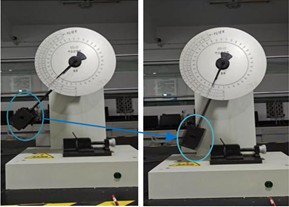
a) Impact process
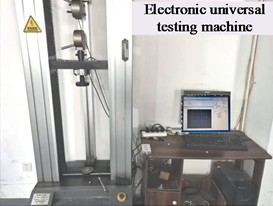
b) Mechanical property testing
An impact load is applied to the test sample using a pendulum impact testing machine. By adjusting the mass and drop height of the hammer, an impact energy of 20-50 J is obtained. An electromagnetic release device is used to precisely control the impact velocity within 2-5 m/s. The system error of the testing machine is calibrated by comparing theoretical calculations with actual sensor measurements, ensuring the force measurement error is controlled within ±2 %. The testing process is illustrated in Fig. 2.
Mechanical properties of CFRP laminated structures were tested using an electronic universal testing machine. After systematically organizing the test data, a stress-strain relationship model for the material was established, based on which key mechanical parameters such as elastic modulus and yield strength were calculated. For acceleration and displacement response data, signal processing techniques such as Fourier transform were applied to present the dynamic response of the material under impact loading.
3. Result analysis
3.1. Mechanical response
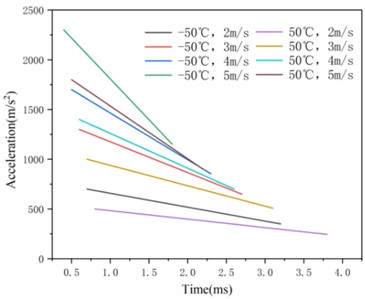
Based on the comprehensive experimental data, after eliminating invalid values and taking the average of each operating condition, the displacement and acceleration responses obtained are shown in Fig. 3.
Fig. 3Mechanical response
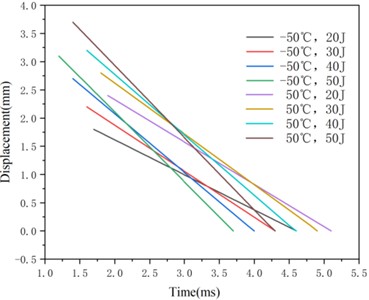
a) Displacement response
b) Acceleration response
As can be seen from Fig. 3, at the same temperature, as the impact energy increases, the displacement also increases, reflecting that the impact failure of CFRP is a process of energy absorption and deformation development: at low energy, elastic deformation predominates, with small displacement; at high energy, the proportion of plastic deformation increases, and the displacement increases. Under the same impact energy, the displacement at low temperature conditions is significantly lower than that at high temperature conditions, indicating that low temperature can enhance the elastic modulus and deformation resistance of CFRP, while high temperature can lead to a decrease in its stiffness. The acceleration rises to a peak and then decays, and its peak value is positively correlated with the impact velocity. The greater the impact velocity, the greater the acceleration, indicating that increasing the speed will increase the impact energy absorbed by the material per unit time, allowing it to withstand greater loads. Under the same impact velocity, the lower the temperature, the greater the acceleration and the rate of decay.
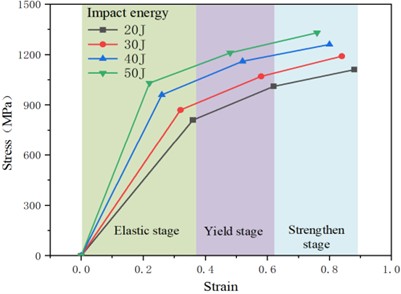
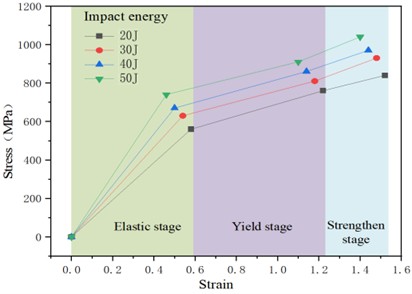
Ignoring the detailed changes near the yield point, the stress-strain relationship of the CFRP laminated structure under different temperature conditions and combinations of impact parameters is shown in Fig. 4 for specimens tested at –50 ℃ and 50 ℃.
As can be seen from Fig. 4, under –50 ℃ conditions, the slope of the stress-strain curve during the elastic deformation stage of the CFRP laminated structure is the largest. As the impact energy increases, the stress increases, the strain decreases, and the deformation process accelerates. Under high impact energy, the dynamic load transfer is stronger. Combined with the high stiffness characteristic, the stress increases significantly, while the matrix loses its plastic deformation space, resulting in a smaller strain. At the same time, the material mainly undergoes brittle failure characterized by matrix cracking and interfacial debonding, with concentrated energy release leading to an accelerated deformation process. Under 50 ℃ conditions, the plasticity of the resin matrix increases, and the stress increases very slowly during the yield stage, with the smallest slope of the curve. In the strengthening stage, the fibers become the main load-bearing carriers, and their high strength limits the development of strain, resulting in minimal strain changes.
Fig. 4Stress-strain relationship
a) –50 ℃ operating condition
b) 50 ℃ operating condition
3.2. Strength and toughness
To further evaluate the performance of CFRP laminated structures, the material strength and toughness are reflected through elastic modulus and energy absorption, respectively. The elastic modulus results of CFRP obtained from the test are shown in Fig. 5, and the energy absorption situation is shown in Fig. 6.
Fig. 5Elastic modulus
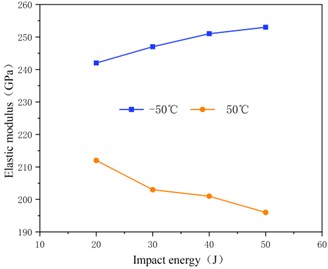
Fig. 6Energy absorption
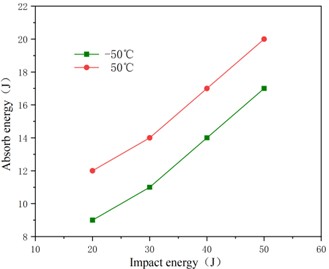
As can be seen from Fig. 5 and 6, the elastic modulus and energy absorption performance of CFRP materials exhibit specific patterns as temperature conditions and impact energy vary. The core reason lies in the synergistic effect of temperature and impact energy on the internal structure of the material. At low temperatures, impact energy enhances the microstructure, leading to an increase in elastic modulus but with diminishing increments. At high temperatures, energy disrupts the structure, causing a decrease in elastic modulus. Therefore, at the same energy level, the modulus is higher at low temperatures. At the same energy level, higher temperatures promote greater deformation and energy distribution, resulting in better energy absorption. When temperatures are the same, the greater the energy, the more active the damage and dissipation, leading to more energy absorption.
3.3. Damage morphology
The visual inspection method was employed to record the surface damage characteristics of the specimens, encompassing macroscopic defects such as crack geometry, deformation, and breakage. The damage morphologies under various working conditions are illustrated in Fig. 7.
Fig. 7Damage morphology. Photo by Fengfeng Wang, Composite Material Testing Lab of Jingling Institute of Technology, 2025
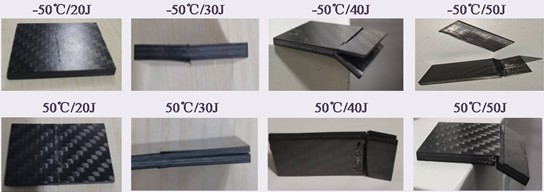
The impact damage of CFRP specimens progresses with increasing energy. Under –50 °C conditions, microcracks appear on the surface upon 20 J impact; after 30 J impact, the number of cracks increases and some become connected, with a width of up to 0.05 mm; under 40 J impact, the surface is covered with dense cracks, forming a fragmented crack cluster, with cracks measuring 2.1 mm in length and approximately 0.09 mm in width; at 50 J impact, the surface material of the specimen is completely fragmented. Under 50 °C conditions, the surface deforms slightly upon 20 J impact, accompanied by a small number of fine thermal expansion cracks; after 30 J impact, cracks are densely distributed, measuring 1.5 mm in length and forming an irregular network with a width of approximately 0.07 mm; under 40 J impact, the surface is severely fragmented, with cracks disordered and measuring 2.8 mm in length and approximately 0.1 mm in width, and material detachment in some areas; at 50 J impact, the surface is covered with cracks measuring 2.0 mm in length and approximately 0.1 mm in width, with large areas of fragmentation.
Taking the numerical simulation under the condition of 50 ℃/40 J as an example, the damage variation contour plot is shown in Fig. 8. At the beginning of damage calculation, the laminated plate deforms to resist the impact. As time progresses, damage begins to occur at the stress concentration points and gradually expands. After 2 ms, the damage situation worsens, but the macroscopic area of damage does not change anymore.
Fig. 8Contour plot of damage variation under 50 ℃/40 J working conditions
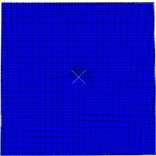
a) 0.1 ms
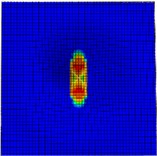
b) 0.5 ms
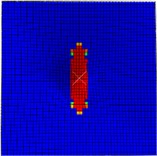
c) 1 ms
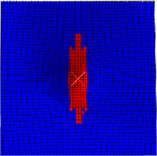
d) 2 ms
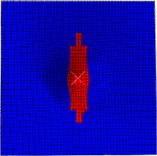
e) 3 ms
Based on the comprehensive comparison of experimental results, at the same temperature, the progressive increase in impact energy leads to the gradual evolution of CFRP damage. From matrix microcracks to fiber fracture, matrix fragmentation, and ultimately macroscopic fracture. Under the same impact conditions, high temperature exacerbates interfacial delamination and matrix damage, while low temperature restricts molecular activity and enhances rigidity, resulting in significantly lower damage levels compared to high temperature.
4. Conclusions
This study focuses on a specific CFRP laminated structure and investigates its mechanical properties and dynamic damage characteristics under the coupled action of heat and impact through experimental methods. The results indicate that the coupled action of heat and impact significantly affects the mechanical properties of composite materials. When the temperature remains constant, there is a positive correlation between impact energy and impact velocity. However, under the same impact velocity, the lower the temperature, the smaller the displacement but the greater the acceleration, the higher the stress and the lower the strain, and the faster the deformation process but the less energy absorption. This study helps to reveal the mechanism of the influence of heat-impact interaction on CFRP, providing a scientific basis for its engineering application under complex working conditions.
References
-
M. Z. Sadeghi et al., “Damage detection by double-sided ultrasonic assessment in low-velocity impacted CFRP plates,” Composite Structures, Vol. 208, pp. 646–655, Jan. 2019, https://doi.org/10.1016/j.compstruct.2018.10.025
-
J. Han, J. Cai, Y. Lin, Y. Sun, and J. Pan, “Impact resistance of engineered geopolymer composite (EGC) in cold temperatures,” Construction and Building Materials, Vol. 343, p. 128150, Aug. 2022, https://doi.org/10.1016/j.conbuildmat.2022.128150
-
S. Choudhury, B. Ramagiri, B. K. Shah, C. S. Yerramalli, and A. Guha, “Ballistic response of woven glass fabric-epoxy composites at low temperatures: Experimental investigation,” Composites Part C: Open Access, Vol. 8, p. 100263, Jul. 2022, https://doi.org/10.1016/j.jcomc.2022.100263
-
W. Mu et al., “Effect of hygrothermal aging on mechanical properties of continuous flax fiber composites,” Polymer Composites, Vol. 45, No. 13, pp. 12199–12210, Sep. 2024, https://doi.org/10.1002/pc.28630
-
B. Zhu, Y. Wei, H. Chu, H. Ye, J. Cai, and J. Pan, “Dynamic response of ultra-high performance engineered cementitious composites (UHP-ECC) under low-velocity impact: Effect of waste rubber incorporation and low temperatures,” Cement and Concrete Composites, Vol. 151, p. 105576, Aug. 2024, https://doi.org/10.1016/j.cemconcomp.2024.105576
-
R. Swart, F. Korkees, P. Dorrington, and J. Thurman, “Evaluation of the impact performance and energy absorption capabilities of 3D printed composites,” Rapid Prototyping Journal, Vol. 28, No. 9, pp. 1636–1654, Oct. 2022, https://doi.org/10.1108/rpj-10-2021-0287
-
Y. Zhou et al., “Low-velocity impact behavior of one-part engineered geopolymer composite under extreme temperatures,” Composites Part A: Applied Science and Manufacturing, Vol. 191, p. 108739, Apr. 2025, https://doi.org/10.1016/j.compositesa.2025.108739
-
A. I. G. Savadelis, J. M. Pereira, and B. E. Schmidt, “Transient temperature measurements in a ballistic impact experiment on a thermoplastic composite material,” Composites Part B: Engineering, Vol. 295, p. 112157, Apr. 2025, https://doi.org/10.1016/j.compositesb.2025.112157
-
R. Z. Yang et al., “A method for predicting the impact limit speed of composite laminates under different ambient temperatures based on the three-dimensional Hashin criterion,” Mechanics of Composite Materials, Vol. 59, No. 6, pp. 1129–1146, Jan. 2024, https://doi.org/10.1007/s11029-023-10161-3
-
S. K. Bhudolia and S. C. Joshi, “Low-velocity impact response of carbon fibre composites with novel liquid methylmethacrylate thermoplastic matrix,” Composite Structures, Vol. 203, pp. 696–708, Nov. 2018, https://doi.org/10.1016/j.compstruct.2018.07.066
-
A. Yudhanto et al., “Revealing the effects of matrix behavior on low-velocity impact response of continuous fiber-reinforced thermoplastic laminates,” Composite Structures, Vol. 210, pp. 239–249, Feb. 2019, https://doi.org/10.1016/j.compstruct.2018.11.040
-
M. Habibi, L. Laperrière, and H. M. Hassanabadi, “Influence of low-velocity impact on residual tensile properties of nonwoven flax/epoxy composite,” Composite Structures, Vol. 186, pp. 175–182, Feb. 2018, https://doi.org/10.1016/j.compstruct.2017.12.024
About this article

This work is partially supported by National Natural Science Foundation of China (Grant number 52405108).
The datasets generated during and/or analyzed during the current study are available from the corresponding author on reasonable request.
The authors declare that they have no conflict of interest.

