Abstract
In this study, the energy expressions of a perforated plate with hysteresis-type elastic-dissipative characteristics subjected to kinematic excitations are determined, and based on them, the differential equation of motion is formulated using the second-order Lagrange equation. The dissipative properties of the plate material are described using the expressions derived from the Pisarenko-Boginich hypothesis, and are incorporated through coefficients in explicit form by means of the harmonic linearization method. The cut-out extracted from the rectangular plate is also assumed to be rectangular in shape, with its sides parallel to those of the plate, and its location considered arbitrary within the plate domain. The kinetic and potential energies are expressed separately for the plate and the corresponding cut-out region, and, based on the equality of displacements along the cut-out boundary, the necessary compatibility relations are established. As a result, both the kinetic and potential energies are ultimately expressed solely in terms of the plate deflection. The mode shapes of the perforated plate are assumed to be orthogonal, and by applying the Bubnov-Galerkin method, the governing differential equation of motion is reduced to a simplified form.
Highlights
- Since the present work is of a theoretical nature, the main objective was to develop and justify a general analytical framework rather than to obtain case-specific numerical results.
- Therefore, no numerical calculations were carried out. The proposed approach and derived results are formulated in a sufficiently general form and can be applied to a wide class of boundary-value problems.
- The obtained analytical results are applicable to arbitrary boundary-value problems and provide a basis for subsequent numerical investigations. This does not affect the value of the article and the significance of the results obtained.
- Numerical calculations are very large calculations, we have analyses on this, but since the article is limited to 6 pages, it is impossible to provide numerical calculations in this article.
- The purpose of the present study was to develop a theoretical framework for the analysis of plates with holes within a general formulation. Therefore, the research was focused on analytical derivations rather than numerical simulations.
1. Introduction
At present, the development of mathematical models of mechanical systems that account for the nonlinear elastic–dissipative characteristics of materials in their complex structural elements is regarded as a pressing scientific problem. Numerous studies have been devoted to this issue.
In studies [1-8], numerical methods have been proposed for analyzing the modal characteristics of plates. Using these approaches, the vibration frequencies of plates containing cut-outs were determined. The regularities governing variations in the natural frequencies were established on the basis of finite element modeling and experimental data. The ABAQUS software package was also employed for numerical simulations. The numerical results obtained from the model were found to be in good agreement with experimental data measured using the PSV-500 vibrometer. The dependence of the natural frequencies of perforated plates on their geometric and physical parameters was identified and analyzed. The parameters exerting the most significant influence on the natural frequencies were determined. It was shown that the established regularities of natural frequencies make it possible to predict crack initiation between cut-outs in perforated plates and to assess their structural durability.
In studies [9-12], the vibrations of rectangular plates with discontinuous boundaries were investigated. A parametric equivalent method was employed to calculate and analyze the vibrations of perforated and edge-discontinuous rectangular plates. A plate of constant thickness was considered, and the displacement functions were expressed in terms of Bessel functions. Based on equilibrium conditions, the governing vibration equations for plates with discontinuous boundaries were derived. The superposition method was applied to analyze their vibrational behavior. The influence of internal cut-outs on plate vibrations was evaluated using the parametric equivalent method. To verify the reliability of the proposed approach, a finite element model of a plate with discontinuous boundaries was also developed. Numerical analyses were performed to study the effect of general boundary discontinuities on the system dynamics, and corresponding recommendations were provided.
In studies [13-16], the problem of investigating vibrating surfaces with cut-outs was considered. It was substantiated that existing methods and results obtained for surfaces with a single cut-out cannot be directly applied to assess the reliability of vibrating surfaces containing cut-outs of complex geometric shapes. The method proposed in these works is based on constructing models of vibration parameters using experimental techniques and the finite element method, followed by comparison of the results. Three cases were analyzed: first, a surface without cut-outs; second, a surface with circular cut-outs; and third, a surface with cut-outs in the form of a five-lobed epicycloid. A model accounting for the presence of cut-outs with complex geometries was developed. Analytical expressions in terms of cut-out parameters were derived, enabling the investigation of vibration behavior as a function of material properties, boundary conditions, and structural and kinematic parameters.
In studies [17-20], issues related to the mathematical modeling, validation, and numerical analysis of distributed-parameter mechanical systems with hysteresis-type elastic-dissipative characteristics were addressed.
The investigation of vibrations of a perforated plate with hysteresis-type elastic-dissipative characteristics remains a relevant and significant research issue.
2. Material and methods.
In this study, the problem of determining the energy expressions and the differential equation of motion of a perforated plate with hysteresis-type elastic–dissipative characteristics is considered (Fig. 1). The dissipative properties of the plate material are described on the basis of the Pisarenko-Boginich hypothesis.
Fig. 1Schematic diagram of a plate with a hole
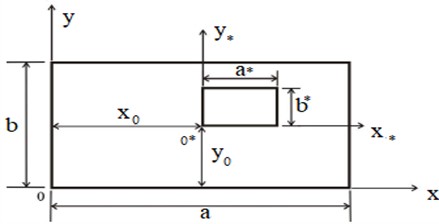
For the perforated plate with hysteresis-type elastic-dissipative characteristics shown in Fig. 1, the plate dimensions are and , while the dimensions of the cut-out are and . One corner of the cut-out is located at the point .
The following relationships hold between the introduced coordinate systems and :
It is well known that, for the transverse bending of a plate, its kinetic and potential energies are defined as follows [21]:
where , are the density and thickness of the plate material, respectively; is the deflection of the plate; , and are the bending and torsional moments, respectively.
The bending and torsional moments, taking into account the hysteresis-type elastic-dissipative properties of the material, are defined as follows [20]:
The stresses , and are expressed in terms of deformations as follows:
where , , , and are first and second type Young modules; is Poisson’s ratio, ; , , , ; ; , , , are linearization coefficients; and are the vibration decrements corresponding to the maximum value of the relative strain of the function; is the vibration decrement depending on the amplitude of the relative strain.
,…, , ,… are numbers determined from experiments:
, and we substitute the expressions for stresses Eq. (4) into the expressions for moments Eq. (3).
The Eq. (4) for the stresses , and are substituted into the Eq. (3) for the bending moments:
where
Since the cut-out is also in the form of a rectangular plate, its kinetic and potential energies in transverse bending are defined as follows [21]:
where, is the deflection of the plate corresponding to the cut-out; , and are the bending and torsional moments in the plate corresponding to the cut-out, respectively.
Thus, the kinetic and potential energies of a perforated plate with hysteresis-type elastic-dissipative characteristics can be expressed as follows:
The determined Eq. (10) make it possible to define the kinetic and potential energies of a perforated plate with hysteresis-type elastic–dissipative characteristics.
3. Results and discussion
We consider the problem of deriving the differential equation of motion for a perforated plate with hysteresis-type elastic–dissipative characteristics under kinematic excitations, using the energy expressions within the framework of the second-order Lagrange equation.
First, the deflections for the plate and the corresponding cut-out region are expressed as follows:
where, and are the mode shapes of the plate and the cut-out, respectively, while , are the time-dependent functions.
At the boundary between the plate and the cut-out, the following condition holds:
This equation can be written in matrix form:
where , represent the column matrices; :
Taking Eq. (13) into account, the deflection in Eq. (11) can be written as follows:
The second-order Lagrange equation for a continuous system is expressed as follows:
where is variation; .
The necessary derivatives are calculated for the second-order Lagrange equation, taking the reference displacement as .
These derivatives are then substituted into the second-order Lagrange Eq. (15):
By substituting the deflection forms Eqs. (11) and (14) into the differential Eq. (16), we obtain the following differential equation using the Bubnov-Galerkin method:
where ; ; are the natural frequencies of the plate and the corresponding cut-out region, respectively:
The obtained differential equation represents the equation of motion for a perforated plate with hysteresis-type elastic-dissipative characteristics under kinematic excitations.
4. Conclusions
The energy expressions for a perforated plate exhibiting hysteresis-type elastic–dissipative properties under kinematic excitation have been formulated as functions of the system parameters. Based on these expressions for kinetic and potential energy, the equation of motion has been derived using the second-order Lagrange equation. The obtained differential equation makes it possible to analyze the dynamic behavior of the perforated plate, taking into account its hysteresis-type elastic–dissipative characteristics under kinematic excitation. Furthermore, this equation provides a basis for evaluating how the system responds to variations in its parameters, enabling a comprehensive study of its performance under different conditions.
References
-
S. Kharchenko, S. Samborski, L. Kloda, and F. Kharchenko, “Combined method of identification of free oscillations of perforated riffled plates,” Scientific Reports, Vol. 15, No. 1, p. 23992, Dec. 2025, https://doi.org/10.1038/s41598-025-06614-5
-
J. Liu, J. Lou, K. Chai, Q. Yang, and J. Chu, “Vibration analysis of internally perforated annular plate with discontinuous boundary conditions,” International Journal of Structural Stability and Dynamics, Vol. 24, No. 19, p. 2450218, Dec. 2024, https://doi.org/10.1142/s0219455424502183
-
J. K. Prusty, G. Papazafeiropoulos, and S. C. Mohanty, “Free vibration analysis of sandwich plates with cut-outs: An experimental and numerical study with artificial neural network modelling,” Composite Structures, Vol. 321, p. 117328, Oct. 2023, https://doi.org/10.1016/j.compstruct.2023.117328.
-
S. Kharchenko, S. Samborski, F. Kharchenko, A. Mitura, J. Paśnik, and I. Korzec, “Identification of the natural frequencies of oscillations of perforated vibrosurfaces with holes of complex geometry,” Materials, Vol. 16, No. 17, p. 5735, Aug. 2023, https://doi.org/10.3390/ma16175735
-
B. Sáez, V. Meruane, R. Fernández, and E. I. Saavedra Flores, “Numerical optimization and experimental validation of finite perforated cellular panels for vibration reduction,” Materials, Vol. 18, No. 24, p. 5620, Dec. 2025, https://doi.org/10.3390/ma18245620
-
K. Tian, Y. Wang, B. Fang, D. Cao, K. Yu, and X. Mei, “A novel unified dynamical modeling of perforated plates based on negative mass equivalence,” Mechanical Systems and Signal Processing, Vol. 232, p. 112723, Mar. 2025, https://doi.org/10.1016/j.ymssp.2025.112723
-
K.-H. Jeong and M.-J. Jhung, “Free vibration analysis of partially perforated circular plates,” Procedia Engineering, Vol. 199, pp. 182–187, Jan. 2017, https://doi.org/10.1016/j.proeng.2017.09.230
-
C. V. Prashanth, U. Anish Kumar, S. Badri Narayanan, and B. R. Lokavarapu, “Vibration analysis of perforated functionally graded circular plates,” Materials Today: Proceedings, Apr. 2024, https://doi.org/10.1016/j.matpr.2024.04.100
-
S. Kharchenko, S. Samborski, F. Kharchenko, and J. Paśnik, “Numerical study of the natural oscillations of perforated vibrating surfaces with holes of complex geometry,” Advances in Science and Technology Research Journal, Vol. 17, No. 6, pp. 73–87, Dec. 2023, https://doi.org/10.12913/22998624/174062
-
Y. Kim and J. Park, “A theory for the free vibration of a laminated composite rectangular plate with holes in aerospace applications,” Composite Structures, Vol. 251, p. 112571, Nov. 2020, https://doi.org/10.1016/j.compstruct.2020.112571
-
H. Jamali et al., “Vibration characteristics of perforated plate using experimental and numerical approaches,” in IEEE 8th International Conference on Engineering Technologies and Applied Sciences (ICETAS), pp. 1–4, 2023, https://doi.org/10.1109/icetas59148.2023.10346538
-
A. Veisiara, H. Mohammad-Sedighi, and A. Reza, “Computational analysis of the nonlinear vibrational behavior of perforated plates with initial imperfection using NURBS-based isogeometric approach,” Journal of Computational Design and Engineering, Vol. 8, No. 5, pp. 1307–1331, Oct. 2021, https://doi.org/10.1093/jcde/qwab043
-
Z. Zhu, Y. Song, Y. Zhang, Q. Liu, and G. Wang, “Sound radiation of the plate with arbitrary holes,” International Journal of Mechanical Sciences, Vol. 264, p. 108814, Feb. 2024, https://doi.org/10.1016/j.ijmecsci.2023.108814
-
J.-R. Cho, “Natural element static and free vibration analysis of functionally graded porous composite plates,” Applied Sciences, Vol. 12, No. 22, p. 11648, Nov. 2022, https://doi.org/10.3390/app122211648
-
S. Ghosh, “Comparison of vibration response from various annulated circular plates attached with holes and concentrated stiffened patches under thermal environment,” International Journal for Research in Applied Science and Engineering Technology, Vol. 13, No. 10, pp. 853–867, Feb. 2025, https://doi.org/10.22214/ijraset.2025.74616
-
H. Zhang, Z. Li, S. Wang, T. Liu, and Q. Wang, “Analysis of vibration characteristics for rotating braided fiber-reinforced composite annular plates with perforations,” Materials, Vol. 17, No. 22, p. 5402, Nov. 2024, https://doi.org/10.3390/ma17225402
-
M. Mirsaidov, O. Dusmatov, and M. Khodjabekov, “Stability of nonlinear vibrations of elastic plate and dynamic absorber in random excitations,” E3S Web of Conferences, Vol. 410, p. 03014, 2023, https://doi.org/10.1051/e3sconf/202341003014
-
M. M. Mirsaidov, O. M. Dusmatov, and M. U. Khodjabekov, “Dynamics of the rod protected from vibration under kinematic excitations,” (in Russian), in AIP Conference Proceedings, Vol. 2612, No. 1, p. 030005, Mar. 2023, https://doi.org/10.1063/5.0113225
-
M. M. Mirsaidov, O. M. Dusmatov, and M. U. Khodjabekov, “Mode shapes of hysteresis type elastic dissipative characteristic plate protected from vibrations,” in Lecture Notes in Civil Engineering, Vol. 282, Cham: Springer International Publishing, 2022, pp. 127–140, https://doi.org/10.1007/978-3-031-10853-2_12
-
M. A. Pavlovsky, L. M. Ryzhkov, V. B. Yakovenko, and O. M. Dusmatov, Nonlinear Problems of Speaker Vibration Protection Systems. (in Ukrainian), Kyiv, Ukraine: Technika, 1997, p. 204.
-
S. P. Timoshenko and S. Woinowsky-Krieger, Theory of Plates and Shells. New York, NY, USA: McGraw-Hill, 1959.
About this article

The authors have not disclosed any funding.
The datasets generated during and/or analyzed during the current study are available from the corresponding author on reasonable request.
The authors declare that they have no conflict of interest.

