Abstract
The study focuses on the nonlinear dynamic behavior of an anisotropic fiber-reinforced viscoelastic rectangular plate made of fiberglass with fully clamped edges, subjected to a parametric load applied along one of its sides. The mathematical formulation describing the plate’s dynamic response is developed within the framework of the generalized Timoshenko plate theory, which accounts for transverse shear deformation as well as rotary inertia effects. To incorporate the viscoelastic nature of the material, the integral representation of the Boltzmann-Volterra hereditary theory is employed, allowing the time-dependent stress relaxation of the material to be taken into account. A parametric analysis is performed to investigate how the geometric characteristics of the plate and the viscoelastic properties of the composite material influence its dynamic response. The obtained results may be useful for the design and analysis of composite structural elements operating under dynamic and parametric loading conditions. The considered problem is directly related to vibration analysis and dynamic stability of engineering structures, which is within the scope of vibroengineering applications.
Highlights
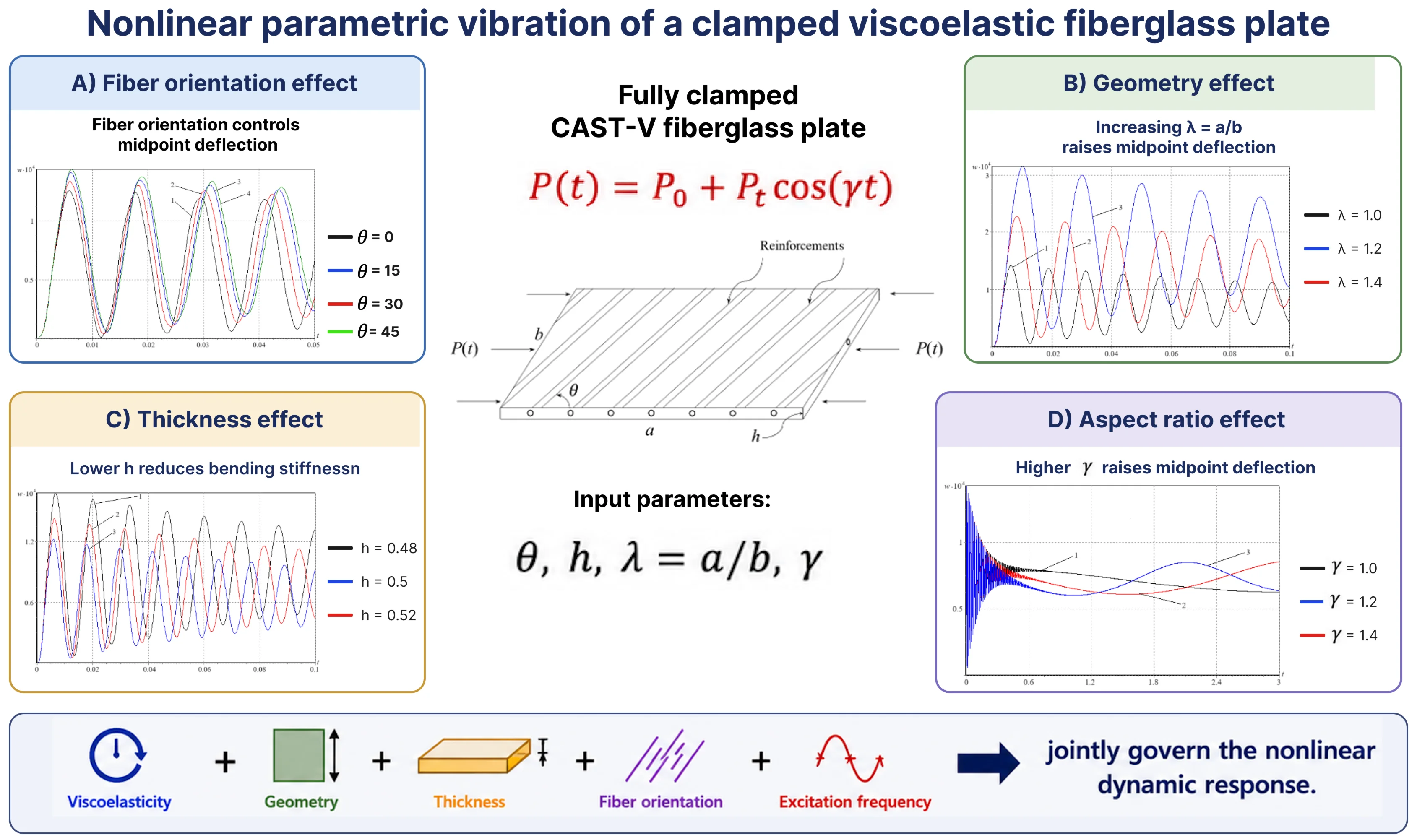
- A clamped viscoelastic fiberglass plate is analyzed under harmonic parametric excitation.
- The study shows how fiber orientation, thickness, geometry, and excitation frequency affect plate vibration.
- Fiber orientation has a clear influence on the midpoint deflection of the laminated plate.
- A larger aspect ratio \gamma=a/b leads to higher midpoint deflection.
1. Introduction
The dynamic stability of laminated and composite plates has been extensively investigated in the works of J. N. Reddy, where refined plate theories and analytical models for multilayer composite structures were developed [1]. Parametric vibrations and stability of plates and shells were further studied by L. Amabili, particularly in the context of nonlinear dynamics of thin-walled structures [2].
In recent years, significant progress has been made in the study of nonlinear vibrations of composite and viscoelastic plates. Modern approaches include time-domain and frequency-domain analyses of viscoelastic laminated structures, accounting for geometric nonlinearity and hereditary material behavior. For instance, nonlinear periodic responses of viscoelastic composite plates under harmonic excitation have been investigated using advanced numerical techniques such as shooting methods and finite element formulations [3].
Further developments include refined theories for laminated plates with viscoelastic layers and fractional constitutive models, allowing for a more accurate description of damping and nonlinear effects [4].
Recent studies [5] also address geometrically nonlinear vibro-acoustic behavior and the influence of structural parameters, boundary conditions, and material heterogeneity on the dynamic response of composite plates.
In addition, various numerical and analytical approaches have been proposed for analyzing nonlinear vibrations of composite plates resting on viscoelastic foundations and subjected to complex loading conditions [6].
A comprehensive overview of recent developments is provided in review papers [7] covering advances in nonlinear vibration analysis of laminated composite structures over the last decade
Despite the considerable number of studies, the problem of dynamic instability of viscoelastic reinforced composite plates, especially under clamped boundary conditions and with consideration of geometric nonlinearity, remains insufficiently explored and requires further development of mathematical models and numerical analysis methods. Problems with a similar formulation were considered in studies [8]-[10].
The main contributions of this study can be summarized as follows:
– Development of a nonlinear mathematical model of a clamped viscoelastic anisotropic composite plate under parametric loading.
– Incorporation of hereditary viscoelastic behavior using the Boltzmann-Volterra model.
– Analysis of the combined influence of geometric nonlinearity, material properties, and structural parameters on the dynamic response.
– Numerical investigation of vibration characteristics using the Bubnov-Galerkin approach.
The developed model is then used to investigate the influence of key parameters on the dynamic behavior of the structure, and the obtained results are discussed in detail.
2. Materials and methods
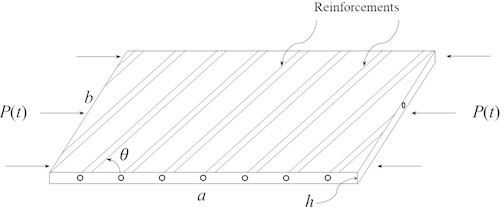
Consider a rectangular plate with all edges clamped, subjected to compressive forces , acting along the sides of length . The applied load varies in time according to the following relation:
where, denotes the constant (static) component of the load, represents the amplitude of the time-dependent (dynamic) component, and is the frequency of the external periodic excitation (Fig. 1).
Fig. 1Reinforced composite under dynamic loading
The mathematical model of the problem is formulated based on the refined Timoshenko plate theory, which accounts for transverse shear deformations and rotary inertia. By incorporating the viscoelastic behavior of the material via the integral representation of the Boltzmann-Volterra hereditary model, a system of nonlinear integro-differential partial differential equations with weakly singular relaxation kernels is obtained. Subsequently, the Bubnov-Galerkin method, employing a polynomial approximation of the transverse deflection, is applied to reduce the original boundary-value problem to a system of nonlinear ordinary integro-differential equations. The resulting system is then solved numerically using a quadrature-based scheme, with the singular kernels first regularized to ensure computational stability and accuracy. This approach provides an accurate description of the coupled effects of geometric nonlinearity, viscoelasticity, and parametric excitation, providing a robust framework for the analysis of dynamic instability in clamped reinforced composite plates. A detailed description of the mathematical model is provided in [8].
For clarity, the mathematical model describes the transverse vibration of the plate within the framework of the Timoshenko-type theory, accounting for shear deformation and rotary inertia. Geometric nonlinearity is included through nonlinear strain-displacement relations, allowing for large deflections. The viscoelastic behavior of the material is incorporated using a hereditary approach based on the Boltzmann-Volterra model, which captures time-dependent stress relaxation effects. The external load is assumed to be periodic with both static and harmonic components.
In this study, a rectangular plate made of CAST-V reinforced fiberglass (a high-temperature structural glass laminate) is analyzed. The material exhibits the following mechanical characteristics: a longitudinal Young’s modulus of 25.5 GPa, a transverse modulus of 14.91 GPa, a shear modulus 4.41 GPa, a Poisson’s ratio 0.2 and a density 1900 kg/m3.
3. Results and discussion
The following graphs illustrate the results for the midpoint of a clamped plate. In these plots, the deflection is expressed in meters (), while time is given in seconds (). All figures are created by the authors.
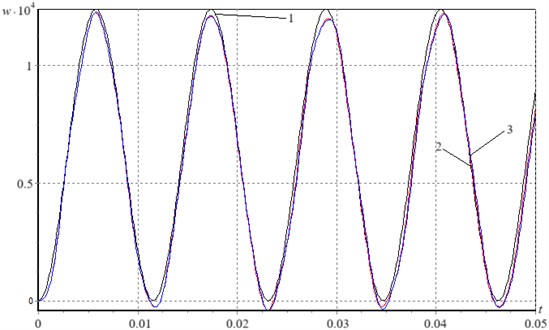
Figs. 2 and 3 present the results of the convergence analysis of the Bubnov-Galerkin method applied to a fiber-reinforced anisotropic plate, considering both viscoelastic and purely elastic material behavior. In the subsequent calculations, the first nine harmonics were taken into account (i.e., 𝑀 = 𝑁 = 3). The results show that the inclusion of additional harmonic components beyond this order has a negligible effect on the vibration amplitude of the plate, confirming the adequacy of the selected approximation level.
Fig. 2Convergence analysis of the Bubnov-Galerkin method for the elastic case: 1-M=N=2, 2-M=N=3, 3-M=N=4
Furthermore, the analysis demonstrates that accounting for the viscoelastic properties of the structural material leads to noticeable damping, which results in a gradual decay of oscillations over time. This attenuation is caused by internal friction between molecules within the material’s microstructure, which dissipates energy during deformation. In contrast, when the viscoelastic properties are neglected, the damping effect is absent. These results highlight the importance of incorporating viscoelastic behavior in the analysis of the dynamic response and stability of composite structures.
Fig. 3Convergence analysis of the Bubnov-Galerkin method for the viscoelastic case: 1-M=N=2, 2-M=N=3, 3-M=N=4
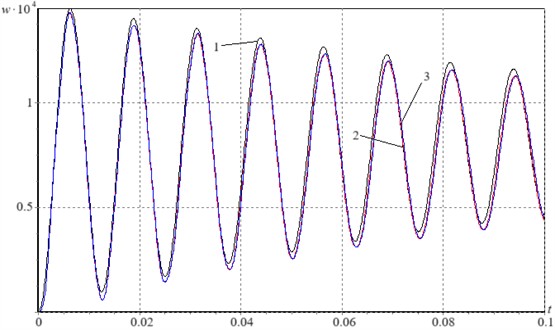
Fig. 4 illustrates the influence of the geometric coefficient 𝜆 (𝜆 = 𝑎/𝑏) on the dynamic behavior of a viscoelastic fiber-reinforced anisotropic plate. It can be observed that increasing the geometric parameter 𝜆 leads to a noticeable growth of the vibration amplitude, indicating a reduction in the overall stiffness of the plate. Quantitatively, the increase in λ results in a rise of the peak deflection amplitude by approximately 20-30 % within the considered range, indicating a pronounced sensitivity of the system to geometric parameters. Conversely, a reduction in the plate thickness results in a proportional increase in the vibration amplitude. This behavior is explained by the decrease in bending stiffness as the plate thickness is reduced. For instance, reducing the plate thickness leads to an increase in the maximum deflection amplitude by more than 50 %, highlighting the dominant role of bending stiffness in the dynamic response. These findings highlight the importance of considering geometric parameters in the analysis of the dynamic response and stability of composite structures (Fig. 5).
Fig. 4Time histories of deflection w (m) versus time t (s) for various values of the geometric parameter λ λ=ab:1- λ=1, 2-λ=1.2, 3-λ=1.4
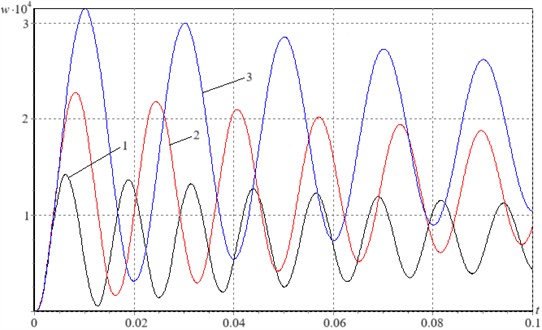
Fig. 6 illustrates the variation of the mid-point deflection of a clamped viscoelastic CAST-V fiberglass plate for different fiber orientation angles. In conventional fiber-reinforced composites, aligning the fibers closer to the direction of the applied load typically increases stiffness and enhances bending resistance due to the high longitudinal modulus of the fibers. When the fiber orientation deviates from the load direction, the influence of the relatively softer matrix becomes more pronounced, leading to greater flexibility of the structure. A similar trend can be observed in the clamped CAST-V plate under consideration. The results confirm that fiber orientation plays a crucial role in controlling the stiffness and dynamic response of the structure. In particular, deviations of the fiber orientation from the loading direction lead to an increase in vibration amplitude by approximately 15-25 %, depending on the angle.
Fig. 5Time histories of deflection w (m) versus time t (s) for various plate thicknesses: 1-h= 0.48 sm, 2-h= 0.5 sm, 3-h= 0.52 sm
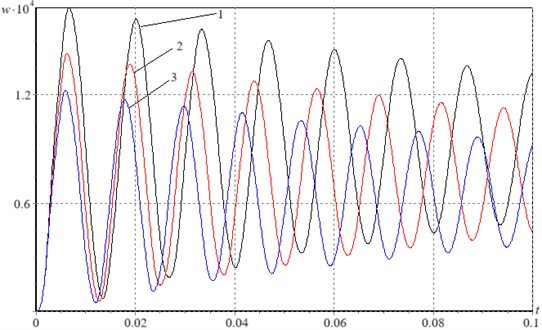
Fig. 6Effect of fiber orientation angle on the dynamic response (deflection w (m) versus time t (s)) of the reinforced plate: 1-θ= 0°, 2-θ= 15°, 3-θ= 30°, 4-θ= 45°
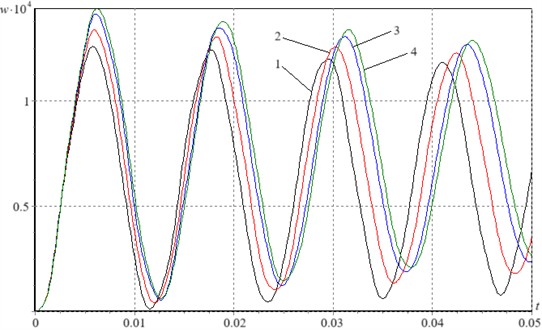
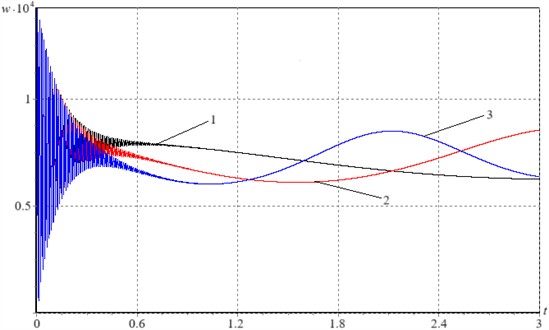
Fig. 7 illustrates the influence of the frequency of the external periodic load on the dynamic behavior of the plate. At the initial stage, variations in the frequency parameter 𝛾 have a negligible effect on the oscillation process. However, as the response develops, an increase in 𝛾 induces a noticeable phase shift to the left. By varying the frequency characteristics of the external load, the natural frequency of the plate can be identified. When the excitation frequency approaches resonance, a significant amplification of the vibration amplitudes occurs, leading to a rapid growth in their magnitude and potentially resulting in dynamic instability.
At the initial stage of the oscillatory process, high-frequency oscillations are observed. This effect is associated with the transient regime arising from the sudden application of parametric excitation. In this stage, higher vibration modes are temporarily activated, even within the truncated Bubnov-Galerkin approximation (𝑀 = 𝑁 = 3), due to nonlinear modal interaction. In addition, geometric nonlinearity leads to an exchange of energy between modes, which results in the appearance of high-frequency components superimposed on the main oscillation. The viscoelastic properties of the material further influence this transient response through hereditary effects, causing short-term irregularities in the motion. As time progresses, these high-frequency oscillations are gradually damped, and the response becomes dominated by the principal vibration mode corresponding to the excitation frequency. This behavior is typical of nonlinear systems subjected to parametric excitation. Quantitatively, as the excitation frequency approaches the natural frequency, the vibration amplitude increases by several times compared to the initial stage, indicating the onset of resonance conditions.
Fig. 7Influence of the excitation frequency parameter γ on the oscillatory process: 1-γ= 1 s-1, 2-γ= 2 s-1, 3-γ= 3 s-1
4. Conclusions
The proposed model provides an effective tool for addressing a wide range of problems related to the vibration characteristics of composite structures. The proposed approach is applicable to both purely elastic models and models accounting for the viscoelastic behavior of the material, and it allows for the consideration of various types of external loading and boundary conditions. The numerical simulations show that accounting for the actual material properties of the structure has a significant impact on the dynamic behavior of a fiber-reinforced composite plate. In particular, it is shown that the inclusion of viscoelastic material properties results in pronounced damping, leading to a gradual decay of vibration amplitudes over time. This effect is of particular importance when composite materials are used for vibration mitigation and dynamic load reduction. Furthermore, the analysis reveals a substantial influence of the plate’s geometric parameters on the vibration response, affecting both amplitude and frequency characteristics. The results highlight the need to consider both the mechanical properties of the material and the geometric features of the structure when designing stable and reliable composite elements.
References
-
J. N. Reddy, Mechanics of Laminated Composite Plates and Shells. Boca Raton, Florida: CRC Press, 2003, https://doi.org/10.1201/b12409
-
M. Amabili, Nonlinear Vibrations and Stability of Shells and Plates. Cambridge: Cambridge University Press, 2008, https://doi.org/10.1017/cbo9780511619694
-
D. Kumar and B. P. Patel, “Nonlinear periodic response of viscoelastic laminated composite plates using shooting technique,” International Journal of Non-Linear Mechanics, Vol. 160, p. 104637, Apr. 2024, https://doi.org/10.1016/j.ijnonlinmec.2024.104637
-
R. Lewandowski and P. Litewka, “Nonlinear harmonic vibrations of laminate plates with viscoelastic layers using refined zig-zag theory. Part 1 – Theoretical background,” Composite Structures, Vol. 320, p. 117200, 2023, https://doi.org/10.1016/j.compstruct.2023.117200
-
D. Kumar and B. P. Patel, “Geometrically nonlinear vibro-acoustic analysis of viscoelastic laminated composite and sandwich plates in time domain,” Journal of Sound and Vibration, Vol. 618, p. 119333, Dec. 2025, https://doi.org/10.1016/j.jsv.2025.119333
-
O. Ragb, M. Abd Elkhalek, T. Osman, M. S. Matbuly, M. Eltaher, and M. Salah, “Dynamic analysis of piezoelectric delaminated composite plates resting on viscoelastic foundation via differential quadrature techniques,” Mechanics Based Design of Structures and Machines, Vol. 53, No. 9, pp. 6380–6421, Sep. 2025, https://doi.org/10.1080/15397734.2025.2482748
-
J. Wang, Z. Chang, T. Liu, and L. Chen, “A review of linear and nonlinear vibration analysis of composite laminated structures by computational approaches: 2015-2024,” Nonlinear Dynamics, Vol. 113, No. 10, pp. 10839–10859, Jan. 2025, https://doi.org/10.1007/s11071-024-10837-y
-
B. Eshmatov, M. Mirsaidov, and R. Abdikarimov, “Dynamic buckling of plate made of glass reinforced plastic under rapidly increasing shear load,” E3S Web of Conferences, Vol. 401, p. 03009, Jul. 2023, https://doi.org/10.1051/e3sconf/202340103009
-
B. Eshmatov, R. Abdikarimov, M. Amabili, and N. Vatin, “Nonlinear vibrations and dynamic stability of viscoelastic anisotropic fiber reinforced plates,” Magazine of Civil Engineering, Vol. 118, No. 1, 2023, https://doi.org/10.34910/mce.118.11
-
B. K. Eshmatov, M. M. Mirsaidov, R. A. Abdikarimov, and N. I. Vatin, “Buckling of a viscoelastic anisotropic fiber reinforced plate under rapidly increasing shear load,” Magazine of Civil Engineering, Vol. 17, No. 5, 2024, https://doi.org/10.34910/mce.129.10
About this article

The authors have not disclosed any funding.
The datasets generated during and/or analyzed during the current study are available from the corresponding author on reasonable request.
The authors declare that they have no conflict of interest.

