Abstract
The assessment of existing bridges requires diagnostic methods capable of identifying structural characteristics without interfering with normal service conditions. Operational Modal Analysis (OMA) represents a powerful technique for this purpose, as it allows the dynamic properties of structures to be extracted from ambient excitation sources such as traffic and environmental vibrations. This paper presents two applications of OMA to reinforced concrete bridge structures located in southern Sardinia, Italy. The first case study concerns a prestressed concrete viaduct composed of multiple simply supported box girders, while the second investigates two arch-stayed reinforced concrete bridges with identical geometry. Accelerometric measurements were acquired under operational conditions and processed using frequency-domain techniques to determine the fundamental natural frequencies of the structures. The experimental results were compared with numerical predictions obtained through finite element modeling. The comparison demonstrates a satisfactory agreement between measured and simulated modal properties, confirming the reliability of the adopted monitoring strategy. The presented approach highlights the potential of operational modal analysis as a practical tool for structural identification and long-term monitoring of existing bridge infrastructure.

Highlights
- Operational Modal Analysis (OMA) successfully identified dynamic properties of two distinct reinforced concrete bridge typologies in Sardinia under real traffic conditions.
- Experimental natural frequencies showed strong correlation with finite element numerical predictions, with relative differences remaining below 10%.
- The study validates OMA as a reliable, non-intrusive tool for structural identification and long-term monitoring of aging Mediterranean bridge infrastructure.
1. Introduction
A significant portion of European transportation infrastructure was constructed several decades ago and is currently approaching or exceeding its original design life. Consequently, reliable techniques for evaluating the structural condition of existing bridges are increasingly necessary. Traditional inspection procedures are often limited to visual assessment or localized tests, which may not provide sufficient information regarding the global structural behavior. The need for robust condition assessment approaches for aging bridge networks is well documented in structural health monitoring (SHM) and dynamic identification literature [1-4].
Dynamic identification methods offer an alternative strategy for assessing structural performance. In particular, Operational Modal Analysis (OMA) enables the estimation of modal parameters – such as natural frequencies, damping ratios, and mode shapes – based solely on measured responses under operational loading conditions. Unlike classical experimental modal analysis, OMA does not require controlled excitation sources, making it especially suitable for large civil structures such as bridges [5].
Changes in modal characteristics can indicate variations in structural stiffness, mass distribution, or boundary conditions, which may result from degradation or damage. For this reason, OMA has been widely applied in structural health monitoring systems for bridges [6], [7] and other infrastructures [8].
This study presents two applications of operational modal analysis to reinforced concrete bridge structures located in Sardinia. The aim is to demonstrate how experimental modal data can be combined with numerical modeling to support structural identification and evaluate the dynamic characteristics of existing bridges. The novelty of this study lies in the combined application of operational modal analysis and calibrated finite element modeling to two distinct reinforced concrete bridge typologies under real operational conditions. The methodology is demonstrated on full-scale Mediterranean bridge infrastructure, providing validated reference data useful for structural identification and monitoring applications.
2. Prestressed concrete box-girder viaduct
2.1. Structural description
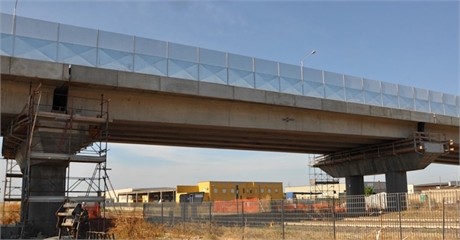
The first case is a prestressed reinforced concrete viaduct with a total length of approximately 154 m. The deck is composed of five spans of roughly 30 m each. The third span crosses a railway line and was selected for the dynamic investigation, see Fig. 1.
The deck consists of five precast prestressed box girders arranged side by side and connected by cross beams and a cast-in-place reinforced concrete slab forming the roadway surface. The slab is approximately 25 cm thick and extends beyond the outer beams. The beams are spaced at 2.85 m, while cross beams are located at the span ends to enhance torsional stiffness.
Each span can be approximated as simply supported. The structure includes reinforced concrete piers and abutments, with prestressed tendons used to counteract bending moments. Main structural elements were built using C45/55 concrete and B450C reinforcement steel. Prestressing strands exhibit a characteristic tensile strength of approximately 1860 MPa.
Fig. 1Prestressed reinforced concrete viaduct representing the first case study. Photo by the authors during field investigation
2.2. Experimental modal analysis
The dynamic characterization of the viaduct was performed through acceleration measurements acquired during normal operational conditions. The primary sources of excitation included vehicular traffic on the deck and trains passing beneath the considered third span.
Seven PCB 393C single-axis accelerometers were installed along the deck. Four sensors measured vertical accelerations, while three sensors were oriented along the longitudinal and transversal directions. Data acquisition was carried out using a multi-channel digital acquisition system with a sampling frequency adequate for the expected frequency range.
The recorded time-domain signals were transformed into the frequency domain using Fast Fourier Transform (FFT). Natural frequencies were then identified through a peak-picking procedure [9] applied to the spectral responses. The peak-picking method was adopted due to its robustness and computational efficiency when dominant modal peaks are clearly identifiable under ambient excitation. This approach is widely used in bridge dynamic identification due to its simplicity and suitability for operational environments. However, limitations may arise in the presence of closely spaced modes or significant measurement noise, where advanced output-only techniques such as frequency domain decomposition or stochastic subspace identification may provide improved accuracy.
Ambient excitation sources such as traffic loads and environmental effects are inherently non-stationary. Although the adopted frequency-domain analysis assumes quasi-stationary response conditions, the selected measurement durations were sufficiently long to ensure statistical stability of the spectral estimates. Nevertheless, it is recognized that strongly non-stationary excitation patterns may influence modal parameter identification accuracy and should be carefully considered in long-term monitoring applications.
2.3. Results and numerical comparison
The experimental analysis allowed the identification of the first three natural frequencies of the viaduct deck. Average values obtained from the sensors are reported in Table 1.
Table 1Experimental and numerical eigenfrequencies of the viaduct
Experimental (Hz) | Numerical (Hz) | Relative differences | |
Mode 1 | 2.83 | 2.57 | 9.2 % |
Mode 2 | 4.39 | 4.30 | 2.0 % |
Mode 3 | 6.62 | 6.73 | 1.7 % |
To interpret the experimental observations, a finite element model of the viaduct was developed using shell and solid elements representing the deck components using Straus7®. The model included more than sixteen thousand nodes and reproduced the structural boundary conditions through link elements.
The predicted modal frequencies obtained from the numerical model showed good agreement with the experimental measurements, see Table 1. Relative differences were below 10 % for all identified modes, indicating that the model adequately represents the structural behavior of the viaduct.
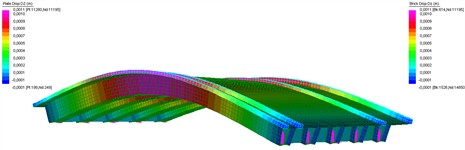
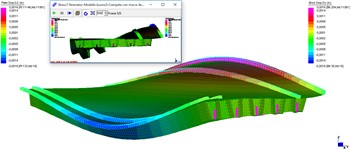
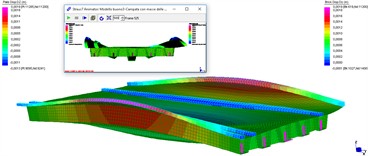
The first vibration mode corresponds mainly to vertical bending of the deck, while the second and third modes involve torsional behavior and transversal deformation, see Fig. 2.
Fig. 2First three bridge eigenmodes obtained with the FE model: a) first, b) second, c) third
a)
b)
c)
3. Arch-stayed reinforced concrete bridges
3.1. Structural characteristics
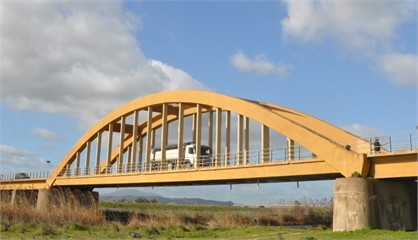
The second case study involves two identical reinforced concrete arch-stayed bridges located along the same roadway. Each bridge has a span of 55.25 m and a deck width of approximately 5 m.
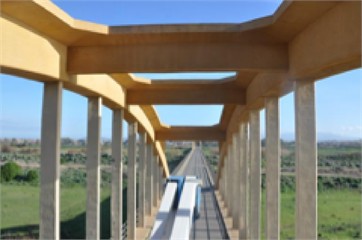
The primary load-bearing system consists of a reinforced concrete arch supporting the deck through vertical ties. The deck structure includes longitudinal beams and transverse cross beams supporting a reinforced concrete slab, see Fig. 3.
Although the two bridges share the same structural layout and dimensions, small differences in material properties may exist due to aging and environmental effects. Concrete compressive strengths were 16 MPa for the vertical ties and about 28 MPa for the remaining structural components. Reinforcing steel corresponds to FeB32K grade with a yield strength of approximately 274 MPa.
Fig. 3Views of the arch stayed bridge 1 as second case study Photo by the authors during field investigation
3.2. Dynamic testing procedure
Operational modal analysis was also applied to these structures. Seven PCB 393C single-axis accelerometers were installed in two orthogonal measurement triads to capture vibrations along the longitudinal, transversal, and vertical directions. Measurements were recorded at a sampling frequency of 200 Hz. A band-pass filter between 0.5 Hz and 15 Hz was applied to reduce noise and isolate the relevant frequency range.
Ambient excitations included wind effects, traffic loads, and controlled impulsive actions applied on the deck. Frequency spectra were obtained through Fast Fourier Transform FFT analysis and modal frequencies were identified using peak-picking techniques.
3.3. Experimental results
The first three modal frequencies identified for the two bridges were very similar, confirming their comparable structural configuration.
Typical average values were reported in Table 2.
Table 2Bridges experimental eigenfrequencies
Bridge 1 (Hz) | Bridge 2 (Hz) | Numerical (Hz) | |
Mode 1 | 1.99 | 2.05 | 2.13 |
Mode 2 | 2.34 | 2.40 | 2.39 |
Mode 3 | 4.34 | 4.55 | 4.31 |
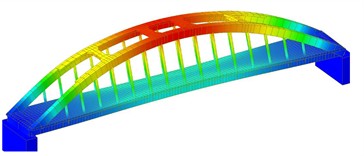
A finite element model was developed the commercial software MIDAS Gen® using beam, shell, and solid elements to reproduce the global structural behavior. The numerical predictions matched the experimental frequencies with deviations generally below 7 %, see Table 2 and Fig. 4.
The first mode mainly corresponds to transversal translation of the arch. The second mode represents flexural deformation involving rotation about the transversal axis, while the third mode is dominated by vertical bending.
Fig. 4Arch stayed bridge 1 as second case study

4. Discussion
The application of Operational Modal Analysis (OMA) to the investigated bridges provided valuable insight into their dynamic behavior under real operational conditions.
For the prestressed concrete viaduct, the experimental and numerical frequencies showed discrepancies below 10 %, indicating satisfactory agreement for large civil structures. Minor differences can be attributed to modelling simplifications, including idealized boundary conditions, uncertainties in material properties, and the influence of non-structural components such as asphalt layers, barriers, and railings.
For the arch-stayed bridges, the modal frequencies obtained for both structures were very similar, confirming their comparable structural configuration. Numerical predictions matched the experimental results with differences generally below 7 %. Such discrepancies are typical in bridge dynamic identification and may arise from uncertainties in material properties, degradation effects, and local stiffness variations that are difficult to represent in simplified numerical models.
Overall, the comparison between measured and simulated modal frequencies shows consistent agreement for all investigated modes, with discrepancies remaining below 10 %, confirming the reliability of the adopted finite element models.
The frequencies identified in the present study are consistent with values reported in the literature for reinforced-concrete bridges tested under ambient excitation, although direct comparison must be made with caution because modal frequencies are strongly affected by structural typology, span, stiffness distribution, support conditions, and retrofitting interventions, see Table 3.
Despite the encouraging results, some limitations remain. Ambient excitation may not sufficiently activate all structural modes, and simplified modeling assumptions regarding boundary conditions and material properties can introduce discrepancies. Damping ratios were not systematically evaluated due to limited recording duration and will be addressed in future investigations.
Table 3Literature bridges eigenfrequencies comparison
Reference | Bridge type | Span (m) | Identification method | First frequency (Hz) |
[10] | RC multi-span bridge | 45-55 | OMA | 2.04 |
[11] | Masonry arch bridge | ≈ 40-60 | Automatic OMA | 1.5-3.0 |
[12] | Historic RC arch bridge | 53 | Automatic OMA | 5.13 |
Present study – box girder viaduct | Prestressed RC girder bridge | 30 | OMA | 2.83 |
Present study – arch-stayed bridges | RC arch-stayed bridge | 55 | OMA | 1.99-2.05 |
5. Conclusions
This paper presented two applications of operational modal analysis for the structural identification of reinforced concrete bridges.
The experimental investigations demonstrated that ambient vibration measurements can provide reliable estimates of modal parameters for large civil structures. The identified natural frequencies showed good agreement with finite element predictions, confirming the validity of the developed numerical models. The results highlight several advantages of the adopted methodology compared to traditional investigation methods. OMA is a non-intrusive testing procedure that do not interrupt bridge service, it is capable of reliable identification of structural dynamic properties and it represents an effective support for numerical model calibration. Operational modal analysis therefore represents a valuable tool for structural health monitoring and can contribute to improved maintenance strategies for aging infrastructure.
Future developments may include long-term monitoring campaigns and automated modal identification techniques to detect structural changes over time.
References
-
A. A. Kasimzade, S. Tuhta, F. Günday, and H. Aydın, “Obtaining dynamic parameters by using ambient vibration recordings on model of the steel arch bridge,” Periodica Polytechnica Civil Engineering, Feb. 2021, https://doi.org/10.3311/ppci.16422
-
D. A. U. Absor, A. Aminullah, and B. Supriyadi, “Structural health assessment of Kretek II bridge using enhanced frequency domain decomposition,” Journal of the Civil Engineering Forum, pp. 123–132, Mar. 2024, https://doi.org/10.22146/jcef.9151
-
R. Suwondo, I. Hidayat, M. Suangga, M. Keintjem, and J. Walewangko, “Dynamic assessment of a railway bridge using operational modal analysis and fast Fourier transform: a comparative study with finite element analysis,” Engineering, Technology and Applied Science Research, Vol. 15, No. 1, pp. 19200–19206, Feb. 2025, https://doi.org/10.48084/etasr.9202
-
F. Stochino, A. Attoli, M. Serra, A. Napoli, D. Meloni, and F. Mistretta, “Structural identification from operational modal analysis: the case of steel structures,” Buildings, Vol. 13, No. 2, p. 548, Feb. 2023, https://doi.org/10.3390/buildings13020548
-
F. Magalhães, A. Cunha, and E. Caetano, “Vibration based structural health monitoring of an arch bridge: from automated OMA to damage detection,” Mechanical Systems and Signal Processing, Vol. 28, pp. 212–228, Apr. 2012, https://doi.org/10.1016/j.ymssp.2011.06.011
-
W. Locke, L. Redmond, and M. Schmid, “Evaluating OMA system identification techniques for drive-by health monitoring on short span bridges,” Journal of Bridge Engineering, Vol. 27, No. 9, p. 04022079, Sep. 2022, https://doi.org/10.1061/(asce)be.1943-5592.0001923
-
C. G. Coviello and M. F. Sabbà, “A comprehensive experimental study on the dynamic identification of historical three-arch masonry bridges using operational modal analysis,” Applied Sciences, Vol. 15, No. 19, p. 10577, Sep. 2025, https://doi.org/10.3390/app151910577
-
D. Foti, N. I. Giannoccaro, M. F. Sabbà, and A. La Scala, “Dynamic identification of a strategic building of the sixties with a mixed structure,” Procedia Structural Integrity, Vol. 44, pp. 782–789, Jan. 2023, https://doi.org/10.1016/j.prostr.2023.01.102
-
H. Naderpour and P. Fakharian, “A synthesis of peak picking method and wavelet packet transform for structural modal identification,” KSCE Journal of Civil Engineering, Vol. 20, No. 7, pp. 2859–2867, Nov. 2016, https://doi.org/10.1007/s12205-016-0523-4
-
V. Nicoletti, R. Martini, S. Carbonari, and F. Gara, “Operational modal analysis as a support for the development of digital twin models of bridges,” Infrastructures, Vol. 8, No. 2, p. 24, Feb. 2023, https://doi.org/10.3390/infrastructures8020024
-
M. Civera, V. Mugnaini, and L. Zanotti Fragonara, “Machine learning-based automatic operational modal analysis: a structural health monitoring application to masonry arch bridges,” Structural Control and Health Monitoring, Vol. 29, No. 10, Oct. 2022, https://doi.org/10.1002/stc.3028
-
C. Gentile and N. Gallino, “Operational modal analysis and assessment of an historic RC arch bridge,” in WIT Transactions on The Built Environment, Vol 95, Vol. I, Southampton, UK: WIT Press, 2007, pp. 525–534, https://doi.org/10.2495/str070491
About this article

The authors have not disclosed any funding.
The datasets generated during and/or analyzed during the current study are available from the corresponding author on reasonable request.
Prof. Flavio Stochino is a chair of the 75th International Conference on Vibroengineering and was not involved in the editorial review and/or the decision to publish this article.

