Abstract
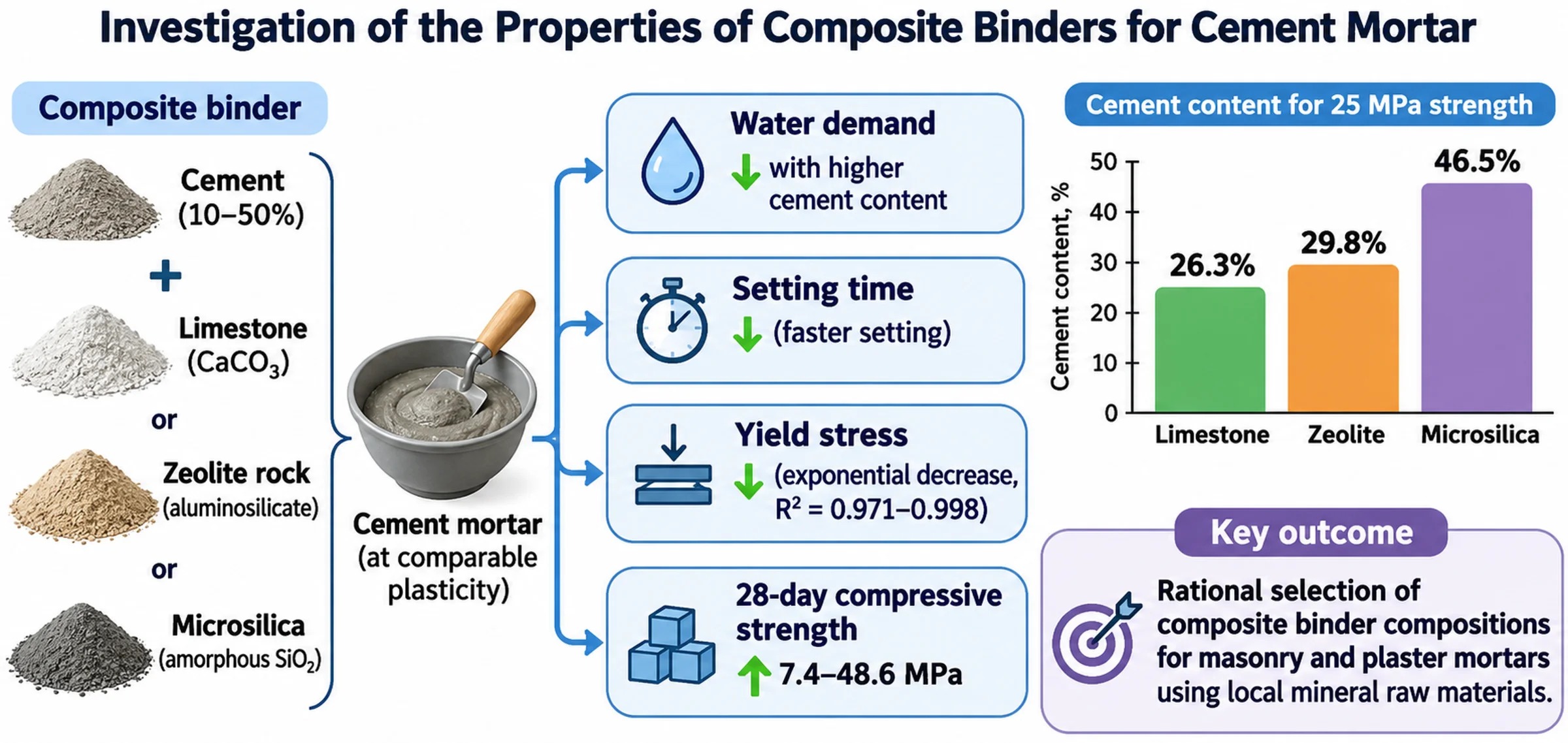
This study investigates the rheological, structural-mechanical, and strength properties of composite cement-based binders containing finely dispersed mineral fillers, including limestone, zeolite-containing rock, and microsilica. The effects of cement content in the range of 10–50% on water demand, yield stress, setting time, and 28-day compressive strength were experimentally evaluated at comparable mixture plasticity. The results showed that water demand strongly depended on the type of mineral filler, with microsilica-containing compositions requiring the highest water-to-solid ratios and limestone-containing compositions the lowest. Increasing the cement content reduced the water-to-solid ratio, decreased yield stress, and accelerated both initial and final setting. The yield stress–cement content relationships were satisfactorily described by exponential regression models, with coefficients of determination of 0.971-0.998. At comparable plasticity, the 28-day compressive strength ranged from 7.4 to 48.6 MPa, with the highest values obtained for limestone-containing compositions, followed by zeolite-containing and microsilica-containing compositions. Linear regression models were used for preliminary selection of cement content to achieve a target compressive strength. For a target strength of 25 MPa, the calculated cement contents were approximately 26.3 %, 29.8 %, and 46.5 % for limestone-, zeolite-, and microsilica-containing binders, respectively. The results provide a basis for rational selection of composite binder compositions for masonry and plaster mortars using local mineral raw materials.
Highlights
- The effects of limestone, zeolite, and microsilica fillers on the rheological and mechanical properties of composite cement binders were experimentally investigated.
- Increasing cement content from 10% to 50% generally reduced water demand and yield stress while accelerating the setting process.
- Limestone-based binders exhibited the lowest water demand and achieved the highest 28-day compressive strength of 48.6 MPa.
- Exponential regression models accurately described the relationship between cement content and yield stress (R² = 0.971–0.998).
- To achieve a target compressive strength of 25 MPa, the predicted cement contents were 26.3%, 29.8%, and 46.5% for limestone, zeolite, and microsilica binders, respectively.
1. Introduction
Studies of the rheological properties of mineral dispersed systems, both in Uzbekistan and abroad, have yielded exhaustive results. It was found that cement mortars mixed with water exhibit the behavior of viscoplastic systems. These systems are characterized by the presence of a yield strength, which is especially high for standard masonry mortars (the ratio of cement to sand is 1:3 or 1:4). To reduce this yield point, fine fillers are used to reduce friction between sand particles and prevent an increase in the viscosity of sand mixtures. Plasticizers, on the other hand, provide an even more significant reduction in yield strength. The management of the rheological characteristics of dispersed systems involved in the construction industry remains important. This enables the resolution of solving a complex of technological problems. Thus, for concrete compositions, this contributes to the development of methods for molding products with reduced or no vibration load, as well as reducing energy consumption during mixing and optimizing the consumption of raw materials. With regard to solutions for masonry, plaster and finishing, modification of their viscous-fluid properties reduces the complexity of work and improves the quality of finishing operations. Based on this, it is extremely important to investigate the components in the composite binder that affect its properties.
The addition of finely dispersed filler of different mineral composition to a composite binder significantly changes its rheological and structural-mechanical characteristics, as well as the properties of building mortars prepared on its basis [4]. An increase in the proportion of such filler in the binder increases its water demand, and this dependence increases if the source rock itself requires more water [4, 6].
2. Research methods and results
Limestone, zeolite-containing rock, and silica fume were used as finely dispersed mineral fillers. Limestone is a carbonate material, with calcite (CaCO3) as its main mineral, and primarily exhibits a microfilling and structure-forming effect. Zeolite-containing rock is a natural aluminosilicate material with a porous structure that can affect water demand, structure formation, and interactions with cement hydration products. Silica fume is a highly dispersed siliceous material consisting predominantly of amorphous SiO₂; due to its high fineness, it fills the interparticle space and participates in the pozzolanic reaction with Ca(OH)2 (Table 1). According to published data, these materials differ in particle size distribution, specific surface area, and water demand, which contributes to differences in their effects on the rheological and mechanical properties of the composite binder [9, 10].
Limestone and natural zeolites are mineral fillers with different mineralogical natures and physical properties, whereas silica fume is characterized by extremely high fineness, with more than 95 % of its particles being smaller than 1 μm [1-3, 9, 10].
Table 1Main nature and mechanism of action of mineral fillers
Mineral filler | Main nature | Main mechanism of action |
Limestone | CaCO3, calcite | Filling of interparticle voids and structure densification |
Zeolite-containing rock | Aluminosilicates | Structure formation and interaction with hydration products |
Silica fume | Amorphous SiO2 | Filling of micropores and pozzolanic reaction |
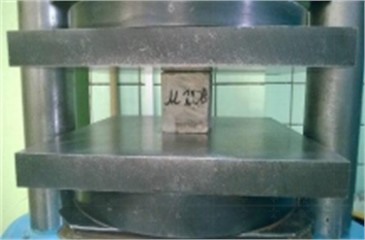
The water demand of the composite binders was determined based on normal consistency by adjusting the amount of water until the required consistency was achieved. The yield stress was determined at normal consistency, followed by regression approximation of the experimental relationships. The initial and final setting times were determined using the Vicat apparatus. The strength was determined from the compressive testing of specimens at the age of 28 days at the same mix plasticity Fig. 1.
Fig. 1Compressive testing of composite binder samples
The Portland cement content in the composite binder was varied from 10 to 50 % by mass of the binder. For each cement content, composite binders based on limestone, zeolite-containing rock, and silica fume were investigated.
Water demand significantly depended on the type of mineral filler. The microsilica-containing composition was characterized by the highest water demand, whereas the limestone-containing composition showed the lowest values. The zeolite-containing composition had an intermediate water demand.
Table 2Water-to-solid ratio (W/S) of composite binder compositions at different cement contents
Cement content, % | Limestone (1) | Zeolite (2) | Microsilica (3) |
10 | 0.29 | 0.61 | 0.83 |
20 | 0.27 | 0.52 | 0.70 |
30 | 0.24 | 0.46 | 0.62 |
40 | 0.25 | 0.42 | 0.58 |
50 | 0.26 | 0.35 | 0.55 |
Fig. 2The effect of cement content on the water-solid ratio of the composite binder
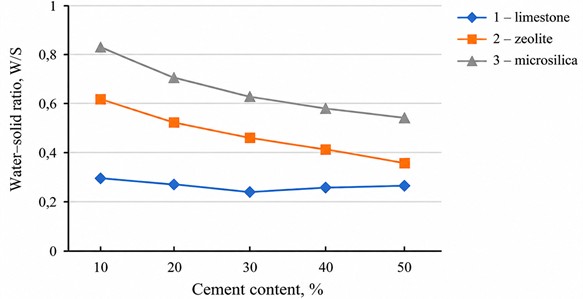
The water-to-solid ratio (W/S) ranged from approximately 0.35 to 0.83 for the silica-containing fillers and from 0.26 to 0.29 for the limestone-containing composition (Fig. 2). The higher W/S values of the silica-containing compositions indicate their greater water demand, which can be associated with the higher specific surface area, microporosity and adsorption capacity of these fillers.
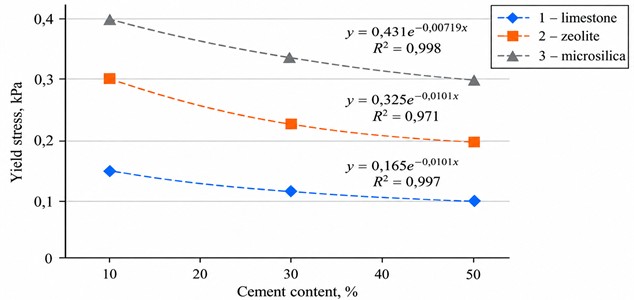
Fig. 3 presents the regression dependence of yield stress on cement content for composite binders containing different mineral fillers.
Fig. 3Regression approximation of the dependence of yield stress on cement content
The analysis of the experimental data showed that the yield stress of the normal-consistency paste varies depending on the cement content and the type of mineral filler. The obtained relationships were approximated using an exponential function:
where is the yield stress, kPa; is the cement content, %; is an empirical coefficient; and α is a coefficient characterizing the change in yield stress with variation in cement content.
For the limestone filler, the following relationship was obtained: 0.165 exp(–0.0101), 0.997.
For the zeolite-containing rock: 0.325 exp(–0.0101), 0.971.
For silica fume: 0.431 exp(–0.00719), 0.998.
In all investigated systems, the coefficient α has a negative value, corresponding to a decrease in yield stress with increasing cement content within the studied range. At the same time, the nature of the relationship depends on the type of mineral filler.
It was found that increasing the cement content from 10 to 50 % resulted in a decrease in yield stress for all investigated compositions.
For the limestone-containing composition, the yield stress decreased from 0.15 to 0.10 kPa, and the experimental data were well described by the exponential relationship , with a coefficient of determination of 0.997. For the zeolite-containing composition, the yield stress decreased from 0.30 to 0.20 kPa, while the regression relationship was described by , with 0.971. The highest yield stress values were observed for the microsilica-containing composition, decreasing from 0.40 to 0.30 kPa. This dependence was described by , with 0.998.
Thus, the high coefficients of determination ( 0.971-0.998) indicate a good fit of the experimental data to the selected exponential model. Throughout the investigated cement-content range, the microsilica-containing composition exhibited the highest yield stress, whereas the limestone-containing composition showed the lowest values.
Fig. 4 shows the effect of cement content on the setting time of mortars containing different mineral fillers: (a) initial setting time and (b) final setting time.
Fig. 4Effect of cement content on the setting time of mortars with different mineral fillers: a) initial setting time, b) final setting time
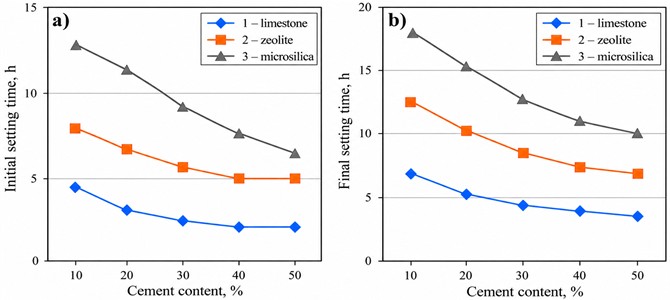
As shown in Fig. 4(a), increasing the cement content from 10 to 50 % results in a reduction in the initial setting time for all investigated compositions. For the limestone-containing composition, the initial setting time decreases from 4.5 to 2.1 h. For the zeolite-containing composition, this value decreases from 8.0 to 5.0 h, whereas for the microsilica-containing composition it decreases from 12.8 to 6.5 h. The microsilica-containing composition exhibits the longest initial setting time throughout the investigated cement-content range.
Fig. 4(b) presents the variation in final setting time. With an increase in cement content from 10 to 50 %, the final setting time also gradually decreases. For the limestone-containing composition, it decreases from 6.8 to 3.5 h, for the zeolite-containing composition from 12.5 to 6.8 h, and for the microsilica-containing composition from 18.0 to 10.0 h. Thus, the microsilica-containing composition maintains the longest final setting time, whereas the limestone-containing composition exhibits the shortest setting time.
Overall, increasing the cement content accelerates both the initial and final setting of the investigated mortars. At the same cement content, the setting time depends on the type of mineral filler: the longest setting time is observed for the microsilica-containing composition, followed by the zeolite-containing composition, while the limestone-containing composition exhibits the shortest setting time.
According to the analysis of the experimental data, at the optimum water-to-solid ratio determined by the normal consistency test, a direct relationship was observed between the component proportions of the composite binder and its setting rate. For the investigated mixtures, increasing the cement content resulted in an acceleration of the setting process.
The incorporation of microsilica into the composite binder promotes the formation of additional calcium silicate hydrates (C-S-H) through its reaction with calcium hydroxide released during cement hydration. This contributes to the development of the cementitious structure and strength. The effect becomes more pronounced with increasing cement content in the composite binder [1-3].
For example, at a cement content of 10 %, the zeolite-containing composite binder exhibited an initial setting time of approximately 3 h and a final setting time of 7 h. Increasing the cement content to 50 % reduced the initial and final setting times to 2.1 and 4.2 h, respectively.
In contrast, the use of microsilica as a mineral filler resulted in longer setting times compared with the zeolite-containing binder, by approximately 33 % for the initial setting time and 38 % for the final setting time. This behavior can be attributed to the very high fineness and specific surface area of microsilica. The limestone-containing composite binder exhibited an intermediate setting behavior.
The analysis of the experimental results also showed that varying the proportions of the binder components allowed the 28-day compressive strength to be controlled within the range of 7.4-48.6 MPa. At comparable plasticity, the highest compressive strength values were obtained for mixtures with a higher cement content. The data presented in Table 3 demonstrate the relationship between the compressive strength of the composite binder, cement content, and the type of finely dispersed mineral filler.
It was found that, at comparable plasticity of the mixtures, the type of mineral filler had a significant effect on the strength of the binder. The highest strength values were observed for the limestone-containing compositions, followed by the zeolite-containing compositions, whereas the microsilica-containing compositions exhibited the lowest strength values (Table 3).
Table 328-day compressive strength of the composite binder with different mineral fillers depending on cement content
Filler type | Cement content, % | ||||
10 | 20 | 30 | 40 | 50 | |
Limestone, MPa | 10.1 | 18.5 | 28.0 | 37.5 | 48.6 |
Zeolite, MPa | 12.2 | 16.0 | 23.0 | 32.2 | 42.5 |
Microsilica, MPa | 7.4 | 13.5 | 14.5 | 18.1 | 30.2 |
To achieve a compressive strength of 18.0-30.0 MPa for the limestone-containing composite binder, a cement content of 20-35 % is required. When silica-based fillers are used, a higher cement content is required: 30-45 % for zeolite and 40-50 % for microsilica.
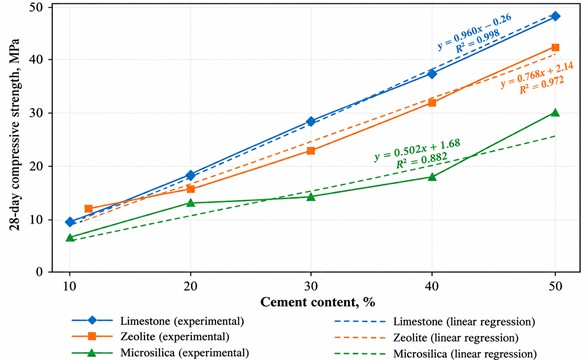
Fig. 5 illustrates the relationship between cement content and the 28-day compressive strength of composite binders containing different mineral fillers, together with the corresponding linear regression models.
Thus, the composition of the composite binder can be adjusted depending on several factors, including the type of finely dispersed mineral filler, component ratio, and intended application of the mortar.
Fig. 5Effect of cement content on the 28-day compressive strength of composite binders with different mineral fillers
For example, for plaster mortars that harden predominantly under atmospheric conditions, a binder with a relatively high lime content may be used. Previous studies have shown that many lime-pozzolan composite binders exhibit reduced strength during hardening in air. To achieve the required performance characteristics of such materials, a high lime content exceeding 50 % may be required.
In contrast, for masonry mortars requiring higher strength and capable of hardening under different environmental conditions, it is appropriate to increase the proportion of cement in the binder composition. Table 4 summarizes the rheological and structural-mechanical characteristics of the investigated composite binder.
Table 4Relationship between filler type and the range of rheological and structural-mechanical parameters of the composite binder
Parameter | Range of values |
Setting time, h: – initial setting time – final setting time | 2.1-13 3–18 |
Water-to-solid ratio (W/S) | 0.24-0.83 |
Yield stress, , kPa | 0.10-0.40 |
28-day compressive strength, , MPa | 7.4-48.6 |
3. Conclusions
The conducted research established that composite cement-based binders containing finely dispersed mineral fillers are ductile-viscous dispersed systems characterized by a limiting shear stress, which depends on both the cement content and the nature of the mineral filler.
An increase in cement content from 10 to 50 % resulted in a decrease in the water-to-solid ratio (W/S) and an acceleration of the setting process, while the effect on the limiting shear stress depended on the type and dispersion of the mineral filler.
The water demand of the composite binders was strongly dependent on the type of mineral filler. Zeolite- and microsilica-containing compositions exhibited substantially higher W/S values than limestone-containing compositions, which can be associated with the higher microporosity and adsorption capacity of silica-based fillers.
The dependence of the limiting shear stress on cement content was described by an exponential function. The parameters of the approximating equations depended on the type of mineral filler, confirming the significant influence of filler characteristics on the rheological behavior of the composite binders.
The analysis of setting time demonstrated that increasing the cement content accelerated the setting process. The zeolite-containing compositions exhibited shorter setting times than the microsilica-containing compositions, whereas the limestone-containing compositions showed an intermediate setting behavior. The longer setting time of the microsilica-containing binder can be associated with the high fineness and specific surface area of microsilica.
The analysis of 28-day compressive strength showed that, at comparable plasticity, the highest strength values were obtained for limestone-containing compositions, followed by zeolite-containing compositions, whereas microsilica-containing compositions exhibited the lowest strength values. Variation of the cement content enabled the 28-day compressive strength to be controlled within the range of 7.4-48.6 MPa.
The regression analysis demonstrated a strong relationship between cement content and 28-day compressive strength, with coefficients of determination of 0.998 for limestone, 0.972 for zeolite, and 0.882 for microsilica. These models can be used for preliminary selection of cement content within the investigated experimental range.
The model-based analysis showed that the required cement content depends strongly on both the target strength and the type of mineral filler. For example, for a target 28-day compressive strength of 25 MPa, the calculated cement contents were approximately 26.3 % for limestone, 29.8 % for zeolite, and 46.5 % for microsilica. These values provide a basis for the rational selection of composite binder compositions, subject to experimental verification.
The results demonstrate that rational selection of the mineral filler type and component proportions makes it possible to purposefully control the rheological, structural-mechanical, and strength properties of composite binders according to the intended application. The obtained results provide a basis for developing masonry and plaster mortars using local mineral raw materials, with the potential to reduce cement consumption and improve the technological and performance characteristics of construction materials.
References
-
L. P. Singh, S. K. Bhattacharyya, S. P. Shah, G. Mishra, S. Ahalawat, and U. Sharma, “Studies on early stage hydration of tricalcium silicate incorporating silica nanoparticles: Part I,” Construction and Building Materials, Vol. 74, pp. 278–286, Sep. 2014, https://doi.org/10.1016/j.conbuildmat.2014.08.046
-
P. Hou, J. Qian, X. Cheng, and S. P. Shah, “Effects of the pozzolanic reactivity of nanoSiO2 on cement-based materials,” Cement and Concrete Composites, Vol. 55, pp. 250–258, 2014, https://doi.org/10.1016/j.cemconcomp.2014.09.014
-
L. P. Singh, S. R. Karade, S. K. Bhattacharyya, M. M. Yousuf, and S. Ahalawat, “Beneficial role of nanosilica in cement based materials – A review,” Construction and Building Materials, Vol. 47, pp. 1069–1077, Jun. 2013, https://doi.org/10.1016/j.conbuildmat.2013.05.052
-
J. Turgunbayeva, Z. Mirzaeva, and Y. Khakimova, “Influence of binary filler of steelmaking slag and fly ash on properties of gypsum binder,” in AIP Conference Proceedings, Vol. 3317, No. 1, p. 030036, Jul. 2025, https://doi.org/10.1063/5.0266889
-
J. R. Turgunbayeva, G. B. Ismoilova, and K. M. Juraev, “Investigation of mechanical activation of steelmaking slag and obtaining fine filler,” E3S Web of Conferences, Vol. 401, p. 02039, Jul. 2023, https://doi.org/10.1051/e3sconf/202340102039
-
J. R. Turgunbayeva, Z. M. Mirzayeva, and Y. T. Hakimova, “Influence of dispersion and content of mineral filler on the structure and properties of gypsum binder,” E3S Web of Conferences, Vol. 401, p. 03020, Jul. 2023, https://doi.org/10.1051/e3sconf/202340103020
-
U. Turgunbayev, D. Sharipova, N. Rakhimova, and F. Yunusova, “Development of technology for obtaining polymer cement glue (PCG) with use of chemical additives and industrial waste,” E3S Web of Conferences, Vol. 401, p. 05008, Jul. 2023, https://doi.org/10.1051/e3sconf/202340105008
-
J. Turgunbayeva, Z. Mirzaeva, Y. Khakimova, and A. Karimova, “Influence of superplasticizer "POLIMIX" on properties of gypsum binder,” in AIP Conference Proceedings, Vol. 3317, No. 1, p. 030024, 2025, https://doi.org/10.1063/5.0266887
-
B. Lothenbach, K. Scrivener, and R. D. Hooton, “Supplementary cementitious materials,” Cement and Concrete Research, Vol. 41, No. 12, pp. 1244–1256, Jan. 2011, https://doi.org/10.1016/j.cemconres.2010.12.001
-
B. Ahmadi and M. Shekarchi, “Use of natural zeolite as a supplementary cementitious material,” Cement and Concrete Composites, Vol. 32, No. 2, pp. 134–141, Oct. 2009, https://doi.org/10.1016/j.cemconcomp.2009.10.006
About this article

The authors have not disclosed any funding.
The datasets generated during and/or analyzed during the current study are available from the corresponding author on reasonable request.
The authors declare that they have no conflict of interest.

