Abstract
This study develops a comprehensive Structural Health Monitoring (SHM) strategy applied to the Spyckstraße Bridge, a three-span composite slab-girder structure constructed in 1976, with the objective of evaluating its structural performance under current design standards and increased traffic loads. A short-term monitoring campaign based on non-destructive techniques was carried out to record dynamic responses, including vibrations, displacements, and modal properties. The collected data served to calibrate and validate a Digital Twin model through an iterative optimization process using a genetic algorithm, achieving a deviation below 3 % between experimental and numerical eigenfrequencies. Once validated, the Digital Twin was used to assess the structural response under code-compliant load combinations and to determine utilisation levels for all critical sections. The analysis showed that none of the structural components reached their ultimate limit state, although the maximum tensile utilisation (97.3 %) was identified in the external girder of the central span under combined extreme traffic and thermal loading conditions. Furthermore, a parametric study addressing tendon corrosion effects indicated notable variations in modal characteristics and a decrease in load-bearing capacity. These findings highlight the effectiveness of integrating short-term SHM data with calibrated numerical models as a reliable framework for structural assessment, enabling early damage detection, informed maintenance strategies, and enhanced lifecycle management of existing bridge assets.
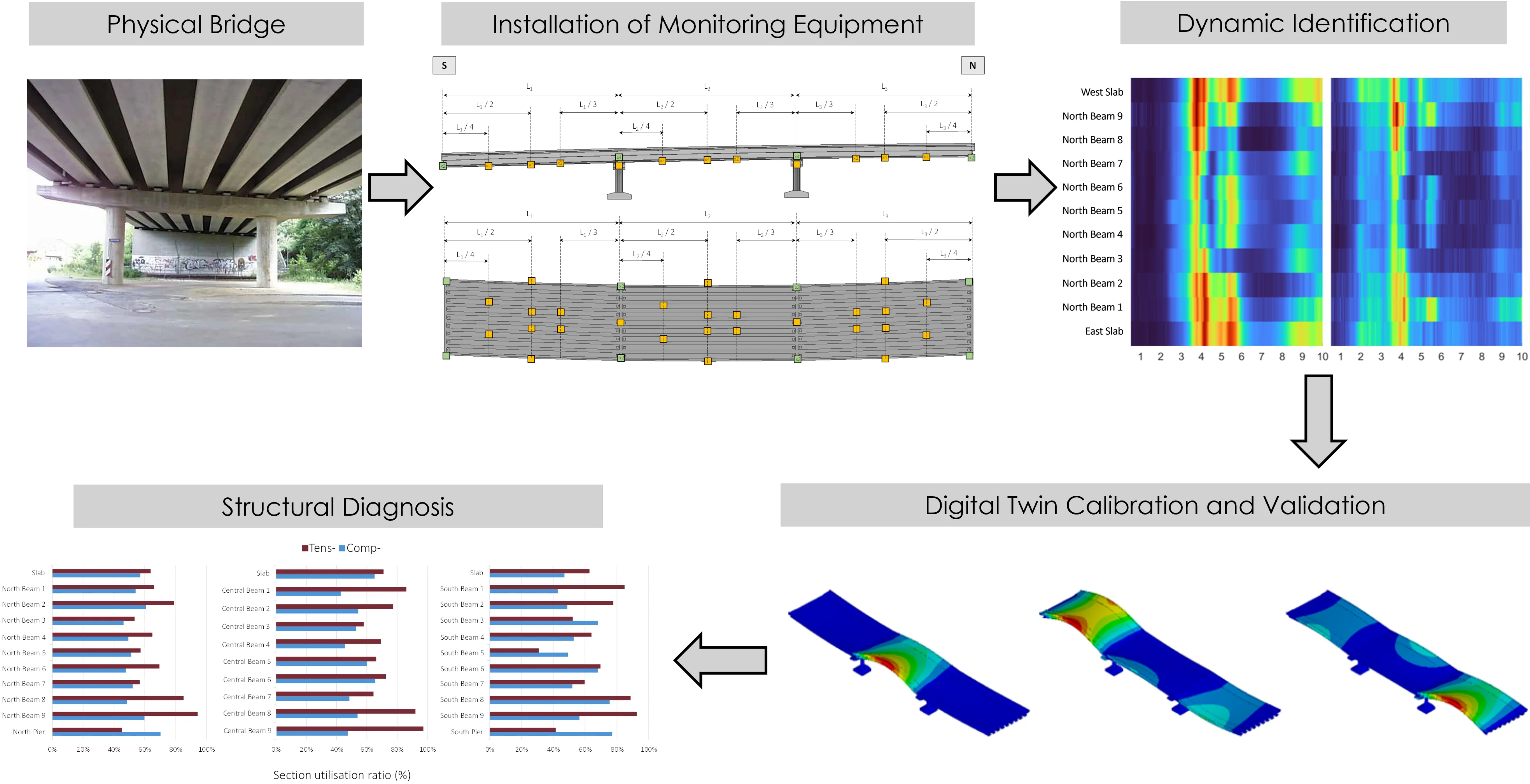
Highlights
- Digital Twin Calibration: A finite element model calibrated via a genetic algorithm using short-term dynamic monitoring achieved under 3% error between experimental and numerical eigenfrequencies
- Eurocode Safety Assessment: Code-compliant evaluations confirm ULS compliance across all spans, identifying a peak tensile utilization ratio of 97.3% in the central span's outer girder under extreme loading
- Asymmetry & Joint Anomalies: Sensor data detected lower effective stiffness in the western deck section and 0.4 mm thermal relative displacements at span joints linked to tendon degradation
- Early Damage Detection: Parametric simulations proved that loss of tendon stiffness alters natural frequencies, validating modal indicators to detect structural damage before visual defects appear
1. Introduction
1.1. Background
Bridges are critical components of modern transport infrastructure, and their structural integrity has a direct impact on public safety, economic activity, and regional development [1-3]. Traditionally, bridge condition assessment has relied on visual inspections and periodic manual measurements. Although these methods remain essential for identifying apparent defects, they are inherently limited in their ability to detect early-stage deterioration, subtle structural anomalies, or the long-term effects of dynamic loads [4-6]. Consequently, visual inspections alone may fail to reveal issues that could compromise the structure’s long-term performance.
The Spyckstraße Bridge, built in 1976, is a composite slab-girder structure spanning 92.19 m over three equal spans. As a nearly 50-year-old bridge, it currently faces increased traffic demands and stricter regulatory requirements compared to those considered in its original design.
An inspection conducted in 2022 identified multiple pathologies, including concrete degradation, corrosion affecting prestressing tendons, malfunctioning bearings, and pavement deterioration, leading to the proposal of several rehabilitation measures. In a later technical assessment carried out in 2024, fractures in prestressing tendons were detected because of water ingress, raising significant concerns regarding the remaining load-bearing capacity of the structure and its long-term serviceability.
To better characterize its structural behaviour under real operating conditions, a short-term non-destructive monitoring campaign was conducted to record its dynamic response. The collected data were used to calibrate a numerical model, refined iteratively until numerical and experimental modal frequencies agreed within a 3 % margin. This calibrated model provides a basis for assessing structural performance under current normative load scenarios and supporting maintenance decisions.
This work contributes by (i) integrating short-term monitoring data with Digital Twin calibration, (ii) establishing a relationship between modal parameters and tendon degradation, and (iii) demonstrating the capability of frequency-based indicators for early damage detection in prestressed bridge systems.
1.2. Review of the state of the art
Over the past few decades, Structural Health Monitoring has moved from a promising research topic to an essential component of modern structural management, especially in bridges. The motivation is clear: traditional inspection practices, primarily visual surveys and periodic non-destructive tests, are no longer sufficient to ensure the safety and long-term performance of aging infrastructure and the increasingly stricter regulatory requirements. As highlighted in the literature, most bridge assessments worldwide still rely on visual inspection, even though this approach is inherently limited by subjectivity, accessibility constraints, and the inability to detect early-stage or internal deterioration. Zinno et al. [7] note that “the great majority of in-service bridge data is still gathered by visual examination” a situation that leaves many subtle or evolving forms of damage undetected between inspection cycles.
These limitations have accelerated the adoption of continuous SHM systems, which combine sensors, data acquisition, and computational tools to monitor structural behaviour under real operating conditions. Rizzo and Enshaeian [8] emphasize that permanent monitoring shifts the paradigm from time-based to condition-based maintenance, allowing engineers to quantify damage as it happens, rather than after it has progressed.
Despite these advances, a key challenge remains the reliable interpretation of monitoring data through physics-based numerical models. In this context, finite element (FE) model updating has become a fundamental tool for aligning numerical predictions with experimental observations, particularly through the calibration of modal parameters such as natural frequencies and mode shapes.
1.2.1. Advances in sensing technologies
The rapid expansion of sensing technologies has been one of the main drivers of SHM’s evolution. Modern systems now incorporate a diverse suite of sensors capable of capturing strain, acceleration, displacement, temperature, humidity, corrosion, and even crack growth, directly. Kang et al. [9] provide a comprehensive overview of these developments, noting that advanced sensors, such as carbon-nanotube-based materials, piezoelectric devices, RFID tags, wireless sensor nodes, fiber-optic systems, and computer-vision platforms, enable high-resolution, real-time monitoring across large structural areas. These technologies overcome many of the limitations of traditional wired sensors, offering improved durability, reduced installation effort, and greater spatial coverage.
Furthermore, the integration of unmanned aerial vehicles (UAVs) is also one big change in SHM methodology, further expanding the monitoring toolkit [10-11]. UAV-based inspections allow engineers to rapidly collect high-quality imagery and LiDAR data over large or inaccessible bridge components, complementing ground-based measurements and reducing the need for traffic disruptions.
However, although these technologies enhance data acquisition, they do not by themselves resolve the challenge of translating measurements into reliable structural assessments, which requires robust model calibration and interpretation frameworks.
1.2.2. Artificial intelligence and data-driven SHM
The increasing availability of long-term monitoring data has opened the door to artificial intelligence (AI) and, particularly, to Machine Learning (ML) techniques. These methods excel at identifying patterns, anomalies, and trends in large, heterogeneous datasets. Zinno et al. [7] argue that AI brings capacity, flexibility, and robustness to SHM, enabling automated modal identification, anomaly detection, environmental compensation, and even prediction of remaining service life. Recent work extends beyond traditional ML models to include deep learning, computer vision, and hybrid physics-informed approaches. In parallel, the integration of SHM with Internet of Thing (IoT) platforms, drones, and digital imaging systems reflects a broader shift toward smart-city infrastructure management.
Within this landscape, the work presented by Gomez-Cabrera et al. [12] demonstrates how AI-enabled SHM can be tightly coupled with physics-based modelling to support Digital Twin development for bridges. The study shows that long-term monitoring data can be systematically fused with numerical simulations to improve damage detection, quantify deterioration, and refine structural models through automated updating procedures. By combining ML-based feature extraction with finite element-based scenario analysis, the authors illustrate how hybrid data and model workflows can identify subtle behavioural changes, distinguish environmental effects from structural anomalies, and generate reliable predictions of future performance.
Their results highlight the growing maturity of AI-assisted Digital Twins as operational tools for bridge management, capable of transforming continuous monitoring data into actionable insights for maintenance planning and life-cycle assessment.
Nevertheless, many of these approaches rely on long-term monitoring data or complex data-driven architectures, limiting their applicability in scenarios where only short-term monitoring campaigns are feasible. Furthermore, the practical integration of calibrated numerical models into structural capacity assessment under different load conditions remains insufficiently addressed in the literature.
1.2.3. Short-term monitoring for Digital Twin calibration in prestressed concrete bridges
Short-term monitoring has traditionally been less prevalent than long-term monitoring in bridge SHM, largely because prestressed concrete bridges are typically assessed through continuous data streams that capture environmental and operational variability [13]. However, recent research has demonstrated that short-term, high-fidelity dynamic measurements are becoming a key procedure for the initial calibration of Digital Twins, as they provide modal parameters with minimal environmental interference and allow controlled excitation conditions. In particular, several studies have shown that metaheuristic optimisation techniques, such as Particle Swarm Optimization (PSO) and Genetic Algorithms (GA), can efficiently calibrate finite element models using short-term vibration data. Marton et al. [14] successfully applied PSO to calibrate the Digital Twin of a cable-stayed bridge, achieving a close match between measured and numerical eigenfrequencies and demonstrating the suitability of short-term campaigns for DT updating. More broadly, optimisation-based calibration frameworks are gaining traction across Digital Twin applications, with GA-based strategies proving effective in aligning simulated and measured system responses [13]. Despite these advances, the combined use of short-term monitoring, Digital Twin calibration, and prestressed concrete bridge assessment remains underrepresented in the literature, underscoring the need for methodologies that explicitly integrate these three components.
1.3. Paper contribution
As stated previously, the progress in SHM technologies and hybrid data–model approaches, a gap remains in the practical use of short-term monitoring data for the development of reliable, calibrated numerical models capable of supporting structural assessment of aging bridges under current design standards.
To address this gap, this work presents a structured methodology for the calibration of a numerical model based on short-term SHM data, applied to the Spyckstraße Bridge. The proposed approach combines targeted dynamic monitoring, modal identification, and iterative model updating using a genetic algorithm, achieving discrepancies below 3 % between experimental and numerical eigenfrequencies.
In contrast to studies focused exclusively on dynamic identification, the calibrated model is further employed to evaluate structural performance under code-based load combinations, enabling the computation of sectional utilisation ratios and the assessment of structural safety margins.
Additionally, parametric analyses are conducted to simulate tendon deterioration scenarios, allowing the investigation of their impact on both modal properties and structural capacity.
Overall, this work demonstrates that short-term SHM campaigns, when combined with rigorous model calibration techniques, can provide a practical and reliable framework for structural assessment and maintenance decision-making in aging bridge infrastructure.
Preliminary results of this study were partially presented in previous conference contributions [15, 16]. The present manuscript significantly extends those works by incorporating an improved Digital Twin calibration and extended monitoring data.
2. Strategic installation of monitoring equipment
The Spyckstraße Bridge (Fig. 1), constructed in 1976, has an overall length of 92.19 m and is arranged in three identical spans of 30.73 m each. The superstructure is composed of a slab-girder composite system formed by nine prestressed concrete beams, each incorporating eight longitudinal tendons. A transversely prestressed deck slab completes the system, resulting in a total structural depth of 1.40 m.
The structure is segmented by four transverse joints, located at the abutments and at the interfaces between adjacent spans. To control horizontal displacements, pre-curved tendons were implemented within the structural system. The substructure consists of reinforced concrete abutments and two intermediate piers with circular columns. Load transfer is achieved through neoprene bearings supporting the longitudinal girders.
Fig. 1Views of the Spyckstraße bridge. by the authors, on 16.10.2024, on the Spyckstraße Road in the city of Kleve (Germany)
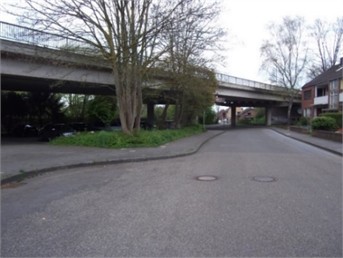
a) General view of the bridge
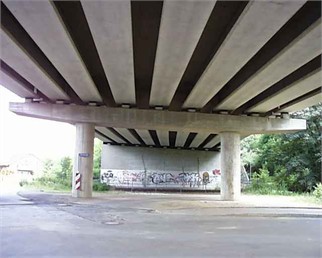
b) Underside view of the bridge
As seen in the previous section, equipment for bridge SHM has experienced a rapid evolution in recent years, driven by advances in sensing technologies, data acquisition architectures, and intelligent processing frameworks. Contemporary research highlights a broad spectrum of complementary approaches that enable both global and local assessment of structural behaviour [17, 18]. Vibration-based SHM remains a cornerstone, with high-rate accelerometers, GNSS receivers, and fiber-optic systems providing continuous measurements of modal frequencies, dynamic displacements, and environmental effects under operational loads. These sensing modalities have been successfully deployed in long-span bridges [19] where GNSS positioning, triaxial accelerometers, and integrated meteorological stations enable the extraction of modal parameters, quasi-static deformations, and load-response correlations even under adverse conditions.
Within this technological landscape, the instrumentation and acquisition architecture implemented in this project follows a non-intrusive monitoring strategy designed to capture the complete bridge’s behaviour. Vertical and horizontal accelerations and displacements were recorded at the deck, girders, and piers, together with relative movements at supports and expansion joints. Additionally, the structure’s natural frequencies and mode shapes were identified.
Control points were strategically distributed according to the bridge typology and monitoring objectives, combining fixed and mobile instrumentation to achieve a comprehensive characterization of both global bending modes and higher-order local responses.
All sensor streams feed a robust preprocessing chain that includes detrending, filtering, and time alignment, followed by time–frequency analyses such as Fast Fourier Transform (FFT), Power Spectral Density (PSD), and spectrogram-based methods to extract modal content. When fused with a calibrated Digital Twin and data-driven classifier algorithms, this methodology integrates continuous monitoring, cross-sensor correlation, and time–frequency analytics to provide a coherent and physically consistent representation of the bridge’s behaviour. The resulting framework supports early anomaly detection, scenario-based forecasting, and the definition of adaptive thresholds for structural health assessment, ensuring that the bridge’s performance is evaluated with both spatial completeness and temporal continuity.
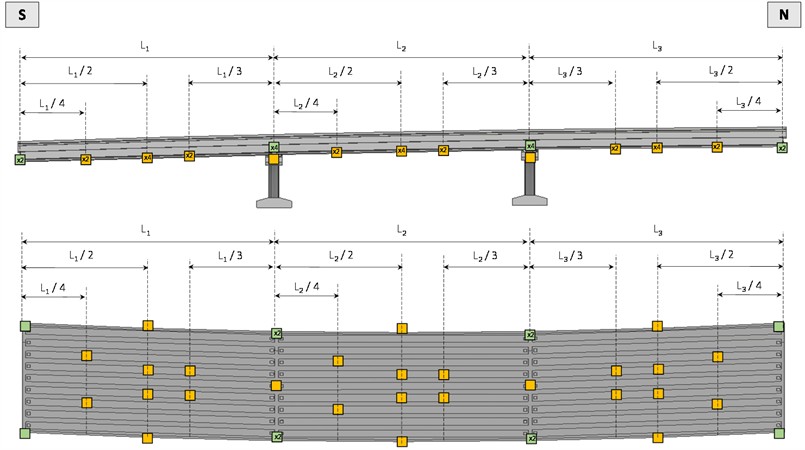
Fig. 2Scheme of fixed equipment installation on the Spyckstraße Bridge. Elevation and underside views
2.1. Monitoring equipment and sensor installation
Fixed instrumentation was installed to continuously record traffic effects and other structural actions. The monitoring system consisted of 26 inertial sensors (yellow block) and 12 displacement sensors (green block) strategically distributed across the bridge, following the distribution shown in Fig. 2. Beams are numbered 1 to 9 from East to West.
Sensor placement was additionally validated considering modal observability criteria and expected mode shape amplitudes.
Two displacement sensors were placed on each abutment to measure longitudinal displacements of the elastomeric bearings supporting girders 1 and 9 (Fig. 3). This configuration enables the assessment of expansion joint behaviour and the verification of displacement compatibility at the supports.
Fig. 3Location of displacement sensors on the abutments of the Spyckstraße bridge

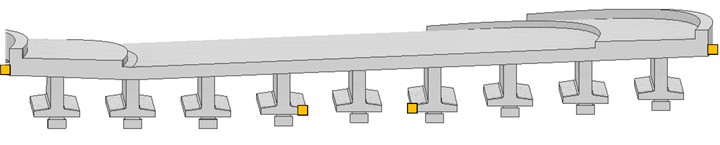
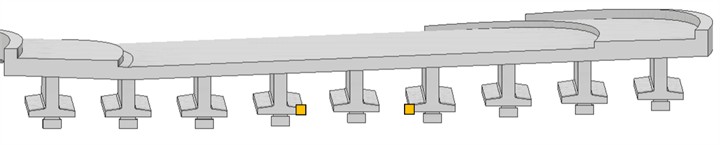
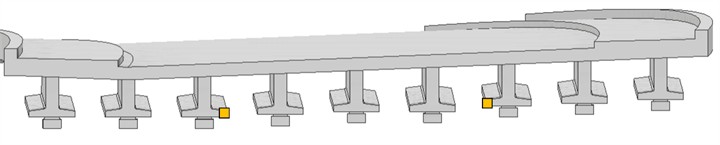
Within the three spans, sensors were distributed identically to ensure comparable measurements. Instrumentation sections were located at midspan (L/2), one-third (L/3), and one-quarter (L/4) of the span length (Fig. 4), enabling the capture of both maximum deflections and higher-order modal contributions.
Midspan sensors were used to capture maximum deflections and dominant modal responses. Accelerometers placed on central girders recorded the highest vibration amplitudes induced by traffic loads, while sensors at L/3 and L/4 positions enabled identification of higher-frequency modes and spatial variability of the dynamic response.
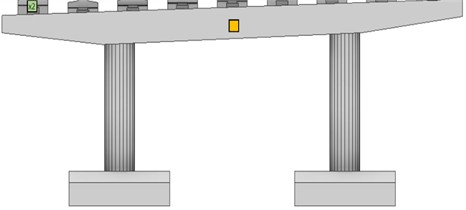
Similarly, piers were instrumented with inertial and displacement sensors (Fig. 5). Inertial sensors placed at the pier head measured three-directional accelerations, tilts and local vibrations, allowing the identification of pier-specific modal characteristics and their interaction with the superstructure. Displacement sensors monitored horizontal movements between spans and relative displacements of the neoprene bearings, supporting the detection of abnormal behaviour and the evaluation of serviceability conditions.
Fig. 4Approximate location of inertial sensors in the spans of the Spyckstraße bridge
a) Section at L/2 of the span
b) Section at L/3 of the span
c) Section at L/4 of the span
Fig. 5Approximate location of inertial and displacement sensors in the Spyckstraße bridge pier
2.2. Installation diagram for mobile equipment
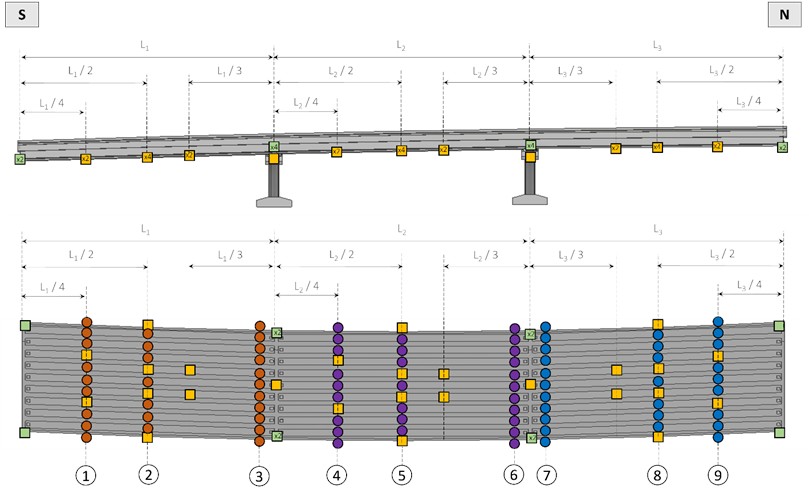
In addition to the fixed instrumentation, a mobile monitoring scheme was implemented to enhance spatial resolution. A total of 27 mobile inertial sensors were deployed to record traffic-induced structural response for approximately one hour in each monitored section, as illustrated in Fig. 6.
The mobile sensors were positioned across all girders and deck sections, including locations at L/2, L/3, L/4, and near supports. This approach enabled a dense spatial sampling of the structural response without increasing the permanent instrumentation complexity.
The combination of fixed and mobile measurements provides complementary datasets: fixed sensors ensure temporal continuity, while mobile sensors improve spatial coverage. This dual strategy enhances the robustness of modal identification and supports the calibration and validation of the numerical model.
Fig. 6Mobile equipment installation scheme on the Spyckstraße Bridge. Elevation and underside views
2.3. Data processing and modal identification
Recorded signals were processed using standard signal processing techniques to extract relevant dynamic information. Preprocessing included detrending, filtering, and synchronization of sensor data.
Power spectral densities (PSD) were computed using Welch’s method, and modal frequencies were identified through peak-picking procedures. Time–frequency analyses, including spectrograms, were used to evaluate the stability of modal parameters under varying traffic conditions.
The extracted modal properties were subsequently used for the calibration and validation of the numerical model, providing a consistent link between experimental observations and structural simulation.
3. Digital Twin calibration and validation
The numerical model of the Spyckstraße Bridge constitutes the core of the proposed methodology, acting as a reference system for the interpretation of the monitoring data. Unlike a purely descriptive numerical model, the Digital Twin is conceived as an adaptive representation whose parameters are continuously updated based on experimental observations.
The model was developed using a detailed finite element (FE) formulation and subsequently refined through a data-driven calibration process. Experimental modal parameters extracted from acceleration records were used as calibration targets, ensuring that the model reproduces the measured dynamic behaviour of the structure.
Once calibrated, the Digital Twin defines the baseline structural state and establishes admissible ranges for key indicators, including natural frequencies, mode shapes, and displacement responses.
3.1. Numerical model calibration
The objective of the calibration process is to minimise the discrepancy between the numerical model and the experimentally identified dynamic behaviour of the bridge.
The structural response is governed by the classical equation of motion Eq. (1):
where is the mass matrix, the damping matrix, the stiffness matrix, and the displacement vector associated with each degree of freedom [20].
The calibration problem is formulated as an optimisation process in which a set of mechanical parameters is iteratively updated to minimise an objective function defined in terms of modal discrepancies. The objective function is Eq. (2), expressed as a weighted error between numerical and experimental natural frequencies:
where are weighting factors assigned according to modal significance.
In the calibration process, the parameters adjusted most directly include the material density and Young’s modulus , as these govern the modal properties with greatest sensitivity [21-23]. Geometric features and boundary conditions remain fixed, as their uncertainty is comparatively low [23]. These parameters were selected based on their high sensitivity to modal properties, while geometric characteristics were kept constant due to their lower uncertainty.
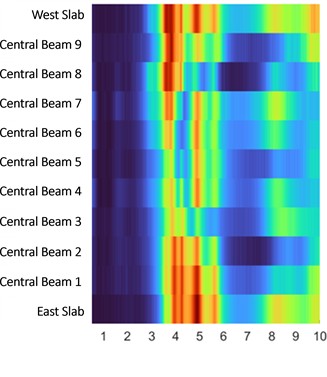
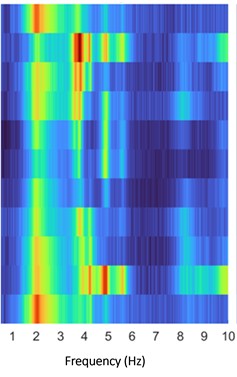
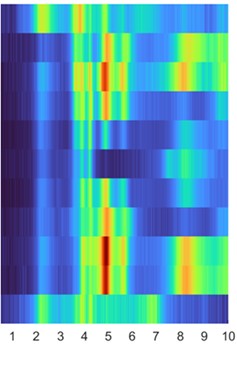
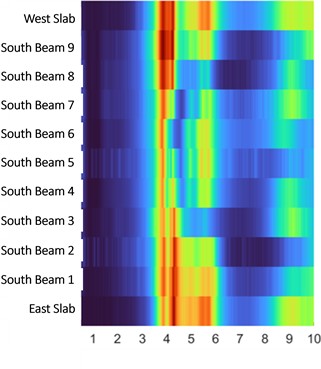
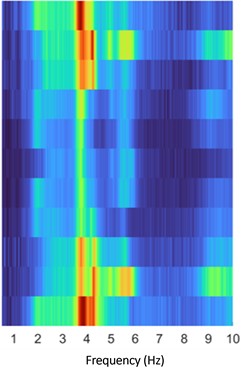
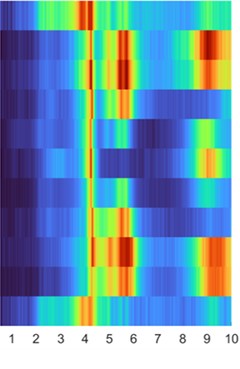
Sensor data served as the primary input for the calibration. To ensure statistical robustness, Power Spectral Density functions were computed from each acceleration record using Welch’s method, with a 16-second window and 8-second overlap, yielding a frequency resolution of 0.1 Hz. The 80 % of records exhibiting the highest cross-correlation in the 0-40 Hz range were selected for calibration. This type of filtering ensures that the modal identification relies on vibration segments where the structural response is stationary and consistently captured across sensors, which is essential for obtaining stable frequency and behaviour estimates. Records with low cross-correlation typically correspond to non-stationary events, such as heavy-truck passages, braking manoeuvres or localized disturbances, that introduce transient peaks and broadband energy not representative of the underlying modal behaviour. Although these transient responses are relevant for assessing operational performance, they do not provide reliable information for frequency-based model updating and are therefore analysed separately within the serviceability and stress-response evaluation. Mean PSD curves were then obtained for each sensor, and peak-picking algorithms were applied to identify the natural frequencies associated with the different structural components. Fig. 7, Fig. 8 and Fig. 9 illustrate the PSD results for the sensors located in the north, central and south span, respectively.
Fig. 7PSD obtained in the structural elements of the north span
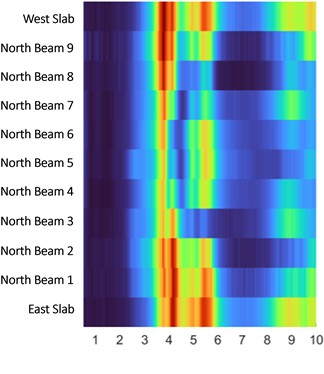
a) Vertical axis
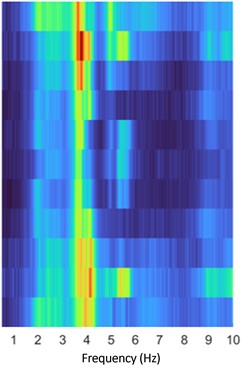
b) Longitudinal axis
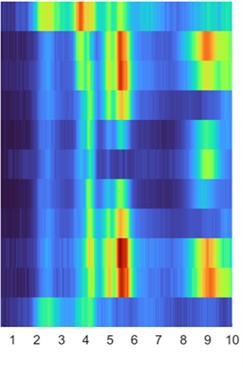
c) Transversal axis
Fig. 8PSD obtained in the structural elements of the central span
a) Vertical axis
b) Longitudinal axis
c) Transversal axis
Using this frequency information as a starting point, typical material properties were assigned to the FE model. An iterative genetic algorithm was then applied to calibrate the model until the difference between experimental and numerical eigenfrequencies fell below 3 %. The GA was implemented with a population of 60 individuals due to the relatively low number of studied parameters and up to 80 generations, using tournament selection, simulated binary crossover (probability 0.85) and polynomial mutation (probability 0.10). The objective function was defined as the weighted squared error between measured and numerical frequencies, prioritising the first modes. Convergence was reached when improvements fell below 10-4, with the final solution satisfying the 3 % threshold across all identified modes. The chosen GA parameters were initially selected by comparison with similar FEM-updating studies, such as the work of Liu et al. on the Canonica Bridge [24] or the calibration strategy proposed by Rahmat Rabi et al. for steel bridge monitoring [25] and subsequently adjusted to obtain the most accurate results for the present structure.
Fig. 9PSD obtained in the structural elements of the south span
a) Vertical axis
b) Longitudinal axis
c) Transversal axis
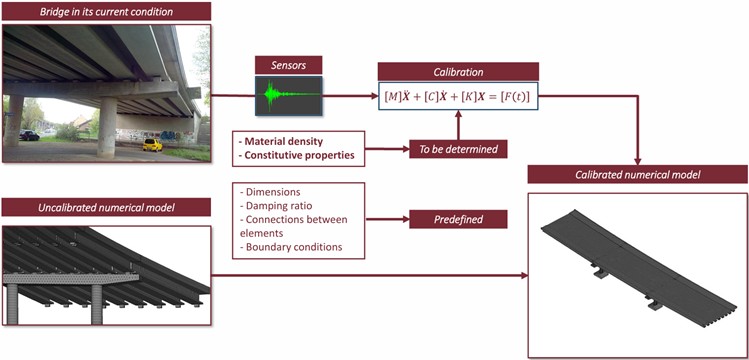
This process enabled the refinement of key mechanical properties, including the modulus of elasticity and global density for each span and pier. Soil–structure interaction was calibrated to reproduce the near-fixed behaviour observed in the monitoring data, consistent with the bridge’s low seismicity and absence of scour-related foundation flexibility. The full sequence of calibration tasks is summarized in Fig. 10.
Fig. 10Numerical model calibration process
3.2. Model validation
The validation stage evaluates the ability of the previously calibrated Digital Twin to reproduce the real structural behaviour of the Spyckstraße Bridge under operational conditions. Following the calibration of material properties, prestressing forces, and soil-structure interaction, the model was subjected to a comprehensive verification process combining boundary condition assessment, modal validation, and comparison with experimental measurements. Validation was complemented by consistency checks in spatial response patterns and displacement levels to avoid over-reliance on frequency matching alone.
Initial prestressing forces in the girders, deck, and piers were incorporated into the model, together with horizontal displacement restraints at span joints to account for tendon effects. All boundary conditions were first verified through visual inspection and subsequently validated against the monitoring data, confirming that the Digital Twin accurately represents the static constraints and deformation patterns observed in the structure. This ensured that the numerical model captured the correct global stiffness distribution and the interaction between spans, supports, and prestressed components.
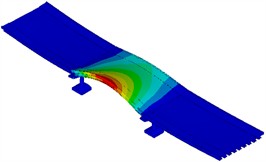
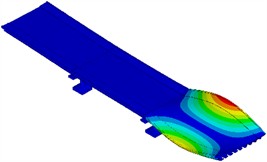
Modal validation was performed by comparing the experimentally identified natural frequencies and mode shapes with those obtained from the calibrated finite element model. Fig. 11 and Fig. 12 illustrate the deformed shapes associated with the vertical bending and torsion around the longitudinal axis modes of each span, showing a high degree of correspondence between numerical and experimental modal patterns.
Fig. 11Deformed shapes associated with the vertical bending modes of each span in the Digital Twin of the Spyckstraße Bridge
a) Central span
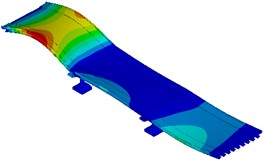
b) South span
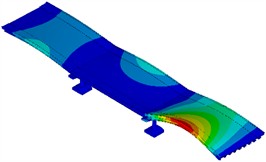
c) North span
Fig. 12Deformed shapes associated with the torsion around the longitudinal axis modes of each span in the Digital Twin of the Spyckstraße Bridge
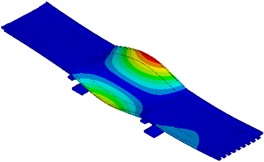
a) Central span
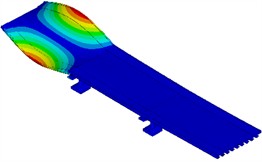
b) South span
c) North span
Table 1 summarizes the measured and simulated frequencies for the main vibration modes of the north, central, and south spans, as well as the north and south piers, together with the relative errors obtained after calibration.
Across all structural components, the discrepancies between measured and numerical frequencies remained below 3 %, with most modes exhibiting errors well under 1 %.
These results demonstrate that the Digital Twin faithfully reproduces the behaviour of the whole Spyckstraße Bridge. The validated model therefore provides a reliable reference for structural assessment, anomaly detection, and scenario-based simulations, forming a robust foundation for the bridge’s ongoing structural health monitoring strategy.
Table 1Vibration modes resulting from the calibration and validation process of the Digital Twin of the Spyckstraße Bridge
Mode | Mode description | Measured frequency (Hz) | Calibrated model frequency (Hz) | Error | |
North Span | 1 | First-order vertical bending | 3.75 | 3.79 | 0.97 % |
2 | First-order torsion around the longitudinal axis | 4.16 | 4.09 | –1.64 % | |
3 | Second-order torsion around the longitudinal axis | 5.41 | 5.57 | 2.96 % | |
Central Span | 1 | First-order vertical bending | 3.58 | 3.60 | 0.45 % |
2 | First-order torsion around the longitudinal axis | 3.82 | 3.85 | 0.83 % | |
3 | Transverse bending + first-order torsion | 4.88 | 4.90 | 0.46% | |
4 | Second-order torsion around the longitudinal axis | 5.60 | 5.47 | –2.32 % | |
South Span | 1 | First-order vertical bending | 3.85 | 3.90 | 1.21 % |
2 | First-order torsion around the longitudinal axis | 4.29 | 4.23 | –1.43 % | |
3 | Second-order torsion around the longitudinal axis | 5.74 | 5.69 | –0.89 % | |
North Pier | 1 | Longitudinal bending of the north pier | 1.96 | 1.98 | 1.13 % |
2 | Transverse bending of the north pier | 2.14 | 2.16 | 0.99 % | |
South Pier | 1 | Longitudinal bending of the south pier | 1.98 | 1.98 | 0.11 % |
2 | Transverse bending of the south pier | 2.17 | 2.16 | –0.41 % |
4. Sensory data analysis
The analysis of the monitoring data provides a comprehensive characterization of the bridge response under operational traffic conditions.
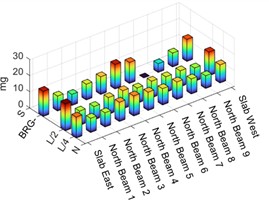
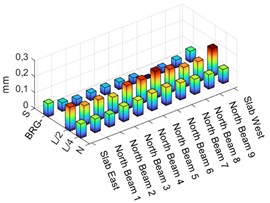
The results indicate that the structural response is dominated by vertical components, with both acceleration and displacement amplitudes consistently exceeding those recorded in the longitudinal and transverse directions. This behaviour is consistent with the expected flexural response of simply supported prestressed girders under moving loads.
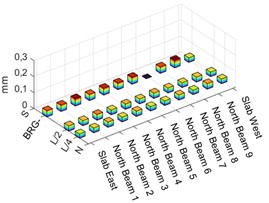
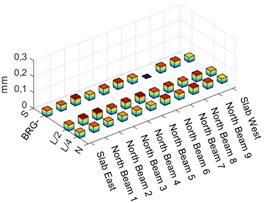
The three spans exhibit a comparable dynamic response in terms of frequency content and amplitude levels. However, a systematic increase in displacement amplitudes was observed in the western sections of the spans, suggesting a localized reduction in effective stiffness.
Although the magnitude of this variation is limited, its spatial consistency indicates that it is not attributable to measurement noise.
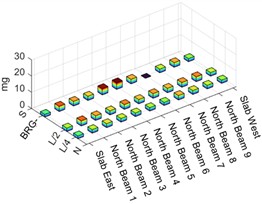
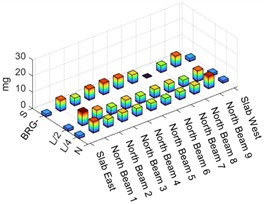
Fig. 13 and Fig. 14 illustrate the median values of maximum accelerations and displacements, respectively, obtained from the mobile sensor deployment in the north span.
The observed asymmetry between eastern and western sections suggests a non-uniform stiffness distribution along the transverse direction of the deck.
This behaviour may be associated with differences in boundary conditions, tendon efficiency, or localized material degradation.
Importantly, no abnormal amplification or modal irregularities were detected in the frequency domain, indicating that the global structural behaviour remains stable.
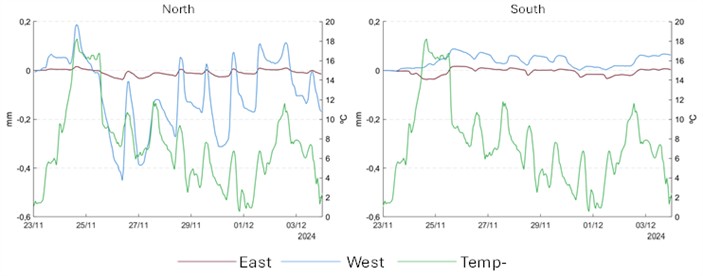
The performance of the expansion joints was assessed by analysing displacement records obtained under different environmental conditions. The results indicate that temperature-driven movements remain generally within acceptable ranges. However, certain irregularities associated with the behaviour of the tendons located at the joints suggest the need for continued monitoring.
Fig. 13Median of the maximum acceleration values recorded with the mobile sensor scheme located in the north span
a) Vertical axis
b) Longitudinal axis
c) Transversal axis
Fig. 14Median of the maximum displacement values recorded with the mobile sensor scheme located in the north span
a) Vertical axis
b) Longitudinal axis
c) Transversal axis
Measured relative displacements of approximately 0.4 mm (Fig. 15) were observed between the central and northern spans in the western slab region because of thermal variations. These movements are expected to be restrained by the joint tendons; therefore, their occurrence may point to a reduction in effectiveness, potentially linked to deterioration processes.
Fig. 15Hourly evolution of relative displacement at the joints between spans
The experimentally recorded structural response shows a strong correlation with the results obtained from the calibrated Digital Twin, especially regarding the identification of dominant vibration modes and the magnitude of displacements.
This consistency reinforces the validity of the calibration process and supports the use of the model for structural interpretation.
Based on the combined analysis of experimental data and numerical modelling, the bridge exhibits a stable structural response under current operational conditions.
No evidence of critical behaviour affecting structural safety has been identified.
However, localized stiffness variations and joint behaviour anomalies indicate the presence of minor degradation mechanisms that should be monitored over time.
5. Advanced structural diagnosis
5.1. Evaluation of regulatory combinations
A calibrated and validated finite element model is employed to evaluate the safety and functional performance of the Spyckstraße Bridge under multiple loading scenarios, including permanent actions such as self-weight, and variable actions due to traffic, snow, wind, temperature effects, and seismic loading, in accordance with DIN standards and the European Eurocodes.
The assessment corresponds to the structural state at the end of the monitoring period and considers eight governing load combinations defined in DIN EN 1990. This framework enables a comprehensive evaluation of the bridge response and provides insights into its long-term structural behaviour [22-30].
The general format for action effects was:
where represents the partial safety factors, and are characteristic values of permanent and variable actions, is the prestressing force and represents combination factors for accompanying variable actions.
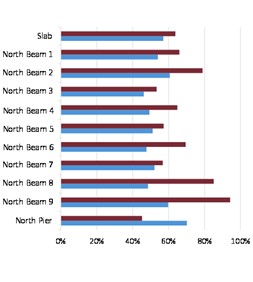
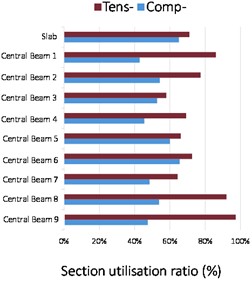
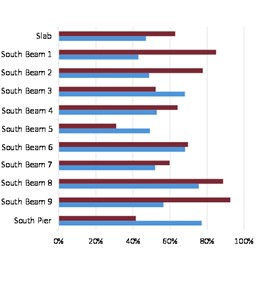
Fig. 16Maximum sectional utilisation factor under tensile and compression stresses for each structural element under combination dominated by traffic loads
a) Northern span
b) Central span
c) Southern span
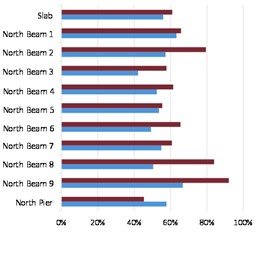
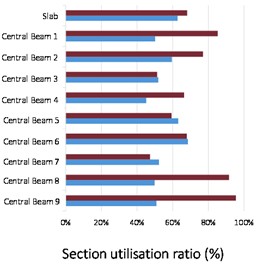
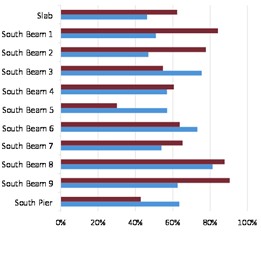
The advanced structural assessment focuses on the evaluation of stress distributions and sectional utilisation ratios in order to detect critical regions and potential early-stage deterioration mechanisms. It is important to note that the utilisation ratios reported, such as the 97.3 % obtained for the most unfavourable combination, correspond to Eurocode design scenarios, which are intentionally more demanding than the actual loads recorded during the short-term monitoring campaign. During the measurement period, neither the traffic spectrum nor the temperature range reached the extreme values prescribed by the standards; for instance, no heavy-traffic surges or peak summer thermal gradients were observed. By applying the full set of normative load combinations, the analysis captures low-probability but structurally relevant situations that may occur over the bridge’s service life, thereby revealing the true safety margin of the structure under design-level actions rather than under the milder conditions observed during monitoring. Under all analysed combinations, the structural components exhibit satisfactory performance, with no evidence of loss of cross-sectional capacity even in these most demanding scenarios, as illustrated in Fig. 16 and Fig. 17.
Among all analysed combinations, the highest compressive stresses were observed when extreme temperature-induced expansion and contraction acted as the leading variable action. The maximum section utilisation levels reached were 66.8 % in beam 9 of the north span, 68.6 % in beam 6 of the central span, and 81.3 % in beam 8 of the south span, all remaining safely below critical levels.
Fig. 17Maximum sectional utilisation factor under tensile and compression stresses for each structural element under combination dominated by temperature effects
a) Northern span
b) Central span
c) Southern span
Tensile stresses are of particular concern because they may lead to cracking in the concrete or indicate potential prestressing pathologies, such as tendon relaxation or early corrosion effects. The most significant tensile stresses occurred under combinations dominated by traffic loads and by temperature effects. The highest tensile stress utilisation ratios were observed in the western beams of all three spans, reaching 94.2 % in beam 9 of the north span, 97.3 % in beam 9 of the central span, and 92.5 % in beam 9 of the south span.
As of the monitoring date, the Spyckstraße Bridge shows no structural safety concerns under any of the considered critical loading scenarios, as confirmed by the calibrated and validated Digital Twin simulations. Nevertheless, beams exhibiting stress utilisation ratios above 80 % under extreme load scenarios, particularly beams 8 and 9 on the western side, should be subjected to closer monitoring and detailed inspections. This will help prevent the initiation or progression of damage mechanisms that could accelerate deterioration over time.
The spatial concentration of high utilisation ratios in the western side is consistent with the stiffness asymmetry previously identified in the sensor data analysis (Section 4).
At the time of the monitoring campaign, the bridge satisfies all ULS verification criteria under the considered load combinations.
However, elements with utilisation ratios above 0.80 should be considered critical from a durability and maintenance perspective, even if safety requirements are formally met.
5.2. Evaluation of deterioration of tendons connecting spans
Based on an expert report issued on January 2024 regarding the corrosion and even fracture of one of the tendons connecting the spans, a tailored simulation was conducted for the Spyckstraße Bridge. The aim was to enable early detection of tendon degradation at span joints that influence the global structural response of the bridge, thereby facilitating cost-effective maintenance planning.
This complementary analysis focused on the variation of the bridge’s natural frequencies under progressive loss of stiffness in the tendons that restrain horizontal movement between spans. Such degradation mechanisms, primarily corrosion, can reduce tendon stiffness and alter the bridge’s dynamic behaviour.
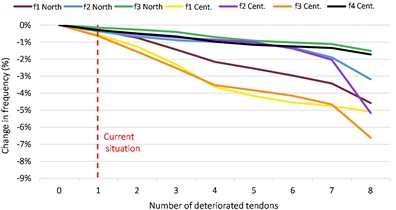
Several scenarios representing different levels of tendon stiffness reduction were simulated at each span joint. The evolution of the natural frequencies of the vibration modes identified during the Digital Twin calibration and validation was monitored. Results for the joint between the north and central spans showed that the tendon closest to the western side (adjacent to beams 9) is currently deteriorated. Hypothetical scenarios assuming further tendon degradation predicted a significant reduction in natural frequencies, altering the global response of the structure (Fig. 18). Such frequency shifts could be detected through routine frequency-based monitoring, even when visual inspection might fail to reveal damage.
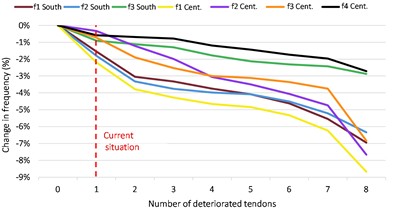
Similarly, simulations for the tendons connecting the central and south spans revealed comparable trends. In this case, the deteriorated tendon is located near beams 4. The most affected frequencies were the first vertical bending mode () of the central span and both the first vertical bending () and first torsional () modes of the south span.
The magnitude of frequency variation observed in the simulations suggests that early-stage tendon degradation can be detected through routine vibration monitoring, even before visible damage appears.
Fig. 18Variation of the natural frequencies of the different vibration modes identified as a function of the number of deteriorated tendons
a) North and central joint
b) South and central joint
Complementary stress analysis under heavy traffic loading scenarios showed that the north and south beams would exceed their load-carrying capacity if four tendons became ineffective, whereas the central span would reach failure at the loss of only three tendons, regardless of whether the damage occurs at the north or south joint (Fig. 19). This demonstrates a non-linear degradation of structural capacity, with critical thresholds depending on span location. In this study, “failure” is defined as the point at which the affected section reaches a sectional utilization ratio of more than 100 %, meaning that the combined axial-flexural demand equals or exceeds the available ultimate capacity of the studied piece.
Fig. 19Percentage of sectional utilisation in tensile and compression stresses of the under combination dominated by traffic loads, as a function of the number of deteriorated tendons
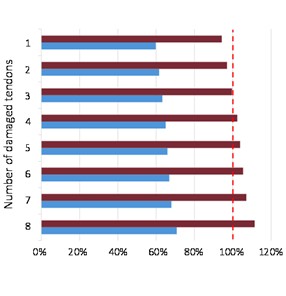
a) Northern span
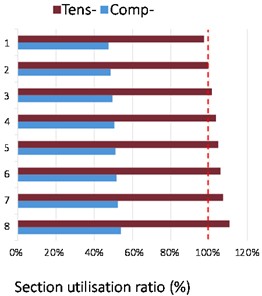
b) Central span
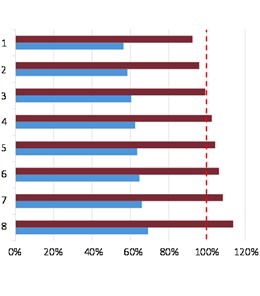
c) Southern span
This study complements the normative load-combination evaluation by providing an integrated understanding of risks associated with the progressive degradation of key bridge components. These results highlight the need for continuous monitoring of tendon performance and justify preventive interventions to mitigate the impact of such deterioration on the global bridge response. The results support the implementation of frequency-based monitoring as an effective tool for early damage detection in prestressed bridges.
6. Conclusions
This study presents an integrated methodology for the structural diagnosis of the Spyckstraße Bridge based on field monitoring and Digital Twin modelling.
The proposed approach combines targeted sensor deployment, data-driven model calibration, and advanced numerical analysis to provide a consistent interpretation of the bridge behaviour under operational conditions.
The calibration of the Digital Twin using experimental modal data resulted in a high level of agreement between numerical and measured responses, with frequency discrepancies below 3 %.
This confirms the capability of the model to represent the global dynamic behaviour of the structure with sufficient accuracy for structural assessment purposes.
The analysis of monitoring data revealed a predominantly vertical structural response and identified a systematic stiffness asymmetry in the western section of the deck, which is consistent with the distribution of stress utilisation obtained from numerical simulations.
Measured relative displacements at span joints, reaching approximately 0.4 mm, indicate a partial loss of effectiveness in the tendon system, supporting previous inspection findings of tendon damage.
This result highlights the ability of the proposed methodology to detect local anomalies through combined static and dynamic indicators.
The structural verification under Eurocode-based load combinations shows that the bridge satisfies ultimate limit state requirements, although reduced safety margins were identified in specific elements, particularly in the western girders.
A parametric analysis of tendon degradation demonstrated that progressive loss of tendon stiffness produces measurable reductions in natural frequencies, with clear sensitivity in dominant bending and torsional modes. This establishes vibration-based indicators as effective tools for the early detection and localisation of tendon deterioration.
Overall, the results confirm that the bridge is currently in a satisfactory structural condition within the scope of the analysed monitoring period.
However, the presence of localised anomalies and the sensitivity of the structural response to tendon degradation underline the need for continuous monitoring.
The main contribution of this work lies in demonstrating that the integration of Digital Twin models with vibration-based monitoring enables not only structural assessment but also early-stage damage detection in prestressed bridge systems.
References
-
Z. Zhou, J. Alcalá, and V. Yepes, “Environmental, economic and social impact assessment: Study of bridges in China’s five major economic regions,” International Journal of Environmental Research and Public Health, Vol. 18, No. 1, p. 122, 2020, https://doi.org/10.3390/ijerph18010122
-
M. Salamak and K. Fross, “Bridges in urban planning and architectural culture,” Procedia Engineering, Vol. 161, pp. 207–212, 2016, https://doi.org/10.1016/j.proeng.2016.08.530
-
K. Anastasiades, J. Blom, M. Buyle, and A. Audenaert, “Translating the circular economy to bridge construction: Lessons learnt from a critical literature review,” Renewable and Sustainable Energy Reviews, Vol. 117, p. 109522, 2019, https://doi.org/10.1016/j.rser.2019.109522
-
S. S. Saidin, A. Jamadin, S. Abdul Kudus, N. Mohd Amin, and M. A. Anuar, “An overview: The application of vibration-based techniques in bridge structural health monitoring,” International Journal of Concrete Structures and Materials, Vol. 16, No. 1, 2022, https://doi.org/10.1186/s40069-022-00557-1
-
B. A. Graybeal, B. M. Phares, D. D. Rolander, M. Moore, and G. Washer, “Visual inspection of highway bridges,” Journal of Nondestructive Evaluation, Vol. 21, No. 3, pp. 67–83, 2003, https://doi.org/10.1023/a:1022508121821
-
F. C. Lea and C. R. Middleton, “Reliability of visual inspection of highway bridges,” CUED/D STRUCT/TR.201, University of Cambridge, 2002.
-
R. Zinno, S. S. Haghshenas, G. Guido, and A. Vitale, “Artificial intelligence and structural health monitoring of bridges: A review of the state-of-the-art,” IEEE Access, Vol. 10, pp. 88058–88078, Aug. 2022, https://doi.org/10.1109/access.2022.3199443
-
P. Rizzo and A. Enshaeian, “Challenges in bridge health monitoring: A review,” Sensors, Vol. 21, No. 13, p. 4336, Jun. 2021, https://doi.org/10.3390/s21134336
-
X. Kang et al., “A concise review of state-of-the-art sensing technologies for bridge structural health monitoring,” Sensors, Vol. 25, No. 17, p. 5460, Sep. 2025, https://doi.org/10.3390/s25175460
-
S. Sreenath, H. Malik, N. Husnu, and K. Kalaichelavan, “Assessment and use of unmanned aerial vehicle for civil structural health monitoring,” Procedia Computer Science, Vol. 170, pp. 656–663, Apr. 2020, https://doi.org/10.1016/j.procs.2020.03.174
-
D. S. Gadiraju, S. E. Azam, and D. Khazanchi, “SHM-traffic: DRL and transfer learning based UAV control for structural health monitoring of bridges with traffic,” IEEE Access, Vol. 13, pp. 6166–6179, 2025, https://doi.org/10.1109/access.2025.3526193
-
A. Gomez-Cabrera and P. J. Escamilla-Ambrosio, “Review of machine-learning techniques applied to structural health monitoring systems for building and bridge structures,” Applied Sciences, Vol. 12, No. 21, p. 10754, 2022, https://doi.org/10.3390/app122110754
-
S. Wu, “Long-term monitoring of externally prestressed concrete bridges using semi-closed elasto-magnetic sensors,” Journal of Infrastructure Intelligence and Resilience, Vol. 5, No. 1, p. 100182, Oct. 2025, https://doi.org/10.1016/j.iintel.2025.100182
-
M. Marton, M. Sokol, J. García-Sanz-Calcedo, G. Sánchez-Barroso, and J. Gonzálezdomínguez, “Digital twin of bridge calibrated by the PSO method,” Slovak Journal of Civil Engineering, Vol. 33, No. 3, pp. 62–71, Sep. 2025, https://doi.org/10.2478/sjce-2025-0021
-
J. Maldonado, S. Mateo, L. Andrés, and A. Miralles, “Digital twin-based structural health monitoring of Spyckstrasse bridge in Germany,” E-Journal of Nondestructive Testing, Vol. 31, No. 2, 2026, https://doi.org/10.58286/32509
-
J. Cano, J. Real, J. R. Torregrosa, and J. Pavón, “Monitoring and structural health diagnosis of the Spyckstraße bridge in Kleve,” in Proceedings of the 27th Mathematical Modelling in Engineering and Human Behaviour Congress, pp. 208–215, 2025.
-
J. Xin, Y. Jiang, J. Zhou, L. Peng, S. Liu, and Q. Tang, “Bridge deformation prediction based on SHM data using improved VMD and conditional KDE,” Engineering Structures, Vol. 261, p. 114285, 2022, https://doi.org/10.1016/j.engstruct.2022.114285
-
G.-Q. Zhang, B. Wang, J. Li, and Y.-L. Xu, “The application of deep learning in bridge health monitoring: A literature review,” Advances in Bridge Engineering, Vol. 3, No. 1, 2022, https://doi.org/10.1186/s43251-022-00078-7
-
Y. Xie, X. Meng, D. T. Nguyen, Z. Xiang, G. Ye, and L. Hu, “A discussion of building a smart SHM platform for long-span bridge monitoring,” Sensors, Vol. 24, No. 10, p. 3163, May 2024, https://doi.org/10.3390/s24103163
-
J. Liu, “Modal analysis of bleed air system based on NASTRAN,” in Proceedings of the 5th International Conference on Advanced Design and Manufacturing Engineering, pp. 272–277, Nov. 2015, https://doi.org/10.2991/icadme-15.2015.54
-
M. Fawad et al., “Automation of structural health monitoring (SHM) system of a bridge using BIMification approach and BIM-based finite element model development,” Scientific Reports, Vol. 13, No. 1, 2023, https://doi.org/10.1038/s41598-023-40355-7
-
S. Cattari et al., “Calibration of numerical models to support SHM: The Consoli Palace of Gubbio, Italy,” in Proceedings of the 8th International Conference on Computational Methods in Structural Dynamics and Earthquake Engineering (COMPDYN 2015), pp. 3778–3794, Jun. 2021, https://doi.org/10.7712/120121.8746.19251
-
D. Uglešić and A. Uglešić, “Case studies of structural natural frequencies assessment and application in SHM and the calibration of FEM models,” in 1st Croatian Conference on Earthquake Engineering, pp. 1345–1356, 2021, https://doi.org/10.5592/co/1crocee.2021.200
-
T. Liu, Q. Zhang, T. Zordan, and B. Briseghella, “Finite element model updating of Canonica bridge using experimental modal data and genetic algorithm,” Structural Engineering International, Vol. 26, No. 1, pp. 27–36, 2018, https://doi.org/10.2749/101686616x14480232444405
-
R. Rahmat Rabi and G. Monti, “Genetic algorithm-based model updating in a real-time digital twin for steel bridge monitoring,” Applied Sciences, Vol. 15, No. 8, p. 4074, 2025, https://doi.org/10.3390/app15084074
-
A. Guan et al., “Dynamic simulation and parameter calibration-based experimental digital twin platform for heat-electric coupled system,” IEEE Transactions on Sustainable Energy, Vol. 17, No. 2, pp. 1132–1145, 2025, https://doi.org/10.1109/tste.2025.3609042
-
“DIN EN 1990: Eurocode – basis of structural design,” Beuth Verlag, Berlin, Germany, 2002.
-
“DIN EN 1991-1-1: Eurocode 1 – actions on structures. Part 1-1: general actions. Dead loads, imposed loads,” Beuth Verlag, Berlin, Germany, 2002.
-
“DIN EN 1991-1-3: Eurocode 1 – actions on structures. Part 1-3: snow loads,” Beuth Verlag, Berlin, Germany, 2003.
-
“DIN EN 1991-1-4: Eurocode 1 – actions on structures. Part 1-4: wind actions,” Beuth Verlag, Berlin, Germany, 2005.
-
“DIN EN 1991-1-5: Eurocode 1 – actions on structures. Part 1-5: thermal actions,” Beuth Verlag, Berlin, Germany, 2005.
-
“DIN EN 1991-2: Eurocode 1 – actions on structures. Part 2: traffic loads on bridges,” Beuth Verlag, Berlin, Germany, 2003.
-
“DIN EN 1992-1-1: Eurocode 2 – design of concrete structures. Part 1-1: general rules and rules for buildings,” Beuth Verlag, Berlin, Germany, 2004.
-
“DIN EN 1992-2: Eurocode 2 – design of concrete structures. Part 2: concrete bridges,” Beuth Verlag, Berlin, Germany, 2005.
-
“DIN EN 1998-2: Eurocode 8 – design of structures for earthquake resistance. Part 2: bridges,” Beuth Verlag, Berlin, Germany, 2005.
About this article

The authors have not disclosed any funding.
The datasets generated during and/or analyzed during the current study are available from the corresponding author on reasonable request.
José Cano: resources, project administration, investigation. Javier Maldonado: data curation, software, visualization, original draft preparation. Teresa Real: investigation, validation, review and editing. Julia Real: conceptualization, methodology, supervision, review and editing.
The authors declare that they have no conflict of interest.

