Abstract
The article is devoted to the problem of vibration protection of main oil pipeline pumping equipment using vibration isolators with quasi-zero stiffness (QZS). The operation of centrifugal pumps at oil pumping stations generates significant dynamic loads transmitted to foundations and adjacent structures, leading to accelerated wear, reduced reliability, and increased construction costs due to the necessity of massive foundations. The theoretical foundations of QZS systems are presented, including the principle of combining positive and negative stiffness elements to achieve a near-zero effective stiffness region while maintaining high static load-bearing capacity. A mathematical model of a proposed QZS vibration isolator based on disk springs (Belleville washers) is developed, and the conditions for achieving the quasi-zero stiffness regime are derived. The force transmissibility analysis demonstrates that QZS isolators with natural frequencies below 1 Hz can reduce transmitted dynamic forces by orders of magnitude compared to conventional rubber or spring mounts. A practical calculation of foundation concrete volume reduction is performed for a NM 10000-210 pump unit, showing that the application of QZS isolators can decrease the required foundation volume by more than 60 %. The results confirm the high efficiency and economic feasibility of QZS vibration isolators for oil pipeline pumping stations, compressor stations, and other industrial equipment in the oil and gas industry.
1. Introduction
Oil pipeline transportation is one of the most critical components of the modern energy infrastructure, providing reliable and cost-effective delivery of crude oil and petroleum products over long distances. The main pumping stations (MPS) of oil pipelines are equipped with centrifugal pumping units that generate significant dynamic loads during operation. These dynamic loads arise primarily from the residual imbalance of rotating parts (rotors, impellers), hydraulic pulsations in the pumping and discharge pipelines, as well as from various transient processes associated with starting, stopping, and regulation of pumping modes. The vibration generated by pumping units is transmitted through foundations to building structures, causing accelerated fatigue, cracking of concrete, and deterioration of operational conditions for personnel and sensitive equipment.
The traditional and most widely used approach to mitigate vibration effects in industrial practice is the construction of massive foundations under vibrating equipment. According to the applicable design codes [1, 2], the foundation under a pump unit must satisfy strength conditions that account for both static and dynamic loads. Since the dynamic component can significantly exceed the static weight of the equipment, the required foundation mass and volume become substantial. For example, for a pump unit NM 10000-210 with a mass of 34,850 kg, the dynamic load transmitted to the foundation at rigid mounting can reach 723 kN, which is significantly greater than the static load of 453 kN [3]. This necessitates the construction of foundations with a concrete volume exceeding 60 m³, which leads to significant economic costs and increased construction timelines.
As early as the 1930s, the P. L. Kapitsa noted that massive foundations under vibrating machinery are often not only unnecessary but can be harmful, as they effectively transmit vibration to building structures and can lead to resonance phenomena [4]. He proposed the use of properly designed vibration isolators to decouple equipment from foundations, thereby reducing both the dynamic loads on the foundation and the vibration transmitted to the building. This idea, while well established in vibration engineering theory, has not been widely adopted in the practice of oil pipeline pumping station construction, despite its evident economic and technical advantages.
The effectiveness of vibration isolation is fundamentally limited by the natural frequency of the isolation system. For a linear passive isolator, effective vibration reduction is achieved only when the excitation frequency exceeds the natural frequency by a factor of the square root of two. Since the rotation frequencies of modern pump rotors typically range from 25 to 75 Hz (1,500 to 4,500 rpm), conventional rubber or spring mounts with natural frequencies of 5-15 Hz provide limited isolation efficiency. Moreover, the presence of pipeline connections with their inherent stiffness further raises the effective natural frequency of the isolated system, often negating the benefits of vibration isolation entirely.
These limitations can be overcome through the use of vibration isolators with quasi-zero stiffness (QZS) [5, 6]. QZS systems are designed to combine high static stiffness, ensuring adequate load-bearing capacity and minimal static deflection, with very low dynamic stiffness in the operating displacement range. This is achieved by combining positive stiffness elements (such as linear springs or elastic supports) with negative stiffness elements (such as buckled beams, pre-compressed springs, or magnetic mechanisms) in a carefully balanced configuration. The resulting system exhibits a near-zero effective stiffness in a specified displacement range, leading to an extremely low natural frequency (below 1 Hz) and, consequently, high vibration isolation efficiency across the entire operating frequency range of pumping equipment.
The present article is dedicated to the theoretical analysis and practical evaluation of QZS vibration isolators for the protection of oil pipeline pumping equipment. The mathematical model of a QZS isolator based on disk springs is developed, the force transmissibility is analyzed, and the economic effect of foundation mass reduction is estimated for a typical pumping unit configuration. The results demonstrate that QZS vibration isolators represent a highly effective and economically feasible solution for vibration protection in the oil and gas transportation industry.
2. Theoretical foundations of quasi-zero stiffness systems
The concept of quasi-zero stiffness was first systematically formulated by Alabuzhev and co-authors [5], who demonstrated that mechanical systems with a specific combination of positive and negative stiffness elements can exhibit a region of near-zero effective stiffness while maintaining the ability to support a static load. The fundamental principle is illustrated in Fig. 1. Consider a system consisting of two parallel force-generating elements: element 1 with a positive stiffness characteristic and element 2 with a negative stiffness characteristic . The total restoring force of the system is the sum of these two characteristics.
The positive stiffness element is typically a linear or weakly nonlinear elastic component, such as a helical spring or elastic support, whose force increases with displacement. The negative stiffness element is a mechanism designed to generate a force that decreases with displacement (or, equivalently, a force with a negative slope in the force-displacement diagram). Negative stiffness can be realized through various physical mechanisms, including buckled beams under axial compression [7, 8], pre-compressed inclined springs [6], magnetic repulsion between permanent magnets [9], and disk springs (Belleville washers) operating in their post-critical deformation regime [10].
Fig. 1Formation of quasi-zero stiffness force characteristic: a) Component force characteristics; b) resulting QZS characteristic
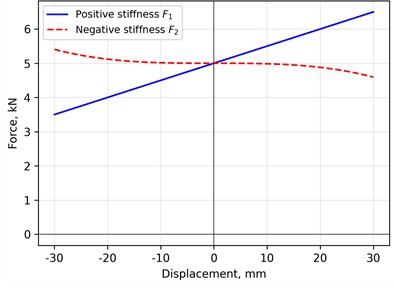
a) Comparison force characteristics
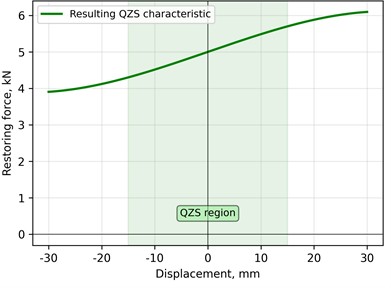
b) Combined quasi-zero stiffness characteristic
For a system to exhibit quasi-zero stiffness, the following conditions must be satisfied at the static equilibrium position corresponding to the supported load . The total restoring force must equal the load:
The effective stiffness, defined as the derivative of the total force with respect to displacement, must be zero or very small in the vicinity of the equilibrium position:
When condition Eq. (2) is satisfied, the natural frequency of the isolated system becomes extremely low, since the natural frequency is proportional to the square root of the effective stiffness divided by the supported mass. This low natural frequency ensures that the excitation frequency of the vibrating equipment (typically 25-50 Hz) falls deep within the effective isolation region, where the force transmissibility is significantly less than unity.
A particularly convenient mathematical model for the force characteristics of QZS systems is based on a cubic polynomial approximation. In this model, the positive stiffness element is represented by a linear spring with stiffness , and the negative stiffness element is represented by a cubic nonlinear characteristic with coefficient :
where is the positive stiffness coefficient (N/m), is the negative stiffness coefficient (N/m3), and is the displacement from the equilibrium position. The effective stiffness of this system is:
At the equilibrium position ( 0), the effective stiffness equals , which would normally be the stiffness of the positive element alone. However, by selecting the geometry of the negative stiffness mechanism such that the linear term of its expansion around the equilibrium position exactly cancels the positive stiffness , one obtains the quasi-zero stiffness condition. This requires careful design of the negative stiffness mechanism, which typically involves pre-loading its elements to an appropriate initial state [11, 12].
3. Dynamic loads from main oil pipeline pumping units
To quantify the vibration problem and evaluate the effectiveness of various vibration protection strategies, it is necessary to characterize the dynamic loads generated by main pumping units. As a representative example, consider the pump unit NM 10000-210 driven by an electric motor STDP-6300-2B, which is widely used at oil pumping stations of main oil pipelines. The total mass of the unit is 34,850 kg, and the mass of the pump rotor is approximately 9,000 kg. The nominal rotation speed is 3,000 rpm, corresponding to an excitation frequency of 50 Hz [3].
According to the Russian design code SP 26.13330.2012 [2], which specifies the requirements for foundations of machines with dynamic loads, the dynamic force transmitted to the foundation at rigid mounting is determined as:
where is the reliability coefficient for the dynamic load (taken as 4 for pump units of this class), is the dynamic load coefficient (taken as 10), is the proportionality coefficient characterizing the residual imbalance of the rotor (typically 0.15-0.25), and is the weight of the rotor (N). For the considered pump unit with 9,000×9.81 = 88,290 N and 0.2, the dynamic force at rigid mounting is:
This value is remarkably large, exceeding the static load ( 341.8 kN) by a factor of approximately 2. The total force acting on the foundation thus reaches approximately 1,048 kN, which necessitates a massive and expensive foundation. The design of the foundation must satisfy the strength condition [1, 2]:
where is the average pressure under the foundation base, and are the coefficients for dynamic loads, is the force transmission coefficient of the vibration isolation system ( 1 for rigid mounting), is the area of the foundation base, and is the design resistance of the soil base. When vibration isolators are installed between the equipment and the foundation, the dynamic force transmitted to the foundation is reduced by the factor , leading to a significant reduction in the required foundation dimensions and concrete volume [3].
The vibration spectrum of main pumping units is dominated by the rotation frequency and its harmonics (1x, 2x, 3x the rotation speed), as well as by hydraulic pulsations at the blade passing frequency of the pump impeller and at the frequency of the discharge pipe standing waves. The frequency range of significant vibration components typically spans from 1 Hz (due to flow instabilities and turbulence) to 500 Hz (higher harmonics of blade passing). The most energetic components, however, are concentrated in the range of 10-100 Hz, which is precisely the range where conventional vibration isolators are least effective due to their relatively high natural frequencies.
4. Mathematical Model of QZS vibration isolator based on disk springs
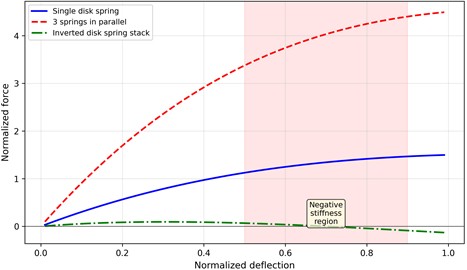
Among the various designs of negative stiffness mechanisms, disk springs (Belleville washers) offer particular advantages for industrial vibration isolation applications, including compactness, high load-bearing capacity, ease of parameter adjustment, and reliability under harsh operating conditions [10, 13]. A disk spring is a conical-shaped annular disk that, when loaded axially, can exhibit a nonlinear force-displacement characteristic with a region of negative slope (negative stiffness) beyond a critical deflection point.
The force-deflection relationship of a single disk spring is described by the Almen-Laszlo formula [14]:
where is the Young modulus of the spring material, is the thickness of the disk spring, is the outer diameter, is the internal cone height (deflection to flat), is the axial deflection, and is a coefficient depending on the ratio of the outer to inner diameters. For a typical ratio / = 2, 0.69. The characteristic feature of the disk spring is that for √2, the force-deflection curve exhibits a maximum followed by a region of decreasing force (negative stiffness), which can be exploited for the construction of QZS systems.
Fig. 2Force-displacement characteristics of disk spring (Belleville washer) configurations
The proposed QZS vibration isolator design (Fig. 3) consists of three main components: (1) a central positive stiffness element, which is a linear helical spring or elastic support that carries the static load of the equipment; (2) two sets of disk springs arranged symmetrically, which serve as the negative stiffness corrector; and (3) an outer casing that houses the entire assembly and provides the structural framework. The positive spring and the disk spring assemblies are connected in parallel between the equipment base and the foundation, so that their forces add.
Fig. 3Schematic diagram of QZS vibration isolator based on disk springs (Belleville washers)
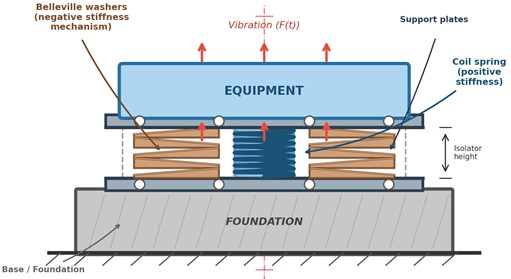
The operating principle of the QZS isolator is as follows. The positive stiffness spring is pre-compressed to support the static weight of the equipment at the nominal equilibrium position. The disk spring assemblies are pre-loaded to a deflection corresponding to the region of maximum negative slope on their force-displacement characteristic (point of inflection). At this operating point, the negative stiffness of the disk springs approximately cancels the positive stiffness of the linear spring, resulting in a near-zero effective stiffness of the combined system.
The total restoring force of the QZS isolator is:
where is the stiffness of the positive element (linear spring) and is the force generated by the negative stiffness corrector (disk springs). Expanding in a Taylor series around the equilibrium position 0, and keeping terms up to the third order, one obtains:
where 0 is the magnitude of the negative linear stiffness of the disk spring assembly at the operating point, and 0 is the coefficient of the nonlinear (hardening) restoring term. The condition for achieving quasi-zero stiffness is:
When this condition is satisfied, the total restoring force becomes:
The effective stiffness is zero at the equilibrium position and increases quadratically with displacement. This is a characteristic feature of QZS systems, which provides stability (the system returns to equilibrium for small perturbations) while maintaining extremely low dynamic stiffness in the operating range. The natural frequency of the system at small amplitudes is proportional to the square root of the effective stiffness, and can be designed to be well below 1 Hz [10, 15].
The practical procedure for designing a QZS isolator for a given application involves the following steps. First, the required load capacity is determined based on the weight of the equipment. Second, the positive stiffness is selected to provide an acceptable static deflection (typically 5-20 mm). Third, the parameters of the disk springs (number, dimensions, arrangement) are chosen such that the negative stiffness equals at the operating deflection. Fourth, the operating displacement range is verified to ensure that the QZS condition is maintained within the expected vibration amplitudes [10, 13].
5. Force transmissibility analysis
The primary performance metric of any vibration isolator is the force transmissibility , defined as the ratio of the dynamic force transmitted to the foundation to the excitation force generated by the equipment. For a linear single-degree-of-freedom system with viscous damping, the force transmissibility is given by the well-known expression:
where is the frequency ratio (the ratio of the excitation frequency to the natural frequency of the isolation system) and is the damping ratio. For effective vibration isolation, the frequency ratio must exceed √2 ≈ 1.414, which means the natural frequency of the isolator must be sufficiently lower than the excitation frequency.
For a conventional rubber mount with a natural frequency of 10 Hz and the pump rotation frequency of 50 Hz, the frequency ratio is 5. With a typical damping ratio of 0.05, the transmissibility is 0.04, meaning that only 4% of the dynamic force is transmitted. However, in practice, the effective natural frequency is often raised by the stiffness of connected pipelines, reducing the isolation efficiency significantly [3].
For a QZS isolator with an effective natural frequency of 1 Hz, the frequency ratio at the pump rotation frequency of 50 Hz becomes 50. Even with a conservative damping ratio of 0.05, the transmissibility is 4×10⁻4, meaning that only 0.04 % of the dynamic force is transmitted to the foundation. This represents an improvement of approximately two orders of magnitude compared to conventional vibration isolators. The comparison of force transmissibility for different isolation systems is presented in Fig. 4.
Fig. 4Comparison of force transmissibility for different vibration isolation systems
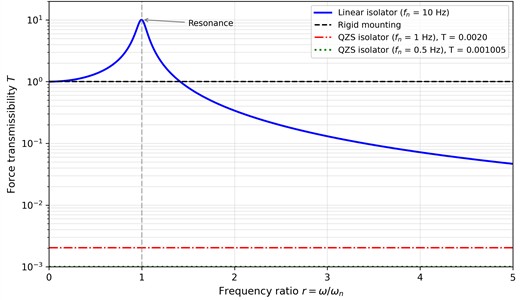
The force transmission coefficient , which represents the ratio of the dynamic force at rigid mounting to the dynamic force transmitted through the isolator, is the inverse of the transmissibility: 1/. For the QZS isolator with 1 Hz, 2,500, while for the conventional rubber mount with 10 Hz, 24. This dramatic reduction in the transmitted dynamic force has profound implications for the design of foundations and supporting structures at oil pumping stations.
6. Application to foundation load reduction
To quantify the economic benefits of QZS vibration isolators for oil pipeline pumping stations, a calculation of the required foundation concrete volume was performed for a typical pump unit NM 10000-210 under different vibration isolation scenarios. The calculation follows the methodology established in the Russian design codes [1, 2] and the approach described in [3].
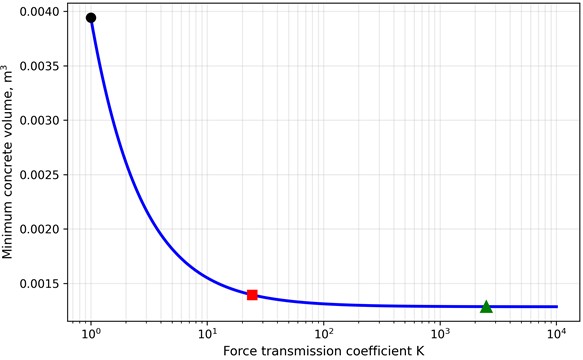
The minimum volume of concrete required for the foundation is determined from the strength condition, which requires that the average pressure under the foundation base does not exceed the design resistance of the soil. The concrete volume depends on the total load, which includes the static weight of the equipment and the dynamic component reduced by the force transmission coefficient of the vibration isolators. The relationship between the concrete volume and the force transmission coefficient is approximately:
where and are the combined coefficients accounting for dynamic load amplification, is the mass of the equipment, is the gravitational acceleration, is the dynamic force at rigid mounting, is the soil resistance, is the density of concrete, and is the foundation depth.
Using the parameters from Section 3 for the pump unit NM 10000-210 on loam soil ( 368 kPa), the calculated concrete volumes for different vibration isolation scenarios are presented in
Table 1Minimum concrete volume for pump unit NM 10000-210 foundation
Installation method | , m3 | Reduction, % | |
Rigid mounting | 1 | 60.9 | 0 |
Rubber isolators | 24 | 25.0 | 58.9 |
QZS isolator ( 1 Hz) | 2,500 | 23.5 | 61.4 |
QZS isolator ( 0.5 Hz) | 10,000 | 23.3 | 61.7 |
The results demonstrate that the use of conventional rubber vibration isolators reduces the required concrete volume by approximately 59 %, while QZS isolators provide a reduction of over 61 %. While the difference between rubber and QZS isolators in terms of concrete volume appears relatively small, the QZS isolators offer a crucial additional advantage: their extremely low natural frequency (below 1 Hz) completely eliminates the possibility of resonance with the building structures and ensures effective vibration isolation regardless of the stiffness of connected pipelines. This is illustrated in Fig. 5, which shows the continuous dependence of concrete volume on the force transmission coefficient.
Fig. 5Dependence of minimum foundation concrete volume on force transmission coefficient K of vibration isolator
It should be noted that the economic benefit extends beyond the direct savings on concrete. With the reduced foundation size, prefabricated foundation blocks (such as FBS type) can be used instead of monolithic concrete pouring, which significantly accelerates the construction timeline and reduces labor costs. Furthermore, the reduced vibration transmitted to the building structure decreases maintenance costs and extends the service life of both the building and the equipment [3, 16].
The sensitivity of QZS isolators to manufacturing tolerances and parameter variations has been studied in previous works [17, 18]. It was found that a group of QZS isolators operating together under a common base has a stabilizing effect, where the overall stiffness of the group is less sensitive to individual parameter deviations than a single isolator. This is an important practical consideration, as it relaxes the manufacturing precision requirements and reduces the cost of QZS isolator production.
7. Discussion
The results obtained in this study confirm that QZS vibration isolators represent a highly effective solution for the vibration protection of oil pipeline pumping equipment. The theoretical analysis shows that by achieving an effective natural frequency below 1 Hz, QZS isolators can reduce the transmitted dynamic force by two to three orders of magnitude compared to rigid mounting, and by approximately two orders of magnitude compared to conventional rubber or spring mounts.
The practical significance of these results lies in the direct economic impact on the construction of oil pipeline pumping stations. The reduction of foundation concrete volume by more than 60 % translates into substantial cost savings, both in terms of material expenses and construction time. Moreover, the use of prefabricated foundation blocks becomes feasible with the reduced foundation loads, further accelerating the construction process and improving quality control.
Several design considerations must be taken into account when implementing QZS isolators in practice. First, the pipeline connections to the isolated equipment must be designed with sufficient flexibility to avoid imposing additional stiffness on the isolation system. This can be achieved through the use of expansion compensators and flexible pipe supports. Second, the static deflection of the QZS isolator must be carefully controlled to ensure that the equipment remains within the QZS operating range under all loading conditions, including variations in product density (e.g., between oil and water during hydrostatic testing), thermal expansion, and wind or snow loads. Third, the damping characteristics of the QZS system must be adequate to limit the amplitude of vibration during transient events such as startup and shutdown [10, 15].
The application of QZS vibration isolators extends beyond pump foundations. Similar benefits can be achieved for gas compressor units, large electric motors, fans, and other vibroactive equipment at oil and gas facilities [15, 19]. Furthermore, the concept of QZS has been applied to pipeline vibration protection, where supports with negative stiffness elements can shift the natural frequencies of pipeline spans away from the excitation frequencies of pumping units, thereby preventing resonance conditions [20, 21]. The development of metamaterials with quasi-zero stiffness properties represents a promising direction for vibration isolation in civil and industrial structures [22, 23].
It should be acknowledged that QZS systems have certain limitations. The nonlinear nature of the force-displacement characteristic can lead to complex dynamic behavior, including jump phenomena and subharmonic resonances at large amplitudes [8, 12]. These effects require careful analysis and, in some cases, may necessitate the incorporation of additional damping or active control elements. The design of QZS isolators for very heavy equipment (mass exceeding 50 tons) also presents engineering challenges related to the scaling of negative stiffness mechanisms, which is an area of ongoing research [10, 13].
8. Conclusions
The article presents a comprehensive theoretical and practical analysis of vibration protection of oil pipeline pumping equipment using systems with quasi-zero stiffness. The main results and conclusions are as follows.
The theoretical foundations of QZS systems have been presented, demonstrating that the combination of positive and negative stiffness elements can achieve a near-zero effective stiffness while maintaining high static load-bearing capacity. The mathematical model of a QZS isolator based on disk springs (Belleville washers) has been developed, and the conditions for achieving the quasi-zero stiffness regime have been derived in the form of analytical expressions relating the geometric and mechanical parameters of the system.
The force transmissibility analysis has shown that QZS isolators with effective natural frequencies below 1 Hz can reduce the transmitted dynamic force by more than two orders of magnitude compared to conventional rubber or spring mounts. For a pump unit with a rotation frequency of 50 Hz, the force transmission coefficient reaches approximately 2,500 for a QZS isolator with 1 Hz, compared to 24 for a conventional rubber mount with 10 Hz.
The practical calculation of foundation concrete volume for a typical NM 10000-210 pump unit has demonstrated that QZS isolators can reduce the required concrete volume by over 61 % compared to rigid mounting. This reduction enables the use of prefabricated foundation blocks, accelerates construction, and reduces overall costs of oil pumping station construction. The QZS approach offers the additional critical advantage of eliminating resonance risk with building structures, which is not guaranteed with conventional vibration isolators.
The results confirm that QZS vibration isolators represent a mature, effective, and economically feasible technology for vibration protection in the oil and gas transportation industry. Future research directions include the experimental validation of the proposed mathematical models for specific pump unit configurations, the development of optimized QZS isolator designs for a wider range of equipment types and operating conditions, and the investigation of hybrid active-passive QZS systems for adaptive vibration control.
References
-
“Foundations of buildings and structures,” (in Russian), Minregion Rossii, Moscow, Russia, SP 22.13330.2011, 2011.
-
“Foundations of machines with dynamic loads,” (in Russian), Minregion Rossii, Moscow, Russia, SP 26.13330.2012, 2012.
-
A. R. Valeev and R. R. Tashbulatov, “Influence of dynamic load on foundation of pumping units,” (in Russian), Neftegazovoye Delo – Oil and Gas Business, Vol. 12, No. 1, pp. 27–30, 2014.
-
P. L. Kapitsa, “Twenty-two reports of academician P. L. Kapitsa,” (in Russian), Khimiya I Zhizn, No. 3-5, 1985.
-
P. M. Alabuzhev, A. Gritchin, L. Kim, G. Migirenko, V. Chon, and P. Stepanov, Vibration Protecting and Measuring Systems with Quasi-Zero Stiffness. New York, USA: Hemisphere Publishing, 1989.
-
A. Carrella, M. J. Brennan, and T. P. Waters, “Static analysis of a passive vibration isolator with quasi-zero-stiffness characteristic,” Journal of Sound and Vibration, Vol. 301, No. 3-5, pp. 678–689, Apr. 2007, https://doi.org/10.1016/j.jsv.2006.10.011
-
X. Liu, X. Huang, and H. Hua, “On the characteristics of a quasi-zero stiffness isolator using Euler buckled beams as negative stiffness corrector,” Journal of Sound and Vibration, Vol. 332, No. 14, pp. 3359–3376, 2013, https://doi.org/10.1016/j.jsv.2012.10.037
-
I. Kovacic, M. J. Brennan, and T. P. Waters, “A study of a nonlinear vibration isolator with a quasi-zero stiffness characteristic,” Journal of Sound and Vibration, Vol. 315, No. 3, pp. 700–711, Aug. 2008, https://doi.org/10.1016/j.jsv.2007.12.019
-
W. S. Robertson, M. R. F. Kidner, B. S. Cazzolato, and A. C. Zander, “Theoretical design parameters for a quasi-zero stiffness magnetic spring for vibration isolation,” Journal of Sound and Vibration, Vol. 326, No. 1-2, pp. 88–103, Sep. 2009, https://doi.org/10.1016/j.jsv.2009.04.015
-
A. R. Valeev, A. N. Zotov, and S. A. Kharisov, “Application of disk springs for manufacturing vibration isolators with quasi-zero stiffness,” Chemical and Petroleum Engineering, Vol. 51, No. 3-4, pp. 194–200, Aug. 2015, https://doi.org/10.1007/s10556-015-0023-2
-
A. Carrella, M. J. Brennan, and T. P. Waters, “Optimization of a quasi-zero-stiffness isolator,” Journal of Mechanical Science and Technology, Vol. 21, No. 6, pp. 946–949, Jun. 2007, https://doi.org/10.1007/bf03027074
-
A. Carrella, M. J. Brennan, I. Kovacic, and T. P. Waters, “On the force transmissibility of a vibration isolator with quasi-zero-stiffness,” Journal of Sound and Vibration, Vol. 322, No. 4-5, pp. 707–717, 2009, https://doi.org/10.1016/j.jsv.2008.11.034
-
A. Valeev, A. Zotov, and S. Kharisov, “Designing of compact low frequency vibration isolator with quasi-zero-stiffness,” Journal of Low Frequency Noise, Vibration and Active Control, Vol. 34, No. 4, pp. 459–473, 2015, https://doi.org/10.1260/0263-0923.34.4.459
-
J. O. Almen and A. Laszlo, “The uniform-section disk spring,” Journal of Fluids Engineering, Vol. 58, No. 4, pp. 305–314, 1936, https://doi.org/10.1115/1.4020233
-
A. Valeev and S. Kharisov, “Application of vibration isolators with a low stiffness for the strongly vibrating equipment,” Procedia Engineering, Vol. 150, pp. 641–646, Jan. 2016, https://doi.org/10.1016/j.proeng.2016.07.060
-
Y. G. Panovko, Fundamentals of applied theory of vibrations and shock. (in Russian), Leningrad, Russia: Politechnika, 1990.
-
A. R. Valeev, A. N. Zotov, M. M. Galiullin, and T. A. Yanbarisov, “Mathematical simulation of joint work of a vibration isolator group with quasi-zero stiffness,” (in Russian), News of the Ural State Mining University, No. 4(52), pp. 74–83, 2018, https://doi.org/10.21440/2307-2091-2018-4-74-83
-
A. Valeev, “Dynamics of a group of quasi-zero stiffness vibration isolators with slightly different parameters,” Journal of Low Frequency Noise, Vibration and Active Control, Vol. 37, No. 3, pp. 640–653, Feb. 2018, https://doi.org/10.1177/1461348418756022
-
Y. A. Burian, M. V. Silkov, and E. N. Trifonova, “Support with quasi-zero stiffness effect for processing equipment,” in AIP Conference Proceedings, Vol. 2151, p. 030067, Jan. 2019, https://doi.org/10.1063/1.5122117
-
A. Tokarev, A. Zotov, and A. Valeev, “Reduction of pipeline natural frequencies by negative stiffness vibration isolators,” IOP Conference Series: Earth and Environmental Science, Vol. 272, No. 3, p. 032010, Jun. 2019, https://doi.org/10.1088/1755-1315/272/3/032010
-
A. P. Tokarev, A. R. Valeev, and A. N. Zotov, “Pump piping vibrations reduction by vibration isolators forming specified force characteristics,” (in Russian), Petroleum Engineering, Vol. 17, No. 5, p. 123, 2019, https://doi.org/10.17122/ngdelo-2019-5-123-129
-
A. Valeev, A. Tokarev, and A. Zotov, “Material with quasi-zero stiffness for vibration isolation in civil and industrial structures and buildings,” IOP Conference Series: Earth and Environmental Science, Vol. 272, No. 3, p. 032048, Jun. 2019, https://doi.org/10.1088/1755-1315/272/3/032048
-
A. R. Valeev, R. R. Tashbulatov, and A. N. Zotov, “Numerical and experimental analysis of metamaterials with quasi-zero effect for vibration isolation,” in AIP Conference Proceedings, Vol. 1859, p. 020061, Jan. 2017, https://doi.org/10.1063/1.4990214
-
V. Anvar, Z. Alexey, and T. Artem, “Study of application of vibration isolators with quasi-zero stiffness for reducing dynamics loads on the foundation,” Procedia Engineering, Vol. 176, pp. 137–143, Jan. 2017, https://doi.org/10.1016/j.proeng.2017.02.281
-
E. I. Rivin, Vibration protection systems: negative and quasi-zero stiffness. Cambridge, UK: Cambridge University Press, 2021, https://doi.org/10.1017/9781108874540.004
About this article

The reported study was funded by the Russian Science Foundation according to the research project No. 25-29-00314, https://rscf.ru/project/25-29-00314/.
The datasets generated during and/or analyzed during the current study are available from the corresponding author on reasonable request.
Anvar Valeev: investigation; software; supervision. Alexey Zotov: validation; methodology. Artem Tokarev: writing-review and editing. Regina Khuramshina: writing-original draft preparation.
Prof. Anvar R. Valeev is an editor in chief for Liquid and Gaseous Energy Resources and was not involved in the editorial review and/or the decision to publish this article.

