Abstract
To address low-frequency vibration and structure-borne sound transmission in distribution transformers, this study investigates a prototype quasi-zero-stiffness (QZS) low-frequency isolator with a composite particle damping unit. Broadband vertical random-vibration tests over 2-2000 Hz were conducted to evaluate the effects of particle medium and filling ratio, while a simplified nonlinear dynamic model was used to qualitatively assess the influences of structural stiffness, equivalent damping, initial oblique-spring angle, and excitation amplitude. Rubber particles, quartz sand, and hybrid particles were tested at 30 % and 60 % filling ratios using acceleration PSD ratio and isolation efficiency as the main indices. The transmission values reported in the tables are acceleration PSD ratios rather than amplitude transmissibility. Both particle medium and filling ratio significantly affect the frequency-domain response. Across the six conditions, the isolation efficiency ranges from 10.07 to 31.21 dB at 100 Hz and from 16.34 to 40.73 dB at 200 Hz. Quartz sand at 60 % filling performs best, reaching 31.21 dB and 40.73 dB, respectively. Quartz sand and hybrid particles generally show better performance at 60 % filling, whereas rubber particles show reduced performance. These results provide a reference for composite damping design and particle-medium selection in QZS isolators for distribution transformers.
Highlights
- A particle-damped quasi-zero-stiffness isolator was developed for distribution transformers and experimentally evaluated under broadband random vibration from 2 to 2000 Hz.
- The measured natural frequency of 3.2853 Hz closely agreed with the finite-element prediction of 3.27882 Hz, while parametric simulations revealed the effects of stiffness, damping, geometry, and excitation level.
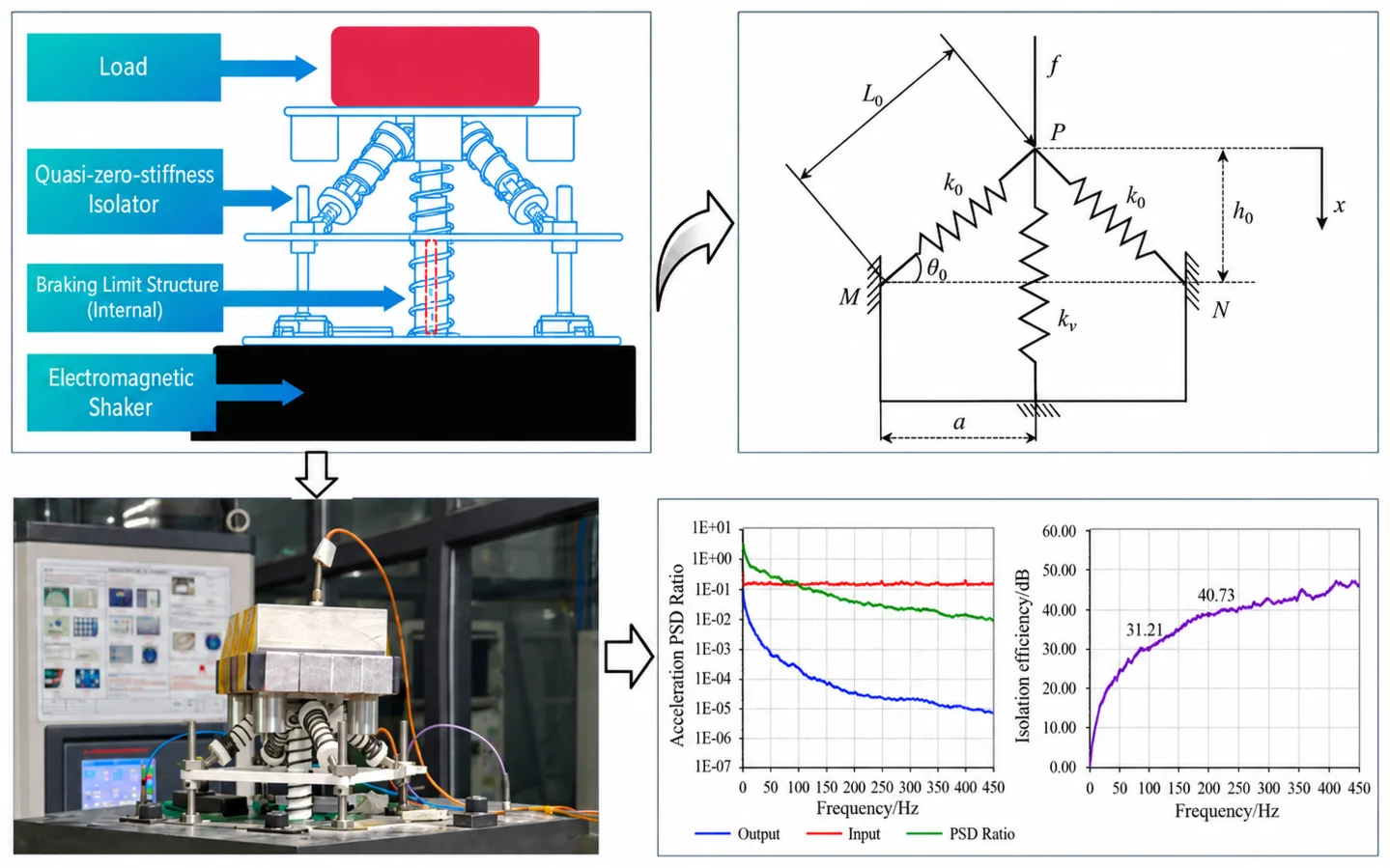
- Quartz sand at 60% filling achieved the best isolation, reaching 31.21 dB at 100 Hz and 40.73 dB at 200 Hz.
1. Introduction
Distribution transformers installed in noise-sensitive environments can transmit vibration through foundations and building structures, with the 100 Hz twice-line-frequency component and its 200 Hz harmonic being key targets for vibration control [1,6]. Conventional rubber and linear-spring isolators are limited by the trade-off between load-bearing stiffness and low-frequency isolation and may amplify response near resonance [1]. Quasi-zero-stiffness (QZS) isolators alleviate this conflict by combining positive- and negative-stiffness elements to achieve low dynamic stiffness near equilibrium while retaining load capacity [8], although experimental validation under realistic random vibration remains limited [3, 5]. Accordingly, this study combines simplified dynamic modeling with prototype random-vibration testing to evaluate a particle-damped QZS isolator under different structural parameters, particle media, and filling ratios. The main contribution is to link the effects of QZS structural parameters and particle-filling conditions with broadband isolation performance, providing an engineering-oriented basis for parameter comparison and damping-medium selection.
2. Design of a nonlinear isolator incorporating particle-impact damping
The proposed QZS isolator combines geometric negative stiffness with particle damping to achieve low dynamic stiffness and enhanced energy dissipation under random excitation [2, 4, 5].
2.1. Stiffness
The QZS isolator combines a vertical positive-stiffness spring with a symmetric umbrella-linkage-oblique-spring negative-stiffness mechanism. Vertical motion of the upper plate drives radial slider motion, continuously changing the length and inclination of the pre-compressed oblique springs and generating nonlinear negative stiffness. Slider guides and mechanical limits constrain the motion and improve stability.
For the equivalent three-spring model in Fig. 1(b), and denote the stiffness and initial length of each oblique spring, the vertical-spring stiffness, a the horizontal half-span, the initial vertical height, the initial oblique-spring angle, and the downward displacement. The corresponding prototype configuration is shown in Fig. 1(a).
Fig. 1Structural configuration and equivalent mechanical model of the QZS isolator
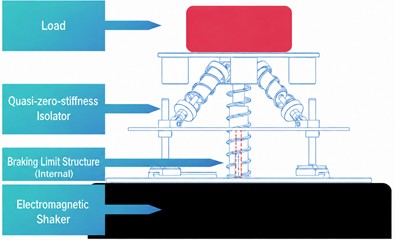
a) Prototype umbrella-type configuration
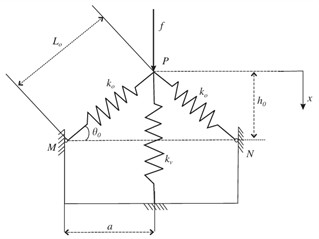
b) Equivalent three-spring model
The geometry gives:
The nonlinear vertical restoring force generated by the two oblique springs is:
Eq. (2) shows that the vertical restoring-force component decreases as the oblique springs approach the horizontal configuration, producing the required negative-stiffness effect.
The positive and total restoring forces are:
Introducing the nondimensional geometric and stiffness parameters:
the nondimensional restoring force and equivalent stiffness become:
At the static equilibrium position, where the oblique springs are horizontal, imposing zero equivalent stiffness gives the explicit QZS matching condition:
Eq. (8) provides the explicit QZS matching relation between geometry and spring stiffness [9]. The prototype analysis indicates a practical initial-angle range of approximately 37°-66° (0.4-0.8). Parameters are selected to satisfy Eq. (8) while maintaining positive equivalent stiffness away from equilibrium, thereby achieving low dynamic stiffness without compromising static stability [3, 4, 6].
2.2. Dynamic model
Using the nonlinear restoring force in Section 2.1, the vertical motion under base excitation is modeled as a nonlinear SDOF system with relative displacement :
where is the supported mass, is the equivalent viscous damping, and is the nonlinear restoring force. Near equilibrium, is approximated by a cubic polynomial [10]:
giving the Duffing-type equation:
For harmonic base excitation , first-order harmonic balance gives:
To account for particle-impact damping, a simplified particle–wall normal-contact model is adopted, in which the collision process is represented by the equivalent contact stiffness and damping coefficient , and the contact force in Eq. (13) is incorporated into the system dynamic equation. In this study, and are treated as empirical equivalent coefficients rather than parameters identified from dedicated contact experiments; therefore, the model is mainly intended to capture qualitative response trends and parameter influences rather than accurately predict absolute vibration amplitudes. The simplified model predicts a dominant low-frequency response around 3 Hz, consistent with the experimentally identified resonance region [7, 12-15].
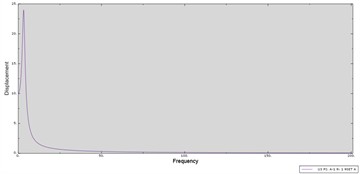
As shown in Fig. 2, the measured natural frequency of the prototype is 3.2853 Hz, while the finite-element simulation gives 3.27882 Hz, corresponding to a relative difference of approximately 0.20 %. The two results are in good agreement, indicating that the numerical model reasonably captures the low-frequency resonance characteristics of the QZS isolator [8, 11]. The measured and simulated responses also show consistent overall trends, with a pronounced low-frequency response below about 10 Hz and effective attenuation above 20 Hz. Since the low-level sine pre-sweep was intended mainly for resonance identification rather than acquisition of a complete transmissibility curve, the available data are insufficient for reliable point-by-point curve fitting or half-power bandwidth identification. Therefore, the present model-test correlation is limited to resonance-location verification and qualitative trend assessment rather than accurate amplitude prediction.
Fig. 2Low-frequency model–test comparison: a) measured sine-sweep response of the prototype; b) finite-element simulated response
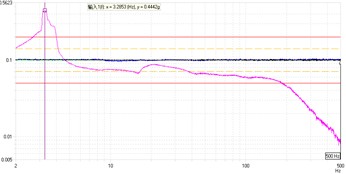
a)
b)
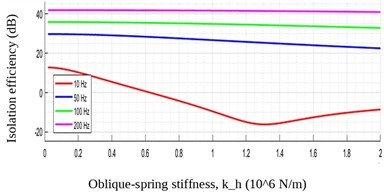
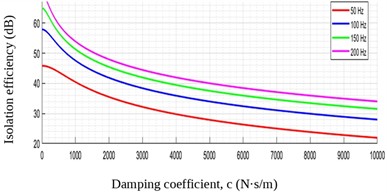
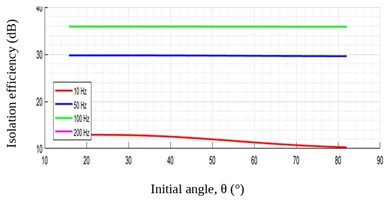
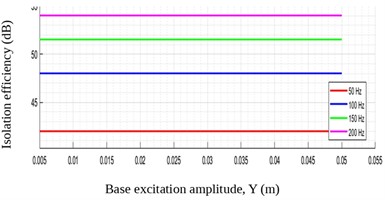
To further assess the engineering applicability of the simplified dynamic model, parametric simulations were carried out by independently varying the oblique-spring stiffness, system equivalent viscous damping coefficient , initial oblique-spring angle, and base excitation amplitude while keeping the remaining parameters unchanged, as shown in Fig. 3.
Fig. 3Parametric simulation results obtained from the simplified dynamic model: a) effect of oblique-spring stiffness; b) effect of equivalent damping coefficient; c) effect of initial oblique-spring angle; and d) effect of base excitation amplitude on isolation efficiency
a)
b)
c)
d)
The results indicate that increasing the oblique-spring stiffness generally reduces the isolation efficiency, demonstrating the importance of stiffness matching in maintaining the low dynamic stiffness of the QZS system. Increasing the equivalent damping coefficient suppresses the resonance response but decreases the calculated isolation efficiency in the post-resonance isolation region, indicating a trade-off between resonance control and broadband isolation. The initial angle modifies the geometric negative-stiffness contribution and thus affects the isolation efficiency, with the lower-frequency response showing greater sensitivity. In contrast, the isolation efficiency remains nearly unchanged over the investigated excitation-amplitude range, although the absolute displacement increases with excitation level. These results show that the simplified model can capture the principal effects of stiffness, damping, geometry, and excitation level on isolation performance and can therefore be used for engineering-oriented parameter comparison and qualitative trend assessment.
3. Test object, measurement system, and evaluation method
3.1. Test object and test conditions
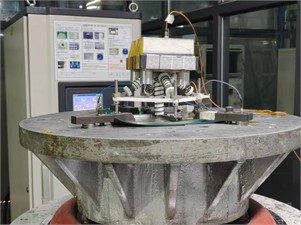
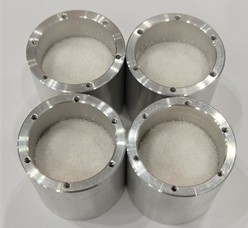
The test object was a scaled QZS low-frequency isolator prototype for distribution transformers, tested in the vertical Z direction. Rubber particles, quartz sand, and hybrid particles were evaluated at filling ratios of 30 % and 60 %, giving six conditions under identical installation, excitation, and acquisition settings. Broadband random excitation of 2-2000 Hz with a target RMS acceleration of 0.3 g was applied. The analysis focused on the representative transformer frequencies of 100 Hz and 200 Hz, with additional data extracted at 10 Hz, 500 Hz, 1000 Hz, and 2000 Hz for broadband performance evaluation. Additional excitation-amplitude tests were also conducted to qualitatively examine the structural stability of the prototype; these tests were used for supplementary durability assessment rather than the quantitative comparison in Tables 1-3.
Fig. 4Experimental photographs: a) test setup; b) quartz-sand 60 % filling condition. Photos by Lian Jie in Xi’an, China, on June 18, 2026.
a)
b)
3.2. Measurement system and sensor arrangement
The measurement system comprised an electromagnetic shaker, dynamic data-acquisition system, accelerometers, a laser displacement sensor, fixtures, and a counterweight. Input acceleration was measured on the shaker table and output acceleration on the isolator top/counterweight, while the laser sensor monitored vertical displacement. Sensors, channels, and connections were checked and calibrated before each test.
3.3. Test procedure and evaluation method
After a low-level sine pre-sweep for resonance identification and mechanical inspection, broadband random-vibration tests were conducted for all particle-filling conditions. Input and output accelerations were synchronously recorded after the excitation reached the target level. Frequency-domain evaluation focused on 100 and 200 Hz, with 10, 500, 1000, and 2000 Hz used for broadband assessment.
For random vibration, the responses were processed as acceleration power spectral density (PSD). Let and denote the input and output PSDs; the reported PSD-based vibration transmission ratio is:
The conventional acceleration-amplitude transmissibility is:
Since PSD is proportional to the squared signal amplitude, the two quantities satisfy:
The isolation efficiency in decibels is:
Thus, and are equivalent. Table 3 therefore retains the directly processed PSD ratios, identified as acceleration PSD ratios, while denotes the corresponding amplitude-based transmissibility; 1 indicates spectral attenuation.
4. Random vibration test results
4.1. Consistency of random vibration input
All six conditions were tested at the same target RMS acceleration of 0.3 g and identical acquisition settings. The controlled acceleration ranged from 0.2987 to 0.3006 g, with a maximum deviation of 0.0013 g, confirming good input consistency. Although the 60 % filling conditions generally required lower drive voltages, isolation performance was evaluated from the output response, acceleration PSD ratio, and vibration attenuation rather than the drive voltage [6].
Table 1Input consistency in the random vibration tests
Condition | Target / g | Controlled / g | Deviation / % | Drive / V |
Rubber 30 % | 0.3000 | 0.2987 | −0.43 | 0.0252 |
Rubber 60 % | 0.3000 | 0.3000 | +0.00 | 0.0223 |
Quartz sand 30 % | 0.3000 | 0.3006 | +0.20 | 0.0245 |
Quartz sand 60 % | 0.3000 | 0.2998 | −0.07 | 0.0218 |
Hybrid 30 % | 0.3000 | 0.2997 | −0.10 | 0.0238 |
Hybrid 60 % | 0.3000 | 0.3004 | +0.13 | 0.0212 |
4.2. Representative-frequency data and low-frequency response
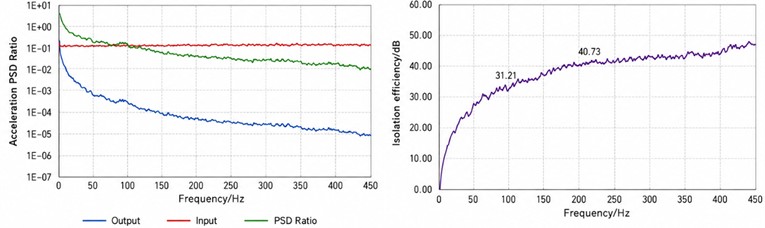
Tables 2 and 3 summarize the isolation efficiency and acceleration PSD ratio at 10-2000 Hz. At 100 and 200 Hz, the six conditions achieved isolation efficiencies of 10.07-31.21 dB and 16.34-40.73 dB, respectively. Quartz sand at 60 % filling showed the best performance, with PSD ratios of 0.000756 and 0.000085 and corresponding isolation efficiencies of 31.21 and 40.73 dB. Quartz-sand and hybrid 60 % conditions outperformed their 30 % counterparts, whereas rubber 60 % performed relatively weakly. The 10 Hz results also indicate strong sensitivity to particle medium and filling ratio, and denser low-frequency measurements remain necessary for further evaluation near resonance.
Table 2Summary of isolation efficiency under each condition
Frequency / Hz | Rubber 30 % | Rubber 60 % | Quartz sand 30 % | Quartz sand 60 % | Hybrid 30 % | Hybrid 60 % |
10 | 1.57 | 0.47 | 2.34 | 11.44 | 1.03 | 2.07 |
100 | 18.21 | 10.07 | 19.75 | 31.21 | 16.24 | 20.57 |
200 | 25.28 | 16.34 | 27.02 | 40.73 | 23.51 | 26.68 |
500 | 33.82 | 27.40 | 36.01 | 46.13 | 33.41 | 34.77 |
1000 | 33.84 | 32.32 | 36.77 | 45.34 | 34.42 | 35.79 |
2000 | 29.65 | 32.36 | 29.65 | 32.76 | 24.70 | 27.47 |
Table 3Summary of acceleration PSD ratio under each condition
Frequency / Hz | Rubber 30 % | Rubber 60 % | Quartz sand 30 % | Quartz sand 60 % | Hybrid 30 % | Hybrid 60 % |
10 | 0.696354 | 0.897076 | 0.582823 | 0.071832 | 0.789256 | 0.621540 |
100 | 0.015106 | 0.098493 | 0.010605 | 0.000756 | 0.023783 | 0.008779 |
200 | 0.002963 | 0.022727 | 0.001988 | 0.000085 | 0.004462 | 0.002149 |
500 | 0.000415 | 0.001820 | 0.000251 | 0.000024 | 0.000456 | 0.000334 |
1000 | 0.000413 | 0.000586 | 0.000210 | 0.000029 | 0.000361 | 0.000264 |
2000 | 0.001085 | 0.000580 | 0.001085 | 0.000530 | 0.003389 | 0.001792 |
Fig. 5PSD ratio and isolation efficiency for quartz sand at 60 % filling
5. Discussion on the effects of composite damping parameters
Both particle medium and filling ratio significantly affect the isolation performance of the QZS isolator. During the experiments, multiple test conditions were implemented by repeatedly changing the particle medium and filling state, including rubber particles, quartz sand, and hybrid particles at filling ratios of 30 % and 60 %. At 30 % filling, quartz sand performed slightly better than rubber and hybrid particles; at 60 % filling, its advantage became more pronounced, with isolation efficiencies of 31.21 dB and 40.73 dB at 100 Hz and 200 Hz, respectively, which may be attributed to stronger frictional and collisional energy dissipation. Increasing the filling ratio from 30 % to 60 % improved the performance of quartz sand and hybrid particles at these frequencies but reduced that of rubber particles. A possible explanation is that, at a higher rubber-particle filling ratio, the available free space for particle motion is reduced, which may promote particle stacking and constrain relative motion, thereby decreasing effective particle-wall and particle–particle collisions and weakening the associated energy dissipation [12-14]. Since particle motion and collision frequency were not measured directly in the present experiments, this interpretation is regarded as a plausible mechanism rather than a quantitatively verified conclusion. Therefore, the filling ratio should be selected according to the particle medium and target frequency band. In addition, continuous broadband random-vibration durability tests and supplementary tests under different excitation amplitudes were conducted. No obvious loosening, deformation, abnormal collision, or structural damage was observed during repeated condition changes and sustained vibration, and the major components remained intact after testing, indicating satisfactory short-term structural stability and adaptability under the present test conditions. However, the current experiments were mainly conducted under normal laboratory conditions; dedicated high- and low-temperature tests, humidity-aging tests, and longer-term cyclic-fatigue evaluations are still required to comprehensively assess the engineering applicability of the isolator.
6. Conclusions
A scaled QZS low-frequency isolator for distribution transformers was evaluated by sine pre-sweep and broadband random-vibration tests. The prototype exhibited a low-frequency resonance near 3.3 Hz, while the six particle-filling conditions showed clear performance differences at 100 and 200 Hz. Quartz sand at 60 % filling provided the best isolation, achieving 31.21 dB and 40.73 dB at the two representative frequencies. Both particle medium and filling ratio significantly influenced the response, and a higher filling ratio did not always improve performance, as demonstrated by the reduced effectiveness of rubber particles at 60 % filling. The results indicate that particle medium and filling ratio should be selected according to the target frequency band, while further low-frequency measurements are required for more detailed resonance-region evaluation.
References
-
Q. Fang, Z. Ye, and C. Chen, “A review of power transformer vibration and noise caused by silicon steel magnetostriction,” Electronics, Vol. 13, No. 5, p. 968, Mar. 2024, https://doi.org/10.3390/electronics13050968
-
Q. Liu, Z. Li, J. Wang, J. Lian, and Y. Wang, “Research progress on quasi-zero-stiffness low-frequency vibration isolation technology,” (in Chinese), Journal of Mechanical Strength, Vol. 43, No. 1, pp. 17–26, 2021, https://doi.org/10.16579/j.issn.1001.9669.2021.01.003
-
B. Yan, N. Yu, and C. Wu, “A state-of-the-art review on low-frequency nonlinear vibration isolation with electromagnetic mechanisms,” Applied Mathematics and Mechanics, Vol. 43, No. 7, pp. 1045–1062, 2022, https://doi.org/10.1007/s10483-022-2868-5
-
G. Sui, X. Zhang, S. Hou, X. Shan, W. Hou, and J. Li, “Quasi-zero stiffness isolator suitable for low-frequency vibration,” Machines, Vol. 11, No. 5, p. 512, Apr. 2023, https://doi.org/10.3390/machines11050512
-
H. Ye, Y. Wang, B. Liu, and X. Jiang, “Experimental study on the damping effect of multi-unit particle dampers applied to bracket structure,” Applied Sciences, Vol. 9, No. 14, p. 2912, Jul. 2019, https://doi.org/10.3390/app9142912
-
A. D. Shaw, S. A. Neild, and D. J. Wagg, “Dynamic analysis of high static low dynamic stiffness vibration isolation mounts,” Journal of Sound and Vibration, Vol. 332, No. 6, pp. 1437–1455, Dec. 2012, https://doi.org/10.1016/j.jsv.2012.10.036
-
X. Wang, Y. Shan, X. Liu, T. He, and J. Wu, “Comparison of the vibration reduction effects of particle dampers under swept-sine and random excitations,” (in Chinese), Noise and Vibration Control, No. 5, p. 198, 2014, https://doi.org/10.3969/j.issn.1006-1335.2014.05.043
-
C. Liu, W. Zhang, K. Yu, T. Liu, and Y. Zheng, “Quasi-zero-stiffness vibration isolation: designs, improvements and applications,” Engineering Structures, Vol. 301, p. 117282, Dec. 2023, https://doi.org/10.1016/j.engstruct.2023.117282
-
Z.-Q. Zhang, M.-Q. Niu, and L.-Q. Chen, “Analysis and optimization of a quasi-zero-stiffness vibration isolator based on partially rigidized compliant mechanisms,” Engineering Structures, Vol. 343, p. 121048, Aug. 2025, https://doi.org/10.1016/j.engstruct.2025.121048
-
N. A. Saeed, L. Hou, H. Yi, A. A. Shukur, S. M. Alamry, and S. M. El-Shourbagy, “On a broadband vibration isolator with tunable stiffness: from quasi-zero-stiffness to zero-stiffness behavior,” Applied Mathematics and Mechanics, Vol. 47, No. 2, pp. 255–282, 2026, https://doi.org/10.1007/s10483-026-3351-9
-
N. Y. P. Vo, T. D. Le, and M. K. Nguyen, “A quasi-zero stiffness-based low-frequency vibration isolation platform: experimental investigation,” Machines, Vol. 14, No. 5, p. 546, May 2026, https://doi.org/10.3390/machines14050546
-
Y. Zhu, X. Guo, Q. Wang, and D. Cao, “A lightweight tuned particle damper for low-frequency vibration attenuation,” Journal of Sound and Vibration, Vol. 583, p. 118440, Apr. 2024, https://doi.org/10.1016/j.jsv.2024.118440
-
B. B. Prasad, F. Duvigneau, T. Reinboth, D. Juhre, and E. Woschke, “Design strategies of particle dampers for large-scale applications,” Journal of Vibration Engineering and Technologies, Vol. 12, No. 4, pp. 5715–5746, 2023, https://doi.org/10.1007/s42417-023-01214-x
-
Y. Zhu, X. Guo, and D. Cao, “Research progress on tuned particle dampers: a review of modeling, energy dissipation mechanisms, and applications,” European Journal of Mechanics – A/Solids, Vol. 113, p. 105720, May 2025, https://doi.org/10.1016/j.euromechsol.2025.105720
-
K. Yang et al., “Mode-resolved, reconfigurable particle damping for printed circuit boards vibration control,” Mechanical Systems and Signal Processing, Vol. 248, p. 113995, Feb. 2026, https://doi.org/10.1016/j.ymssp.2026.113995
About this article

This work was supported by the Science and Technology Project of State Grid (Xi’an) Environmental Protection Technology Center Co., Ltd., “Development of a Quasi-Zero-Stiffness Low-Frequency Isolator for Distribution Transformers”.
The datasets generated during and/or analyzed during the current study are available from the corresponding author on reasonable request.
The authors declare that they have no conflict of interest.

