Abstract
This study investigates the problem of excessive reactive power losses and dynamic instability in single-phase powered asynchronous motors supplied by solar energy systems. To accurately evaluate non-sinusoidal and unbalanced current components-which significantly affect electromagnetic behavior and vibration-related electrical asymmetry-a high-precision electromagnetic current measurement device was developed. Unlike conventional current transformers that saturate under harmonic distortion, the proposed device provides reliable detection of harmonic currents up to the 49th order. Based on the measured signals, an optimized control scheme incorporating phase-shifting inductive elements and capacitor banks was designed. Experimental results show that the proposed method improves the motor’s power balance by 75-80 %, reduces total harmonic distortion (THD) by up to 33.5 %, and decreases voltage asymmetry by 15-16 % under no-load and nominal load conditions. The approach ensures stable operation, enhanced dynamic performance, and more efficient utilization of solar-generated electrical energy. These findings contribute to the development of advanced vibro-electromechanical systems and improved reactive power management in renewable-energy-based motor applications.
1. Introduction
Today the whole world in countries oil, gas, coal and other primary energy sources increasingly decreasing is going on, this and step by step sun , wind and bioenergy resources to practice current to do demand is doing, this regarding wide becoming popular managed sun energy from sources use according to our country energy field employees and scientists are also how much scientific, pedagogical and practical research take is going, the field further development, sun panels working outgoing electricity of energy quality indicators improve and to practice current sun panels working outgoing electricity energy variable to the vine when transferred exit sinusoidal and symmetrical work modes provide electricity device inventory device exit voltages quality to the indicators the impact to study in matters row matters there is this problems in solution sun electricity energy transmission from the network provided , electricity of energy the most many consumer was one and three with a smile asynchronous motors high effective work modes with to provide, and in an asynchronous motor device reactive power waste control and in control, electromagnetic vine modifiers from your devices use efficiency high from methods is considered [1]. In the development of three-phase asynchronous motors, copper windings are mounted on the stator core at an angle of 120 degrees to each other and connected to a three-phase source. When powering a three-phase asynchronous motor from a single-phase source, phase-shifting and starting elements, capacitance and inductance are used. As a result, the voltage and current supplied to the stator differ from each other and in magnitude by 90 degrees, and due to this difference, the asynchronous motor can also operate on a single-phase source. In asynchronous motors powered from a single-phase solar energy source, if the phase-shifting and starting elements (capacitive and inductive) are not selected correctly, the difference between the phases is not distributed correctly and excessive vibration occurs in the motor, the bearings make noise, the device temperature rises and burns out. Analyses and studies show that when vibration occurs in single-phase asynchronous motors, reactive power consumption increases. Today, based on data from current transformers, only one or a variable capacitor bank is used to start and operate a single-phase asynchronous motor, which in turn leads to waste of reactive power in the asynchronous motor, reduced efficiency, and malfunction of the device [2]. It is powered by energy produced by the Green Solar Company, with a rated power of 550 W, an output voltage of 12-24 V, an electric current of 12.65 A, and a nominal operating temperature of 45±5 °C. With the increasing adoption of renewable energy sources, solar power has become a widely used solution for both residential and industrial applications However, integrating solar panels with conventional electrical equipment, such as three-wire asynchronous motors, presents significant challenges-particularly when operating from a single-phase network [3]. One of the key issues in such systems is the generation and waste of reactive power, which can lead to inefficiencies, increased energy costs, and potential instability in the electrical network. Asynchronous motors typically require a balanced three-phase power supply for optimal performance. When powered by a single-phase electrical network, additional measures, such as capacitor banks or phase converters, must be implemented to compensate for the missing phases. In addition, accurate measurement of rotating parts of asynchronous machines is also important [4]. However, these solutions often result in excessive reactive power generation, leading to unnecessary energy losses. Effective management of this reactive power is crucial to improving the overall efficiency of the system and ensuring the reliable operation of the motor.
This study focuses on the control and management of reactive power waste in a system where a three-wire asynchronous motor is operated using a single-phase electrical network powered by solar panels. The aim is to explore efficient techniques for reducing reactive power losses, enhancing power factor correction, and optimizing the integration of solar energy with industrial and commercial motor-driven applications [5]. By addressing these challenges, the study contributes to the development of more energy-efficient and sustainable electrical systems. Analysis and research show that based on the data obtained from current transformers, only one or a variable capacitor bank is used to start and operate a single-phase asynchronous motor in reactive power control and management, which in turn leads to waste of reactive power in the asynchronous motor, reduced efficiency, and malfunction of the device.
2. Methods
2.1. Problem formulation
Today on the day phase as a turning element inductive throttle elemental , capacitor battery through , half with conductor elements and other one how many methods there is to be asynchronous in the engine pure turnover magnet field harvest to do through of the device high fruitful work modes with provide as far as possible has we will be this in process condenser from batteries use other to methods than effective and pure turnover magnet field with provide opportunity give research work within A synchronous motor with a power of 250 W, supplied with electricity generated by solar panels , supplied with a single-phase electrical energy source generated by solar panels, is used to evaluate the amount of symmetrical and non-sinusoidal indicators constituting reactive power in motors [6]. Solar power plants are convenient to calculate as a source of electricity different from the main grid [7].
The operation of a three-wire asynchronous motor using a single-phase electrical network presents significant technical challenges, particularly in systems powered by solar panels. One of the primary issues is the imbalance created by the absence of a true three-phase power supply, leading to inefficient motor performance, excessive reactive power generation, and reduced power factor [8]. In conventional three-phase systems, reactive power is naturally managed through the balanced distribution of electrical phases. However, when such a motor is connected to a single-phase network, additional components – such as phase-shifting capacitors or electronic phase converters – are required to create an artificial three-phase supply. While these solutions enable motor operation, they also contribute to increased reactive power waste, leading to:
– Lower system efficiency – excessive reactive power results in higher current draw, increasing losses in the electrical system and reducing overall energy efficiency [9].
– Voltage instability – poor reactive power management can cause voltage fluctuations, affecting both motor performance and other connected loads.
– Overloading of electrical components – additional current demand due to low power factor can overload transformers, inverters, and other power electronics, shortening their lifespan [10].
– Suboptimal utilization of solar power – solar energy systems operate most efficiently when loads are properly matched. Excessive reactive power consumption reduces the effective utilization of solar-generated electricity, limiting overall system performance.
Given these challenges, there is a critical need for an effective control and management strategy to minimize reactive power waste while ensuring stable and efficient motor operation. This study aims to analyze the underlying causes of reactive power waste, evaluate existing compensation methods, and propose an optimized approach for integrating three-wire asynchronous motors with single-phase solar-powered networks [11]. The goal is to enhance energy efficiency, reduce losses, and improve the reliability of such systems in practical applications.
2.2. Solution of the problem
To effectively manage and control reactive power waste in a system where a three-wire asynchronous motor is powered by a single-phase solar-based electrical network, several technical solutions must be considered. The primary objective is to improve power factor, reduce energy losses, and ensure stable motor performance. The proposed solutions focus on phase balancing, reactive power compensation, and optimized solar power integration [12].
Implementation of a Phase Converter. A static or rotary phase converter can be used to generate an artificial third phase, enabling the asynchronous motor to operate more efficiently. This method helps in reducing voltage imbalance and improving the overall power factor of the system. However, the design and selection of the phase converter must be optimized to minimize additional power losses.
Use of Power Factor Correction (PFC) Capacitors. The installation of power factor correction capacitors helps in compensating for reactive power demand. Properly sized capacitors can reduce the reactive power component of the current, leading to: Improved voltage stability, reduction in unnecessary power losses, Lower current draw from the single-phase source
Application of a Variable Frequency Drive (VFD). A VFD with single-phase input and three-phase output can provide a more efficient and dynamic solution for operating the asynchronous motor. The VFD converts the single-phase input into a controlled three-phase output, improving motor efficiency and reducing reactive power waste. Additionally, VFDs offer speed control, which can further enhance energy savings.
Optimization of Solar Power Utilization with Smart Inverters. Using smart inverters that support reactive power compensation can help optimize the interaction between the solar power system and the motor. These inverters can dynamically adjust their output to support voltage regulation and power factor correction, ensuring more efficient utilization of solar-generated electricity [13].
Hybrid Energy Storage and Load Management. Integrating energy storage systems (ESS), such as batteries, can help balance power supply fluctuations. A well-designed control strategy can ensure that peak demand periods are managed efficiently, reducing the strain on the single-phase network and minimizing reactive power waste.
The study was conducted on the basis of an asynchronous motor of type 4AA63A4Y3 [14]. The passport data of the asynchronous motor are as follows: 220 V, 50 Hz, 1356, 0.19 om, 0.13 om, 0.15 om, 0.075 om, 65 %. Asynchronous motor stator main Number of rolls 140.
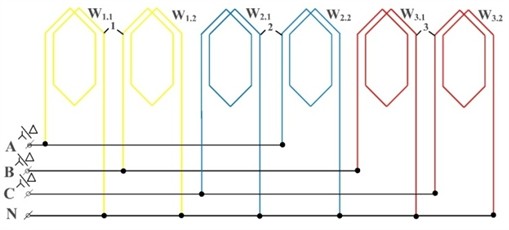
The research scheme of an electromagnetic converter for monitoring and controlling the reactive power consumed by a three-phase asynchronous motor supplied from a single-phase electrical power source generated by solar panels is presented in the diagram in Fig. 1 [12].
Fig. 1Star and delta connection diagram of the electromagnetic current transformer outputs. W1.1, W1.2, W2.1, W2.2, W3.1, W3.3 – location of the rings of the phase-to-phase measuring sensitive element in the air gap between the stator slots and the insulating wedge, AY/∆, BY/∆, CY/∆ – output terminals of the measuring sensitive element loops connected in a star-delta connection, N – neutral wire output voltage
3. Mathematical model
In industrial manufacturing enterprises, current transformers that are widely used tend to experience magnetic core saturation when the current exceeds the designed value or when the non-sinusoidal component of the current increases. As a result, this leads to distortions and measurement errors in the protection and metering systems.
To power three- phase asynchronous motors from a single-phase power grid generated by solar panels, we select a capacitor bank according to the scheme developed for a 250 W asynchronous motor in Figure 1, in which the following expression was used according to the rule for connecting the stator windings of an asynchronous motor to the grid [2, 8]:
where – the nominal current consumed by the asynchronous motor, – the nominal network voltage to which the stator windings of the asynchronous motor are connected, it is preferable to choose a working capacitor bank that is one-time smaller than the starting capacitor bank . When using a three-phase asynchronous motor with a single-phase electrical network, the correct selection of the phase-shifting inductive coil element is one of the main factors that allows the asynchronous motor to effectively use the total power balance.
When connecting three-phase induction motors to a single-phase electrical network, a copper conductor wire with the same reactive resistance and active resistance as the primary windings of the asynchronous motor stator is used, and the resistance of the copper wire is determined by the following formula:
where – frequency, – relative resistance, 2 – constant coefficient, – capacitor capacitance.
The total harmonic distortion (THD) of the non-sinusoidal currents generated in an asynchronous motor is determined as follows, and its value is expressed in percentage (%):
4. Results and discussion
4.1. Experimental images and schemes
Thus, the phase shifter, inductive coil, and working capacitor battery provided in the scheme made it possible to increase the power balance of an asynchronous motor connected to a single-phase solar power grid by 75 %-80 %. The electromagnetic current transformer placed in the air gap between the stator slots of the asynchronous motor and the insulation wedge is able to accurately represent the high harmonic currents that constitute the reactive power indicators in electrical networks up to 49 harmonics. The current transformer, which is widespread in industrial production enterprises, has a low accuracy due to the saturation of the magnetic core after the 19th harmonic.
Fig. 2One phased sun energy from the source provided asynchronous motor reactive power control and management scheme, a three-phase asynchronous motor electromagnetic converter structure research scheme, M – asynchronous motor, C1,2– capacitor bank, L – phase-shifting inductive element, W – wattmeter, KM – magnetic starter, K1, K2,K3– switch, A1, A2– ammeter, BB – control unit, Uout– converter output voltages MK – microcontroller. The photograph was taken by S. Azamov on 18 October 2024 at the rooftop solar power station of Andijan State Technical Institute
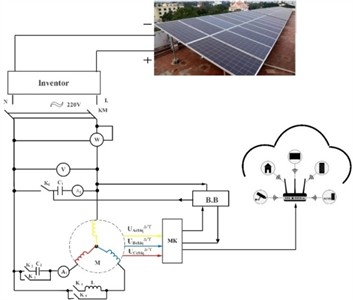
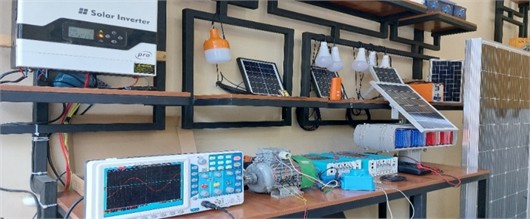
In converting the electrical energy generated by solar panels into alternating current, the inverter device plays a crucial role in ensuring high-quality and uninterrupted power that meets all electrical energy standards. In addition, it is also important to analyze the dynamic modes of oscillations of this system [15]. The experimental study of the electromagnetic current converter device powered by an asynchronous motor supplied through a solar inverter – which, in turn, is connected to a single-phase electrical energy source generated by solar panels – is presented based on the schematic diagram shown in Fig. 3.
The proposed reactive power control and management system significantly improved the performance of an asynchronous motor powered by a single-phase solar energy network. The integration of a phase shifter, inductive coil, and capacitor bank enabled a 75 %-80 % increase in power balance, ensuring more stable and efficient motor operation.
1. Improvement in Power Balance and Efficiency. By incorporating a well-calibrated phase-shifting inductive element (L) and a capacitor bank (C1, C2), the system effectively compensated for reactive power, leading to a more balanced power supply. The experimental results demonstrated a substantial reduction in voltage fluctuations, enhancing the overall stability of the motor drive system.
2. High Harmonic Current Analysis and Compensation. The use of an electromagnetic current transformer positioned in the air gap between the stator slots and insulation wedge allowed for accurate measurement of high-order harmonic currents. The system successfully detected and analyzed harmonics up to the 49th order, providing a detailed insight into the reactive power characteristics in the electrical network. However, traditional current transformers, commonly used in industrial applications, exhibited saturation effects beyond the 19th harmonic, limiting their accuracy in high-frequency harmonic compensation.
Fig. 3Research experiment process of an asynchronous motor electromagnetic converter powered by a single-phase power grid powered by solar panels. The photograph was taken by S. Azamov on 18 October 2024 in the Electrical Engineering Department Laboratory of Andijan State Technical Institute
4.2. Experimental results and analysis
The proposed control scheme was tested using an experimental setup, as illustrated in Fig. 2.
Table 1Asynchronous motor electromagnetic vine changer device exit of size dynamic descriptions
An asynchronous motor is connected to the network through a phase- shifting capacitor bank | An asynchronous motor connected to the network through a phase- shifting inductive coil and a working capacitor bank | Asynchronous motor starting and connected to a single-phase solar grid through a working capacitor bank | The induction motor is connected to the network through a phase-shifting inductive coil and a working capacitor bank. |
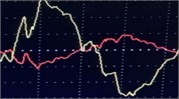 |  | 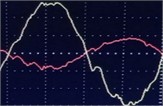 | 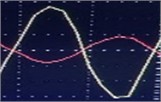 |
Asynchronous motor in no-load operation mode 6.01, 20° | Asynchronous motor in no-load operation mode 5.8, 10° | Asynchronous motor in no-load operation mode 5.6, 40° | Asynchronous motor in no-load operation mode 5.3, 30° |
Asynchronous motor in no-load operation mode 7.3 | Asynchronous motor in no-load operation mode 6.8 | Asynchronous motor in no-load operation mode 6.1 | Asynchronous motor in no-load operation mode 4.9 |
3.31 3.17 4.02 | 3.19 3.06 4.15 | 3.89 3.75 4.21 | 3.27 3.19 3.95 |
0.95 1.09 | 0.82 1.17 0.32 | 1.39 0.63 0.45 | 1.25 0.63 0.48 0.22 |
Key observations from the results include:
– Reduction in Reactive Power Losses: The wattmeter (W) readings confirmed that the implemented compensation scheme significantly minimized excess reactive power.
– Improved Motor Performance: The asynchronous motor (M) operated with increased efficiency, exhibiting smoother operation and reduced overheating.
– Stable Converter Output Voltages (): The controlled switching mechanism ensured stable voltage outputs, preventing power instability.
In the control and management of the reactive power consumption of the asynchronous motor, it can be concluded that the output voltage is 10 times higher when connected in a star-delta connection than in a star-delta connection .
5. Conclusions
The conducted research showed that integrating a phase-shifting inductive coil and capacitor banks into the control scheme of a three-phase asynchronous motor powered from a single-phase solar network significantly enhanced its performance. The proposed configuration reduced THD by up to 33.5 %, improved voltage asymmetry by 15-16 %, and increased the motor’s overall power balance by 75-80 %. The developed electromagnetic current converter provided accurate harmonic detection up to the 49th order, surpassing the performance of conventional current transformers. Furthermore, precise control of the phase-shifting and starting elements-based on the converter signal-reduced motor oscillations, stabilized reactive power consumption, and improved operational efficiency. Future work will focus on implementing adaptive control and smart inverter technologies to further optimize reactive power compensation in solar-powered motor systems.
References
-
O. Ishnazarov and X. Xaydarov, “Mathematical analysis of the impact of external factors on the operating modes of pump installations in the technological process,” Academia Open, Vol. 10, No. 1, Jan. 2025, https://doi.org/10.21070/acopen.10.2025.10507
-
I. K. Siddikov, A. Malikov, M. T. Makhsudov, Z. U. Boikhanov, and R. Uzaqov, “Study of the static characteristics of the secondary stator voltage converter of the currents of an induction motor,” in 2021 Asia-Pacific Conference on Applied Mathematics and Statistics, Vol. 2471, No. 1, p. 020003, Jan. 2022, https://doi.org/10.1063/5.0089681
-
Z. G. Chen, T. Lei, Z. J. Hua, B. Z. Urazali Ugli, and A. R. Yigitali Ugli, “Short-term photovoltaic power generation prediction based on VMD-IGWO-LSTM,” in IEEE 4th International Conference on Digital Twins and Parallel Intelligence (DTPI), pp. 682–686, Oct. 2024, https://doi.org/10.1109/dtpi61353.2024.10778814
-
A. Mustafoqulov, R. Baratov, Z. Radjapov, S. Kadirov, and B. Urinov, “Angular displacement measurement and control sensors of agricultural robot-manipulators,” in BIO Web of Conferences, Vol. 105, p. 03003, Apr. 2024, https://doi.org/10.1051/bioconf/202410503003
-
D. D. Karimjonov, I. X. Siddikov, S. S. Azamov, and R. Uzakov, “Study on determination of an asynchronous motor’s reactive power by the current-to-voltage converter,” in IOP Conference Series: Earth and Environmental Science, Vol. 1142, No. 1, p. 012023, Mar. 2023, https://doi.org/10.1088/1755-1315/1142/1/012023
-
M. Yakubov, I. Karimov, and D. Abdullaev, “Structure and distribution of function between the stages of the information and measurement system for diagnostics of traction substations and contact network installations,” in E3S Web of Conferences, Vol. 383, p. 01027, Apr. 2023, https://doi.org/10.1051/e3sconf/202338301027
-
A. Denmukhammadiev, A. Mustafoqulov, H. Valikhonova, E. Sobirov, and Raimov, “Electricity metering and backup power supply for multi-storey buildings,” in E3S Web of Conferences, Vol. 264, p. 05051, Jun. 2021, https://doi.org/10.1051/e3sconf/202126405051
-
N. Pirmatov, S. Mahamadjonov, M. Matqosimov, and H. Haydarov, “Characteristics of the static and dynamic operating modes of the asynchronous generator in renewable energy sources and the production of electric energy control through a frequency converter,” in E3S Web of Conferences, Vol. 480, p. 01007, Jan. 2024, https://doi.org/10.1051/e3sconf/202448001007
-
D. D. Gulamova et al., “Nanostructured Low-Resistance Ceramics Based on the Bi-Pb-Sr-Ca-Cu-O System Produced by Solar Technology,” Refractories and Industrial Ceramics, Vol. 63, No. 1, pp. 60–65, Nov. 2022, https://doi.org/10.1007/s11148-022-00681-1
-
J. A. Nizamov, S. O. Ergashov, and D. I. Kurbanbaeva, “Phase angle measurement device between the resultable electric drive force and the electric drive force of the main harmonic magnetic field in the air gap of the industrial industrial engine,” in 3rd International Scientific and Technical Conference Actual Issues of Power Supply Systems (ICAIPSS2023), Vol. 3152, p. 040021, Jan. 2024, https://doi.org/10.1063/5.0218808
-
Z. Boixanov, I. Siddikov, J. Nizamov, and S. Abdurahmonov, “Three-phase asynchronous motor three-phase current converter for the research of electromagnetic processes,” in 4th International Scientific and Technical Conference Actual Issues of Power Supply Systems: ICAIPSS2024, Vol. 3331, p. 030038, Jan. 2025, https://doi.org/10.1063/5.0306165
-
N. B. Pirmаtоv and H. M. Haydarov, “Investigating the issues of energy saving by means of a mathematical model of transient processes of asynchronous engines in pump units,” (in Uzbek), Journal of Science and Innovative Development, Vol. 6, No. 5, pp. 63–71, Oct. 2023, https://doi.org/10.36522/2181-9637-2023-5-7
-
M. Makhsudov and D. Karimjonov, “Research algorithm and dynamic characteristics of three-phase electromagnetic current transducers in filter-compensation devices,” in E3S Web of Conferences, Vol. 461, p. 01056, Dec. 2023, https://doi.org/10.1051/e3sconf/202346101056
-
S. Amirov, I. Karimov, and I. Abduazimova, “Application of the method of direct mathematical modeling to diamond-shaped contact lines,” in E3S Web of Conferences, Vol. 401, p. 02060, Jul. 2023, https://doi.org/10.1051/e3sconf/202340102060
-
X. Xaydarov, K. Qarshiyev, and U. Berdiyorov, “Energy saving using a frequency converter in asynchronous motor operating modes,” in 3rd International Scientific and Technical Conference Actual Issues of Power Supply Systems (ICAIPSS2023), Vol. 3152, p. 030008, Jan. 2024, https://doi.org/10.1063/5.0219049
About this article

The authors have not disclosed any funding.
The authors would like to express their sincere gratitude to Andijan State Technical Institute for providing laboratory resources and technical assistance. The research team also acknowledges the assistance of the PREK-TECH-1265 OSCILLOGRAPH vibration meter, multimeter, and technical staff in collecting experimental data.
The datasets generated during and/or analyzed during the current study are available from the corresponding author on reasonable request.
The authors declare that they have no conflict of interest.

