Abstract
In this article, the authors present a method for calculating the drive power of a two-mass resonant vibration stand with an electromagnetic drive. To achieve this, analytical expressions for the amplitude of the disturbance force and the velocity of the oscillating masses in a two-mass oscillatory system with an electromagnetic drive were used to determine the actual power consumed by the electromagnetic drive during the excitation of the oscillatory system. The key difference between the proposed approach and existing studies is that energy dissipation in the system is taken into account by considering the phase shift angle between the displacement and the disturbance force. By specifying the maximum possible phase shift angle between the displacement and the disturbance force and performing the necessary integration, the authors derived algebraically simple analytical expressions that describe the maximum power consumption of a two-mass oscillatory system with an electromagnetic drive. The proposed algebraic expressions make it possible to accurately estimate the required drive power, thereby ensuring that the vibration system maintains the technologically required vibration amplitudes even under critical loading conditions.
Highlights
- As a result of the approach proposed by the authors, analytical dependencies were derived to determine the actual power consumption of the electromagnetic drive of the two-mass oscillatory system of the vibration stand.
- The key difference between the proposed approach and existing studies is that energy dissipation within the system is accounted for through the phase shift angle between displacement and the disturbance force.
- By assuming the maximum possible phase shift angle between displacement and disturbance force, the authors obtained algebraically simple analytical dependencies that describe the maximum power consumption of a two-mass oscillatory system with an electromagnetic drive.
1. Introduction
When designing any vibrating technological equipment, it is necessary to determine the power required by the drive to initiate and maintain the motion of the vibrating system. Numerous researchers have addressed this problem.
The reviewed literature indicates considerable advances in the development, mathematical modeling, and optimization of vibratory machines, especially those employing electromagnetic actuators and dual-frequency resonant operating modes. Contemporary research focuses on expanding the capabilities of vibration technology through the design of innovative vibration equipment [1], as well as enhancing the performance of existing systems by optimizing their operating conditions [2]. Significant attention has also been devoted to the generation of optimal motion trajectories for vibrating working bodies [3] and to the optimization of amplitude-frequency characteristics to achieve stable and efficient resonant operation [4].
In addition, numerous studies investigate the dynamic behavior of inertial vibration exciters [5] and propose methods to improve their operational characteristics [6]. Mathematical modeling remains an essential research direction, providing tools for predicting and optimizing the performance of vibration systems [7]. Furthermore, researchers continue to explore the dynamics of vibratory machines [8], including the synchronization mechanisms of inertial vibration exciters [9], while also developing advanced control strategies to enhance their stability, efficiency, and operational reliability [10].
Harmonic analysis of the currents in electromagnetic vibrators, investigated in [11], provides valuable insights into the electrical characteristics that significantly affect the dynamic behavior of vibration machines. The identification of harmonic components enables the development of effective control strategies aimed at reducing undesirable vibrations and electrical losses, thereby enhancing the overall reliability and operational efficiency of the system.
Similarly, the study presented in [12] proposes methodologies for the rational synthesis of two-frequency resonant vibratory machines, with particular emphasis on structural optimization. The proposed approaches are intended to achieve the required dynamic performance while ensuring sufficient mechanical strength and durability.
The authors of [13] further investigate the synthesis and operational performance of two-mass resonant vibrating tables equipped with electromagnetic drives. Their experimental results emphasize the influence of factors such as structural damping and mass distribution on resonance efficiency. By combining theoretical analysis with practical validation, this work provides valuable recommendations for the design, optimization, and modernization of industrial vibratory equipment.
The primary objective of the study reported in [14] is the development of a dynamic model based on a two-mass system. The proposed model serves as a theoretical basis for analyzing the dynamic response and optimizing the operating conditions of resonant vibration machines. Of particular interest are the works [15, 16], which present a methodology for determining the parameters of vibrating machines with an eccentric drive. However, these works do not consider the determination of the required drive power.
Finally, [17] presents a comprehensive reference on the fundamental principles of the analysis and design of vibratory machines. The textbook integrates theoretical concepts, computational techniques, and experimental methodologies, providing a unified framework that supports both academic research and practical engineering applications.
Despite these significant advances, the literature lacks a simplified method for determining the power consumption of an electromagnetic drive based on a straightforward algebraic relationship. This research is intended to address this gap.
2. Description of the design and operation of the vibration stand
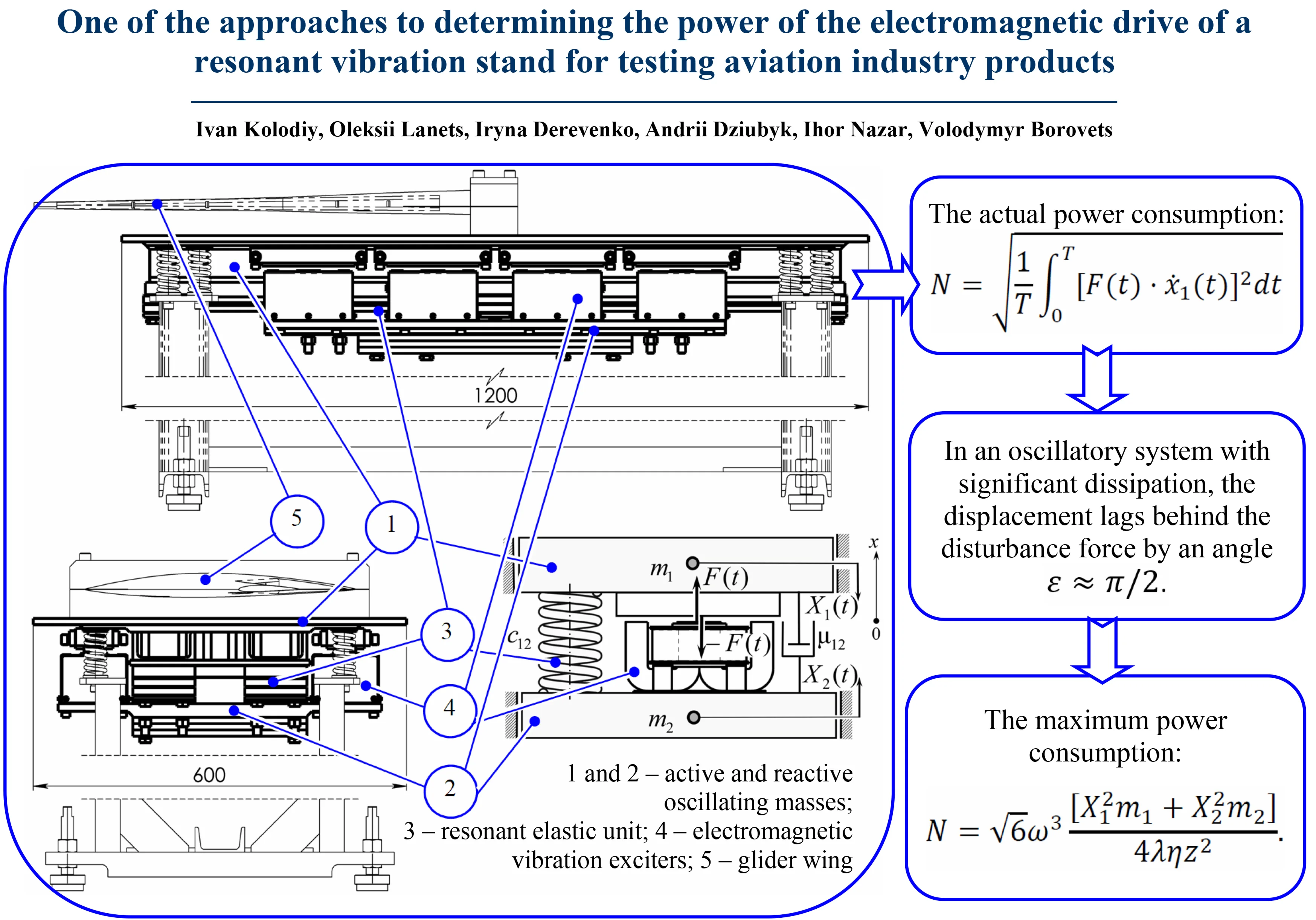
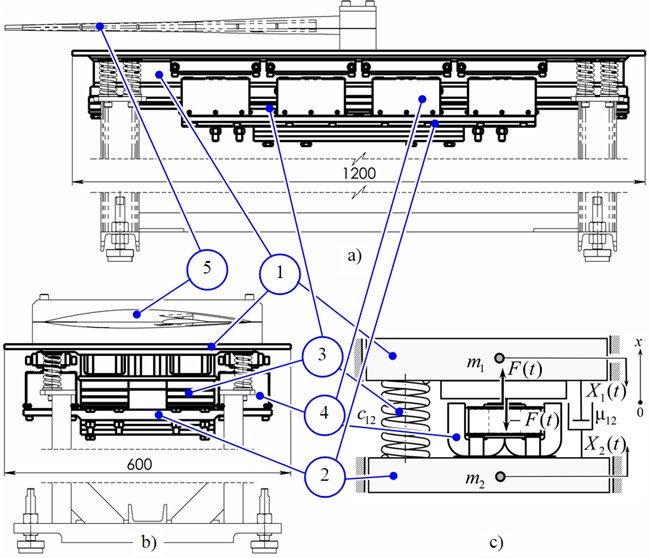
The two-mass mechanical vibration system of the vibration stand [18] (Fig. 1(a, b)) consists of active oscillating mass 1, with an inertial mass of , and a reactive oscillating mass 2, with an inertial mass of . The active oscillating mass 1 is connected to the reactive oscillating mass 2 through a resonant elastic node 3, having a stiffness coefficient of . Oscillations are excited by electromagnetic vibration exciters 4. The presence of dissipation in the resonant elastic node is represented by the viscous resistance coefficient as shown in Fig. 1(c).
The electromagnetic vibration exciters 4 generate a time varying alternating disturbance force , which excites the two-mass oscillatory system at a circular frequency . The oscillating masses 1 and 2 move in antiphase with amplitudes and , respectively. The vibration stand is designed for testing aircraft components under alternating loads. As an example, Fig. 1 illustrates a wing 5 fixed to the active oscillating mass 1. To simplify the presentation and the subsequent analysis, the influence of the payload and the vibration isolators on the dynamic processes within the vibration system is neglected. The influence of properly selected vibration isolators on the dynamic behavior of the system is negligible. Including vibration isolators in the model changes the calculated vibration amplitudes by no more than 3 % [17]. Therefore, their stiffness is neglected in the subsequent analysis. In contrast, accounting for the payload mass, represented by a wing rigidly cantilevered from the working body, significantly complicates the analysis. This issue requires a separate investigation, which the authors intend to address in future work.
3. Methodology for determining power consumption by an electromagnetic drive
Let us consider steady-state harmonic motion under the action of a disturbance force, which is described by the following expression:
Fig. 1a), b) Projection views of a resonant vibration stand with an electromagnetic drive and c) a schematic diagram of a two-mass vibration system of a vibration stand, where: 1 – active oscillating mass; 2 – reactive oscillating mass; 3 – resonant elastic unit; 4 – electromagnetic vibration exciters; 5 – glider wing attached to the active oscillating mass 1
We analyze the motion of only the active oscillating mass 1. The obtained results can be extended analogously to the reactive oscillating mass 2. Therefore, the amplitude of the disturbance force corresponding to the oscillation amplitude of the active mass 1 is determined using the analytical expression [17]:
where is the total mass of the two-mass oscillatory system; , where corresponds to the resonant tuning condition of the oscillatory system; . In practice, the coefficient of viscous drag can vary widely: [17]. It all depends on the properties of the load mass. For the case considered in the article, the value of the coefficient of viscous drag is insignificant.
The law of motion of the active oscillating mass 1 during harmonic oscillations is described by the well-known equation:
where is the phase shift between the displacement and the disturbance force caused by dissipation in the system. The velocity of the active oscillating mass 1 is obtained by differentiating Eq. (3) with respect to time, namely:
The power consumed by the oscillatory system during linear motion is equal to the product of the force and the velocity. Therefore, the actual power consumption is determined as:
where is the integration period. Substituting Eq. (1), (2), and (4) into Eq. (5), the following expression is obtained for the active oscillating mass 1:
Let us consider the case of the maximum phase shift , corresponding to the maximum power consumption. The phase shift in the oscillatory system varies as the excitation frequency passes through the natural circular frequency (Fig. 2).
Fig. 2Phase-frequency characteristic of the two-mass oscillatory system of the vibration stand
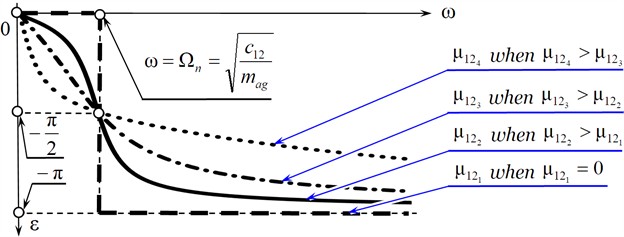
From Fig. 2, it can be seen that, in the absence of damping, the phase shift angle is always equal to or . When damping is present, the phase shift angle increases as the excitation frequency approaches the natural circular frequency (the resonance region). Theoretically, under the most unfavorable operating conditions, this angle may approach:
Thus, in an oscillatory system with significant dissipation, the displacement lags behind the disturbance force by an angle . Consequently, a phase shift angle of indicates a high level of energy dissipation within the system. In practice, this phenomenon is clearly observed during the operation of vibration stands under load. The energy dissipated in the load can be characterized by the viscous resistance coefficient, since dissipative forces remove useful mechanical energy from the oscillatory system.
Accordingly, the phase shift angle is adopted as one of the governing parameters for evaluating the power consumption of the oscillatory system, as it indirectly reflects the influence of the loading conditions. By using the limiting value given in Eq. (7), the worst-case operating scenario is considered a priori, thereby ensuring that the calculated drive power is sufficient to excite the oscillatory system under maximum energy dissipation. It should be noted that Eq. (7) is applicable to vibration stands operating in both pre-resonant and far-above-resonant modes.
Integrating Eq. (6) over the period corresponding to the maximum power consumption, the minimum required actual drive power , taking into account the drive efficiency , can be expressed as:
or, equivalently:
Eq. (8) can also be written in terms of the dynamic coefficient of the active oscillating mass 1:
It should be noted that the dynamic coefficients of both oscillating masses are identical (). Therefore, substituting Eq. (10) into Eq. (8) yields:
Extending Eq. (8) and (10) to the reactive oscillating mass 2 (Fig. 1), the total power consumed by the drive is determined by:
Alternatively, these expressions can be written as:
Given that, in the oscillatory system, the natural circular frequency is denoted as and it is also known that , Eq. (15) can be rewritten in the following form:
The publication [17] presents a formula similar to Eq. (16); however, it does not account for the resonant tuning of the oscillatory system. In the present study, the authors have refined the relationship that determines the power of the electromagnetic drive of a two-mass oscillatory system of a vibration stand, explicitly taking resonant tuning into account.
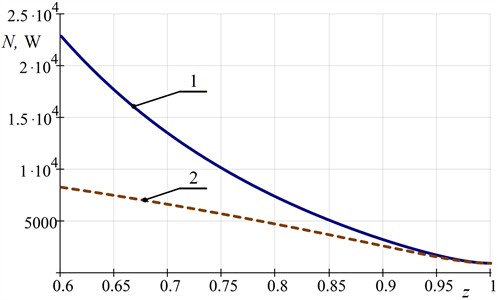
As an example, let us analyze the power consumption of the drive of the two-mass vibration system of the vibration test stand shown in Fig. 1. This system is also considered in detail in [18]. The parameters of the vibration system are as follows: 207 kg; 162 kg; 0.97; 628 rad/s (100 Hz); 2.5×10⁻³ kg/s; 0.5 (for the electromagnetic drive). The technologically specified vibration amplitude of the working body (active oscillating mass) is 0.3 mm. The vibration amplitude of the reactive oscillating mass is then 0.38 mm, and the power consumption of the vibration system drive, according to Eq. (16), is 986 W.
If the resonance tuning parameter is not taken into account, as was erroneously presented in [17], the calculated power consumption is underestimated and amounts to 928 W. The farther the vibration system is detuned from resonance (i.e., the smaller the value of relative to unity), the greater the discrepancy between the results becomes (Fig. 3).
Fig. 3Dependence of the power consumption of the electromagnetic drive on the resonance tuning of the vibration system: 1 – dependence obtained using Eq. (16); 2 – dependence obtained using the expression given in [17]
4. Conclusions
As a result of the approach proposed by the authors, analytical dependencies were derived to determine the actual power consumption of the electromagnetic drive of the two-mass oscillatory system of the vibration stand (Eq. (14), (15) and (16)). The key difference between the proposed approach and existing studies is that energy dissipation within the system is accounted for through the phase shift angle between displacement and the disturbance force. Thus, by assuming the maximum possible phase shift angle between displacement and disturbance force, the authors obtained algebraically simple analytical dependencies that describe the maximum power consumption of a two-mass oscillatory system with an electromagnetic drive. By selecting the drive power based on the proposed analytical dependencies Eq. (14), (15) and (16), it is possible to guarantee that the oscillatory system will provide the required technological amplitudes of oscillation even under critical loading conditions.
References
-
P. Czubak, “Vibratory conveyor of the controlled transport velocity with the possibility of reversal operations,” Journal of Vibroengineering, Vol. 18, No. 6, pp. 3539–3547, 2016, https://doi.org/10.21595/jve.2016.17257
-
R. Modrzewski, A. Obraniak, A. Rylski, and K. Siczek, “A study on the dynamic behavior of a sieve in an industrial sifter,” Applied Sciences, Vol. 12, No. 17, p. 8590, 2022, https://doi.org/10.3390/app12178590
-
S. Ogonowski and P. Krauze, “Trajectory control for vibrating screen with magnetorheological dampers,” Sensors, Vol. 22, No. 11, p. 4225, Jun. 2022, https://doi.org/10.3390/s22114225
-
V. Gursky, P. Krot, V. Korendiy, and R. Zimroz, “Dynamic analysis of an enhanced multi-frequency inertial exciter for industrial vibrating machines,” Machines, Vol. 10, No. 2, p. 130, Feb. 2022, https://doi.org/10.3390/machines10020130
-
N. Yaroshevich, V. Puts, T. Yaroshevich, and O. Herasymchuk, “Slow oscillations in systems with inertial vibration exciters,” Vibroengineering Procedia, Vol. 32, pp. 20–25, 2020, https://doi.org/10.21595/vp.2020.21509
-
V. Gursky, I. Kuzio, P. Krot, and R. Zimroz, “Energy-saving inertial drive for dual-frequency excitation of vibrating machines,” Energies, Vol. 14, No. 1, p. 71, Dec. 2020, https://doi.org/10.3390/en14010071
-
G. Filimonikhin, V. Yatsun, A. Kyrychenko, A. Hrechka, and K. Shcherbyna, “Synthesizing a resonance anti-phase two-mass vibratory machine whose operation is based on the Sommerfeld effect,” Eastern-European Journal of Enterprise Technologies, Vol. 6, No. 7 (108), pp. 42–50, 2020, https://doi.org/10.15587/1729-4061.2020.217628
-
V. Yatsun, G. Filimonikhin, N. Podoprygora, and V. Pirogov, “Studying the excitation of resonance oscillations in a rotor on isotropic supports by a pendulum, a ball, a roller,” Eastern-European Journal of Enterprise Technologies, Vol. 6, No. 7 (102), pp. 32–43, Nov. 2019, https://doi.org/10.15587/1729-4061.2019.182995
-
G. Cieplok and K. Wójcik, “Conditions for self-synchronization of inertial vibrators of vibratory conveyors in general motion,” Journal of Theoretical and Applied Mechanics, Vol. 58, No. 2, pp. 513–524, Apr. 2020, https://doi.org/10.15632/jtam-pl/119023
-
Z. V. Despotovic, A. M. Pavlovic, and D. Ivanic, “Exciting force frequency control of unbalanced vibratory actuators,” in 2019 20th International Symposium on Power Electronics (Ee), pp. 1–6, Oct. 2019, https://doi.org/10.1109/pee.2019.8923574
-
O. O. Cherno, “Harmonic components of electromagnetic vibrator current,” Tekhnichna Elektrodynamika, Vol. 2017, No. 4, pp. 65–71, 2017, https://doi.org/10.15407/techned2017.04.065
-
V. Gursky, I. Kuzio, and V. Korendiy, “Optimal synthesis and implementation of resonant vibratory systems,” Universal Journal of Mechanical Engineering, Vol. 6, No. 2, pp. 38–46, Aug. 2018, https://doi.org/10.13189/ujme.2018.060202
-
O. S. Lanets, V. Borovets, O. V. Lanets, Y. Shpak, and V. Lozynskyy, “Synthesis of structure and research of operation of resonance two-mass vibrating table with electromagnetic drive,” Ukrainian Journal of Mechanical Engineering and Materials Science, Vol. 1, No. 1, pp. 9–34, 2015.
-
M. Sturm, “Two-mass linear vibratory conveyor with reduced vibration transmission to the ground,” Vibroengineering Procedia, Vol. 13, pp. 20–23, Sep. 2017, https://doi.org/10.21595/vp.2017.19066
-
V. Korendiy, O. Lanets, O. Kachur, P. Dmyterko, and R. Kachmar, “Determination of inertia-stiffness parameters and motion modelling of three-mass vibratory system with crank excitation mechanism,” Vibroengineering Procedia, Vol. 36, pp. 7–12, Mar. 2021, https://doi.org/10.21595/vp.2021.21924
-
V. Korendiy, O. Yaniv, R. Predko, I. Laushnyk, A. Dzyubyk, and S. Hrevtsov, “Trajectory-based synthesis of a three-mass vibratory system excited by a dual phase-controlled crank-slider mechanism,” Vibroengineering Procedia, Vol. 62, pp. 41–50, Jun. 2026, https://doi.org/10.21595/vp.2026.26165
-
O. Lanets, Fundamentals of Analysis and Design of Vibratory Machines. (in Ukrainian), Lviv, Ukraine: Lviv Polytechnic Publishing House, 2018.
-
I. Kolodiy, O. Lanets, P. Maistruk, I. Derevenko, I. Nazar, and I. Khomych, “Modernization of the electromagnetic vibration stand for testing aviation industry products,” Vibroengineering Procedia, Vol. 59, pp. 21–27, Sep. 2025, https://doi.org/10.21595/vp.2025.25065
About this article

The authors have not disclosed any funding.
The datasets generated during and/or analyzed during the current study are available from the corresponding author on reasonable request.
Prof. Oleksii Lanets is a scientific committee member of the 78th International Conference on Vibroengineering and was not involved in the editorial review and/or the decision to publish this article.

